|
시장보고서
상품코드
2081121
농업용 필름 시장 예측(-2031년) : 유형(LDPE, LLDPE, EVA, 재생재, HDPE), 용도(온실용 필름(기존형 온실, 소형 터널), 멀치 필름(블랙 멀치, 투명 멀치)), 사일리지용 필름(사일리지용 스트레치 랩), 지역별Agricultural Films Market by Type (LDPE, LLDPE, EVA, Reclaim, HDPE), Application [Greenhouse Film (Classic Greenhouses, Low Tunnel), Mulch Film (Black Mulches, Transparent Mulches), Silage Film (Silage Stretch Wrap)], and Region - Forecast to 2031 |
||||||

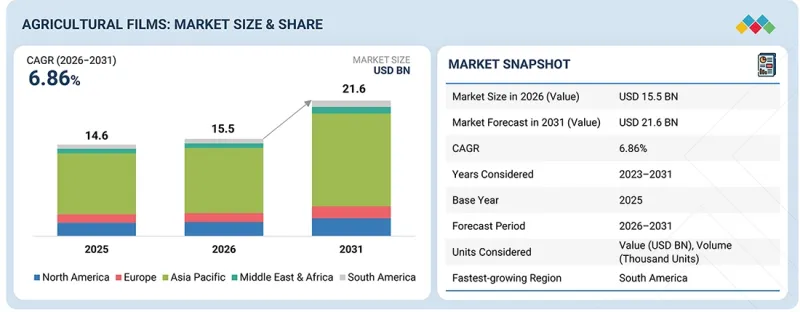
농업용 필름 시장 규모는 2025년 146억 달러에서 2031년에는 216억 달러로 성장하며, CAGR은 6.86%에 달할 것으로 추정되고 있습니다.
중동 및 아프리카 및 아시아태평양의 인구 증가, 식생활의 변화, 가공식품에 대한 수요 증가가 농업용 필름 시장의 성장을 촉진하고 있습니다.
| 조사 범위 | |
|---|---|
| 조사 대상 기간 | 2023-2031년 |
| 기준연도 | 2025년 |
| 예측 기간 | 2026-2031년 |
| 단위 | 톤·금액(달러) |
| 부문 | 유형, 용도, 지역 |
| 대상 지역 | 아시아태평양, 북미, 유럽, 중동 및 아프리카, 남미 |
농업용 필름 폐기에 따른 잠재적인 건강 피해에 대한 인식이 높아짐에 따라 바이오 기반 및 생분해성 농업용 필름 대체재에 대한 수요가 확대되고 있으며, 이는 시장의 특징으로 점점 더 두드러지고 있습니다.
'EVA 부문이 예측 기간 중 가장 높은 연평균 성장률(CAGR)을 기록할 것으로 전망됩니다'
EVA(에틸렌-비닐아세테이트 공중합체)는 농업용 필름 시장 전체에서 가장 빠르게 성장하는 부문이 될 것으로 전망됩니다. EVA는 투명성, 유연성, 자외선 저항성 면에서 뛰어난 성능을 발휘하므로 온실 용도로 가장 적합하며, 그 사용이 확대되고 있습니다. 또한 특히 예산을 중시하는 지역에서 농가에게 비용 대비 효과가 높은 선택지가 되고 있습니다. 생분해성 EVA의 개발은 농업 분야의 환경 지속가능성에 대한 관심이 높아지는 추세에 부응하는 것으로, 환경 의식이 높은 농가의 관심을 끌고 있습니다. 기능성, 합리적인 가격, 환경 친화성이라는 이 독특한 조합 덕분에 EVA는 농업용 필름 시장에서 상당한 성장이 예상됩니다.
'중동 및 아프리카는 예측 기간 중 농업용 필름 시장에서 세 번째로 높은 성장률을 보일 것으로 전망됩니다'
중동 및 아프리카에서는 여러 요인으로 인해 농업용 필름 시장이 크게 성장할 것으로 전망됩니다. 이 지역의 건조한 기후와 물 부족으로 인해 토양의 수분을 유지하는 멀치 필름과 같은 해결책이 필수적입니다. 또한 인구 증가에 따라 식량안보에 대한 수요가 높아지면서 온실에 대한 수요도 증가하고 있습니다. 정책과 다양한 노력을 통한 정부의 지원도 농업용 필름의 도입을 더욱 촉진하고 있습니다. 해당 지역에서 농업의 현대화가 진행됨에 따라 농업용 필름의 활용은 그 중요성이 점점 더 커지고 있습니다. 이러한 요인들로 인해 중동 및 아프리카는 농업용 필름 시장에서 인상적인 성장을 이룰 것으로 전망됩니다.
이 보고서에서는 전 세계 농업용 필름 시장을 조사하여, 시장 개요, 시장 성장에 영향을 미치는 다양한 요인에 대한 분석, 기술 및 특허 동향, 법규제 환경, 사례 연구, 시장 규모 추이 및 전망, 각종 분류·지역/주요 국가별 상세 분석, 경쟁 현황, 주요 기업 개요 등을 정리하여 전해드립니다.
자주 묻는 질문
목차
제1장 서론
제2장 개요
제3장 주요 인사이트
제4장 시장 개요
제5장 업계 동향
제6장 규제 상황과 지속가능성 구상
제7장 기술의 진보, AI의 영향, 특허, 혁신, 향후 응용
제8장 고객 상황과 구매 행동
제9장 농업용 필름 시장 : 유형별
제10장 농업용 필름 시장 : 용도별
제11장 농업용 필름 시장 : 지역별
제12장 경쟁 구도
제13장 기업 개요
제14장 조사 방법
제15장 부록
KSA 26.07.14The agricultural films market is estimated to grow from USD 14.6 billion in 2025 to USD 21.6 billion by 2031, at a CAGR of 6.86%. The rising population in the Middle East & Africa and Asia Pacific, changing preferences regarding food, and mounting demand for processed foods are driving the agricultural films market.
| Scope of the Report | |
|---|---|
| Years Considered for the Study | 2023-2031 |
| Base Year | 2025 |
| Forecast Period | 2026-2031 |
| Units Considered | Volume (Kiloton) and Value (USD Million) |
| Segments | Type, Application, and Region |
| Regions covered | Asia Pacific, North America, Europe, Middle East & Africa, and South America |
The market is increasingly characterized by the growing demand for bio-based and degradable agricultural film alternatives due to increasing awareness about the potential health hazards linked to the disposal of agricultural films.
"EVA segment projected to register highest CAGR in agricultural films market during forecast period"
EVA (Ethylene Vinyl Acetate) is projected to be the fastest-growing segment in the overall agricultural films market. EVA is increasingly adopted due to its superior performance in terms of clarity, flexibility, and UV resistance, making it ideal for greenhouses. It also offers a cost-effective option for farmers, especially in budget-conscious regions. The development of biodegradable EVA caters to the growing focus on environmental sustainability in agriculture, attracting eco-conscious farmers. This unique combination of functionality, affordability, and environmental responsibility positions EVA for significant growth in the agricultural films market.
"Middle East & Africa to be third fastest-growing agricultural films market during forecast period"
The Middle East & Africa region is expected to see significant growth in the agricultural films market due to several factors. Dry climates and water scarcity in the region necessitate solutions like mulching films that conserve water in the soil. Additionally, the rising population creates demand for increased food security, which increases the need for greenhouses. Government support through policies and initiatives further fuels the adoption of agricultural films. With the region witnessing agricultural modernization, the application of agricultural films is gaining relevance. These factors position the Middle East & Africa region for remarkable growth in the agricultural films market.
- By Company Type: Tier 1 - 69%, Tier 2 - 23%, and Tier 3 - 8%
- By Designation: C-Level - 23%, Director Level - 37%, and Others - 40%
- By Region: North America - 24%, Europe - 40%, Asia Pacific - 17%, South America - 7%, Middle East & Africa - 12%,
The key players profiled in the report include Amcor plc (Switzerland), Dow Inc. (US), RKW Group (Germany), BASF SE (Germany), Coveris (Austria), Kuraray Co., Ltd. (Japan), Rani Group (Finland), and Armando Alvarez Group (Spain), among others.
Research Coverage
This report segments the market for agricultural films based on type, application, and region and provides estimations of volume (Kiloton) and value (USD million) for the overall market size across various regions. A detailed analysis of key industry players has been conducted to provide insights into their business overviews, services, and key strategies associated with the agricultural films market.
Reasons to Buy this Report
This research report is focused on various levels of analysis- industry analysis (industry trends), market share analysis of top players, and company profiles-which together provide an overall view of the competitive landscape, emerging and high-growth segments, high-growth regions, and market drivers, restraints, and opportunities.
The report provides insights on the following pointers:
- Market Penetration: Comprehensive information on agricultural films offered by top players in the global market
- Analysis of key drivers: (Global food security imperative and expanding agricultural productivity requirements, Accelerating global water scarcity driving mulch film adoption, and Expansion of protected cultivation and greenhouse horticulture), restraints (Accumulation of polyethylene film residue and microplastic soil contamination, Raw material price volatility and polyethylene resin cost exposure, and Inadequate agricultural plastic collection and recycling infrastructure), opportunities (Government-supported expansion of certified biodegradable film markets, Precision agriculture and smart farming integration, and Expanding high-growth markets in Middle East & Africa, and Southeast Asia), and challenges (Inconsistent biodegradation performance across diverse soil and climate conditions, and High capital and deployment costs of advanced greenhouse film systems) influencing the growth of agricultural films market.
- Product Development/Innovation: Detailed insights on upcoming technologies, research & development activities, and new product & service launches in the agricultural films market
- Market Development: Comprehensive information about lucrative emerging markets - the report analyzes the markets for agricultural films across regions.
- Market Diversification: Exhaustive information about new products, untapped regions, and recent developments in the agricultural films market
- Competitive Assessment: In-depth assessment of market shares, strategies, products, and manufacturing capabilities of leading players, such as Amcor plc (Switzerland), Dow Inc. (US), RKW Group (Germany), BASF SE (Germany), Coveris (Austria), Kuraray Co., Ltd. (Japan), Rani Group (Finland), and Armando Alvarez Group (Spain) in the agricultural films market.
TABLE OF CONTENTS
1 INTRODUCTION
- 1.1 STUDY OBJECTIVES
- 1.2 MARKET DEFINITION
- 1.3 STUDY SCOPE
- 1.3.1 MARKETS COVERED AND REGIONAL SCOPE
- 1.3.2 INCLUSIONS AND EXCLUSIONS OF STUDY
- 1.3.3 MARKET DEFINITION AND INCLUSIONS, BY TYPE
- 1.3.4 MARKET DEFINITION AND INCLUSIONS, BY APPLICATION
- 1.3.5 YEARS CONSIDERED
- 1.3.6 CURRENCY CONSIDERED
- 1.3.7 UNIT CONSIDERED
- 1.4 STAKEHOLDERS
- 1.5 SUMMARY OF CHANGES
2 EXECUTIVE SUMMARY
- 2.1 MARKET HIGHLIGHTS AND KEY INSIGHTS
- 2.2 KEY MARKET PARTICIPANTS: MAPPING OF STRATEGIC DEVELOPMENTS
- 2.3 DISRUPTIVE TRENDS IN AGRICULTURAL FILMS MARKET
- 2.4 HIGH-GROWTH SEGMENTS
- 2.5 REGIONAL SNAPSHOT: MARKET SIZE, GROWTH RATE, AND FORECAST
3 PREMIUM INSIGHTS
- 3.1 ATTRACTIVE OPPORTUNITIES FOR PLAYERS IN AGRICULTURAL FILMS MARKET
- 3.2 AGRICULTURAL FILMS MARKET, BY TYPE AND REGION
- 3.3 AGRICULTURAL FILMS MARKET, BY APPLICATION
- 3.4 AGRICULTURAL FILMS MARKET, BY COUNTRY
4 MARKET OVERVIEW
- 4.1 INTRODUCTION
- 4.2 MARKET DYNAMICS
- 4.2.1 DRIVERS
- 4.2.1.1 Global food security imperative and expanding agricultural productivity requirements
- 4.2.1.2 Accelerating global water scarcity
- 4.2.1.3 Expansion of protected cultivation and greenhouse horticulture
- 4.2.1.4 Regulatory-driven transition to certified biodegradable agricultural films
- 4.2.2 RESTRAINTS
- 4.2.2.1 Accumulation of polyethylene film residue and microplastic soil contamination
- 4.2.2.2 Raw material price volatility and polyethylene resin cost exposure
- 4.2.2.3 Inadequate agricultural plastic collection and recycling infrastructure
- 4.2.2.4 Performance limitations and cost premiums of certified biodegradable films
- 4.2.3 OPPORTUNITIES
- 4.2.3.1 Government-supported expansion of certified biodegradable film markets
- 4.2.3.2 Precision agriculture and smart farming integration
- 4.2.3.3 Expanding high-growth markets in Middle East & Africa and Southeast Asia
- 4.2.3.4 Circular economy and recycled content integration
- 4.2.4 CHALLENGES
- 4.2.4.1 Inconsistent biodegradation performance across diverse soil and climate conditions
- 4.2.4.2 High capital and deployment costs of advanced greenhouse film systems
- 4.2.4.3 Absence of commercially available USDA NOP-compliant biodegradable biobased mulch films
- 4.2.4.4 Multi-jurisdictional regulatory complexity and compliance cost burden
- 4.2.1 DRIVERS
- 4.3 INTERCONNECTED MARKETS AND CROSS-SECTOR OPPORTUNITIES
- 4.3.1 INTERCONNECTED MARKETS
- 4.3.2 CROSS-SECTOR OPPORTUNITIES
- 4.4 STRATEGIC MOVES BY TIER-1/2/3 PLAYERS
- 4.4.1 KEY MOVES AND STRATEGIC FOCUS
5 INDUSTRY TRENDS
- 5.1 PORTER'S FIVE FORCES ANALYSIS
- 5.1.1 THREAT OF NEW ENTRANTS
- 5.1.2 THREAT OF SUBSTITUTES
- 5.1.3 BARGAINING POWER OF BUYERS
- 5.1.4 BARGAINING POWER OF SUPPLIERS
- 5.1.5 INTENSITY OF COMPETITIVE RIVALRY
- 5.2 MACROECONOMIC OUTLOOK
- 5.2.1 INTRODUCTION
- 5.2.2 GDP TRENDS AND FORECAST
- 5.2.3 TRENDS IN AGRICULTURE AND HORTICULTURE INDUSTRY
- 5.3 SUPPLY CHAIN ANALYSIS
- 5.3.1 RAW MATERIALS
- 5.3.2 MANUFACTURERS
- 5.3.3 DISTRIBUTION NETWORK
- 5.3.4 END USERS
- 5.4 ECOSYSTEM ANALYSIS
- 5.5 PRICING ANALYSIS
- 5.5.1 AVERAGE SELLING PRICE OF KEY PLAYERS, BY APPLICATION, 2025
- 5.5.2 AVERAGE SELLING PRICE TREND OF AGRICULTURAL FILMS, BY REGION, 2023-2025
- 5.6 TRADE ANALYSIS
- 5.6.1 IMPORT SCENARIO (HS CODE 392010)
- 5.6.2 EXPORT SCENARIO (HS CODE 392010)
- 5.7 KEY CONFERENCES & EVENTS, 2026-2027
- 5.8 TRENDS/DISRUPTIONS IMPACTING CUSTOMER BUSINESS
- 5.8.1 REVENUE SHIFTS & REVENUE POCKETS FOR AGRICULTURAL FILMS MARKET
- 5.9 INVESTMENT AND FUNDING SCENARIO
- 5.10 CASE STUDY ANALYSIS
- 5.10.1 BASF ECOVIO BIODEGRADABLE MULCH FILM ENABLES LARGE-SCALE REGULATORY-COMPLIANT DEPLOYMENT IN CHINA
- 5.10.2 RKW HYTILUX ADVANCED GREENHOUSE FILM IMPROVES LIGHT MANAGEMENT IN MEDITERRANEAN HORTICULTURE
- 5.10.3 ARMANDO ALVAREZ SMART MULTILAYER FILM DELIVERS PRECISION MICROCLIMATE MANAGEMENT FOR MEDITERRANEAN GROWERS
- 5.11 IMPACT OF 2025 US TARIFF - OVERVIEW
- 5.11.1 INTRODUCTION
- 5.11.2 KEY TARIFF RATES
- 5.11.3 PRICE IMPACT ANALYSIS
- 5.11.4 IMPACT ON COUNTRIES/REGIONS
- 5.11.4.1 US
- 5.11.4.2 Europe
- 5.11.4.3 Asia Pacific
- 5.11.5 IMPACT ON APPLICATIONS
6 REGULATORY LANDSCAPE AND SUSTAINABILITY INITIATIVES
- 6.1 REGIONAL REGULATIONS AND COMPLIANCE
- 6.1.1 REGULATORY BODIES, GOVERNMENT AGENCIES, AND OTHER ORGANIZATIONS
- 6.1.2 INDUSTRY STANDARDS
- 6.2 SUSTAINABILITY INITIATIVES
- 6.2.1 TRANSITION TO BIODEGRADABLE AND BIO-BASED AGRICULTURAL FILMS
- 6.2.2 CIRCULAR ECONOMY AND AGRICULTURAL PLASTIC RECYCLING
- 6.2.3 MANUFACTURING AND CARBON FOOTPRINT REDUCTION
- 6.3 SUSTAINABILITY IMPACT AND REGULATORY POLICY INITIATIVES
- 6.4 CERTIFICATIONS, LABELING, AND ECO-STANDARDS
7 TECHNOLOGICAL ADVANCEMENTS, AI-DRIVEN IMPACT, PATENTS, INNOVATIONS, AND FUTURE APPLICATIONS
- 7.1 KEY EMERGING TECHNOLOGIES
- 7.1.1 BIODEGRADABLE POLYMER BLEND TECHNOLOGY (PBAT/PLA-BASED SYSTEMS)
- 7.1.2 ADVANCED MULTILAYER CO-EXTRUSION FILM TECHNOLOGY
- 7.1.3 NANO-ENHANCED AGRICULTURAL FILM TECHNOLOGY
- 7.2 COMPLEMENTARY TECHNOLOGIES
- 7.2.1 PRECISION AGRICULTURE AND IOT-ENABLED CROP MONITORING PLATFORMS
- 7.2.2 DIGITAL TWIN TECHNOLOGY FOR GREENHOUSE AND CROP MANAGEMENT
- 7.2.3 ADVANCED RECYCLING AND CIRCULAR ECONOMY TECHNOLOGIES FOR AGRICULTURAL PLASTICS
- 7.3 ADJACENT TECHNOLOGIES
- 7.3.1 FOOD PACKAGING FILM TECHNOLOGY (ACTIVE AND INTELLIGENT PACKAGING)
- 7.4 TECHNOLOGY/PRODUCT ROADMAP
- 7.4.1 SHORT-TERM (2026-2027) | BIODEGRADABLE FILM OPTIMIZATION & PRECISION AGRICULTURE INTEGRATION
- 7.4.2 MID-TERM (2027-2030) | PERFORMANCE ENHANCEMENT & FUNCTIONAL FILM MAINSTREAM ADOPTION
- 7.4.3 LONG-TERM (2030-2035+) | ADVANCED MATERIALS & LARGE-SCALE COMMERCIALIZATION
- 7.5 PATENT ANALYSIS
- 7.5.1 APPROACH
- 7.5.2 DOCUMENT TYPES
- 7.5.3 TOP APPLICANTS
- 7.5.4 JURISDICTION ANALYSIS
- 7.6 IMPACT OF AI/GEN AI ON AGRICULTURAL FILMS MARKET
- 7.6.1 TOP USE CASES AND MARKET POTENTIAL
- 7.6.2 BEST PRACTICES IN AGRICULTURAL FILMS PROCESSING
- 7.6.3 CASE STUDIES OF AI IMPLEMENTATION IN AGRICULTURAL FILMS MARKET
- 7.6.4 INTERCONNECTED ADJACENT ECOSYSTEM AND IMPACT ON MARKET PLAYERS
- 7.6.5 CLIENTS' READINESS TO ADOPT GENERATIVE AI IN AGRICULTURAL FILMS MARKET
8 CUSTOMER LANDSCAPE & BUYER BEHAVIOR
- 8.1 DECISION-MAKING PROCESS
- 8.2 BUYER STAKEHOLDERS AND BUYING EVALUATION CRITERIA
- 8.2.1 KEY STAKEHOLDERS IN BUYING PROCESS
- 8.2.2 BUYING CRITERIA
- 8.3 ADOPTION BARRIERS & INTERNAL CHALLENGES
- 8.4 UNMET NEEDS IN VARIOUS APPLICATIONS
9 AGRICULTURAL FILMS MARKET, BY TYPE
- 9.1 INTRODUCTION
- 9.2 LINEAR LOW-DENSITY POLYETHYLENE (LLDPE)
- 9.2.1 HIGH PUNCTURE RESISTANCE AND TENSILE STRENGTH TO FUEL ADOPTION
- 9.3 LOW-DENSITY POLYETHYLENE (LDPE)
- 9.3.1 HIGH RESISTANCE TO SUNLIGHT AND EXTERNAL ENVIRONMENT TO DRIVE ADOPTION
- 9.4 RECLAIM
- 9.4.1 GROWING DEMAND FOR COST-EFFECTIVE MATERIALS AND SUSTAINABILITY INITIATIVES TO DRIVE MARKET
- 9.5 ETHYLENE-VINYL ACETATE (EVA)
- 9.5.1 INCREASING DEMAND FROM DAIRY INDUSTRY TO DRIVE MARKET GROWTH
- 9.6 HIGH-DENSITY POLYETHYLENE (HDPE)
- 9.6.1 HIGH BARRIER PROPERTIES AND LESSER TRANSPARENCY
- 9.7 OTHER TYPES
10 AGRICULTURAL FILMS MARKET, BY APPLICATION
- 10.1 INTRODUCTION
- 10.2 GREENHOUSE FILMS
- 10.2.1 CLASSIC GREENHOUSE FILMS
- 10.2.1.1 Unique structure and controlled atmosphere
- 10.2.2 MACRO TUNNELS/WALKING TUNNELS
- 10.2.2.1 Demand for cost-effective protected cultivation for high-value fruit and vegetable production to drive market
- 10.2.3 LOW TUNNELS
- 10.2.3.1 Helps extend growing seasons and safeguard early-stage crops
- 10.2.1 CLASSIC GREENHOUSE FILMS
- 10.3 MULCH FILMS
- 10.3.1 TRANSPARENT OR CLEAR MULCHES
- 10.3.1.1 Need for season extension and soil productivity enhancement to drive growth
- 10.3.2 BLACK MULCHES
- 10.3.2.1 High adoption in production of leafy vegetables to drive market growth
- 10.3.3 OTHER MULCHES
- 10.3.1 TRANSPARENT OR CLEAR MULCHES
- 10.4 SILAGE FILMS
- 10.4.1 SILAGE STRETCH WRAPS
- 10.4.1.1 Growing adoption of mechanized bale wrapping to boost demand
- 10.4.2 SILAGE SHEETS
- 10.4.2.1 Adoption as reliable bunker silo coverage for commercial livestock and dairy operations to fuel demand
- 10.4.3 SILAGE BAGS
- 10.4.3.1 Enables scalable feed storage for modernizing and mechanizing livestock farms
- 10.4.1 SILAGE STRETCH WRAPS
11 AGRICULTURAL FILMS MARKET, BY REGION
- 11.1 INTRODUCTION
- 11.2 ASIA PACIFIC
- 11.2.1 CHINA
- 11.2.1.1 Massive protected cultivation infrastructure, agricultural modernization, and expanding dairy sector to drive market
- 11.2.2 JAPAN
- 11.2.2.1 Advanced agricultural technology, precision horticulture, and government food security initiatives to fuel demand
- 11.2.3 INDIA
- 11.2.3.1 Government-supported protected horticulture expansion, water scarcity imperatives, and growing dairy sector to drive market
- 11.2.4 AUSTRALIA & NEW ZEALAND
- 11.2.4.1 Advanced commercial agriculture, strong dairy sector, and sustainable farming to fuel demand
- 11.2.5 SOUTH KOREA
- 11.2.5.1 Smart agriculture adoption, expanding protected cultivation, and government food security investment to drive market
- 11.2.1 CHINA
- 11.3 EUROPE
- 11.3.1 ITALY
- 11.3.1.1 Premium horticulture, extensive fruit production, and EU sustainability mandates to fuel market
- 11.3.2 SPAIN
- 11.3.2.1 Extensive use of plastic films to protect greenhouses from sunlight
- 11.3.3 GERMANY
- 11.3.3.1 Sustainability regulations, advanced dairy farming, and circular economy leadership to drive market
- 11.3.4 FRANCE
- 11.3.4.1 Precision agriculture, sustainable farming regulations, and diversified agricultural output to create demand
- 11.3.5 UK
- 11.3.5.1 Post-Brexit agricultural policy reform, strong dairy and livestock sector, and sustainable farming initiatives to drive market
- 11.3.6 TURKEY
- 11.3.6.1 Rapidly expanding protected cultivation and agricultural export growth to drive market
- 11.3.1 ITALY
- 11.4 NORTH AMERICA
- 11.4.1 US
- 11.4.1.1 Large-scale commercial agriculture, precision farming adoption, and water conservation supporting market
- 11.4.2 MEXICO
- 11.4.2.1 Expanding horticultural exports, agricultural modernization, and protected cultivation to drive market
- 11.4.3 CANADA
- 11.4.3.1 Advanced greenhouse horticulture, cannabis cultivation, and dairy modernization to fuel demand
- 11.4.1 US
- 11.5 MIDDLE EAST & AFRICA
- 11.5.1 SAUDI ARABIA
- 11.5.1.1 Food security initiatives and greenhouse expansion driving demand
- 11.5.2 IRAN
- 11.5.2.1 Government policies and efficient crop management to fuel market
- 11.5.3 EGYPT
- 11.5.3.1 Growth of food & dairy industry to fuel market expansion
- 11.5.4 SOUTH AFRICA
- 11.5.4.1 Dual agricultural economy to support market growth
- 11.5.1 SAUDI ARABIA
- 11.6 SOUTH AMERICA
- 11.6.1 BRAZIL
- 11.6.1.1 Commercial agriculture expansion and livestock growth to fuel market growth
- 11.6.2 ARGENTINA
- 11.6.2.1 Agricultural recovery and dairy modernization driving significant growth
- 11.6.1 BRAZIL
12 COMPETITIVE LANDSCAPE
- 12.1 INTRODUCTION
- 12.2 KEY PLAYERS' STRATEGIES/RIGHT TO WIN, 2022-2025
- 12.3 MARKET SHARE ANALYSIS, 2025
- 12.4 REVENUE ANALYSIS, 2023-2025
- 12.5 COMPANY EVALUATION MATRIX: KEY PLAYERS, 2025
- 12.5.1 STARS
- 12.5.2 EMERGING LEADERS
- 12.5.3 PERVASIVE PLAYERS
- 12.5.4 PARTICIPANTS
- 12.5.5 COMPANY FOOTPRINT: KEY PLAYERS, 2025
- 12.5.5.1 Company footprint
- 12.5.5.2 Region footprint
- 12.5.5.3 Type footprint
- 12.5.5.4 Application footprint
- 12.6 COMPANY EVALUATION MATRIX: STARTUPS/SMES, 2025
- 12.6.1 PROGRESSIVE COMPANIES
- 12.6.2 RESPONSIVE COMPANIES
- 12.6.3 DYNAMIC COMPANIES
- 12.6.4 STARTING BLOCKS
- 12.6.5 COMPETITIVE BENCHMARKING: STARTUPS/SMES, 2025
- 12.6.5.1 Detailed list of key startups/SMEs
- 12.6.5.2 Competitive benchmarking of startups/SMEs
- 12.7 BRAND/PRODUCT COMPARISON
- 12.8 COMPANY VALUATION AND FINANCIAL METRICS
- 12.9 COMPETITIVE SCENARIO
- 12.9.1 NEW PRODUCT LAUNCHES
- 12.9.2 DEALS
- 12.9.3 EXPANSIONS
13 COMPANY PROFILE
- 13.1 KEY PLAYERS
- 13.1.1 AMCOR PLC
- 13.1.1.1 Business overview
- 13.1.1.2 Products/Solutions/Services offered
- 13.1.1.3 Recent developments
- 13.1.1.3.1 New product launches
- 13.1.1.3.2 Deals
- 13.1.1.3.3 Expansions
- 13.1.1.3.4 Other developments
- 13.1.1.4 Strategic intelligence
- 13.1.1.5 MnM view
- 13.1.1.5.1 Key strengths
- 13.1.1.5.2 Strategic choices
- 13.1.1.5.3 Weaknesses and competitive threats
- 13.1.2 KURARAY CO., LTD.
- 13.1.2.1 Business overview
- 13.1.2.2 Products/Solutions/Services offered
- 13.1.2.3 Recent developments
- 13.1.2.3.1 New product launches
- 13.1.2.3.2 Expansions
- 13.1.2.4 Strategic intelligence
- 13.1.2.5 MnM view
- 13.1.2.5.1 Key strengths
- 13.1.2.5.2 Strategic choices
- 13.1.2.5.3 Weaknesses and competitive threats
- 13.1.3 COVERIS
- 13.1.3.1 Business overview
- 13.1.3.2 Products/Solutions/Services offered
- 13.1.3.3 Recent developments
- 13.1.3.3.1 New product launches
- 13.1.3.3.2 Expansions
- 13.1.3.4 Strategic intelligence
- 13.1.3.5 MnM view
- 13.1.3.5.1 Key strengths
- 13.1.3.5.2 Strategic choices
- 13.1.3.5.3 Weaknesses and competitive threats
- 13.1.4 RKW GROUP
- 13.1.4.1 Business overview
- 13.1.4.2 Products/Solutions/Services offered
- 13.1.4.3 Recent developments
- 13.1.4.3.1 New product launches
- 13.1.4.4 Strategic intelligence
- 13.1.4.5 MnM view
- 13.1.4.5.1 Key strengths
- 13.1.4.5.2 Strategic choices
- 13.1.4.5.3 Weaknesses and competitive threats
- 13.1.5 BASF SE
- 13.1.5.1 Business overview
- 13.1.5.2 Products/Solutions/Services offered
- 13.1.5.3 Recent developments
- 13.1.5.3.1 Deals
- 13.1.5.3.2 Expansions
- 13.1.5.4 Strategic intelligence
- 13.1.5.5 MnM view
- 13.1.5.5.1 Key strengths
- 13.1.5.5.2 Strategic choices
- 13.1.5.5.3 Weaknesses and competitive threats
- 13.1.6 RANI GROUP
- 13.1.6.1 Business overview
- 13.1.6.2 Products/Solutions/Services offered
- 13.1.6.3 Recent developments
- 13.1.6.3.1 New product launches
- 13.1.6.3.2 Deals
- 13.1.6.3.3 Expansions
- 13.1.7 DOW INC.
- 13.1.7.1 Business overview
- 13.1.7.2 Products/Solutions/Services offered
- 13.1.7.3 Recent developments
- 13.1.7.3.1 Deals
- 13.1.7.4 Strategic intelligence
- 13.1.7.5 MnM view
- 13.1.7.5.1 Key strengths
- 13.1.7.5.2 Strategic choices
- 13.1.7.5.3 Weaknesses and competitive threats
- 13.1.8 ARMANDO ALVAREZ GROUP
- 13.1.8.1 Business overview
- 13.1.8.2 Products/Solutions/Services offered
- 13.1.8.3 Recent developments
- 13.1.8.3.1 Deals
- 13.1.8.4 Strategic intelligence
- 13.1.8.5 MnM view
- 13.1.8.5.1 Key strengths
- 13.1.8.5.2 Strategic choices
- 13.1.8.5.3 Weaknesses & competitive threats
- 13.1.9 TRIOWORLD
- 13.1.9.1 Business overview
- 13.1.9.2 Products/Solutions/Services offered
- 13.1.9.3 Recent developments
- 13.1.9.3.1 New product launches
- 13.1.9.3.2 Deals
- 13.1.9.3.3 Expansions
- 13.1.9.4 Strategic intelligence
- 13.1.9.5 MnM view
- 13.1.9.5.1 1.1.5.4.1 Key strengths
- 13.1.9.5.2 1.1.5.4. Strategic choices
- 13.1.9.5.3 1.1.5.4.1 Weaknesses & competitive threats
- 13.1.10 INDUSTRIAL DEVELOPMENT COMPANY SAL
- 13.1.10.1 Business overview
- 13.1.10.2 Products/Solutions/Services offered
- 13.1.10.3 Strategic intelligence
- 13.1.10.4 MnM view
- 13.1.10.4.1 Key strengths
- 13.1.10.4.2 Strategic choices
- 13.1.10.4.3 Weaknesses & competitive threats
- 13.1.1 AMCOR PLC
- 13.2 OTHER PLAYERS
- 13.2.1 EXXON MOBIL CORPORATION
- 13.2.2 TILAK POLYPACK PRIVATE LIMITED
- 13.2.3 MEGAPLAST INDIA PVT LTD.
- 13.2.4 PLASTIKA KRITIS S.A.
- 13.2.5 GROUPE BARBIER
- 13.2.6 ACHILLES CORPORATION
- 13.2.7 POLIFILM GROUP
- 13.2.8 ANHUI GUOFENG PLASTIC INDUSTRY CO., LTD.
- 13.2.9 AGRIPLAST TECH INDIA PRIVATE LIMITED
- 13.2.10 PLASTIK V SDN. BHD.
- 13.2.11 IM SANIN SRL
- 13.2.12 AGRIPLAST
- 13.2.13 GINEGAR PLASTIC PRODUCTS LTD.
- 13.2.14 ECOPOLYSTW
- 13.2.15 FUTAMURA CHEMICAL CO., LTD.
14 RESEARCH METHODOLOGY
- 14.1 RESEARCH DATA
- 14.1.1 SECONDARY DATA
- 14.1.1.1 Key data from secondary sources
- 14.1.2 PRIMARY DATA
- 14.1.2.1 Key data from primary sources
- 14.1.2.2 Primary interview - demand side and supply side
- 14.1.2.3 Breakdown of primary interviews
- 14.1.2.4 Key industry insights
- 14.1.1 SECONDARY DATA
- 14.2 MARKET SIZE ESTIMATION
- 14.2.1 BOTTOM-UP APPROACH
- 14.2.2 TOP-DOWN APPROACH
- 14.3 GROWTH FORECAST
- 14.3.1 SUPPLY SIDE
- 14.3.2 DEMAND SIDE
- 14.4 DATA TRIANGULATION
- 14.5 RESEARCH ASSUMPTIONS
- 14.6 RESEARCH LIMITATIONS
- 14.7 RISK ASSESSMENT
15 APPENDIX
- 15.1 DISCUSSION GUIDE
- 15.2 KNOWLEDGESTORE: MARKETSANDMARKETS' SUBSCRIPTION PORTAL
- 15.3 CUSTOMIZATION OPTIONS
- 15.4 RELATED REPORTS
- 15.5 AUTHOR DETAILS