
|
시장보고서
상품코드
2086833
데이터센터 인증 시장 : 인증 유형별(시설 및 신뢰성, 운영, 지속가능성 및 에너지), 인프라별(IT, 전력, 냉각), 최종사용자별(클라우드 서비스 프로바이더, BFSI, 제조) - 세계 예측(-2032년)Data Center Certification Market by Certification Type (Facility & Reliability, Operational, Sustainability & Energy), Infrastructure (IT, Power, Cooling), and End User (Cloud Service Providers, BFSI, Manufacturing) - Global Forecast to 2032 |
||||||

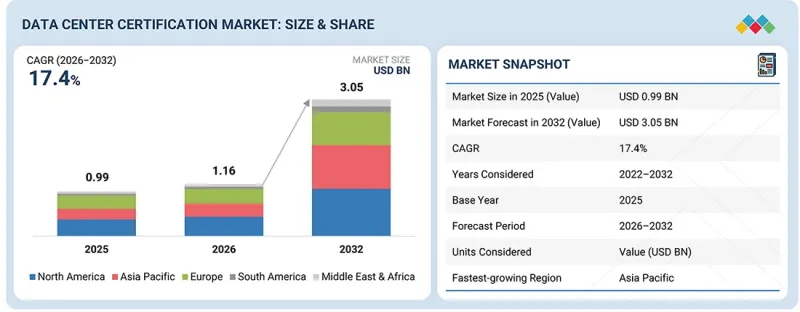
데이터센터 인증 시장 규모는 2026년 추정 11억 6,000만 달러에서 2032년에는 30억 5,000만 달러에 달할 것으로 예측되며, CAGR은 17.4%를 기록할 전망입니다.
| 조사 범위 | |
|---|---|
| 조사 대상 기간 | 2021-2032년 |
| 기준 연도 | 2025년 |
| 예측 기간 | 2026-2032년 |
| 단위 | 금액(달러) |
| 부문 | 인증 유형, 최종사용자, 지역별 |
| 대상 지역 | 북미, 유럽, 아시아태평양, 기타 지역 |
"최종사용자별로는, 예측 기간 동안 클라우드 서비스 제공업체가 가장 높은 연평균 성장률(CAGR)을 기록할 것으로 전망됩니다."
하이퍼스케일 클라우드 인프라의 급속한 확대와 AI 워크로드 도입 증가에 힘입어, 클라우드 서비스 제공업체 부문이 가장 높은 연평균 성장률(CAGR)을 기록할 것으로 예상됩니다. 클라우드 사업자들은 지리적으로 분산된 시설 전반에 걸쳐 고가용성, 운영 복원력, 사이버 보안, 지속가능성, 규정 준수를 확보하기 위해 인증 취득을 우선시하고 있습니다. AI 지원 데이터센터 및 미션 크리티컬 디지털 인프라에 대한 투자 확대에 따라, 설계, 건설, 시운전, 운영을 아우르는 인증에 대한 수요가 더욱 가속화되고 있습니다. 또한, 세계적으로 인정받는 인증 및 지속적인 규정 준수에 대한 고객의 기대가 높아짐에 따라, 클라우드 서비스 제공업체들 사이에서 운영의 지속가능성, 복원력, 정보 보안에 관한 인증 프로그램 도입이 확대되고 있습니다.
"인증 유형별로 보면 시설·신뢰성 인증 부문이 예측 기간 동안 가장 큰 시장 점유율을 차지할 것으로 전망됩니다."
인프라의 가용성, 내결함성, 운영상의 신뢰성을 검증하는 인증의 보급에 힘입어, 시설·신뢰성 인증 부문은 데이터센터 인증 시장에서 가장 큰 점유율을 차지할 것으로 전망됩니다. 데이터센터 소유주들은 세계적으로 인정받는 성능 기준을 준수하고 있음을 입증하기 위해 설계, 건설, 시운전 각 단계에서 이러한 인증을 우선시하고 있습니다. 하이퍼스케일, 코로케이션, 엔터프라이즈 시설에 대한 투자가 확대됨에 따라, 운영 위험을 줄이고 사업 연속성을 향상시키는 인증에 대한 수요가 높아지고 있습니다. 탄력적인 디지털 인프라, 중단 없는 서비스 가용성, 그리고 미션 크리티컬한 성능에 대한 중요성이 커짐에 따라, 전 세계 데이터센터 프로젝트에서 시설 및 신뢰성 인증의 중요성이 더욱 부각되고 있습니다.
"예측 기간 동안 북미가 가장 큰 시장 점유율을 차지할 것으로 예상됩니다."
북미는 대규모 하이퍼스케일 및 코로케이션 데이터센터의 구축, 엄격한 규제 요건, 세계적으로 인정받는 인증 프레임워크의 적극적인 도입에 힘입어, 예측 기간 동안 데이터센터 인증 시장에서 가장 큰 점유율을 차지할 것으로 전망됩니다. AI 인프라, 클라우드 컴퓨팅, 미션 크리티컬 디지털 시설에 대한 투자 확대에 따라, 신뢰성, 사이버 보안, 지속가능성, 운영상의 탁월성을 포괄하는 인증에 대한 수요가 가속화되고 있습니다. 또한, 이 지역은 주요 인증 제공업체의 존재와 성숙한 디지털 인프라의 혜택을 누리고 있습니다. 운영상의 회복탄력성, 에너지 효율, 지속적인 규정 준수에 대한 중요성이 부각되면서, 북미 전역에서 독립적인 데이터센터 인증 서비스에 대한 수요가 더욱 증가하고 있습니다.
본 보고서에서는 전 세계 데이터센터 인증 시장을 조사하여, 시장 개요, 시장 성장에 영향을 미치는 다양한 요인에 대한 분석, 기술 및 특허 동향, 법규제 환경, 사례 연구, 시장 규모 추정 및 전망, 각종 분류·지역/주요 국가별 상세 분석, 경쟁 현황, 주요 기업 개요 등을 정리하고 있습니다.
자주 묻는 질문
목차
제1장 소개
제2장 주요 요약
제3장 주요 인사이트
제4장 시장 개요
제5장 업계 동향
제6장 기술의 진보, AI의 영향, 특허, 혁신, 향후 응용
제7장 규제 상황과 지속가능성에 대한 대처
제8장 고객 상황과 구매 행동
제9장 데이터센터 인증을 주도하는 신기술 동향
제10장 데이터센터 인증 시장 : 인증 유형별
제11장 데이터센터 인증 시장 : 인프라별
제12장 데이터센터 인증 시장 : 인증 제공 모델별
제13장 데이터센터 인증 시장 : 데이터센터 유형별
제14장 데이터센터 인증 시장 : 최종사용자별
제15장 데이터센터 인증 시장 : 지역별
제16장 경쟁 구도
제17장 기업 개요
제18장 조사 방법
제19장 부록
KSM 26.07.20The data center certification market is projected to reach USD 3.05 billion by 2032 from an estimated USD 1.16 billion in 2026, growing at a CAGR of 17.4%.
| Scope of the Report | |
|---|---|
| Years Considered for the Study | 2021-2032 |
| Base Year | 2025 |
| Forecast Period | 2026-2032 |
| Units Considered | Value (USD Billion) |
| Segments | By Certification Type, End User and Region |
| Regions covered | North America, Europe, APAC, RoW |
"Based on end user, cloud service providers are projected to register the highest CAGR during the forecast period"
The cloud service providers segment is expected to witness the highest CAGR in the data center certification market due to the rapid expansion of hyperscale cloud infrastructure and increasing AI workload deployments. Cloud operators are prioritizing certification to ensure high availability, operational resilience, cybersecurity, sustainability, and compliance across geographically distributed facilities. Growing investments in AI-ready data centers and mission-critical digital infrastructure are further accelerating demand for certifications covering design, construction, commissioning, and operations. Additionally, increasing customer expectations for globally recognized certifications and continuous compliance are driving higher adoption of operational sustainability, resilience, and information security certification programs among cloud service providers.
"Based on certification type, the facility & reliability certifications segment is projected to account for the largest market share throughout the forecast period"
The facility & reliability certifications segment is likely to hold the largest share of the data center certification market due to widespread adoption of certifications validating infrastructure availability, fault tolerance, and operational reliability. Data center owners prioritize these certifications during design, construction, and commissioning to demonstrate compliance with globally recognized performance standards. Growing investments in hyperscale, colocation, and enterprise facilities are increasing demand for certifications that reduce operational risks and improve business continuity. Rising emphasis on resilient digital infrastructure, uninterrupted service availability, and mission-critical performance is further strengthening the dominance of facility and reliability certifications across global data center projects.
"North America is expected to hold the largest market share throughout the forecast period"
North America is likely to account for the largest share of the data center certification market over the forecast period due to extensive hyperscale and colocation data center deployments, stringent regulatory requirements, and strong adoption of globally recognized certification frameworks. Growing investments in AI infrastructure, cloud computing, and mission-critical digital facilities are accelerating demand for certifications covering reliability, cybersecurity, sustainability, and operational excellence. The region also benefits from the presence of leading certification providers and mature digital infrastructure. Increasing emphasis on operational resilience, energy efficiency, and continuous compliance is further strengthening demand for independent data center certification services across North America.
Extensive primary interviews were conducted with key industry experts in the data center certification market to determine and validate the market size for various segments and subsegments identified through secondary research. The breakdown of primary participants for the report is presented below.
The study incorporates insights from certification bodies, accreditation organizations, data center operators, consultants, and industry experts involved in facility reliability, operational, cybersecurity, and sustainability certifications. The break-up of the primaries is as follows:
- By Company Type - Tier 1 - 40%, Tier 2 - 35%, and Tier 3 - 25%
- By Designation - C-level Executives - 33%, Directors - 38%, and Others - 29%
- By Region - North America - 30%, Europe - 40%, Asia Pacific - 20%, South America - 5%, and MEA - 5%
The data center certification market is characterized by the presence of globally recognized certification providers, including Uptime Institute (US), TUV SUD (Germany), BSI Group (UK), TUV Rheinland (Germany), TUV NORD (Germany), EPI (Singapore), Bureau Veritas (France), Schellman (US), Coalfire Cert (US), SGS SA (Switzerland), and A-LIGN (US), among others.
The study includes an in-depth competitive analysis of key players in the data center certification market, covering company profiles, recent developments, certification portfolios, strategic initiatives, and key growth strategies.
Study Coverage:
The report segments the data center certification market and forecasts its size by Certification Type (Facility & Reliability Certifications, Operational Certifications, Information Security & Cybersecurity Certifications, Sustainability & Energy Certifications, Infrastructure Performance & System Certifications), Infrastructure (IT, Power, Cooling, Racks & Enclosures), Certification Delivery Model (Design Phase Certification, Construction Phase Certification, Commissioning & Integrated Validation Certification, Operational Certification, Continuous Monitoring & Recertification), Data Center Type (Hyperscale, Enterprise, Colocation), and End User (Cloud Service Providers, BFSI, Telecom & Network Operators, Government & Defense, Healthcare & Life Sciences, Manufacturing, Retail & E-commerce, IT, Technology & Digital Infrastructure Providers, Other End Users). It analyzes key market drivers, restraints, opportunities, and challenges influencing industry growth. The study provides a detailed regional assessment across North America, Europe, Asia Pacific, South America, and the Middle East & Africa, along with country-level insights for major markets. In addition, the report includes competitive benchmarking, market ranking, pricing analysis, value chain analysis, ecosystem analysis, and a comprehensive assessment of leading companies operating in the global data center certification market.
Key Benefits of Buying the Report:
- Analysis of key drivers (increasing hyperscale and colocation data center deployments; rising focus on operational resilience, cybersecurity, and sustainability), restraints (high costs of obtaining and maintaining certifications; fragmented certification frameworks and evolving standards), opportunities (growing demand for AI-ready data center certifications; expansion of continuous monitoring and recertification services), and challenges (maintaining consistency across multiple certification frameworks and regions; keeping pace with evolving cybersecurity, sustainability, and regulatory requirements).
- Product development/innovation: Detailed insights into evolving certification frameworks, operational sustainability programs, cybersecurity certifications, resilience standards, energy efficiency certifications, accreditation developments, and strategic initiatives adopted by leading certification providers.
- Market Development: Comprehensive information on high-growth markets. The report analyzes the data center certification market across North America, Europe, Asia Pacific, South America, and the Middle East & Africa.
- Market Diversification: Comprehensive insights into emerging certification opportunities, evolving regulatory requirements, AI-ready infrastructure, sustainability initiatives, operational resilience programs, and expanding certification adoption across hyperscale, colocation, and enterprise data centers.
- Competitive Assessment: In-depth assessment of market shares and growth strategies of leading companies, including Uptime Institute (US), TUV SUD (Germany), BSI Group (UK), TUV Rheinland (Germany), TUV NORD (Germany), EPI (Singapore), Bureau Veritas (France), Schellman (US), Coalfire Cert (US), SGS SA (Switzerland), and A-LIGN (US).
TABLE OF CONTENTS
1 INTRODUCTION
- 1.1 STUDY OBJECTIVES
- 1.2 MARKET DEFINITION
- 1.3 STUDY SCOPE
- 1.3.1 MARKET SEGMENTATION AND REGIONAL SCOPE
- 1.3.2 YEARS CONSIDERED
- 1.3.3 INCLUSIONS AND EXCLUSIONS
- 1.4 CURRENCY CONSIDERED
- 1.5 STAKEHOLDERS
2 EXECUTIVE SUMMARY
- 2.1 MARKET HIGHLIGHTS AND KEY INSIGHTS
- 2.2 KEY MARKET PARTICIPANTS: MAPPING OF STRATEGIC DEVELOPMENTS
- 2.3 DISRUPTIVE TRENDS IN DATA CENTER CERTIFICATION MARKET
- 2.4 HIGH-GROWTH SEGMENTS
- 2.5 REGIONAL SNAPSHOT: MARKET SIZE, GROWTH RATE, AND FORECAST
3 PREMIUM INSIGHTS
- 3.1 ATTRACTIVE OPPORTUNITIES FOR PLAYERS IN DATA CENTER CERTIFICATION MARKET
- 3.2 DATA CENTER CERTIFICATION MARKET, BY CERTIFICATION TYPE
- 3.3 DATA CENTER CERTIFICATION MARKET, BY INFRASTRUCTURE
- 3.4 DATA CENTER CERTIFICATION MARKET, BY CERTIFICATION DELIVERY MODEL
- 3.5 DATA CENTER CERTIFICATION MARKET, BY DATA CENTER TYPE
- 3.6 DATA CENTER CERTIFICATION MARKET, BY END USER
- 3.7 DATA CENTER CERTIFICATION MARKET, BY REGION
- 3.8 DATA CENTER CERTIFICATION MARKET, BY COUNTRY
4 MARKET OVERVIEW
- 4.1 INTRODUCTION
- 4.2 MARKET DYNAMICS
- 4.2.1 DRIVERS
- 4.2.1.1 Increasing regulatory requirements for data security and operational resilience
- 4.2.1.2 Growing emphasis on Environmental, Social, and Governance (ESG) initiatives
- 4.2.1.3 Rapid expansion of hyperscale, colocation, and AI-ready data centers
- 4.2.1.4 Rising customer preference for certified data center facilities
- 4.2.2 RESTRAINTS
- 4.2.2.1 High certification, audit, and recurring surveillance costs
- 4.2.2.2 Limited awareness of long-term business value of certification
- 4.2.2.3 Complexities in managing multiple certification requirements
- 4.2.2.4 Long certification preparation timelines
- 4.2.3 OPPORTUNITIES
- 4.2.3.1 Rapid digitalization of data center operations
- 4.2.3.2 Increasing demand for integrated certification programs
- 4.2.3.3 Growing emphasis on data sovereignty and edge computing
- 4.2.3.4 Shifting preference toward continuous compliance models
- 4.2.4 CHALLENGES
- 4.2.4.1 Issues in maintaining consistency across global certification standards
- 4.2.4.2 Shortage of skilled auditors and technical experts
- 4.2.4.3 Complexities in keeping pace with evolving data center technologies
- 4.2.1 DRIVERS
- 4.3 INTERCONNECTED MARKETS AND CROSS-SECTOR OPPORTUNITIES
- 4.4 STRATEGIC MOVES BY TIER-1/2/3 PLAYERS
5 INDUSTRY TRENDS
- 5.1 INTRODUCTION
- 5.2 PORTER'S FIVE FORCES ANALYSIS
- 5.2.1 THREAT OF NEW ENTRANTS
- 5.2.2 THREAT OF SUBSTITUTES
- 5.2.3 BARGAINING POWER OF SUPPLIERS
- 5.2.4 BARGAINING POWER OF BUYERS
- 5.2.5 INTENSITY OF COMPETITIVE RIVALRY
- 5.3 MACROECONOMIC OUTLOOK
- 5.3.1 INTRODUCTION
- 5.3.2 GDP TRENDS AND FORECAST
- 5.3.3 TRENDS RELATED TO INFRASTRUCTURE RELIABILITY, CYBERSECURITY, AND SUSTAINABILITY CERTIFICATION FOR DATA CENTERS
- 5.3.4 TRENDS RELATED TO AI-READY, LIQUID COOLING, AND HIGH-DENSITY INFRASTRUCTURE CERTIFICATION
- 5.4 VALUE CHAIN ANALYSIS
- 5.5 ECOSYSTEM ANALYSIS
- 5.6 KEY CONFERENCES AND EVENTS, 2026-2027
- 5.7 TRENDS/DISRUPTIONS IMPACTING CUSTOMER BUSINESS
- 5.8 INVESTMENT AND FUNDING SCENARIO, 2022-2026
- 5.9 CASE STUDY ANALYSIS
- 5.9.1 DIGITAL REALTY COLLABORATES WITH UPTIME INSTITUTE TO OBTAIN UPTIME INSTITUTE TIER CERTIFICATION
- 5.9.2 EQUINIX IMPLEMENTS ISO/IEC 27001 ISMS CERTIFICATION TO STRENGTHEN INFORMATION SECURITY GOVERNANCE
- 5.9.3 VANTAGE DATA CENTERS INTEGRATES LEED CERTIFICATION REQUIREMENTS TO MEET ESG GOALS
- 5.10 IMPACT OF US TARIFFS - DATA CENTER CERTIFICATION MARKET
- 5.10.1 INTRODUCTION
- 5.10.2 KEY TARIFF RATES
- 5.10.3 PRICE IMPACT ANALYSIS
- 5.10.4 IMPACT ON COUNTRIES/REGIONS
- 5.10.4.1 US
- 5.10.4.2 Europe
- 5.10.4.3 Asia Pacific
- 5.10.5 IMPACT ON END USERS
6 TECHNOLOGICAL ADVANCEMENTS, AI-DRIVEN IMPACT, PATENTS, INNOVATIONS, AND FUTURE APPLICATIONS
- 6.1 KEY EMERGING TECHNOLOGIES
- 6.1.1 DATA CENTER INFRASTRUCTURE MANAGEMENT (DCIM) AND INTELLIGENT BUILDING MANAGEMENT SYSTEMS (BMS)
- 6.1.2 INTERNET OF THINGS (IOT)-BASED ENVIRONMENTAL AND INFRASTRUCTURE MONITORING
- 6.1.3 ARTIFICIAL INTELLIGENCE (AI) AND PREDICTIVE ANALYTICS
- 6.1.4 DIGITAL TWIN
- 6.1.5 ADVANCED ENERGY MANAGEMENT AND SUSTAINABILITY ANALYTICS
- 6.1.6 AUTOMATED COMPLIANCE AND DIGITAL AUDIT MANAGEMENT PLATFORMS
- 6.2 COMPLEMENTARY TECHNOLOGIES
- 6.2.1 ADVANCED COOLING
- 6.2.2 RENEWABLE ENERGY INTEGRATION AND SMART POWER INFRASTRUCTURE
- 6.2.3 CYBERSECURITY AUTOMATION AND ZERO TRUST TECHNOLOGIES
- 6.3 TECHNOLOGY ROADMAP
- 6.3.1 SHORT-TERM (2025-2027): DIGITALIZATION OF CERTIFICATION AND COMPLIANCE
- 6.3.2 MID-TERM (2027-2030): INTELLIGENT AND CONTINUOUS CERTIFICATION
- 6.3.3 LONG-TERM (2030-2035+): AUTONOMOUS CERTIFICATION AND PREDICTIVE COMPLIANCE
- 6.4 PATENT ANALYSIS
- 6.5 IMPACT OF AI/GEN AI ON DATA CENTER CERTIFICATION MARKET
- 6.5.1 TOP USE CASES AND MARKET POTENTIAL
- 6.5.2 BEST PRACTICES FOLLOWED BY OEMS IN DATA CENTER CERTIFICATION MARKET
- 6.5.3 CASE STUDIES RELATED TO AI/GEN AI IMPLEMENTATION IN DATA CENTER CERTIFICATION MARKET
- 6.5.4 INTERCONNECTED ECOSYSTEM AND IMPACT ON MARKET PLAYERS
- 6.5.5 CLIENTS' READINESS TO ADOPT AI/GEN AI-INTEGRATED DATA CENTER CERTIFICATION PROCESSES
7 REGULATORY LANDSCAPE AND SUSTAINABILITY INITIATIVES
- 7.1 INTRODUCTION
- 7.2 REGIONAL REGULATIONS AND COMPLIANCE
- 7.2.1 REGULATORY BODIES, GOVERNMENT AGENCIES, AND OTHER ORGANIZATIONS
- 7.2.2 INDUSTRY STANDARDS
- 7.2.2.1 Data Center Infrastructure Standards (TIA-942, EN 50600, ISO/ IEC 22237)
- 7.2.2.2 Information Security and Business Continuity Standards (ISO/ IEC 27001, ISO 22301)
- 7.2.2.3 Energy Management and Environmental Standards (ISO 50001, ISO 14001)
- 7.2.2.4 Operational Management and Service Standards (ISO/IEC 20000-1, ISO 9001)
- 7.2.2.5 Electrical Safety and Supporting Infrastructure Standards (IEC 60364, NFPA 70, ASHRAE Thermal Guidelines)
- 7.2.3 INDUSTRY FRAMEWORKS AND RATING ORGANIZATIONS
- 7.2.3.1 TIA-942 Framework
- 7.2.3.2 LEED Sustainability Framework
- 7.2.3.3 BREEAM Sustainability Rating Framework
- 7.2.3.4 ENERGY STAR Energy Efficiency Framework
- 7.2.3.5 EN 50600 and ISO/IEC 22237 Infrastructure Framework
- 7.2.3.6 ISO-based Information Security and Business Continuity Framework
- 7.2.3.7 Other Regional and Industry-specific Frameworks
- 7.3 SUSTAINABILITY INITIATIVES
- 7.3.1 RENEWABLE ENERGY ADOPTION AND CARBON REDUCTION INITIATIVES
- 7.3.2 ENERGY EFFICIENCY AND RESOURCE OPTIMIZATION INITIATIVES
- 7.3.3 WATER CONSERVATION AND SUSTAINABLE COOLING INITIATIVES
- 7.3.4 CIRCULAR ECONOMY AND ELECTRONIC WASTE MANAGEMENT INITIATIVES
- 7.3.5 SUSTAINABLE FACILITY DESIGN AND GREEN INFRASTRUCTURE INITIATIVES
- 7.4 IMPACT OF REGULATORY POLICIES ON SUSTAINABILITY INITIATIVES
- 7.4.1 ENERGY EFFICIENCY AND DECARBONIZATION POLICIES
- 7.4.2 CARBON REDUCTION AND CLIMATE NEUTRALITY POLICIES
- 7.4.3 CIRCULAR ECONOMY AND ELECTRONIC WASTE POLICIES
- 7.4.4 WATER CONSERVATION AND RESOURCE MANAGEMENT POLICIES
- 7.4.5 SUSTAINABLE INFRASTRUCTURE AND GREEN BUILDING POLICIES
8 CUSTOMER LANDSCAPE AND BUYER BEHAVIOR
- 8.1 INTRODUCTION
- 8.2 DECISION-MAKING PROCESS
- 8.3 KEY STAKEHOLDERS INVOLVED IN BUYING PROCESS AND THEIR EVALUATION CRITERIA
- 8.3.1 KEY STAKEHOLDERS IN BUYING PROCESS
- 8.3.2 BUYING CRITERIA
- 8.4 ADOPTION BARRIERS AND INTERNAL CHALLENGES
- 8.5 UNMET NEEDS OF VARIOUS END USERS
9 EMERGING TECHNOLOGY TRENDS SHAPING DATA CENTER CERTIFICATION
- 9.1 INTRODUCTION
- 9.2 AI DATA CENTERS
- 9.3 LIQUID-COOLED DATA CENTERS
- 9.4 EDGE & MICRO DATA CENTERS
- 9.5 SUSTAINABLE DATA CENTERS
- 9.6 AUTONOMOUS OPERATIONS INFRASTRUCTURE
10 DATA CENTER CERTIFICATION MARKET, BY CERTIFICATION TYPE
- 10.1 INTRODUCTION
- 10.2 FACILITY & RELIABILITY CERTIFICATIONS
- 10.2.1 DESIGN
- 10.2.1.1 Focus on delivering reliable and future-ready digital infrastructure to boost segmental growth
- 10.2.2 CONSTRUCTED FACILITY
- 10.2.2.1 Deployment of high-density AI infrastructure, liquid cooling technologies, and modular data center designs to drive market
- 10.2.3 OPERATIONAL SUSTAINABILITY
- 10.2.3.1 Emphasis on remote operations, predictive maintenance, and AI-enabled monitoring to augment segmental growth
- 10.2.4 RESILIENCY
- 10.2.4.1 Reliance on cloud platforms and AI infrastructure to bolster segmental growth
- 10.2.5 COMMISSIONING
- 10.2.5.1 Adoption of prefabricated modular data centers, liquid cooling systems, and high-density GPU clusters to fuel segmental growth
- 10.2.1 DESIGN
- 10.3 OPERATIONAL CERTIFICATIONS
- 10.3.1 QUALITY MANAGEMENT
- 10.3.1.1 Rise in multi-site data center portfolios, remote infrastructure management, and AI-enabled operations to expedite segmental growth
- 10.3.2 IT SERVICE MANAGEMENT
- 10.3.2.1 Migration of mission-critical applications to cloud, colocation, and hybrid environments to bolster segmental growth
- 10.3.3 BUSINESS CONTINUITY
- 10.3.3.1 Need to prioritize operational resilience amid digital transformation to accelerate segmental growth
- 10.3.1 QUALITY MANAGEMENT
- 10.4 INFORMATION SECURITY & CYBERSECURITY CERTIFICATIONS
- 10.4.1 INFORMATION SECURITY MANAGEMENT
- 10.4.1.1 Rising demand for integrated governance frameworks to facilitate segmental growth
- 10.4.2 CYBERSECURITY
- 10.4.2.1 Growing interconnected environments and digital traffic to boost segmental growth
- 10.4.3 PRIVACY & DATA PROTECTION
- 10.4.3.1 Rapid growth of cloud services, digital platforms, and cross-border data processing to drive market
- 10.4.4 SECURITY AUDIT
- 10.4.4.1 Increasing outsourcing of critical workloads to cloud service providers and colocation facilities to fuel segmental growth
- 10.4.1 INFORMATION SECURITY MANAGEMENT
- 10.5 SUSTAINABILITY & ENERGY CERTIFICATIONS
- 10.5.1 GREEN BUILDING
- 10.5.1.1 Environmental considerations in data center facility construction to contribute to segmental growth
- 10.5.2 ENERGY EFFICIENCY
- 10.5.2.1 Focus on reducing operating costs, improving infrastructure utilization, and supporting long-term sustainability objectives to drive market
- 10.5.3 ENVIRONMENTAL MANAGEMENT
- 10.5.3.1 Need to simplify regulatory reporting, improve supplier oversight, and strengthen environmental risk management to foster segmental growth
- 10.5.4 CARBON & EMISSION
- 10.5.4.1 Net-zero commitments, mandatory climate disclosures, and increasing procurement requirements to expedite segmental growth
- 10.5.5 WATER & RESOURCE EFFICIENCY
- 10.5.5.1 Focus on improving operational efficiency while demonstrating responsible management of critical natural resources to drive market
- 10.5.1 GREEN BUILDING
- 10.6 INFRASTRUCTURE PERFORMANCE & SYSTEM CERTIFICATIONS
- 10.6.1 POWER RELIABILITY & REDUNDANCY
- 10.6.1.1 Adoption of renewable energy integration, microgrids, and AI-assisted predictive maintenance to augment segmental growth
- 10.6.2 THERMAL PERFORMANCE
- 10.6.2.1 Deployment of AI servers, high-performance computing clusters, and high-density GPU racks to bolster segmental growth
- 10.6.3 ELECTRICAL SAFETY
- 10.6.3.1 Transition toward high-density AI infrastructure, high operating voltages, and complex electrical architectures to fuel segmental growth
- 10.6.4 MECHANICAL RELIABILITY
- 10.6.4.1 Accommodation of increasingly dense computing environments to expedite segmental growth
- 10.6.5 INTEGRATED SYSTEM VALIDATION
- 10.6.5.1 Rising interconnection of digital infrastructure and demand for end-to-end infrastructure validation to augment segmental growth
- 10.6.1 POWER RELIABILITY & REDUNDANCY
11 DATA CENTER CERTIFICATION MARKET, BY INFRASTRUCTURE
- 11.1 INTRODUCTION
- 11.2 IT
- 11.2.1 INCREASING DIGITAL AND MISSION-CRITICAL WORKLOADS TO BOLSTER SEGMENTAL GROWTH
- 11.3 POWER
- 11.3.1 RISING ADOPTION OF LITHIUM-ION BATTERY SYSTEMS, MICROGRIDS, RENEWABLE ENERGY, AND PREDICTIVE MAINTENANCE PLATFORMS TO FUEL SEGMENTAL GROWTH
- 11.4 COOLING
- 11.4.1 GROWING SUPPORT INCREASINGLY POWER-INTENSIVE COMPUTING ENVIRONMENTS TO CONTRIBUTE TO SEGMENTAL GROWTH
- 11.5 RACKS & ENCLOSURES
- 11.5.1 RISING NEED TO PROVIDE STRUCTURAL INTEGRITY AND COMPATIBILITY WITH ADVANCED POWER AND COOLING TECHNOLOGIES TO DRIVE MARKET
12 DATA CENTER CERTIFICATION MARKET, BY CERTIFICATION DELIVERY MODEL
- 12.1 INTRODUCTION
- 12.2 DESIGN PHASE CERTIFICATION
- 12.2.1 FOCUS ON EARLY IDENTIFICATION OF ENGINEERING GAPS AND REDUCTION OF DESIGN REVISIONS TO BOOST SEGMENTAL GROWTH
- 12.3 CONSTRUCTION & INSTALLATION CERTIFICATION
- 12.3.1 INVESTMENT IN LARGE HYPERSCALE CAMPUSES, AI-READY FACILITIES, AND COLOCATION SITES TO EXPEDITE SEGMENTAL GROWTH
- 12.4 COMMISSIONING & INTEGRATED SYSTEMS VALIDATION CERTIFICATION
- 12.4.1 DEPENDENCE ON INTERCONNECTED ELECTRICAL, MECHANICAL, COOLING, AUTOMATION, AND MONITORING SYSTEMS TO FOSTER SEGMENTAL GROWTH
- 12.5 OPERATIONAL PHASE CERTIFICATION
- 12.5.1 SUPPORT FOR INCREASINGLY CRITICAL BUSINESS SERVICES TO ACCELERATE SEGMENTAL GROWTH
- 12.6 CONTINUOUS MONITORING & RECERTIFICATION
- 12.6.1 NEED TO SATISFY TECHNICAL, OPERATIONAL, AND PERFORMANCE REQUIREMENTS TO FUEL SEGMENTAL GROWTH
13 DATA CENTER CERTIFICATION MARKET, BY DATA CENTER TYPE
- 13.1 INTRODUCTION
- 13.2 HYPERSCALE
- 13.2.1 INCREASING INVESTMENT IN LARGE-SCALE DIGITAL INFRASTRUCTURE AND NEXT-GENERATION COMPUTING TO AUGMENT SEGMENTAL GROWTH
- 13.3 ENTERPRISE
- 13.3.1 RAPID MODERNIZATION OF DIGITAL INFRASTRUCTURE TO IMPROVE SECURITY AND OPERATIONAL EFFICIENCY TO FUEL SEGMENTAL GROWTH
- 13.4 COLOCATION
- 13.4.1 GROWING DEMAND FOR OUTSOURCING SERVICES TO CONTRIBUTE TO SEGMENTAL GROWTH
14 DATA CENTER CERTIFICATION MARKET, BY END USER
- 14.1 INTRODUCTION
- 14.2 CLOUD SERVICE PROVIDERS
- 14.2.1 GROWING COMPLEXITY AND GLOBAL DISTRIBUTION OF DIGITAL INFRASTRUCTURE TO BOOST SEGMENTAL GROWTH
- 14.3 BFSI
- 14.3.1 RISING NEED TO SUPPORT CUSTOMER-FACING SERVICES, DIGITAL BANKING PLATFORMS, CAPITAL MARKETS, AND INSURANCE OPERATIONS TO DRIVE MARKET
- 14.4 TELECOM & NETWORK OPERATORS
- 14.4.1 RAPID EXPANSION OF 5G NETWORKS AND EDGE INFRASTRUCTURE TO CONTRIBUTE TO SEGMENTAL GROWTH
- 14.5 GOVERNMENT & DEFENSE
- 14.5.1 GROWING RELIANCE ON HIGHLY SECURE AND RESILIENT DATA CENTER INFRASTRUCTURE FOR NATIONAL SECURITY TO EXPEDITE SEGMENTAL GROWTH
- 14.6 HEALTHCARE & LIFE SCIENCES
- 14.6.1 RAPID DIGITIZATION OF CLINICAL OPERATIONS AND ADOPTION OF DATA-INTENSIVE TECHNOLOGIES TO FACILITATE SEGMENTAL GROWTH
- 14.7 MANUFACTURING
- 14.7.1 INCREASING INVESTMENT IN DEDICATED DATA CENTER INFRASTRUCTURE TO SUPPORT SMART FACTORIES AND AUTOMATION TO FUEL SEGMENTAL GROWTH
- 14.8 RETAIL & E-COMMERCE
- 14.8.1 RISING CUSTOMER EXPECTATIONS FOR UNINTERRUPTED ONLINE SERVICES TO ACCELERATE SEGMENTAL GROWTH
- 14.9 IT, TECHNOLOGY & DIGITAL INFRASTRUCTURE PROVIDERS
- 14.9.1 GROWING EMPHASIS ON SUPPORTING CLOUD-NATIVE APPLICATIONS AND SAAS PLATFORMS TO BOLSTER SEGMENTAL GROWTH
- 14.10 OTHER END USERS
15 DATA CENTER CERTIFICATION MARKET, BY REGION
- 15.1 INTRODUCTION
- 15.2 NORTH AMERICA
- 15.2.1 US
- 15.2.1.1 Increasing AI investments, hyperscale infrastructure expansion, and mature certification ecosystem to support market growth
- 15.2.2 CANADA
- 15.2.2.1 Expanding digital economy and cloud infrastructure development to contribute to market growth
- 15.2.3 MEXICO
- 15.2.3.1 Rising colocation capacity and renewable energy integration to foster market growth
- 15.2.1 US
- 15.3 EUROPE
- 15.3.1 UK
- 15.3.1.1 Increasing investment in cloud platforms and stringent cybersecurity and sustainability requirements to drive market
- 15.3.2 GERMANY
- 15.3.2.1 Rising Industry 4.0 initiatives and expanding cloud infrastructure to expedite market growth
- 15.3.3 FRANCE
- 15.3.3.1 Growing emphasis on sovereign cloud services, cybersecurity, and low-carbon digital infrastructure to boost market growth
- 15.3.4 ITALY
- 15.3.4.1 Rapid public-sector digital transformation and investments in hyperscale and colocation infrastructure to fuel market growth
- 15.3.5 SPAIN
- 15.3.5.1 Mounting demand for cloud services, AI infrastructure, and edge computing to augment market growth
- 15.3.6 RUSSIA
- 15.3.6.1 Rising government-led digital sovereignty initiatives and data center expansion to bolster market growth
- 15.3.7 POLAND
- 15.3.7.1 Expanding fiber connectivity and growing availability of skilled IT professionals to foster market growth
- 15.3.8 SWITZERLAND
- 15.3.8.1 Stringent information security requirements and stable electricity network to accelerate market growth
- 15.3.9 SWEDEN
- 15.3.9.1 Abundant renewable electricity, advanced fiber connectivity, and government support for digital innovation to drive market
- 15.3.10 BELGIUM
- 15.3.10.1 Dense fiber connectivity and extensive internet exchange infrastructure to facilitate market growth
- 15.3.11 NETHERLANDS
- 15.3.11.1 Strong concentration of hyperscale and colocation facilities to boost market growth
- 15.3.12 REST OF EUROPE
- 15.3.1 UK
- 15.4 ASIA PACIFIC
- 15.4.1 CHINA
- 15.4.1.1 Strong government support for digital infrastructure and rapid cloud adoption to expedite market growth
- 15.4.2 JAPAN
- 15.4.2.1 High enterprise digitalization and demand for resilient mission-critical infrastructure to augment market growth
- 15.4.3 INDIA
- 15.4.3.1 Rising data localization requirements and government-led digital transformation initiatives to support market growth
- 15.4.4 SOUTH KOREA
- 15.4.4.1 Increasing broadband penetration and advanced semiconductor capabilities to contribute to market growth
- 15.4.5 AUSTRALIA
- 15.4.5.1 Rising cloud adoption, AI investments, and digital transformation to accelerate market growth
- 15.4.6 SINGAPORE
- 15.4.6.1 Rapid expansion of interconnected digital infrastructure to bolster market growth
- 15.4.7 INDONESIA
- 15.4.7.1 Strong growth in e-commerce and expanding fintech adoption to foster market growth
- 15.4.8 NEW ZEALAND
- 15.4.8.1 Increasing enterprise cloud migration and government digital transformation programs to augment market growth
- 15.4.9 REST OF ASIA PACIFIC
- 15.4.1 CHINA
- 15.5 SOUTH AMERICA
- 15.5.1 BRAZIL
- 15.5.1.1 Increasing hyperscale data center and renewable energy investments to provide market growth opportunities
- 15.5.2 ARGENTINA
- 15.5.2.1 Rapid modernization of mission-critical infrastructure and expansion of digital services to fuel market growth
- 15.5.3 REST OF SOUTH AMERICA
- 15.5.1 BRAZIL
- 15.6 MIDDLE EAST & AFRICA
- 15.6.1 GCC
- 15.6.1.1 National AI strategies and hyperscale cloud investments to accelerate market growth
- 15.6.2 SOUTH AFRICA
- 15.6.2.1 Cloud expansion and digital infrastructure investments to strengthen market
- 15.6.3 REST OF MIDDLE EAST & AFRICA
- 15.6.1 GCC
16 COMPETITIVE LANDSCAPE
- 16.1 OVERVIEW
- 16.2 KEY PLAYER COMPETITIVE STRATEGIES/RIGHT TO WIN, 2022-2025
- 16.3 MARKET SHARE ANALYSIS, 2025
- 16.4 COMPANY VALUATION AND FINANCIAL METRICS
- 16.5 COMPANY EVALUATION MATRIX: KEY PLAYERS, 2025
- 16.5.1 STARS
- 16.5.2 EMERGING LEADERS
- 16.5.3 PERVASIVE PLAYERS
- 16.5.4 PARTICIPANTS
- 16.5.5 COMPANY FOOTPRINT: KEY PLAYERS, 2025
- 16.5.5.1 Company footprint
- 16.5.5.2 Region footprint
- 16.5.5.3 Certification type footprint
- 16.5.5.4 Infrastructure footprint
- 16.5.5.5 Data center type footprint
- 16.5.5.6 End user footprint
- 16.6 BRAND COMPARISON
- 16.7 COMPETITIVE SCENARIO
- 16.7.1 SERVICE LAUNCHES/ENHANCEMENTS
- 16.7.2 DEALS
17 COMPANY PROFILES
- 17.1 INTRODUCTION
- 17.2 INTEGRATED FRAMEWORK OWNERS & CERTIFICATION PROVIDERS: KEY PLAYERS
- 17.2.1 UPTIME INSTITUTE, LLC
- 17.2.1.1 Business overview
- 17.2.1.2 Services offered
- 17.2.1.3 Recent developments
- 17.2.1.3.1 Service launches/enhancements
- 17.2.1.4 MnM view
- 17.2.1.4.1 Key strengths/Right to win
- 17.2.1.4.2 Strategic choices
- 17.2.1.4.3 Weaknesses/Competitive threats
- 17.2.2 EPI SINGAPORE
- 17.2.2.1 Business overview
- 17.2.2.2 Services offered
- 17.2.2.3 Recent developments
- 17.2.2.3.1 Service launches/enhancements
- 17.2.2.3.2 Deals
- 17.2.2.4 MnM view
- 17.2.2.4.1 Key strengths/Right to win
- 17.2.2.4.2 Strategic choices
- 17.2.2.4.3 Weaknesses/Competitive threats
- 17.2.1 UPTIME INSTITUTE, LLC
- 17.3 INTEGRATED FRAMEWORK OWNERS & CERTIFICATION PROVIDERS: OTHER PLAYERS
- 17.3.1 INTERNATIONAL COMPUTER ROOM EXPERTS ASSOCIATION SC (ICREA)
- 17.3.2 BRE
- 17.4 CERTIFICATION BODIES & CONFORMITY ASSESSMENT ORGANIZATIONS: KEY PLAYERS
- 17.4.1 TUV SUD
- 17.4.1.1 Business overview
- 17.4.1.2 Services offered
- 17.4.1.3 Recent developments
- 17.4.1.3.1 Service launches/enhancements
- 17.4.1.4 MnM view
- 17.4.1.4.1 Key strengths/Right to win
- 17.4.1.4.2 Strategic choices
- 17.4.1.4.3 Weaknesses/Competitive threats
- 17.4.2 TUV RHEINLAND
- 17.4.2.1 Business overview
- 17.4.2.2 Services offered
- 17.4.2.3 Recent developments
- 17.4.2.3.1 Service launches/enhancements
- 17.4.2.4 MnM view
- 17.4.2.4.1 Key strengths/Right to win
- 17.4.2.4.2 Strategic choices
- 17.4.2.4.3 Weaknesses/Competitive threats
- 17.4.3 BUREAU VERITAS
- 17.4.3.1 Business overview
- 17.4.3.2 Services offered
- 17.4.3.3 Recent developments
- 17.4.3.3.1 Service launches/enhancements
- 17.4.3.3.2 Deals
- 17.4.3.4 MnM view
- 17.4.3.4.1 Key strengths/Right to win
- 17.4.3.4.2 Strategic choices
- 17.4.3.4.3 Weaknesses/Competitive threats
- 17.4.4 SCHELLMAN & COMPANY, LLC
- 17.4.4.1 Business overview
- 17.4.4.2 Services offered
- 17.4.4.3 Recent developments
- 17.4.4.3.1 Service launches/enhancements
- 17.4.4.3.2 Deals
- 17.4.4.4 MnM view
- 17.4.4.4.1 Key strengths/Right to win
- 17.4.4.4.2 Strategic choices
- 17.4.4.4.3 Weaknesses/Competitive threats
- 17.4.5 THE BRITISH STANDARDS INSTITUTION
- 17.4.5.1 Business overview
- 17.4.5.2 Services offered
- 17.4.5.3 Recent developments
- 17.4.5.3.1 Service launches/enhancements
- 17.4.5.4 MnM view
- 17.4.5.4.1 Key strengths/Right to win
- 17.4.5.4.2 Strategic choices
- 17.4.5.4.3 Weaknesses/Competitive threats
- 17.4.6 COALFIRE CERTIFICATION INC.
- 17.4.6.1 Business overview
- 17.4.6.2 Services offered
- 17.4.6.3 Recent developments
- 17.4.6.3.1 Service launches/enhancements
- 17.4.6.3.2 Other developments
- 17.4.6.4 MnM view
- 17.4.6.4.1 Key strengths/Right to win
- 17.4.6.4.2 Strategic choices
- 17.4.6.4.3 Weaknesses/Competitive threats
- 17.4.7 SOCIETE GENERALE DE SURVEILLANCE SA
- 17.4.7.1 Business overview
- 17.4.7.2 Services offered
- 17.4.7.3 Recent developments
- 17.4.7.3.1 Service launches/enhancements
- 17.4.7.4 MnM view
- 17.4.7.4.1 Key strengths/Right to win
- 17.4.7.4.2 Strategic choices
- 17.4.7.4.3 Weaknesses/Competitive threats
- 17.4.8 A-LIGN
- 17.4.8.1 Business overview
- 17.4.8.2 Services offered
- 17.4.8.3 Recent developments
- 17.4.8.3.1 Service launches/enhancements
- 17.4.8.4 MnM view
- 17.4.8.4.1 Key strengths/Right to win
- 17.4.8.4.2 Strategic choices
- 17.4.8.4.3 Weaknesses/Competitive threats
- 17.4.9 INTERTEK GROUP PLC
- 17.4.9.1 Business overview
- 17.4.9.2 Services offered
- 17.4.9.3 Recent developments
- 17.4.9.3.1 Service launches/enhancements
- 17.4.9.3.2 Deals
- 17.4.9.4 MnM view
- 17.4.9.4.1 Key strengths/Right to win
- 17.4.9.4.2 Strategic choices
- 17.4.9.4.3 Weaknesses/Competitive threats
- 17.4.10 DNV GL
- 17.4.10.1 Business overview
- 17.4.10.2 Services offered
- 17.4.10.3 Recent developments
- 17.4.10.3.1 Service launches/enhancements
- 17.4.10.4 MnM view
- 17.4.10.4.1 Key strengths/Right to win
- 17.4.10.4.2 Strategic choices
- 17.4.10.4.3 Weaknesses/Competitive threats
- 17.4.1 TUV SUD
- 17.5 CERTIFICATION BODIES & CONFORMITY ASSESSMENT ORGANIZATIONS: OTHER PLAYERS
- 17.5.1 TUV NORD GROUP
- 17.5.2 DEKRA
- 17.5.3 UL LLC
- 17.5.4 LRQA GROUP LIMITED
- 17.5.5 APPLUS+
- 17.5.6 KIWA
- 17.5.7 DQS HOLDING GMBH
- 17.5.8 AENOR
- 17.5.9 NQA
- 17.5.10 SIRIM QAS INTERNATIONAL SDN. BHD.
- 17.5.11 GREEN BUSINESS CERTIFICATION INC.
- 17.5.12 SOCOTEC
- 17.5.13 RINA S.P.A.
- 17.5.14 CONTROL UNION
- 17.5.15 EUROFINS SCIENTIFIC
- 17.5.16 CONTROLCASE LLC
- 17.5.17 PRESCIENT SECURITY LLC
- 17.5.18 PERRY JOHNSON REGISTRARS, INC.
- 17.5.19 QUALITY AUSTRIA
- 17.5.20 BM TRADA
- 17.5.21 ISOQAR LIMITED
- 17.5.22 NSF
- 17.5.23 CCS CERTIFICATION SERVICES CO., LTD.
- 17.5.24 TUV AUSTRIA
- 17.6 STANDARDS & FRAMEWORK DEVELOPERS: KEY PLAYERS
- 17.6.1 INTERNATIONAL ORGANIZATION FOR STANDARDIZATION (ISO)
- 17.6.2 TELECOMMUNICATIONS INDUSTRY ASSOCIATION (TIA)
- 17.6.3 IEC
- 17.6.4 ASHRAE
- 17.6.5 THE GREEN GRID
- 17.6.6 U.S. GREEN BUILDING COUNCIL, INC.
- 17.6.7 SWISS DATACENTER EFFICIENCY ASSOCIATION (SDEA)
- 17.6.8 BICSI
- 17.6.9 IEEE
- 17.6.10 CEN-CENELEC
- 17.6.11 OPEN COMPUTE PROJECT (OCP) FOUNDATION
- 17.6.12 NATIONAL FIRE PROTECTION ASSOCIATION (NFPA)
- 17.6.13 ETSI
- 17.6.14 ITU
18 RESEARCH METHODOLOGY
- 18.1 RESEARCH DATA
- 18.1.1 SECONDARY AND PRIMARY RESEARCH
- 18.1.2 SECONDARY DATA
- 18.1.2.1 List of key secondary sources
- 18.1.2.2 Key data from secondary sources
- 18.1.3 PRIMARY DATA
- 18.1.3.1 List of primary interview participants
- 18.1.3.2 Breakdown of primary interviews
- 18.1.3.3 Key data from primary sources
- 18.1.3.4 Key industry insights
- 18.2 MARKET SIZE ESTIMATION
- 18.2.1 BOTTOM-UP APPROACH
- 18.2.1.1 Approach to arrive at market size using bottom-up analysis (demand side)
- 18.2.2 TOP-DOWN APPROACH
- 18.2.2.1 Approach to arrive at market size using top-down analysis (supply side)
- 18.2.1 BOTTOM-UP APPROACH
- 18.3 DATA TRIANGULATION
- 18.4 RESEARCH ASSUMPTIONS
- 18.5 RESEARCH LIMITATIONS
- 18.6 RISK ANALYSIS
19 APPENDIX
- 19.1 INSIGHTS FROM INDUSTRY EXPERTS
- 19.2 DISCUSSION GUIDE
- 19.3 KNOWLEDGESTORE: MARKETSANDMARKETS' SUBSCRIPTION PORTAL
- 19.4 CUSTOMIZATION OPTIONS
- 19.5 RELATED REPORTS
- 19.6 AUTHOR DETAILS


