

|
시장보고서
상품코드
2087994
혈관 접근 장치 시장 : 유형별, 삽입 경로별, 용도별, 최종사용자별, 지역별 - 예측(-2031년)Vascular Access Device Market by Type, Route of Insertion, Application, End User and Region - Global Forecast to 2031 |
||||||

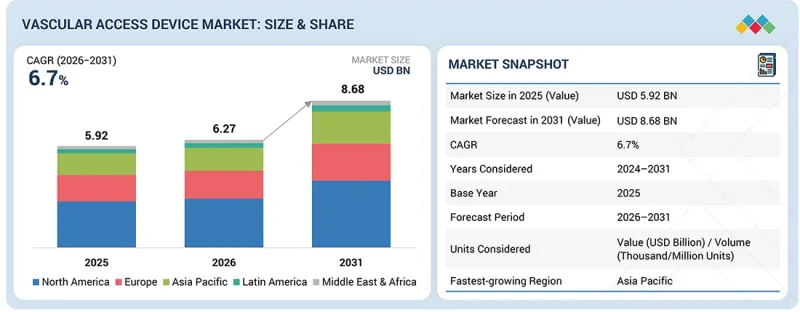
혈관 접근 장치 시장 규모는 2026년 62억 7,000만 달러에서 2031년까지 86억 8,000만 달러에 이를 것으로 예측되며, 2026년부터 2031년까지 연평균 복합 성장률(CAGR)은 6.7%를 기록할 전망입니다.
| 조사 범위 | |
|---|---|
| 조사 대상 기간 | 2024-2031년 |
| 기준연도 | 2025년 |
| 예측 기간 | 2026-2031년 |
| 산정 단위 | 금액(10억 달러) |
| 부문 | 유형별, 삽입 경로별, 용도별, 최종사용자별, 지역별 |
| 대상 지역 | 북미, 유럽, 아시아태평양, 라틴아메리카, 중동 및 아프리카 |
혈관 접근 장치 시장은 암, 심장 질환, 신부전 등 만성 질환 증가에 따라 확대되고 있습니다. 이러한 질환들은 모두 정맥 내 치료가 필요합니다. 입원 환자 수와 외과 수술 건수 증가, 그리고 집중 치료 및 응급 의료에 대한 수요 증가가 이러한 기기에 대한 수요를 견인하고 있습니다. 또한, 안전성을 중시하여 설계된 기기, 항균 코팅, 초음파 유도 하에 삽입하는 기술 등의 발전으로 인해 임상 성과가 향상되고 합병증이 감소함에 따라, 혈관 접근 기기의 보급이 촉진되고 있습니다. 또한, 고령 인구 증가, 외래 진료 및 재택치료 시설의 확대, 그리고 감염 관리와 환자 안전에 대한 극히 높은 중시 태도가 의료 시스템 내 혈관 접근 기기 수요를 견인하고 있습니다.
'유형별로는 말초 혈관 접근 장치 부문이 예측 기간 동안 가장 높은 연평균 성장률(CAGR)을 보일 것으로 예측됩니다. '
유형별로는 병원 및 기타 의료시설에서의 단기 정맥 내 치료 수요가 증가하고 있는 만큼, 말초 혈관 접근 장치 부문이 혈관 접근 장치 시장을 주도할 것으로 추정됩니다. 말초 혈관 접근 장치 수요는 만성 질환 증가, 외과 수술 및 응급 처치 증가, 그리고 정맥 내 투여 약물 및 수액 사용의 확대에 힘입어 더욱 증가하고 있습니다. 이러한 장점 외에도, 이 장치들은 삽입이 용이하고 비용이 저렴하며, 중심정맥 접근법에 비해 심각한 합병증의 위험이 낮다는 점에서도 선호되고 있습니다. 또한, 새로운 카테터 소재, 바늘 찔림 사고를 방지하도록 설계된 안전 기능, 그리고 외래 진료 및 보다 저렴한 의료 모델로의 전환 역시 시장 성장에 기여하고 있습니다.
'용도별로는 약물 투여 부문이 예측 기간 동안 가장 높은 연평균 성장률(CAGR)을 보일 것으로 전망됩니다. '
용도별로는 암, 심장 질환, 감염증, 자가면역 질환 등의 만성 질환 치료에 정맥 내 요법의 활용이 증가하고 있는 만큼, 약물 투여 부문이 가장 높은 성장률을 보일 것으로 예측됩니다. 또한, 화학요법, 항생제, 생물학적 제제, 통증 관리 분야에서 정맥 내 투여가 신속한 효과 발현과 높은 생체이용률을 이유로 점점 더 많이 활용되고 있는 점도 수요를 뒷받침하고 있습니다. 또한, 입원 환자 수 증가, 외래 수액 치료 센터의 확대, 재택 정맥 내 요법의 보급도 해당 부문의 성장에 기여하고 있습니다. 투여 정확도 향상, 감염 위험 감소, 장기적인 약물 투여 지원 등 혈관 접근 장치의 혁신적인 기능들은 의료 현장에서의 도입을 촉진하고 있습니다.
'최종 사용자별로는 예측 기간 동안 클리닉 및 외래 진료 센터 부문이 가장 높은 성장률을 보일 것으로 예측됩니다. '
클리닉과 외래 진료 센터의 부상은 혈관 접근 기기 시장의 성장에 있어 주요 요인으로 작용하고 있습니다. 이는 주로 병원이 환자를 외래 치료로 전환하는 추세에 힘입은 것으로, 결과적으로 의료비 전반의 절감으로 이어질 것으로 기대되고 있습니다. 또한, 최소 침습 수술, 정맥 주사 요법, 만성 질환 관리, 당일 수술의 확대는 이러한 환경에서 효율적이고 안전한 혈관 접근의 필요성을 높이고 있습니다. 사용하기 쉽고 합병증이 적은 혈관 접근 장치를 이용할 수 있게 된 것이, 클리닉 및 외래수술센터(ASC)에서 이 장치가 빠르게 도입된 주된 요인입니다. 또한, 유리한 보험 환급 제도, 회복 기간 단축을 원하는 환자들의意向, 그리고 독립형 전문 클리닉 증가 역시 시장 확대를 더욱 뒷받침하는 요인 중 일부입니다.
'아시아태평양은 예측 기간 동안 가장 높은 연평균 성장률(CAGR)을 보일 것으로 추정됩니다. '
외래 진료 서비스 및 시설의 확대는 혈관 접근 장치 시장을 크게 견인하고 있습니다. 병원과 환자들은 외래 진료에 따른 비용 절감과 불편함 해소를 이유로, 입원 치료에서 외래 진료로 선택의 방향을 점점 더 전환하고 있습니다. 소규모 수술, 정맥 주사 요법, 항암제 투여 및 만성 질환 관리 분야에서 혈관 접근 장치의 사용 증가 역시 시장 성장에 기여하고 있습니다. 또한, 기술의 발전으로 인해 이러한 기기를 신속하고 무균적이며 간편하게 삽입할 수 있게 되어 그 매력이 더욱 높아지고 있습니다. 진료소나 외래 치료 센터에서 혈관 접근 장치의 사용을 촉진하는 다른 요인으로는 지원적인 보험 급여 정책, 시술의 신속한 시행, 그리고 환자들의 당일 치료에 대한 선호도 증가 등을 들 수 있습니다.
혈관 접근 장치 시장의 주요 기업
이 시장의 주요 기업으로는 Becton, Dickinson and Company(미국), Teleflex Incorporated(미국), ICU Medical, Inc.(미국), B. Braun SE(독일), AngioDynamics, Inc.(미국), Medtronic, Plc(아일랜드), Merit Medical Systems Inc.(미국), Terumo Corporation(일본), Nipro(일본), Vygon(프랑스), AMECATH(이집트), Medical Components, Inc.(미국), HealthLine Medical Products(미국), Cook Medical(미국), Access Vascular, Inc.(미국) 등이 있습니다.
조사 범위:
본 보고서에서는 혈관 접근 기기 시장을 분석하여, 혈관 성형술용 스텐트, 혈관 내 동맥류 수복용 스텐트그래프트, 하대정맥 필터, 카테터, 혈관성형술용 풍선, 플라크 수정 기기, 혈역학적 변화 기기, 기타 기기 및 최종 사용자 등 다양한 부문을 바탕으로 시장 규모와 향후 성장 가능성을 추정하는 것을 목적으로 합니다. 본 보고서에는 시장에서 구할 수 있는 각종 혈관 접근 기기의 제품 포트폴리오 매트릭스가 수록되어 있습니다. 또한, 이 시장의 주요 기업에 대한 경쟁 분석 외에도 각 기업의 기업 프로파일, 제품 라인업 및 주요 시장 전략에 대해서도 설명하고 있습니다.
이 보고서를 구매해야 하는 이유
본 보고서는 혈관 접근 기기 시장 전체 및 각 하위 부문의 매출에 관한 가장 정확한 추정치를 제공함으로써, 이 시장의 선도 기업과 신규 진출기업을 지원합니다. 본 보고서는 이해관계자들이 경쟁 구도를 이해하고, 자사의 비즈니스를 더 유리한 위치에 놓으며, 적절한 시장 진출 전략을 수립하는 데 필요한 추가적인 인사이트를 얻는 데 도움이 됩니다. 또한, 본 보고서는 이해관계자들이 시장 동향을 파악할 수 있도록 지원하며, 주요 시장 성장 촉진요인, 억제요인, 과제 및 기회에 대한 정보를 제공합니다.
본 보고서에서는 다음 사항에 대한 인사이트를 제공합니다.
- 주요 촉진요인(생활습관병 유병률 증가, 화학요법 시행 건수 증가, 소아 환자에서의 혈관 접근 장치 사용 확대), 제약 요인(혈관 접근 장치의 삽입 및 유지 관리에 따른 높은 비용, 제품 리콜 및 결함), 과제(숙련된 전문가 부족, 혈관 접근 장치와 관련된 위험), 기회(기술 발전, 병원 수 증가)에 대한 분석
- 제품 개선 및 혁신 : 혈관 접근 기기 시장에서 신제품 출시 및 예상되는 동향에 관한 종합적인 상세 정보.
- 제품 개발 및 혁신 : 혈관 접근 기기 시장의 향후 동향, 연구개발 활동 및 신제품 출시에 관한 상세한 인사이트
- 시장 개발: 혈관 성형술용 스텐트, 구조적 심장 기기, 카테터, 혈관 성형술용 풍선, 플라크 수정 기기, 혈역학적 흐름 조절 기기, 기타 기기 및 최종 사용자별 수익성이 높은 신흥 시장에 대한 종합적인 정보.
- 시장의 다양화: 혈관 접근 기기 시장에서 출시된 신제품 및 신규 서비스, 또는 제품 및 서비스의 기능 강화, 성장세가 두드러지는 지역, 최근 동향, 그리고 투자에 관한 종합적인 정보.
- 경쟁 분석 : 혈관 접근 장치 시장에서 주요 경쟁사 시장 점유율, 성장 계획, 제품 및 서비스 제공 내용, 그리고 생산 능력에 대한 철저한 평가.
자주 묻는 질문
목차
제1장 서론
제2장 주요 요약
제3장 프리미엄 인사이트
제4장 시장 개요
제5장 업계 동향
제6장 기술 진보, AI의 영향, 특허, 혁신, 그리고 향후 응용
제7장 규제 상황과 지속가능성 이니셔티브
제8장 고객 현황과 구매 행동
제9장 혈관 접근 장치 시장(유형별)
제10장 혈관 접근 장치 시장(삽입 경로별)
제11장 혈관 접근 장치 시장(용도별)
제12장 혈관 접근 장치 시장(최종사용자별)
제13장 혈관 접근 장치 시장(지역별)
제14장 경쟁 구도
제15장 기업 개요
제16장 조사 방법
제17장 부록
LSH 26.07.20The vascular access device market is projected to reach USD 8.68 billion by 2031 from USD 6.27 billion in 2026, at a CAGR of 6.7% from 2026 to 2031.
| Scope of the Report | |
|---|---|
| Years Considered for the Study | 2024-2031 |
| Base Year | 2025 |
| Forecast Period | 2026-2031 |
| Units Considered | Value (USD billion) |
| Segments | Type, Route of Insertion, Application, End User, and Region |
| Regions covered | North America, Europe, APAC, LATAM, MEA |
The vascular access device market is expanding due to the rise in chronic diseases such as cancer, heart disorders, and kidney failure, all of which require intravenous therapies. The increase in hospitalizations, surgical procedures, and the demand for critical care and emergency services is driving the need for these devices. Additionally, advancements in technology-such as safety-engineered devices, antimicrobial coatings, and ultrasound-guided placement-are enhancing clinical outcomes, reducing complications, and supporting broader adoption of vascular access devices. Besides, the growing elderly population, rising ambulatory care and home healthcare facilities, and the tremendous emphasis on infection control and patient safety are all driving the demand for vascular access devices in the healthcare system.
"Based on type, the peripheral vascular access device segment is expected to experience the highest CAGR during the forecast period."
By type, the peripheral vascular access device segment is estimated to lead the vascular access device market because of the increasing need for short-term intravenous therapy in hospitals and other medical facilities. The demand for peripheral vascular access devices has been further propelled by the rise in chronic diseases, surgical and emergency procedures, and increased use of IV medications and fluids. Apart from these benefits, the devices are also preferred for their insertion convenience, cost, and lower risk of severe complications than central access. Moreover, new catheter materials, engineered safety designs that avoid needlestick injury, and a movement toward outpatient and more affordable care models are also contributing to the market's growth.
"Based on application, the drug administration segment is projected to register the highest CAGR during the forecast period."
By application, the drug administration segment is projected to grow at the highest rate due to the increasing use of intravenous therapies in the treatment of chronic illnesses like cancer, heart diseases, infections, and autoimmune disorders. Demand is additionally supported by increasing dependence on IV drug delivery for chemotherapy, antibiotics, biologics, and pain management, owing to its rapid onset and higher bioavailability. Besides, the increase in hospital admissions, the extension of outpatient infusion centers, and home-based IV therapy are all contributing to the segment's growth. The innovative features of vascular access devices, such as better dosing accuracy, lower infection risks, and long-term drug delivery support, are all contributing to their adoption in healthcare settings.
"Based on end user, the clinic & ambulatory care centers segment is expected to grow at the highest rate during the forecast period."
The rise of clinics and ambulatory care centers has been a major factor in the growth of the vascular access device market, mainly driven by the trend of hospitals moving patients to outpatient care, which, in turn, is expected to cut down on overall healthcare costs. Besides, the scale-up of minimally invasive procedures, infusion therapies, chronic disease management, and same-day surgeries has contributed to the need for efficient and safe vascular access in these environments. Access to easy-to-use, low-complication vascular access devices is a major factor behind the rapid adoption by clinics and ASCs. Also, favorable reimbursement systems, patient preference for shorter recovery times, and the growth of stand-alone specialty clinics are some of the reasons further contributing to the market expansion.
"Asia Pacific is estimated to register the highest CAGR during the forecast period."
The growth of outpatient services and facilities has significantly boosted the vascular access device market. Hospitals and patients are increasingly shifting their preference from inpatient to outpatient services due to the cost savings and reduced inconvenience associated with outpatient care. The rising use of vascular access devices for small surgeries, infusion therapies, chemotherapy administration, and chronic disease management has also contributed to market growth. Additionally, advancements in technology have enabled the quick, sterile, and straightforward insertion of these devices, further enhancing their appeal. Other favorable factors for the use of vascular access devices in clinics and ambulatory care centers include supportive reimbursement policies, quick procedure turnaround times, and patients' growing preference for same-day treatments.
Key players in the vascular access device market
Some of the major players in this market are Becton, Dickinson and Company (US), Teleflex Incorporated (US), ICU Medical, Inc. (US), B. Braun SE (Germany), AngioDynamics, Inc. (US), Medtronic, Plc (Ireland), Merit Medical Systems Inc. (US), Terumo Corporation (Japan), Nipro (Japan), Vygon (France), AMECATH (Egypt), Medical Components, Inc. (US), HealthLine Medical Products (US), Cook Medical (US), and Access Vascular, Inc. (US).
Research Coverage:
The report analyzes the vascular access device market and aims to estimate its size and future growth potential based on various segments, such as angioplasty stents, endovascular aneurysm repair stent grafts, inferior cava filters, catheters, angioplasty balloons, plaque modification devices, hemodynamic flow alteration devices, other devices, and end users. The report includes a product portfolio matrix of various vascular access devices available in the market. It also provides a competitive analysis of the key players in this market, along with their company profiles, product offerings, and key market strategies.
Reasons to Buy the Report
The report will help the market leaders/new entrants in this market with information on the closest approximations of the revenue numbers for the overall vascular access device market and the subsegments. This report will help stakeholders understand the competitive landscape and gain more insights to position their businesses better and plan suitable go-to-market strategies. The report also helps stakeholders understand the pulse of the market and provides them with information on key market drivers, restraints, challenges, and opportunities.
This report provides insights into the following pointers:
- Analysis of key divers (Growing prevalence of lifestyle diseases, increasing number of chemotherapy procedures, growing use of vascular access devices in pediatric patients), restraints (High cost associated with placement and maintenance of vascular access device, product recalls and failures), challenges (Shortage of skilled professionals, risks associated with vascular access devices), and opportunities (Technological Advancements, growth in number of hospitals)
- Product Enhancement/Innovation: Comprehensive details about new product launches and anticipated trends in the vascular access device market.
- Product Development/Innovation: Detailed insights on upcoming trends, research & development activities, and new product launches in the vascular access device market
- Market Development: Comprehensive information on the lucrative emerging markets by angioplasty stents, structural heart devices, catheters, angioplasty balloons, plaque modification devices, hemodynamic flow alteration devices, other devices, and end users.
- Market Diversification: Exhaustive information about new products and services or product and service enhancements, growing geographies, recent developments, and investments in the vascular access device market.
- Competitive Assessment: Thorough evaluation of the market shares, growth plans, offerings of products and services, and capacities of the major competitors in the vascular access device market.
TABLE OF CONTENTS
1 INTRODUCTION
- 1.1 STUDY OBJECTIVES
- 1.2 MARKET DEFINITION
- 1.3 STUDY SCOPE
- 1.3.1 MARKETS COVERED & REGIONAL SEGMENTATION
- 1.3.2 INCLUSIONS & EXCLUSIONS
- 1.3.3 YEARS CONSIDERED
- 1.3.4 CURRENCY CONSIDERED
- 1.4 STAKEHOLDERS
- 1.5 SUMMARY OF CHANGES
2 EXECUTIVE SUMMARY
- 2.1 MARKET HIGHLIGHTS AND KEY INSIGHTS
- 2.2 KEY MARKET PARTICIPANTS: MAPPING OF STRATEGIC DEVELOPMENTS
- 2.3 DISRUPTIVE TRENDS IN VASCULAR ACCESS DEVICE MARKET
- 2.4 HIGH GROWTH SEGMENTS
- 2.5 REGIONAL SNAPSHOT: MARKET SIZE, GROWTH RATE, AND FORECAST
3 PREMIUM INSIGHTS
- 3.1 VASCULAR ACCESS DEVICE MARKET OVERVIEW
- 3.2 ASIA PACIFIC: VASCULAR ACCESS DEVICE MARKET, BY COUNTRY AND END USER
- 3.3 GEOGRAPHIC SNAPSHOT OF VASCULAR ACCESS DEVICE MARKET
4 MARKET OVERVIEW
- 4.1 INTRODUCTION
- 4.2 MARKET DYNAMICS
- 4.2.1 DRIVERS
- 4.2.1.1 Rising global prevalence of chronic and lifestyle-related diseases
- 4.2.1.2 Rapid growth in the geriatric population and associated vascular disease burden
- 4.2.1.3 Favorable reimbursement scenario for vascular procedures
- 4.2.1.4 Increase in cancer incidence driving demand for vascular access devices in chemotherapy
- 4.2.2 RESTRAINTS
- 4.2.2.1 High costs of vascular access device placement and maintenance
- 4.2.2.2 Rising product failures and device recalls
- 4.2.3 OPPORTUNITIES
- 4.2.3.1 Technological innovation in vascular access devices
- 4.2.3.2 Growing adoption of midline catheters in clinical and outpatient settings
- 4.2.4 CHALLENGES
- 4.2.4.1 Clinical complications associated with vascular access devices
- 4.2.4.2 Shortage of skilled professionals for vascular access device placement and management
- 4.2.1 DRIVERS
- 4.3 UNMET NEEDS AND WHITE SPACES
- 4.3.1 UNMET NEEDS IN VASCULAR ACCESS DEVICE MARKET
- 4.3.2 WHITE SPACE OPPORTUNITIES
- 4.4 INTERCONNECTED MARKETS & CROSS-SECTOR OPPORTUNITIES
- 4.4.1 INTERCONNECTED MARKETS
- 4.4.2 CROSS-SECTOR OPPORTUNITIES
- 4.5 STRATEGIC MOVES BY TIER-1/2/3 PLAYERS
5 INDUSTRY TRENDS
- 5.1 PORTER'S FIVE FORCES ANALYSIS
- 5.1.1 THREAT OF NEW ENTRANTS
- 5.1.2 THREAT OF SUBSTITUTES
- 5.1.3 BARGAINING POWER OF BUYERS
- 5.1.4 BARGAINING POWER OF SUPPLIERS
- 5.1.5 INTENSITY OF COMPETITIVE RIVALRY
- 5.2 MACROECONOMIC OUTLOOK
- 5.2.1 INTRODUCTION
- 5.2.2 GDP TRENDS & FORECAST
- 5.2.3 TRENDS IN GLOBAL MEDICAL DEVICES INDUSTRY
- 5.2.4 TRENDS IN GLOBAL HEALTHCARE INDUSTRY
- 5.3 SUPPLY CHAIN ANALYSIS
- 5.4 VALUE CHAIN ANALYSIS
- 5.5 ECOSYSTEM ANALYSIS
- 5.6 PRICING ANALYSIS
- 5.6.1 AVERAGE SELLING PRICE TREND OF CENTRAL VENOUS ACCESS DEVICES, BY TYPE (2023-2025)
- 5.6.2 AVERAGE SELLING PRICE TREND OF PERIPHERAL VASCULAR ACCESS DEVICES, BY TYPE (2023-2025)
- 5.6.3 AVERAGE SELLING PRICE TREND OF KEY PRODUCTS, BY APPLICATION (2023-2025)
- 5.6.4 AVERAGE SELLING PRICE TREND, BY REGION (2023-2025)
- 5.7 TRADE ANALYSIS
- 5.7.1 IMPORT DATA FOR HS CODE 9018.39
- 5.7.2 EXPORT DATA FOR HS CODE 9018.39
- 5.8 KEY CONFERENCES & EVENTS, 2026-2027
- 5.9 TRENDS/DISRUPTIONS IMPACTING CUSTOMERS' BUSINESSES
- 5.10 INVESTMENT & FUNDING SCENARIO
- 5.11 CASE STUDY ANALYSIS
- 5.12 IMPACT OF US TARIFFS-VASCULAR ACCESS DEVICE MARKET
- 5.12.1 INTRODUCTION
- 5.12.2 KEY TARIFF RATES
- 5.12.3 PRICE IMPACT ANALYSIS
- 5.12.4 IMPACT ON COUNTRIES/REGIONS
- 5.12.5 IMPACT ON END-USE INDUSTRIES
- 5.12.5.1 Hospitals
- 5.12.5.2 Clinics
- 5.12.5.3 Ambulatory care centers
- 5.12.5.4 Other end users
6 TECHNOLOGICAL ADVANCEMENTS, AI-DRIVEN IMPACT, PATENTS, INNOVATIONS, AND FUTURE APPLICATIONS
- 6.1 KEY EMERGING TECHNOLOGIES
- 6.1.1 NEEDLE-FREE AND CLOSED IV SYSTEMS
- 6.1.2 ULTRASOUND-GUIDED AND TIP-NAVIGATION SYSTEMS
- 6.2 COMPLEMENTARY TECHNOLOGIES
- 6.2.1 VEIN VISUALIZATION SYSTEMS
- 6.2.2 INFUSION PUMPS AND FLOW CONTROL SYSTEMS
- 6.3 ADJACENT TECHNOLOGIES
- 6.3.1 ULTRASOUND SYSTEMS FOR VASCULAR ACCESS
- 6.4 TECHNOLOGY/PRODUCT ROADMAP
- 6.4.1 NEAR TERM (2025-2027)
- 6.4.2 MID TERM (2028-2030)
- 6.4.3 LONG TERM (2030+)
- 6.5 PATENT ANALYSIS
- 6.5.1 JURISDICTION & TOP APPLICANT ANALYSIS
- 6.6 FUTURE APPLICATIONS
- 6.6.1 HOME-BASED AND REMOTE INFUSION THERAPIES
- 6.6.2 SMART VASCULAR ACCESS DEVICES WITH SENSOR INTEGRATION
- 6.6.3 EXPANSION OF CRITICAL CARE AND EXTRACORPOREAL THERAPIES
- 6.6.4 ULTRASOUND-GUIDED AND ROBOTIC VASCULAR ACCESS PLACEMENT
- 6.6.5 ADVANCED ANTIMICROBIAL AND BIOCOMPATIBLE CATHETER TECHNOLOGIES
- 6.6.6 PRECISION MEDICINE AND SPECIALIZED DRUG DELIVERY APPLICATIONS
- 6.7 IMPACT OF AI/GENERATIVE AI ON VASCULAR ACCESS DEVICE MARKET
- 6.7.1 BEST PRACTICES IN VASCULAR ACCESS DEVICE MARKET
- 6.7.2 CASE STUDIES OF AI IMPLEMENTATION IN VASCULAR ACCESS DEVICE MARKET
- 6.7.3 INTERCONNECTED ADJACENT ECOSYSTEMS AND IMPACT ON MARKET PLAYERS
- 6.7.4 CLIENTS' READINESS TO ADOPT GENERATIVE AI IN VASCULAR ACCESS DEVICE MARKET
7 REGULATORY LANDSCAPE & SUSTAINABILITY INITIATIVES
- 7.1 REGIONAL REGULATIONS & COMPLIANCE
- 7.1.1 REGULATORY ANALYSIS
- 7.1.1.1 North America
- 7.1.1.1.1 US
- 7.1.1.1.2 Canada
- 7.1.1.2 Europe
- 7.1.1.3 Asia Pacific
- 7.1.1.4 Latin America
- 7.1.1.5 Middle East & Africa
- 7.1.1.1 North America
- 7.1.2 REGULATORY BODIES, GOVERNMENT AGENCIES, AND OTHER ORGANIZATIONS
- 7.1.1 REGULATORY ANALYSIS
- 7.2 INDUSTRY STANDARDS
- 7.2.1 QUALITY MANAGEMENT SYSTEM FOR MEDICAL DEVICES (ISO 13485)
- 7.2.2 BIOLOGICAL EVALUATION OF MEDICAL DEVICES (ISO 10993)
- 7.2.3 INTRAVASCULAR CATHETERS (ISO 10555)
- 7.2.4 RISK MANAGEMENT FOR MEDICAL DEVICES (ISO 14971)
- 7.3 SUSTAINABILITY INITIATIVES
- 7.3.1 ENVIRONMENTAL SUSTAINABILITY IN VASCULAR ACCESS PRODUCT LIFECYCLE- BECTON, DICKINSON AND COMPANY
- 7.3.2 RESOURCE EFFICIENCY AND WASTE REDUCTION IN MEDICAL DEVICE MANUFACTURING - VYGON
- 7.3.3 SUSTAINABILITY IMPACT & REGULATORY POLICY INITIATIVES
- 7.3.4 CERTIFICATIONS, LABELING, AND ECO-STANDARDS
8 CUSTOMER LANDSCAPE & BUYER BEHAVIOR
- 8.1 DECISION-MAKING PROCESS
- 8.2 KEY BUYER STAKEHOLDERS AND THEIR EVALUATION CRITERIA
- 8.2.1 KEY STAKEHOLDERS IN BUYING PROCESS
- 8.2.2 BUYING CRITERIA
- 8.3 ADOPTION BARRIERS & INTERNAL CHALLENGES
- 8.4 UNMET NEEDS FROM VARIOUS END-USE INDUSTRIES
- 8.5 MARKET PROFITABILITY
9 VASCULAR ACCESS DEVICE MARKET, BY TYPE
- 9.1 INTRODUCTION
- 9.2 CENTRAL VENOUS ACCESS DEVICES
- 9.2.1 PERIPHERALLY INSERTED CENTRAL CATHETERS
- 9.2.1.1 Enhanced convenience and risk reduction boost PICC adoption
- 9.2.2 TUNNELED CATHETERS
- 9.2.2.1 Advantages of tunneled catheters, such as lower risk of infection and lower chances of accidental removal, to boost demand
- 9.2.2.2 Volume analysis for tunneled cathers market, by region, 2024-2031 (Units)
- 9.2.3 NON-TUNNELED CATHETERS
- 9.2.3.1 Increasing adoption of non-tunneled CVCs driven by affordability and their critical role in emergency care
- 9.2.3.2 Volume analysis for non-tunneled cathers market, by region, 2024-2031 (Units)
- 9.2.4 IMPLANTABLE PORTS
- 9.2.4.1 Implantable conventional ports
- 9.2.4.1.1 Lowest risk of infection associated with implanted ports to support growth
- 9.2.4.2 Implantable power injectable ports
- 9.2.4.2.1 Increasing chemotherapy treatments and high-flow infusion needs fuel demand for implantable power injectable ports
- 9.2.4.1 Implantable conventional ports
- 9.2.1 PERIPHERALLY INSERTED CENTRAL CATHETERS
- 9.3 PERIPHERAL VASCULAR ACCESS DEVICES
- 9.3.1 PERIPHERAL VENOUS ACCESS DEVICES
- 9.3.1.1 Peripheral intravenous catheters
- 9.3.1.1.1 Growing hospitalizations and widespread IV therapy drive demand for peripheral intravenous catheters in healthcare
- 9.3.1.2 Volume analysis for peripheral intravenous catheters market, by region, 2024-2031 (Units)
- 9.3.1.3 Midline catheters
- 9.3.1.3.1 Cost-efficiency and extended treatment capabilities drive midline catheter growth in vascular access markets
- 9.3.1.3.2 MST max barrier midline catheters
- 9.3.1.3.3 Integrated/Accelerated midline catheters
- 9.3.1.4 Butterfly/Winged steel needles
- 9.3.1.4.1 Wide usage of winged steel needles in blood sampling and diagnosis to propel growth
- 9.3.1.1 Peripheral intravenous catheters
- 9.3.2 PERIPHERAL ARTERIAL ACCESS DEVICES
- 9.3.2.1 Real-time hemodynamic monitoring in critical and surgical care to drive market
- 9.3.2.2 Volume analysis for peripheral arterial access devices market, by region, 2024-2031 (Units)
- 9.3.1 PERIPHERAL VENOUS ACCESS DEVICES
- 9.4 ACCESSORIES
- 9.4.1 RECURRENT NEED FOR ACCESSORIES TO BOOST MARKET
- 9.5 INTRAOSSEOUS VASCULAR ACCESS DEVICES
- 9.5.1 INCREASING INCIDENCE OF CARDIAC ARRESTS TO DRIVE DEMAND FOR INTRAOSSEOUS VASCULAR ACCESS DEVICES
10 VASCULAR ACCESS DEVICE MARKET, BY ROUTE OF INSERTION
- 10.1 INTRODUCTION
- 10.2 INTRAVENOUS
- 10.2.1 GROWING HOSPITALIZATIONS AND DEMAND FOR FAST THERAPEUTIC EFFECTS DRIVE USAGE OF INTRAVENOUS ROUTE
- 10.3 SUBCUTANEOUS
- 10.3.1 RISING CANCER CASES AND DEMAND FOR LONG-TERM THERAPIES DRIVE SEGMENTAL GROWTH
- 10.4 INTRAOSSEOUS
- 10.4.1 RISING PREVALENCE OF CORONARY ARTERY DISEASES TO DRIVE MARKET GROWTH
11 VASCULAR ACCESS DEVICE MARKET, BY APPLICATION
- 11.1 INTRODUCTION
- 11.2 DRUG ADMINISTRATION
- 11.2.1 CHEMOTHERAPY
- 11.2.1.1 Rising cancer cases to propel chemotherapy demand and boost market growth
- 11.2.2 OTHER DRUG ADMINISTRATION APPLICATIONS
- 11.2.1 CHEMOTHERAPY
- 11.3 FLUID & NUTRITION ADMINISTRATION
- 11.3.1 GROWING USE OF PERIPHERAL VASCULAR ACCESS DEVICES FOR SHORT-TERM NUTRITIONAL THERAPY TO SUPPORT MARKET
- 11.4 BLOOD TRANSFUSION
- 11.4.1 FREQUENT NEED FOR BLOOD TRANSFUSION IN THE TREATMENT OF VARIOUS CONDITIONS TO BOOST GROWTH
- 11.5 DIAGNOSTICS & TESTING
- 11.5.1 GROWING POPULARITY OF PERIPHERAL LINES FOR DIAGNOSTIC & TESTING APPLICATIONS TO DRIVE MARKET GROWTH
12 VASCULAR ACCESS DEVICE MARKET, BY END USER
- 12.1 INTRODUCTION
- 12.2 HOSPITALS
- 12.2.1 PUBLIC HOSPITALS
- 12.2.1.1 Affordability and accessibility drive patients toward public hospitals
- 12.2.2 PRIVATE HOSPITALS
- 12.2.2.1 Rising availability of specialized treatments and diagnostic services in private hospitals fuels growth
- 12.2.1 PUBLIC HOSPITALS
- 12.3 CLINICS
- 12.3.1 INCREASING DEMAND FOR OUTPATIENT PROCEDURES AND COST-EFFECTIVE TREATMENTS TO PROPEL MARKET
- 12.4 AMBULATORY CARE CENTERS
- 12.4.1 INCREASING DEMAND FOR OUTPATIENT PROCEDURES AND COST-EFFECTIVE TREATMENTS TO SUPPORT MARKET GROWTH
- 12.5 OTHER END USERS
13 VASCULAR ACCESS DEVICE MARKET, BY REGION
- 13.1 INTRODUCTION
- 13.2 NORTH AMERICA
- 13.2.1 MACROECONOMIC OUTLOOK FOR NORTH AMERICA
- 13.2.2 NORTH AMERICA VOLUME ANALYSIS FOR CENTRAL VENOUS ACCESS DEVICES MARKET, BY TYPE (UNITS)
- 13.2.3 NORTH AMERICA VOLUME ANALYSIS FOR PERIPHERAL VASCULAR ACCESS DEVICES MARKET, BY TYPE (UNITS)
- 13.2.4 US
- 13.2.4.1 US to dominate North American vascular access device market during forecast period
- 13.2.5 CANADA
- 13.2.5.1 Rising cancer prevalence and advanced research initiatives propel Canada's vascular access device market growth.
- 13.3 EUROPE
- 13.3.1 MACROECONOMIC OUTLOOK FOR EUROPE
- 13.3.2 EUROPE VOLUME ANALYSIS FOR CENTRAL VENOUS ACCESS DEVICES MARKET, BY TYPE (UNITS)
- 13.3.3 EUROPE VOLUME ANALYSIS FOR PERIPHERAL VASCULAR ACCESS DEVICES MARKET, BY TYPE (UNITS)
- 13.3.4 GERMANY
- 13.3.4.1 Germany to dominate European vascular access device market during forecast period
- 13.3.5 UK
- 13.3.5.1 Increased need for intravenous treatments due to CKD and CHD drives market growth
- 13.3.6 FRANCE
- 13.3.6.1 Growing elderly population and healthcare needs foster rapid market growth for vascular access devices in France
- 13.3.7 ITALY
- 13.3.7.1 Strong healthcare policies by government to propel growth
- 13.3.8 SPAIN
- 13.3.8.1 Growing geriatric population to increase demand for vascular access devices
- 13.3.9 REST OF EUROPE
- 13.4 ASIA PACIFIC
- 13.4.1 MACROECONOMIC OUTLOOK FOR ASIA PACIFIC
- 13.4.2 ASIA PACIFIC: VOLUME ANALYSIS FOR CENTRAL VENOUS ACCESS DEVICES MARKET, BY TYPE (UNITS)
- 13.4.3 ASIA PACIFIC: VOLUME ANALYSIS FOR PERIPHERAL VASCULAR ACCESS DEVICES MARKET, BY TYPE (UNITS)
- 13.4.4 CHINA
- 13.4.4.1 China to dominate Asia Pacific's vascular access device market during forecast period.
- 13.4.5 INDIA
- 13.4.5.1 Increasing healthcare expenditure and chronic disease prevalence support market growth in India
- 13.4.6 JAPAN
- 13.4.6.1 Growing healthcare needs among elderly individuals fuel vascular access device market expansion in Japan.
- 13.4.7 AUSTRALIA
- 13.4.7.1 Rising demand for pharmaceuticals and increasing advancements in drug formulations to drive market
- 13.4.8 SOUTH KOREA
- 13.4.8.1 Increasing diabetes and CKD prevalence to drive the market growth
- 13.4.9 REST OF ASIA PACIFIC
- 13.5 LATIN AMERICA
- 13.5.1 MACROECONOMIC OUTLOOK FOR LATIN AMERICA
- 13.5.2 LATIN AMERICA: VOLUME ANALYSIS FOR CENTRAL VENOUS ACCESS DEVICES MARKET, BY TYPE (UNITS)
- 13.5.3 LATIN AMERICA: VOLUME ANALYSIS FOR PERIPHERAL VASCULAR ACCESS DEVICES MARKET, BY TYPE (UNITS)
- 13.5.4 BRAZIL
- 13.5.4.1 Expanding chronic disease prevalence in Brazil supports demand growth
- 13.5.5 MEXICO
- 13.5.5.1 Growing ESRD cases and obesity trends to propel market growth
- 13.5.6 REST OF LATIN AMERICA
- 13.6 MIDDLE EAST & AFRICA
- 13.6.1 MACROECONOMIC OUTLOOK FOR MIDDLE EAST & AFRICA
- 13.6.2 MIDDLE EAST & AFRICA: VOLUME ANALYSIS FOR CENTRAL VENOUS ACCESS DEVICES MARKET, BY TYPE (UNITS)
- 13.6.3 MIDDLE EAST & AFRICA: VOLUME ANALYSIS FOR CENTRAL VENOUS ACCESS DEVICES MARKET, BY TYPE (UNITS)
- 13.6.4 GCC COUNTRIES
- 13.6.4.1 Kingdom of Saudi Arabia
- 13.6.4.1.1 Rising chronic disease burden and strategic healthcare investments to drive market
- 13.6.4.2 United Arab Emirates
- 13.6.4.2.1 Healthcare infrastructural development and rising medical tourism to drive demand
- 13.6.4.3 Rest of GCC Countries
- 13.6.4.1 Kingdom of Saudi Arabia
- 13.6.5 REST OF MIDDLE EAST & AFRICA
14 COMPETITIVE LANDSCAPE
- 14.1 INTRODUCTION
- 14.2 KEY PLAYER COMPETITIVE STRATEGIES/RIGHT TO WIN, 2024-2026
- 14.2.1 OVERVIEW OF STRATEGIES ADOPTED BY KEY PLAYERS IN VASCULAR ACCESS DEVICE MARKET
- 14.3 REVENUE ANALYSIS, 2023-2025
- 14.4 MARKET SHARE ANALYSIS, 2025
- 14.4.1 GLOBAL MARKET SHARE ANALYSIS (2025)
- 14.4.2 US MARKET SHARE ANALYSIS (2025)
- 14.4.3 EUROPE MARKET SHARE ANALYSIS (2025)
- 14.5 COMPANY EVALUATION MATRIX: KEY PLAYERS, 2025
- 14.5.1 STARS
- 14.5.2 EMERGING LEADERS
- 14.5.3 PERVASIVE PLAYERS
- 14.5.4 PARTICIPANTS
- 14.5.5 COMPANY FOOTPRINT: KEY PLAYERS, 2025
- 14.5.5.1 Company footprint
- 14.5.5.2 Type footprint
- 14.5.5.3 Route of insertion footprint
- 14.5.5.4 Application footprint
- 14.5.5.5 Region footprint
- 14.6 COMPANY EVALUATION MATRIX: STARTUPS/SMES, 2024
- 14.6.1 PROGRESSIVE COMPANIES
- 14.6.2 RESPONSIVE COMPANIES
- 14.6.3 DYNAMIC COMPANIES
- 14.6.4 STARTING BLOCKS
- 14.6.5 COMPETITIVE BENCHMARKING: STARTUPS/SMES, 2025
- 14.6.5.1 Detailed list of key startups/SMEs
- 14.6.5.2 Competitive benchmarking of key startups/SMEs
- 14.7 COMPANY VALUATION AND FINANCIAL METRICS
- 14.7.1 FINANCIAL METRICS
- 14.7.2 COMPANY VALUATION
- 14.8 BRAND/PRODUCT COMPARISON
- 14.9 COMPETITIVE SCENARIO
- 14.9.1 PRODUCT LAUNCHES & APPROVALS
- 14.9.2 DEALS
- 14.9.3 EXPANSIONS
- 14.9.4 OTHER DEVELOPMENTS
15 COMPANY PROFILES
- 15.1 KEY PLAYERS
- 15.1.1 BECTON, DICKINSON AND COMPANY
- 15.1.1.1 Business overview
- 15.1.1.2 Products offered
- 15.1.1.3 Recent developments
- 15.1.1.3.1 Product launches & approvals
- 15.1.1.3.2 Other developments
- 15.1.1.4 MnM view
- 15.1.1.4.1 Right to win
- 15.1.1.4.2 Strategic choices
- 15.1.1.4.3 Weaknesses & competitive threats
- 15.1.2 TERUMO CORPORATION
- 15.1.2.1 Business overview
- 15.1.2.2 Products offered
- 15.1.2.3 Recent developments
- 15.1.2.3.1 Product launches & approvals
- 15.1.2.3.2 Expansions
- 15.1.2.3.3 Other developments
- 15.1.3 TELEFLEX INCORPORATED
- 15.1.3.1 Business overview
- 15.1.3.2 Products offered
- 15.1.3.3 Recent developments
- 15.1.3.3.1 Product launches & approvals
- 15.1.3.3.2 Deals
- 15.1.3.3.3 Other developments
- 15.1.3.4 MnM view
- 15.1.3.4.1 Right to win
- 15.1.3.4.2 Strategic choices
- 15.1.3.4.3 Weaknesses & competitive threats
- 15.1.4 ICU MEDICAL INC.
- 15.1.4.1 Business overview
- 15.1.4.2 Products offered
- 15.1.4.3 Recent developments
- 15.1.4.3.1 Product launches & approvals
- 15.1.4.3.2 Expansions
- 15.1.4.3.3 Other developments
- 15.1.4.4 MnM view
- 15.1.4.4.1 Right to win
- 15.1.4.4.2 Strategic choices
- 15.1.4.4.3 Weaknesses & competitive threats
- 15.1.5 B. BRAUN SE
- 15.1.5.1 Business overview
- 15.1.5.2 Products offered
- 15.1.5.3 Recent developments
- 15.1.5.3.1 Product launches & approvals
- 15.1.5.3.2 Other developments
- 15.1.5.4 MnM view
- 15.1.5.4.1 Right to win
- 15.1.5.4.2 Strategic choices
- 15.1.5.4.3 Weaknesses and competitive threats
- 15.1.6 MERIT MEDICAL SYSTEMS
- 15.1.6.1 Business overview
- 15.1.6.2 Products offered
- 15.1.6.3 Recent developments
- 15.1.6.3.1 Product launches
- 15.1.6.3.2 Deals
- 15.1.6.3.3 Other developments
- 15.1.7 NIPRO CORPORATION
- 15.1.7.1 Business overview
- 15.1.7.2 Products offered
- 15.1.7.3 Recent developments
- 15.1.7.3.1 Deals
- 15.1.7.3.2 Expansions
- 15.1.7.3.3 Other developments
- 15.1.7.4 MnM view
- 15.1.7.4.1 Right to Win
- 15.1.7.4.2 Strategic choices
- 15.1.7.4.3 Weaknesses & competitive threats
- 15.1.8 VYGON
- 15.1.8.1 Business overview
- 15.1.8.2 Products offered
- 15.1.8.3 Recent developments
- 15.1.8.3.1 Deals
- 15.1.9 ANGIODYNAMICS
- 15.1.9.1 Business overview
- 15.1.9.2 Products offered
- 15.1.9.3 Recent developments
- 15.1.9.3.1 Product launches and approvals
- 15.1.10 MOZARC MEDICAL HOLDING LLC
- 15.1.10.1 Business overview
- 15.1.10.2 Products offered
- 15.1.10.3 Recent developments
- 15.1.10.3.1 Deals
- 15.1.10.3.2 Other developments
- 15.1.11 SPECTRUM VASCULAR
- 15.1.11.1 Business overview
- 15.1.11.2 Products offered
- 15.1.11.3 Recent developments
- 15.1.11.3.1 Deals
- 15.1.11.3.2 Expansions
- 15.1.12 AMECATH
- 15.1.12.1 Business overview
- 15.1.12.2 Products offered
- 15.1.13 MEDICAL COMPONENTS, INC.
- 15.1.13.1 Business overview
- 15.1.13.2 Products offered
- 15.1.13.3 Recent developments
- 15.1.13.3.1 Product launches and approvals
- 15.1.14 HEALTHLINE MEDICAL PRODUCTS
- 15.1.14.1 Business overview
- 15.1.14.2 Products offered
- 15.1.14.3 Recent developments
- 15.1.14.3.1 Deals
- 15.1.15 ACCESS VASCULAR, INC.
- 15.1.15.1 Business overview
- 15.1.15.2 Products offered
- 15.1.15.3 Recent developments
- 15.1.15.3.1 Product launches and approvals
- 15.1.15.3.2 Deals
- 15.1.15.3.3 Other developments
- 15.1.1 BECTON, DICKINSON AND COMPANY
- 15.2 OTHER PLAYERS
- 15.2.1 ARGON MEDICAL DEVICES
- 15.2.2 PAKUMED MEDICAL PRODUCTS GMBH
- 15.2.3 GUANGDONG BAIHE MEDICAL TECHNOLOGY CO., LTD.
- 15.2.4 PFM MEDICAL GMBH
- 15.2.5 MEDI-TECH DEVICES PVT. LTD.
- 15.2.6 KIMAL
- 15.2.7 POLYMED
- 15.2.8 DELTA MED S.P.A.
- 15.2.9 NEWTECH MEDICAL DEVICES PVT. LTD.
- 15.2.10 SHANGHAI PUYI MEDICAL INSTRUMENTS CO., LTD.
16 RESEARCH METHODOLOGY
- 16.1 RESEARCH DATA
- 16.1.1 SECONDARY DATA
- 16.1.1.1 Key data from secondary sources
- 16.1.2 PRIMARY DATA
- 16.1.2.1 Key data from primary sources
- 16.1.2.2 Key industry insights
- 16.1.1 SECONDARY DATA
- 16.2 MARKET SIZE ESTIMATION
- 16.3 GROWTH FORECAST
- 16.4 MARKET BREAKDOWN & DATA TRIANGULATION
- 16.5 MARKET RANKING ANALYSIS
- 16.6 STUDY ASSUMPTIONS
- 16.7 RESEARCH LIMITATIONS
- 16.7.1 METHODOLOGY-RELATED LIMITATIONS
- 16.7.2 SCOPE-RELATED LIMITATIONS
- 16.8 RISK ASSESSMENT
17 APPENDIX
- 17.1 DISCUSSION GUIDE
- 17.2 KNOWLEDGESTORE: MARKETSANDMARKETS' SUBSCRIPTION PORTAL
- 17.3 CUSTOMIZATION OPTIONS
- 17.3.1 PRODUCT ANALYSIS
- 17.3.2 GEOGRAPHIC ANALYSIS
- 17.3.3 COMPANY INFORMATION
- 17.4 RELATED REPORTS
- 17.5 AUTHOR DETAILS


