

|
시장보고서
상품코드
2116566
유럽의 혈관 접근 기기 시장 : 점유율 분석, 업계 동향과 통계, 성장 예측(2026-2031년)Europe Vascular Access Device - Market Share Analysis, Industry Trends & Statistics, Growth Forecasts (2026 - 2031) |
||||||
 Mordor Intelligence
Mordor Intelligence에 의하면, 유럽 혈관 접근 기기 시장 규모는 2025년 16억 4,000만 달러에서 2026년에는 17억 5,000만 달러로 확대되어 2026년부터 2031년까지 CAGR 6.47%로 성장을 지속하여, 2031년에는 23억 9,000만 달러에 이를 것으로 예측됩니다.
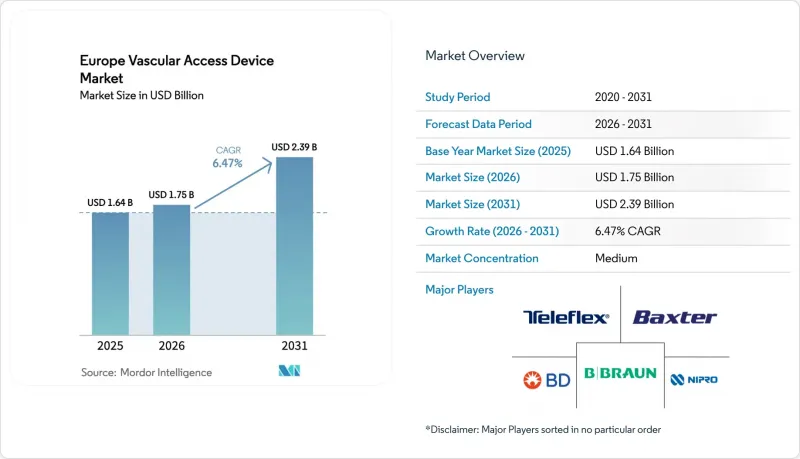
본 보고서는 기기 유형(중추 혈관 접근 기기 및 말초 혈관 접근 기기), 용도(약물 투여, 수액·영양 공급 등), 최종 사용자(병원 및 진료소 등), 소재(폴리우레탄, 실리콘 등), 지역(독일 등)별로 분류되어 있습니다. 시장 규모 및 전망은 금액(달러) 기준으로 제시되어 있습니다.
유럽 혈관 접근 기기 시장 동향 및 인사이트
만성 질환 유병률 증가
유럽의 고령화에 따라 지속적인 정맥 접근이 필요한 심혈관 질환, 신장 질환, 대사성 질환의 발생률이 증가하고 있습니다. 2030년까지 유럽 인구의 22.9%가 65세 이상이 될 것으로 예상되며, 혈관 시술 건수는 40.5% 증가할 것으로 예측됩니다. 이로 인해 내구성이 높고 합병증이 적은 카테터에 대한 필요성이 더욱 높아지고 있습니다. 따라서 병원에서는 항균 코팅이 적용된 중심정맥 카테터가 선호되고 있으며, 외래 진료 시 경과 관찰에는 말초정맥 카테터(미드라인)의 도입이 확대되고 있습니다. 기기 제조업체들은 혈전 형성을 방지하는 친수성 생체 재료를 채택하여 이에 대응하고 있으며, 한편 임상의들은 여러 번의 천자나 예정에 없던 교체를 최소화하기 위해 초음파 유도 하 삽입을 확대되고 있습니다. 만성기 치료 기간이 장기화되고 재입원에 대한 제재가 강화되는 가운데, 이러한 동향이 맞물려 유럽의 혈관 접근 기기 시장 전체에서 안정적인 수요가 뒷받침되고 있습니다.
화학요법 시행 건수 증가와 장기 입원
종양 센터에서는 수개월에 걸쳐 진행될 수 있는 다제 병용 요법을 시행하기 위해 신뢰성 높은 정맥 접근이 필수적입니다. 소아 환자의 경우, 중심정맥 포트가 터널형 카테터보다 감염률이 낮은 것으로 나타나 소아 병원에서 광범위하게 도입되고 있습니다. 성인 종양학과에서도 드레싱 교체 횟수가 줄어들어 간호 부담이 경감되고 외래 치료가 가능해진다는 점에서 이식형 포트가 선호되고 있습니다. 그 결과, 고유량 주입이 가능한 포트 및 부속품의 소비량이 증가하고 있으며, 이것이 유럽 혈관 접근 기기 시장의 주요 판매량 견인 요인이 되고 있습니다. 현재 경쟁의 초점은 조영제의 높은 유량을 견디면서도 새로운 EU-MDR(의료기기 규정)의 기계적 무결성 시험 요건을 충족하는 얇은 두께의 설계에 집중되고 있습니다.
카테터 사용에 따른 위험 및 합병증
중심정맥 카테터 관련 감염은 여전히 뿌리 깊은 과제로 남아 있습니다. 그리스의 중환자실(ICU)에서는 카테터 사용 일수 1,000일당 8.6건의 혈류 감염이 기록되고 있으며, 이로 인해 환자의 입원 기간이 약 19일 연장되고 사망률이 20.1% 증가하고 있습니다. 폴란드의 ICU에서도 유사한 경향이 나타나며, 카테터 관련 요로 감염이 환자의 8.83%에 영향을 미치고 있습니다. 모범 사례 지침을 준수하고 있음에도 불구하고, 모니터링 대상인 정맥 주입의 5.4%에서 말초 침윤 손상이 발생하고 있습니다. 이러한 사건들은 의료 과실로 인한 비용을 증가시키고, 의료기기의 회전율을 저하시키며, 병원으로 하여금 실적이 입증된 브랜드를 우선적으로 선택하도록 강요함으로써, 유럽의 혈관 접근 기기 시장에서 단기적인 판매량 증가를 억제하고 있습니다.
부문 분석
2025년에도 중앙정맥카테터는 매출의 54.86%를 계속 차지하고 있습니다. 이는 종양 전문의와 중환자 치료팀이 다회 투여 요법에서 포트나 터널형 카테터에 의존하고 있기 때문입니다. 반면, 말초 카테터는 7.29%라는 가장 높은 CAGR을 기록하고 있는데, 이는 의료진이 위험이 낮은 삽입 부위를 선호하는 경향과 초음파 유도 하 시술 능력의 향상을 반영한 것입니다. 새로운 친수성 미드라인 카테터는 혈전 형성을 96% 감소시키며, 항균성 폴리우레탄 허브는 표준 플라스틱 허브에 비해 세균 부착을 99.998% 감소시킵니다. 각 공급업체는 추가 천자가 필요 없는 검사용 채혈을 가능하게 하기 위해 말초 삽입형 중심정맥카테터(PICC)에 채혈 밸브를 통합하고 있으며, 이 기능은 소아 병동에서 높은 평가를 받고 있습니다.
일체형 단거리 말초 캐뉼라에는 노출을 제한하는 폐쇄형 시스템이 점점 더 많이 채택되고 있으며, 이로 인해 삽입 기간이 96시간 이상으로 연장되고 있습니다. 중규모 병원에서는 환자를 직접 중심정맥카테터로 전환하는 대신, 짧은 캐뉼라에서 미드라인으로 단계적으로 전환하는 ‘디바이스 애질리티(Device Agility)’ 프로토콜을 채택하여 입원부터 퇴원까지의 사이클 타임을 단축하고 있습니다. 그 결과, 구매 위원회는 카테터 SKU의 최적 구성을 재검토하고 있으며, 이는 유럽 혈관 접근 기기 시장에서 말초 기기의 출하 대수를 끌어올리고 있습니다. 그러나 고압 주입을 통한 영상 진단이나 자극성 약물 치료에서는 중심정맥 임플란트가 여전히 필수적이며, 지속적인 기본 수요가 확보되고 있습니다.
2025년에는 항균제 및 화학요법의 지속적인 점적 투여에 힘입어, 약물 투여가 유럽 혈관 접근 기기 시장 규모의 38.02%를 차지했습니다. 진단·검사 분야는 규모는 작지만, 현장 진단(Point-of-Care) 프로토콜에 따라 반복적인 채혈이 의무화되어 있어 2031년까지 연평균 성장률(CAGR) 7.36%로 확대되고 있습니다. 이에 따라 각 제조업체는 오염 위험에 대응하기 위해, 검체 채취에 최적화된 유로를 갖춘 무바늘 커넥터를 패키지로 제공합니다. 센서가 탑재된 캐뉼라는 폐색을 실시간으로 감지하여 검체의 무결성을 향상시키는 동시에, 소모품 비용을 증가시킬 수 있는 반복적인 천자를 억제하고 있습니다.
혈액 제제 수혈 라인에서는 병원의 정보 기술과 연동되는 폐쇄 루프 식별 시스템이 활용되어 수혈 오류가 감소하고 있습니다. 영양 공급 용도는 요양 시설에서 장기적인 비경구 영양 지원이 필요한 고령 환자층이 증가함에 따라 안정적인 수요를 유지하고 있습니다. 현재 많은 시설에서 12시간마다 플러싱 방침을 갱신하고 있어, 생리식염수 및 헤파린 락 용액의 판매가 증가하고 있습니다. 종양학 분야에서 듀얼 루멘 카테터의 채택이 확대됨에 따라, 유럽의 혈관 접근 기기 시장은 한 번의 시술로 치료 및 진단 양쪽 모두에서 수익을 창출할 수 있는 위치에 있습니다.
기타 혜택:
- 엑셀 형식 시장 예측(ME) 시트
- 3개월간의 애널리스트 지원
자주 묻는 질문
목차
제1장 서론
제2장 조사 방법
제3장 주요 요약
제4장 시장 구도
제5장 시장 규모와 성장 예측
제6장 경쟁 구도
제7장 시장 기회와 향후 전망
JHS 26.08.28According to Mordor Intelligence, the Europe vascular access devices market size is expected to grow from USD 1.64 billion in 2025 to USD 1.75 billion in 2026 and is forecast to reach USD 2.39 billion by 2031 at 6.47% CAGR over 2026-2031.
This report is Segmented by Device Type (Central Vascular Access Devices and Peripheral Vascular Access Devices), Application (Medication or Drug Administration, Fluid and Nutrition Administration, and More), End User (Hospitals & Clinics, and More), Material (Polyurethane, Silicone, and Others), and Geography (Germany, and More). The Market and Forecasts are Provided in Terms of Value (USD).
Europe Vascular Access Device Market Trends and Insights
Growing prevalence of chronic diseases
Europe's aging profile is increasing the incidence of cardiovascular, renal, and metabolic illnesses that require sustained venous access. By 2030, 22.9% of Europeans will be 65 years or older, and vascular procedures are projected to rise by 40.5%, underscoring the need for durable and low-complication catheters. Hospitals therefore favor antimicrobial-coated central lines, and peripheral midlines are gaining acceptance for outpatient follow-up. Device makers respond with hydrophilic biomaterials that resist thrombus formation, while clinicians expand ultrasound-guided insertion to minimize multiple punctures and unplanned replacements. Collectively, these trends reinforce steady demand across the Europe vascular access devices market as chronic-care pathways lengthen and readmission penalties tighten.
Rising number of chemotherapy procedures & high hospitalization
Oncology centers depend on reliable venous access to administer multidrug regimens that can last several months. Central venous ports show lower infection rates than tunneled catheters in pediatric cases, prompting wide adoption in children's hospitals. Adult oncology units also prefer implantable ports because fewer dressing changes reduce nursing burden and permit outpatient regimens. The result is heightened consumption of power-injectable ports and accessories, a key volume driver in the Europe vascular access devices market. Competition now centers on thin-walled designs that withstand high flow rates for contrast media while meeting new EU-MDR mechanical-integrity testing.
Risks & complications associated with catheter use
Central line infections remain a persistent obstacle . Greek intensive-care units record 8.6 bloodstream infections per 1,000 catheter-days, extending patient stays by nearly 19 days and adding mortality of 20.1%. Similar patterns in Polish ICUs show catheter-associated urinary infections affecting 8.83% of patients. Peripheral infiltration injuries occur in 5.4% of monitored infusions despite adherence to best-practice guidelines. These incidents elevate malpractice costs, slow device turnover, and oblige hospitals to favor proven brands, capping short-term volume uplift in the Europe vascular access devices market .
Other drivers and restraints analyzed in the detailed report include:
- Increasing pediatric utilization of VADs
- Shift toward home-infusion therapies in Europe
- Stringent regulations & product recalls
For complete list of drivers and restraints, kindly check the Table Of Contents.
Segment Analysis
Central lines continued to account for 54.86% of revenue in 2025 as oncologists and critical-care teams rely on ports and tunneled catheters for multidose regimens. At the same time, peripheral alternatives recorded the highest 7.29% CAGR, reflecting clinician preference for lower-risk insertion sites and growing ultrasound-guided competency. New hydrophilic midline formats reduce thrombus formation by 96%, and antimicrobial polyurethane hubs exhibit 99.998% lower bacterial adhesion than standard plastics. Vendors are integrating blood-draw valves into peripherally inserted central catheters to support lab sampling without additional sticks, a feature valued in pediatric wards.
Integrated short peripheral cannulas increasingly carry closed systems that limit exposure, extending dwell times beyond 96 hours. Mid-sized hospitals adopt device-agility protocols that graduate patients from short cannulas to midlines rather than directly to central lines, tightening the cycle time between admissions and discharge. As a result, purchasing committees reevaluate the optimal mix of catheter SKUs, buoying unit shipments of peripheral devices within the Europe vascular access devices market. However, central implants remain irreplaceable for power-injection imaging and vesicant therapy, ensuring sustained baseline demand.
Medication delivery absorbed 38.02% of the Europe vascular access devices market size in 2025, driven by continual antimicrobial and chemotherapy infusion. Diagnostics and testing, though smaller, accelerate at a 7.36% CAGR to 2031 as point-of-care protocols mandate repeat blood draws. Manufacturers therefore package needle-free connectors with sample-optimized flow paths, addressing contamination risks. Sensor-enabled cannulas detect occlusions in real time, improving sample integrity and curtailing repeat sticks that can inflate consumable costs.
Blood-product transfusion lines benefit from closed-loop identification systems that synchronize with hospital information technology, cutting mismatch errors. Nutrition-delivery applications remain steady amid an aging patient population requiring long-term parenteral support in nursing facilities. Many facilities now update flush policy every 12 hours, lifting saline and heparin lock solution sales. With wider adoption of dual-lumen catheters in oncology, the Europe vascular access devices market positions itself to capture both therapeutic and diagnostic revenues in a single procedure.
Complete Report Scope:
- By Device Type
- Central Vascular Access Devices
- Peripherally-Inserted Central Catheters (PICCs)
- Non-tunnelled Catheters
- Tunnelled Catheters
- Other Central Vascular Access Devices
- Peripheral Vascular Access Devices
- Peripheral IV Catheters (PIVC)
- Midline Catheters
- Other Peripheral Vascular Access Devices
- Central Vascular Access Devices
- By Application
- Medication or Drug Administration
- Fluid and Nutrition Administration
- Blood and Blood-Product Transfusion
- Diagnostics and Testing
- Other Applications
- By End User
- Hospitals & Clinics
- Ambulatory Surgery Centers
- Others
- By Material
- Polyurethane
- Silicone
- Others
- By Geography
- Germany
- United Kingdom
- France
- Italy
- Spain
- Rest of Europe
List of Companies Covered in this Report:
- Beckton Dickinson
- B. Braun
- Baxter
- ICU Medical
- Teleflex
- Edward Lifesciences
- AngioDynamics
- Terumo
- Nipro
- Medtronic
- Fresenius
- Vygon
- VascuLogic
- Access Scientific LLC
- Poly Medicure Ltd.
- Merit Medical Systems
- Penumbra
- Cook Group
- Vantex (Vascular Technology Inc.)
- GBUK Group
- VasoVet
Additional Benefits:
- The market estimate (ME) sheet in Excel format
- 3 months of analyst support
TABLE OF CONTENTS
1 Introduction
- 1.1 Study Assumptions & Market Definition
- 1.2 Scope of the Study
2 Research Methodology
3 Executive Summary
4 Market Landscape
- 4.1 Market Overview
- 4.2 Market Drivers
- 4.2.1 Growing prevalence of chronic diseases
- 4.2.2 Rising number of chemotherapy procedures & high hospitalization
- 4.2.3 Increasing pediatric utilization of VADs
- 4.2.4 Shift toward home-infusion therapies in Europe
- 4.2.5 EU-MDR-driven adoption of antimicrobial-coated catheters
- 4.2.6 Pilots of sensor-enabled catheters for IV infiltration alerts
- 4.3 Market Restraints
- 4.3.1 Risks & complications associated with catheter use
- 4.3.2 Stringent regulations & product recalls
- 4.3.3 Polyurethane supply-chain vulnerability
- 4.3.4 Growth of needle-free connectors cannibalising short PIVCs
- 4.4 Regulatory Landscape
- 4.5 Technological Outlook
- 4.6 Porters Five Forces Analysis
- 4.6.1 Threat of New Entrants
- 4.6.2 Bargaining Power of Buyers/Consumers
- 4.6.3 Bargaining Power of Suppliers
- 4.6.4 Threat of Substitute Products
- 4.6.5 Intensity of Competitive Rivalry
5 Market Size & Growth Forecasts (Value, USD)
- 5.1 By Device Type
- 5.1.1 Central Vascular Access Devices
- 5.1.1.1 Peripherally-Inserted Central Catheters (PICCs)
- 5.1.1.2 Non-tunnelled Catheters
- 5.1.1.3 Tunnelled Catheters
- 5.1.1.4 Other Central Vascular Access Devices
- 5.1.2 Peripheral Vascular Access Devices
- 5.1.2.1 Peripheral IV Catheters (PIVC)
- 5.1.2.2 Midline Catheters
- 5.1.2.3 Other Peripheral Vascular Access Devices
- 5.1.1 Central Vascular Access Devices
- 5.2 By Application
- 5.2.1 Medication or Drug Administration
- 5.2.2 Fluid and Nutrition Administration
- 5.2.3 Blood and Blood-Product Transfusion
- 5.2.4 Diagnostics and Testing
- 5.2.5 Other Applications
- 5.3 By End User
- 5.3.1 Hospitals & Clinics
- 5.3.2 Ambulatory Surgery Centers
- 5.3.3 Others
- 5.4 By Material
- 5.4.1 Polyurethane
- 5.4.2 Silicone
- 5.4.3 Others
- 5.5 By Geography
- 5.5.1 Germany
- 5.5.2 United Kingdom
- 5.5.3 France
- 5.5.4 Italy
- 5.5.5 Spain
- 5.5.6 Rest of Europe
6 Competitive Landscape
- 6.1 Market Concentration
- 6.2 Market Share Analysis
- 6.3 Company Profiles (includes Global level Overview, Market level Overview, Core Segments, Financials as available, Strategic Information, Market Rank/Share, Products & Services, Recent Developments)
- 6.3.1 Becton, Dickinson and Company
- 6.3.2 B. Braun SE
- 6.3.3 Baxter International
- 6.3.4 ICU Medical Inc.
- 6.3.5 Teleflex Incorporated
- 6.3.6 Edwards Lifesciences Corporation
- 6.3.7 AngioDynamics
- 6.3.8 Terumo Corporation
- 6.3.9 Nipro Corporation
- 6.3.10 Medtronic plc
- 6.3.11 Fresenius Medical Care AG & Co. KGaA
- 6.3.12 Vygon SA
- 6.3.13 VascuLogic
- 6.3.14 Access Scientific LLC
- 6.3.15 Poly Medicure Ltd.
- 6.3.16 Merit Medical Systems
- 6.3.17 Penumbra, Inc
- 6.3.18 Cook Medical
- 6.3.19 Vantex (Vascular Technology Inc.)
- 6.3.20 GBUK Group
- 6.3.21 VasoVet
7 Market Opportunities & Future Outlook
- 7.1 White-space & Unmet-need Assessment


