

|
시장보고서
상품코드
2122338
혈관 접근 기기 시장 : 시장 점유율 분석, 업계 동향 및 통계, 성장 예측(2026-2031년)Vascular Access Devices - Market Share Analysis, Industry Trends & Statistics, Growth Forecasts (2026 - 2031) |
||||||
 Mordor Intelligence
Mordor Intelligence에 의하면, 혈관 접근 기기 시장 규모는 2025년 62억 5,000만 달러로 평가되었고, 2026년에는 66억 8,000만 달러로 추정되고, 2026-2031년 CAGR 6.92%로 성장을 지속할 전망이며, 2031년에는 93억 4,000만 달러에 이를 것으로 예측됩니다.
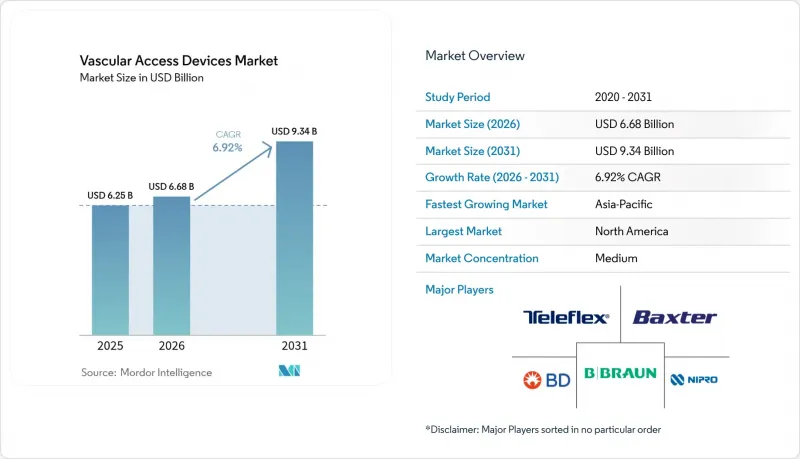
본 보고서는 기기 유형별(중추 혈관 접근 기기 및 말초 혈관 접근 기기), 용도별(약물 투여, 수액·영양 공급 등), 최종 사용자별(병원 및 진료소 등), 소재별(폴리우레탄, 실리콘 등), 지역별(북미 등)로 분류되어 있습니다. 시장 규모 및 전망은 금액(달러) 기준으로 제시되어 있습니다.
세계의 혈관 접근 기기 시장 동향 및 인사이트
만성 질환 부담 증가와 정맥 내 요법 수요 증가
당뇨병 및 심부전과 같은 만성 질환으로 인해 전 세계적으로 장기간에 걸친 정맥 내 치료 수요가 증가하고 있습니다. 현재, 재택 수액 요법은 연간 320만 명 이상의 미국인이 이용하고 있으며, 그 지출액은 1,100억 달러를 초과하고 매년 5-7%의 속도로 증가하고 있습니다. 내구성이 뛰어난 미드라인 카테터와 장기 삽입형 말초 혈관 접근 기기는 합병증 위험을 줄여주며, 외래 치료의 확대를 뒷받침하고 있습니다. Access Vascular사의 MIMIX와 같은 친수성 생체 재료는 고장률을 낮추어 1,000병상 규모의 병원에서 연간 180만 달러의 비용 절감을 실현합니다. 이러한 경제적 이점으로 인해 혈관 접근 기기는 단순한 소모품에서 필수적인 인프라로 그 위상이 높아지고 있습니다.
항암 치료 시행 건수 및 입원 건수 증가
맞춤형 암 치료에서는 자극성이 강한 약물을 견디면서 빈번한 채혈을 가능하게 하는 중심정맥카테터에 대한 의존도가 높아지고 있습니다. 말초 삽입형 중심정맥카테터(PICC)는 외래 치료의 유연성을 높이고, 치료 지연 및 입원 기간을 단축합니다. 클로르헥시딘 함침 드레싱은 임상시험에서 혈류 감염을 52% 감소시킨 것으로 나타났으며, 이는 감염 저항성 기기에 대한 프리미엄 가격 책정의 근거가 되고 있습니다.
카테터 관련 혈류 감염(CLABSI)
중환자실(ICU)에서는 여전히 카테터 사용 일수 1,000일당 4.9건의 감염이 기록되고 있으며, 감염이 발생할 때마다 치료비 증가와 사망 위험 증가로 이어지고 있습니다. 디지털 대시보드는 CLABSI 발생률을 최대 73%까지 감소시키지만, 설비 투자가 필요합니다. 클로르헥시딘 함유 드레싱은 카테터 내 콜로니 형성을 54% 감소시킵니다. 그 결과, 병원 측은 통합적인 감염 관리 전략을 선호하게 되었으며, 첨단 코팅 기술을 보유하지 않은 범용 제품 공급업체들은 어려운 상황에 몰리고 있습니다.
부문 분석
2025년, 중심정맥 카테터는 혈관 접근 기기 시장 점유율의 56.12%를 차지했습니다. PICC는 여전히 종양학 및 중환자 치료 현장에서 주력 제품이며, 한편 터널형 카테터는 1년에 걸친 치료를 뒷받침하고 있습니다. 병원 측은 신뢰성 높은 혈류 확보와 재삽입 빈도가 낮다는 점을 중시하고 있지만, 한편으로는 보험 환급 압박으로 인해 감염 위험 및 삽입 기간에 대한 심사가 엄격해지고 있습니다.
반면, 말초 카테터는 연평균 성장률(CAGR) 7.61%를 기록하며 가장 빠르게 성장하는 부문입니다. 장기 삽입 설계는 표준 말초 정맥 카테터(PIVC)와 PICC 사이의 격차를 메워, 중기 치료에 드는 비용과 합병증 발생률을 낮춥니다. B. Braun사의 ‘Introcan Safety 2’와 같은 FDA 승인 기기는 삽입 기간의 중앙값을 5.7일로 연장합니다. 초음파 유도 하 삽입은 임상 현장에서의 수용이 확대되고 있으며, 항균성 폴리우레탄을 채택한 개량형 제품을 통해 각사의 제품 차별화가 더욱 진행되고 있습니다. 외래 환자 대상의 정맥 주사 투여량이 증가하는 가운데, 말초 카테터 분야의 혁신 기술은 혈관 접근 기기 시장에서 더욱 탄력을 받을 전망입니다.
약물 투여는 2025년 매출의 39.55%를 차지했으며, 안전한 정맥 내 약물 투여에 있어 필수적인 역할을 부각시키고 있습니다. 복잡한 생물학적 제제, 화학요법 병용 요법, 고삼투압 용액의 경우, 무결성을 손상시키지 않고 반복적으로 접근할 수 있는 견고한 중심정맥 카테터나 포트가 필수적입니다. 코팅된 루멘과 내압성 허브는 표준이 되어 가격 프리미엄을 뒷받침하고 있습니다.
정밀의료 프로토콜에서 바이오마커의 지속적인 샘플링이 요구됨에 따라, 진단 및 검사 분야는 연평균 성장률(CAGR) 7.68%를 나타낼 것으로 예측됩니다. 포인트 오브 케어(PoC) 기기는 검사 결과 보고 시간을 단축하기 때문에 병원에서는 용혈률이 낮고 채혈이 용이한 카테터가 선호되고 있습니다. 멀티루멘 구조나 AI를 통해 최적화된 형상을 통합한 제조업체들은 워크플로우 효율화를 실현하며, 혈관 접근 기기 시장에서의 경쟁력을 강화하고 있습니다.
지역별 분석
북미는 선진 의료 인프라와 감염 저감 기술을 높이 평가하는 보험 제도를 배경으로 2025년 매출의 39.85%를 차지했습니다. BD사는 2024년, 미국 내 카테터 생산 확대를 위해 1,000만 달러 이상을 투자하고 연간 수억 개의 생산 능력을 추가함으로써 국내 공급의 회복탄력성을 강화했습니다. 테르모는 푸에르토리코에서 ‘Angio-Seal’의 생산 능력 확대에 3,000만 달러를 배정하여, 해당 지역의 제조 수요 증가를 뒷받침하고 있습니다.
아시아태평양은 만성 질환 유병률 상승과 의료비 증가를 반영하여 2031년까지 연평균 성장률(CAGR) 7.95%를 나타낼 것으로 예측됩니다. 중국 내 가치 중심 조달로의 전환이 가격 압박을 초래하고 있지만, 현지 유력 기업들은 국내 이익률 감소를 상쇄하기 위해 수출 시장에 주목하고 있습니다. 일본에 본사를 둔 테르모는 자사의 ‘Rika’ 미드 클램프 플랫폼이 현재 해당 지역 내 98개 시설에 도입되어 100개 시설이라는 이정표에 가까워지고 있다고 보고했습니다.
유럽에서는 엄격한 감염 예방 대책의 의무화와 HTA(의료기술평가)의 조기 도입으로 인해 견조한 도입 실적을 유지하고 있습니다. 한편, 중동의 의료 시스템 확충과 남미의 경제 회복에 힘입어, 특히 공적 보험이 외래 수액 치료를 지원하는 지역을 중심으로 높은 성장이 예상되는 지역이 나타나고 있습니다. 지속되는 지정학적 마찰과 원자재 공급 제약으로 인해 각 기업은 멀티 허브형 조달 모델 구축을 추진하고 있으며, 이를 통해 혈관 접근 기기 시장은 혼란을 초래하지 않으면서도 다양한 지역 수요에 대응할 수 있게 될 것입니다.
기타 혜택 :
- 엑셀 형식 시장 예측(ME) 시트
- 3개월간 애널리스트의 지원
자주 묻는 질문
목차
제1장 서론
제2장 조사 방법
제3장 주요 요약
제4장 시장 구도
제5장 시장 규모 및 성장 예측
제6장 경쟁 구도
제7장 시장 기회 및 향후 전망
AJY 26.09.07According to Mordor Intelligence, the vascular access devices market size is expected to grow from USD 6.25 billion in 2025 to USD 6.68 billion in 2026 and is forecast to reach USD 9.34 billion by 2031 at 6.92% CAGR over 2026-2031.
This report is Segmented by Device Type (Central Vascular Access Devices and Peripheral Vascular Access Devices), Application (Medication or Drug Administration, Fluid and Nutrition Administration, and More), End User (Hospitals & Clinics, and More), Material (Polyurethane, Silicone, and Others), and Geography (North America and More). The Market and Forecasts are Provided in Terms of Value (USD).
Global Vascular Access Devices Market Trends and Insights
Rising burden of chronic diseases & high IV-therapy demand
Chronic conditions such as diabetes and heart failure are driving long-term intravenous treatment requirements worldwide. Home infusion now serves more than 3.2 million Americans annually, with spending exceeding USD 110 billion and rising 5-7% each year. Durable midline catheters and extended-dwell peripheral devices lower complication risk, supporting broader outpatient management. Hydrophilic biomaterials like Access Vascular's MIMIX reduce failure rates and can save a 1,000-bed hospital USD 1.8 million a year. These economics elevate vascular access devices from commodity supplies to essential infrastructure.
Growth in chemotherapy procedures & hospitalization
Personalized oncology regimens increasingly depend on central venous catheters that tolerate vesicant drugs while permitting frequent sampling . Peripherally inserted central catheters (PICCs) improve outpatient flexibility, cutting treatment delays and hospital stays. Chlorhexidine-impregnated dressings have trimmed bloodstream infections by 52% in trials, underpinning premium pricing for infection-resistant devices .
Catheter-associated bloodstream infections (CLABSI)
Intensive-care units still record 4.9 infections per 1,000 catheter days, with every episode adding treatment cost and mortality risk. Digital dashboards cut CLABSI rates by up to 73% but require capital investment. Chlorhexidine dressings reduce catheter colonization by 54%. Hospitals consequently favor integrated infection-control bundles, squeezing commodity vendors that lack advanced coatings.
Other drivers and restraints analyzed in the detailed report include:
- Increasing pediatric & neonatal vascular access
- Adoption of ultrasound-guided DIVA solutions
- Stringent regulatory scrutiny & product recalls
For complete list of drivers and restraints, kindly check the Table Of Contents.
Segment Analysis
Central devices captured 56.12% of vascular access devices market share in 2025. PICCs remain the workhorse for oncology and critical-care settings, whereas tunneled catheters support year-long therapies. Hospitals value their reliable flow and lower reinsertion frequency, even as reimbursement pressures intensify scrutiny of infection risk and dwell time.
Peripheral catheters, however, are the fastest-growing class at a 7.61% CAGR. Extended-dwell designs bridge the gap between standard PIVCs and PICCs, reducing cost and complication rates for intermediate therapies. FDA-cleared devices such as B. Braun's Introcan Safety 2 extend median dwell to 5.7 days. Ultrasound-guided placement has broadened clinical acceptance, and antimicrobial polyurethane upgrades further differentiate offerings. As outpatient infusion volumes swell, peripheral innovations are positioned to gain additional vascular access devices market traction.
Medication administration commanded 39.55% of 2025 revenue, underlining the indispensable role of safe intravenous drug delivery. Complex biologics, chemotherapy cocktails and high-osmolar solutions necessitate robust central lines and ports capable of repeated access without integrity loss. Coated lumens and pressure-tolerant hubs have become standard, supporting price premiums.
Diagnostics and testing is forecast to grow at a 7.68% CAGR as precision-medicine protocols demand serial biomarker sampling. Point-of-care devices shorten turnaround times, spurring hospitals to favor catheters with low hemolysis rates and easy blood-draw access. Manufacturers integrating multi-lumen configurations and AI-optimized geometries offer tangible workflow savings, strengthening competitive positioning within the vascular access devices market.
Complete Report Scope:
- By Device Type
- Central Vascular Access Devices
- Peripherally-Inserted Central Catheters (PICCs)
- Non-tunnelled Catheters
- Tunnelled Catheters
- Other Central Vascular Access Devices
- Peripheral Vascular Access Devices
- Peripheral IV Catheters (PIVC)
- Midline Catheters
- Other Peripheral Vascular Access Devices
- Central Vascular Access Devices
- By Application
- Medication or Drug Administration
- Fluid and Nutrition Administration
- Blood and Blood-Product Transfusion
- Diagnostics and Testing
- Other Applications
- By End User
- Hospitals & Clinics
- Ambulatory Surgery Centers
- Others
- By Material
- Polyurethane
- Silicone
- Others
- By Geography
- North America
- United States
- Canada
- Mexico
- Europe
- Germany
- United Kingdom
- France
- Italy
- Spain
- Rest of Europe
- Asia-Pacific
- China
- Japan
- India
- Australia
- South Korea
- Rest of Asia-Pacific
- Middle East and Africa
- GCC
- South Africa
- Rest of Middle East and Africa
- South America
- Brazil
- Argentina
- Rest of South America
- North America
Geography Analysis
North America commanded 39.85% of 2025 revenue on the back of sophisticated healthcare infrastructure and an insurance mix that rewards infection-reduction technologies. BD invested more than USD 10 million in 2024 to expand U.S. catheter production, adding hundreds of millions of units annually and reinforcing domestic supply resilience. Terumo earmarked USD 30 million for Angio-Seal capacity in Puerto Rico, underscoring the region's manufacturing pull.
Asia-Pacific is projected to post an 7.95% CAGR through 2031, reflecting rising chronic disease prevalence and healthcare spending. China's shift to value-based procurement is exerting price pressure, yet local champions eye export markets to offset domestic margin compression. Japan-headquartered Terumo reported that its Rika mid-clamp platform is now installed in 98 centers across the region, nearing its 100-site milestone.
Europe maintains a robust installed base driven by strict infection-prevention mandates and early HTA adoption. Meanwhile, Middle Eastern health-system build-outs and South American economic recovery create pockets of high growth, especially where public insurers support outpatient infusion. Ongoing geopolitical frictions and raw-material constraints are encouraging firms to develop multi-hub sourcing models so the vascular access devices market can meet varied regional demand without disruption.
- Beckton Dickinson
- Teleflex
- ICU Medical (inc. Smiths Medical)
- B. Braun
- Baxter
- Fresenius
- Medtronic
- Terumo Corp.
- Nipro Medical Corp.
- Siemens Healthineers
- AngioDynamics
- Cook Group
- Access Vascular Inc.
- Vygon
- Merit Medical Systems
- Delta Med SpA
- Poly Medicure Ltd.
- Argon Medical Devices
- Vyaire Medical
- Sam Medical
Additional Benefits:
- The market estimate (ME) sheet in Excel format
- 3 months of analyst support
TABLE OF CONTENTS
1 Introduction
- 1.1 Study Assumptions & Market Definition
- 1.2 Scope of the Study
2 Research Methodology
3 Executive Summary
4 Market Landscape
- 4.1 Market Overview
- 4.2 Market Drivers
- 4.2.1 Rising burden of chronic diseases & high IV-therapy demand
- 4.2.2 Growth in chemotherapy procedures & hospitalization
- 4.2.3 Increasing pediatric & neonatal vascular access
- 4.2.4 Adoption of ultrasound-guided DIVA solutions
- 4.2.5 Expansion of home & community infusion therapy
- 4.2.6 Favorable reimubursement policies and guidelines
- 4.3 Market Restraints
- 4.3.1 Catheter-associated bloodstream infections (CLABSI)
- 4.3.2 Stringent regulatory scrutiny & product recalls
- 4.3.3 Alternate long-acting drug-delivery routes
- 4.3.4 Medical-grade PU & silicone supply constraints
- 4.4 Regulatory Landscape
- 4.5 Technological Outlook
- 4.6 Porters Five Forces Analysis
- 4.6.1 Threat of New Entrants
- 4.6.2 Bargaining Power of Buyers
- 4.6.3 Bargaining Power of Suppliers
- 4.6.4 Threat of Substitutes
- 4.6.5 Competitive Rivalry
5 Market Size & Growth Forecasts (Value, USD)
- 5.1 By Device Type
- 5.1.1 Central Vascular Access Devices
- 5.1.1.1 Peripherally-Inserted Central Catheters (PICCs)
- 5.1.1.2 Non-tunnelled Catheters
- 5.1.1.3 Tunnelled Catheters
- 5.1.1.4 Other Central Vascular Access Devices
- 5.1.2 Peripheral Vascular Access Devices
- 5.1.2.1 Peripheral IV Catheters (PIVC)
- 5.1.2.2 Midline Catheters
- 5.1.2.3 Other Peripheral Vascular Access Devices
- 5.1.1 Central Vascular Access Devices
- 5.2 By Application
- 5.2.1 Medication or Drug Administration
- 5.2.2 Fluid and Nutrition Administration
- 5.2.3 Blood and Blood-Product Transfusion
- 5.2.4 Diagnostics and Testing
- 5.2.5 Other Applications
- 5.3 By End User
- 5.3.1 Hospitals & Clinics
- 5.3.2 Ambulatory Surgery Centers
- 5.3.3 Others
- 5.4 By Material
- 5.4.1 Polyurethane
- 5.4.2 Silicone
- 5.4.3 Others
- 5.5 By Geography
- 5.5.1 North America
- 5.5.1.1 United States
- 5.5.1.2 Canada
- 5.5.1.3 Mexico
- 5.5.2 Europe
- 5.5.2.1 Germany
- 5.5.2.2 United Kingdom
- 5.5.2.3 France
- 5.5.2.4 Italy
- 5.5.2.5 Spain
- 5.5.2.6 Rest of Europe
- 5.5.3 Asia-Pacific
- 5.5.3.1 China
- 5.5.3.2 Japan
- 5.5.3.3 India
- 5.5.3.4 Australia
- 5.5.3.5 South Korea
- 5.5.3.6 Rest of Asia-Pacific
- 5.5.4 Middle East and Africa
- 5.5.4.1 GCC
- 5.5.4.2 South Africa
- 5.5.4.3 Rest of Middle East and Africa
- 5.5.5 South America
- 5.5.5.1 Brazil
- 5.5.5.2 Argentina
- 5.5.5.3 Rest of South America
- 5.5.1 North America
6 Competitive Landscape
- 6.1 Market Concentration
- 6.2 Market Share Analysis
- 6.3 Company Profiles (includes Global Level Overview, Market Level Overview, Core Segments, Financials, Strategic Info, Market Rank/Share, Products & Services, Recent Developments)
- 6.3.1 Becton, Dickinson and Company (BD)
- 6.3.2 Teleflex Inc.
- 6.3.3 ICU Medical (inc. Smiths Medical)
- 6.3.4 B. Braun SE
- 6.3.5 Baxter International Inc.
- 6.3.6 Fresenius Medical Care AG & Co. KGaA
- 6.3.7 Medtronic plc
- 6.3.8 Terumo Corp.
- 6.3.9 Nipro Medical Corp.
- 6.3.10 Siemens Healthineers
- 6.3.11 AngioDynamics Inc.
- 6.3.12 Cook Medical
- 6.3.13 Access Vascular Inc.
- 6.3.14 Vygon SA
- 6.3.15 Merit Medical Systems
- 6.3.16 Delta Med SpA
- 6.3.17 Poly Medicure Ltd.
- 6.3.18 Argon Medical Devices
- 6.3.19 Vyaire Medical
- 6.3.20 Sam Medical
7 Market Opportunities & Future Outlook
- 7.1 White-space & Unmet-Need Assessment


