|
시장보고서
상품코드
2092398
엣지 컴퓨팅 시장 예측(-2031년) : 오퍼링별, 용도별, 배포 모드별, 조직 규모별, 업계별, 지역별Edge Computing Market by Offering (Hardware, Software, Services), Application (Video Analytics, Asset Monitoring, Automation, IoT Monitoring, Content Delivery), Deployment Mode, Organization Size, Vertical, and Region - Global Forecast to 2031 |
||||||

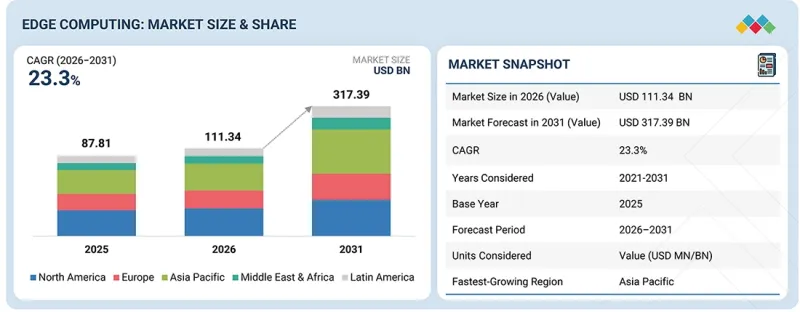
세계의 엣지 컴퓨팅 시장 규모는 급속히 확대하고 있으며, 시장 규모는 2026년 1,113억 4,000만 달러에서 2031년에는 3,173억 9,000만 달러로 확대하며, CAGR은 23.3%에 달할 것으로 예측됩니다.
엣지 컴퓨팅 시장의 성장은 주로 몇 가지 주요 촉진요인과 제약 요인에 의해 좌우되고 있습니다. 촉진요인으로는 다양한 산업 분야에서 IoT(사물인터넷) 솔루션의 도입과 활용이 급증하고 있으며, 네트워크 엣지에서의 실시간 데이터 처리 및 분석에 대한 수요가 높아지고 있다는 점을 들 수 있습니다. 또한 저지연 애플리케이션에 대한 수요가 증가함에 따라 시장 확대가 더욱 가속화되고 있을 뿐만 아니라, 안전하고 규정 준수를 충족하는 엣지 배포를 촉진하는 정부의 엄격한 규제 요건 역시 시장 확대에 기여하고 있습니다.
| 조사 범위 | |
|---|---|
| 조사 대상 기간 | 2021-2031년 |
| 기준연도 | 2025년 |
| 예측 기간 | 2026-2031년 |
| 산정 단위 | 금액(100만/10억 달러) |
| 부문 | 오퍼링별, 용도별, 배포 모드별, 조직 규모별, 업계별, 지역별 |
| 대상 지역 | 북미, 유럽, 아시아태평양, 중동 및 아프리카, 라틴아메리카 |
또한 인공지능(AI)과 머신러닝을 통합함으로써 조직은 엣지 환경에서 직접 더 스마트하고 자율적인 운영을 실현할 수 있게 됩니다. 한편, 제약 요인으로는 엣지 컴퓨팅 인프라의 복잡한 특성이 꼽히며, 이는 도입, 관리 및 레거시 시스템과의 원활한 통합에 있으며, 큰 과제로 대두되고 있습니다.
"용도별로는 실시간 분석 및 의사결정 지원이 예측 기간 중 가장 높은 성장률을 보일 것으로 예상됩니다."
실시간 분석 및 의사결정 지원은 예측 기간 중 가장 높은 성장률을 보일 것으로 예상됩니다. 이러한 성장은 제조, 의료, 운송, 소매, 에너지, 스마트 시티 등 각 분야에서 즉각적인 데이터 처리, 저지연 인사이트, 그리고 자동화된 의사결정에 대한 수요가 증가함에 따라 주도되고 있습니다. 엣지 컴퓨팅을 통해 운영 데이터를 기계, 센서, 디바이스 및 기업 시스템과 더 가까운 곳에서 처리할 수 있게 되어, 응답 시간 단축, 대역폭 사용량 절감, 그리고 중앙 집중형 클라우드 인프라에 대한 의존도 저하를 실현할 수 있습니다. 조직이 분산된 모든 거점에서 AI 기반 분석, 산업용 IoT 시스템, 예측 유지보수, 자율적인 워크플로우를 도입함에 따라 엣지 컴퓨팅은 신속한 탐지, 로컬 수준의 지능, 지속적인 운영 의사결정에 있으며, 필수적인 요소가 될 것입니다. 이를 통해 엣지 환경에서 확장성이 뛰어나고 안전하며, 업계에 특화된 실시간 분석 및 의사결정 지원 플랫폼을 제공하는 벤더들에게 큰 비즈니스 기회가 창출됩니다.
"구현 모드별로는 예측 기간 중 리저널/클라우드 엣지 부문이 가장 큰 시장 점유율을 차지할 것으로 예상됩니다."
지역/클라우드 엣지 부문은 예측 기간 중 가장 큰 시장 점유율을 차지할 것으로 예상됩니다. 이러한 우위는 하이퍼스케일러의 엣지 영역, CDN 엣지 컴퓨팅, 분산형 클라우드 리전, 그리고 사용자, 기기, 기업의 거점에 더 가까운 곳에 구축되는 클라우드 관리형 인프라의 확장에 힘입어 이루어지고 있습니다. 기업은 온프레미스 인프라를 완전히 관리하지 않으면서도 저지연 애플리케이션, AI 추론, 동영상 분석, 컨텐츠 전송, 게임, IoT 플랫폼 및 여러 거점에 걸친 디지털 운영을 지원하기 위해 리저널/클라우드 엣지의 활용을 점점 더 확대하고 있습니다. 이 부문에는 확장성 향상, 통합 관리, 신속한 도입, 그리고 퍼블릭 클라우드 서비스와의 통합과 같은 장점이 있습니다. 기업이 분산형 워크로드를 현대화하고 하이브리드 아키텍처를 채택함에 따라 리저널/클라우드 엣지는 확장성이 뛰어나고 안전하며 지연 시간에 민감한 엣지 컴퓨팅 환경에서 선호되는 도입 모델로 자리 잡고 있습니다.
"북미는 첨단인 인프라, 강력한 5G 커버리지, 그리고 실시간 솔루션에 대한 기업의 활발한 수요 덕분에 엣지 컴퓨팅 시장을 주도하고 있습니다. 한편, 아시아태평양은 클라우드의 급속한 보급, 대규모 IoT 도입, 그리고 정부 주도의 지역 밀착형 엣지 인프라에 대한 투자에 힘입어 가장 빠르게 성장하고 있는 지역이 되었습니다."
북미는 실시간 데이터 처리, 저지연 애플리케이션, 그리고 안전한 분산 아키텍처에 대한 기업의 수요가 증가하는 것을 배경으로, 엣지 컴퓨팅 시장을 주도할 것으로 예상됩니다. 벤더와 솔루션 제공업체에게 이는 제조, 의료, 통신, 자율주행차 등의 산업에 확장 가능한 플랫폼과 서비스를 제공할 수 있는 큰 기회가 될 것입니다. 해당 지역의 성숙한 5G 인프라와 확대되는 IoT 도입으로 인해 중앙 집중형 클라우드에서 엣지 기반 처리로의 전환이 가능해졌으며, 데이터 주권 규정을 준수하는 로컬 솔루션에 대한 중요한 수요가 대두되고 있습니다. 통신 네트워크에 엣지 기능을 통합하는 것과 같은 전략적 파트너십은 엣지 컴퓨팅이 업무 효율과 사용자 경험을 어떻게 향상시키는지 보여주고 있습니다. 이러한 동향을 활용함으로써, 벤더는 변화하는 고객 요구 사항에 대응하고, 지연을 줄이며, 급속한 성장과 혁신이 예상되는 시장에서 확고한 기반을 다질 수 있습니다.
이 보고서에는 엣지 컴퓨팅 시장의 주요 업체에 대한 조사 결과가 포함되어 있습니다. 엣지 컴퓨팅 시장의 주요 공급업체를 소개합니다. 주요 시장 참여자로는 HPE(미국), AWS(미국), Dell Technologies(미국), Cisco(미국), Microsoft(미국), IBM(미국), Google(미국), Nvidia(미국), Intel(미국), Huawei(중국), Nokia(핀란드), VMware(미국), Fastly(미국), Adlink(대만), Oracle(미국), Semtech(미국), Moxa(미국), Belden(미국), GE Digital(미국), DG International(미국), Litmus Automation(미국), Zededa(미국), Clearblade(미국), Vapor IO(미국) 등이 있습니다.
조사 범위
본 조사 보고서에서는 엣지 컴퓨팅 시장을 ‘제공 [엣지 인프라의 하드웨어, 소프트웨어 및 서비스]’, ‘용도’, ‘조직 규모’, ‘구축 방식’, ‘업종’, ‘지역’에 따라 분류하고 있습니다. 제공별로 보면 엣지 인프라의 하드웨어에는 엣지 서버 및 어플라이언스, 엣지 게이트웨이, AI 가속기 및 프로세서, 엣지 스토리지, 네트워크 장비가 포함됩니다. 소프트웨어에는 엣지 오케스트레이션 및 관리 플랫폼, 엣지 AI 및 분석 플랫폼, 엣지 데이터 관리 및 통합 소프트웨어, 엣지 보안 소프트웨어가 포함됩니다. 서비스에는 전문 서비스 및 매니지드 엣지 서비스가 포함됩니다. 용도별로는 시장에는 영상 분석·컴퓨터 비전, 자산 감시·예지 유지보수, 산업 자동화·운영 제어, 커넥티드 자산·IoT 감시, 실시간 분석·의사결정 지원, 컨텐츠 전송·네트워크 최적화, 자율 시스템·몰입형 애플리케이션 및 기타 애플리케이션이 포함됩니다. 기업 규모별로 보면 시장은 대기업과 중소기업으로 구분됩니다. 구축 모드별로는 온프레미스 에지, 통신사/네트워크 엣지, 지역/클라우드 에지가 대상이 됩니다. 업종별로는 제조, 통신, 소매·E-Commerce, 의료·생명과학, 운송·물류, 에너지·공공사업, 정부·국방, BFSI(은행·금융·보험), 미디어·엔터테인먼트가 대상입니다. 지역별로는 북미, 유럽, 아시아태평양, 중동 및 아프리카, 라틴아메리카가 대상입니다.
이 보고서를 구매해야 하는 이유
이 보고서는 시장을 선도하는 기업 및 신규 진입 기업을 대상으로, 엣지 컴퓨팅 시장 전체 및 그 하위 부문의 매출에 대한 가장 정확한 추정치를 제공합니다. 이를 통해 이해관계자들은 경쟁 구도를 파악하고, 더 심층 인사이트를 얻어 자사의 비즈니스를 최적의 위치에 자리매김하며, 적절한 시장 진입 전략을 수립하는 데 도움이 됩니다. 또한 시장 동향을 파악하고 주요 시장 촉진요인·과제, 시장 억제요인 및 기회에 관한 정보를 얻을 수도 있습니다.
이 보고서에서는 다음 사항에 대한 인사이트를 제공합니다. :
- 주요 촉진요인(산업 전반에 걸친 IoT 도입 및 활용의 급증, 저지연 애플리케이션에 대한 수요 증가, 국가별 엄격한 규제 요건, AI 및 ML 통합), 제약 요인(엣지 컴퓨팅 인프라의 복잡한 특성), 기회(대규모 5G 네트워크 구축의 길을 열어주는 5G 네트워크의 등장, IoT의 보급, 각 부문에서의 엣지 컴퓨팅 솔루션의 급속한 확산, 자율주행차 및 커넥티드 카 인프라의 부상), 그리고 과제(데이터 개인정보 보호 및 보안에 대한 우려 증가, 호환성 및 상호운용성 문제)
- 제품 개발/혁신: 엣지 컴퓨팅 시장의 향후 기술, 연구개발 활동 및 신제품·서비스 출시에 관한 상세 인사이트
- 시장 개발: 수익성이 높은 시장에 대한 포괄적인 정보 - 이 보고서에서는 다양한 지역의 엣지 컴퓨팅 시장을 분석하고 있습니다.
- 시장의 다양화: 엣지 컴퓨팅 시장의 신제품·서비스, 미개발 지역, 최근 동향 및 투자에 관한 포괄적인 정보
- 경쟁사 분석: Dell Technologies(미국), NVIDIA(미국), HPE(미국), Microsoft(미국), Huawei(중국), Cisco(미국), IBM(미국), Google(미국), Intel(미국), Supermicro(미국), Advantech(대만), 아카마이 테크놀러지스(미국), 노키아(핀란드), 레노버(중국), 지멘스(독일), 브로드컴(미국), ZTE(중국), 오라클(미국), 벨덴(미국), 모크사(대만), 스케일 컴퓨팅(미국), 클리어블레이드(미국) 등 주요 기업의 시장 점유율, 성장 전략, 서비스 제공에 대해 상세히 평가하고 있습니다. 또한 이 보고서는 이해관계자들이 엣지 컴퓨팅 시장의 동향을 파악하는 데 도움이 되며, 주요 시장 촉진요인, 제약 요인, 과제 및 기회에 대한 정보를 제공합니다.
자주 묻는 질문
목차
제1장 서론
제2장 규제기관, 업계 제휴 및 기술 투자자 개요
제3장 주요 인사이트
제4장 시장 개요
제5장 업계 동향
제6장 기술, 특허, 디지털 기술, AI의 도입에 의한 전략적 파괴
제7장 규제 상황
제8장 고객 상황과 구매 행동
제9장 엣지 컴퓨팅 시장(오퍼링별)
제10장 엣지 컴퓨팅 시장(용도별)
제11장 엣지 컴퓨팅 시장(배포 모드별)
제12장 엣지 컴퓨팅 시장(조직 규모별)
제13장 엣지 컴퓨팅 시장(업계별)
제14장 엣지 컴퓨팅 시장(지역별)
제15장 경쟁 구도
제16장 기업 개요
제17장 조사 방법
제18장 부록
KSA 26.07.23The global edge computing market is expanding rapidly, with a projected market size rising from USD 111.34 billion in 2026 to USD 317.39 billion by 2031, for a CAGR of 23.3%. Several key drivers and restraints primarily shape the growth of the edge computing market. Drivers include the surge in adoption and practice of Internet of Things solutions across various industries, driving the need for real-time data processing and analytics at the network's edge. Rising demand for low-latency applications further propels market expansion, alongside strict government regulatory requirements that encourage secure and compliant edge deployments.
| Scope of the Report | |
|---|---|
| Years Considered for the Study | 2021-2031 |
| Base Year | 2025 |
| Forecast Period | 2026-2031 |
| Units Considered | Value (USD Million/Billion) |
| Segments | Offering, Application, Organization Size, Deployment Mode, Vertical |
| Regions covered | North America, Europe, Asia Pacific, Middle East & Africa, Latin America |
Additionally, integrating artificial intelligence and machine learning empowers organizations to realize smarter, autonomous operations directly at the edge. On the other hand, restraints center around the complex nature of edge computing infrastructure, which poses significant challenges in deployment, management, and seamless integration with legacy systems.
"By application, real-time analytics & decision support is expected to account for the fastest growth rate during the forecast period."
Real-time analytics & decision support is expected to account for the fastest growth during the forecast period. This growth is driven by rising demand for instant data processing, low-latency insights, and automated decision-making across manufacturing, healthcare, transportation, retail, energy, and smart city environments. Edge computing enables operational data to be processed closer to machines, sensors, devices, and enterprise systems, reducing response time, bandwidth usage, and dependency on centralized cloud infrastructure. As organizations adopt AI-enabled analytics, industrial IoT systems, predictive monitoring, and autonomous workflows across distributed locations, edge computing becomes critical for faster detection, localized intelligence, and continuous operational decision-making. This creates strong opportunities for vendors offering scalable, secure, and industry-specific real-time analytics and decision support platforms at the edge.
"By deployment mode, the regional/cloud edge segment is expected to account for the largest market share during the forecast period."
The regional/cloud edge segment is expected to account for the largest market share during the forecast period. This dominance is driven by expanding hyperscaler edge zones, CDN edge compute, distributed cloud regions, and cloud-managed infrastructure deployed closer to users, devices, and enterprise locations. Organizations are increasingly using regional/cloud edge to support low-latency applications, AI inference, video analytics, content delivery, gaming, IoT platforms, and multi-site digital operations without fully managing on-premises infrastructure. The segment benefits from easier scalability, centralized management, faster deployment, and integration with public cloud services. As enterprises modernize distributed workloads and adopt hybrid architectures, regional/cloud edge is becoming the preferred deployment model for scalable, secure, and latency-sensitive edge computing environments.
"North America leads the edge computing market with advanced infrastructure, strong 5G coverage, and high enterprise demand for real-time solutions, while Asia Pacific is the fastest-growing region driven by rapid cloud adoption, large-scale IoT deployments, and government-backed investments in localized edge infrastructure."
North America is expected to lead the edge computing market, driven by increasing enterprise demand for real-time data processing, low-latency applications, and secure distributed architectures. For vendors and solution providers, this presents significant opportunities to deliver scalable platforms and services to industries such as manufacturing, healthcare, telecommunications, and autonomous vehicles. The region's mature 5G infrastructure and growing IoT deployments enable the shift from centralized cloud to edge-based processing, creating a critical need for localized solutions that ensure compliance with data sovereignty regulations. Strategic partnerships, such as integrating edge capabilities into telecommunications networks, demonstrate how edge computing enhances operational efficiency and user experience. Capitalizing on these trends allows vendors to address evolving customer requirements, reduce latency, and establish a strong foothold in a market poised for rapid growth and innovation.
Breakdown of Primaries
In-depth interviews were conducted with Chief Executive Officers (CEOs), innovation and technology directors, system integrators, and executives from various key organizations operating in the edge computing market.
- By Company: Tier I - 35%, Tier II - 25%, and Tier III - 40%
- By Designation: C-Level Executives - 25%, D-Level Executives -30%, and others - 45%
- By Region: North America - 42%, Europe - 25%, Asia Pacific - 18%, and Rest of the world - 15%
The report includes a study of key players in the edge computing market. It profiles major vendors in the edge computing market. The major market players include HPE (US), AWS (US), Dell Technologies (US), Cisco (US), Microsoft (US), IBM (US), Google (US), Nvidia (US), Intel (US), Huawei (China), Nokia (Finland), VMware (US), Fastly (US), Adlink (Taiwan), Oracle (US), Semtech (US), Moxa (US), Belden (US), GE Digital (US), DG International (US), Litmus Automation (US), Zededa (US), Clearblade (US), and Vapor IO (US).
Research Coverage
This research report categorizes the edge computing market based on Offering [edge infrastructure hardware, software, and services], Application, Organization Size, Deployment Mode, Vertical, and Region. By offering, edge infrastructure hardware includes edge servers & appliances, edge gateways, AI accelerators & processors, edge storage, and networking equipment. Software includes edge orchestration & management platforms, edge AI & analytics platforms, edge data management & integration software, and edge security software. Services include professional services and managed edge services. By application, the market includes video analytics & computer vision, asset monitoring & predictive maintenance, industrial automation & operational control, connected asset & IoT monitoring, real-time analytics & decision support, content delivery & network optimization, autonomous systems & immersive applications, and other applications. By organization size, the market is segmented into large enterprises and SMEs. By deployment mode, the market covers on-premises edge, telco/network edge, and regional/cloud edge. By vertical, the market covers manufacturing, telecommunications, retail & e-commerce, healthcare & life sciences, transportation & logistics, energy & utilities, government & defense, BFSI, and media & entertainment. By region, the market covers North America, Europe, Asia Pacific, Middle East & Africa, and Latin America.
Reason to buy this Report
The report would provide market leaders and new entrants with information on the closest approximations of the revenue numbers for the overall edge computing market and its subsegments. It would help stakeholders understand the competitive landscape and gain more insights to better position their businesses and plan suitable go-to-market strategies. It also helps stakeholders understand the market's pulse and provides them with information on key market drivers, restraints, challenges, and opportunities.
The report provides insights into the following pointers:
- Analysis of key drivers (Surge in adoption and practice of IoT across industries, Rising demand for low-latency applications, Strict government regulatory requirements, Integration of AI and ML), restraints (Complex nature of the edge computing infrastructure), opportunities (Advent of 5G network to provide open avenues for large-scale 5G network deployment, Proliferation of IoT, Rapid adoption of edge computing solutions across sectors, Emergence of autonomous automobiles and connected car infrastructure), and challenges (Increasing data privacy and security concerns, Challenges in compatibility or interoperability)
- Product Development/Innovation: Detailed insights on upcoming technologies, research & development activities, and new product & service launches in the edge computing market
- Market Development: Comprehensive information about lucrative markets - the report analyses the edge computing market across varied regions
- Market Diversification: Exhaustive information about new products & services, untapped geographies, recent developments, and investments in the edge computing market
- Competitive Assessment: Competitive Assessment: In-depth assessment of market shares, growth strategies, and service offerings of leading players such as Dell Technologies (US), NVIDIA (US), HPE (US), Microsoft (US), Huawei (China), Cisco (US), IBM (US), Google (US), Intel (US), Supermicro (US), Advantech (Taiwan), Akamai Technologies (US), Nokia (Finland), Lenovo (China), Siemens (Germany), Broadcom (US), ZTE (China), Oracle (US), Belden (US), Moxa (Taiwan), Scale Computing (US), and ClearBlade (US). The report also helps stakeholders understand the pulse of the edge computing market and provides information on key drivers, restraints, challenges, and opportunities.
TABLE OF CONTENTS
1 INTRODUCTION
- 1.1 STUDY OBJECTIVES
- 1.2 MARKET DEFINITION
- 1.3 MARKET SCOPE
- 1.3.1 MARKET SEGMENTATION AND REGIONAL SCOPE
- 1.3.2 INCLUSIONS AND EXCLUSIONS
- 1.3.3 YEARS CONSIDERED
- 1.4 CURRENCY CONSIDERED
- 1.5 LIMITATIONS
- 1.6 STAKEHOLDERS
2 REGULATORY BODIES, INDUSTRY ALLIANCES, AND TECHNOLOGY INVESTORS EXECUTIVE SUMMARY
- 2.1 MARKET HIGHLIGHTS AND KEY INSIGHTS
- 2.2 KEY MARKET PARTICIPANTS: MAPPING OF STRATEGIC DEVELOPMENTS
- 2.3 DISRUPTIVE TRENDS IN EDGE COMPUTING MARKET
- 2.4 HIGH-GROWTH SEGMENTS
- 2.5 REGIONAL SNAPSHOT: MARKET SIZE, GROWTH RATE, AND FORECAST
3 PREMIUM INSIGHTS
- 3.1 ATTRACTIVE OPPORTUNITIES FOR PLAYERS IN EDGE COMPUTING MARKET
- 3.2 EDGE COMPUTING MARKET, BY OFFERING
- 3.3 EDGE COMPUTING MARKET, BY HARDWARE
- 3.4 EDGE COMPUTING MARKET, BY APPLICATION
- 3.5 EDGE COMPUTING MARKET, BY REGION
4 MARKET OVERVIEW
- 4.1 INTRODUCTION
- 4.2 MARKET DYNAMICS
- 4.2.1 DRIVERS
- 4.2.1.1 Rising demand for low-latency processing across distributed enterprise environments
- 4.2.1.2 Increasing adoption of AI-led automation and computer vision at edge
- 4.2.1.3 Growing deployment of private 5G and MEC to enable reliable low-latency edge connectivity
- 4.2.2 RESTRAINTS
- 4.2.2.1 Limited enterprise readiness and specialized skill shortages delaying edge AI adoption
- 4.2.2.2 Expanding Security Risks and Governance Complexity Across Distributed Edge Environments
- 4.2.3 OPPORTUNITIES
- 4.2.3.1 Growing shift toward managed lifecycle orchestration to address scaling complexity in distributed edge environments
- 4.2.3.2 Increasing enterprise shift toward pre-packaged industry-specific edge AI deployments
- 4.2.4 CHALLENGES
- 4.2.4.1 Network performance variability and infrastructure heterogeneity limiting edge reliability at scale
- 4.2.4.2 Difficulty in standardizing multi-site edge deployments from pilot to production
- 4.2.1 DRIVERS
- 4.3 UNMET NEEDS AND WHITE SPACES
- 4.3.1 UNMET NEEDS IN EDGE COMPUTING MARKET
- 4.3.2 WHITE SPACE OPPORTUNITIES
- 4.4 INTERCONNECTED MARKETS AND CROSS-SECTOR OPPORTUNITIES
- 4.4.1 INTERCONNECTED MARKETS
- 4.4.2 CROSS-SECTOR OPPORTUNITIES
- 4.5 EMERGING BUSINESS MODELS AND ECOSYSTEM SHIFTS
- 4.5.1 EMERGING BUSINESS MODELS
- 4.5.2 EDGE COMPUTING BUSINESS MODELS
- 4.5.3 ECOSYSTEM SHIFTS
- 4.6 STRATEGIC MOVES BY TIER-1/2/3 PLAYERS
5 INDUSTRY TRENDS
- 5.1 PORTER'S FIVE FORCES ANALYSIS
- 5.1.1 THREAT OF NEW ENTRANTS
- 5.1.2 THREAT OF SUBSTITUTES
- 5.1.3 BARGAINING POWER OF SUPPLIERS
- 5.1.4 BARGAINING POWER OF BUYERS
- 5.1.5 INTENSITY OF COMPETITIVE RIVALRY
- 5.2 MACROECONOMIC INDICATORS
- 5.2.1 INTRODUCTION
- 5.2.2 GDP TRENDS AND FORECASTS
- 5.2.3 TRENDS IN GLOBAL CLOUD COMPUTING INDUSTRY
- 5.2.4 TRENDS IN GLOBAL IOT INDUSTRY
- 5.3 VALUE CHAIN ANALYSIS
- 5.4 ECOSYSTEM ANALYSIS
- 5.5 KEY CONFERENCES AND EVENTS, 2025-2026
- 5.6 TRENDS/DISRUPTIONS IMPACTING CUSTOMER BUSINESS
- 5.7 CASE STUDY ANALYSIS
- 5.7.1 DELL TECHNOLOGIES ENABLED LOWE'S TO TRANSFORM RETAIL OPERATIONS THROUGH EDGE AI
- 5.7.2 GOOGLE CLOUD ENABLED NLB TO DELIVER LOW-LATENCY IMMERSIVE AI EXPERIENCES
- 5.7.3 HPE ENABLED BOSCH DIGITAL TWIN INDUSTRIES TO DELIVER EDGE AI-POWERED PREDICTIVE MAINTENANCE
- 5.8 IMPACT OF 2025 US TARIFF - EDGE COMPUTING MARKET
- 5.8.1 INTRODUCTION
- 5.8.2 KEY TARIFF RATES
- 5.8.3 PRICE IMPACT ANALYSIS
- 5.8.4 IMPACT ON COUNTRY/REGION
- 5.8.4.1 US
- 5.8.4.2 Europe
- 5.8.4.3 Asia Pacific
- 5.8.5 IMPACT ON END-USE INDUSTRIES
- 5.8.5.1 Manufacturing
- 5.8.5.2 Telecommunications
- 5.8.5.3 Retail & E-Commerce
- 5.8.5.4 Healthcare & life sciences
- 5.8.5.5 Transportation & logistics
- 5.8.5.6 Energy & utilities
- 5.8.5.7 Government & defense
- 5.8.5.8 BFSI
- 5.8.5.9 Media & entertainment
6 STRATEGIC DISRUPTION THROUGH TECHNOLOGY, PATENTS, DIGITAL, AND AI ADOPTION
- 6.1 TECHNOLOGY ANALYSIS
- 6.1.1 KEY EMERGING TECHNOLOGIES
- 6.1.1.1 Edge Artificial Intelligence
- 6.1.1.2 Private 5G and Multi-access Edge Computing
- 6.1.1.3 Edge Orchestration and Management Platforms
- 6.1.2 COMPLEMENTARY TECHNOLOGIES
- 6.1.2.1 Internet of Things and Industrial IoT
- 6.1.2.2 Cloud Computing and Distributed Cloud
- 6.1.2.3 Edge Security and Zero Trust
- 6.1.3 ADJACENT TECHNOLOGIES
- 6.1.3.1 Digital Twin Technology
- 6.1.3.2 Generative AI
- 6.1.3.3 5G and Advanced Connectivity Infrastructure
- 6.1.1 KEY EMERGING TECHNOLOGIES
- 6.2 TECHNOLOGY/PRODUCT ROADMAP
- 6.2.1 SHORT-TERM (2026-2028) | EDGE AI SCALING & CLOUD-MANAGED EDGE EXPANSION
- 6.2.1.1 Focus Areas:
- 6.2.1.1.1 Technology Development
- 6.2.1.1.2 Product/Service Innovations
- 6.2.1.1.3 Market Adoption
- 6.2.1.1 Focus Areas:
- 6.2.2 MID-TERM (2028-2031) | PLATFORMIZED EDGE ECOSYSTEMS & INDUSTRY-SPECIFIC SOLUTIONS
- 6.2.2.1 Focus Areas
- 6.2.2.1.1 Technology Development
- 6.2.2.1.2 Product/Service Innovations
- 6.2.2.1.3 Market Adoption
- 6.2.2.1 Focus Areas
- 6.2.3 LONG-TERM (2031-2035) | AUTONOMOUS, AI-NATIVE & SELF-OPTIMIZING EDGE ECOSYSTEMS
- 6.2.3.1 Focus Areas
- 6.2.3.1.1 Technology Development
- 6.2.3.1.2 Product/Service Innovations
- 6.2.3.1.3 Market Adoption
- 6.2.3.1 Focus Areas
- 6.2.1 SHORT-TERM (2026-2028) | EDGE AI SCALING & CLOUD-MANAGED EDGE EXPANSION
- 6.3 PATENT ANALYSIS
- 6.4 FUTURE APPLICATIONS
- 6.4.1 AI-POWERED INDUSTRIAL AUTOMATION & PREDICTIVE MAINTENANCE
- 6.4.2 EDGE COMPUTER VISION & REAL-TIME VIDEO ANALYTICS
- 6.4.3 PRIVATE 5G/MEC-ENABLED ENTERPRISE APPLICATIONS
- 6.4.4 CONNECTED HEALTHCARE & REMOTE DIAGNOSTICS
- 6.4.5 AUTONOMOUS LOGISTICS & SMART TRANSPORTATION
- 6.5 IMPACT OF AI/GENERATIVE AI ON EDGE COMPUTING MARKET
- 6.5.1 TOP USE CASES AND MARKET POTENTIAL
- 6.5.2 BEST PRACTICES IN EDGE COMPUTING
- 6.5.3 CASE STUDY OF AI IMPLEMENTATION IN EDGE COMPUTING MARKET
- 6.5.3.1 Siemens and NVIDIA Enabled Industrial AI and Edge-based Factory Intelligence
- 6.5.4 INTERCONNECTED ADJACENT ECOSYSTEMS AND IMPACT ON MARKET PLAYERS
- 6.5.5 CLIENT READINESS TO ADOPT AI/GENERATIVE AI IN EDGE COMPUTING MARKET
- 6.5.6 DELL TECHNOLOGIES: AI-READY EDGE INFRASTRUCTURE FOR DISTRIBUTED ENTERPRISE OPERATIONS
- 6.5.7 AWS: CLOUD-MANAGED EDGE SERVICES FOR LOW-LATENCY AND IOT-DRIVEN WORKLOADS
7 REGULATORY LANDSCAPE
- 7.1 REGULATORY LANDSCAPE
- 7.1.1 REGULATORY BODIES, GOVERNMENT AGENCIES, AND OTHER ORGANIZATIONS
- 7.1.2 INDUSTRY STANDARDS, BY REGION
8 CUSTOMER LANDSCAPE AND BUYER BEHAVIOR
- 8.1 DECISION-MAKING PROCESS
- 8.2 BUYER STAKEHOLDERS AND BUYING EVALUATION CRITERIA
- 8.2.1 KEY STAKEHOLDERS IN BUYING PROCESS
- 8.2.2 BUYING CRITERIA
- 8.3 ADOPTION BARRIERS AND INTERNAL CHALLENGES
- 8.4 UNMET NEEDS ACROSS END-USE INDUSTRIES
- 8.5 MARKET PROFITABILITY
- 8.5.1 REVENUE POTENTIAL
- 8.5.2 COST DYNAMICS
- 8.5.3 MARGIN OPPORTUNITIES IN END-USE INDUSTRIES
9 EDGE COMPUTING MARKET, BY OFFERING
- 9.1 INTRODUCTION
- 9.1.1 OFFERING: EDGE COMPUTING MARKET DRIVERS
- 9.2 EDGE INFRASTRUCTURE HARDWARE
- 9.2.1 EDGE SERVERS & APPLIANCES
- 9.2.1.1 Rising Demand for Distributed Compute Is Driving Workload-Specific Edge Server Adoption
- 9.2.1.2 Compact/Ruggedized Edge Servers
- 9.2.1.3 Hyperconverged Edge Appliances
- 9.2.1.4 Edge AI Compute Appliances
- 9.2.2 EDGE GATEWAYS
- 9.2.2.1 Edge Gateways Are Evolving from Connectivity Devices into Intelligent Local Control Layers
- 9.2.2.2 Industrial IoT Gateways
- 9.2.2.3 Network/MEC Gateways
- 9.2.3 AI ACCELERATORS & PROCESSORS
- 9.2.3.1 Growing Edge AI Workloads Are Accelerating Demand for Specialized Local Processing Hardware
- 9.2.3.2 Edge GPUs & AI Modules
- 9.2.3.3 Edge-optimized CPUs & SoCs
- 9.2.3.4 FPGAs & ASICs/NPUs
- 9.2.4 EDGE STORAGE
- 9.2.4.1 Increasing Local Data Retention Needs Are Reshaping Distributed Edge Storage Architectures
- 9.2.4.2 Local Edge Storage
- 9.2.4.3 Shared/Distributed Edge Storage
- 9.2.5 NETWORKING EQUIPMENT
- 9.2.5.1 Edge Networking Is Shifting Toward Intelligent, Secure, and Low-Latency Distributed Connectivity
- 9.2.5.2 Edge Switches
- 9.2.5.3 Edge Routers
- 9.2.5.4 Wireless Networking Infrastructure
- 9.2.1 EDGE SERVERS & APPLIANCES
- 9.3 SOFTWARE
- 9.3.1 EDGE ORCHESTRATION & MANAGEMENT PLATFORMS
- 9.3.1.1 Enterprises Are Standardizing Edge Operations Through Centralized Orchestration and Lifecycle Control
- 9.3.1.2 Container Orchestration for Edge
- 9.3.1.3 Edge Device & Fleet Management
- 9.3.1.4 Edge Operating Systems & Runtimes
- 9.3.2 EDGE AI & ANALYTICS PLATFORMS
- 9.3.2.1 Edge AI Platforms Are Moving Decision Intelligence Closer to Real-Time Operational Environments
- 9.3.2.2 Edge AI Inference & Model Serving
- 9.3.2.3 Real-time Streaming Analytics
- 9.3.2.4 Edge MLOps & Model Lifecycle Management
- 9.3.2.5 Computer Vision/Video Analytics Platforms
- 9.3.3 EDGE DATA MANAGEMENT & INTEGRATION SOFTWARE
- 9.3.3.1 Edge Data Platforms Are Shifting from Data Movement to Controlled Local Intelligence
- 9.3.3.2 Edge-Cloud Data Synchronization
- 9.3.3.3 Edge Databases & Time-Series Data Stores
- 9.3.3.4 Event Streaming & Messaging at Edge
- 9.3.4 EDGE SECURITY SOFTWARE
- 9.3.4.1 Edge Security Is Evolving from Perimeter Defense to Distributed Identity-Led Protection
- 9.3.4.2 Zero-Trust & Identity/Access Management at Edge
- 9.3.4.3 Edge Data Protection & Encryption
- 9.3.4.4 Edge Threat Detection & SASE
- 9.3.1 EDGE ORCHESTRATION & MANAGEMENT PLATFORMS
- 9.4 SERVICES
- 9.4.1 PROFESSIONAL SERVICES
- 9.4.1.1 Professional Services are Standardizing Edge Deployments Through Scalable Architecture and Integration Frameworks
- 9.4.1.2 Consulting, Advisory, and Architecture Design
- 9.4.1.3 Deployment, Integration & Support
- 9.4.2 MANAGED EDGE SERVICES
- 9.4.2.1 Managed Edge Services Are Expanding as Enterprises Outsource Distributed Infrastructure Operations at Scale
- 9.4.2.2 Managed Edge Infrastructure & Operations
- 9.4.2.3 Managed Edge Security & Platform Services
- 9.4.1 PROFESSIONAL SERVICES
10 EDGE COMPUTING MARKET, BY APPLICATION
- 10.1 INTRODUCTION
- 10.1.1 APPLICATION: EDGE COMPUTING MARKET DRIVERS
- 10.2 APPLICATION
- 10.2.1 VIDEO ANALYTICS & COMPUTER VISION
- 10.2.1.1 Video Analytics Is Moving from Passive Monitoring to Real-Time Operational Decision Intelligence
- 10.2.2 ASSET MONITORING & PREDICTIVE MAINTENANCE
- 10.2.2.1 Predictive Maintenance Is Replacing Scheduled Servicing with Continuous Edge-Based Asset Intelligence
- 10.2.3 INDUSTRIAL AUTOMATION & OPERATIONAL CONTROL
- 10.2.3.1 Industrial Operations Are Becoming Software-Defined as Intelligence Moves Closer to Production Assets
- 10.2.4 CONNECTED ASSET & IOT MONITORING
- 10.2.4.1 IoT Monitoring Is Evolving from Device Connectivity to Standardized Edge Data Orchestration
- 10.2.5 REAL-TIME ANALYTICS & DECISION SUPPORT
- 10.2.5.1 Real-Time Analytics Is Shifting Enterprise Decisions from Centralized Systems to Local Execution
- 10.2.6 CONTENT DELIVERY & NETWORK OPTIMIZATION
- 10.2.6.1 Content Delivery Is Expanding into Distributed Compute, Security, and Traffic Optimization Layers
- 10.2.7 AUTONOMOUS SYSTEMS & IMMERSIVE APPLICATIONS
- 10.2.7.1 Autonomous Systems Are Accelerating Demand for Low-Latency AI and Localized Edge Intelligence
- 10.2.8 OTHER APPLICATIONS
- 10.2.1 VIDEO ANALYTICS & COMPUTER VISION
11 EDGE COMPUTING MARKET, BY DEPLOYMENT MODE
- 11.1 INTRODUCTION
- 11.1.1 DEPLOYMENT MODE: EDGE COMPUTING MARKET DRIVERS
- 11.2 ON-PREMISE EDGE
- 11.2.1 ON-PREMISE EDGE IS STRENGTHENING ENTERPRISE CONTROL OVER LOCALIZED DATA AND CRITICAL OPERATIONS
- 11.3 TELCO/NETWORK EDGE
- 11.3.1 TELCO EDGE IS CONVERTING NETWORK INFRASTRUCTURE INTO DISTRIBUTED LOW-LATENCY SERVICE PLATFORMS
- 11.4 REGIONAL/CLOUD EDGE
- 11.4.1 REGIONAL/CLOUD EDGE IS EXPANDING CLOUD PROXIMITY FOR LOCALIZED PROCESSING AND COMPLIANCE NEEDS
12 EDGE COMPUTING MARKET, BY ORGANIZATION SIZE
- 12.1 INTRODUCTION
- 12.1.1 ORGANIZATION SIZE: EDGE COMPUTING MARKET DRIVERS
- 12.2 LARGE ENTERPRISES
- 12.2.1 LARGE ENTERPRISES ARE STANDARDIZING EDGE PLATFORMS TO GOVERN DISTRIBUTED AI, DATA, AND OPERATIONS
- 12.3 SMES
- 12.3.1 SMES ARE ACCELERATING EDGE ADOPTION THROUGH SIMPLIFIED, PACKAGED, AND CLOUD-MANAGED SOLUTIONS
13 EDGE COMPUTING MARKET, BY VERTICAL
- 13.1 INTRODUCTION
- 13.1.1 VERTICAL: EDGE COMPUTING MARKET DRIVERS
- 13.2 RETAIL & E-COMMERCE
- 13.2.1 RETAILERS ARE MOVING STORE INTELLIGENCE CLOSER TO SHELVES, CHECKOUT, INVENTORY, AND CUSTOMER INTERACTION POINTS
- 13.2.2 USE CASES: RETAIL & E-COMMERCE
- 13.2.3 SMART STORES
- 13.2.4 INVENTORY OPTIMIZATION
- 13.2.5 CASHIER-LESS CHECKOUTS
- 13.2.6 DYNAMIC CUSTOMER EXPERIENCE
- 13.3 MANUFACTURING & INDUSTRIAL
- 13.3.1 INDUSTRIAL ENTERPRISES ARE SHIFTING AI CONTROL, QUALITY, AUTOMATION, AND SIMULATION WORKLOADS TO THE FACTORY EDGE
- 13.3.2 USE CASES: MANUFACTURING & INDUSTRIAL
- 13.3.3 SMART FACTORY OPERATIONS
- 13.3.4 PRODUCTION QUALITY ENHANCEMENT
- 13.3.5 PROCESS AUTOMATION
- 13.3.6 DIGITAL TWIN-BASED OPERATIONS
- 13.4 IT & DATA CENTERS
- 13.4.1 DISTRIBUTED IT ARCHITECTURES ARE BECOMING CLOUD-CONTROLLED EDGE FABRICS FOR AI, COMPLIANCE, AND LOCAL DATA PROCESSING
- 13.4.2 USE CASES: IT & DATA CENTERS
- 13.4.3 DISTRIBUTED INFRASTRUCTURE MANAGEMENT
- 13.4.4 EDGE CLOUD SERVICES
- 13.4.5 DATA PROCESSING OPTIMIZATION
- 13.5 TELECOMMUNICATIONS
- 13.5.1 TELECOM OPERATORS ARE EMBEDDING EDGE COMPUTE INTO 5G NETWORKS TO IMPROVE PERFORMANCE AND MONETIZE LOW-LATENCY SERVICES
- 13.5.2 USE CASES: TELECOMMUNICATIONS
- 13.5.3 5G NETWORK OPTIMIZATION
- 13.5.4 MULTI-ACCESS EDGE COMPUTING
- 13.5.5 CONTENT CACHING
- 13.5.6 VIRTUAL NETWORK FUNCTIONS
- 13.6 AUTOMOTIVE
- 13.6.1 AUTOMOTIVE EDGE COMPUTING IS SHIFTING INTELLIGENCE INTO VEHICLES, CHARGING NETWORKS, ROADSIDE SYSTEMS, AND MOBILITY FLEETS
- 13.6.2 USE CASES: AUTOMOTIVE
- 13.6.3 CONNECTED VEHICLE SERVICES
- 13.6.4 VEHICLE-TO-EVERYTHING COMMUNICATION
- 13.6.5 EV CHARGING INFRASTRUCTURE OPTIMIZATION
- 13.6.6 AUTONOMOUS FLEET COORDINATION
- 13.7 HEALTHCARE & LIFE SCIENCES
- 13.7.1 HEALTHCARE EDGE COMPUTING IS MOVING CLINICAL INTELLIGENCE CLOSER TO PATIENTS, DEVICES, IMAGING SYSTEMS, AND CARE TEAMS
- 13.7.2 USE CASES: HEALTHCARE & LIFE SCIENCES
- 13.7.3 REMOTE PATIENT MONITORING
- 13.7.4 CONNECTED MEDICAL DEVICES
- 13.7.5 TELEMEDICINE ENABLEMENT
- 13.7.6 MEDICAL IMAGING WORKFLOW SUPPORT
- 13.8 TRANSPORTATION & LOGISTICS
- 13.8.1 TRANSPORTATION AND LOGISTICS COMPANIES ARE BRINGING OPERATIONAL INTELLIGENCE CLOSER TO VEHICLES, WAREHOUSES, DISTRIBUTION CENTERS, AND SUPPLY CHAIN ASSETS
- 13.8.2 USE CASES: TRANSPORTATION & LOGISTICS
- 13.8.3 FLEET MANAGEMENT
- 13.8.4 ROUTE OPTIMIZATION
- 13.8.5 WAREHOUSE AUTOMATION
- 13.8.6 SHIPMENT TRACKING
- 13.9 ENERGY & UTILITIES
- 13.9.1 ENERGY PROVIDERS ARE MOVING GRID INTELLIGENCE CLOSER TO DISTRIBUTED ASSETS, SUBSTATIONS, RENEWABLE SYSTEMS, AND CRITICAL FIELD OPERATIONS
- 13.9.2 USE CASES: ENERGY & UTILITIES
- 13.9.3 SMART GRID MANAGEMENT
- 13.9.4 POWER DISTRIBUTION MONITORING
- 13.9.5 OIL & GAS FIELD OPERATIONS
- 13.9.6 RENEWABLE ENERGY OPTIMIZATION
- 13.10 GOVERNMENT & DEFENSE
- 13.10.1 GOVERNMENT AGENCIES AND DEFENSE ORGANIZATIONS ARE DEPLOYING EDGE INTELLIGENCE CLOSER TO FIELD OPERATIONS, PUBLIC SAFETY SYSTEMS, AND MISSION-CRITICAL ENVIRONMENTS
- 13.10.2 USE CASES: GOVERNMENT & DEFENSE
- 13.10.3 PUBLIC SAFETY SYSTEMS
- 13.10.4 EMERGENCY RESPONSE SYSTEMS
- 13.10.5 MISSION-CRITICAL FIELD OPERATIONS
- 13.10.6 BATTLEFIELD EDGE COMPUTING
- 13.11 BFSI
- 13.11.1 FINANCIAL INSTITUTIONS ARE BRINGING INTELLIGENCE CLOSER TO BRANCHES, ATMS, CUSTOMER TOUCHPOINTS, AND REAL-TIME TRANSACTION PROCESSING
- 13.11.2 USE CASES: BFSI
- 13.11.3 BRANCH ANALYTICS
- 13.11.4 ATM MONITORING
- 13.11.5 FRAUD INVESTIGATION SUPPORT
- 13.11.6 EDGE-BASED CUSTOMER SERVICE
- 13.12 MEDIA & ENTERTAINMENT
- 13.12.1 MEDIA COMPANIES ARE MOVING CONTENT PROCESSING CLOSER TO VIEWERS TO ENABLE INTERACTIVE STREAMING, IMMERSIVE EXPERIENCES, AND LOW-LATENCY CONTENT DELIVERY
- 13.12.2 USE CASES: MEDIA & ENTERTAINMENT
- 13.12.3 CONTENT DELIVERY
- 13.12.4 LIVE STREAMING OPTIMIZATION
- 13.12.5 IMMERSIVE AR/VR EXPERIENCES
- 13.13 OTHER VERTICALS
14 EDGE COMPUTING MARKET, BY REGION
- 14.1 INTRODUCTION
- 14.2 NORTH AMERICA
- 14.2.1 US
- 14.2.1.1 US Expands AI-Centric Edge Zones Through Metro Compute, Fiber Density, and 5G Scale
- 14.2.2 CANADA
- 14.2.2.1 Canada strengthens immersive entertainment through game development talent and expanding digital infrastructure
- 14.2.1 US
- 14.3 EUROPE
- 14.3.1 UK
- 14.3.1.1 The UK Commercializes Telecom Edge Through 5G Density, Enterprise Mobility, and Real-Time Services
- 14.3.2 GERMANY
- 14.3.2.1 Germany Advances Industrial Edge Through Private 5G, Fiber Expansion, and Sovereign AI Infrastructure
- 14.3.3 FRANCE
- 14.3.3.1 France Expands Edge Readiness Through National Fiber Scale and Energy-Efficient 5G Modernization
- 14.3.4 ITALY
- 14.3.4.1 Italy Converts Telecom-Led Cloud Assets into Sovereign Enterprise Edge Infrastructure
- 14.3.5 REST OF EUROPE
- 14.3.1 UK
- 14.4 ASIA PACIFIC
- 14.4.1 CHINA
- 14.4.1.1 China Scales Industrial Edge Through Massive 5G, IoT, and Manufacturing Infrastructure
- 14.4.2 JAPAN
- 14.4.2.1 Japan Converts Mature 5G Infrastructure into Secure Enterprise MEC and Industrial AI Deployments
- 14.4.3 INDIA
- 14.4.3.1 India Builds Mass-Scale Edge Demand Through 5G Reach, Fiber Expansion, and Enterprise Digitization
- 14.4.4 AUSTRALIA & NEW ZEALAND (ANZ)
- 14.4.4.1 Australia and New Zealand Expand Edge Through Remote Operations, Enterprise Networks, and Data-Center Density
- 14.4.5 REST OF ASIA PACIFIC
- 14.4.1 CHINA
- 14.5 MIDDLE EAST & AFRICA
- 14.5.1 GCC COUNTRIES
- 14.5.1.1 Saudi Arabia
- 14.5.1.1.1 Saudi Arabia Anchors Edge Growth Through Sovereign Cloud Regions, AI Factories, and Industrial Compute Capacity
- 14.5.1.2 United Arab Emirates (UAE)
- 14.5.1.2.1 UAE Strengthens Edge Leadership Through Sovereign Cloud, Fiber Depth, and 5.5G Enterprise Networks
- 14.5.1.3 Rest of GCC
- 14.5.1.1 Saudi Arabia
- 14.5.2 SOUTH AFRICA
- 14.5.2.1 South Africa Converts Cloud Maturity and Network Resilience into Sub-Saharan Edge Infrastructure Readiness
- 14.5.3 REST OF MIDDLE EAST & AFRICA
- 14.5.1 GCC COUNTRIES
- 14.6 LATIN AMERICA
- 14.6.1 BRAZIL
- 14.6.1.1 Brazil Scales Hyperscale Cloud and 5G Density into Industrial and Enterprise Edge Deployments
- 14.6.2 MEXICO
- 14.6.2.1 Mexico Accelerates Edge Infrastructure Through Queretaro Cloud Expansion and Nearshoring-Led Digital Demand
- 14.6.3 REST OF LATIN AMERICA
- 14.6.1 BRAZIL
15 COMPETITIVE LANDSCAPE
- 15.1 INTRODUCTION
- 15.2 KEY PLAYER STRATEGIES/RIGHT TO WIN, 2023-2026
- 15.3 REVENUE ANALYSIS, 2021-2025
- 15.4 MARKET SHARE ANALYSIS, 2025
- 15.5 PRODUCT COMPARISON, 2026
- 15.6 COMPANY EVALUATION MATRIX: KEY PLAYERS, 2025 (EDGE COMPUTING MARKET)
- 15.6.1 STARS
- 15.6.2 EMERGING LEADERS
- 15.6.3 PERVASIVE PLAYERS
- 15.6.4 PARTICIPANTS
- 15.6.5 COMPANY FOOTPRINT: KEY PLAYERS, 2025
- 15.6.5.1 Company footprint
- 15.6.5.2 Regional footprint
- 15.6.5.3 Hardware footprint
- 15.6.5.4 Software footprint
- 15.6.5.5 Services footprint
- 15.7 COMPANY EVALUATION MATRIX: STARTUPS/SMES, 2025
- 15.7.1 EVALUATION MATRIX FOR STARTUPS/SMES: CRITERIA WEIGHTAGE
- 15.7.2 PROGRESSIVE COMPANIES
- 15.7.3 RESPONSIVE COMPANIES
- 15.7.4 DYNAMIC COMPANIES
- 15.7.5 STARTING BLOCKS
- 15.7.6 COMPETITIVE BENCHMARKING: STARTUPS/SMES, 2025
- 15.7.6.1 Detailed list of key startups/SMEs
- 15.7.6.2 Competitive benchmarking of key startups/SMEs
- 15.8 COMPANY VALUATION AND FINANCIAL METRICS, 2026
- 15.8.1 COMPANY VALUATION OF KEY VENDORS
- 15.8.2 FINANCIAL METRICS OF KEY VENDORS
- 15.9 COMPETITIVE SCENARIO
- 15.9.1 PRODUCT LAUNCHES
- 15.9.2 DEALS
16 COMPANY PROFILES
- 16.1 INTRODUCTION
- 16.2 KEY PLAYERS
- 16.2.1 AMAZON WEB SERVICES (AWS)
- 16.2.1.1 Business overview
- 16.2.1.2 Products/Solutions/Services offered
- 16.2.1.3 Recent developments
- 16.2.1.3.1 Product launches and enhancements
- 16.2.1.3.2 Deals
- 16.2.1.4 MnM view
- 16.2.1.4.1 Right to win
- 16.2.1.4.2 Strategic choices
- 16.2.1.4.3 Weaknesses and competitive threats
- 16.2.2 DELL TECHNOLOGIES
- 16.2.2.1 Business overview
- 16.2.2.2 Products/Solutions/Services offered
- 16.2.2.3 Recent developments
- 16.2.2.3.1 Product launches and enhancements
- 16.2.2.3.2 Deals
- 16.2.2.4 MnM view
- 16.2.2.4.1 Right to win
- 16.2.2.4.2 Strategic choices
- 16.2.2.4.3 Weaknesses and competitive threats
- 16.2.3 NVIDIA
- 16.2.3.1 Business overview
- 16.2.3.2 Products/Solutions/Services offered
- 16.2.3.3 Recent developments
- 16.2.3.3.1 Product launches and enhancements
- 16.2.3.3.2 Deals
- 16.2.3.4 MnM view
- 16.2.3.4.1 Right to win
- 16.2.3.4.2 Strategic choices
- 16.2.3.4.3 Weaknesses and competitive threats
- 16.2.4 MICROSOFT
- 16.2.4.1 Business overview
- 16.2.4.2 Products/Solutions/Services offered
- 16.2.4.3 Recent developments
- 16.2.4.3.1 Product launches and enhancements
- 16.2.4.3.2 Deals
- 16.2.4.4 MnM view
- 16.2.4.4.1 Right to win
- 16.2.4.4.2 Strategic choices
- 16.2.4.4.3 Weaknesses and competitive threats
- 16.2.5 HEWLETT PACKARD ENTERPRISE COMPANY (HPE)
- 16.2.5.1 Business overview
- 16.2.5.2 Products/Solutions/Services offered
- 16.2.5.3 Recent developments
- 16.2.5.3.1 Product launches and enhancements
- 16.2.5.3.2 Deals
- 16.2.5.4 MnM view
- 16.2.5.4.1 Right to win
- 16.2.5.4.2 Strategic choices
- 16.2.5.4.3 Weaknesses and competitive threats
- 16.2.6 GOOGLE
- 16.2.6.1 Business overview
- 16.2.6.2 Products/Solutions/Services offered
- 16.2.6.3 Recent developments
- 16.2.6.3.1 Product launches and enhancements
- 16.2.6.3.2 Deals
- 16.2.7 CISCO
- 16.2.7.1 Business overview
- 16.2.7.2 Products/Solutions/Services offered
- 16.2.7.3 Recent developments
- 16.2.7.3.1 Product launches and enhancements
- 16.2.7.3.2 Deals
- 16.2.8 HUAWEI TECHNOLOGIES
- 16.2.8.1 Business overview
- 16.2.8.2 Products/Solutions/Services offered
- 16.2.8.3 Recent developments
- 16.2.8.3.1 Product launches and enhancements
- 16.2.8.3.2 Deals
- 16.2.9 IBM
- 16.2.9.1 Business overview
- 16.2.9.2 Products/Solutions/Services offered
- 16.2.9.3 Recent developments
- 16.2.9.3.1 Product launches and enhancements
- 16.2.9.3.2 Deals
- 16.2.10 INTEL
- 16.2.10.1 Business overview
- 16.2.10.2 Products/Solutions/Services offered
- 16.2.10.3 Recent developments
- 16.2.10.3.1 Product launches and enhancements
- 16.2.10.3.2 Deals
- 16.2.1 AMAZON WEB SERVICES (AWS)
- 16.3 OTHER PLAYERS
- 16.3.1 ZEDEDA
- 16.3.2 SPECTRO CLOUD
- 16.3.3 AVASSA SYSTEMS AB
- 16.3.4 AXELERA AI
- 16.3.5 KNERON
- 16.3.6 EDGECORTIX INC
- 16.3.7 VAPOR IO
- 16.3.8 NOKIA
- 16.3.9 LENOVO
- 16.3.10 ZTE
- 16.3.11 SIEMENS
- 16.3.12 ADVANTECH
- 16.3.13 BELDEN
- 16.3.14 ORACLE
- 16.3.15 AKAMAI TECHNOLOGIES
- 16.3.16 CLEARBLADE
- 16.3.17 MOXA
- 16.3.18 BROADCOM
- 16.3.19 SUPERMICRO
- 16.3.20 SCALE COMPUTING
17 RESEARCH METHODOLOGY
- 17.1 RESEARCH DATA
- 17.1.1 SECONDARY DATA
- 17.1.1.1 Data & List of Key Secondary Sources
- 17.1.2 PRIMARY DATA
- 17.1.2.1 Breakdown of primary interviews
- 17.1.2.2 Key industry insights
- 17.1.3 MARKET SIZE ESTIMATION
- 17.1.4 DATA TRIANGULATION
- 17.1.5 FACTOR ANALYSIS
- 17.1.6 RESEARCH ASSUMPTIONS
- 17.1.1 SECONDARY DATA
18 APPENDIX
- 18.1 DISCUSSION GUIDE
- 18.2 KNOWLEDGESTORE: MARKETSANDMARKETS' SUBSCRIPTION PORTAL
- 18.3 CUSTOMIZATION OPTIONS
- 18.4 RELATED REPORTS
- 18.5 AUTHOR DETAILS