|
시장보고서
상품코드
2096351
질량 분석 시장 : 제품 유형별, 인렛 유형별(LC-MS, GC-MS, ICP-MS, 기타), 용도별(오믹스, Drug Discovery, 식품, 환경), 최종사용자별(제약, 바이오테크놀러지) - 세계 예측(-2031년)Mass Spectrometry Market by Product, Inlet Type (LC-MS, GC-MS, ICP-MS, Other Inlet Types), Application (Omics, Drug Discovery, Food, Environmental), End User (Pharma, Biotech) - Global Forecast to 2031 |
||||||

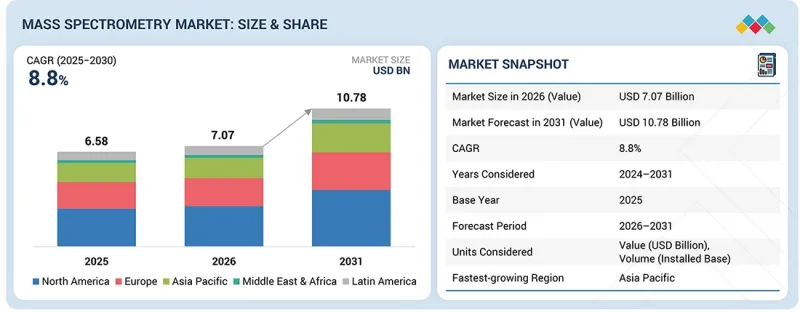
세계의 질량 분석 시장 규모는 2026년 70억 7,400만 달러에서 2031년에는 107억 8,330만 달러에 달할 것으로 예측되며, 2026년부터 2031년까지 CAGR은 8.8%를 기록할 전망입니다.
| 조사 범위 | |
|---|---|
| 조사 대상 기간 | 2026-2031년 |
| 기준 연도 | 2025년 |
| 예측 기간 | 2026-2031년 |
| 단위 | 금액(달러) |
| 부문 | 제품, 인렛 유형, 용도, 최종사용자, 지역 |
| 대상 지역 | 북미, 유럽, 아시아태평양, 라틴아메리카, 중동 및 아프리카 |
세계 질량 분석 시장은 제약, 생명공학, 임상 진단, 식품 안전, 환경 등 각 분야에서 정밀 의료, 생물학적 제제 개발, 멀티오믹스 연구, 규제 주도형 바이오 분석 시험이 급속히 확대되고 있는 것을 배경으로 강력한 성장을 이루고 있습니다. 시장 성장을 가속화하고 있는 최신 동향 중 하나는, 처리량, 재현성 및 운영 효율성을 향상시키기 위해 AI를 활용한 분석, 자동화, 클라우드 연동 실험실 워크플로우, 로봇을 이용한 시료 전처리를 통합한 고분해능 LC-MS/MS 및 하이브리드 질량 분석 플랫폼의 도입이 증가하고 있다는 점입니다.
제약 및 바이오의약품 기업들은 바이오마커 발굴, 항체약물접합체(ADC)의 특성 평가, 세포·유전자 치료제 개발, FDA 기준에 부합하는 약동학 분석을 위해 첨단 질량 분석 시스템에 막대한 투자를 하고 있습니다. 한편, 병원이나 진단 실험실에서는 내분비학, 독물학, 정밀 종양학 검사를 위해 탁상형 임상용 LC-MS/MS 시스템의 도입이 점점 더 확대되고 있습니다. 또한, CRO를 통한 바이오 분석 서비스의 급속한 확대, PFAS 및 환경 오염 물질 검사의 증가, 디지털 통합 및 표준화된 분석 생태계로의 전환에 힘입어 차세대 하이브리드형 및 고처리량형 질량 분석 플랫폼에 대한 전 세계적 수요가 더욱 높아지고 있습니다.
기기 부문이 질량 분석 시장에서 가장 큰 점유율을 차지하고 있습니다.
제품별로는 제약, 생명공학, 임상 연구, 멀티오믹스 분야에서의 첨단 분석 기술에 대한 투자 증가로 인해, 예측 기간 동안 장비 부문이 가장 큰 점유율을 차지할 것으로 전망됩니다. 고성능 질량 분석기에 대한 수요 증가는 바이오의약품, 항체약물접합체(ADC), 세포·유전자 치료, 정밀 의학 관련 노력을 수반하는 의약품 개발 워크플로우의 복잡화에 힘입어 가속화되고 있습니다. 제약 및 바이오의약품 기업들은 바이오 분석의 효율성 향상, 연구 일정 단축, 규제 준수 확보를 위해 감도 향상, 고분해능 분석, 자동화, AI를 활용한 워크플로우 기능을 갖춘 차세대 질량 분석 플랫폼에 대한 투자를 확대하고 있습니다. 또한, 북미나 유럽 등 선진 지역에서는 지속적인 기술 혁신과 연구소, 병원, 임상 시설에서의 고처리량 분석 시스템 도입 확대에 따라 장비 교체 및 업그레이드 주기가 가속화되고 있습니다.
LC-MS 부문이 질량 분석 시장에서 가장 큰 점유율을 차지하고 있습니다.
인렛 유형별로 살펴보면, LC-MS 부문이 예측 기간 동안 제약, 생명공학, 임상 진단, 식품 안전, 환경 시험 등의 분야에서 널리 채택됨에 따라 전 세계 질량 분석 시장을 주도할 것으로 예상됩니다. LC-MS는 고감도 및 고정밀도로 복잡한 생물학적·화학적 화합물을 동정 및 정량하기 위해 가장 널리 사용되는 분석 기법 중 하나입니다. 이 부문은 규제 당국의 승인 증가, 생물학적 제제 및 정밀 의학 연구 확대, 첨단 바이오 분석 시험 워크플로우에 대한 수요 증가에 힘입어 눈부신 성장을 이루고 있습니다. LC-MS 도입을 촉진하는 주요 시장 동향 중 하나는 FDA 및 기타 국제 규제 당국이 ICH M10 생물분석법 검증 지침을 도입한 것입니다. 이 지침에서는 약동학 분석, 바이오마커 정량, 규제 대상 의약품 시험에 있어 LC-MS/MS가 권장되는 기술로 인정되고 있습니다. 이러한 규제 변화로 인해 제약 기업과 위탁 연구 기관(CRO)은 임상 개발, 규제 준수, 고처리량 의약품 분석을 지원하기 위해 차세대 LC-MS/MS 플랫폼에 대한 투자를 확대하도록 장려받고 있습니다.
아시아태평양이 시장에서 가장 높은 성장률을 보일 것으로 전망됩니다.
아시아태평양의 질량 분석 시장은 중국, 인도, 일본, 한국, 동남아시아에서의 바이오의약품 제조, 멀티오믹스 연구, 정밀 의료 프로그램, 대규모 제약 아웃소싱의 확대에 힘입어 급속한 변화를 겪고 있습니다. 최신 동향 중 하나로, CRO, CDMO 및 바이오의약품 제조 시설에서 첨단 바이오의약품의 특성 평가, 불순물 프로파일링, 글리칸 분석, 세포·유전자 치료 워크플로우를 위해 고분해능 하이브리드 LC-MS/MS, Orbitrap, Q-TOF 시스템의 도입이 증가하고 있습니다. 이 지역의 각국 정부는 유전체학, 단백체학, 대사체학, 중개 의학에 관한 사업에 막대한 투자를 하고 있으며, 연구 및 임상 진단 분야 모두에서 AI 지원 및 클라우드 연동형 질량 분석 플랫폼의 도입이 가속화되고 있습니다. 이 지역을 변화시키고 있는 또 다른 주요 동향은, 고처리량 신약 개발 및 규제 준수를 지원하기 위한 로봇을 활용한 시료 전처리, 실험실 정보 시스템(LIS) 통합, 자동화된 생물학적 분석 워크플로우를 통한 분석 실험실의 급속한 디지털화입니다. 또한, 아시아태평양은 전 세계 제약 및 바이오 분석 아웃소싱의 허브로 부상하고 있으며, CRO 및 수탁 시험 기관들 사이에서 첨단 LC-MS 인프라에 대한 꾸준하고 지속적인 수요를 창출하고 있습니다.
본 보고서에서는 전 세계 질량 분석 시장을 조사하여, 시장 개요, 시장 성장에 영향을 미치는 다양한 요인에 대한 분석, 기술 및 특허 동향, 법규제 환경, 사례 연구, 시장 규모 추정 및 전망, 각종 분류·지역/주요 국가별 상세 분석, 경쟁 구도, 주요 기업 개요 등을 정리하고 있습니다.
자주 묻는 질문
목차
제1장 소개
제2장 주요 요약
제3장 주요 인사이트
제4장 시장 개요
제5장 업계 동향
제6장 기술의 진보, AI의 영향, 특허, 혁신
제7장 규제 상황
제8장 고객 상황과 구매 행동
제9장 질량 분석 시장 : 제공별
제10장 질량 분석 시장 : 인렛 유형별
제11장 질량 분석 시장 : 용도별
제12장 질량 분석 시장 : 최종사용자별
제13장 질량 분석 시장 : 지역별
제14장 경쟁 구도
제15장 기업 개요
제16장 조사 방법
제17장 부록
KSM 26.07.29The global mass spectrometry market is projected to reach USD 10,783.3 million by 2031 from USD 7,074.0 million in 2026, at a CAGR of 8.8% from 2026 to 2031.
| Scope of the Report | |
|---|---|
| Years Considered for the Study | 2026-2031 |
| Base Year | 2025 |
| Forecast Period | 2026-2031 |
| Units Considered | Value (USD billion) |
| Segments | Product, Inlet Type, Application, End User, and Region |
| Regions covered | North America, Europe, the Asia Pacific, Latin America, and the Middle East & Africa |
The global mass spectrometry market is experiencing strong growth driven by the rapid expansion of precision medicine, biologics development, multi-omics research, and regulatory-driven bioanalytical testing across pharmaceutical, biotechnology, clinical diagnostics, food safety, and environmental sectors. One of the latest trends accelerating market growth is the increasing adoption of high-resolution LC-MS/MS and hybrid mass spectrometry platforms integrated with AI-enabled analytics, automation, cloud-connected laboratory workflows, and robotic sample preparation to improve throughput, reproducibility, and operational efficiency.
Pharmaceutical and biopharmaceutical companies are heavily investing in advanced mass spectrometry systems for biomarker discovery, antibody-drug conjugate (ADC) characterization, cell and gene therapy development, and FDA-compliant pharmacokinetic analysis, while hospitals and diagnostic laboratories are increasingly deploying benchtop clinical LC-MS/MS systems for endocrinology, toxicology, and precision oncology testing. Additionally, the rapid growth of outsourced bioanalytical services through CROs, increasing PFAS and environmental contaminant testing, and the transition toward digitally integrated and standardized analytical ecosystems are further strengthening global demand for next-generation hybrid and high-throughput mass spectrometry platforms.
The instruments segment accounted for the largest share of the mass spectrometry market.
By product, the mass spectrometry market is segmented into instruments, software, and services. During the forecast period, the instruments segment is projected to hold the largest share of the mass spectrometry market owing to increasing investments in advanced analytical technologies across pharmaceutical, biotechnology, clinical research, and multi-omics applications. The growing demand for high-performance mass spectrometry instruments is being driven by the rising complexity of drug development workflows involving biologics, antibody-drug conjugates (ADCs), cell and gene therapies, and precision medicine initiatives. Pharmaceutical and biopharmaceutical companies are increasingly investing in next-generation mass spectrometry platforms with improved sensitivity, high-resolution analysis, automation, and AI-enabled workflow capabilities to enhance bioanalytical efficiency, accelerate research timelines, and ensure regulatory compliance. Furthermore, developed regions such as North America and Europe are witnessing faster instrument replacement and upgrade cycles due to continuous technological innovation and the increasing adoption of high-throughput analytical systems across research laboratories, hospitals, and clinical institutions.
"The LC-MS segment accounted for the largest share of the mass spectrometry market."
By inlet type, the mass spectrometry market is segmented into GC-MS, LC-MS, ICP-MS, and other inlet types. During the forecast period, the LC-MS segment is expected to dominate the global mass spectrometry market owing to its widespread adoption across pharmaceutical, biotechnology, clinical diagnostics, food safety, and environmental testing applications. LC-MS is one of the most extensively utilized analytical techniques for the identification and quantification of complex biological and chemical compounds with high sensitivity and accuracy. The segment is witnessing significant growth due to increasing regulatory acceptance, expanding biologics and precision medicine research, and rising demand for advanced bioanalytical testing workflows. One of the major market trends driving LC-MS adoption is the implementation of ICH M10 bioanalytical method validation guidelines by the U.S. Food and Drug Administration and other international regulatory agencies, which recognize LC-MS/MS as the preferred technology for pharmacokinetic analysis, biomarker quantification, and regulated drug testing. This regulatory shift is encouraging pharmaceutical companies and contract research organizations to increase investments in next-generation LC-MS/MS platforms to support clinical development, regulatory compliance, and high-throughput drug analysis applications.
"The pharma/biopharma manufacturing application segment accounted for the largest share of the mass spectrometry market."
The pharmaceutical and biopharmaceutical sectors are emerging as major application areas and key news trends in the mass spectrometry market due to the growing demand for advanced analytical technologies in drug discovery, biologics characterization, biomarker identification, and GMP-compliant quality control. Pharmaceutical companies are increasingly adopting LC-MS/MS and high-resolution mass spectrometry systems to support complex biologics, antibody-drug conjugates, peptides, cell and gene therapies, and biosimilar development, where traditional analytical methods are often insufficient. The rising focus on precision medicine, regulatory compliance, impurity profiling, and real-time process monitoring is further accelerating the adoption of advanced mass spectrometry platforms across pharmaceutical R&D and manufacturing operations.
In addition, the rapid expansion of omics research, proteomics, metabolomics, and personalized medicine is driving continuous innovation and product launches in the mass spectrometry industry. Leading companies are introducing automated, high-throughput, and AI-enabled mass spectrometry solutions to support translational research and biopharma workflows. The increasing outsourcing of bioanalytical testing to CROs and CDMOs, along with growing investments in biologics and advanced therapies, is further strengthening the role of mass spectrometry in pharmaceutical and biotechnology applications. These trends are positioning pharma and biopharma as the fastest-growing and highest-revenue-generating application segments within the global mass spectrometry market.
By end-user, the pharmaceutical companies segment is projected to account for the largest market share during the forecast period.
By end user, the mass spectrometry market is segmented into pharmaceutical companies, biotechnology companies, research laboratories & academic institutes, environmental testing laboratories, food & beverage industry, hospital clinical & forensic laboratories, petrochemical industry, and other end users. During the forecast period, the pharmaceutical companies segment is expected to register the fastest growth owing to the increasing adoption of advanced analytical technologies in biologics development, precision therapeutics, and multi-omics-based drug discovery workflows. One of the major trends driving growth in this segment is the rising deployment of advanced hybrid mass spectrometry platforms such as Orbitrap, Q-TOF, Triple Quadrupole Linear Ion Trap, and FT-MS systems for complex biologic characterization, antibody-drug conjugate (ADC) analysis, host-cell protein monitoring, and real-time process analytical technology (PAT) applications. Pharmaceutical and biopharmaceutical manufacturers are increasingly integrating high-resolution hybrid MS systems into manufacturing, quality control, and bioanalytical environments to support continuous bioprocessing, impurity profiling, glycosylation studies, and ultra-trace contaminant detection. This trend is particularly prominent in monoclonal antibody, mRNA, and cell therapy manufacturing facilities, where next-generation therapeutics require highly sensitive and high-resolution analytical capabilities beyond conventional testing technologies.
"Asia Pacific is projected to show the highest growth rate in the mass spectrometry market."
The mass spectrometry market spans five primary regions: North America, Europe, Asia Pacific, Latin America, and the Middle East & Africa. The Asia-Pacific mass spectrometry market is witnessing rapid transformation driven by the expansion of biologics manufacturing, multi-omics research, precision medicine programs, and large-scale pharmaceutical outsourcing across China, India, Japan, South Korea, and Southeast Asia. One of the latest trends is the increasing deployment of high-resolution hybrid LC-MS/MS, Orbitrap, and Q-TOF systems in CROs, CDMOs, and biopharmaceutical manufacturing facilities for advanced biologic characterization, impurity profiling, glycan analysis, and cell & gene therapy workflows. Governments across the region are heavily investing in genomics, proteomics, metabolomics, and translational medicine initiatives, accelerating the adoption of AI-enabled and cloud-connected mass spectrometry platforms in both research and clinical diagnostics environments. Another major trend reshaping the region is the rapid digitalization of analytical laboratories through robotic sample preparation, laboratory information system (LIS) integration, and automated bioanalytical workflows to support high-throughput drug development and regulatory compliance. Additionally, APAC is emerging as a global pharmaceutical and bioanalytical outsourcing hub, creating strong recurring demand for advanced LC-MS infrastructure among CROs and contract testing laboratories.
A breakdown of the primary participants referred to for this report is provided below:
- By Company Type: Tier 1 (35%), Tier 2 (45%), and Tier 3 (20%)
- By Designation: C-level Executives (35%), Directors (25%), and Others (40%)
- By Region: North America (40%), Europe (30%), Asia Pacific (20%), Latin America (5%), and Middle East & Africa (5%)
The major players in the mass spectrometry market include Thermo Fisher Scientific (US), Agilent Technologies (US), Sciex (US), Waters Corporation (US), Bruker (US), Shimadzu Corporation (Japan), and PerkinElmer Inc. (US), among others.
Research Coverage
The research report examines the mass spectrometry market by product, inlet type, application, end users, and region. This research covers factors that are driving market expansion, analyzes prospects and parameters faced by industries in the present time, and provides specifics on the competitive landscape, considering market leaders and small and medium enterprises. This research also estimates the revenue of different market segments by considering five regions and micro-market analysis.
Reasons to Buy the Report
The report will provide market leaders and new entrants with valuable information regarding the revenue estimates for the overall mass spectrometry market and its subsegments. It will help stakeholders understand the competitive landscape, allowing them to position their businesses more effectively and develop appropriate go-to-market strategies. Additionally, the report offers insights into the market dynamics, including key drivers, restraints, challenges, and opportunities.
This report provides insightful data on the following pointers:
- Market Penetration: In-depth coverage of product portfolios offered by the top players in the mass spectrometry market
- Product Development/Innovation: In-depth coverage of product portfolios offered by the top players in the mass spectrometry market
- Market Development: Insightful data on profitable developing areas
- Market Diversification: Details about recent developments and advancements in the mass spectrometry market
- Competitive Assessment: Extensive assessment of the products, growth tactics, revenue projections, and market categories of the top competitors
TABLE OF CONTENTS
1 INTRODUCTION
- 1.1 STUDY OBJECTIVES
- 1.2 MARKET DEFINITION
- 1.3 MARKET SCOPE
- 1.3.1 MARKET SEGMENTATION AND REGIONAL SCOPE
- 1.3.2 INCLUSIONS AND EXCLUSIONS
- 1.3.3 YEARS CONSIDERED
- 1.4 CURRENCY CONSIDERED
- 1.5 STAKEHOLDERS
- 1.6 SUMMARY OF CHANGES
2 EXECUTIVE SUMMARY
- 2.1 MARKET HIGHLIGHTS AND KEY INSIGHTS
- 2.2 KEY MARKET PARTICIPANTS: MAPPING OF STRATEGIC DEVELOPMENTS
- 2.3 DISRUPTIVE TRENDS IN MASS SPECTROMETRY MARKET
- 2.4 HIGH-GROWTH SEGMENTS
- 2.5 REGIONAL SNAPSHOT: MARKET SIZE, GROWTH RATE, AND FORECAST
3 PREMIUM INSIGHTS
- 3.1 ATTRACTIVE OPPORTUNITIES FOR PLAYERS IN MASS SPECTROMETRY MARKET
- 3.2 ASIA PACIFIC: MASS SPECTROMETRY MARKET, BY INLET TYPE AND COUNTRY
- 3.3 MASS SPECTROMETRY MARKET: GEOGRAPHIC GROWTH OPPORTUNITIES
4 MARKET OVERVIEW
- 4.1 INTRODUCTION
- 4.2 MARKET DYNAMICS
- 4.2.1 DRIVERS
- 4.2.1.1 Precision medicine & biomarker-driven healthcare system to drive adoption
- 4.2.1.2 Adoption of send-out tests to control turnaround and cost
- 4.2.1.3 Increased privatization of environmental services and regulatory framework
- 4.2.1.4 Increasing investments in pharmaceutical research & development
- 4.2.2 RESTRAINTS
- 4.2.2.1 Capital-intensive investments for high-end equipment
- 4.2.2.2 Time-consuming sample preparation steps
- 4.2.3 OPPORTUNITIES
- 4.2.3.1 Growing application of mass spectrometry in clinical and forensic settings
- 4.2.3.2 Expansion of microbiome and infection diagnostics
- 4.2.3.3 Development of novel mass sensors and nanopore ion sources
- 4.2.4 CHALLENGES
- 4.2.4.1 Software interoperability and data management fragmentation
- 4.2.4.2 Inadequate infrastructure and shortage of skilled professionals
- 4.2.1 DRIVERS
- 4.3 TRENDS/DISRUPTIONS IMPACTING CUSTOMER BUSINESS
- 4.4 UNMET NEEDS
- 4.5 INTERCONNECTED MARKETS AND CROSS-SECTOR OPPORTUNITIES
- 4.6 STRATEGIC MOVES BY TIER-1/2/3 PLAYERS
5 INDUSTRY TRENDS
- 5.1 PORTER'S FIVE FORCES ANALYSIS
- 5.1.1 BARGAINING POWER OF SUPPLIERS
- 5.1.2 BARGAINING POWER OF BUYERS
- 5.1.3 THREAT OF NEW ENTRANTS
- 5.1.4 THREAT OF SUBSTITUTES
- 5.1.5 INTENSITY OF COMPETITIVE RIVALRY
- 5.2 MACROECONOMIC OUTLOOK
- 5.2.1 INTRODUCTION
- 5.2.2 GDP TRENDS AND FORECAST
- 5.2.3 TRENDS IN MASS SPECTROMETRY INDUSTRY
- 5.3 VALUE CHAIN ANALYSIS
- 5.3.1 R&D
- 5.3.2 RAW MATERIAL PROCUREMENT
- 5.3.3 MANUFACTURING
- 5.3.4 DISTRIBUTION, MARKETING & SALES, AND POST-SALES SERVICES
- 5.4 ECOSYSTEM ANALYSIS
- 5.5 PRICING ANALYSIS
- 5.5.1 AVERAGE SELLING PRICE TREND, BY PRODUCT
- 5.5.2 AVERAGE SELLING PRICE TREND, BY REGION
- 5.6 TRADE ANALYSIS
- 5.6.1 IMPORT SCENARIO (HS CODE 902781)
- 5.6.2 EXPORT SCENARIO (HS CODE 902781)
- 5.7 KEY CONFERENCES AND EVENTS, 2026-2027
- 5.8 TRENDS/DISRUPTIONS IMPACTING CUSTOMER BUSINESS
- 5.9 INVESTMENT AND FUNDING SCENARIO
- 5.10 CASE STUDY ANALYSIS
- 5.11 IMPACT OF 2025 US TARIFF - MASS SPECTROMETRY MARKET
- 5.11.1 INTRODUCTION
- 5.11.2 KEY TARIFF RATES
- 5.11.3 PRICE IMPACT ANALYSIS
- 5.11.4 IMPACT ON COUNTRIES/REGIONS
- 5.11.4.1 US
- 5.11.4.2 Europe
- 5.11.4.3 Asia Pacific
- 5.11.5 IMPACT ON END-USE INDUSTRIES
6 TECHNOLOGICAL ADVANCEMENTS, AI-DRIVEN IMPACT, PATENTS, AND INNOVATIONS
- 6.1 TECHNOLOGICAL ANALYSIS
- 6.1.1 KEY TECHNOLOGIES
- 6.1.1.1 Miniaturized ion trap and quadrupole mass analyzer
- 6.1.1.2 Quadrupole mass analyzer
- 6.1.1.3 Time-of-flight mass analyzer
- 6.1.1.4 Ion trap mass analyzer
- 6.1.2 COMPLEMENTARY TECHNOLOGIES
- 6.1.2.1 LC-MS
- 6.1.2.2 IOT sensor integration and environmental monitoring networks
- 6.1.3 ADJACENT TECHNOLOGIES
- 6.1.3.1 Mass spectrometry imaging
- 6.1.3.2 Ion mobility spectrometry
- 6.1.1 KEY TECHNOLOGIES
- 6.2 PATENT ANALYSIS
- 6.3 IMPACT OF AI ON MASS SPECTROMETRY MARKET
- 6.3.1 TOP USE CASES AND MARKET POTENTIAL
- 6.3.2 KEY COMPANIES IMPLEMENTING AI
- 6.3.3 BEST PRACTICES IN MASS SPECTROMETRY MARKET
- 6.3.4 INTERCONNECTED ECOSYSTEM AND IMPACT ON MARKET PLAYERS
- 6.3.5 CLIENTS' READINESS TO ADOPT AI IN MASS SPECTROMETRY
- 6.4 SUCCESS STORIES AND REAL-WORLD APPLICATIONS
7 REGULATORY LANDSCAPE
- 7.1 REGIONAL REGULATIONS AND COMPLIANCE
- 7.1.1 REGULATORY BODIES, GOVERNMENT AGENCIES, AND OTHER ORGANIZATIONS
- 7.1.2 REGULATORY SCENARIO
- 7.1.2.1 North America
- 7.1.2.2 Europe
- 7.1.2.3 Asia Pacific
- 7.1.2.4 Rest of the World
8 CUSTOMER LANDSCAPE AND BUYER BEHAVIOR
- 8.1 DECISION-MAKING PROCESS
- 8.2 KEY STAKEHOLDERS AND BUYING CRITERIA
- 8.2.1 KEY STAKEHOLDERS IN BUYING PROCESS
- 8.2.2 KEY BUYING CRITERIA
- 8.3 UNMET NEEDS OF END USERS
- 8.4 MARKET PROFITABILITY
9 MASS SPECTROMETRY MARKET, BY OFFERING
- 9.1 INTRODUCTION
- 9.2 INSTRUMENTS
- 9.2.1 HYBRID MASS SPECTROMETRY INSTRUMENTS
- 9.2.1.1 Triple quadrupole MS
- 9.2.1.1.1 Enhanced selectivity, better accuracy, and greater reproducibility to drive adoption
- 9.2.1.2 Quadrupole-time of flight (Q-TOF) MS
- 9.2.1.2.1 Latest advances in Q-TOF mass spectrometry technology to streamline workflow, making it more efficient
- 9.2.1.3 Fourier transform MS
- 9.2.1.3.1 High-resolution biomolecule analysis to drive adoption
- 9.2.1.1 Triple quadrupole MS
- 9.2.2 SINGLE MASS SPECTROMETRY INSTRUMENTS
- 9.2.2.1 Quadrupole MS
- 9.2.2.1.1 Wide application base in industry and academia to boost market growth
- 9.2.2.2 Time-of-flight MS
- 9.2.2.2.1 More precise results in proteomics and conventional analytical studies to favor adoption
- 9.2.2.3 Ion trap MS
- 9.2.2.3.1 More accurate results on higher mass-to-charge ratio extensions to favor adoption in specialized studies
- 9.2.2.1 Quadrupole MS
- 9.2.3 OTHER MASS SPECTROMETRY INSTRUMENTS
- 9.2.1 HYBRID MASS SPECTROMETRY INSTRUMENTS
- 9.3 SOFTWARE & SERVICES
- 9.3.1 NEED FOR EFFICIENT DATA MANAGEMENT AND PROCESSING TO PROPEL MARKET
10 MASS SPECTROMETRY MARKET, BY INLET TYPE
- 10.1 INTRODUCTION
- 10.2 LC-MS
- 10.2.1 REGULATORY SHIFTS WILL DRIVE ADOPTION OF LC-MS IN ENVIRONMENTAL TESTING
- 10.3 GC-MS
- 10.3.1 STANDARDIZED METHODS AND REGULATORY REFORMS FOR VOLATILE ORGANIC MOLECULES TO INCREASE ADOPTION OF GC-MS
- 10.4 ICP-MS
- 10.4.1 SIMPLE SAMPLE PREPARATION AND HIGH THROUGHPUT TO DRIVE GROWTH
- 10.5 OTHER INLET TYPES
11 MASS SPECTROMETRY MARKET, BY APPLICATION
- 11.1 INTRODUCTION
- 11.2 OMICS RESEARCH
- 11.2.1 RECENT ADVANCEMENTS IN BIOLOGICAL RESEARCH, PARTICULARLY IN PROTEOMICS AND GENOMICS, TO DRIVE MARKET
- 11.3 DRUG DISCOVERY
- 11.3.1 NEED FOR HIGHER EFFICACY AND PRODUCT QUALITY TO SUPPORT GROWTH
- 11.4 ENVIRONMENTAL TESTING
- 11.4.1 INCREASING NEED FOR MONITORING WATER CONTAMINATION TO PROPEL MARKET
- 11.5 FOOD TESTING
- 11.5.1 INCREASING IMPORTANCE OF SAFETY STANDARDS TO AMPLIFY GROWTH
- 11.6 PHARMA/BIOPHARMA MANUFACTURING
- 11.6.1 RISING USE OF MASS SPECTROMETRY IN PESTICIDE RESIDUE ANALYSIS, PROTEIN IDENTIFICATION, AND CARBON DATING TO AID GROWTH
- 11.7 CLINICAL DIAGNOSTICS
- 11.7.1 GROWING USE OF MASS SPECTROMETRY IN DRUG MONITORING, TOXICOLOGY, AND ENDOCRINOLOGY TO DRIVE MARKET
- 11.8 APPLIED SCIENCES
- 11.8.1 NEED FOR QUALITY CONTROL IN SEMICONDUCTOR INDUSTRY TO SUPPORT GROWTH
- 11.9 OTHER APPLICATIONS
12 MASS SPECTROMETRY MARKET, BY END USER
- 12.1 INTRODUCTION
- 12.2 PHARMACEUTICAL COMPANIES
- 12.2.1 GROWTH IN PHARMACEUTICAL SECTOR WILL FUEL DEMAND FOR MASS SPECTROMETRY
- 12.3 BIOTECHNOLOGY COMPANIES
- 12.3.1 GROWING BIOPHARMACEUTICAL APPLICATIONS TO DRIVE MARKET
- 12.4 RESEARCH LABS & ACADEMIC INSTITUTES
- 12.4.1 BREAKTHROUGH DEVELOPMENTS AND INDUSTRY-ACADEMIA PARTNERSHIPS TO PROPEL MARKET
- 12.5 ENVIRONMENTAL TESTING LABS
- 12.5.1 NEW AMENDMENTS IN ENVIRONMENTAL LAWS AND PRIVATIZATION OF TESTING SERVICES TO DRIVE MARKET
- 12.6 FOOD & BEVERAGE INDUSTRY
- 12.6.1 GROWING FOOD SAFETY CONCERNS TO SUPPORT MARKET GROWTH
- 12.7 FORENSIC LABS
- 12.7.1 ADVANCEMENTS IN TECHNOLOGY AND STRICT LAWS TO CREATE OPPORTUNITIES FOR MASS SPECTROMETRY
- 12.8 PETROCHEMICAL INDUSTRY
- 12.8.1 GROWING NUMBER OF NEW OIL & GAS FIELDS TO PROPEL MARKET
- 12.9 OTHER END USERS
13 MASS SPECTROMETRY MARKET, BY REGION
- 13.1 INTRODUCTION
- 13.2 NORTH AMERICA
- 13.2.1 US
- 13.2.1.1 Increased government investments and research funding to drive market
- 13.2.2 CANADA
- 13.2.2.1 Growing focus on clean energy technology to propel market
- 13.2.1 US
- 13.3 EUROPE
- 13.3.1 GERMANY
- 13.3.1.1 Growing pharmaceutical industry to drive market
- 13.3.2 UK
- 13.3.2.1 Industry academia partnerships to drive market
- 13.3.3 FRANCE
- 13.3.3.1 Strong environmental policies and public-funded research programs to drive demand
- 13.3.4 ITALY
- 13.3.4.1 Growing utilization of mass spectrometry among pharmaceutical and biotechnology end-use industries to drive market
- 13.3.5 SPAIN
- 13.3.5.1 Strong environmental monitoring framework to drive market
- 13.3.6 REST OF EUROPE
- 13.3.1 GERMANY
- 13.4 ASIA PACIFIC
- 13.4.1 JAPAN
- 13.4.1.1 Strong research infrastructure to drive demand for advanced MS models
- 13.4.2 CHINA
- 13.4.2.1 Increasing investments in scientific R&D to advance growth
- 13.4.3 INDIA
- 13.4.3.1 Increased government investments to drive market
- 13.4.4 SOUTH KOREA
- 13.4.4.1 Large industrial application base to drive demand for mass spectrometry
- 13.4.5 AUSTRALIA
- 13.4.5.1 Increasing focus on early cancer diagnosis and development of RNA therapies to aid growth
- 13.4.6 REST OF ASIA PACIFIC
- 13.4.1 JAPAN
- 13.5 LATIN AMERICA
- 13.5.1 BRAZIL
- 13.5.1.1 Increased local agricultural manufacturing to drive market growth
- 13.5.2 MEXICO
- 13.5.2.1 Growth in local manufacturing for pharmaceuticals to drive market
- 13.5.3 REST OF LATIN AMERICA
- 13.5.1 BRAZIL
- 13.6 MIDDLE EAST & AFRICA
- 13.6.1 GCC COUNTRIES
- 13.6.1.1 Favorable government initiatives to support market growth
- 13.6.2 REST OF MIDDLE EAST & AFRICA
- 13.6.1 GCC COUNTRIES
14 COMPETITIVE LANDSCAPE
- 14.1 OVERVIEW
- 14.2 KEY PLAYER STRATEGIES/RIGHT TO WIN
- 14.2.1 OVERVIEW OF STRATEGIES ADOPTED BY PLAYERS IN MASS SPECTROMETRY MARKET, JANUARY 2022-JUNE 2026
- 14.3 REVENUE ANALYSIS, 2021-2025
- 14.4 MARKET SHARE ANALYSIS, 2025
- 14.5 COMPANY EVALUATION MATRIX: KEY PLAYERS, 2025
- 14.5.1 STARS
- 14.5.2 EMERGING LEADERS
- 14.5.3 PERVASIVE PLAYERS
- 14.5.4 PARTICIPANTS
- 14.5.5 COMPANY FOOTPRINT: KEY PLAYERS, 2025
- 14.5.5.1 Company footprint
- 14.5.5.2 Offering footprint
- 14.5.5.3 Application footprint
- 14.5.5.4 End-user footprint
- 14.5.5.5 Region footprint
- 14.6 COMPANY EVALUATION MATRIX: STARTUPS/SMES, 2025
- 14.6.1 PROGRESSIVE COMPANIES
- 14.6.2 RESPONSIVE COMPANIES
- 14.6.3 DYNAMIC COMPANIES
- 14.6.4 STARTING BLOCKS
- 14.6.5 COMPETITIVE BENCHMARKING: STARTUPS/SMES, 2025
- 14.6.5.1 Detailed list of key startups/SMEs, 2025
- 14.6.5.2 Competitive benchmarking of key startups/SMEs
- 14.7 COMPANY VALUATION & FINANCIAL METRICS
- 14.7.1 FINANCIAL METRICS
- 14.7.2 COMPANY VALUATION
- 14.8 BRAND COMPARISON
- 14.9 COMPETITIVE SCENARIO
- 14.9.1 PRODUCT LAUNCHES
- 14.9.2 DEALS
- 14.9.3 EXPANSIONS
15 COMPANY PROFILES
- 15.1 KEY PLAYERS
- 15.1.1 AGILENT TECHNOLOGIES, INC.
- 15.1.1.1 Business overview
- 15.1.1.2 Products offered
- 15.1.1.3 Recent developments
- 15.1.1.3.1 Product launches & approvals
- 15.1.1.3.2 Deals
- 15.1.1.3.3 Expansions
- 15.1.1.4 MnM view
- 15.1.1.4.1 Right to win
- 15.1.1.4.2 Strategic choices
- 15.1.1.4.3 Weaknesses & competitive threats
- 15.1.2 THERMO FISHER SCIENTIFIC INC.
- 15.1.2.1 Business overview
- 15.1.2.2 Products offered
- 15.1.2.3 Recent developments
- 15.1.2.3.1 Product launches
- 15.1.2.3.2 Deals
- 15.1.2.3.3 Expansions
- 15.1.2.4 MnM view
- 15.1.2.4.1 Right to win
- 15.1.2.4.2 Strategic choices
- 15.1.2.4.3 Weaknesses & competitive threats
- 15.1.3 WATERS CORPORATION
- 15.1.3.1 Business overview
- 15.1.3.2 Products Offered
- 15.1.3.3 Recent developments
- 15.1.3.3.1 Product launches
- 15.1.3.3.2 Deals
- 15.1.3.3.3 Expansions
- 15.1.3.4 MnM view
- 15.1.3.4.1 Right to win
- 15.1.3.4.2 Strategic choices
- 15.1.3.4.3 Weaknesses & competitive threats
- 15.1.4 DANAHER CORPORATION
- 15.1.4.1 Business overview
- 15.1.4.2 Products offered
- 15.1.4.3 Recent developments
- 15.1.4.3.1 Product launches
- 15.1.4.3.2 Deals
- 15.1.4.3.3 Expansions
- 15.1.4.4 MnM view
- 15.1.4.4.1 Right to win
- 15.1.4.4.2 Strategic choices
- 15.1.4.4.3 Weaknesses & competitive threats
- 15.1.5 BRUKER CORPORATION
- 15.1.5.1 Business overview
- 15.1.5.2 Products offered
- 15.1.5.3 Recent developments
- 15.1.5.3.1 Product launches & approvals
- 15.1.5.3.2 Deals
- 15.1.5.3.3 Expansions
- 15.1.5.3.4 Other developments
- 15.1.5.4 MnM view
- 15.1.5.4.1 Right to win
- 15.1.5.4.2 Strategic choices
- 15.1.5.4.3 Weaknesses & competitive threats
- 15.1.6 SHIMADZU CORPORATION
- 15.1.6.1 Business overview
- 15.1.6.2 Products offered
- 15.1.6.3 Recent developments
- 15.1.6.3.1 Product launches
- 15.1.6.3.2 Deals
- 15.1.6.3.3 Expansions
- 15.1.7 MKS INC.
- 15.1.7.1 Business overview
- 15.1.7.2 Products offered
- 15.1.8 PERKINELMER, INC.
- 15.1.8.1 Business overview
- 15.1.8.2 Products offered
- 15.1.8.3 Recent developments
- 15.1.8.3.1 Product launches
- 15.1.8.3.2 Deals
- 15.1.9 JEOL LTD
- 15.1.9.1 Business overview
- 15.1.9.2 Products offered
- 15.1.10 HITACHI HIGH-TECH CORPORATION
- 15.1.10.1 Business overview
- 15.1.10.2 Products offered
- 15.1.10.3 Recent developments
- 15.1.10.3.1 Other developments
- 15.1.11 TELEDYNE TECHNOLOGIES INCORPORATED
- 15.1.11.1 Business overview
- 15.1.11.2 Products offered
- 15.1.11.3 Recent developments
- 15.1.11.3.1 Product launches
- 15.1.11.3.2 Deals
- 15.1.12 AMETEK, INC.
- 15.1.12.1 Business overview
- 15.1.12.2 Products offered
- 15.1.12.3 Recent developments
- 15.1.12.3.1 Deals
- 15.1.13 JASCO
- 15.1.13.1 Business overview
- 15.1.13.2 Products offered
- 15.1.14 F. HOFFMANN-LA ROCHE LTD.
- 15.1.14.1 Business overview
- 15.1.14.2 Products offered
- 15.1.14.3 Recent developments
- 15.1.14.3.1 Product launches
- 15.1.14.3.2 Expansions
- 15.1.1 AGILENT TECHNOLOGIES, INC.
- 15.2 OTHER PLAYERS
- 15.2.1 ANALYTIK JENA GMBH
- 15.2.2 HIDEN ANALYTICAL
- 15.2.3 LECO CORPORATION
- 15.2.4 RIGAKU HOLDINGS CORPORATION
- 15.2.5 YOUNGIN CHROMASS
- 15.2.6 SCION INSTRUMENTS
- 15.2.7 KORE TECHNOLOGY
- 15.2.8 PROCESS INSIGHTS, INC.
- 15.2.9 MASSTECH
- 15.2.10 ADVION, INC.
- 15.2.11 SPACETEK TECHNOLOGY AG
- 15.2.12 ELEMENTAR ANALYSENSYSTEME GMBH
- 15.2.13 SKYRAY INSTRUMENTS USA, INC.
- 15.2.14 MICROSAIC SYSTEMS PLC
- 15.2.15 PFEIFFER VACUUM GMBH
16 RESEARCH METHODOLOGY
- 16.1 RESEARCH DATA
- 16.1.1 SECONDARY RESEARCH
- 16.1.1.1 Key secondary sources
- 16.1.1.2 Key data from secondary sources
- 16.1.2 PRIMARY RESEARCH
- 16.1.2.1 Key primary sources
- 16.1.2.2 Key supply- and demand-side participants
- 16.1.2.3 Breakdown of primary interviews
- 16.1.2.4 Key primary insights
- 16.1.1 SECONDARY RESEARCH
- 16.2 MARKET SIZE ESTIMATION METHODOLOGY
- 16.2.1 REVENUE MAPPING-BASED MARKET ESTIMATION
- 16.2.2 END-USER-BASED MAPPING MARKET ESTIMATION
16.3 GROWTH FORECASTING MODEL
- 16.4 DATA TRIANGULATION AND MARKET BREAKDOWN
- 16.5 RESEARCH ASSUMPTIONS
- 16.6 RESEARCH LIMITATIONS
- 16.7 RISK ANALYSIS
17 APPENDIX
- 17.1 DISCUSSION GUIDE
- 17.2 KNOWLEDGESTORE: MARKETSANDMARKETS' SUBSCRIPTION PORTAL
- 17.3 CUSTOMIZATION OPTIONS
- 17.4 RELATED REPORTS
- 17.5 AUTHOR DETAILS