

|
시장보고서
상품코드
2120704
질량분석 : 시장 점유율 분석, 업계 동향과 통계, 성장 예측(2026-2031년)Mass Spectrometry - Market Share Analysis, Industry Trends & Statistics, Growth Forecasts (2026 - 2031) |
||||||
 Mordor Intelligence
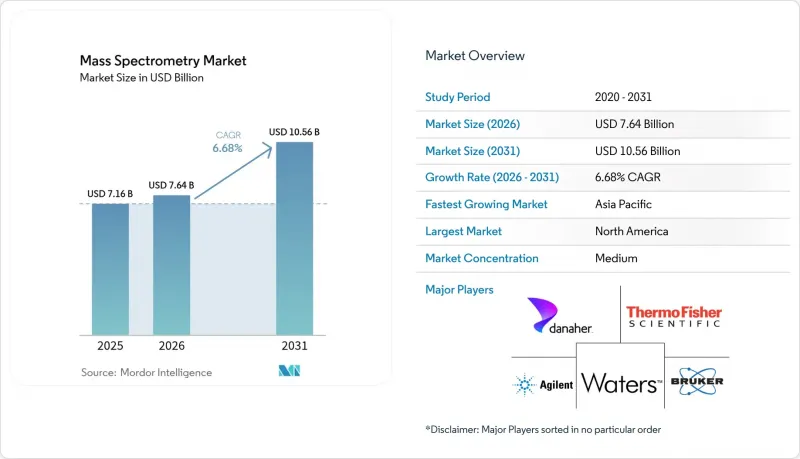
Mordor Intelligence에 의하면, 질량분석 시장 규모는 2025년 71억 6,000만 달러, 2026년 76억 4,000만 달러에서 2031년까지 105억 6,000만 달러에 이르고, 2026-2031년 연평균 복합 성장률(CAGR)은 6.68%를 기록할 전망입니다.
본 보고서는 기술별(하이브리드, 싱글 등), 구성 요소별(장비 등), 용도별(제약·바이오기술 등), 지역별(북미, 유럽, 아시아태평양, 중동 및 아프리카, 남미)로 분류되어 있습니다. 시장 예측은 금액(달러) 기준으로 제시되어 있습니다.
세계 질량 분석 시장 동향 및 인사이트
바이오의약품 파이프라인의 복잡성 확대
항체-약물 복합체(ADC), 이중 특이성 항체 및 세포 치료제는 FDA의 유효한 IND 신청 건수의 40% 이상을 차지하고 있으며, 각 분류에서 무손상 질량 검증, 링커의 안정성 및 글리코폼 매핑을 위해 직교 질량 분석법이 요구되고 있습니다. NIH는 2025 회계연도에 구조 생물학 및 단백질체학 예산을 21억 달러로 증액하고, 단일 아미노산 수준의 분해능으로 번역 후 변형을 분석하기 위한 Orbitrap 및 Q-TOF 시스템에 자금을 배정했습니다. 인도 및 중국의 수탁 제조 기업들은 기존의 크로마토그래피를 통한 유지 시간 확인보다 질량 기반 동정 시험을 우선시하는 유럽 및 미국의 신청 요건을 충족하기 위해 하이브리드형 사중극자·비행시간형 플랫폼을 도입하고 있습니다. Thermo Fisher는 2025년에 아시아태평양의 바이오의약품 고객을 대상으로 한 Orbitrap 출하 대수가 22% 증가했다고 기록했으며, 이 지역에서 고분해능 분석으로의 전환이 두드러지고 있습니다. 이러한 변화에 따라, 사용자들이 95%의 가동률을 보장받기 위해 다년 유지보수 계약을 체결함에 따라 서비스 수익이 확대되고 있습니다.
엄격한 세계 식품 안전 규제
유럽연합(EU)은 2025년에 최대 잔류 기준치(MRL) 데이터베이스를 1,100개의 농약·작물 쌍으로 확대하고, 식품 검사 기관에 대해 인증된 표준 물질을 사용하여 각 쌍의 타당성을 검증할 것을 의무화했습니다. 트리플 쿼드러폴러 LC-MS/MS가 주류를 이루고 있는 이유는 지방을 포함하는 매트릭스 내에서 클로르피리포스나 클로르피리포스메틸과 같은 동중체 농약을 식별할 수 있기 때문입니다. 일본은 2024년에 유사한 다중 잔류 규제를 도입했으며, 그 결과 12개월 이내에 LC-MS/MS 입찰 건수가 30% 급증했습니다. 이에 이어 브라질에서는 2025년 9월부터 EU로 수출되는 모든 옥수수에 대해 아플라톡신의 동위원소 희석법을 이용한 검사가 의무화됩니다. 이러한 규제로 인해 장비의 잔여 수명과 관계없이 교체 주기가 발생하여, 2020년 이후에 구입한 시스템이라도 업그레이드가 불가피하게 되었습니다.
높은 설비 투자 및 운영 비용
오토샘플러와 규정 준수 대응 소프트웨어를 완비한 LC-MS/MS 플랫폼의 가격은 약 40만 달러에 달하며, 사용자는 서비스 및 소모품 비용으로 연간 6만 달러를 추가로 예산에 계상해야 합니다. 2024년에 도입된 리스 프로그램을 통해 초기 비용은 40% 절감되지만, 리스 계약자는 여전히 유지보수 비용을 부담해야 하며, 이는 5년간의 총 소유 비용의 70%를 차지합니다. 푸리에 변환식 장치는 지속적으로 15kW의 전력을 소비하며, 산업용 전기 요금으로 연간 1만 8,000달러의 전기 요금이 발생합니다. 이는 전력 공급이 불안정한 지역이나 전기 요금이 높은 지역에 위치한 연구소에게는 과제가 됩니다. EU 및 일본의 규제 당국은 소유자가 변경될 경우 완전한 재검증을 의무화하고 있으며, 이로 인해 재생 제품의 매력이 떨어지고 있습니다.
부문 분석
MALDI-TOF 플랫폼은 병원 미생물 검사실에서 세균 및 곰팡이의 당일 식별을 위해 이 기술을 채택함에 따라 2031년까지 연평균 8.54%의 성장률을 보일 것으로 예상되며, 이는 전체 시장 성장률인 6.68%를 상회할 전망입니다. 2024년 혈액 배양에서 직접 분석 워크플로우에 대해 FDA 승인을 획득한 브루커(Bruker)사의 ‘MALDI Biotyper’는 결과 도출 시간을 48시간에서 30분 미만으로 단축하여, 패혈증 1건당 3,500달러의 비용 절감을 실현합니다. 2025년 매출의 46.65%를 차지할 하이브리드형 트리플 쿼드러폴 LC-MS/MS 시스템은 타의 추종을 불허하는 표적 정량 능력을 바탕으로 제약 업계의 품질 관리(QC) 및 다중 잔류 농약 검사 분야에서 압도적인 점유율을 차지하고 있습니다. 사중극자·비행시간형 분석 장비는 데이터 비의존형 수집(DIA) 분야에서 단백질체학 분야의 입지를 강화하고 있지만, Orbitrap 및 FT-ICR은 매출 점유율이 12%로 다소 낮음에도 불구하고 높은 분해능이 요구되는 작업에서 골드 스탠다드로서의 지위를 유지하고 있습니다. 한때 교육용 실험실의 주력 장비였던 단일 분석 장치는 하이브리드형 장치의 가격대가 낮아짐에 따라 그 위상을 서서히 잃어가고 있습니다. 1 ppb 미만의 금속 오염 물질을 검출해야 하는 반도체 제조 공장에서는 ICP-MS에 대한 수요가 가속화되고 있습니다.
보다 광범위한 기술 도입 추세가 질량 분석 시장을 재편하고 있습니다. 각 벤더사는 현재 하드웨어를 교체하지 않고도 측정 모드를 추가할 수 있는 펌웨어를 통한 업그레이드가 가능한 플랫폼을 판매하고 있으며, 이를 통해 장비의 수명을 연장하고 전자 폐기물을 줄이고 있습니다. 기술 세분화별 질량 분석 시장에서는 복잡한 매트릭스 내의 동중체 물질을 분리하기 위해 이온 이동도를 내장한 시스템으로의 전환이 진행되고 있습니다. 하이브리드 플랫폼은 2025년 질량 분석 시장 점유율의 46.65%를 차지하고 있으며, 이는 구매자들이 단일 용도 설계보다 유연성을 더 중요하게 여기고 있음을 반영합니다. 규제 기준이 엄격해지는 가운데, 고분해능·고정밀도 질량 분석 플랫폼의 매출은 Orbitrap 및 Q-TOF를 주축으로 연평균 성장률(CAGR) 8.1%로 확대되어 2031년까지 49억 달러에 달할 것으로 예측됩니다. 한편, 10만 미달러 미만의 가격대의 휴대용 시스템은 보안 검사 및 현장 환경 시험 분야에서 지지를 얻고 있으며, 기존 탁상형 장비에 대한 2차 업그레이드의 길을 열어주고 있습니다.
지역별 분석
북미는 2025년 매출의 42.65%를 차지할 것으로 예상되며, 이는 제약 분야의 집중적인 연구 개발, MS법 검증을 위한 FDA의 엄격한 지침, 그리고 환경 시험에 대한 조기 도입이 원동력이 되고 있습니다. EPA의 PFAS 규제만으로도 2025년부터 2027년에 걸쳐 주 및 지방 자치 단체 연구소를 대상으로 한 장비 판매를 4억 달러까지 끌어올릴 것으로 예측됩니다. 캐나다는 UBC(브리티시컬럼비아 대학교)의 고처리량 단백질체학에 9,000만 캐나다 달러(6,600만 달러)를 투자하여, 이 대학을 멀티오믹스의 거점으로 자리매김했습니다. 멕시코에서는 바이오의약품의 수탁 제조가 확대되어 2024년부터 2025년에 걸쳐 12개의 시설이 신설되었으며, 각 시설은 여러 대의 LC-MS/MS 시스템을 발주했습니다.
아시아태평양은 2031년까지 연평균 성장률(CAGR)이 7.54%로 가장 빠르게 성장하는 지역입니다. 중국 규제 당국은 2025년에 22개의 바이오시밀러를 승인했으며, 각각에 대해 질량 분석법을 통한 동등성 평가 자료가 요구됨에 따라 플랫폼에 대한 수요가 확대되었습니다. 인도의 API(원료의약품) 수출액은 2025 회계연도에 280억 달러에 달하여 전년 대비 19% 증가했습니다. 불순물 프로파일링에서는 ICP-MS 및 LC-MS/MS가 중심적인 역할을 하고 있습니다. 일본에서는 2025년 4월, MS를 이용한 비타민 D 검사의 보험 적용 범위가 확대되어 연간 200만 건의 검사가 추가되었습니다. 한편, 한국의 반도체 팹에서는 3nm 이하 노드에서 초순수 관리를 위해 ICP-MS가 도입되었습니다.
2025년도 매출액 중 유럽이 28%를 차지했습니다. ‘그린 딜’의 배출량 55% 감축 목표를 계기로, 고분해능 MS를 이용한 VOC 및 PM의 성분 모니터링이 촉진되고 있습니다. 영국에서는 2024년에 신생아 선별검사의 대상 질환을 35종으로 확대함에 따라, 14개 지역 검사 기관이 탠덤 MS 플랫폼으로 업그레이드했습니다. 중동 및 아프리카은 6%의 점유율을 차지하고 있으며, GCC 국가들이 식품 안전 검사 시설을 확충함에 따라 6.9%의 성장세를 보이고 있습니다. 한편, 남미 지역의 6.2% 성장은 브라질의 환경 규제와 아르헨티나의 의약품 수출에 힘입고 있으나, 환율 변동이 설비 투자를 억제하고 있습니다.
기타 혜택:
- 엑셀 형식 시장 예측(ME) 시트
- 3개월간의 애널리스트 지원
자주 묻는 질문
목차
제1장 서론
제2장 조사 방법
제3장 주요 요약
제4장 시장 구도
제5장 시장 규모와 성장 예측
제6장 경쟁 구도
제7장 시장 기회와 향후 전망
LSH 26.09.08According to Mordor Intelligence, the mass spectrometry market size is projected to expand from USD 7.16 billion in 2025 and USD 7.64 billion in 2026 to USD 10.56 billion by 2031, registering a CAGR of 6.68% between 2026 to 2031.
This report is Segmented by Technology (Hybrid, Single, and More), Component (Instruments, and More), Application (Pharmaceutical & Biotechnology, and More), and Geography (North America, Europe, Asia-Pacific, Middle East & Africa, and South America). Market Forecasts are Provided in Terms of Value (USD).
Global Mass Spectrometry Market Trends and Insights
Expanding Biopharmaceutical Pipeline Complexity
Antibody-drug conjugates, bispecifics, and cell therapies exceed 40% of the FDA's active IND docket, and each class demands orthogonal mass spectrometry for intact-mass verification, linker stability, and glycoform mapping. NIH raised its structural-biology and proteomics budget to USD 2.1 billion in fiscal 2025, earmarking funds for Orbitrap and Q-TOF systems to resolve post-translational modifications at single-amino-acid resolution. Contract manufacturers in India and China are installing hybrid quadrupole-time-of-flight platforms to meet Western filing requirements that prioritize mass-based identity testing over legacy chromatographic retention-time checks. Thermo Fisher recorded a 22% rise in Orbitrap shipments to Asia-Pacific biopharma clients during 2025, underscoring the regional pivot toward high-resolution analysis. The shift boosts service revenue as users lock into multi-year maintenance contracts to guarantee 95% uptime.
Stringent Global Food Safety Regulations
The European Union expanded its Maximum Residue Level database to 1,100 pesticide-crop pairs in 2025, obliging food-testing labs to validate each pairing with accredited reference materials. Triple-quadrupole LC-MS/MS dominates because it discerns isobaric pesticides such as chlorpyrifos and chlorpyrifos-methyl in fatty matrices. Japan adopted parallel multi-residue rules in 2024, triggering a 30% jump in LC-MS/MS tenders within 12 months. Brazil followed with mandatory isotope-dilution testing for aflatoxins on all corn exports to the EU starting September 2025. These mandates create a replacement cycle that overrides remaining instrument life, forcing upgrades even for systems purchased after 2020.
High Capital and Operating Costs
A fully configured LC-MS/MS platform with autosampler and compliance software costs nearly USD 400,000, and users budget another USD 60,000 per year for service and consumables. Leasing programs introduced in 2024 trim upfront cash by 40% yet still leave lessees covering maintenance, which represents 70% of total cost of ownership over five years. Fourier-transform instruments draw 15 kW continuously, costing USD 18,000 per year in electricity at industrial rates, an issue for labs facing unstable grids or high tariffs. EU and Japanese regulators mandate full revalidation when ownership changes, eroding the appeal of refurbished instruments.
Other drivers and restraints analyzed in the detailed report include:
- Rising Multi-Omics Research Funding
- Increasing Environmental Monitoring Mandates
- Shortage of Skilled Mass Spectrometry Personnel
For complete list of drivers and restraints, kindly check the Table Of Contents.
Segment Analysis
MALDI-TOF platforms are projected to grow 8.54% annually through 2031, outstripping the broader 6.68% rate as hospital microbiology labs adopt the technology for same-day bacterial and fungal ID. The Bruker MALDI Biotyper, FDA-cleared in 2024 for direct-from-blood-cultur workflows, cuts time-to-result from 48 hours to under 30 minutes, saving USD 3,500 per sepsis case. Hybrid triple-quadrupole LC-MS/MS systems, anchoring 46.65% of 2025 revenue, dominate pharmaceutical QC and multi-residue pesticide testing thanks to unrivaled targeted quantitation. Quadrupole-time-of-flight analyzers are carving space in proteomics for data-independent acquisition, while Orbitrap and FT-ICR remain gold standards for resolving power-intensive tasks despite a modest 12% revenue share. Single-analyzer instruments, once mainstays of teaching labs, are losing ground as hybrid price points fall. ICP-MS demand is accelerating in semiconductor fabs that need to detect metal contaminants at levels below 1 ppb.
Broader technology adoption trends are reshaping the mass spectrometry market. Vendors now market firmware-upgradable platforms that add acquisition modes without hardware swaps, prolonging instrument life and reducing electronic waste. The mass spectrometry market for technology segments is tilting toward systems with embedded ion mobility to decouple isobaric species in complex matrices. Hybrid platforms captured 46.65% of the 2025 mass spectrometry market share, reflecting buyers' preference for flexibility over single-purpose designs. As regulatory limits tighten, sales of high-resolution, accurate-mass platforms are forecast to reach USD 4.9 billion by 2031, with an 8.1% CAGR led by Orbitrap and Q-TOF. Meanwhile, portable systems priced under USD 100,000 are finding traction in security screening and field environmental testing, opening a secondary upgrade path for legacy benchtops.
Complete Report Scope:
- By Technology
- Hybrid Mass Spectrometry
- Triple Quadrupole (LC-MS/MS)
- Quadrupole Time-of-Flight (Q-TOF)
- Fourier-Transform (FT-MS)
- Single Mass Spectrometry
- Quadrupole
- Time-of-Flight (TOF)
- Ion Trap
- MALDI-TOF Mass Spectrometry
- Inductively Coupled Plasma Mass Spectrometry (ICP-MS)
- Other Technologies
- Hybrid Mass Spectrometry
- By Component
- Instruments
- Ionisation Sources
- Detectors & Analysers
- Software & Informatics
- Services
- By Application
- Pharmaceutical & Biotechnology
- Clinical Diagnostics & Proteomics
- Food & Beverage Testing
- Environmental Testing
- Chemical & Petrochemical
- Forensic & Toxicology
- Academia & Research Institutes
- Other Applications
- Geography
- North America
- United States
- Canada
- Mexico
- Europe
- Germany
- United Kingdom
- France
- Italy
- Spain
- Rest of Europe
- Asia-Pacific
- China
- Japan
- India
- Australia
- South Korea
- Rest of Asia-Pacific
- Middle East & Africa
- GCC
- South Africa
- Rest of Middle East & Africa
- South America
- Brazil
- Argentina
- Rest of South America
- North America
Geography Analysis
North America accounts for 42.65% of 2025 revenue, driven by concentrated pharmaceutical R&D, stringent FDA guidance on MS method validation, and early adoption of environmental testing. The EPA's PFAS rule alone is expected to drive USD 400 million in instrument sales to state and municipal labs between 2025 and 2027. Canada invested CAD 90 million (USD 66 million) in high-throughput proteomics at UBC, positioning it as a multi-omics hub. Mexico's expansion in biologics contract manufacturing added 12 facilities in 2024-2025, each ordering multiple LC-MS/MS systems.
Asia-Pacific is the fastest-growing region at 7.54% CAGR through 2031. China's regulator approved 22 biosimilars in 2025, each requiring mass-spectrometry comparability dossiers, fuelling platform demand. India's API exports hit USD 28 billion in fiscal 2025, up 19% year on year, with ICP-MS and LC-MS/MS central to impurity profiling. Japan expanded reimbursement for MS-based vitamin-D testing in April 2025, adding 2 million annual assays, while South Korea's chip fabs deployed ICP-MS for ultrapure-water control at sub-3 nm nodes.
Europe accounted for 28% of 2025 revenue. The Green Deal's 55% emissions-cut goal is catalyzing VOC and PM composition monitoring using high-resolution MS. The UK expanded its newborn screening panel to 35 disorders in 2024, prompting 14 regional labs to upgrade to tandem-MS platforms. Middle East & Africa, with 6% share, grows 6.9% as GCC states expand food-safety labs, while South America's 6.2% growth rests on Brazil's environmental mandates and Argentina's pharma exports, although currency swings limit capex.
- Advion Inc.
- Agilent Technologies
- Analytik Jena GmbH
- Bio-Rad Laboratories
- Bruker
- Danaher
- Exum Instruments
- Hitachi
- Hiden Analytical Ltd.
- JEOL Ltd.
- Kore Technology Ltd.
- LECO
- MKS Instruments (Extrel)
- PerkinElmer
- Rigaku
- Shimadzu
- Thermo Fisher Scientific
- TOFWERK AG
- Trajan Scientific And Medical
- Waters Corporation
Additional Benefits:
- The market estimate (ME) sheet in Excel format
- 3 months of analyst support
TABLE OF CONTENTS
1 Introduction
- 1.1 Study Assumptions & Market Definition
- 1.2 Scope of the Study
2 Research Methodology
3 Executive Summary
4 Market Landscape
- 4.1 Market Overview
- 4.2 Market Drivers
- 4.2.1 Expanding Biopharmaceutical Pipeline Complexity
- 4.2.2 Stringent Global Food Safety Regulations
- 4.2.3 Rising Multi-Omics Research Funding
- 4.2.4 Increasing Environmental Monitoring Mandates
- 4.2.5 AI-Driven Real-Time Data Interpretation Platforms
- 4.2.6 Proliferation of Portable Mass Spectrometry in Security Screening
- 4.3 Market Restraints
- 4.3.1 High Capital and Operating Costs
- 4.3.2 Shortage of Skilled Mass Spectrometry Personnel
- 4.3.3 Data Management and Cybersecurity Concerns
- 4.3.4 Supply Chain Disruptions for Critical Components
- 4.4 Value / Supply-Chain Analysis
- 4.5 Regulatory Landscape
- 4.6 Technological Outlook
- 4.7 Porter's Five Forces Analysis
- 4.7.1 Threat of New Entrants
- 4.7.2 Bargaining Power of Buyers
- 4.7.3 Bargaining Power of Suppliers
- 4.7.4 Threat of Substitutes
- 4.7.5 Intensity of Competitive Rivalry
5 Market Size & Growth Forecasts (Value in USD)
- 5.1 By Technology
- 5.1.1 Hybrid Mass Spectrometry
- 5.1.1.1 Triple Quadrupole (LC-MS/MS)
- 5.1.1.2 Quadrupole Time-of-Flight (Q-TOF)
- 5.1.1.3 Fourier-Transform (FT-MS)
- 5.1.2 Single Mass Spectrometry
- 5.1.2.1 Quadrupole
- 5.1.2.2 Time-of-Flight (TOF)
- 5.1.2.3 Ion Trap
- 5.1.3 MALDI-TOF Mass Spectrometry
- 5.1.4 Inductively Coupled Plasma Mass Spectrometry (ICP-MS)
- 5.1.5 Other Technologies
- 5.1.1 Hybrid Mass Spectrometry
- 5.2 By Component
- 5.2.1 Instruments
- 5.2.2 Ionisation Sources
- 5.2.3 Detectors & Analysers
- 5.2.4 Software & Informatics
- 5.2.5 Services
- 5.3 By Application
- 5.3.1 Pharmaceutical & Biotechnology
- 5.3.2 Clinical Diagnostics & Proteomics
- 5.3.3 Food & Beverage Testing
- 5.3.4 Environmental Testing
- 5.3.5 Chemical & Petrochemical
- 5.3.6 Forensic & Toxicology
- 5.3.7 Academia & Research Institutes
- 5.3.8 Other Applications
- 5.4 Geography
- 5.4.1 North America
- 5.4.1.1 United States
- 5.4.1.2 Canada
- 5.4.1.3 Mexico
- 5.4.2 Europe
- 5.4.2.1 Germany
- 5.4.2.2 United Kingdom
- 5.4.2.3 France
- 5.4.2.4 Italy
- 5.4.2.5 Spain
- 5.4.2.6 Rest of Europe
- 5.4.3 Asia-Pacific
- 5.4.3.1 China
- 5.4.3.2 Japan
- 5.4.3.3 India
- 5.4.3.4 Australia
- 5.4.3.5 South Korea
- 5.4.3.6 Rest of Asia-Pacific
- 5.4.4 Middle East & Africa
- 5.4.4.1 GCC
- 5.4.4.2 South Africa
- 5.4.4.3 Rest of Middle East & Africa
- 5.4.5 South America
- 5.4.5.1 Brazil
- 5.4.5.2 Argentina
- 5.4.5.3 Rest of South America
- 5.4.1 North America
6 Competitive Landscape
- 6.1 Market Concentration
- 6.2 Market Share Analysis
- 6.3 Company Profiles {(Includes Global Level Overview, Market Level Overview, Core Segments, Financials As Available, Strategic Information, Market Rank/Share For Key Companies, Products & Services, And Recent Developments)}
- 6.3.1 Advion Inc.
- 6.3.2 Agilent Technologies Inc.
- 6.3.3 Analytik Jena GmbH
- 6.3.4 Bio-Rad Laboratories Inc.
- 6.3.5 Bruker Corporation
- 6.3.6 Danaher Corporation (SCIEX)
- 6.3.7 Exum Instruments
- 6.3.8 Hitachi High-Tech Corporation
- 6.3.9 Hiden Analytical Ltd.
- 6.3.10 JEOL Ltd.
- 6.3.11 Kore Technology Ltd.
- 6.3.12 LECO Corporation
- 6.3.13 MKS Instruments (Extrel)
- 6.3.14 PerkinElmer Inc.
- 6.3.15 Rigaku Corporation
- 6.3.16 Shimadzu Corporation
- 6.3.17 Thermo Fisher Scientific Inc.
- 6.3.18 TOFWERK AG
- 6.3.19 Trajan Scientific And Medical
- 6.3.20 Waters Corporation
7 Market Opportunities & Future Outlook
- 7.1 White-Space & Unmet-Need Assessment


