

|
시장보고서
상품코드
2101314
POC(Point of Care) 진단 시장 예측(-2031년) : 제품(혈당, 감염증, 임신), 구입 형태(처방약, 일반의약품(OTC)), 기술(생화학, MDx), 검체(혈액, 뇨), 최종사용자별(재택 의료, 병원)Point of Care Diagnostics Market by Product (Glucose, Infectious Disease, Pregnancy), Purchase Mode (Rx, OTC), Technology (Biochemistry, MDx ), Sample (Blood, Urine), End User (Home Care, Hospitals) - Global Forecast to 2031 |
||||||

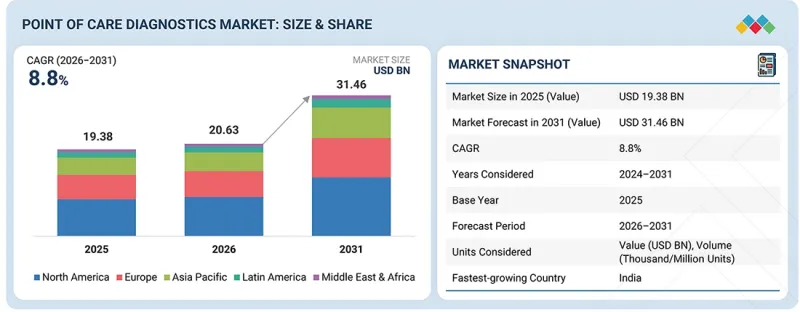
POC(Point of Care) 진단 시장 규모는 2026년 206억 3,000만 달러에서 2031년에는 314억 6,000만 달러에 달할 것으로 예측되고 있으며, CAGR은 8.8%에 달할 전망입니다.
| 조사 범위 | |
|---|---|
| 조사 대상 기간 | 2026-2031년 |
| 기준연도 | 2025년 |
| 예측 기간 | 2026-2031년 |
| 단위 | 금액(달러) |
| 부문 | 제품, 검체, 구입 형태, 기술, 최종사용자, 지역 |
| 대상 지역 | 북미, 유럽, 아시아태평양, 라틴아메리카, 중동 및 아프리카 |
끊임없는 기술 발전과 신속하고 정확하며 분산형 검사에 대한 수요 증가가 현장 진단(Point-of-Care) 시장의 성장을 주도하고 있습니다. 생화학 검사 기술은 병원, 임상 검사실, 응급실, 진료소 등에서 혈당 모니터링, 혈액 가스·전해질 분석, 콜레스테롤 검사, 기타 일상적인 진단 용도로 널리 활용되고 있으며, 가장 큰 시장 점유율을 차지하고 있습니다. 폭넓은 임상적 유용성, 비용 대비 효과, 신속한 결과 제공 능력 덕분에 대량 검사가 필요한 현장 진단(Point-of-Care) 분야에서 생화학 기술은 가장 선호되는 기술로 자리 잡고 있습니다.
한편, 분자 진단은 감염병 검출, 약물 내성 검사, 집단 감염 대비를 목적으로 한 신속한 PCR 기반 플랫폼의 도입이 증가하고 있으며, 가장 빠른 성장이 예상됩니다.
면역측정법, 분자진단 플랫폼, 미세유체 기술, 다항목 검사, 휴대용 분석 장치의 지속적인 혁신을 통해 진단 정확도가 향상되고 검사 소요 시간이 단축되며, 기존의 검사실 범위를 넘어선 검사가 가능해졌습니다. 이러한 진보로 인해 병원, 외래 진료 시설, 소매 클리닉, 약국, 재택 의료 현장에서 차세대 현장 진단(Point-of-Care) 기술의 도입이 가속화되고 있으며, 첨단 진단 솔루션에 대한 전 세계적인 수요가 지속적으로 창출되고 있습니다.
제품별로는 감염병 검사 제품이 예측 기간 중 가장 높은 성장률을 보일 것으로 전망됩니다. 이 부문이 주도적인 위치를 차지하는 배경에는 감염병 부담의 증가, 신속하고 정확한 환자 현장 진단에 대한 수요 증가, 효과적인 치료와 감염 관리를 지원하기 위한 시기적절한 임상적 의사결정의 필요성이 있습니다. 병원, 응급실, 진료소, 소매 클리닉, 약국, 재택 의료 현장에서의 현장 진단 검사 도입 확대와 감염병 감시 및 분산형 의료 제공을 위한 정부 주도의 노력 확대에 힘입어, 감염병 검사 제품의 시장 지위는 지속적으로 강화되고 있습니다.
최종사용자별로는 임상 검사 실험실이 현장 진단 시장에서 가장 큰 점유율을 차지하고 있습니다. 이는 급성 질환과 만성질환 모두에 대해 신속하고 정확한 진단 검사를 제공하는 데 있으며, 임상 검사 실험실이 중심적인 역할을 수행하고 있기 때문입니다. 이러한 시설에서는 감염병, 당뇨병, 심혈관 질환, 응고 모니터링, 임상화학 검사를 위한 현장 진단 검사를 일상적으로 실시하여 시기적절한 진단 및 치료 결정을 지원하고 있습니다. 광범위한 검사 역량, 숙련된 검사 기술자, 확립된 품질관리 시스템, 병원 워크플로우와의 원활한 통합이 POC(Point-Of-Care) 진단 솔루션에 대한 수요를 지속적으로 견인하고 있습니다. 또한 검사 건수의 증가, 신속한 결과 제공에 대한 중요성 부각, 검사 네트워크내 분산형 검사의 도입 확대가 전 세계 현장 진단 시장에서 임상 검사실의 우위를 더욱 공고히 하고 있습니다.
북미는 첨단인 의료 인프라, 충실한 보험 환급 제도, 분산형 진단 검사의 광범위한 도입으로 인해 POC(Point-Of-Care) 진단 시장에서 가장 큰 점유율을 차지하고 있습니다. 이 지역에는 병원, 임상 검사실, 진료소, 응급의료센터, 소매 클리닉, 약국으로 구성된 광범위한 네트워크가 있으며, 감염병, 당뇨병, 심혈관 질환, 호흡기 질환을 신속하게 검출하고 관리하기 위해 일상적으로 현장 진단이 활용되고 있습니다. 높은 의료비, 주요 진단 기기 제조사의 강력한 입지, 유리한 규제 지원에 힘입어 미국 및 캐나다 전역에서 현장 진단 검사의 도입이 가속화되고 있습니다. 또한 조기 진단의 중요성이 커지고, 환자 예후 개선 및 환자 곁에서 이루어지는 검사를 통한 의료비 절감에 대한 관심이 높아짐에 따라 전 세계 현장 진단 시장에서 북미의 주도적 입지가 더욱 공고해지고 있습니다.
이 보고서에서는 전 세계 현장 진단 시장을 조사하여 시장 개요, 시장 성장에 영향을 미치는 각종 요인 분석, 기술 및 특허 동향, 법규제 환경, 사례 연구, 시장 규모 추이 및 전망, 각종 분류·지역/주요 국가별 상세 분석, 경쟁 구도, 주요 기업 개요 등을 종합적으로 다루고 있습니다.
자주 묻는 질문
목차
제1장 서론
제2장 개요
제3장 주요 인사이트
제4장 시장 개요
제5장 업계 동향
제6장 기술의 진보, AI의 영향, 특허, 혁신, 향후 응용
제7장 규제 상황과 지속가능성 구상
제8장 고객 상황과 구매 행동
제9장 POC(Point of Care) 진단 시장 : 기술별
제10장 POC(Point of Care) 진단 시장 : 검체별
제11장 POC(Point of Care) 진단 시장 : 구입 방법별
제12장 POC(Point of Care) 진단 시장 : 최종사용자별
제13장 POC(Point of Care) 진단 시장 : 제품별
제14장 POC(Point of Care) 진단 시장 : 지역별
제15장 경쟁 구도
제16장 기업 개요
제17장 조사 방법
제18장 부록
KSA 26.07.31The Point of Care Diagnostics market is projected to reach USD 31.46 billion by 2031 from USD 20.63 billion in 2026, growing at a CAGR of 8.8%.
| Scope of the Report | |
|---|---|
| Years Considered for the Study | 2026-2031 |
| Base Year | 2025 |
| Forecast Period | 2026-2031 |
| Units Considered | Value (USD billion) |
| Segments | Product, Sample, Mode of Purchase, Technology, End User, And Region |
| Regions covered | North America, Europe, Asia Pacific, Latin America, and the Middle East & Africa |
Continuous technological advancements and the growing demand for rapid, accurate, and decentralized testing are driving growth in the point-of-care diagnostics market. Biochemistry technology accounts for the largest market share due to its widespread use in blood glucose monitoring, blood gas and electrolyte analysis, cholesterol testing, and other routine diagnostic applications across hospitals, clinical laboratories, emergency departments, and physician offices. Its broad clinical utility, cost-effectiveness, and ability to deliver rapid results make it the preferred technology for high-volume point-of-care testing. Meanwhile, molecular diagnostics is projected to grow the fastest, owing to the increasing adoption of rapid PCR-based platforms for infectious disease detection, antimicrobial resistance testing, and outbreak preparedness. Continuous innovations in immunoassays, molecular platforms, microfluidics, multiplex testing, and portable analyzers are improving diagnostic accuracy, reducing turnaround time, and expanding testing beyond traditional laboratories. These advancements are accelerating the adoption of next-generation point-of-care diagnostic technologies across hospitals, ambulatory care facilities, retail clinics, pharmacies, and home healthcare settings, thereby creating sustained global demand for advanced diagnostic solutions.
Based on product: Infectious disease testing products are projected to register the highest growth during the forecast period. The segment's dominance is driven by the increasing burden of infectious diseases, the growing demand for rapid, accurate near-patient diagnosis, and the need for timely clinical decision-making to support effective treatment and infection control. The growing adoption of point-of-care testing across hospitals, emergency departments, physicians' offices, retail clinics, pharmacies, and home healthcare settings, coupled with expanding government initiatives for infectious disease surveillance and decentralized healthcare delivery, continues to strengthen the market position of infectious disease testing products.
Based on end user: Clinical laboratories account for the largest share of the point-of-care diagnostics market due to their central role in delivering rapid and accurate diagnostic testing for both acute and chronic diseases. These facilities routinely perform point-of-care testing for infectious diseases, diabetes, cardiovascular disorders, coagulation monitoring, and clinical chemistry, supporting timely diagnosis and treatment decisions. Their extensive testing capabilities, skilled laboratory personnel, established quality management systems, and seamless integration with hospital workflows continue to drive demand for point-of-care diagnostic solutions. Furthermore, increasing test volumes, the growing emphasis on faster turnaround times, and the expanding adoption of decentralized testing within laboratory networks reinforce the dominance of clinical laboratories in the global point-of-care diagnostics market.
North America accounts for the largest share of the point-of-care diagnostics market due to its advanced healthcare infrastructure, strong reimbursement framework, and widespread adoption of decentralized diagnostic testing. The region has an extensive network of hospitals, clinical laboratories, physicians' offices, urgent care centers, retail clinics, and pharmacies that routinely use point-of-care diagnostics to rapidly detect and manage infectious diseases, diabetes, cardiovascular disorders, and respiratory conditions. High healthcare expenditure, a strong presence of leading diagnostic manufacturers, and favorable regulatory support have accelerated the adoption of point-of-care testing across the U.S. and Canada. Furthermore, increasing emphasis on early diagnosis, improved patient outcomes, and reducing healthcare costs through near-patient testing continues to reinforce North America's leadership in the global point-of-care diagnostics market.
A breakdown of the primary respondents (supply-side) for the POC diagnostics s market referred to in this report is provided below:
- By Company Type: Tier 1: 40%, Tier 2: 30%, and Tier 3: 30%
- By Designation: C-level: 55%, Director Level: 27%, and Others: 18%
- By Region: North America: 43%, Europe: 28%, Asia Pacific: 20%, Latin America: 6%, and Middle East & Africa: 3%
Prominent players in the global point-of-care diagnostics market include Abbott Laboratories (US), F. Hoffmann-La Roche Ltd. (Switzerland), Danaher Corporation (US), Siemens Healthineers AG (Germany), QuidelOrtho Corporation (US), bioMerieux SA (France), Werfen S.A. (Spain), Becton, Dickinson and Company (US), QIAGEN N.V. (Netherlands), Thermo Fisher Scientific Inc. (US), OraSure Technologies, Inc. (US), EKE Diagnostics (China), Trinity Biotech plc (Ireland), Grifols S.A. (Spain), Nova Biomedical Corporation (US), Sekisui Diagnostics, LLC (US), Trividia Health, Inc. (US), Sysmex Corporation (Japan), HemoCue AB (Sweden), and Bio-Rad Laboratories, Inc. (US) among others.
Research Coverage
The report evaluates the POC diagnostics market and estimates the market size and future growth potential of this market based on various segments, including product, end user, and region. The report also includes a competitive analysis of the major players in this market, along with company profiles, product offerings, recent developments, and key market strategies.
Reasons to Buy the Report
The report will assist market leaders and new entrants in the POC diagnostics s market with data on the nearest approximations of revenue figures for the overall market and its subsegments. The report will help stakeholders understand the competitive landscape and gain insights to better position their businesses and develop effective go-to-market strategies. It also enables stakeholders to understand market dynamics and provides insights into key drivers, restraints, challenges, and growth opportunities influencing the POC diagnostics market.
This report provides insights into the following points:
- Analysis of key drivers (rising prevalence of chronic diseases such as diabetes, cardiovascular diseases, and infectious diseases requiring rapid diagnosis, growing demand for decentralized and near-patient testing to enable faster clinical decision-making, increasing adoption of portable and user-friendly diagnostic devices in hospitals, clinics, and home care settings, technological advancements in microfluidics, biosensors, AI-enabled diagnostics, and smartphone-integrated testing solutions), restraints (high cost of advanced point-of-care diagnostic devices and consumables, stringent regulatory approval and quality compliance requirements, limited accuracy of certain rapid tests compared to centralized laboratory testing, data security and interoperability concerns with connected diagnostic systems), opportunities (expansion of point-of-care testing in emerging markets, increasing demand for home-based diagnostic kits and self-testing solutions, growing adoption of multiplex and molecular point-of-care diagnostics, rising investments in digital health, telemedicine, and AI-powered diagnostic platforms), and challenges (limited healthcare infrastructure and trained personnel in low-resource settings, reimbursement and pricing pressures, supply chain constraints for diagnostic reagents and consumables, standardization and integration of point-of-care diagnostic data with electronic health record systems)
- Product Enhancement/Innovation: Comprehensive details about product launches and anticipated trends in the global POC diagnostics market.
- Market Development: Thorough knowledge and analysis of the profitable rising markets by product, sample, mode of purchase, technology, end user, and region.
- Market Diversification: Comprehensive information about newly launched products, expanding markets, current advancements, and investments in the global POC diagnostics market.
- Competitive Assessment: Thorough evaluation of the market shares, growth plans, offerings, and capacities of the major competitors in the global POC diagnostics market.
TABLE OF CONTENTS
1 INTRODUCTION
- 1.1 STUDY OBJECTIVES
- 1.2 MARKET DEFINITION
- 1.3 STUDY SCOPE
- 1.3.1 MARKETS COVERED AND REGIONAL SCOPE
- 1.3.2 INCLUSIONS AND EXCLUSIONS
- 1.3.3 YEARS CONSIDERED
- 1.3.4 CURRENCY CONSIDERED
- 1.4 STAKEHOLDERS
- 1.5 SUMMARY OF CHANGES
2 EXECUTIVE SUMMARY
- 2.1 KEY INSIGHTS AND MARKET HIGHLIGHTS
- 2.2 KEY MARKET PARTICIPANTS: SHARE INSIGHTS AND STRATEGIC DEVELOPMENTS
- 2.3 DISRUPTIVE TRENDS SHAPING MARKET
- 2.4 HIGH-GROWTH SEGMENTS AND EMERGING FRONTIERS
- 2.5 SNAPSHOT: GLOBAL MARKET SIZE, GROWTH RATE, AND FORECAST
3 PREMIUM INSIGHTS
- 3.1 POC DIAGNOSTICS MARKET OVERVIEW
- 3.2 POC DIAGNOSTICS MARKET, BY PRODUCT, 2026 VS. 2031
- 3.3 POC DIAGNOSTICS MARKET, BY MODE OF PURCHASE, 2026 VS. 2031
- 3.4 POC DIAGNOSTICS MARKET, BY TECHNOLOGY, 2026 VS. 2031
- 3.5 POC DIAGNOSTICS MARKET, BY SAMPLE, 2026 VS. 2031
- 3.6 POC DIAGNOSTICS MARKET, BY END USER, 2026 VS. 2031
- 3.7 POC DIAGNOSTICS MARKET: GEOGRAPHIC GROWTH OPPORTUNITIES
4 MARKET OVERVIEW
- 4.1 INTRODUCTION
- 4.2 MARKET DYNAMICS
- 4.2.1 DRIVERS
- 4.2.1.1 Growing incidence of infectious diseases
- 4.2.1.2 Increasing prevalence of chronic diseases
- 4.2.1.3 Favorable government initiatives for POC testing
- 4.2.1.4 Rising number of waived tests
- 4.2.2 RESTRAINTS
- 4.2.2.1 Pricing pressure on manufacturers
- 4.2.2.2 Stringent regulatory approval process for product commercialization
- 4.2.3 OPPORTUNITIES
- 4.2.3.1 Increasing growth potential in emerging markets
- 4.2.3.2 Rising inclination toward decentralized healthcare systems
- 4.2.3.3 Booming healthcare spending worldwide
- 4.2.4 CHALLENGES
- 4.2.4.1 Inadequate standardization with centralized lab methods
- 4.2.4.2 Premium pricing of novel platforms
- 4.2.1 DRIVERS
- 4.3 UNMET NEEDS AND WHITE SPACES
- 4.3.1 UNMET NEEDS IN POC DIAGNOSTICS MARKET
- 4.3.2 WHITE SPACE OPPORTUNITIES
- 4.4 INTERCONNECTED MARKETS AND CROSS-SECTOR OPPORTUNITIES
- 4.4.1 INTERCONNECTED MARKETS
- 4.4.2 CROSS-SECTOR OPPORTUNITIES
- 4.5 STRATEGIC MOVES BY TIER 1/2/3 PLAYERS
- 4.5.1 KEY MOVES AND STRATEGIC FOCUS
5 INDUSTRY TRENDS
- 5.1 PORTER'S FIVE FORCES ANALYSIS
- 5.1.1 BARGAINING POWER OF SUPPLIERS
- 5.1.2 BARGAINING POWER OF BUYERS
- 5.1.3 THREAT OF NEW ENTRANTS
- 5.1.4 THREAT OF SUBSTITUTES
- 5.1.5 INTENSITY OF COMPETITIVE RIVALRY
- 5.2 MACROECONOMIC INDICATORS
- 5.2.1 INTRODUCTION
- 5.2.2 GDP TRENDS AND FORECAST
- 5.3 SUPPLY CHAIN ANALYSIS
- 5.4 ECOSYSTEM ANALYSIS
- 5.5 INVESTMENT AND FUNDING SCENARIO
- 5.6 PRICING ANALYSIS
- 5.6.1 AVERAGE SELLING PRICE, BY PRODUCT
- 5.6.1.1 Average selling price OF glucose monitoring test strips, by key player
- 5.6.2 AVERAGE SELLING PRICE, BY REGION
- 5.6.2.1 Average selling price of glucose monitoring test strips, by region
- 5.6.2.2 Average selling price of infectious disease testing products, by region
- 5.6.2.3 Average selling price of cardiometabolic monitoring products, by region
- 5.6.1 AVERAGE SELLING PRICE, BY PRODUCT
- 5.7 VALUE CHAIN ANALYSIS
- 5.8 TRENDS/DISRUPTIONS IMPACTING CUSTOMERS' BUSINESSES
- 5.9 IMPACT OF US TARIFFS-POC DIAGNOSTICS MARKET
- 5.9.1 INTRODUCTION
- 5.9.2 KEY TARIFF RATES
- 5.9.3 PRICE IMPACT ANALYSIS
- 5.9.4 IMPACT ON COUNTRIES/REGIONS
- 5.9.4.1 North America
- 5.9.4.2 Europe
- 5.9.4.3 Asia Pacific
6 TECHNOLOGICAL ADVANCEMENTS, AI-DRIVEN IMPACT, PATENTS, INNOVATIONS, AND FUTURE APPLICATIONS
- 6.1 KEY EMERGING TECHNOLOGIES
- 6.1.1 IMMUNOASSAYS
- 6.2 COMPLEMENTARY TECHNOLOGIES
- 6.2.1 MOLECULAR DIAGNOSTICS
- 6.3 ADJACENT TECHNOLOGIES
- 6.3.1 BIOCHEMICAL TECHNOLOGIES
- 6.4 TECHNOLOGY/PRODUCT ROADMAP
- 6.5 PATENT ANALYSIS
- 6.5.1 LIST OF MAJOR PATENTS
- 6.6 FUTURE APPLICATIONS
- 6.7 IMPACT OF AI/GENERATIVE AI ON POC DIAGNOSTICS MARKET
- 6.7.1 INTRODUCTION
- 6.7.2 TOP USE CASES AND MARKET POTENTIAL
- 6.7.3 KEY COMPANIES IMPLEMENTING AI
- 6.7.4 FUTURE OF AI
7 REGULATORY LANDSCAPE AND SUSTAINABILITY INITIATIVES
- 7.1 REGIONAL REGULATIONS AND COMPLIANCE
- 7.1.1 REGULATORY BODIES, GOVERNMENT AGENCIES, AND OTHER ORGANIZATIONS
- 7.1.2 INDUSTRY STANDARDS
- 7.2 SUSTAINABILITY INITIATIVES
- 7.2.1 ENVIRONMENTAL IMPACT AND ECO-FRIENDLY INITIATIVES IN POC DIAGNOSTICS
- 7.2.1.1 Eco-friendly Initiatives
- 7.2.1 ENVIRONMENTAL IMPACT AND ECO-FRIENDLY INITIATIVES IN POC DIAGNOSTICS
- 7.3 SUSTAINABILITY IMPACT AND REGULATORY POLICY INITIATIVES
8 CUSTOMER LANDSCAPE & BUYER BEHAVIOR
- 8.1 DECISION-MAKING PROCESS
- 8.2 BUYER STAKEHOLDERS AND BUYING EVALUATION CRITERIA
- 8.2.1 KEY STAKEHOLDERS IN BUYING PROCESS
- 8.2.2 BUYING CRITERIA
- 8.3 ADOPTION BARRIERS & INTERNAL CHALLENGES
- 8.4 UNMET NEEDS IN VARIOUS END-USE INDUSTRIES
- 8.5 MARKET PROFITABILITY
- 8.5.1 REVENUE POTENTIAL
- 8.5.2 COST DYNAMICS
- 8.5.3 MARGIN OPPORTUNITIES IN KEY APPLICATIONS
9 POINT OF CARE DIAGNOSTICS MARKET, BY TECHNOLOGY
- 9.1 INTRODUCTION
- 9.2 BIOCHEMISTRY
- 9.2.1 INCREASING PREVALENCE OF URINARY TRACT INFECTIONS TO EXPEDITE GROWTH
- 9.3 IMMUNOASSAYS
- 9.3.1 GROWING INCLINATION TOWARD DECENTRALIZED HEALTHCARE TO DRIVE MARKET
- 9.4 MOLECULAR DIAGNOSTICS
- 9.4.1 RT-PCR
- 9.4.1.1 Growing use of RT-PCR in proteomics and genomics to boost market
- 9.4.2 INAAT
- 9.4.2.1 Emerging new pathogens to facilitate growth
- 9.4.1 RT-PCR
10 POINT OF CARE DIAGNOSTICS MARKET, BY SAMPLE
- 10.1 INTRODUCTION
- 10.2 BLOOD SAMPLES
- 10.2.1 GROWING APPLICATION OF BLOOD SAMPLES IN DISEASE DETECTION TO DRIVE MARKET
- 10.3 NASAL & OROPHARYNGEAL SWABS
- 10.3.1 INCREASING PREVALENCE OF INFECTIOUS DISEASES TO AID GROWTH
- 10.4 URINE SAMPLES
- 10.4.1 NEED FOR EARLY DETECTION AND MONITORING OF DIABETES-RELATED COMPLICATIONS TO PROPEL MARKET
- 10.5 OTHER SAMPLES
11 POINT OF CARE DIAGNOSTICS MARKET, BY MODE OF PURCHASE
- 11.1 INTRODUCTION
- 11.2 PRESCRIPTION-BASED TESTING PRODUCTS
- 11.2.1 RISING INCIDENCE OF CHRONIC DISEASES TO AUGMENT GROWTH
- 11.3 OTC TESTING PRODUCTS
- 11.3.1 GROWING PATIENT PREFERENCE FOR REMOTE HEALTHCARE TO PROPEL MARKET
12 POINT OF CARE DIAGNOSTICS MARKET, BY END USER
- 12.1 INTRODUCTION
- 12.2 CLINICAL LABORATORIES
- 12.2.1 GROWING IMPROVEMENTS IN AUTOMATED TESTING SERVICES TO BOOST MARKET
- 12.3 HOME CARE SETTINGS & SELF-TESTING
- 12.3.1 INCREASING PREFERENCE AMONG WOMEN FOR CONFIDENTIALITY AND ACCESSIBILITY TO SUPPORT GROWTH
- 12.4 HOSPITALS, CRITICAL CARE CENTERS, AND URGENT CARE CENTERS
- 12.4.1 RISING DEMAND FOR FAST DIAGNOSTIC SOLUTIONS TO SPUR GROWTH
- 12.5 AMBULATORY CARE FACILITIES & PHYSICIAN OFFICES
- 12.5.1 NEED FOR RAPID RESULT GENERATION AND IMMEDIATE PATIENT CARE TO AID GROWTH
- 12.6 OTHER END USERS
13 POINT OF CARE DIAGNOSTICS MARKET, BY PRODUCT
- 13.1 INTRODUCTION
- 13.2 GLUCOSE MONITORING PRODUCTS
- 13.2.1 GLUCOSE MONITORING STRIPS
- 13.2.1.1 Growing trend toward preventive healthcare to drive market
- 13.2.2 GLUCOSE MONITORING METERS
- 13.2.2.1 Growing technological advancements in glucose meters to propel market
- 13.2.3 GLUCOSE MONITORING LANCETS & LANCING DEVICES
- 13.2.3.1 Increasing tendency for home-based care and self-monitoring to aid growth
- 13.2.1 GLUCOSE MONITORING STRIPS
- 13.3 CARDIOMETABOLIC TESTING PRODUCTS
- 13.3.1 CARDIAC MARKER TESTING PRODUCTS
- 13.3.1.1 Growing government support for cardiovascular diseases to drive market
- 13.3.2 BLOOD GAS/ELECTROLYTE TESTING PRODUCTS
- 13.3.2.1 Need to optimize hospital workflow to favor growth
- 13.3.3 HBA1C TESTING PRODUCTS
- 13.3.3.1 Increasing recommendations by government healthcare authorities to boost market
- 13.3.1 CARDIAC MARKER TESTING PRODUCTS
- 13.4 INFECTIOUS DISEASE TESTING PRODUCTS
- 13.4.1 RESPIRATORY INFECTION TESTING PRODUCTS
- 13.4.1.1 Influenza testing products
- 13.4.1.1.1 Need for targeted treatments to expedite growth
- 13.4.1.2 Tuberculosis testing products
- 13.4.1.2.1 Increasing demand for diagnostic products and services to contribute to growth
- 13.4.1.3 Other respiratory infection testing products
- 13.4.1.1 Influenza testing products
- 13.4.2 HAI TESTING PRODUCTS
- 13.4.2.1 Growing rate of surgical-site infections to boost market
- 13.4.3 TROPICAL DISEASE TESTING PRODUCTS
- 13.4.3.1 Rising incidence of malaria and dengue to support growth
- 13.4.4 STD TESTING PRODUCTS
- 13.4.4.1 HIV testing products
- 13.4.4.1.1 Growing availability and awareness of testing products to boost market
- 13.4.4.2 Hepatitis testing products
- 13.4.4.2.1 Hepatitis B testing products
- 13.4.4.2.1.1 Increasing prevalence of liver infections to favor growth
- 13.4.4.2.2 Hepatitis C testing products
- 13.4.4.2.2.1 Need to combat hepatitis among high-risk subgroup populations to aid growth
- 13.4.4.2.1 Hepatitis B testing products
- 13.4.4.3 Syphilis testing products
- 13.4.4.3.1 Need for early and accessible diagnosis to expedite growth
- 13.4.4.4 Human papillomavirus testing products
- 13.4.4.4.1 Rising cases of cervical cancer to promote growth
- 13.4.4.5 Chlamydia trachomatis testing products
- 13.4.4.5.1 Growing adoption of advanced techniques to drive market
- 13.4.4.6 Neisseria gonorrhea testing products
- 13.4.4.6.1 Rising incidence of gonorrhea and antimicrobial resistance to augment growth
- 13.4.4.7 HSV testing products
- 13.4.4.7.1 Increasing incidence of herpes to support growth
- 13.4.4.1 HIV testing products
- 13.4.5 CLOSTRIDIUM DIFFICILE INFECTION TESTING PRODUCTS
- 13.4.5.1 Rising cases among hospitalized patients to boost demand
- 13.4.6 OTHER INFECTIOUS DISEASE TESTING PRODUCTS
- 13.4.1 RESPIRATORY INFECTION TESTING PRODUCTS
- 13.5 COAGULATION MONITORING PRODUCTS
- 13.5.1 NEED FOR REGULAR MONITORING AND RISING DEMAND FOR HOME-USE KITS TO PROPEL MARKET
- 13.5.2 PT/INR TESTING PRODUCTS
- 13.5.2.1 Increasing number of atrial fibrillation cases to accelerate growth
- 13.5.3 ACT/APTT TESTING PRODUCTS
- 13.5.3.1 Rise in surgical procedures to speed up growth
- 13.6 PREGNANCY & FERTILITY TESTING PRODUCTS
- 13.6.1 PREGNANCY TESTING PRODUCTS
- 13.6.1.1 Increasing awareness about family planning to stimulate growth
- 13.6.2 FERTILITY TESTING PRODUCTS
- 13.6.2.1 Growing infertility issues to fuel market
- 13.6.1 PREGNANCY TESTING PRODUCTS
- 13.7 TUMOR/CANCER MARKER TESTING PRODUCTS
- 13.7.1 GROWING CANCER INCIDENCE AND GOVERNMENT SUPPORT FOR CANCER MANAGEMENT AND THERAPIES DRIVE MARKET
- 13.8 URINALYSIS TESTING PRODUCTS
- 13.8.1 INCREASING DEMAND FOR RAPID POC TESTING TECHNOLOGIES TO SUPPORT MARKET GROWTH
- 13.9 CHOLESTEROL TESTING PRODUCTS
- 13.9.1 GROWING GERIATRIC POPULATION AND RISING OBESITY LEVELS TO DRIVE MARKET
- 13.10 HEMATOLOGY TESTING PRODUCTS
- 13.10.1 RAPID DIAGNOSTICS AND MONITORING SUPPORT TO PROPEL END-USER ADOPTION
- 13.11 DRUGS-OF-ABUSE TESTING PRODUCTS
- 13.11.1 GROWING CONSUMPTION OF ILLICIT DRUGS TO FAVOR MARKET
- 13.12 THYROID-STIMULATING HORMONE TESTING PRODUCTS
- 13.12.1 GROWING PREVALENCE OF THYROID DISORDERS DRIVING DEMAND FOR TSH TESTING PRODUCTS
- 13.13 FECAL OCCULT TESTING PRODUCTS
- 13.13.1 GROWING INCIDENCE OF CANCER TO PROPEL THE MARKET
- 13.14 OTHER PRODUCTS
14 POINT OF CARE DIAGNOSTICS MARKET, BY REGION
- 14.1 INTRODUCTION
- 14.2 NORTH AMERICA
- 14.2.1 MACROECONOMIC OUTLOOK FOR NORTH AMERICA
- 14.2.2 US
- 14.2.2.1 Presence of advanced healthcare infrastructure and high healthcare expenditure to aid growth
- 14.2.3 CANADA
- 14.2.3.1 Rising incidence of diabetes and infectious diseases to support growth
- 14.3 EUROPE
- 14.3.1 MACROECONOMIC OUTLOOK FOR EUROPE
- 14.3.2 GERMANY
- 14.3.2.1 Increasing need for rapid and accurate diagnostic solutions to promote growth
- 14.3.3 FRANCE
- 14.3.3.1 Growing demand for accessible and convenient diagnostic tools to propel market
- 14.3.4 UK
- 14.3.4.1 Rising number of accredited clinical and hospital laboratories to sustain growth
- 14.3.5 ITALY
- 14.3.5.1 Growing burden of infectious and parasitic diseases to boost market
- 14.3.6 SPAIN
- 14.3.6.1 Rising prevalence of circulatory system diseases to contribute to growth
- 14.3.7 REST OF EUROPE
- 14.4 ASIA PACIFIC
- 14.4.1 MACROECONOMIC OUTLOOK FOR ASIA PACIFIC
- 14.4.2 CHINA
- 14.4.2.1 Increasing impact of diabetes on public health to amplify growth
- 14.4.3 JAPAN
- 14.4.3.1 Booming geriatric population to stimulate growth
- 14.4.4 INDIA
- 14.4.4.1 Increasing cases of chronic heart and kidney diseases to foster growth
- 14.4.5 AUSTRALIA
- 14.4.5.1 Growing research investments for next-gen POC devices to boost market
- 14.4.6 SOUTH KOREA
- 14.4.6.1 Growing focus on innovative diagnostic products to drive market
- 14.4.7 REST OF ASIA PACIFIC
- 14.5 LATIN AMERICA
- 14.5.1 MACROECONOMIC OUTLOOK FOR LATIN AMERICA
- 14.5.2 BRAZIL
- 14.5.2.1 Increasing public initiatives in healthcare to encourage growth
- 14.5.3 MEXICO
- 14.5.3.1 Need for frequent testing for disease management to expedite growth
- 14.5.4 REST OF LATIN AMERICA
- 14.6 MIDDLE EAST & AFRICA
- 14.6.1 GROWING OUTBREAKS OF INFECTIOUS DISEASES AND EMPHASIS ON PREVENTIVE HEALTHCARE TO DRIVE MARKET
- 14.6.2 MACROECONOMIC OUTLOOK FOR MIDDLE EAST & AFRICA
15 COMPETITIVE LANDSCAPE
- 15.1 INTRODUCTION
- 15.2 KEY PLAYER STRATEGIES/RIGHT TO WIN
- 15.2.1 OVERVIEW OF STRATEGIES ADOPTED BY PLAYERS IN POC DIAGNOSTICS MARKET
- 15.3 REVENUE ANALYSIS, 2023-2025
- 15.4 MARKET SHARE ANALYSIS, 2025
- 15.5 COMPANY VALUATION AND FINANCIAL METRICS
- 15.6 BRAND/PRODUCT COMPARISON
- 15.7 COMPANY EVALUATION MATRIX: KEY PLAYERS, 2025
- 15.7.1 STARS
- 15.7.2 EMERGING LEADERS
- 15.7.3 PERVASIVE PLAYERS
- 15.7.4 PARTICIPANTS
- 15.7.5 COMPANY FOOTPRINT, KEY PLAYERS, 2025
- 15.7.5.1 Company footprint
- 15.7.5.2 Region footprint
- 15.7.5.3 Mode of purchase footprint
- 15.7.5.4 Technology footprint
- 15.7.5.5 Sample footprint
- 15.8 COMPANY EVALUATION MATRIX: STARTUPS/SMES, 2023
- 15.8.1 PROGRESSIVE COMPANIES
- 15.8.2 RESPONSIVE COMPANIES
- 15.8.3 DYNAMIC COMPANIES
- 15.8.4 STARTING BLOCKS
- 15.8.5 COMPANY EVALUATION MATRIX: STARTUPS/SMES, 2023
- 15.8.5.1 Detailed list of key startups/SMEs
- 15.8.5.2 Competitive benchmarking of startups/SMEs
- 15.9 COMPETITIVE SCENARIO
- 15.9.1 PRODUCT LAUNCHES AND APPROVALS
16 COMPANY PROFILES
- 16.1 KEY PLAYERS
- 16.1.1 ABBOTT
- 16.1.1.1 Business overview
- 16.1.1.2 Products offered
- 16.1.1.3 Recent developments
- 16.1.1.3.1 Product launches and approvals
- 16.1.1.3.2 Deals
- 16.1.1.4 MnM view
- 16.1.1.4.1 Right to win
- 16.1.1.4.2 Strategic choices
- 16.1.1.4.3 Weaknesses and competitive threats
- 16.1.2 F. HOFFMANN-LA ROCHE LTD
- 16.1.2.1 Business overview
- 16.1.2.2 Products offered
- 16.1.2.3 Recent developments
- 16.1.2.3.1 Product launches and approvals
- 16.1.2.3.2 Deals
- 16.1.2.3.3 Expansions
- 16.1.2.4 MnM view
- 16.1.2.4.1 Right to win
- 16.1.2.4.2 Strategic choices
- 16.1.2.4.3 Weaknesses and competitive threats
- 16.1.3 SIEMENS HEALTHINEERS AG
- 16.1.3.1 Business overview
- 16.1.3.2 Products offered
- 16.1.3.3 Recent developments
- 16.1.3.3.1 Product launches and approvals
- 16.1.3.3.2 Deals
- 16.1.3.3.3 Expansions
- 16.1.3.4 MnM view
- 16.1.3.4.1 Right to win
- 16.1.3.4.2 Strategic choices
- 16.1.3.4.3 Weaknesses and competitive threats
- 16.1.4 QUIDELORTHO CORPORATION
- 16.1.4.1 Business overview
- 16.1.4.2 Products offered
- 16.1.4.3 Recent developments
- 16.1.4.3.1 Product launches and approvals
- 16.1.4.3.2 Deals
- 16.1.4.3.3 Expansions
- 16.1.4.4 MnM view
- 16.1.4.4.1 Right to win
- 16.1.4.4.2 Strategic choices
- 16.1.4.4.3 Weaknesses and competitive threats
- 16.1.5 DANAHER
- 16.1.5.1 Business overview
- 16.1.5.2 Products offered
- 16.1.5.3 Recent developments
- 16.1.5.3.1 Product launches and approvals
- 16.1.5.3.2 Deals
- 16.1.5.3.3 Expansions
- 16.1.5.4 MnM view
- 16.1.5.4.1 Right to win
- 16.1.5.4.2 Strategic choices
- 16.1.5.4.3 Weaknesses and competitive threats
- 16.1.6 WERFEN
- 16.1.6.1 Business overview
- 16.1.6.2 Products offered
- 16.1.6.3 Recent developments
- 16.1.6.3.1 Product launches and approvals
- 16.1.6.3.2 Deals
- 16.1.6.3.3 Expansions
- 16.1.6.4 MnM view
- 16.1.6.4.1 Right to win
- 16.1.6.4.2 Strategic choices
- 16.1.6.4.3 Weaknesses and competitive threats
- 16.1.7 BD
- 16.1.7.1 Business overview
- 16.1.7.2 Products offered
- 16.1.7.3 Recent developments
- 16.1.7.3.1 Product launches and approvals
- 16.1.7.3.2 Deals
- 16.1.7.3.3 Expansions
- 16.1.8 THERMO FISHER SCIENTIFIC INC.
- 16.1.8.1 Business overview
- 16.1.8.2 Products offered
- 16.1.8.3 Recent developments
- 16.1.8.3.1 Deals
- 16.1.9 BIOMERIEUX
- 16.1.9.1 Business overview
- 16.1.9.2 Products offered
- 16.1.9.3 Recent developments
- 16.1.9.3.1 Product launches and approvals
- 16.1.9.3.2 Deals
- 16.1.10 EKF DIAGNOSTICS HOLDINGS PLC
- 16.1.10.1 Business overview
- 16.1.10.2 Products offered
- 16.1.10.3 Recent developments
- 16.1.10.3.1 Product launches and approvals
- 16.1.10.3.2 Expansions
- 16.1.10.3.3 Other developments
- 16.1.11 TRINITY BIOTECH
- 16.1.11.1 Business overview
- 16.1.11.2 Products offered
- 16.1.11.3 Recent developments
- 16.1.11.3.1 Product launches and approvals
- 16.1.11.3.2 Deals
- 16.1.12 ORASURE TECHNOLOGIES, INC.
- 16.1.12.1 Business overview
- 16.1.12.2 Products offered
- 16.1.12.3 Recent developments
- 16.1.12.3.1 Product launches and approvals
- 16.1.12.3.2 Deals
- 16.1.13 GRIFOLS S.A.
- 16.1.13.1 Business overview
- 16.1.13.2 Products offered
- 16.1.13.3 Recent developments
- 16.1.13.3.1 Product launches and approvals
- 16.1.14 QIAGEN
- 16.1.14.1 Business overview
- 16.1.14.2 Products offered
- 16.1.14.3 Recent developments
- 16.1.14.3.1 Product launches and approvals
- 16.1.14.3.2 Deals
- 16.1.14.3.3 Expansions
- 16.1.1 ABBOTT
- 16.2 OTHER PLAYERS
- 16.2.1 NOVA BIOMEDICAL
- 16.2.1.1 Business overview
- 16.2.1.2 Products offered
- 16.2.1.3 Recent developments
- 16.2.1.3.1 Product launches and approvals
- 16.2.1.3.2 Deals
- 16.2.2 SEKISUI DIAGNOSTICS
- 16.2.2.1 Business overview
- 16.2.2.2 Products offered
- 16.2.2.3 Recent developments
- 16.2.2.3.1 Product launches and approvals
- 16.2.3 SEKISUI DIAGNOSTICS
- 16.2.3.1 Business overview
- 16.2.3.2 Products offered
- 16.2.3.3 Recent developments
- 16.2.3.3.1 Product launches and approvals
- 16.2.4 LIFESCAN IP HOLDINGS, LLC
- 16.2.5 PTS DIAGNOSTICS
- 16.2.6 EUROLYSER DIAGNOSTICA GMBH
- 16.2.7 RESPONSE BIOMEDICAL
- 16.2.8 ALFA SCIENTIFIC DESIGNS, INC.
- 16.2.9 BTNX INC.
- 16.2.10 ASCENSIA DIABETES CARE HOLDINGS AG
- 16.2.11 FLUXERGY
- 16.2.12 PRECISION BIOSENSOR, INC.
- 16.2.13 ACON LABORATORIES, INC.
- 16.2.14 MENARINI DIAGNOSTICS S.R.L
- 16.2.15 MANKIND PHARMA
- 16.2.1 NOVA BIOMEDICAL
17 RESEARCH METHODOLOGY
- 17.1 RESEARCH DATA
- 17.2 RESEARCH APPROACH
- 17.2.1 SECONDARY RESEARCH
- 17.2.1.1 Key data from secondary sources
- 17.2.2 PRIMARY DATA
- 17.2.2.1 Primary sources
- 17.2.2.2 Key data from primary sources
- 17.2.2.3 Key industry insights
- 17.2.1 SECONDARY RESEARCH
- 17.3 MARKET SIZE ESTIMATION
- 17.3.1 BOTTOM-UP APPROACH
- 17.3.1.1 Approach 1: Company revenue estimation approach
- 17.3.1.2 Approach 2: Presentations of companies and primary interviews
- 17.3.1.3 Growth forecast
- 17.3.2 TOP-DOWN APPROACH
- 17.3.1 BOTTOM-UP APPROACH
- 17.4 MARKET BREAKDOWN AND DATA TRIANGULATION
- 17.5 MARKET SHARE ANALYSIS
- 17.6 RESEARCH ASSUMPTIONS
- 17.6.1 PARAMETRIC ASSUMPTIONS
- 17.6.2 GROWTH RATE ASSUMPTIONS
- 17.7 RESEARCH LIMITATIONS
- 17.8 RISK ASSESSMENT
18 APPENDIX
- 18.1 DISCUSSION GUIDE
- 18.2 KNOWLEDGESTORE: MARKETSANDMARKETS' SUBSCRIPTION PORTAL
- 18.3 CUSTOMIZATION OPTIONS
- 18.4 RELATED REPORTS
- 18.5 AUTHOR DETAILS


