
|
시장보고서
상품코드
2101318
웨어러블 기술 시장 : 기술별, 연결 방식별, 업계별, 유통 채널별, OS별, 구성요소별, 제품별, 운영별, 유형별, 용도별, 지역별 - 세계 예측(-2032년)Wearable Technology Market by Product (Smartwatch, Fitness Tracker, Head-Mounted Display, Smart Shoe, Smart Glasses, Smart Vest, Smart Ring, Body-worn camera, Exoskeleton, SkinPatch, Smart Helmet), Operation (AI, Conventional) - Global Forecast to 2032 |
||||||

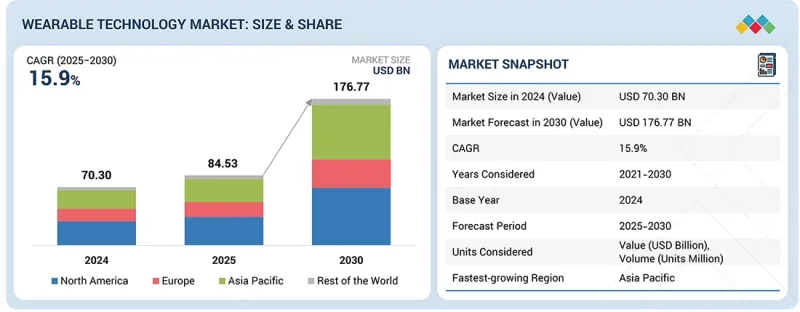
웨어러블 기술 시장 규모는 2026년에 1,049억 4,000만 달러, 2032년까지 2,387억 1,000만 달러에 달할 것으로 예측되며, 예측 기간 동안 CAGR 14.7%를 나타낼 것으로 전망됩니다.
소비자와 기업은 실시간 건강 모니터링, 피트니스 추적, 통신, 생산성 향상 기능을 제공하는 웨어러블 기기를 점점 더 많이 채택하고 있습니다. 센서 기술, 인공지능, 저전력 칩셋의 발전으로 인해 스마트워치, 피트니스 트래커, 스마트 링, 스마트 글라스, 이어웨어, 스마트웨어 등의 웨어러블 제품은 보다 정확한 정보를 제공하면서도 배터리 수명을 연장할 수 있게 되었습니다. 이러한 혁신을 통해 생체 신호의 지속적인 모니터링, 맞춤형 건강 관리 제안, 디지털 생태계 전반에 걸친 원활한 연결이 실현되어 전반적인 사용자 경험이 향상되고 있습니다.
| 조사 범위 | |
|---|---|
| 조사 대상 기간 | 2022-2032년 |
| 기준 연도 | 2025년 |
| 예측 기간 | 2026-2032년 |
| 산정 단위 | 금액(10억 달러) |
| 부문 | 기술별, 연결 방식별, 업계별, 유통 채널별, OS별, 구성요소별, 제품별, 운영별, 유형별, 용도별, 지역별 |
| 대상 지역 | 북미, 유럽, 아시아태평양, 기타 지역 |
또한, 예방 의료에 대한 인식 제고, 원격 환자 모니터링 수요 증가, 그리고 산업 및 물류 환경에서 기업용 웨어러블 기기 도입 확대가 시장 확산을 가속화하고 있습니다. 기능 향상, 기기의 지능화, 그리고 응용 분야의 확대로 인해 웨어러블 기술은 전 세계 소비자, 의료 종사자, 기업에게 점점 더 매력적인 투자 대상으로 자리 잡고 있습니다.
"제품별로는 헤드 마운트 디스플레이가 예측 기간 동안 가장 높은 연평균 성장률(CAGR)을 기록할 것으로 전망됩니다."
헤드 마운트 디스플레이(HMD) 부문은 소비자 및 기업용 애플리케이션에서 증강현실(AR), 가상현실(VR), 혼합현실(MR) 기기의 채택 확대에 힘입어, 예측 기간 동안 웨어러블 기술 시장에서 가장 높은 성장률을 기록할 것으로 예상됩니다. 제조, 의료, 물류, 국방 및 교육 환경의 조직에서는 업무 효율, 직원 생산성 및 몰입형 학습 경험을 향상시키기 위해 AR 및 VR 헤드셋 도입이 점점 더 확대되고 있습니다. 동시에 디스플레이 기술의 발전, 경량 설계, AI 기반 기능, 공간 컴퓨팅 기능의 향상으로 인해 사용자 채택이 증가하고 있습니다. 기술 기업들의 차세대 몰입형 생태계에 대한 막대한 투자와 핸즈프리 디지털 상호작용에 대한 수요 증가가 시장 확대를 더욱 가속화하고 있습니다. 하드웨어 성능이 향상되고 기기 비용이 점차 낮아짐에 따라 헤드 마운트 디스플레이는 시장의 주요 성장 동력이 될 것으로 예상됩니다.
"제품 유형별로는 2032년에 웨어러블 제품(비섬유계) 부문이 가장 큰 시장 점유율을 차지할 전망입니다."
웨어러블 제품(비섬유계) 부문은 폭넓은 소비자의 지지, 확립된 제품 생태계, 그리고 광범위한 용도를 아우르고 있기 때문에 2032년에는 웨어러블 기술 시장에서 가장 큰 점유율을 차지할 것으로 예상됩니다. 이 카테고리에는 스마트워치, 피트니스 트래커, 스마트 링, 이어웨어, 스마트 글래스, 웨어러블 카메라, 헤드 마운트 디스플레이가 포함되며, 이들 모두 지속적인 기술 혁신과 대량 생산의 혜택을 받고 있습니다. 건강 모니터링, 피트니스 추적, 커뮤니케이션, 엔터테인먼트, 생산성 향상 솔루션에 대한 강력한 수요가 소비자 및 기업 부문에서의 광범위한 보급을 뒷받침하고 있습니다. 또한, 주요 제조사들은 첨단 센서, AI 지원 기능, 배터리 수명 연장, 스마트폰 및 클라우드 플랫폼과의 원활한 연결 방식을 지속적으로 도입하고 있습니다. 섬유 기반 웨어러블과 비교할 때, 비섬유 기반 제품은 더 높은 상용화 성숙도, 견고한 유통 네트워크, 그리고 더 빠른 업그레이드 주기를 갖추고 있어 이를 통해 시장에서 지배적인 위치를 유지할 수 있습니다.
"2026년부터 2032년까지 아시아태평양이 웨어러블 기술 시장에서 가장 빠르게 성장하는 지역이 될 전망됩니다."
아시아태평양은 대규모 소비자 기반, 급속한 디지털화, 그리고 견고한 전자기기 제조 생태계에 힘입어 예측 기간 동안 웨어러블 기술 시장에서 가장 빠르게 성장하는 지역 시장이 될 것으로 전망됩니다. 중국, 일본, 한국, 인도에서는 소비자의 건강에 대한 인식 제고와 네트워크에 연결된 라이프스타일의 확산에 따라 스마트워치, 피트니스 트래커, 이어웨어, 스마트 링, 스마트 글래스의 보급이 확대되고 있습니다. 주요 웨어러블 기기 제조사의 진출, 중산층의 확대, 가처분 소득의 증가도 시장 성장을 더욱 뒷받침하고 있습니다. 또한, 디지털 헬스케어, 스마트 제조, 첨단 기술을 지원하는 정부의 노력으로 인해 산업 분야 및 의료 현장에서 기업들의 웨어러블 기기 도입이 촉진되고 있습니다. 지속적인 제품 혁신, 경쟁력 있는 가격 전략, E-Commerce의 확산에 힘입어 해당 지역은 시장에서 가장 빠르게 성장하는 지역으로서의 입지를 더욱 공고히 할 것으로 예상됩니다.
1차 조사 내역
웨어러블 기술 시장에서 사업을 전개하는 주요 조직의 경영진(CEO, 마케팅 책임자, 혁신·기술 책임자 등)을 대상으로 상세한 인터뷰를 실시했습니다.
본 보고서에서 다루고 있는 주요 기업 - 웨어러블 기술 시장에서 사업을 전개하는 주요 기업으로는 Apple Inc.(미국), 삼성(한국), 샤오미(중국), 화웨이 테크놀러지스(중국), 가민(Garmin Ltd., 미국), 이매진 마케팅 리미티드(Imagine Marketing Limited, boAT, 인도), 소니(Sony Corporation, 일본), LG전자(한국), 알파벳(Alphabet Inc., 미국), 레노버(Lenovo, 중국), Meta(미국), 그리고 OPPO(중국) 등이 있습니다. 이들 기업은 첨단 건강 모니터링, AI를 활용한 분석, 배터리 성능 향상, 센서의 소형화, 그리고 스마트 생태계 전반에 걸친 원활한 연결 방식에 초점을 맞추어 웨어러블 기기의 기능을 지속적으로 강화함으로써 경쟁을 펼치고 있습니다. 다양한 소비자 및 기업의 요구에 부응하기 위해 스마트워치, 피트니스 트래커, 이어웨어, 스마트 링, 스마트 글라스, 헤드 마운트 디스플레이, 웨어러블 카메라, 스마트웨어, 외골격 등 혁신적인 제품 포트폴리오 개발에 전략적 중점을 두고 있습니다.
시장에 진출한 기업들은 사용자 경험, 기기의 정확도, 인체공학적 디자인, 그리고 스마트폰, 클라우드 플랫폼, 디지털 헬스 생태계와의 연동을 최우선으로 하고 있습니다. 또한, 헬스케어, 스포츠·피트니스, 산업, 물류 분야에서의 응용 확대에 중점을 두는 한편, 소프트웨어 기능 및 기기 내 AI 처리 능력 강화에도 주력하고 있습니다. 첨단 센서 기술, 증강현실(AR) 및 가상현실(VR) 플랫폼, 저전력 칩셋에 대한 지속적인 투자, 그리고 의료 서비스 제공자, 기술 기업, 기업 고객과의 전략적 파트너십을 통해 전 세계 웨어러블 기술 시장의 경쟁이 지속되고 보급이 가속화될 것으로 예상됩니다.
본 조사에서는 웨어러블 기술 시장의 주요 기업에 대해 상세한 경쟁 분석을 수행하고, 각 기업 개요, 최근 동향 및 주요 시장 전략을 소개하고 있습니다.
조사 범위
본 웨어러블 기술 시장 보고서는 제품, 작동 방식, 종류, 용도 및 지역을 기반으로 한 상세한 분석을 제시하고 있습니다. 제품별로는 시장이 리스트웨어, 헤드 마운트 디스플레이, 스마트 의류·신발, 스마트 글래스, 스마트 링, 웨어러블 카메라, 이어웨어, 외골격 및 기타 제품으로 분류됩니다. 종류별로는 웨어러블 스마트 텍스타일과 웨어러블 제품(비텍스타일)으로 나뉩니다. 작동 방식별로는 AI 기반과 기존 방식으로 구분됩니다. 용도별로는 소비자용 전자기기, 헬스케어, 기업·산업용 및 기타 용도가 포함됩니다. 지역별 분석에서는 북미, 유럽, 아시아태평양 및 기타 지역(RoW)을 대상으로 하며, 전 세계 웨어러블 기술 시장 전체의 보급 동향, 기술 발전, 경쟁 동향 및 성장 기회를 평가할 수 있습니다.
본 보고서를 구매해야 하는 이유
본 보고서는 시장을 선도하는 기업 및 신규 진입 기업에게 시장 전체 및 각 하위 부문의 매출액에 관한 가장 정확한 추정치를 제공합니다. 또한 이해관계자가 경쟁 구도를 이해하고, 비즈니스 위치를 최적화하며, 적절한 시장 진입 전략을 수립하기 위한 인사이트를 얻는 데 도움이 됩니다. 또한, 웨어러블 기술 시장의 동향을 파악하고, 주요 시장 촉진요인, 억제요인, 과제 및 기회에 대한 정보를 제공합니다.
본 보고서를 구매해야 하는 주요 이점
- 주요 촉진요인(플렉서블 디스플레이 기술의 급속한 발전, 정교하고 컴팩트한 기기에 대한 소비자 선호도 증가, IoT 기기의 인기 상승, 증강현실(AR) 웨어러블에 대한 수요 급증, 핸즈프리 뱅킹 및 결제 솔루션에 대한 의존도 증가), 제약요인(짧은 배터리 수명, 보안 취약성), 기회(컴퓨팅 및 모니터링 요구를 충족하는 소형 기기에 대한 수요 증가, 원격 환자 모니터링에 대한 선호도 상승, 운동선수의 실시간 모니터링에 대한 관심 증가, 몰입형 기술에 대한 접근성 확대), 및 과제(변화하는 고객 기대, 규제 문제 및 의료 정보의 취약성, 장기적인 고객 참여 유지)에 대한 분석. 이러한 요소들은 웨어러블 기술 시장의 성장에 영향을 미치고 있습니다
- 제품 개발/혁신 : 웨어러블 기술 시장의 향후 기술, 연구개발 활동 및 신제품 출시에 대한 상세한 인사이트
- 시장 개발 : 수익성 높은 시장에 대한 종합적인 정보 ? 본 보고서는 다양한 지역에 걸친 웨어러블 기술 시장을 분석합니다
- 시장 다각화 : 웨어러블 기술 시장의 신제품 및 서비스, 미개척 지역, 최근 동향 및 투자에 대한 종합적인 정보
- 경쟁 분석 : 샤오미(중국), 애플(미국), 화웨이 테크놀러지스(중국), 삼성(한국), Garmin Ltd(미국), Imagine Marketing Limited(boAt)(인도), Sony Corporation(일본), Alphabet Inc.(미국), Lenovo(중국), Meta(미국), OPPO(중국) 등 주요 기업의 시장 점유율, 성장 전략, 서비스 제공 내용에 대한 상세한 평가
자주 묻는 질문
목차
제1장 소개
제2장 주요 요약
제3장 주요 인사이트
제4장 시장 개요
제5장 업계 동향
제6장 기술 진보, AI에 의한 영향, 특허, 그리고 혁신
제7장 규제 상황
제8장 고객 상황과 구매 행동
제9장 웨어러블 기술 시장(기술별)
제10장 웨어러블 기술 시장(연결 방식별)
제11장 웨어러블 기술 시장(업계별)
제12장 웨어러블 기술 시장(유통 채널별)
제13장 웨어러블 기술 시장(OS별)
제14장 웨어러블 기술 시장(구성요소별)
제15장 웨어러블 기술 시장(제품별)
제16장 웨어러블 기술 시장(운영별)
제17장 웨어러블 기술 시장(유형별)
제18장 웨어러블 기술 시장(용도별)
제19장 웨어러블 기술 시장(지역별)
제20장 경쟁 구도
제21장 기업 개요
제22장 조사 방법
제23장 부록
KSM 26.08.03According to MarketsandMarkets, the wearable technology market is projected to be valued at USD 104.94 billion in 2026 and USD 238.71 billion by 2032, exhibiting a CAGR of 14.7% during the forecast period. Consumers and enterprises are increasingly adopting wearable devices that offer real-time health monitoring, fitness tracking, communication, and productivity-enhancing capabilities. Advancements in sensor technologies, artificial intelligence, and low-power chipsets are enabling wearable products, such as smartwatches, fitness trackers, smart rings, smart glasses, earwear, and smart clothing, to deliver more accurate insights while extending battery life. These innovations support continuous monitoring of vital parameters, personalized wellness recommendations, and seamless connectivity across digital ecosystems, enhancing overall user experience.
| Scope of the Report | |
|---|---|
| Years Considered for the Study | 2022-2032 |
| Base Year | 2025 |
| Forecast Period | 2026-2032 |
| Units Considered | Value (USD Billion) |
| Segments | By Product, Type, Operation and Region |
| Regions covered | North America, Europe, APAC, RoW |
Additionally, growing awareness of preventive healthcare, rising demand for remote patient monitoring, and increasing deployment of enterprise wearables in industrial and logistics environments are accelerating market adoption. Enhanced functionality, improved device intelligence, and expanding application areas make wearable technology an increasingly attractive investment for consumers, healthcare providers, and enterprises worldwide.
"By product, head-mounted displays to record the highest CAGR during the forecast period"
The head-mounted displays segment is expected to register the highest growth rate in the wearable technology market during the forecast period, driven by the increasing adoption of augmented reality (AR), virtual reality (VR), and mixed reality devices across consumer and enterprise applications. Organizations in manufacturing, healthcare, logistics, defense, and training environments are increasingly deploying AR and VR headsets to improve operational efficiency, workforce productivity, and immersive learning experiences. At the same time, advancements in display technologies, lightweight designs, AI-enabled functionality, and spatial computing capabilities are enhancing user adoption. High investments by technology companies in next-generation immersive ecosystems and the mounting demand for hands-free digital interaction are further accelerating market expansion. As hardware performance improves and device costs gradually decline, head-mounted displays are expected to become a key growth engine within the market.
"By type, the wearable products (non-textiles) segment to capture the largest market share in 2032"
The wearable products (non-textiles) segment is anticipated to account for the largest share of the wearable technology market in 2032 due to their broad consumer acceptance, established product ecosystems, and extensive application coverage. This category includes smartwatches, fitness trackers, smart rings, earwear, smart glasses, wearable cameras, and head-mounted displays, all of which benefit from continuous technological innovation and high-volume manufacturing. Strong demand for health monitoring, fitness tracking, communication, entertainment, and productivity solutions is supporting widespread adoption across consumer and enterprise segments. In addition, leading manufacturers continue to introduce advanced sensors, AI-enabled features, longer battery life, and seamless connectivity with smartphones and cloud platforms. Compared with textile-based wearables, non-textile products offer greater commercialization maturity, stronger distribution networks, and faster upgrade cycles, enabling them to maintain their dominant market position.
"Asia Pacific to be the fastest-growing region in the wearable technology market from 2026 to 2032"
Asia Pacific is projected to be the fastest-growing regional market for wearable technology during the forecast period, supported by its large consumer base, rapid digitalization, and strong electronics manufacturing ecosystem. China, Japan, South Korea, and India are witnessing increasing adoption of smartwatches, fitness trackers, earwear, smart rings, and smart glasses as consumers become more health-conscious and connected lifestyles gain prominence. The presence of major wearable device manufacturers, expanding middle-class populations, and rising disposable incomes are further contributing to market growth. Additionally, government initiatives supporting digital healthcare, smart manufacturing, and advanced technologies are encouraging enterprise adoption of wearable devices across industrial and healthcare settings. Continuous product innovation, competitive pricing strategies, and growing e-commerce penetration are expected to strengthen its position as the fastest-growing region in the market.
Breakdown of Primaries
A variety of executives from key organizations operating in the wearable technology market were interviewed in-depth, including CEOs, marketing directors, and innovation and technology directors.
- By Company Type: Tier-1 - 40%, Tier-2 - 32%, and Tier-3 - 28%
- By Designation: C-level Executives - 40%, Directors - 30%, and Others - 30%
- By Region: North America - 35%, Asia Pacific - 35%, Europe - 20%, and RoW - 10%
Note: RoW includes the Middle East, Africa, and South America.
Other designations include product, sales, and marketing managers.
Three tiers of companies have been defined based on their total revenues: tier 3: revenue less than USD 100 million; tier 2: revenue between USD 100 million and USD 1 billion; and tier 1: revenue more than USD 1 billion.
Major Players Profiled in This Report: Major players operating in wearable technology market include Apple Inc. (US), SAMSUMG (South Korea), Xiaomi (China), Huawei Technologies Co., Ltd. (China), Garmin Ltd. (US), Imagine Marketing Limited (boAT) (India), Sony Corporation (Japan), LG Electronics (South Korea), Alphabet Inc. (US), Lenovo (China), Meta (US), and OPPO (China). These companies compete by continuously enhancing wearable device capabilities, focusing on advanced health monitoring, AI-powered analytics, improved battery performance, miniaturized sensors, and seamless connectivity across smart ecosystems. Strategic emphasis is placed on developing innovative product portfolios spanning smartwatches, fitness trackers, earwear, smart rings, smart glasses, head-mounted displays, wearable cameras, smart clothing, and exoskeletons to address diverse consumer and enterprise requirements.
Market participants prioritize user experience, device accuracy, ergonomic design, and integration with smartphones, cloud platforms, and digital health ecosystems. Strong focus is also placed on expanding healthcare, sports & fitness, industrial, and logistics applications while strengthening software capabilities and on-device AI processing. Continued investments in advanced sensor technologies, augmented and virtual reality platforms, low-power chipsets, and strategic partnerships with healthcare providers, technology firms, and enterprise customers are expected to sustain competition and accelerate adoption across the global wearable technology market.
The study provides a detailed competitive analysis of these key players in the wearable technology market, presenting their company profiles, most recent developments, and key market strategies.
Research Coverage
This report on the wearable technology market presents a detailed analysis based on product, operation, type, application, and region. By product, the market is segmented into wristwear, head-mounted displays, smart clothing & footwear, smart glasses, smart rings, wearable cameras, earwear, exoskeletons, and other products. By type, the market is divided into wearable smart textiles and wearable products (non-textiles). By operation, the market is segmented into AI-based and conventional. By application, it includes consumer electronics, healthcare, enterprise & industrial, and other applications. The regional analysis covers North America, Europe, Asia Pacific, and RoW, enabling evaluation of adoption trends, technology advancements, competitive dynamics, and growth opportunities across the global wearable technology market.
Reasons to buy the report
The report will help the leaders/new entrants in this market with information on the closest approximations of the revenue numbers for the overall market and the sub-segments. This report will help stakeholders understand the competitive landscape and gain more insights to position their businesses better and plan suitable go-to-market strategies. The report also helps stakeholders understand the wearable technology market's pulse and provides information on key market drivers, restraints, challenges, and opportunities.
Key Benefits of Buying the Report
- Analysis of key drivers (Rapid advances in flexible display technology, Growing consumer preference for sleek and compact devices, Rising popularity of IoT devices, Burgeoning demand for augmented reality wearables, Increasing reliance on hands-free banking and payment solutions), restraints (Limited battery life, Security vulnerabilities), opportunities (Rising demand for compact devices to address computing and monitoring needs, Increasing preference for remote patient monitoring, Growing focus on real-time monitoring of athletes, Increasing access to immersive technologies), and challenges (Changing customer expectations, Regulatory issues and vulnerability of healthcare information, Maintaining long-term customer engagement) influencing the growth of the wearable technology market
- Product Development/Innovation: Detailed insights on upcoming technologies, research and development activities, and new product launches in the wearable technology market
- Market Development: Comprehensive information about lucrative markets-the report analyses the wearable technology market across varied regions
- Market Diversification: Exhaustive information about new products/services, untapped geographies, recent developments, and investments in the wearable technology market
- Competitive Assessment: In-depth assessment of market shares, growth strategies, and service offerings of leading players, such as Xiaomi (China), Apple Inc. (US), Huawei Technologies Co., Ltd. (China), SAMSUNG (South Korea), Garmin Ltd. (US), Imagine Marketing Limited (boAt) (India), Sony Corporation (Japan), Alphabet Inc. (US), Lenovo (China), Meta (US), and OPPO (China)
TABLE OF CONTENTS
1 INTRODUCTION
- 1.1 STUDY OBJECTIVES
- 1.2 MARKET DEFINITION
- 1.3 MARKET SCOPE
- 1.3.1 MARKET SEGMENTATION AND REGIONAL SCOPE
- 1.3.2 INCLUSIONS AND EXCLUSIONS
- 1.3.3 YEARS CONSIDERED
- 1.4 CURRENCY CONSIDERED
- 1.5 LIMITATIONS
- 1.6 STAKEHOLDERS
- 1.7 SUMMARY OF CHANGES
2 EXECUTIVE SUMMARY
- 2.1 MARKET HIGHLIGHTS AND KEY INSIGHTS
- 2.2 KEY MARKET PARTICIPANTS: MAPPING OF STRATEGIC DEVELOPMENTS
- 2.3 DISRUPTIVE TRENDS IN WEARABLE TECHNOLOGY MARKET
- 2.4 HIGH-GROWTH SEGMENTS
- 2.5 REGIONAL SNAPSHOT: MARKET SIZE, GROWTH RATE, AND FORECAST
3 PREMIUM INSIGHTS
- 3.1 ATTRACTIVE OPPORTUNITIES FOR PLAYERS IN WEARABLE TECHNOLOGY MARKET
- 3.2 WEARABLE TECHNOLOGY MARKET, BY PRODUCT
- 3.3 WEARABLE TECHNOLOGY MARKET, BY TYPE
- 3.4 WEARABLE TECHNOLOGY MARKET, BY OPERATION
- 3.5 WEARABLE TECHNOLOGY MARKET, BY APPLICATION
- 3.6 WEARABLE TECHNOLOGY MARKET IN NORTH AMERICA, BY PRODUCT AND COUNTRY
- 3.7 WEARABLE TECHNOLOGY MARKET, BY COUNTRY/REGION
4 MARKET OVERVIEW
- 4.1 INTRODUCTION
- 4.2 MARKET DYNAMICS
- 4.2.1 DRIVERS
- 4.2.1.1 Increasing growth prospects of next-generation displays in wearable devices
- 4.2.1.2 Growing consumer preference for sleek and compact devices in fitness and healthcare applications
- 4.2.1.3 Rising popularity of IoT and connected devices
- 4.2.1.4 Augmented reality integration in wearables enhances immersive, context-aware experiences
- 4.2.1.5 Hands-free banking and payments enhance convenience and security for customers
- 4.2.2 RESTRAINTS
- 4.2.2.1 Limited battery life
- 4.2.2.2 Security vulnerabilities in wearable-to-network connections pose data protection challenges
- 4.2.3 OPPORTUNITIES
- 4.2.3.1 Demand for wearables that integrate all computing requirements in one compact device
- 4.2.3.2 Adoption of wearables in multiple applications
- 4.2.3.3 Data-driven performance optimization in sports through real-time monitoring of athlete metrics
- 4.2.3.4 Growing integration of AR/VR and affordable designs
- 4.2.4 CHALLENGES
- 4.2.4.1 Demand for continuous developments in devices
- 4.2.4.2 Unaddressed regulatory issues and vulnerability of healthcare information
- 4.2.4.3 Achieving long-term, sustainable customer engagement
- 4.2.1 DRIVERS
- 4.3 INTERCONNECTED MARKETS AND CROSS-SECTOR OPPORTUNITIES
- 4.4 STRATEGIC MOVES BY TIER-1/2/3 PLAYERS
5 INDUSTRY TRENDS
- 5.1 PORTER'S FIVE FORCES ANALYSIS
- 5.1.1 BARGAINING POWER OF SUPPLIERS
- 5.1.2 BARGAINING POWER OF BUYERS
- 5.1.3 THREAT OF NEW ENTRANTS
- 5.1.4 THREAT OF SUBSTITUTES
- 5.1.5 INTENSITY OF COMPETITIVE RIVALRY
- 5.2 MACROECONOMIC OUTLOOK
- 5.2.1 INTRODUCTION
- 5.2.2 GDP TRENDS AND FORECAST
- 5.2.3 TRENDS IN GLOBAL CONSUMER ELECTRONICS INDUSTRY
- 5.2.4 TRENDS IN GLOBAL HEALTHCARE INDUSTRY
- 5.3 VALUE CHAIN ANALYSIS
- 5.4 ECOSYSTEM ANALYSIS
- 5.5 PRICING ANALYSIS
- 5.5.1 PRICING RANGE OF WEARABLE TECHNOLOGY PRODUCTS OFFERED BY KEY PLAYERS, 2025
- 5.5.2 AVERAGE SELLING PRICE TREND OF SMARTWATCHES, BY REGION
- 5.5.3 AVERAGE SELLING PRICE TREND OF FITNESS TRACKERS, BY REGION
- 5.5.4 AVERAGE SELLING PRICE TREND OF SMART EARWEAR, BY REGION
- 5.6 TRADE ANALYSIS
- 5.6.1 IMPORT SCENARIO (HS CODE 910212)
- 5.6.2 EXPORT SCENARIO (HS CODE 910212)
- 5.7 KEY CONFERENCES AND EVENTS, 2026-2027
- 5.8 TRENDS/DISRUPTIONS IMPACTING CUSTOMER BUSINESS
- 5.9 INVESTMENT AND FUNDING SCENARIO
- 5.10 CASE STUDY ANALYSIS
- 5.10.1 SAMSUNG ALLOWS USERS TO EXPERIENCE S9'S ARCORE CAPABILITIES THROUGH VRAI'S INTERACTIVE AR CAMERA AND SAMPLE MARKERS
- 5.10.2 BMW REVOLUTIONIZES OPERATIONS WITH XR TECHNOLOGY INTEGRATION
- 5.10.3 VEE WEAR SOFTWARE PLATFORM ENHANCES SMARTWATCHES BY ENSURING ULTRA-FAST CUSTOMIZATION
- 5.10.4 HEALTHCARE AND TELEMATICS SECTORS ADOPT WEARABLE TECHNOLOGY TO IMPROVE PERSONAL WELL-BEING AND SAFETY
- 5.10.5 REMOTE HEALTH MONITORING AND ACTIVITY ANALYTICS IMPROVE PERSONALIZED WELLNESS THROUGH BIOSTRAP WEARABLE TECHNOLOGY
- 5.11 IMPACT OF US TARIFF - WEARABLE TECHNOLOGY MARKET
- 5.11.1 INTRODUCTION
- 5.11.2 KEY TARIFF RATES
- 5.11.3 PRICE IMPACT ANALYSIS
- 5.11.4 IMPACT ON COUNTRIES/REGIONS
- 5.11.4.1 US
- 5.11.4.2 Europe
- 5.11.4.3 Asia Pacific
- 5.11.5 IMPACT ON INDUSTRIES
6 TECHNOLOGICAL ADVANCEMENTS, AI-DRIVEN IMPACT, PATENTS, AND INNOVATIONS
- 6.1 KEY TECHNOLOGIES
- 6.1.1 OPTICAL SENSORS
- 6.1.2 ACCELEROMETERS
- 6.2 COMPLEMENTARY TECHNOLOGIES
- 6.2.1 IOT INTEGRATION
- 6.3 ADJACENT TECHNOLOGIES
- 6.3.1 FLEXIBLE ELECTRONICS
- 6.4 TECHNOLOGY ROADMAP
- 6.5 PATENT ANALYSIS, 2017-2026
- 6.6 IMPACT OF AI ON WEARABLE TECHNOLOGY MARKET
- 6.6.1 TOP USE CASES AND MARKET POTENTIAL
- 6.6.2 BEST PRACTICES FOLLOWED BY MANUFACTURERS IN WEARABLE TECHNOLOGY MARKET
- 6.6.3 CASE STUDIES RELATED TO AI IMPLEMENTATION IN WEARABLE TECHNOLOGY MARKET
- 6.6.4 INTERCONNECTED ECOSYSTEM AND IMPACT ON MARKET PLAYERS
- 6.6.5 CLIENTS' READINESS TO ADOPT AI-INTEGRATED WEARABLE TECHNOLOGY
- 6.7 SUCCESS STORIES AND REAL-WORLD APPLICATIONS
7 REGULATORY LANDSCAPE
- 7.1 REGIONAL REGULATIONS AND COMPLIANCE
- 7.1.1 REGULATORY BODIES, GOVERNMENT AGENCIES, AND OTHER ORGANIZATIONS
- 7.1.2 STANDARDS
- 7.1.2.1 General Data Protection Regulation (GDPR)
- 7.1.2.2 Federal Communications Commission (FCC)
- 7.1.2.3 IEC 62368
- 7.1.2.4 IEEE Standards for AI Ethics and Transparency
- 7.1.2.5 Health Insurance Portability and Accountability Act (HIPAA)
- 7.1.2.6 ISO 13485
- 7.1.2.7 Bluetooth Special Interest Group (SIG) Standards
- 7.1.3 GOVERNMENT REGULATIONS
- 7.1.3.1 US
- 7.1.3.2 Europe
- 7.1.3.3 China
- 7.1.3.4 Japan
8 CUSTOMER LANDSCAPE AND BUYER BEHAVIOR
- 8.1 DECISION-MAKING PROCESS
- 8.2 KEY STAKEHOLDERS AND BUYING CRITERIA
- 8.2.1 KEY STAKEHOLDERS IN BUYING PROCESS
- 8.2.2 BUYING CRITERIA
- 8.3 ADOPTION BARRIERS AND INTERNAL CHALLENGES
- 8.4 UNMET NEEDS OF VARIOUS INDUSTRIES
- 8.5 MARKET PROFITABILITY
9 WEARABLE TECHNOLOGY MARKET, BY TECHNOLOGY
- 9.1 INTRODUCTION
- 9.2 COMPUTING
- 9.3 DISPLAY
- 9.4 NETWORKING
- 9.5 POSITIONING
10 WEARABLE TECHNOLOGY MARKET, BY CONNECTIVITY
- 10.1 INTRODUCTION
- 10.2 WI-FI
- 10.3 BLUETOOTH
- 10.4 CELLULAR
- 10.5 NEAR FIELD COMMUNICATION
11 WEARABLE TECHNOLOGY MARKET, BY VERTICAL
- 11.1 INTRODUCTION
- 11.2 GAMING
- 11.2.1 USE CASE: ADVANCING COMMUNICATION IN VIRTUAL REALITY THROUGH GESTURES
- 11.3 FASHION
- 11.3.1 USE CASE: ENHANCING INNOVATION AND EFFICIENCY IN FASHION WEARABLE TECHNOLOGY MARKET
- 11.4 EDUCATION
- 11.4.1 USE CASE: IMPROVING PHARMACY EDUCATION BY INTEGRATING AUGMENTED REALITY INTO WEARABLE TECHNOLOGY
- 11.5 INDUSTRIAL
- 11.5.1 USE CASE: TRANSFORMING EMPLOYEE ONBOARDING EXPERIENCES BY LEVERAGING VIRTUAL REALITY TECHNOLOGY
12 WEARABLE TECHNOLOGY MARKET, BY DISTRIBUTION CHANNEL
- 12.1 INTRODUCTION
- 12.2 OFFLINE
- 12.3 ONLINE
13 WEARABLE TECHNOLOGY MARKET, BY OPERATING SYSTEM
- 13.1 INTRODUCTION
- 13.2 ANDROID
- 13.3 WEAR OS
- 13.4 RTOS
- 13.5 WINDOWS
- 13.6 WATCHOS
- 13.7 OTHER OPERATING SYSTEMS
14 WEARABLE TECHNOLOGY MARKET, BY COMPONENT
- 14.1 INTRODUCTION
- 14.2 POWER SUPPLY COMPONENTS
- 14.3 POSITIONING AND NETWORKING COMPONENTS
- 14.4 CONTROL COMPONENTS
- 14.5 DISPLAY AND OPTOELECTRONIC COMPONENTS
- 14.6 MEMORY COMPONENTS
- 14.7 INTERFACE COMPONENTS
- 14.7.1 MICROPHONES & MICROSPEAKERS
- 14.7.2 TOUCH SENSORS
- 14.8 SENSORS
- 14.8.1 ACCELEROMETERS
- 14.8.2 MAGNETOMETERS
- 14.8.3 GYROSCOPES
- 14.8.4 INERTIAL SENSORS
- 14.8.5 MOTION SENSORS
- 14.8.6 PRESSURE & FORCE SENSORS
- 14.8.7 TEMPERATURE & HUMIDITY SENSORS
- 14.8.8 MEDICAL-BASED SENSORS
- 14.8.9 IMAGE SENSORS
15 WEARABLE TECHNOLOGY MARKET, BY PRODUCT
- 15.1 INTRODUCTION
- 15.2 WRISTWEAR
- 15.2.1 SMARTWATCHES
- 15.2.1.1 Increasing use of smartwatches in healthcare and fitness to boost market
- 15.2.2 FITNESS TRACKERS
- 15.2.2.1 Innovations in fitness trackers to propel growth
- 15.2.1 SMARTWATCHES
- 15.3 HEAD-MOUNTED DISPLAYS
- 15.3.1 AUGMENTED REALITY (AR)
- 15.3.1.1 AR smart glasses to drive growth across enterprise, healthcare, retail, automotive, and consumer sectors
- 15.3.2 VIRTUAL REALITY (VR)
- 15.3.2.1 VR applications in motion pictures and video games to boost market growth
- 15.3.3 OTHER HEAD-MOUNTED DISPLAYS
- 15.3.1 AUGMENTED REALITY (AR)
- 15.4 SMART CLOTHING & FOOTWEAR
- 15.4.1 SMART SHOES
- 15.4.1.1 Innovations in smart shoe technology to accelerate market growth
- 15.4.2 SMART VESTS
- 15.4.2.1 Real-time health monitoring and personalized fitness to propel growth
- 15.4.3 OTHER SMART CLOTHING & FOOTWEAR PRODUCTS
- 15.4.1 SMART SHOES
- 15.5 SMART GLASSES
- 15.5.1 BASIC
- 15.5.1.1 Basic smart glasses enable continuous everyday health monitoring through integrated wearable sensors
- 15.5.2 ADVANCED
- 15.5.2.1 Advanced smart glasses integrate AI, augmented reality, and advanced health monitoring to transform connected wearable experiences
- 15.5.1 BASIC
- 15.6 SMART RINGS
- 15.6.1 SURGING POPULARITY OF SMART RINGS TO PROPEL MARKET GROWTH
- 15.7 WEARABLE CAMERAS
- 15.7.1 NEED FOR ENHANCED SAFETY AND SECURITY TO DRIVE MARKET
- 15.8 EARWEAR
- 15.8.1 INCREASING ADOPTION OF WIRELESS AUDIO DEVICES TO PROPEL MARKET
- 15.9 EXOSKELETONS
- 15.9.1 ADVANCEMENTS IN EXOSKELETONS TO ACCELERATE MARKET GROWTH
- 15.10 OTHER PRODUCTS
16 WEARABLE TECHNOLOGY MARKET, BY OPERATION
- 16.1 INTRODUCTION
- 16.2 AI-BASED
- 16.2.1 ON-DEVICE AI
- 16.2.1.1 Real-time data processing and privacy protection to drive demand
- 16.2.2 CLOUD-BASED AI
- 16.2.2.1 Ease of implementation and cost-effectiveness of cloud-based AI to drive market
- 16.2.1 ON-DEVICE AI
- 16.3 CONVENTIONAL
- 16.3.1 SENSOR-BASED CONVENTIONAL WEARABLES OFFER RELIABLE PERFORMANCE FOR BASIC HEALTH AND ACTIVITY TRACKING
17 WEARABLE TECHNOLOGY MARKET, BY TYPE
- 17.1 INTRODUCTION
- 17.2 WEARABLE SMART TEXTILES
- 17.2.1 ACTIVE
- 17.2.1.1 Flexible applications in wearables, automotive, and other sectors to boost market
- 17.2.2 PASSIVE
- 17.2.2.1 Wide adoption in outdoor apparel, medical wearables, and various consumer goods to propel adoption
- 17.2.3 ULTRA-SMART
- 17.2.3.1 Pivotal in industries requiring both advanced functionality and seamless integration
- 17.2.1 ACTIVE
- 17.3 WEARABLE PRODUCTS (NON-TEXTILES)
- 17.3.1 ENHANCE USER EXPERIENCE THROUGH DATA COLLECTION AND INTERACTION
18 WEARABLE TECHNOLOGY MARKET, BY APPLICATION
- 18.1 INTRODUCTION
- 18.2 CONSUMER ELECTRONICS
- 18.2.1 FITNESS & SPORTS
- 18.2.1.1 Increasing health consciousness to boost adoption
- 18.2.2 INFOTAINMENT & MULTIMEDIA
- 18.2.2.1 Growing gaming industry to accelerate market growth
- 18.2.3 GARMENTS & FASHION
- 18.2.3.1 Commercialization of E-textiles and AI wearables accelerates market expansion
- 18.2.4 MULTIFUNCTION
- 18.2.4.1 AR modeling and 3D visualization are expected to boost healthcare sector
- 18.2.1 FITNESS & SPORTS
- 18.3 HEALTHCARE
- 18.3.1 CLINICAL APPLICATIONS
- 18.3.1.1 AI-enabled clinical wearables advance real-time patient monitoring and intelligent healthcare delivery
- 18.3.2 NON-CLINICAL APPLICATIONS
- 18.3.2.1 Non-clinical wearables expand preventive healthcare through continuous remote monitoring and wellness analytics
- 18.3.1 CLINICAL APPLICATIONS
- 18.4 ENTERPRISE & INDUSTRIAL
- 18.4.1 LOGISTICS, PACKAGING, & WAREHOUSE
- 18.4.1.1 Smart wearables to enhance warehouse efficiency and workforce productivity in logistics
- 18.4.2 OTHER ENTERPRISE & INDUSTRIAL APPLICATIONS
- 18.4.1 LOGISTICS, PACKAGING, & WAREHOUSE
- 18.5 OTHER APPLICATIONS
19 WEARABLE TECHNOLOGY MARKET, BY REGION
- 19.1 INTRODUCTION
- 19.2 NORTH AMERICA
- 19.2.1 MACROECONOMIC OUTLOOK FOR NORTH AMERICA
- 19.2.2 US
- 19.2.2.1 Rising diabetes prevalence to drive demand for wearable health technology
- 19.2.3 CANADA
- 19.2.3.1 Strategic R&D investments to propel market
- 19.2.4 MEXICO
- 19.2.4.1 Partnerships and product launches to boost market growth
- 19.3 EUROPE
- 19.3.1 MACROECONOMIC OUTLOOK FOR EUROPE
- 19.3.2 UK
- 19.3.2.1 Aging population and healthcare innovation to drive wearable technology adoption
- 19.3.3 GERMANY
- 19.3.3.1 Expansion of digital healthcare and remote patient monitoring ecosystem to propel market growth
- 19.3.4 FRANCE
- 19.3.4.1 Increasing adoption of wearable technology in healthcare and fitness to drive growth
- 19.3.5 ITALY
- 19.3.5.1 AI-powered wearables strengthen logistics efficiency and smart warehouse operations
- 19.3.6 REST OF EUROPE
- 19.4 ASIA PACIFIC
- 19.4.1 MACROECONOMIC OUTLOOK FOR ASIA PACIFIC
- 19.4.2 CHINA
- 19.4.2.1 Large presence of key market players to boost market growth
- 19.4.3 JAPAN
- 19.4.3.1 Growing aging population to propel market growth
- 19.4.4 SOUTH KOREA
- 19.4.4.1 Innovations and product developments to drive market
- 19.4.5 INDIA
- 19.4.5.1 Make in India initiative to drive growth
- 19.4.6 REST OF ASIA PACIFIC
- 19.5 ROW
- 19.5.1 MACROECONOMIC OUTLOOK FOR ROW
- 19.5.2 SOUTH AMERICA
- 19.5.2.1 Rising prevalence of lifestyle-related diseases to accelerate market demand
- 19.5.3 MIDDLE EAST
- 19.5.3.1 Industrialization and government initiatives to fuel market growth
- 19.5.3.2 GCC countries
- 19.5.3.3 Rest of Middle East
- 19.5.4 AFRICA
- 19.5.4.1 Rising internet and mobile technology penetration to drive growth
20 COMPETITIVE LANDSCAPE
- 20.1 OVERVIEW
- 20.2 KEY PLAYER STRATEGIES/RIGHT TO WIN, 2022-2026
- 20.3 REVENUE ANALYSIS, 2021-2025
- 20.4 MARKET SHARE ANALYSIS, 2025
- 20.5 COMPANY VALUATION AND FINANCIAL METRICS, 2025
- 20.6 BRAND COMPARATIVE ANALYSIS
- 20.7 COMPANY EVALUATION MATRIX: KEY PLAYERS, 2025
- 20.7.1 STARS
- 20.7.2 EMERGING LEADERS
- 20.7.3 PERVASIVE PLAYERS
- 20.7.4 PARTICIPANTS
- 20.7.5 COMPANY FOOTPRINT: KEY PLAYERS, 2025
- 20.7.5.1 Company footprint
- 20.7.5.2 Region footprint
- 20.7.5.3 Product footprint
- 20.7.5.4 Operation footprint
- 20.7.5.5 Type footprint
- 20.7.5.6 Application footprint
- 20.8 COMPANY EVALUATION MATRIX: STARTUPS/SMES, 2025
- 20.8.1 PROGRESSIVE COMPANIES
- 20.8.2 RESPONSIVE COMPANIES
- 20.8.3 DYNAMIC COMPANIES
- 20.8.4 STARTING BLOCKS
- 20.8.5 COMPETITIVE BENCHMARKING: STARTUPS/SMES, 2025
- 20.8.5.1 Detailed list of key startups/SMEs
- 20.8.5.2 Competitive benchmarking of key startups/SMEs
- 20.9 COMPETITIVE SCENARIO
- 20.9.1 PRODUCT LAUNCHES AND DEVELOPMENTS
- 20.9.2 DEALS
21 COMPANY PROFILES
- 21.1 KEY PLAYERS
- 21.1.1 XIAOMI
- 21.1.1.1 Business overview
- 21.1.1.2 Products/Solutions/Services offered
- 21.1.1.3 Recent developments
- 21.1.1.3.1 Product launches
- 21.1.1.3.2 Deals
- 21.1.1.4 MnM view
- 21.1.1.4.1 Key strengths
- 21.1.1.4.2 Strategic choices
- 21.1.1.4.3 Weaknesses and competitive threats
- 21.1.2 APPLE INC.
- 21.1.2.1 Business overview
- 21.1.2.2 Products/Solutions/Services offered
- 21.1.2.3 Recent developments
- 21.1.2.3.1 Product launches
- 21.1.2.3.2 Deals
- 21.1.2.4 MnM view
- 21.1.2.4.1 Key strengths
- 21.1.2.4.2 Strategic choices
- 21.1.2.4.3 Weaknesses and competitive threats
- 21.1.3 HUAWEI TECHNOLOGIES CO., LTD.
- 21.1.3.1 Business overview
- 21.1.3.2 Products/Solutions/Services offered
- 21.1.3.3 Recent developments
- 21.1.3.3.1 Product launches
- 21.1.3.3.2 Deals
- 21.1.3.4 MnM view
- 21.1.3.4.1 Key strengths
- 21.1.3.4.2 Strategic choices
- 21.1.3.4.3 Weaknesses and competitive threats
- 21.1.4 SAMSUNG
- 21.1.4.1 Business overview
- 21.1.4.2 Products/Solutions/Services offered
- 21.1.4.3 Recent developments
- 21.1.4.3.1 Product launches
- 21.1.4.3.2 Deals
- 21.1.4.3.3 Expansions
- 21.1.4.4 MnM view
- 21.1.4.4.1 Key strengths
- 21.1.4.4.2 Strategic choices
- 21.1.4.4.3 Weaknesses and competitive threats
- 21.1.5 GARMIN LTD.
- 21.1.5.1 Business overview
- 21.1.5.2 Products/Solutions/Services offered
- 21.1.5.3 Recent developments
- 21.1.5.3.1 Product launches
- 21.1.5.3.2 Deals
- 21.1.5.3.3 Expansions
- 21.1.5.4 MnM view
- 21.1.5.4.1 Key strengths
- 21.1.5.4.2 Strategic choices
- 21.1.5.4.3 Weaknesses and competitive threats
- 21.1.6 SONY GROUP CORPORATION
- 21.1.6.1 Business overview
- 21.1.6.2 Products/Solutions/Services offered
- 21.1.6.3 Recent developments
- 21.1.6.3.1 Product launches
- 21.1.6.3.2 Deals
- 21.1.6.3.3 Expansions
- 21.1.7 ALPHABET INC.
- 21.1.7.1 Business overview
- 21.1.7.2 Products/Solutions/Services offered
- 21.1.7.3 Recent developments
- 21.1.7.3.1 Product launches
- 21.1.7.3.2 Deals
- 21.1.8 LENOVO
- 21.1.8.1 Business overview
- 21.1.8.2 Products/Solutions/Services offered
- 21.1.8.3 Recent developments
- 21.1.8.3.1 Product launches
- 21.1.8.3.2 Deals
- 21.1.9 META
- 21.1.9.1 Business overview
- 21.1.9.2 Products/Solutions/Services offered
- 21.1.9.3 Recent developments
- 21.1.9.3.1 Product launches
- 21.1.9.3.2 Deals
- 21.1.10 OPPO
- 21.1.10.1 Business overview
- 21.1.10.2 Products/Solutions/Services offered
- 21.1.10.3 Recent developments
- 21.1.10.3.1 Product launches
- 21.1.11 IMAGINE MARKETING LIMITED
- 21.1.11.1 Business overview
- 21.1.11.2 Products/Solutions/Services offered
- 21.1.11.3 Recent developments
- 21.1.11.3.1 Deals
- 21.1.1 XIAOMI
- 21.2 OTHER PLAYERS
- 21.2.1 VUZIX
- 21.2.2 MOTOROLA MOBILITY LLC
- 21.2.3 INTELLITIX
- 21.2.4 COMAU
- 21.2.5 HYUNDAI MOTOR COMPANY
- 21.2.6 CYBERDYNE INC.
- 21.2.7 EKSO BIONICS
- 21.2.8 MCLEAR LTD.
- 21.2.9 JAKCOM TECHNOLOGY CO., LTD.
- 21.2.10 TOKEN
- 21.2.11 ADIDAS AG
- 21.2.12 LIFESENSE GROUP B.V.
- 21.2.13 DYNABOOK AMERICAS, INC.
- 21.2.14 OPTINVENT
- 21.2.15 SEIKO EPSON CORPORATION
- 21.2.16 WHOOP
- 21.2.17 MOTIV INC.
- 21.2.18 BRAGI
- 21.2.19 CLIM8
- 21.2.20 PROGLOVE
- 21.2.21 BIOBEAT
- 21.2.22 MOOV INC.
22 RESEARCH METHODOLOGY
- 22.1 RESEARCH DATA
- 22.1.1 SECONDARY AND PRIMARY RESEARCH
- 22.1.2 SECONDARY DATA
- 22.1.2.1 Major secondary sources
- 22.1.2.2 Key data from secondary sources
- 22.1.3 PRIMARY DATA
- 22.1.3.1 Intended participants in primary interviews
- 22.1.3.2 Key primary interview participants
- 22.1.3.3 Breakdown of primaries
- 22.1.3.4 Key data from primary sources
- 22.1.3.5 Key industry insights
- 22.2 MARKET SIZE ESTIMATION METHODOLOGY
- 22.2.1 BOTTOM-UP APPROACH
- 22.2.1.1 Approach to arrive at market size using bottom-up analysis (demand side)
- 22.2.2 TOP-DOWN APPROACH
- 22.2.2.1 Approach to arrive at market size using top-down analysis (supply side)
- 22.2.1 BOTTOM-UP APPROACH
- 22.3 DATA TRIANGULATION
- 22.4 RESEARCH ASSUMPTIONS
- 22.5 RESEARCH LIMITATIONS
- 22.6 RISK ANALYSIS
23 APPENDIX
- 23.1 DISCUSSION GUIDE
- 23.2 KNOWLEDGESTORE: MARKETSANDMARKETS' SUBSCRIPTION PORTAL
- 23.3 CUSTOMIZATION OPTIONS
- 23.4 RELATED REPORTS
- 23.5 AUTHOR DETAILS


