

|
시장보고서
상품코드
2101325
자동차용 펌프 시장 : 유형별, 기술별, 용량별, 용도별, 차종별, EV 유형별, 오프 하이웨이 차종별, 판매 채널별, 지역별 - 세계 예측(-2035년)Automotive Pumps Market by Pump Type (Water, Oil, Vacuum), Technology (Electric, Mechanical), Vehicle Type (PC, LCV, HCV, Off-highway), EV Type, Displacement Type, Sales Channel (OEM, Aftermarket), Application, and Region - Global Forecast to 2035 |
||||||

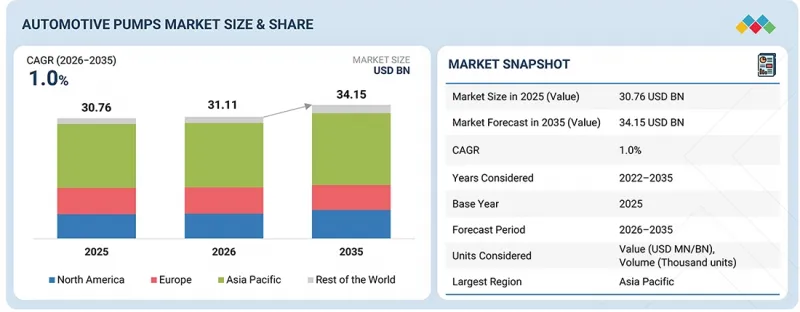
세계의 자동차용 펌프 시장 규모는 2026년 311억 1,000만 달러에서 2035년에는 341억 5,000만 달러로 확대되어 2026년에서 2035년까지 CAGR은 1.0%에 달할 것으로 예측됩니다.
| 조사 범위 | |
|---|---|
| 조사 대상 기간 | 2026-2035년 |
| 기준 연도 | 2025년 |
| 예측 기간 | 2026-2035년 |
| 대상 단위 | 10억 달러 |
| 부문 | 유형별, 기술별, 용량별, 용도별, 차종별, EV 유형별, 오프 하이웨이 차종별, 판매 채널별, 지역별 |
| 대상 지역 | 아시아태평양, 유럽, 북미 및 세계 기타 지역 |
가변 배기량 펌프의 채택 확대는 자동차용 펌프 시장을 견인하고 있습니다. 이는 각 OEM 업체들이 엔진을 대폭 재설계하지 않고도 내연기관(ICE) 및 하이브리드 파워트레인의 효율을 더욱 향상시키려 하고 있기 때문입니다. 가변 배기량 오일 펌프는 실제 주행 조건에서 유압 손실을 줄이기 위해 첨단 엔진 및 변속기 플랫폼에 통합되어 있으며, 제조사들이 점점 더 엄격해지는 연비 및 CO2 규제를 충족하는 데 기여하고 있습니다. 프리미엄 차량 및 고효율 차량 플랫폼에서의 채택 확대는 윤활 시스템의 가치를 높이고 전자 제어식 펌프 기술에 대한 수요를 견인하고 있는 반면, 비용 효율을 중시하는 차량 부문에서는 고정 배기량 펌프가 여전히 주류를 이루고 있습니다.
"예측 기간 동안 자동차용 펌프 시장에서는 기계식 펌프가 주도적인 위치를 차지할 것으로 예상됩니다."
예측 기간 동안 자동차용 펌프 시장을 주도할 것으로 예상되는 것은 기계식 펌프입니다. 이는 내연기관(ICE) 차량이 여전히 전 세계 차량 보유 대수 및 연간 생산 대수의 대부분을 차지하고 있으며, 엔진 구동식 워터 펌프, 오일 펌프, 연료 펌프, 진공 펌프가 필요하기 때문입니다. 벨트 또는 체인 구동식 기계식 펌프는 높은 유량, 입증된 내구성, 낮은 제조 비용을 갖추고 있어 주류 승용차, 소형 상용차 및 대형 트럭에서 선호되는 솔루션입니다. 엔진의 윤활 및 냉각수 순환은 특히 터보차저가 장착된 가솔린 엔진이나 디젤 엔진에서 지속적으로 이루어지는 기능으로, 견고하고 대용량의 기계식 펌프에 대한 수요를 지속적으로 뒷받침하고 있습니다. 기계식 오일 펌프 또한 가변 배기량 기술을 통해 진화하고 있으며, 엔진 구동에 의한 작동 신뢰성을 유지하면서 연비 효율을 향상시키고 있습니다. 전동 보조 펌프의 채택은 확대되고 있지만, 기존의 내연기관(ICE) 파워트레인에서는 기계식 펌프를 대체하기보다는 주로 보완하는 역할을 하고 있습니다. 또한, 전 세계에 다수 존재하는 내연기관(ICE) 차량의 도입 대수도 기계식 펌프의 애프터마켓을 견고하게 뒷받침하고 있습니다. 벨트 구동식 엔진의 경우, 정기적인 타이밍 벨트 교체 시 엔진 워터 펌프가 빈번하게 교체되는 반면, 기계식 오일 펌프는 엔진 점검이나 주행 거리가 긴 차량의 수리 시에 교체됩니다. 대조적으로, 전동식 냉각수 펌프는 일반적으로 수명이 길게 설계되어 있어 교체 빈도가 낮기 때문에 애프터마켓에서의 수요도 낮은 편입니다. 이러한 대규모 교체 시장과 내연기관(ICE)의 지속적인 생산이 맞물리면서 기계식 펌프 기술의 우위가 더욱 공고해지고 있습니다. SHW AG(독일), Rheinmetall AG(독일), Carter Fuel Systems LLC(미국), Concentric AB(영국) 등의 기업이 세계 유수의 OEM 제조사에 기계식 펌프를 공급하고 있습니다.
"예측 기간 동안 BEV 부문이 자동차용 펌프 시장을 주도할 것으로 예상됩니다."
예측 기간 동안 BEV 부문이 자동차용 펌프 시장을 주도할 것으로 예상됩니다. 엔진 냉각 및 윤활에 주로 엔진 구동식 기계식 펌프에 의존하는 내연기관(ICE) 차량과 달리, BEV에서는 개별 열 회로에 대응하기 위해 독립적으로 제어되는 여러 대의 전동식 냉각수 펌프가 사용되고 있어, 차량당 펌프 수와 전자 시스템의 복잡성이 모두 증가하고 있습니다. 800V 전기 아키텍처 및 초고속 충전으로의 전환에 따라 열 부하가 증가하고 있으며, 신속한 방열이 가능한 고유량·고효율 냉각수 펌프에 대한 수요가 확대되고 있습니다. 또한, 각 OEM 업체들은 펌프, 밸브, 열교환기, 히트 펌프를 연계하는 통합형 열 관리 시스템을 채택하여 주행 거리 극대화, 배터리 수명 연장 및 전반적인 에너지 효율 향상을 도모하고 있습니다. 더욱이, 급속 충전이나 한랭 지역 주행에 앞서 이루어지는 배터리 프리컨디셔닝에는 소프트웨어 제어를 통한 정밀한 냉각수 순환이 필요하며, 이로 인해 전동 펌프의 가치와 고도화가 더욱 진전되고 있습니다. 전 세계 BEV 생산이 확대됨에 따라 수요는 기존의 기계식 펌프에서 지능형 제어 전자 장치를 갖춘 고전압 브러시리스 전동 펌프로 전환되고 있으며, 열 관리는 차세대 전기자동차의 중요한 차별화 요소가 되고 있습니다. Tesla(미국), BYD(중국), Volkswagen AG(독일), SAIC Motors(중국), BYD(중국), Geely-Volvo(중국), Stellantis(네덜란드)를 비롯한 주요 OEM 각사는 시장의 수요에 부응하기 위해 BEV를 잇달아 출시하고 있습니다. 예를 들어, Bethel Automotive Safety Systems는 ARCFOX의 2026년형 ‘aT7 EV’ 및 ‘aT7 REEV’ 모델에 전동 진공 펌프를 공급했습니다.
"예측 기간 동안 유럽은 자동차용 펌프 시장에서 큰 시장 점유율을 차지할 것으로 예상됩니다."
유럽은 유로 7 배기가스 규제의 도입, 하이브리드 차량의 보급 확대, 그리고 첨단 열·유체 관리 시스템이 필요한 고급차 제조사들의 강력한 기반에 힘입어 자동차용 펌프의 주요 시장으로 자리매김할 것으로 예상됩니다. 유럽자동차산업협회(ACEA)에 따르면, 2025년에는 유럽연합(EU) 내 승용차 신규 등록 대수의 34.5%를 하이브리드차가 차지하여 최대의 파워트레인 부문이 될 것이며, 이에 따라 냉각수 펌프, 오일 펌프, 변속기 펌프 및 진공 펌프에 대한 수요가 증가하고 있습니다. 이러한 동향은 1차 자동차용 펌프 공급업체들에게 보다 효율적이고 전자 제어되는 펌프 시스템을 개발함으로써 유럽 OEM과의 공급 프로그램을 확대할 수 있는 큰 기회를 제공하고 있습니다. 이 지역의 주요 자동차용 펌프 제조업체로는 Robert Bosch GmbH, Aumovio SE, Valeo, SHW AG, ZF Friedrichshafen AG 등이 있습니다. 이들 제조업체는 전 세계 주요 OEM에 자동차용 펌프를 공급하고 있습니다. 예를 들어, Valeo(프랑스)는 DS Automobiles의 2026년형 ‘DS N°8’ 및 Jeep의 2026년형 ‘Compass’에 히트 펌프를 공급하고 있습니다.
자동차용 펌프 시장은 Denso Corporation(일본), Aisin Corporation(일본), Robert Bosch GmbH(독일), Aumovio SE(독일), Mitsubishi Electric Corporation(일본) 등의 주요 기업들이 주도하고 있습니다. 이 기업들은 전기자동차(EV) 대응에 발맞춰 제품 포트폴리오를 확대하고, 자동차용 펌프 시장 내 생태계에서의 입지를 강화하는 것을 목표로 하고 있습니다.
조사 범위:
본 보고서에서는 펌프의 종류, 기술, 차종, 전기자동차(EV)의 종류, 배기량, 판매 채널, 용도 및 지역별로 자동차용 펌프 시장을 분석하고 있습니다. 또한, 자동차용 펌프 시장 생태계의 주요 참여 기업에 대한 경쟁 현황 및 기업 개요에 대해서도 포괄적으로 다루고 있습니다.
또한, 본 조사에서는 주요 시장 참여 기업에 대한 상세한 경쟁 분석 외에도 각 기업 개요, 제품 및 사업 제공과 관련된 주요 관찰 사항, 최근 동향, 주요 시장 전략에 대해서도 다루고 있습니다.
본 보고서를 구매할 때의 주요 이점:
- 본 보고서는 자동차용 펌프 시장 전체 및 그 하위 부문의 매출액에 대한 가장 정확한 추정치를 제공함으로써, 시장 선도 기업 및 신규 진입 기업을 지원합니다.
- 본 보고서는 이해관계자가 경쟁 구도를 이해하고, 자사의 비즈니스를 더 나은 위치로 이끌며, 적절한 시장 진입 전략을 수립하기 위한 추가적인 인사이트를 얻는 데 도움이 됩니다.
- 또한, 본 보고서는 이해관계자가 시장 동향을 파악하는 데 도움을 주며, 주요 시장 촉진요인, 시장 억제요인, 과제 및 기회에 대한 정보를 제공합니다.
- 본 보고서는 이해관계자가 자동차용 펌프 시장의 현재 및 미래 가격 동향을 이해하는 데에도 도움이 됩니다.
본 보고서는 다음 사항에 대한 인사이트를 제공합니다:
- 주요 촉진요인(전기자동차 및 하이브리드 차량의 전동화와 열 관리의 복잡화, 통합형 열·유체 관리 모듈로의 전환), 제약요인(비용에 대한 높은 민감도 및 차량 플랫폼 간 표준화의 한계), 기회(상용차 및 비도로용 장비의 전동화, 소프트웨어 정의형 열 관리 시스템에서 통합 복잡성의 심화), 그리고 과제(고전압 및 급속 충전 조건 하에서의 열적 신뢰성 관리)에 대한 분석
- 제품 개발 및 혁신 : 자동차용 펌프 시장의 향후 기술, 연구 개발 활동, 그리고 제품 및 서비스 출시에 대한 상세한 인사이트
- 시장 개발 : 수익성이 높은 시장에 대한 종합적인 정보(본 보고서에서는 다양한 지역의 자동차용 펌프 시장을 분석하고 있습니다)
- 시장 다각화 : 자동차용 펌프 시장의 신제품·서비스, 미개척 지역, 최근 동향 및 투자에 관한 종합적인 정보
- 경쟁 분석 : 자동차용 펌프 시장에서 Denso Corporation(일본), Aisin Corporation(일본), Robert Bosch GmbH(독일), Aumovio SE(독일), Mitsubishi Electric Corporation(일본) 등 주요 기업의 시장 점유율, 성장 전략 및 서비스 제공 내용에 대한 상세한 평가
자주 묻는 질문
목차
제1장 소개
제2장 주요 요약
제3장 주요 인사이트
제4장 시장 개요
제5장 업계 동향
제6장 기술 진보, AI에 의한 영향, 특허, 혁신, 그리고 향후 응용
제7장 규제 상황과 지속가능성에 대한 대처
제8장 고객 상황과 구매 행동
제9장 OEM 및 티어 1 공급업체를 위한 전략적 고려사항
제10장 자동차용 펌프 시장(유형별)
제11장 자동차용 펌프 시장(기술별)
제12장 자동차용 펌프 시장(용량별)
제13장 자동차용 펌프 시장(용도별)
제14장 자동차용 펌프 시장(차종별)
제15장 자동차용 펌프 시장(EV 유형별)
제16장 자동차용 펌프 시장(오프 하이웨이 차종별)
제17장 자동차용 펌프 시장(판매 채널별)
제18장 자동차용 펌프 시장(지역별)
제19장 경쟁 구도
제20장 기업 개요
제21장 조사 방법
제22장 부록
KSM 26.08.03The global automotive pumps market is projected to grow from USD 31.11 billion in 2026 to USD 34.15 billion in 2035, at a CAGR of 1.0% from 2026 to 2035.
| Scope of the Report | |
|---|---|
| Years Considered for the Study | 2026-2035 |
| Base Year | 2025 |
| Forecast Period | 2026-2035 |
| Units Considered | USD billion |
| Segments | by Pump Type, Technology, Vehicle Type, EV Type, Displacement Type, Sales Channel, Application, and Region |
| Regions covered | Asia Pacific, Europe, North America, and Rest of the World |
The increasing adoption of variable-displacement pumps is supporting the automotive pumps market as OEMs seek additional efficiency gains from ICE and hybrid powertrains without major engine redesigns. Variable-displacement oil pumps are being integrated into advanced engine and transmission platforms to reduce hydraulic losses under real-world driving conditions, helping manufacturers meet increasingly stringent fuel economy and CO2 regulations. Their growing use in premium and high-efficiency vehicle platforms is increasing the value of lubrication systems and driving demand for electronically controlled pump technologies, while fixed-displacement pumps continue to dominate cost-sensitive vehicle segments.
"Mechanical pumps are expected to lead the automotive pumps market during the forecast period."
Mechanical pumps are expected to lead the automotive pumps market during the forecast period, as ICE vehicles still account for the majority of the global vehicle parc and annual production, requiring engine-driven water, oil, fuel, and vacuum pumps. Belt- or chain-driven mechanical pumps provide high flow rates, proven durability, and low manufacturing cost, making them the preferred solution for mainstream passenger cars, light commercial vehicles, and heavy-duty trucks. Engine lubrication and coolant circulation remain continuous functions, particularly in turbocharged gasoline and diesel engines, sustaining demand for robust, high-capacity mechanical pumps. Mechanical oil pumps are also evolving through variable-displacement technology, improving fuel efficiency while retaining the reliability of engine-driven operation. Although electric auxiliary pumps are gaining adoption, they primarily complement rather than replace mechanical pumps in conventional ICE powertrains. In addition, the large global installed base of ICE vehicles also supports a strong aftermarket for mechanical pumps. Engine water pumps are frequently replaced during scheduled timing-belt service on belt-driven engines, while mechanical oil pumps are replaced during engine overhaul or high-mileage repairs. In contrast, electric coolant pumps are generally designed for longer service life and are replaced less frequently, resulting in lower aftermarket demand. This large replacement market, combined with continued ICE production, reinforces the dominance of mechanical pump technologies. Companies such as SHW AG (Germany), Rheinmetall AG (Germany), Carter Fuel Systems LLC (US), and Concentric AB (UK) provide mechanical pumps to global leading OEMs.
"The BEV segment is expected to lead the automotive pumps market during the forecast period."
The BEV segment is expected to lead the automotive pumps market during the forecast period. Unlike ICE vehicles, which primarily rely on engine-driven mechanical pumps for engine cooling and lubrication, BEVs use multiple independently controlled electric coolant pumps to serve separate thermal circuits, increasing both pump count and electronic complexity per vehicle. The transition to 800 V electrical architectures and ultra-fast charging is generating higher thermal loads, driving demand for higher-flow, high-efficiency coolant pumps capable of rapid heat dissipation. OEMs are also adopting integrated thermal management systems that coordinate pumps, valves, heat exchangers, and heat pumps to maximize driving range, improve battery life, and enhance overall energy efficiency. In addition, battery pre-conditioning before fast charging and cold-weather operation requires precise, software-controlled coolant circulation, further increasing the value and sophistication of electric pumps. As global BEV production expands, demand is shifting from conventional mechanical pumps toward high-voltage brushless electric pumps with intelligent control electronics, making thermal management a key differentiator in next-generation electric vehicles. Leading OEMs, including Tesla (US), BYD (China), Volkswagen AG (Germany), SAIC Motors (China), BYD (China), Geely-Volvo (China), and Stellantis (Netherlands), are launching BEVs to cater to market demand. For instance, Bethel Automotive Safety Systems Co., Ltd. provided an electric vacuum pump to the ARCFOX for its 2026 aT7 EV and aT7 REEV vehicle models.
"Europe is expected to have a significant market share in the automotive pumps market during the forecast period."
Europe is expected to remain a key market for automotive pumps, driven by the implementation of Euro 7 emission regulations, growing hybrid vehicle adoption, and the region's strong base of premium vehicle manufacturers that require advanced thermal and fluid management systems. According to the European Automobile Manufacturers Association, in 2025, hybrid electric vehicles accounted for 34.5% of all new passenger car registrations in the European Union, making them the largest powertrain segment and increasing demand for coolant, oil, transmission, and vacuum pumps. These trends are creating significant opportunities for Tier 1 automotive pump suppliers to expand supply programs with European OEMs by developing more efficient and electronically controlled pump systems. Leading automotive pump manufacturers in the region include Robert Bosch GmbH, Aumovio SE, Valeo, SHW AG, and ZF Friedrichshafen AG. These manufacturers provide automobile pumps to major OEMs worldwide. For instance, Valeo (France) provides heat pumps to DS Automobiles for its 2026 DS N°8 model and Jeep for its 2026 Compass model.
In-depth interviews were conducted with CEOs, marketing directors, other innovation and technology directors, and executives from various key organizations operating in this market.
- By Company Type: Tier I - 52%, Tier II - 21%, and OEM - 27%
- By Designation: C- Level Executives - 47%, Directors - 37%, and Others - 16%
- By Region: Asia Pacific - 26%, North America - 32%, Europe - 36%, and Rest of the World - 6%
The automotive pumps market is dominated by major players, including Denso Corporation (Japan), Aisin Corporation (Japan), Robert Bosch GmbH (Germany), Aumovio SE (Germany), and Mitsubishi Electric Corporation (Japan). These companies are expanding their portfolios to align with EVs, aiming to strengthen their automotive pumps market ecosystem position.
Research Coverage:
The report covers the automotive pumps market by pump type, technology, vehicle type, EV type, displacement type, sales channel, application, and region. It covers the competitive landscape and company profiles of the major automotive pump market ecosystem players.
The study also includes an in-depth competitive analysis of the key market players, along with their company profiles, key observations related to product and business offerings, recent developments, and key market strategies.
Key Benefits of Buying the Report:
- The report will help market leaders/new entrants with information on the closest approximations of revenue numbers for the overall automotive pumps market and its subsegments.
- This report will help stakeholders understand the competitive landscape and gain more insights to position their businesses better and plan suitable go-to-market strategies.
- The report also helps stakeholders understand the market pulse and provides information on key market drivers, restraints, challenges, and opportunities.
- The report also helps stakeholders understand the current and future pricing trends of the automotive pumps market.
The report provides insight into the following pointers:
- Analysis of key drivers (electrification and thermal management complexity in EVs and hybrid vehicles, shift toward integrated thermal & fluid management modules), restraints (high cost sensitivity and limited standardization across vehicle platforms), opportunities (electrification of commercial vehicles and off-highway equipment, increasing integration complexity in software-defined thermal management systems), and challenges (managing thermal reliability under high-voltage and fast-charging conditions)
- Product Development/Innovation: Detailed insights into upcoming technologies, research & development activities, and product & service launches in the automotive pumps market
- Market Development: Comprehensive information about lucrative markets (the report analyzes the automotive pump market across varied regions)
- Market Diversification: Exhaustive information about new products & services, untapped geographies, recent developments, and investments in the automotive pumps market
- Competitive Assessment: In-depth assessment of market share, growth strategies, and service offerings of leading players such as Denso Corporation (Japan), Aisin Corporation (Japan), Robert Bosch GmbH (Germany), Aumovio SE (Germany), and Mitsubishi Electric Corporation (Japan), among others, in the automotive pumps market
TABLE OF CONTENTS
1 INTRODUCTION
- 1.1 STUDY OBJECTIVES
- 1.2 MARKET DEFINITION
- 1.3 STUDY SCOPE
- 1.3.1 MARKETS COVERED
- 1.3.2 INCLUSIONS AND EXCLUSIONS
- 1.4 YEARS CONSIDERED
- 1.5 CURRENCY CONSIDERED
- 1.6 UNIT CONSIDERED
- 1.7 STAKEHOLDERS
- 1.8 SUMMARY OF CHANGES
2 EXECUTIVE SUMMARY
- 2.1 KEY INSIGHTS & MARKET HIGHLIGHTS
- 2.2 KEY MARKET PARTICIPANTS: MAPPING OF STRATEGIC DEVELOPMENTS
- 2.3 DISRUPTIVE TRENDS SHAPING AUTOMOTIVE PUMPS MARKET
- 2.4 HIGH-GROWTH SEGMENTS
- 2.5 SNAPSHOT: GLOBAL MARKET SIZE, GROWTH RATE, AND FORECAST
3 PREMIUM INSIGHTS
- 3.1 ATTRACTIVE OPPORTUNITIES FOR PLAYERS IN AUTOMOTIVE PUMPS MARKET
- 3.2 AUTOMOTIVE PUMPS MARKET, BY REGION
- 3.3 AUTOMOTIVE PUMPS MARKET, BY TYPE
- 3.4 AUTOMOTIVE PUMPS MARKET, BY VEHICLE TYPE
- 3.5 AUTOMOTIVE PUMPS MARKET, BY TECHNOLOGY
- 3.6 AUTOMOTIVE PUMPS MARKET, BY DISPLACEMENT
- 3.7 AUTOMOTIVE PUMPS MARKET, BY EV TYPE
- 3.8 AUTOMOTIVE PUMPS MARKET, BY APPLICATION
- 3.9 AUTOMOTIVE PUMPS MARKET, BY SALES CHANNEL
- 3.10 AUTOMOTIVE PUMPS MARKET FOR OFF-HIGHWAY VEHICLES, BY TYPE
4 MARKET OVERVIEW
- 4.1 INTRODUCTION
- 4.2 MARKET DYNAMICS
- 4.2.1 DRIVERS
- 4.2.1.1 Electrification and thermal management complexity in EVs and hybrid vehicles
- 4.2.1.2 Shift toward integrated thermal & fluid management modules
- 4.2.2 RESTRAINTS
- 4.2.2.1 High cost sensitivity and limited standardization across vehicle platforms
- 4.2.3 OPPORTUNITIES
- 4.2.3.1 Electrification of commercial vehicles and off-highway equipment
- 4.2.3.2 Increase in integration complexity in software-defined thermal management systems
- 4.2.4 CHALLENGES
- 4.2.4.1 Managing thermal reliability under high-voltage and fast-charging conditions
- 4.2.1 DRIVERS
- 4.3 UNMET NEEDS AND WHITE SPACES
- 4.3.1 UNMET NEEDS IN AUTOMOTIVE PUMPS MARKET
- 4.3.2 WHITE SPACE OPPORTUNITIES
- 4.4 INTERCONNECTED MARKETS AND CROSS-SECTOR OPPORTUNITIES
- 4.4.1 INTERCONNECTED MARKETS
- 4.4.2 CROSS-SECTOR OPPORTUNITIES
- 4.5 STRATEGIC MOVES BY TIER 1/2/3 PLAYERS
5 INDUSTRY TRENDS
- 5.1 MACROECONOMIC INDICATORS
- 5.1.1 INTRODUCTION
- 5.1.2 GDP TRENDS AND FORECAST
- 5.1.3 TRENDS IN GLOBAL FLUID AND THERMAL MANAGEMENT MARKET
- 5.1.4 TRENDS IN GLOBAL AUTOMOTIVE INDUSTRY
- 5.2 ECOSYSTEM ANALYSIS
- 5.2.1 ORIGINAL EQUIPMENT MANUFACTURERS (OEMS)
- 5.2.2 AUTOMOTIVE PUMP MANUFACTURERS
- 5.2.3 AUTOMOTIVE PUMP COMPONENT SUPPLIERS
- 5.2.4 AFTERMARKET SUPPLIERS
- 5.3 EVOLUTION OF AUTOMOTIVE THERMAL MANAGEMENT ARCHITECTURES
- 5.3.1 TRANSITION FROM DISTRIBUTED TO CENTRALIZED AND SOFTWARE-CONTROLLED THERMAL MANAGEMENT SYSTEMS
- 5.3.2 IMPACT ON PUMP INTEGRATION AND VEHICLE EFFICIENCY
- 5.3.3 PLATFORM SCALABILITY FOR NEXT-GENERATION EVS
- 5.4 SUPPLY ANALYSIS
- 5.5 PRICING ANALYSIS
- 5.5.1 AVERAGE SELLING PRICE TREND, BY TYPE
- 5.5.2 AVERAGE SELLING PRICE TREND, BY REGION
- 5.5.2.1 Oil transmission pumps
- 5.5.2.2 Steering pumps
- 5.6 SUPPLIER ANALYSIS
- 5.6.1 DENSO CORPORATION
- 5.6.2 AISIN CORPORATION
- 5.6.3 AUMOVIO SE
- 5.6.4 ROBERT BOSCH GMBH
- 5.6.5 VALEO
- 5.7 BILL OF MATERIALS
- 5.7.1 OIL TRANSMISSION PUMPS
- 5.7.2 ELECTRO-HYDRAULIC STEERING PUMPS
- 5.7.3 COMPONENT COST ANALYSIS FOR BEV AND ICE VEHICLE PUMP SYSTEMS
- 5.8 INVESTMENT AND FUNDING SCENARIO
- 5.9 TRENDS AND DISRUPTIONS IMPACTING CUSTOMERS' BUSINESSES
- 5.10 CASE STUDY ANALYSIS
- 5.10.1 COGNITO PUMPS REDUCED ENERGY CONSUMPTION AND ENHANCED PROCESS RELIABILITY WITH ELECTRIC-OPERATED DOUBLE DIAPHRAGM PUMP TECHNOLOGY
- 5.10.2 VIKING PUMP AND ASCO POMPE ENABLED RELIABLE GEARBOX OIL TESTING THROUGH PRECISION FLUID HANDLING SOLUTIONS
- 5.10.3 GATES CORPORATION ADVANCED TRANSMISSION THERMAL MANAGEMENT WITH ELECTRIC WATER PUMP INNOVATION
- 5.10.4 CONCENTRIC AB ENABLED ENERGY-EFFICIENT THERMAL MANAGEMENT THROUGH ADVANCED ELECTRIC WATER PUMP TECHNOLOGY
- 5.10.5 ADVANCED TEST AND AUTOMATION INC. ENHANCED WATER PUMP RELIABILITY THROUGH ENGINEERING OPTIMIZATION
- 5.10.6 VARIABLE DISPLACEMENT GEAR OIL PUMP TECHNOLOGY ENHANCES EFFICIENCY AND RELIABILITY
- 5.10.7 HUBEI PROVINCIAL DEPARTMENT OF SCIENCE AND TECHNOLOGY IMPROVED ENGINE THERMAL MANAGEMENT WITH HIGH-EFFICIENCY COOLING WATER PUMP
- 5.11 TRADE DATA
- 5.11.1 IMPORT DATA (HS CODE 841330)
- 5.11.2 EXPORT DATA (HS CODE 841330)
- 5.12 KEY CONFERENCES AND EVENTS, 2026-2027
- 5.13 EUROPE-INDIA TRADE DEALS: IMPACT ANALYSIS
- 5.13.1 EU TARIFF
- 5.13.2 IMPORT TO INDIA
- 5.13.3 EXPORT FROM INDIA
- 5.14 IRAN-ISRAEL WAR IMPACT ON AUTOMOTIVE PUMPS MARKET
- 5.14.1 RAW MATERIAL, COMPONENT, AND MANUFACTURING COST TRENDS
- 5.14.2 AUTOMOTIVE PRODUCTION AND PUMP DEMAND TRENDS
- 5.14.3 SUPPLY-CHAIN DISRUPTIONS
- 5.14.3.1 Aluminum Castings and Precision Machining
- 5.14.3.2 Electric Motor Components and Electronics
- 5.14.3.3 Engineering Plastics, Bearings, and Sealing Systems
- 5.14.3.4 Shipping and logistics
- 5.14.4 REGIONAL/COUNTRY-LEVEL IMPACTS
- 5.14.4.1 Europe
- 5.14.4.2 South Korea and Japan
- 5.14.4.3 China
- 5.14.4.4 North America
- 5.15 AFTERMARKET AND REMANUFACTURING OPPORTUNITIES FOR AUTOMOTIVE PUMPS
- 5.15.1 AGING ICE PARC SUSTAINS PUMP REPLACEMENT DEMAND
- 5.15.2 ELECTRIC PUMPS CREATE A HIGH-VALUE AFTERMARKET
- 5.15.3 SKU CONSOLIDATION IMPROVES INVENTORY ECONOMICS
- 5.15.4 HIGH-VALUE PUMPS DRIVE REMANUFACTURING POTENTIAL
- 5.15.5 PREDICTIVE MAINTENANCE CREATES SERVICE REVENUE
- 5.16 EMERGENCE OF INTELLIGENT THERMAL CONTROL SYSTEMS
- 5.16.1 INTEGRATED THERMAL MANAGEMENT
- 5.16.2 MODULES & SMART PUMP SYSTEMS
- 5.16.3 SENSOR-DRIVEN THERMAL INTELLIGENCE
- 5.16.4 INTELLIGENT PUMP CONTROL SOFTWARE
- 5.16.5 INTEGRATION WITH BATTERY MANAGEMENT SYSTEMS (BMS)
- 5.17 EVOLUTION OF ELECTRIC PUMP TECHNOLOGIES
- 5.17.1 IMPACT OF EV ADOPTION AND POWERTRAIN TRANSITION
- 5.17.1.1 Shift from mechanical pumps to 48V/12V electric coolant and oil pumps
- 5.17.2 EMERGING FUNCTIONAL REQUIREMENTS IN BEVS
- 5.17.2.1 Battery thermal management pumps
- 5.17.2.2 HVAC pumps for cabin heat pump systems
- 5.17.2.3 High-efficiency coolant loops for batteries, motors, and power electronics
- 5.17.3 EVOLUTION OF INTELLIGENT ELECTRIC PUMP SYSTEMS
- 5.17.3.1 Smart/connected pumps with sensors and ECU integration
- 5.17.3.2 Predictive maintenance and software-controlled operation
- 5.17.3.3 Materials and efficiency improvements
- 5.17.1 IMPACT OF EV ADOPTION AND POWERTRAIN TRANSITION
6 TECHNOLOGICAL ADVANCEMENTS, AI-DRIVEN IMPACT, PATENTS, INNOVATIONS, AND FUTURE APPLICATIONS
- 6.1 PATENT ANALYSIS
- 6.2 KEY EMERGING TECHNOLOGIES
- 6.2.1 ELECTRIC POWER STEERING
- 6.2.2 NEW FUEL PUMP MODULES
- 6.3 COMPLEMENTARY TECHNOLOGIES
- 6.3.1 ELECTRIC COOLANT PUMPS WITH NON-SEALED PUMP MATERIALS
- 6.3.1.1 Shaft materials
- 6.3.1.2 Bearing materials
- 6.3.1 ELECTRIC COOLANT PUMPS WITH NON-SEALED PUMP MATERIALS
- 6.4 ADJACENT TECHNOLOGIES
- 6.4.1 POWER TRENDS IN ELECTRIC COOLANT PUMPS
- 6.5 TECHNOLOGY/PRODUCT ROADMAP
- 6.5.1 SHORT-TERM (2026-2027): FOUNDATION AND EARLY COMMERCIALIZATION
- 6.5.2 MID-TERM (2028-2030): EXPANSION AND STANDARDIZATION
- 6.5.3 LONG-TERM (2031-2035+): MASS COMMERCIALIZATION AND DISRUPTION
- 6.6 IMPACT OF AI/GEN AI
- 6.6.1 TOP USE CASES AND MARKET POTENTIAL
- 6.6.2 BEST PRACTICES FOLLOWED BY MANUFACTURERS
- 6.6.3 CASE STUDIES RELATED TO AI IMPLEMENTATION
- 6.6.3.1 AI-Based Software-Defined Thermal Management
- 6.6.3.2 AI-Assisted Component Design and Manufacturing Quality
- 6.6.4 INTERCONNECTED ECOSYSTEM AND IMPACT OF MARKET PLAYERS
- 6.6.5 CLIENTS' READINESS TO ADOPT AI
7 REGULATORY LANDSCAPE AND SUSTAINABILITY INITIATIVES
- 7.1 REGULATORY LANDSCAPE
- 7.1.1 REGULATORY FRAMEWORK
- 7.1.2 REGULATORY BODIES, GOVERNMENT AGENCIES, AND OTHER ORGANIZATIONS
- 7.1.2.1 North America
- 7.1.2.2 Europe
- 7.1.2.3 Asia Pacific
- 7.1.2.4 Rest of the World
- 7.2 SUSTAINABILITY INITIATIVES
- 7.3 IMPACT OF REGULATORY POLICIES ON SUSTAINABILITY INITIATIVES
8 CUSTOMER LANDSCAPE & BUYER BEHAVIOR
- 8.1 DECISION-MAKING PROCESS
- 8.2 BUYER STAKEHOLDERS AND BUYING EVALUATION CRITERIA
- 8.2.1 KEY STAKEHOLDERS IN BUYING PROCESS
- 8.2.2 BUYING CRITERIA
- 8.3 ADOPTION BARRIERS & INTERNAL CHALLENGES
- 8.4 UNMET NEEDS OF VARIOUS END-USE USERS/END-USE INDUSTRIES
9 STRATEGIC CONSIDERATIONS FOR OEMS AND TIER-1 SUPPLIERS
- 9.1 SYSTEM-LEVEL THERMAL MANAGEMENT AND PUMP INTEGRATION STRATEGY
- 9.1.1 INTEGRATING PUMPS WITH THERMAL MANAGEMENT AND SOFTWARE-DEFINED VEHICLE ARCHITECTURES
- 9.1.2 INTEGRATION WITH ZONAL ARCHITECTURES, CENTRAL VEHICLE CONTROLLERS, AND BMS
- 9.1.3 OPTIMIZATION OF PUMP CONTROL FOR ENERGY EFFICIENCY AND VEHICLE RANGE
- 9.2 NEXT-GENERATION PUMP SPECIFICATION ROADMAP
- 9.2.1 ENERGY BUDGETS FOR PUMPS IN NEXT-GENERATION BEVS
- 9.2.2 SCALABILITY OF PUMPS FOR DIFFERENT BATTERY SIZES
10 AUTOMOTIVE PUMPS MARKET, BY TYPE
- 10.1 INTRODUCTION
- 10.2 FUEL PUMPS
- 10.2.1 ELECTRIFICATION TRENDS DUE TO STRINGENT EMISSION REGULATIONS TO IMPEDE MARKET
- 10.3 WATER PUMPS
- 10.3.1 RAPID ADOPTION OF ELECTRIC AND HYBRID VEHICLES TO DRIVE MARKET
- 10.4 WINDSHIELD WASHER PUMPS
- 10.4.1 CONSUMER PREFERENCE FOR ENHANCED VEHICLE FEATURES TO DRIVE MARKET
- 10.5 STEERING PUMPS
- 10.5.1 INCREASED INSTALLATION OF HYDRAULIC SYSTEMS IN HEAVY COMMERCIAL VEHICLES TO DRIVE MARKET
- 10.6 OIL TRANSMISSION PUMPS
- 10.6.1 SHIFT TOWARD AUTOMATED TRANSMISSION TECHNIQUES TO DRIVE MARKET
- 10.7 FUEL INJECTION PUMPS
- 10.7.1 ADVANCEMENTS IN ENGINE TECHNOLOGY TO DRIVE MARKET
- 10.8 VACUUM PUMPS
- 10.8.1 SURGE IN DEMAND FOR LIGHTWEIGHT VEHICLE COMPONENTS TO DRIVE MARKET
- 10.9 HEADLIGHT WASHER PUMPS
- 10.9.1 RISE IN PREMIUM VEHICLE SALES TO DRIVE MARKET
- 10.10 KEY INDUSTRY INSIGHTS
11 AUTOMOTIVE PUMPS MARKET, BY TECHNOLOGY
- 11.1 INTRODUCTION
- 11.2 ELECTRIC PUMPS
- 11.2.1 COMPLIANCE WITH STRINGENT EMISSION NORMS TO DRIVE MARKET
- 11.3 MECHANICAL PUMPS
- 11.3.1 SHIFT TOWARD ELECTRIC PUMPS TO IMPEDE MARKET
- 11.4 KEY INDUSTRY INSIGHTS
12 AUTOMOTIVE PUMPS MARKET, BY DISPLACEMENT
- 12.1 INTRODUCTION
- 12.2 FIXED DISPLACEMENT PUMPS
- 12.2.1 EXTENSIVE USE IN AUTOMOTIVE APPLICATIONS DUE TO DURABILITY AND COST-EFFECTIVENESS TO DRIVE MARKET
- 12.3 VARIABLE DISPLACEMENT PUMPS
- 12.3.1 EMPHASIS ON REDUCING VEHICULAR EMISSIONS TO DRIVE MARKET
- 12.4 KEY INDUSTRY INSIGHTS
13 AUTOMOTIVE PUMPS MARKET, BY APPLICATION
- 13.1 INTRODUCTION
- 13.2 BODY & INTERIOR
- 13.2.1 INCREASING SALES OF SUVS TO DRIVE MARKET
- 13.3 ENGINE & HVAC
- 13.3.1 NEED FOR OPTIMAL ENGINE TEMPERATURES TO DRIVE MARKET
- 13.4 POWERTRAIN
- 13.4.1 ADVANCEMENTS IN TRANSMISSION TECHNOLOGIES TO DRIVE MARKET
- 13.5 KEY INDUSTRY INSIGHTS
14 AUTOMOTIVE PUMPS MARKET, BY VEHICLE TYPE
- 14.1 INTRODUCTION
- 14.2 PASSENGER CARS
- 14.2.1 RISING DEMAND FOR FUEL-EFFICIENT SYSTEMS TO DRIVE MARKET
- 14.3 LIGHT COMMERCIAL VEHICLES
- 14.3.1 FOCUS ON REDUCING OPERATIONAL COSTS TO DRIVE MARKET
- 14.4 BUSES
- 14.4.1 CONSUMER INCLINATION TOWARD SUSTAINABLE PUBLIC TRANSPORTATION SOLUTIONS TO DRIVE MARKET
- 14.5 TRUCKS
- 14.5.1 PUSH FOR ENHANCED FUEL EFFICIENCY AND LOWER EMISSIONS TO DRIVE MARKET
- 14.6 KEY INDUSTRY INSIGHTS
15 AUTOMOTIVE PUMPS MARKET, BY EV TYPE
- 15.1 INTRODUCTION
- 15.2 BATTERY ELECTRIC VEHICLES
- 15.2.1 HEIGHTENED DEMAND FOR LOW-EMISSION COMMUTING TO DRIVE MARKET
- 15.3 HYBRID ELECTRIC VEHICLES
- 15.3.1 FOCUS ON REDUCING ENVIRONMENTAL IMPACT AND FUEL COSTS TO DRIVE MARKET
- 15.4 PLUG-IN HYBRID VEHICLES
- 15.4.1 TAX BENEFITS AND GOVERNMENT INCENTIVES TO DRIVE MARKET
- 15.5 FUEL CELL ELECTRIC VEHICLES
- 15.6 KEY INDUSTRY INSIGHTS
16 AUTOMOTIVE PUMPS MARKET, BY OFF-HIGHWAY VEHICLE TYPE
- 16.1 INTRODUCTION
- 16.2 CONSTRUCTION EQUIPMENT
- 16.3 MINING EQUIPMENT
- 16.4 KEY INDUSTRY INSIGHTS
17 AUTOMOTIVE PUMPS MARKET, BY SALES CHANNEL
- 17.1 INTRODUCTION
- 17.2 OEM
- 17.2.1 INCREASING INVESTMENTS IN PRODUCT R&D TO DRIVE MARKET
- 17.3 AFTERMARKET
- 17.3.1 ONGOING TECHNOLOGICAL INNOVATIONS TO DRIVE MARKET
- 17.4 KEY INDUSTRY INSIGHTS
18 AUTOMOTIVE PUMPS MARKET, BY REGION
- 18.1 INTRODUCTION
- 18.2 ASIA PACIFIC
- 18.2.1 CHINA
- 18.2.1.1 High production and sales volume of vehicles to drive market
- 18.2.2 INDIA
- 18.2.2.1 Government policies promoting electric vehicles to drive market
- 18.2.3 JAPAN
- 18.2.3.1 The significant presence of automotive pump manufacturers drives the market
- 18.2.4 SOUTH KOREA
- 18.2.4.1 Shift toward next-generation technologies to drive the market
- 18.2.5 THAILAND
- 18.2.5.1 Strong export activities to drive market
- 18.2.6 REST OF ASIA PACIFIC
- 18.2.1 CHINA
- 18.3 EUROPE
- 18.3.1 FRANCE
- 18.3.1.1 Extensive use of fuel-efficient vehicles to drive market
- 18.3.2 GERMANY
- 18.3.2.1 Early introduction of advanced automotive technologies to drive the market
- 18.3.3 RUSSIA
- 18.3.3.1 Construction of new manufacturing facilities to drive market
- 18.3.4 SPAIN
- 18.3.4.1 Growing adoption of electric fleets is driving the market
- 18.3.5 TURKEY
- 18.3.5.1 Rising FDI flow in the automotive industry to drive the market
- 18.3.6 UK
- 18.3.6.1 Surge in domestic production of electric vehicles to drive market
- 18.3.7 REST OF EUROPE
- 18.3.1 FRANCE
- 18.4 NORTH AMERICA
- 18.4.1 CANADA
- 18.4.1.1 Increasing investments in zero-emission vehicles to drive market
- 18.4.2 MEXICO
- 18.4.2.1 Growing production capacity of light and heavy vehicles to drive market
- 18.4.3 US
- 18.4.3.1 Government push for adopting fuel-efficient vehicles to drive market
- 18.4.1 CANADA
- 18.5 REST OF THE WORLD
- 18.5.1 BRAZIL
- 18.5.1.1 Low manufacturing and labor costs to drive market
- 18.5.2 IRAN
- 18.5.2.1 Expanding automotive industry drives the market
- 18.5.3 SOUTH AFRICA
- 18.5.3.1 Rising demand for emission-free vehicles to drive market
- 18.5.1 BRAZIL
19 COMPETITIVE LANDSCAPE
- 19.1 INTRODUCTION
- 19.2 KEY PLAYER STRATEGIES/RIGHT TO WIN, 2022-2026
- 19.3 MARKET SHARE ANALYSIS, 2025
- 19.4 REVENUE ANALYSIS, 2021-2025
- 19.5 COMPANY VALUATION AND FINANCIAL METRICS
- 19.6 BRAND/PRODUCT COMPARISON
- 19.7 COMPANY EVALUATION MATRIX: KEY PLAYERS, 2025
- 19.7.1 STARS
- 19.7.2 EMERGING LEADERS
- 19.7.3 PERVASIVE PLAYERS
- 19.7.4 PARTICIPANTS
- 19.7.5 COMPANY FOOTPRINT
- 19.7.5.1 Company footprint
- 19.7.5.2 Regional footprint
- 19.7.5.3 Application footprint
- 19.7.5.4 Vehicle type footprint
- 19.7.5.5 Technology footprint
- 19.8 COMPANY EVALUATION MATRIX: STARTUPS/SMES, 2025
- 19.8.1 PROGRESSIVE COMPANIES
- 19.8.2 RESPONSIVE COMPANIES
- 19.8.3 DYNAMIC COMPANIES
- 19.8.4 STARTING BLOCKS
- 19.8.5 COMPETITIVE BENCHMARKING
- 19.8.5.1 List of start-ups/SMEs
- 19.8.5.2 Competitive benchmarking of start-ups/SMEs
- 19.9 COMPETITIVE SCENARIO
- 19.9.1 PRODUCT LAUNCHES/DEVELOPMENTS
- 19.9.2 DEALS
- 19.9.3 EXPANSIONS
- 19.9.4 OTHER DEVELOPMENTS
20 COMPANY PROFILES
- 20.1 KEY PLAYERS
- 20.1.1 DENSO CORPORATION
- 20.1.1.1 Business overview
- 20.1.1.2 Products offered
- 20.1.1.3 Recent developments
- 20.1.1.3.1 Product launches/developments
- 20.1.1.3.2 Deals
- 20.1.1.4 MnM view
- 20.1.1.4.1 Key strengths
- 20.1.1.4.2 Strategic choices
- 20.1.1.4.3 Weaknesses and competitive threats
- 20.1.2 AISIN CORPORATION
- 20.1.2.1 Business overview
- 20.1.2.2 Products offered
- 20.1.2.3 Recent developments
- 20.1.2.3.1 Other developments
- 20.1.2.4 MnM view
- 20.1.2.4.1 Key strengths
- 20.1.2.4.2 Strategic choices
- 20.1.2.4.3 Weaknesses and competitive threats
- 20.1.3 AUMOVIO SE
- 20.1.3.1 Business overview
- 20.1.3.2 Products offered
- 20.1.3.3 MnM view
- 20.1.3.3.1 Key strengths
- 20.1.3.3.2 Strategic choices
- 20.1.3.3.3 Weaknesses and competitive threats
- 20.1.4 ROBERT BOSCH GMBH
- 20.1.4.1 Business overview
- 20.1.4.2 Products offered
- 20.1.4.3 Recent developments
- 20.1.4.3.1 Deals
- 20.1.4.3.2 Other developments
- 20.1.4.4 MnM view
- 20.1.4.4.1 Key strengths
- 20.1.4.4.2 Strategic choices
- 20.1.4.4.3 Weaknesses and competitive threats
- 20.1.5 MITSUBISHI ELECTRIC CORPORATION
- 20.1.5.1 Business overview
- 20.1.5.2 Products offered
- 20.1.5.3 MnM view
- 20.1.5.3.1 Key strengths
- 20.1.5.3.2 Strategic choices
- 20.1.5.3.3 Weaknesses and competitive threats
- 20.1.6 VALEO
- 20.1.6.1 Business overview
- 20.1.6.2 Products offered
- 20.1.6.3 Recent developments
- 20.1.6.3.1 Product launches/developments
- 20.1.6.3.2 Deals
- 20.1.6.3.3 Other developments
- 20.1.7 JOHNSON ELECTRIC HOLDINGS LIMITED
- 20.1.7.1 Business overview
- 20.1.7.2 Products offered
- 20.1.7.3 Recent developments
- 20.1.7.3.1 Other developments
- 20.1.8 SHW AG
- 20.1.8.1 Business overview
- 20.1.8.2 Products offered
- 20.1.8.3 Recent developments
- 20.1.8.3.1 Other developments
- 20.1.9 ZF FRIEDRICHSHAFEN AG
- 20.1.9.1 Business overview
- 20.1.9.2 Products offered
- 20.1.9.3 Recent developments
- 20.1.9.3.1 Expansions
- 20.1.10 ASTEMO, LTD.
- 20.1.10.1 Business overview
- 20.1.10.2 Products offered
- 20.1.10.3 Recent developments
- 20.1.10.3.1 Other developments
- 20.1.11 RHEINMETALL AG
- 20.1.11.1 Business overview
- 20.1.11.2 Products offered
- 20.1.11.3 Recent developments
- 20.1.11.3.1 Product launches/developments
- 20.1.11.3.2 Other developments
- 20.1.12 MAGNA INTERNATIONAL INC.
- 20.1.12.1 Business overview
- 20.1.12.2 Products offered
- 20.1.12.3 Recent developments
- 20.1.12.3.1 Other developments
- 20.1.1 DENSO CORPORATION
- 20.2 OTHER PLAYERS
- 20.2.1 MIKUNI CORPORATION
- 20.2.2 GMB CORPORATION
- 20.2.3 PRICOL LIMITED
- 20.2.4 MAHLE GMBH
- 20.2.5 MARELLI HOLDINGS CO., LTD.
- 20.2.6 CUMMINS INC.
- 20.2.7 INFINEON TECHNOLOGIES AG
- 20.2.8 HELLA GMBH & CO. KGAA
- 20.2.9 TI FLUID SYSTEMS
- 20.2.10 CARTER FUEL SYSTEMS, LLC
- 20.2.11 BORGWARNER INC.
- 20.2.12 STANDARD MOTOR PRODUCTS, INC.
- 20.2.13 EATON
- 20.2.14 MTQ ENGINE SYSTEMS (AUST) PTY LTD
- 20.2.15 TRICO CORPORATION
- 20.2.16 SCHAEFFLER AG
- 20.2.17 CONCENTRIC AB
- 20.2.18 JTEKT CORPORATION
21 RESEARCH METHODOLOGY
- 21.1 RESEARCH DATA
- 21.1.1 SECONDARY DATA
- 21.1.1.1 Secondary sources
- 21.1.2 PRIMARY DATA
- 21.1.2.1 Key industry insights and breakdown of primary interviews
- 21.1.2.2 Breakdown of primary interviews
- 21.1.2.3 List of primary participants
- 21.1.1 SECONDARY DATA
- 21.2 MARKET SIZE ESTIMATION
- 21.2.1 BOTTOM-UP APPROACH
- 21.2.2 TOP-DOWN APPROACH
- 21.3 DATA TRIANGULATION
- 21.4 FACTOR ANALYSIS
- 21.5 RESEARCH ASSUMPTIONS
- 21.6 RESEARCH LIMITATIONS
- 21.7 RISK ASSESSMENT
22 APPENDIX
- 22.1 DISCUSSION GUIDE
- 22.2 KNOWLEDGESTORE: MARKETSANDMARKETS' SUBSCRIPTION PORTAL
- 22.3 CUSTOMIZATION OPTIONS
- 22.3.1 ADDITIONAL COMPANY PROFILES (UPTO 5)
- 22.3.2 DETAILED ANALYSIS OF AUTOMOTIVE PUMPS MARKET, BY ELECTRIC COMMERCIAL VEHICLE
- 22.3.3 DETAILED ANALYSIS OF AUTOMOTIVE PUMPS MARKET, BY DISPLACEMENT
- 22.3.4 DETAILED ANALYSIS OF AUTOMOTIVE OIL TRANSMISSION AND STEERING PUMPS MARKET
- 22.4 RELATED REPORTS
- 22.5 AUTHOR DETAILS


