

|
시장보고서
상품코드
2105654
생성형 AI 시장 예측(-2033년) : 제공 형태(기반 모델, 생성형 AI 코파일럿, 생성형 AI 액셀러레이터, 생성형 AI 메모리), 데이터 모달리티(텍스트, 영상, 멀티모달), 용도별(컨텐츠 생성, 자율적 태스크 수행, 코드 생성)Generative AI Market by Offering (Foundation Models, Gen AI Co-pilots, Gen AI Accelerators, Gen AI Memory), Data Modality (Text, Video, Multimodal), Application (Content Generation, Autonomous Task Execution, Code Generation) - Global Forecast to 2033 |
||||||

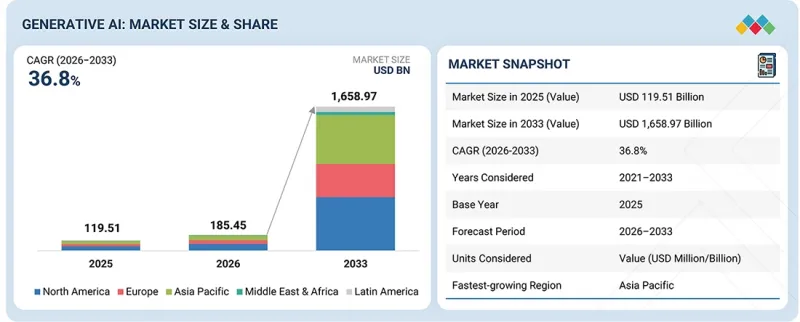
생성형 AI 시장 규모는 2026년에 1,854억 5,000만 달러로 추계되고 있으며, 2033년에는 1조 6,589억 7,000만 달러에 달할 것으로 예측됩니다.
예측 기간 중 연평균 성장률(CAGR)은 36.8%에 달할 것으로 보입니다.
이러한 성장은 기업 소프트웨어, 고객 대응 업무, 소프트웨어 엔지니어링, 분석, 연구개발, 워크플로우 자동화 등의 분야에서 실험적인 사용 사례에서 실제 운영 수준의 도입으로 전환되고 있는 점이 지원하고 있습니다. AI 가속기, 클라우드 인프라, 모델 개발 플랫폼, 기업 코파일럿, 멀티모달 시스템, 에이전트형 AI에 대한 투자가 증가하면서 기술 스택 전반에 걸쳐 수요를 창출하고 있습니다.
| 조사 범위 | |
|---|---|
| 조사 대상 기간 | 2021-2033년 |
| 기준연도 | 2025년 |
| 예측 기간 | 2026-2033년 |
| 단위 | 금액(달러) |
| 부문 | 제공 형태, 데이터 모달리티, 용도, 최종사용자, 지역 |
| 대상 지역 | 북미, 유럽, 아시아태평양, 중동 및 아프리카, 라틴아메리카 |
동시에 기업은 생성형 AI를 실제 운영 환경에서 신뢰할 수 있게 만들기 위해 통합, 맞춤화, 보안, 거버넌스, 모니터링, 관리형 서비스에 대한 지출을 늘리고 있습니다. 그러나 높은 인프라 비용, 데이터 개인정보 보호 위험, 불확실한 투자 수익률(ROI), 모델의 환각 현상, 지적 재산권에 대한 우려, 끊임없이 변화하는 규제 등으로 인해 규제가 엄격하거나 위험에 민감한 산업에서는 도입 속도가 둔화될 가능성이 있습니다.
"자율적 실행에 대한 기업의 수요로 인해 예측 기간 중 워크플로우 자동화가 가장 빠르게 확대될 것으로 전망됩니다."
기업이 단순히 컨텐츠나 권장사항을 생성하는 데 그치는 생성형 AI 시스템을 넘어서는 가운데, 자율적 작업 실행 및 워크플로 자동화 부문은 예측 기간 중 가장 높은 연평균 성장률(CAGR)을 기록할 것으로 예상됩니다. 에이전트형 시스템은 작업 계획, 기업 애플리케이션과의 연동, 조직 데이터 수집, 외부 툴 활용, 인적 개입을 최소화한 다단계 프로세스 완료를 목적으로 점점 더 많이 설계되고 있습니다. 이러한 변화로 인해 고객 서비스, 재무 업무, 조달, 소프트웨어 개발, IT 서비스 관리, 조사, 영업 지원, 관리 업무의 워크플로우에서 도입이 확대되고 있습니다. 또한 이 부문의 성장은 에이전트 오케스트레이션, 실행 환경, 메모리, ID 관리, 권한, 가시성, 평가, 수동 승인 메커니즘에 대한 수요에 의해서도 지원될 것입니다. 자율 실행과 기업급 거버넌스 및 시스템 통합을 결합할 수 있는 벤더는 신흥 지출 시장에서 큰 점유율을 확보할 가능성이 높습니다.
"소프트웨어 개발, 매니지드 서비스, 디지털 딜리버리 분야의 조기 도입으로 인해 2026년에도 IT 및 ITeS는 최종사용자 점유율 측면에서 선두를 유지할 것으로 예상됩니다."
IT 및 ITeS 부문은 2026년 생성형 AI 시장에서 가장 큰 점유율을 차지할 것으로 예상됩니다. 이는 기술 제공업체와 서비스 기업이 생성형 AI 솔루션의 주요 사용자일 뿐만 아니라, 그 상용 공급업체이기도 하기 때문입니다. 이러한 기업은 코드 생성, 소프트웨어 테스트, 애플리케이션 현대화, 기술 지원, 지식 검색, 문서 작성, 클라우드 운영, 관리형 서비스 제공에 생성형 AI를 활용하고 있습니다. 또한 이 기업은 다양한 산업 분야의 고객에게 제공하는 플랫폼, 애플리케이션, 컨설팅 업무, 아웃소싱 계약에 생성형 AI를 통합하고 있습니다. 이 부문은 우수한 기술 인재, 확립된 클라우드 및 소프트웨어 생태계, 대규모 기업 고객 기반, 그리고 지역을 초월하여 재현 가능한 사용 사례를 확장할 수 있는 능력 등의 강점을 활용하고 있습니다. 코파일럿, 개발자용 어시스턴트, 에이전트형 플랫폼, AI를 활용한 서비스 제공 모델의 조기 상용화를 통해 그 주도적 위상은 더욱 공고해지고 있습니다.
"2026년에도 북미는 강력한 인프라 투자와 벤더의 집중으로 인해 생성형 AI 시장에서 최대 규모를 유지할 것으로 예상되는 반면, 아시아태평양은 국가 주도의 AI 구상과 기업 차원의 도입이 가속화되는 가운데, 2026-2033년에 가장 급속한 성장을 이룰 것으로 예상됩니다."
북미는 하이퍼스케일 클라우드 제공업체, 반도체 기업, 기반 모델 개발자, 기업 소프트웨어 벤더, 연구 기관, 벤처 캐피털 지원 스타트업이 해당 지역에 집중되어 있는 것을 배경으로, 2026년 생성형 AI 시장에서 가장 큰 점유율을 차지할 것으로 예상됩니다. 미국에는 액셀러레이터, 클라우드 인프라, 모델, 개발 플랫폼, 코파일럿, 거버넌스 툴, 전문 서비스에 이르기까지 전 세계 생성형 AI 스택을 형성하는 많은 기업이 거점을 두고 있습니다. 데이터센터, AI 서버, 네트워크, 에너지 인프라에 대한 지속적인 투자 또한 훈련 및 추론 능력에 대한 수요 증가를 지원하고 있습니다. 따라서 북미의 우위는 기술 공급에 그치지 않고, 사내 업무 및 고객용 애플리케이션용 생성형 AI 상용화에 적극적인 대규모 기업 고객 기반에도 반영되어 있습니다.
아시아태평양은 각국 정부, 클라우드 제공업체, 통신사, 대기업이 국내 AI 역량에 대한 투자를 확대함에 따라 예측 기간 중 생성형 AI 시장에서 가장 빠른 성장을 기록할 것으로 전망됩니다. 주권 AI 프로그램은 국내 모델 개발, 인프라 현지화, 기업 및 공공 부문 데이터에 대한 관리 강화를 촉진하고 있습니다. 이 지역의 방대한 디지털 사용자 기반은 상거래, 고객 서비스, 교육, 금융 서비스, 제조, 미디어, 소프트웨어 개발 등 각 분야에서 큰 사업 기회를 창출하고 있습니다. 또한 중견 기업의 도입 장벽을 낮추는 저비용 모델, 관리형 플랫폼, 산업별 특화 솔루션의 이용 가능성이 높아지고 있는 점도 성장을 지원하고 있습니다.
이 보고서에서는 전 세계 생성형 AI 시장을 조사하여, 시장 개요, 시장 성장에 영향을 미치는 다양한 요인에 대한 분석, 기술 및 특허 동향, 법규제 환경, 사례 연구, 시장 규모 추이 및 전망, 각종 분류·지역/주요 국가별 상세 분석, 경쟁 구도, 주요 기업 개요 등을 종합적으로 다루고 있습니다.
자주 묻는 질문
목차
제1장 서론
제2장 개요
제3장 주요 인사이트
제4장 시장 개요
제5장 업계 동향
제6장 기술의 진보, 특허, 혁신, 향후 응용
제7장 관세 분석과 규제 상황
제8장 고객 상황과 구매 행동
제9장 생성형 AI 시장 : 제공 형태별
제10장 생성형 AI 시장 : 인프라별
제11장 생성형 AI 시장 : 소프트웨어별
제12장 생성형 AI 시장 : 서비스별
제13장 생성형 AI 시장 : 데이터 모달리티별
제14장 생성형 AI 시장 : 용도별
제15장 생성형 AI 시장 : 최종사용자별
제16장 생성형 AI 시장 : 지역별
제17장 경쟁 구도
제18장 기업 개요
제19장 조사 방법
제20장 인접 시장 및 관련 시장
제21장 부록
KSA 26.08.19The generative AI market is estimated at USD 185.45 billion in 2026 and is projected to reach USD 1,658.97 billion by 2033, registering a CAGR of 36.8% during the forecast period. Growth is being supported by the transition from experimental use cases to production-grade deployments across enterprise software, customer operations, software engineering, analytics, research, and workflow automation. Rising investments in AI accelerators, cloud infrastructure, model-development platforms, enterprise copilots, multimodal systems, and agentic AI are creating demand across the full technology stack.
| Scope of the Report | |
|---|---|
| Years Considered for the Study | 2021-2033 |
| Base Year | 2025 |
| Forecast Period | 2026-2033 |
| Units Considered | Value (USD Billion) |
| Segments | Offering, Data Modality, Application, End User, and Region |
| Regions covered | North America, Europe, Asia Pacific, Middle East & Africa, and Latin America |
At the same time, enterprises are increasing spending on integration, customization, security, governance, monitoring, and managed services to make generative AI reliable in real-world operating environments. However, high infrastructure costs, data privacy risks, uncertain return on investment, model hallucinations, intellectual-property concerns, and evolving regulations may slow adoption in highly regulated or risk-sensitive industries.
"Enterprise demand for autonomous execution is expected to propel workflow automation as the fastest-expanding application during the forecast period"
The autonomous task execution & workflow automation segment is expected to record the highest CAGR during the forecast period as enterprises move beyond generative AI systems that only produce content or recommendations. Agentic systems are increasingly being designed to plan tasks, interact with enterprise applications, retrieve organizational data, use external tools, and complete multistep processes with limited human intervention. This shift is expanding adoption across customer service, finance operations, procurement, software development, IT service management, research, sales support, and administrative workflows. Growth in this segment will also be supported by demand for agent orchestration, runtime environments, memory, identity management, permissions, observability, evaluation, and human-approval mechanisms. Vendors that can combine autonomous execution with enterprise-grade governance and system integration are likely to capture a significant share of emerging spending.
"Early adoption across software development, managed services, and digital delivery is expected to keep IT & ITeS at the forefront of end-user share in 2026"
The IT & ITeS segment is expected to hold the largest share of the generative AI market in 2026 because technology providers and service firms are both major users and commercial suppliers of generative AI solutions. These companies use generative AI for code generation, software testing, application modernization, technical support, knowledge retrieval, documentation, cloud operations, and managed service delivery. They also embed generative AI into platforms, applications, consulting engagements, and outsourcing contracts delivered to clients across multiple industries. The segment benefits from strong technical talent, established cloud and software ecosystems, large enterprise customer bases, and the ability to scale repeatable use cases across geographies. Early commercialization of copilots, developer assistants, agentic platforms, and AI-enabled service delivery models further strengthens its leadership position.
"North America remains the largest generative AI market in 2026 due to strong infrastructure investment and vendor concentration, while Asia Pacific is the fastest-growing between 2026 and 2033 as sovereign AI initiatives and enterprise adoption accelerate"
North America is expected to account for the largest share of the generative AI market in 2026, supported by the region's concentration of hyperscale cloud providers, semiconductor companies, foundation-model developers, enterprise software vendors, research institutions, and venture-backed startups. The US hosts several of the companies shaping the global generative AI stack, spanning accelerators, cloud infrastructure, models, development platforms, copilots, governance tools, and professional services. Continued investment in data centers, AI servers, networking, and energy infrastructure is also supporting higher demand for training and inference capacity. North America's advantage is therefore not limited to technology supply; it also reflects a large base of enterprise buyers willing to commercialize generative AI across internal operations and customer-facing applications.
Asia Pacific is projected to register the fastest growth in the generative AI market during the forecast timeline as governments, cloud providers, telecommunications companies, and large enterprises increase investment in domestic AI capabilities. Sovereign AI programs are encouraging domestic model development, localized infrastructure, and greater control over enterprise and public-sector data. The region's large digital user base creates substantial opportunities across commerce, customer service, education, financial services, manufacturing, media, and software development. Growth is also supported by the increasing availability of lower-cost models, managed platforms, and industry-specific solutions that reduce adoption barriers for mid-sized enterprises.
Breakdown of Primaries
In-depth interviews were conducted with chief executive officers (CEOs), innovation and technology directors, system integrators, and executives from various key organizations operating in the generative AI market.
- By Company: Tier 1 - 38%, Tier 2 - 20%, and Tier 3 - 42%
- By Designation: Directors - 31%, Managers - 46%, and Others - 23%
- By Region: North America - 48%, Europe - 18%, Asia Pacific - 23%, Middle East & Africa - 4%, and Latin America - 7%
AWS (US), Microsoft (US), Google (US), NVIDIA (US), OpenAI (US), Anthropic (US), Meta (US), IBM (US), Salesforce (US), Accenture (Ireland), AMD (US), Broadcom (US), Qualcomm (US), Intel (US), Cisco (US), Micron (US), SK Hynix (South Korea), Dell Technologies (US), Mistral AI (France), Cohere (Canada), xAI (US), DeepSeek AI (China), Midjourney (US), Databricks (US), Snowflake (US), Hugging Face (US), LlamaIndex (US), Weights & Biases (US), Credo AI (US), Lakera (Switzerland), Protect AI (US), HiddenLayer (US), Lasso Security (Israel), LangChain (US), CrewAI (US), Kore.ai (US), Cognigy (Germany), UiPath (US), Adobe (US), ServiceNow (US), SAP (Germany), Oracle (US), Perplexity AI (US), Harvey (US), Deloitte (UK), TCS (India), Infosys (India), HCLTech (India), Cognizant (US), and EPAM Systems (US) are some of the key players in the generative AI market.
The study includes an in-depth competitive analysis of these key players in the generative AI market, with their company profiles, recent developments, and key market strategies.
Research Coverage
This research report categorizes the generative AI market by offering (infrastructure, software, and services), application (content generation & management, knowledge management & discovery, code generation & software engineering, generative analytics & insight generation, synthetic data generation, autonomous task execution & workflow automation, generative design & simulation, other applications), data modality (text, image, video, audio & speech, code, 3D & simulation content, multimodal), end user (consumers, enterprises {BFSI, retail & consumer goods, government, defense & national security, healthcare, pharmaceuticals, & life sciences, manufacturing & industrial, telecommunications, energy & utilities, transportation & logistics, media & entertainment, IT & ITeS, professional services, education, other enterprises}), and region (North America, Europe, Asia Pacific, Middle East & Africa, and Latin America). The scope of the report covers detailed information regarding the major factors, such as drivers, restraints, challenges, and opportunities, influencing the growth of the generative AI market. A detailed analysis of key industry players has been provided to offer insights into their business overview, solutions and services, key strategies, contracts, partnerships, agreements, new product & service launches, mergers and acquisitions, and recent developments in the generative AI market. This report also covers competitive analysis of upcoming startups in the generative AI market ecosystem.
Reasons to Buy This Report
The report will provide market leaders and new entrants with information on the closest approximations of the revenue numbers for the overall generative AI market and its subsegments. It will help stakeholders understand the competitive landscape and gain insights to better position their business and plan suitable go-to-market strategies. It also helps stakeholders understand the pulse of the market and provides them with information on key market drivers, restraints, challenges, and opportunities.
The report provides insights into the following pointers:
- Analysis of key drivers (Rapid enterprise adoption of generative AI copilots and AI-enabled workflows; advancements in multimodal, reasoning, and context-aware foundation models; declining model inference costs and improving compute efficiency; growing demand for automation across content creation, software development, knowledge management, and analytics), restraints (High cost of compute infrastructure, model training, and large-scale inference; data privacy, intellectual property, and regulatory compliance concerns), opportunities (Expansion of agentic AI and autonomous multi-step workflow orchestration; development of domain-specific, small, and customized generative AI models; rising demand for sovereign, localized, and industry-compliant generative AI solutions), and challenges (Ensuring accuracy, reliability, explainability, and consistency of model outputs; mitigating prompt injection, data poisoning, model abuse, and other generative AI security risks)
- Product Development/Innovation: Detailed insights into upcoming technologies, research & development activities, and product & service launches in the generative AI market
- Market Development: Comprehensive information about lucrative markets - analysis of the generative AI market across varied regions
- Market Diversification: Exhaustive information about new products & services, untapped geographies, recent developments, and investments in the generative AI market
- Competitive Assessment: In-depth assessment of market shares, growth strategies and product portfolios of AWS (US), Microsoft (US), Google (US), NVIDIA (US), OpenAI (US), Anthropic (US), DeepSeek AI (China), Midjourney (US), Hugging Face (US), and LlamaIndex (US), among others, in the generative AI market
TABLE OF CONTENTS
1 INTRODUCTION
- 1.1 STUDY OBJECTIVES
- 1.2 MARKET DEFINITION
- 1.2.1 INCLUSIONS AND EXCLUSIONS
- 1.3 MARKET SCOPE
- 1.3.1 YEARS CONSIDERED FOR THE STUDY
- 1.4 CURRENCY CONSIDERED
- 1.5 STAKEHOLDERS
- 1.6 SUMMARY OF CHANGES
2 EXECUTIVE SUMMARY
- 2.1 MARKET HIGHLIGHTS AND KEY INSIGHTS
- 2.2 KEY MARKET PARTICIPANTS: MAPPING OF STRATEGIC DEVELOPMENTS
- 2.3 DISRUPTIVE TRENDS IN GENERATIVE AI MARKET
- 2.4 HIGH-GROWTH SEGMENTS
- 2.5 REGIONAL SNAPSHOT: MARKET SIZE, GROWTH RATE, AND FORECAST
3 PREMIUM INSIGHTS
- 3.1 ATTRACTIVE OPPORTUNITIES IN GENERATIVE AI MARKET
- 3.2 GENERATIVE AI MARKET, BY REGION
- 3.3 GENERATIVE AI MARKET: TOP THREE OFFERINGS
- 3.4 NORTH AMERICA: GENERATIVE AI MARKET, BY INFRASTRUCTURE AND SERVICE
- 3.5 GENERATIVE AI MARKET, BY REGION
4 MARKET OVERVIEW
- 4.1 INTRODUCTION
- 4.2 MARKET DYNAMICS
- 4.2.1 DRIVERS
- 4.2.1.1 Rapid enterprise adoption of generative AI copilots and AI-enabled workflows
- 4.2.1.2 Advancements in multimodal, reasoning, and context-aware foundation models
- 4.2.1.3 Declining model inference costs and improving compute efficiency
- 4.2.1.4 Growing demand for automation across content creation, software development, knowledge management, and analytics
- 4.2.2 RESTRAINTS
- 4.2.2.1 High total cost of compute infrastructure, model development, and enterprise-scale deployment
- 4.2.2.2 Data privacy, intellectual property, and regulatory compliance concerns
- 4.2.3 OPPORTUNITIES
- 4.2.3.1 Expansion of agentic AI and autonomous multi-step workflow orchestration
- 4.2.3.2 Development of domain-specific, small, and customized generative AI models
- 4.2.3.3 Rising demand for sovereign, localized, and industry-compliant generative AI solutions
- 4.2.4 CHALLENGES
- 4.2.4.1 Ensuring accuracy, reliability, explainability, and consistency of model outputs
- 4.2.4.2 Mitigating prompt injection, data poisoning, model abuse, and other generative AI security risks
- 4.2.1 DRIVERS
- 4.3 UNMET NEEDS AND WHITE SPACES
- 4.3.1 UNMET NEEDS IN GENERATIVE AI MARKET
- 4.3.2 WHITE SPACE OPPORTUNITIES
- 4.4 INTERCONNECTED MARKETS AND CROSS-SECTOR OPPORTUNITIES
- 4.4.1 INTERCONNECTED MARKETS
- 4.4.2 CROSS-SECTOR OPPORTUNITIES
- 4.5 STRATEGIC MOVES BY TIER-1/2/3 PLAYERS
5 INDUSTRY TRENDS
- 5.1 EVOLUTION OF GENERATIVE AI
- 5.2 PORTER'S FIVE FORCES ANALYSIS
- 5.2.1 THREAT OF NEW ENTRANTS
- 5.2.2 THREAT OF SUBSTITUTES
- 5.2.3 BARGAINING POWER OF SUPPLIERS
- 5.2.4 BARGAINING POWER OF BUYERS
- 5.2.5 INTENSITY OF COMPETITIVE RIVALRY
- 5.3 MACROECONOMIC OUTLOOK
- 5.3.1 INTRODUCTION
- 5.3.2 GDP TRENDS AND FORECAST
- 5.3.3 TRENDS IN AI INFRASTRUCTURE AND SEMICONDUCTOR INDUSTRY
- 5.3.4 TRENDS IN AGENTIC AI INDUSTRY
- 5.4 SUPPLY CHAIN ANALYSIS
- 5.5 ECOSYSTEM ANALYSIS
- 5.5.1 GENERATIVE AI GOVERNANCE & SECURITY PLATFORM VENDORS
- 5.5.2 AGENTIC AI PLATFORMS & RUNTIME SYSTEM VENDORS
- 5.5.3 GENERATIVE AI SERVICE PROVIDERS
- 5.5.4 FOUNDATION MODEL VENDORS
- 5.5.5 AGENTIC AI PLATFORMS & RUNTIME SYSTEM VENDORS
- 5.5.6 GENERATIVE AI HARDWARE VENDORS
- 5.5.7 GENERATIVE AI APPLICATION & COPILOT VENDORS
- 5.6 PRICING ANALYSIS
- 5.6.1 AVERAGE SELLING PRICE TREND OF GEN AI ACCELERATORS
- 5.6.2 INDICATIVE PRICING ANALYSIS, BY GENERATIVE AI SOFTWARE
- 5.7 TRADE ANALYSIS
- 5.7.1 EXPORT SCENARIO OF COMPUTER PROCESSING UNITS (HSN: 847150)
- 5.7.2 IMPORT SCENARIO OF COMPUTER PROCESSING UNITS (HSN: 847150)
- 5.8 KEY CONFERENCES AND EVENTS, 2026-2027
- 5.9 TRENDS/DISRUPTIONS IMPACTING CUSTOMER BUSINESSES
- 5.10 INVESTMENT AND FUNDING SCENARIO
- 5.11 CASE STUDY ANALYSIS
- 5.11.1 DISCOVERY BANK DOUBLED ENGAGEMENT THROUGH PERSONALIZED, MULTIMODAL BANKING ASSISTANCE
- 5.11.2 WAYFAIR CORRECTED 2.5 MILLION PRODUCT TAGS AND AUTOMATED HIGH-VOLUME SUPPLIER SUPPORT
- 5.11.3 SUPER TEACHER DOUBLED TEAM PRODUCTIVITY BY EMBEDDING CLAUDE ACROSS CONTENT AND PRODUCT DEVELOPMENT
- 5.11.4 WIMBLEDON MODERNIZED ITS DIGITAL PLATFORM AND EXPANDED AI-POWERED FAN ENGAGEMENT
- 5.11.5 HEATHROW AIRPORT RESOLVED 90% OF PASSENGER CHATS THROUGH AN AGENTFORCE-POWERED TRAVEL ASSISTANT
- 5.11.6 SPACE LLAMA BROUGHT LOW-LATENCY, OFFLINE GENERATIVE AI PROCESSING TO THE INTERNATIONAL SPACE STATION
- 5.12 IMPACT OF 2025 US TARIFFS - GENERATIVE AI MARKET
- 5.12.1 INTRODUCTION
- 5.12.1.1 Tariff/Trade Policy Updates (June-July 2026)
- 5.12.2 KEY TARIFF RATES
- 5.12.3 PRICE IMPACT ANALYSIS
- 5.12.3.1 Strategic shifts and emerging trends
- 5.12.4 IMPACT ON COUNTRY/REGION
- 5.12.4.1 US
- 5.12.4.2 China
- 5.12.4.3 Europe
- 5.12.4.4 Asia Pacific (excluding China)
- 5.12.5 IMPACT ON END-USE INDUSTRIES
- 5.12.1 INTRODUCTION
6 TECHNOLOGICAL ADVANCEMENTS, PATENTS, INNOVATIONS, AND FUTURE APPLICATIONS
- 6.1 KEY EMERGING TECHNOLOGIES
- 6.1.1 FOUNDATION MODELS AND LARGE LANGUAGE MODELS
- 6.1.2 MACHINE LEARNING & DEEP LEARNING
- 6.1.3 NATURAL LANGUAGE PROCESSING (NLP)
- 6.1.4 COMPUTER VISION
- 6.1.5 AI ACCELERATORS AND HIGH-PERFORMANCE COMPUTING
- 6.2 COMPLEMENTARY TECHNOLOGIES
- 6.2.1 CLOUD COMPUTING AND AI INFRASTRUCTURE
- 6.2.2 VECTOR DATABASES AND RETRIEVAL-AUGMENTED GENERATION
- 6.2.3 KNOWLEDGE GRAPHS AND ENTERPRISE SEARCH
- 6.2.4 DATA ENGINEERING AND MLOPS
- 6.2.5 AI GOVERNANCE, SECURITY, AND MODEL OBSERVABILITY
- 6.3 ADJACENT TECHNOLOGIES
- 6.3.1 CONVERSATIONAL AI
- 6.3.2 AGENTIC AI AND AI AGENTS
- 6.3.3 DOCUMENT AI AND INTELLIGENT DOCUMENT PROCESSING
- 6.3.4 PREDICTIVE AI AND ADVANCED ANALYTICS
- 6.3.5 ROBOTIC PROCESS AUTOMATION
- 6.4 TECHNOLOGY ROADMAP
- 6.5 PATENT ANALYSIS
- 6.5.1 METHODOLOGY
- 6.5.2 PATENTS FILED, BY DOCUMENT TYPE, 2016-2026
- 6.5.3 INNOVATION AND PATENT APPLICATIONS
- 6.6 FUTURE APPLICATIONS
- 6.6.1 AUTONOMOUS ENTERPRISE AI AGENTS
- 6.6.2 GENERATIVE PRODUCT AND ENGINEERING DESIGN
- 6.6.3 PRECISION HEALTHCARE AND DRUG DISCOVERY
- 6.6.4 REAL-TIME MULTIMODAL DECISION SUPPORT
- 6.6.5 HYPER-PERSONALIZED DIGITAL EXPERIENCES
7 TARIFF ANALYSIS AND REGULATORY LANDSCAPE
- 7.1 TARIFF RELATED TO COMPUTER PROCESSING UNITS
- 7.1.1 TARIFF RELATED TO COMPUTER PROCESSING UNITS (HSN: 847150)
- 7.2 REGIONAL REGULATIONS AND COMPLIANCE
- 7.2.1 REGULATORY BODIES, GOVERNMENT AGENCIES, AND OTHER ORGANIZATIONS
- 7.2.2 KEY REGULATIONS
- 7.2.2.1 North America
- 7.2.2.1.1 AI Risk Management Framework: Generative AI Profile (US)
- 7.2.2.1.2 Voluntary Code of Conduct for Advanced Generative AI Systems (Canada)
- 7.2.2.2 Europe
- 7.2.2.2.1 Pro-Innovation Approach to AI Regulation (UK)
- 7.2.2.2.2 German AI Market Surveillance and Implementation Act (Germany)
- 7.2.2.2.3 CNIL Recommendations for AI Systems under the GDPR (France)
- 7.2.2.2.4 Italian Data Protection Code and Garante Measures for Generative AI (Italy)
- 7.2.2.2.5 AI Act Compliance and National Supervision Framework (Spain)
- 7.2.2.2.6 European Union Artificial Intelligence Act (EU)
- 7.2.2.3 Asia Pacific
- 7.2.2.3.1 Interim Measures for the Management of Generative Artificial Intelligence Services (China)
- 7.2.2.3.2 Information Technology Intermediary Rules and MeitY AI Advisories (India)
- 7.2.2.3.3 AI Guidelines for Business (Japan)
- 7.2.2.3.4 Personal Information Processing Guidelines for Generative AI Development and Use (South Korea)
- 7.2.2.3.5 Expanded ASEAN Guide on AI Governance and Ethics for Generative AI (ASEAN)
- 7.2.2.4 Middle East & Africa
- 7.2.2.4.1 Generative AI Guidelines (Saudi Arabia)
- 7.2.2.4.2 Federal Personal Data Protection Law (UAE)
- 7.2.2.4.3 Protection of Personal Information Act (South Africa)
- 7.2.2.4.4 Personal Data Protection Law No. 6698 and AI Recommendations (Turkey)
- 7.2.2.4.5 Continental Artificial Intelligence Strategy (African Union)
- 7.2.2.5 Latin America
- 7.2.2.5.1 General Data Protection Law and ANPD GenAI Enforcement (Brazil)
- 7.2.2.5.2 Federal Personal Data Protection Law and Emerging AI Framework (Mexico)
- 7.2.2.5.3 Digital Agenda for Latin America and the Caribbean, eLAC2026 (Latin America)
- 7.2.2.1 North America
- 7.2.3 INDUSTRY STANDARDS
8 CUSTOMER LANDSCAPE & BUYER BEHAVIOR
- 8.1 DECISION-MAKING PROCESS
- 8.2 BUYER STAKEHOLDERS AND BUYING EVALUATION CRITERIA
- 8.2.1 BUYING CRITERIA
- 8.3 ADOPTION BARRIERS & INTERNAL CHALLENGES
- 8.4 UNMET NEEDS FROM VARIOUS INDUSTRY VERTICALS
9 GENERATIVE AI MARKET, BY OFFERING
- 9.1 INTRODUCTION
- 9.1.1 DRIVERS: GENERATIVE AI MARKET, BY OFFERING
- 9.2 INFRASTRUCTURE
- 9.2.1 EVOLVING INTO INTEGRATED STACK FOR INCREASINGLY INTENSIVE INFERENCE WORKLOADS
- 9.3 SOFTWARE
- 9.3.1 SHIFTING TOWARD EMBEDDED APPLICATIONS, GOVERNED PLATFORMS, AND AGENTIC ENTERPRISE SYSTEMS
- 9.4 SERVICES
- 9.4.1 ESSENTIAL FOR CUSTOMIZATION, INTEGRATION, DEPLOYMENT, AND ONGOING OPTIMIZATION
10 GENERATIVE AI MARKET, BY INFRASTRUCTURE
- 10.1 INTRODUCTION
- 10.1.1 DRIVERS: GENERATIVE AI MARKET, BY INFRASTRUCTURE
- 10.2 GEN AI ACCELERATORS
- 10.2.1 ADVANCING TOWARD WORKLOAD-SPECIFIC COMPUTE ARCHITECTURES FOR PERFORMANCE IMPROVEMENT
- 10.2.2 GRAPHICS PROCESSING UNITS (GPUS)
- 10.2.3 AI ASICS & TPUS
- 10.2.4 FIELD-PROGRAMMABLE GATE ARRAYS (FPGAS)
- 10.2.5 CENTRAL PROCESSING UNITS (CPUS)
- 10.2.6 EDGE AI PROCESSORS
- 10.2.6.1 Neural processing units (NPUs)
- 10.2.6.2 System on Chip (SoC)
- 10.3 GEN AI MEMORY
- 10.3.1 EVOLVING INTO CRITICAL PERFORMANCE LAYER AS LARGER MODELS PLACE GREATER PRESSURE ON DATA MOVEMENT
- 10.3.2 HIGH BANDWIDTH MEMORY (HBM)
- 10.3.3 GRAPHICS DOUBLE DATA RATE (GDDR) MEMORY
- 10.3.4 LOW POWER DOUBLE DATA RATE (LPDDR) MEMORY
- 10.3.5 PROCESSING-IN-MEMORY
- 10.4 GEN AI STORAGE
- 10.4.1 SHIFTING TOWARD FASTER, SCALABLE ARCHITECTURES THAT SUPPORT TRAINING DATA PIPELINES
- 10.4.2 ENTERPRISE SSDS
- 10.4.3 ALL-FLASH ARRAYS
- 10.4.4 HIGH-CAPACITY HDD SYSTEMS
- 10.4.5 STORAGE CONTROLLERS & EXPANSION SYSTEMS
- 10.5 GEN AI NETWORKING HARDWARE
- 10.5.1 EVOLVING TO IMPROVE ACCELERATOR-CLUSTER UTILIZATION
- 10.5.2 INFINIBAND HCAS & SWITCHES
- 10.5.3 HIGH SPEED ETHERNET NICS
11 GENERATIVE AI MARKET, BY SOFTWARE
- 11.1 INTRODUCTION
- 11.1.1 DRIVERS: GENERATIVE AI MARKET, BY SOFTWARE
- 11.2 FOUNDATION MODELS
- 11.2.1 EVOLVING INTO SHARED INTELLIGENCE LAYER AS PROVIDERS COMPETE ON CAPABILITY AND EFFICIENCY
- 11.3 GEN AI DEVELOPMENT PLATFORMS
- 11.3.1 CONSOLIDATING MODEL ORCHESTRATION AND LIFECYCLE MANAGEMENT
- 11.4 GEN AI GOVERNANCE & SECURITY PLATFORMS
- 11.4.1 PROGRESSIVELY ESSENTIAL FOR MAINTAINING TRUSTWORTHY AI OPERATIONS
- 11.5 AGENTIC AI PLATFORMS & RUNTIME SYSTEMS
- 11.5.1 ADVANCING FROM EXPERIMENTATION TOWARD GOVERNED EXECUTION ACROSS ENTERPRISE WORKFLOWS
- 11.6 GEN AI APPLICATIONS & COPILOTS
- 11.6.1 EMBEDDING INTELLIGENCE DIRECTLY INTO USER TASKS AND BUSINESS PROCESSES
- 11.7 OTHER GEN AI SOFTWARE
12 GENERATIVE AI MARKET, BY SERVICE
- 12.1 INTRODUCTION
- 12.1.1 DRIVERS: GENERATIVE AI MARKET, BY SERVICE
- 12.2 STRATEGY & CONSULTING
- 12.2.1 GEN AI CONSULTING IS SHIFTING FROM USE-CASE DISCOVERY TO ENTERPRISE-SCALE TRANSFORMATION PLANNING
- 12.3 MODEL DEVELOPMENT & CUSTOMIZATION
- 12.3.1 MODEL DEVELOPMENT & CUSTOMIZATION SERVICES ARE ADAPTING GENERATIVE AI TO MEASURABLE BUSINESS OUTCOMES
- 12.4 INTEGRATION & DEPLOYMENT
- 12.4.1 INTEGRATION & DEPLOYMENT SERVICES ARE CONNECTING GENERATIVE AI WITH ENTERPRISE DATA AND PRODUCTION WORKFLOWS
- 12.5 MANAGED GEN AI
- 12.5.1 MANAGED GENERATIVE AI SERVICES ARE EXPANDING AS ENTERPRISES SEEK CONTINUOUS OPTIMIZATION AND OPERATIONAL SUPPORT
- 12.6 AI TRAINING DATA
- 12.6.1 AI TRAINING DATA SERVICES REMAIN CRITICAL FOR PREPARING, VALIDATING, AND ENRICHING DOMAIN-SPECIFIC DATA
13 GENERATIVE AI MARKET, BY DATA MODALITY
- 13.1 INTRODUCTION
- 13.1.1 DRIVERS: GENERATIVE AI MARKET, BY DATA MODALITY
- 13.2 TEXT
- 13.2.1 BROADEST COMMERCIAL MODALITY ACROSS DOCUMENT-INTENSIVE WORKFLOWS
- 13.3 IMAGE
- 13.3.1 SCALABLE PRODUCTION CAPABILITY ACROSS DESIGN, MARKETING, RETAIL, AND VISUAL CONTENT
- 13.4 VIDEO
- 13.4.1 EVOLVING INTO CONTROLLABLE, PRODUCTION-READY CREATION FOR MARKETING, MEDIA, TRAINING, AND SIMULATION
- 13.5 AUDIO & SPEECH
- 13.5.1 EXPANDING THROUGH MULTILINGUAL VOICE INTERFACES AND CONVERSATIONAL APPLICATIONS
- 13.6 CODE
- 13.6.1 CORE DEVELOPER PRODUCTIVITY LAYER ACROSS CREATION, TRANSFORMATION, AND MAINTENANCE TASKS
- 13.7 3D & SIMULATION CONTENT
- 13.7.1 ENABLING FASTER DESIGN, DIGITAL TWINS, AND ENGINEERING EXPERIMENTATION
- 13.8 MULTIMODAL
- 13.8.1 DEFAULT ARCHITECTURE FOR SYSTEMS THAT GENERATE ACROSS MULTIPLE DATA TYPES
14 GENERATIVE AI MARKET, BY APPLICATION
- 14.1 INTRODUCTION
- 14.1.1 DRIVERS: GENERATIVE AI MARKET, BY APPLICATION
- 14.2 CONTENT GENERATION & MANAGEMENT
- 14.2.1 EVOLVING FROM ISOLATED CREATION TOOLS INTO INTEGRATED ENTERPRISE CONTENT OPERATIONS
- 14.3 KNOWLEDGE MANAGEMENT & DISCOVERY
- 14.3.1 MAKING ENTERPRISE INFORMATION MORE ACTIONABLE THROUGH GENERATIVE INTERFACES
- 14.4 CODE GENERATION & SOFTWARE ENGINEERING
- 14.4.1 EXTENDING AUTOMATION ACROSS DEVELOPMENT AND TESTING
- 14.5 GENERATIVE ANALYTICS & INSIGHT GENERATION
- 14.5.1 SIMPLIFYING ACCESS TO BUSINESS INTELLIGENCE THROUGH NATURAL-LANGUAGE EXPLORATION
- 14.6 SYNTHETIC DATA GENERATION
- 14.6.1 ADDRESSING PRIVACY, SCARCITY, AND RARE-EVENT CHALLENGES ACROSS MODEL DEVELOPMENT AND TESTING
- 14.7 AUTONOMOUS TASK EXECUTION & WORKFLOW AUTOMATION
- 14.7.1 MOVING GENERATIVE AI FROM USER ASSISTANCE TOWARD MULTI-STEP BUSINESS PROCESS COMPLETION
- 14.8 GENERATIVE DESIGN & SIMULATION
- 14.8.1 ACCELERATING PRODUCT EXPLORATION AND DIGITAL EXPERIMENTATION
- 14.9 OTHER APPLICATIONS
15 GENERATIVE AI MARKET, BY END USER
- 15.1 INTRODUCTION
- 15.1.1 DRIVERS: GENERATIVE AI MARKET, BY END USER
- 15.2 CONSUMERS
- 15.2.1 BROADENING GEN AI ADOPTION THROUGH AFFORDABLE ASSISTANTS, CREATOR TOOLS, AND EMBEDDED AI EXPERIENCES
- 15.3 ENTERPRISES
- 15.3.1 IT & ITES
- 15.3.1.1 IT & ITeS to retain leadership as Gen AI becomes embedded across software creation and digital operations
- 15.3.2 BFSI
- 15.3.2.1 Gen AI adoption moving from employee assistance toward governed decision support and high-volume process automation
- 15.3.3 RETAIL & CONSUMER GOODS
- 15.3.3.1 Application of Gen AI across merchandising, marketing, service, and product content at scale
- 15.3.4 GOVERNMENT
- 15.3.4.1 Gen AI adoption centered on secure knowledge access, citizen services, and administrative productivity
- 15.3.5 DEFENSE & NATIONAL SECURITY
- 15.3.5.1 Expanding Gen AI demand around secure intelligence, mission planning, simulation, and operator support
- 15.3.6 HEALTHCARE, PHARMACEUTICALS, & LIFE SCIENCES
- 15.3.6.1 Spending set to increase as Gen AI adoption expands across clinical research and regulatory workflows
- 15.3.7 MANUFACTURING & INDUSTRIAL
- 15.3.7.1 Advancing Gen AI adoption through engineering assistance, maintenance knowledge, and simulation
- 15.3.8 TELECOMMUNICATIONS
- 15.3.8.1 Application of Gen AI to improve service operations, network knowledge, and digital customer engagements
- 15.3.9 ENERGY & UTILITIES
- 15.3.9.1 Expanding Gen AI adoption through engineering support, asset knowledge, and regulated operational workflows
- 15.3.10 TRANSPORTATION & LOGISTICS
- 15.3.10.1 Adoption of Gen AI across service coordination and frontline decision supports
- 15.3.11 MEDIA & ENTERTAINMENT
- 15.3.11.1 Gen AI adoption shifting from experimental content generation toward monetization workflows
- 15.3.12 PROFESSIONAL SERVICES
- 15.3.12.1 Scaling of Gen AI across research, client delivery, and knowledge-intensive workflows
- 15.3.13 EDUCATION
- 15.3.13.1 Progressive Gen AI adoption through personalized content preparation, administration, and institutional knowledge services
- 15.3.14 OTHER ENTERPRISES
- 15.3.1 IT & ITES
16 GENERATIVE AI MARKET, BY REGION
- 16.1 INTRODUCTION
- 16.2 NORTH AMERICA
- 16.2.1 NORTH AMERICA: GENERATIVE AI MARKET DRIVERS
- 16.2.2 US
- 16.2.2.1 Robust computing infrastructure, model innovation, and enterprise commercialization to elevate regional leadership
- 16.2.3 CANADA
- 16.2.3.1 Strong academic and applied-research base and close integration with US technology ecosystem
- 16.3 EUROPE
- 16.3.1 EUROPE: GENERATIVE AI MARKET DRIVERS
- 16.3.2 UK
- 16.3.2.1 Europe's leading generative AI market through strong financial services and enterprise software adoption
- 16.3.3 GERMANY
- 16.3.3.1 Among Europe's largest generative AI markets through manufacturing, engineering, and controlled deployment
- 16.3.4 FRANCE
- 16.3.4.1 Market expansion through public-sector modernization, financial services, and growing domestic AI ecosystem
- 16.3.5 ITALY
- 16.3.5.1 Market development through manufacturing, industrial design, and mid-market demand for practical productivity applications
- 16.3.6 SPAIN
- 16.3.6.1 Expansion through banking, telecom, public services, and Spanish-language applications serving domestic markets
- 16.3.7 REST OF EUROPE
- 16.4 ASIA PACIFIC
- 16.4.1 ASIA PACIFIC: GENERATIVE AI MARKET DRIVERS
- 16.4.2 CHINA
- 16.4.2.1 World's largest generative AI markets through domestic models and sovereign infrastructure
- 16.4.3 JAPAN
- 16.4.3.1 Building high-value generative AI market around productivity improvement in labor-constrained economy
- 16.4.4 INDIA
- 16.4.4.1 Fast-growing markets through technology-services industry and multilingual demand
- 16.4.5 SOUTH KOREA
- 16.4.5.1 Market growth through semiconductors, electronics, telecom, and Korean-language AI services
- 16.4.6 ASEAN
- 16.4.6.1 Expansion through cloud adoption, business-process operations, and multilingual consumer markets
- 16.4.7 REST OF ASIA PACIFIC
- 16.5 MIDDLE EAST & AFRICA
- 16.5.1 MIDDLE EAST & AFRICA: GENERATIVE AI MARKET DRIVERS
- 16.5.2 SAUDI ARABIA
- 16.5.2.1 Key regional market for generative AI through national transformation programs
- 16.5.3 UAE
- 16.5.3.1 Leading regional generative AI market through sovereign investment and cloud and data-center development
- 16.5.4 SOUTH AFRICA
- 16.5.4.1 Leading sub-Saharan enterprise adoption through banking, telecom, mining, and business-process services
- 16.5.5 TURKEY
- 16.5.5.1 Expansion through manufacturing, banking, telecom, retail, defense, and Turkish-language enterprise applications
- 16.5.6 REST OF MIDDLE EAST & AFRICA
- 16.6 LATIN AMERICA
- 16.6.1 LATIN AMERICA: GENERATIVE AI MARKET DRIVERS
- 16.6.2 BRAZIL
- 16.6.2.1 Largest regional generative AI market through advanced AI startup hosting and enterprise ecosystem
- 16.6.3 MEXICO
- 16.6.3.1 Market growth through nearshore technology services and integration with North American supply chains
- 16.6.4 REST OF LATIN AMERICA
17 COMPETITIVE LANDSCAPE
- 17.1 OVERVIEW
- 17.2 KEY PLAYER STRATEGIES, 2021-2026
- 17.3 REVENUE ANALYSIS, 2021-2025
- 17.4 MARKET SHARE ANALYSIS, 2025
- 17.4.1 MARKET RANKING ANALYSIS, 2025
- 17.5 PRODUCT COMPARATIVE ANALYSIS
- 17.5.1 PRODUCT COMPARATIVE ANALYSIS OF GEN AI ACCELERATORS
- 17.5.1.1 B200 Tensor Core GPU (NVIDIA)
- 17.5.1.2 Instinct MI325X (AMD)
- 17.5.1.3 Gaudi 3 (Intel)
- 17.5.1.4 Cloud AI 100 Ultra (Qualcomm)
- 17.5.2 PRODUCT COMPARATIVE ANALYSIS OF FOUNDATION MODELS
- 17.5.2.1 GPT-5 (OpenAI)
- 17.5.2.2 Gemini 2.5 (Google)
- 17.5.2.3 Claude 4 (Anthropic)
- 17.5.2.4 Llama 4 (Meta)
- 17.5.1 PRODUCT COMPARATIVE ANALYSIS OF GEN AI ACCELERATORS
- 17.6 COMPANY EVALUATION MATRIX: GEN AI INFRASTRUCTURE VENDORS
- 17.6.1 STARS
- 17.6.2 EMERGING LEADERS
- 17.6.3 PERVASIVE PLAYERS
- 17.6.4 PARTICIPANTS
- 17.6.5 COMPANY FOOTPRINT: GEN AI INFRASTRUCTURE VENDORS
- 17.6.5.1 Company Footprint (Gen AI Infrastructure Vendors)
- 17.6.5.2 Regional Footprint (Gen AI Infrastructure Vendors)
- 17.6.5.3 Offering Footprint (Gen AI Infrastructure Vendors)
- 17.6.5.4 Application Footprint (Gen AI Infrastructure Vendors)
- 17.6.5.5 End User Footprint (Gen AI Infrastructure Vendors)
- 17.7 COMPANY EVALUATION MATRIX: FOUNDATION MODEL VENDORS
- 17.7.1 STARS
- 17.7.2 EMERGING LEADERS
- 17.7.3 PERVASIVE PLAYERS
- 17.7.4 PARTICIPANTS
- 17.7.5 COMPANY FOOTPRINT: FOUNDATION MODEL VENDORS, 2025
- 17.7.5.1 Company Footprint (Foundation Model Vendors)
- 17.7.5.2 Regional Footprint (Foundation Model Vendors)
- 17.7.5.3 Offering Footprint (Foundation Model Vendors)
- 17.7.5.4 Data Modality Footprint (Foundation Model Vendors)
- 17.7.5.5 End User Footprint (Foundation Model Vendors)
- 17.8 COMPANY EVALUATION MATRIX: GEN AI DEVELOPMENT PLATFORM, VENDORS
- 17.8.1 STARS
- 17.8.2 EMERGING LEADERS
- 17.8.3 PERVASIVE PLAYERS
- 17.8.4 PARTICIPANTS
- 17.8.5 COMPANY FOOTPRINT: GEN AI DEVELOPMENT PLATFORM VENDORS, 2025
- 17.8.5.1 Company Footprint (Gen AI Development Platform Vendors)
- 17.8.5.2 Regional Footprint (Gen AI Development Platform Vendors)
- 17.8.5.3 Offering Footprint (Gen AI Development Platform Vendors)
- 17.8.5.4 Application Footprint (Gen AI Development Platform Vendors)
- 17.8.5.5 End User Footprint (Gen AI Development Platform Vendors)
- 17.9 COMPANY EVALUATION MATRIX: GEN AI GOVERNANCE & SECURITY PLATFORM VENDORS
- 17.9.1 STARS
- 17.9.2 EMERGING LEADERS
- 17.9.3 PERVASIVE PLAYERS
- 17.9.4 PARTICIPANTS
- 17.9.5 COMPANY FOOTPRINT: GEN AI GOVERNANCE & SECURITY PLATFORM VENDORS, 2025
- 17.9.5.1 Company Footprint (Gen AI Governance & Security Platform Vendors)
- 17.9.5.2 Regional Footprint (Gen AI Governance & Security Platform Vendors)
- 17.9.5.3 Offering Footprint (Gen AI Governance & Security Platform Vendors)
- 17.9.5.4 Application Footprint (Gen AI Governance & Security Platform Vendors)
- 17.9.5.5 End User Footprint (Gen AI Governance & Security Platform Vendors)
- 17.10 COMPANY EVALUATION MATRIX: AGENTIC AI PLATFORM & RUNTIME SYSTEM VENDORS
- 17.10.1 STARS
- 17.10.2 EMERGING LEADERS
- 17.10.3 PERVASIVE PLAYERS
- 17.10.4 PARTICIPANTS
- 17.10.5 COMPANY FOOTPRINT: AGENTIC AI PLATFORM & RUNTIME SYSTEM VENDORS, 2025
- 17.10.5.1 Company Footprint (Agentic AI Platform & Runtime System Vendors)
- 17.10.5.2 Regional Footprint (Agentic AI Platform & Runtime System Vendors)
- 17.10.5.3 Offering Footprint (Agentic AI Platform & Runtime System Vendors)
- 17.10.5.4 Application Footprint (Agentic AI Platform & Runtime System Vendors)
- 17.10.5.5 End User Footprint (Agentic AI Platform & Runtime System Vendors)
- 17.11 COMPANY EVALUATION MATRIX: GEN AI APPLICATION & COPILOT VENDORS
- 17.11.1 STARS
- 17.11.2 EMERGING LEADERS
- 17.11.3 PERVASIVE PLAYERS
- 17.11.4 PARTICIPANTS
- 17.11.5 COMPANY FOOTPRINT: GEN AI APPLICATION & COPILOT VENDORS, 2025
- 17.11.5.1 Company Footprint (Gen AI Application & Copilot Vendors)
- 17.11.5.2 Regional Footprint (Gen AI Application & Copilot Vendors)
- 17.11.5.3 Offering Footprint (Gen AI Application & Copilot Vendors)
- 17.11.5.4 Application Footprint (Gen AI Application & Copilot Vendors)
- 17.11.5.5 End User Footprint (Gen AI Application & Copilot Vendors)
- 17.12 COMPANY EVALUATION MATRIX: GEN AI SERVICE PROVIDERS
- 17.12.1 STARS
- 17.12.2 EMERGING LEADERS
- 17.12.3 PERVASIVE PLAYERS
- 17.12.4 PARTICIPANTS
- 17.12.5 COMPANY FOOTPRINT: GEN AI SERVICE PROVIDERS, 2025
- 17.12.5.1 Company Footprint (Gen AI Service Providers)
- 17.12.5.2 Regional Footprint (Gen AI Service Providers)
- 17.12.5.3 Offering Footprint (Gen AI Service Providers)
- 17.12.5.4 Application Footprint (Gen AI Service Providers)
- 17.12.5.5 End User Footprint (Gen AI Service Providers)
- 17.13 COMPANY VALUATION AND FINANCIAL METRICS
- 17.14 COMPETITIVE SCENARIO
- 17.14.1 PRODUCT LAUNCHES AND ENHANCEMENTS
- 17.14.2 DEALS
- 17.14.3 EXPANSIONS
18 COMPANY PROFILES
- 18.1 INTRODUCTION
- 18.2 GENERATIVE AI INFRASTRUCTURE PROVIDERS
- 18.2.1 NVIDIA
- 18.2.1.1 Business overview
- 18.2.1.2 Products/Solutions/Services offered
- 18.2.1.3 Recent developments
- 18.2.1.3.1 Product launches & enhancements
- 18.2.1.3.2 Deals
- 18.2.1.4 MnM view
- 18.2.1.4.1 Key strengths
- 18.2.1.4.2 Strategic choices
- 18.2.1.4.3 Weaknesses and competitive threats
- 18.2.2 AMD
- 18.2.3 BROADCOM
- 18.2.4 QUALCOMM
- 18.2.5 INTEL
- 18.2.6 CISCO
- 18.2.7 MICRON
- 18.2.8 SK HYNIX
- 18.2.9 DELL TECHNOLOGIES
- 18.2.1 NVIDIA
- 18.3 FOUNDATION MODEL VENDORS
- 18.3.1 OPENAI
- 18.3.1.1 Business overview
- 18.3.1.2 Products/Solutions/Services offered
- 18.3.1.3 Recent developments
- 18.3.1.3.1 Product launches & enhancements
- 18.3.1.3.2 Deals
- 18.3.1.4 MnM view
- 18.3.1.4.1 Key strengths
- 18.3.1.4.2 Strategic choices
- 18.3.1.4.3 Weaknesses and competitive threats
- 18.3.2 GOOGLE
- 18.3.2.1 Business overview
- 18.3.2.2 Products/Solutions/Services offered
- 18.3.2.3 Recent developments
- 18.3.2.3.1 Product launches & enhancements
- 18.3.2.3.2 Deals
- 18.3.3 ANTHROPIC
- 18.3.3.1 Business overview
- 18.3.3.2 Products/Solutions/Services offered
- 18.3.3.3 Recent developments
- 18.3.3.3.1 Product launches & enhancements
- 18.3.3.3.2 Deals
- 18.3.3.4 MnM view
- 18.3.3.4.1 Key strengths
- 18.3.3.4.2 Strategic choices
- 18.3.3.4.3 Weaknesses and competitive threats
- 18.3.4 META
- 18.3.4.1 Business overview
- 18.3.4.2 Products/Solutions/Services offered
- 18.3.4.3 Recent developments
- 18.3.4.3.1 Product launches & enhancements
- 18.3.4.3.2 Deals
- 18.3.5 MISTRAL AI
- 18.3.6 COHERE
- 18.3.7 XAI
- 18.3.8 DEEPSEEK AI
- 18.3.9 MIDJOURNEY
- 18.3.1 OPENAI
- 18.4 GEN AI DEVELOPMENT PLATFORM VENDORS
- 18.4.1 AWS
- 18.4.1.1 Business overview
- 18.4.1.2 Products/Solutions/Services offered
- 18.4.1.3 Recent developments
- 18.4.1.3.1 Product launches & enhancements
- 18.4.1.3.2 Deals
- 18.4.1.3.3 Expansions
- 18.4.1.4 MnM view
- 18.4.1.4.1 Key strengths
- 18.4.1.4.2 Strategic choices
- 18.4.1.4.3 Weaknesses and competitive threats
- 18.4.2 MICROSOFT
- 18.4.2.1 Business overview
- 18.4.2.2 Products/Solutions/Services offered
- 18.4.2.3 Recent developments
- 18.4.2.3.1 Product launches & enhancements
- 18.4.2.3.2 Deals
- 18.4.2.4 MnM view
- 18.4.2.4.1 Key strengths
- 18.4.2.4.2 Strategic choices
- 18.4.2.4.3 Weaknesses and competitive threats
- 18.4.3 IBM
- 18.4.3.1 Business overview
- 18.4.3.2 Products/Solutions/Services offered
- 18.4.3.3 Recent developments
- 18.4.3.3.1 Product launches & enhancements
- 18.4.3.3.2 Deals
- 18.4.4 DATABRICKS
- 18.4.5 SNOWFLAKE
- 18.4.6 HUGGING FACE
- 18.4.7 LLAMAINDEX
- 18.4.8 WEIGHTS & BIASES
- 18.4.1 AWS
- 18.5 GEN AI GOVERNANCE & SECURITY PLATFORM VENDORS
- 18.5.1 CREDO AI
- 18.5.2 LAKERA
- 18.5.3 PROTECT AI
- 18.5.4 HIDDENLAYER
- 18.5.5 LASSO SECURITY
- 18.6 AGENTIC AI PLATFORMS & RUNTIME SYSTEM VENDORS
- 18.6.1 LANGCHAIN
- 18.6.2 CREWAI
- 18.6.3 KORE.AI
- 18.6.4 COGNIGY
- 18.6.5 UIPATH
- 18.7 GEN AI APPLICATION & CO-PILOT VENDORS
- 18.7.1 SALESFORCE
- 18.7.1.1 Business overview
- 18.7.1.2 Products/Solutions/Services offered
- 18.7.1.3 Recent developments
- 18.7.1.3.1 Product launches & enhancements
- 18.7.1.3.2 Deals
- 18.7.2 ADOBE
- 18.7.3 SERVICENOW
- 18.7.4 SAP
- 18.7.5 ORACLE
- 18.7.6 PERPLEXITY AI
- 18.7.7 HARVEY
- 18.7.1 SALESFORCE
- 18.8 GEN AI SERVICE PROVIDERS
- 18.8.1 ACCENTURE
- 18.8.1.1 Business overview
- 18.8.1.2 Products/Solutions/Services offered
- 18.8.1.3 Recent developments
- 18.8.1.3.1 Product launches & enhancements
- 18.8.1.3.2 Deals
- 18.8.1.3.3 Expansions
- 18.8.2 DELOITTE
- 18.8.3 TCS
- 18.8.4 INFOSYS
- 18.8.5 HCLTECH
- 18.8.6 COGNIZANT
- 18.8.7 EPAM SYSTEMS
- 18.8.1 ACCENTURE
19 RESEARCH METHODOLOGY
- 19.1 RESEARCH DATA
- 19.1.1 SECONDARY DATA
- 19.1.2 PRIMARY DATA
- 19.1.2.1 Breakup of primary profiles
- 19.1.2.2 Key industry insights
- 19.2 DATA TRIANGULATION
- 19.3 MARKET SIZE ESTIMATION
- 19.3.1 TOP-DOWN APPROACH
- 19.3.2 BOTTOM-UP APPROACH
- 19.4 MARKET FORECAST
- 19.5 RESEARCH ASSUMPTIONS
- 19.6 STUDY LIMITATIONS
20 ADJACENT AND RELATED MARKETS
- 20.1 INTRODUCTION
- 20.2 ARTIFICIAL INTELLIGENCE (AI) MARKET - GLOBAL FORECAST TO 2033
- 20.2.1 MARKET DEFINITION
- 20.2.2 MARKET OVERVIEW
- 20.2.2.1 Artificial Intelligence Market, By Offering
- 20.2.2.2 Artificial Intelligence Market, By Technology
- 20.2.2.3 Artificial Intelligence Market, By Deployment Model
- 20.2.2.4 Artificial Intelligence Market, By Business Function
- 20.2.2.5 Artificial Intelligence Market, By End User
- 20.2.2.6 Artificial Intelligence Market, By Region
- 20.3 AI AGENTS MARKET - GLOBAL FORECAST TO 2030
- 20.3.1 MARKET DEFINITION
- 20.3.2 MARKET OVERVIEW
- 20.3.2.1 AI Agents Market, By Offering
- 20.3.2.2 AI Agent Market, By Agent System
- 20.3.2.3 AI Agents Market, By Product Type
- 20.3.2.4 AI Agents Market, By End User
- 20.3.2.5 AI Agents Market, By Region
21 APPENDIX
- 21.1 DISCUSSION GUIDE
- 21.2 KNOWLEDGESTORE: MARKETSANDMARKETS' SUBSCRIPTION PORTAL
- 21.3 CUSTOMIZATION OPTIONS
- 21.4 RELATED REPORTS
- 21.5 AUTHOR DETAILS


