

|
시장보고서
상품코드
2099123
생성형 AI용 GPU 시장 : 점유율 분석, 업계 동향 및 통계, 성장 예측(2026-2031년)Generative AI GPU - Market Share Analysis, Industry Trends & Statistics, Growth Forecasts (2026 - 2031) |
||||||
 Mordor Intelligence
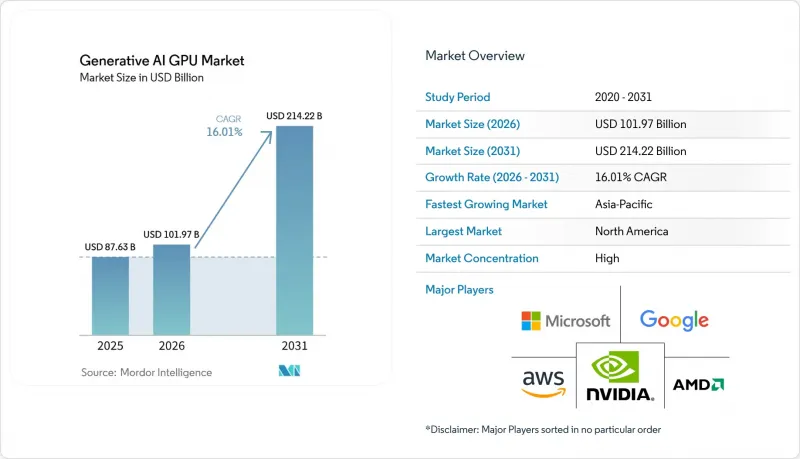
Mordor Intelligence에 의하면, 생성형 AI용 GPU 시장 규모는 2025년 876억 3,000만 달러, 2026년 1,019억 7,000만 달러에서 2031년까지 2,142억 2,000만 달러로 확대한다고 예측되고 있어 2026년부터 2031년까지 연평균 복합 성장률(CAGR)은 16.01%를 나타낼 전망입니다.
본 보고서는 배포 유형(클라우드 및 On-Premise), 기능(훈련 및 추론), GPU 유형(데이터센터용 훈련, 추론 등), 모델 유형(LLM, 멀티모달, 이미지·동영상, 음성·오디오 모델 등), 최종 사용자(클라우드 서비스 제공업체, 기업, 정부·연구기관 등) 및 지역별로 분류되어 있습니다. 시장 전망은 금액(달러) 기준으로 제시되어 있습니다.
전 세계 생성형 AI용 GPU 시장 동향 및 인사이트
사설 생성형 AI 훈련 클러스터에 대한 기업 수요 증가
사설 생성형 AI 인프라는 기업의 표준 자본 계획에 점차 통합되고 있으며, 이로 인해 생성형 AI용 GPU 시장에는 하이퍼스케일러의 지출에만 의존하지 않는 수요 흐름이 형성되고 있습니다. 구매자들은 데이터 관리, 규정 준수, 비용 가시성, 그리고 제3자 처리 계층을 거치지 않고 관리된 환경 내에서 자체 모델을 미세 조정할 수 있는 능력에 중점을 두고 있습니다. 이러한 변화가 중요한 이유는 생성형 AI용 GPU 시장이 현재 단기적인 실험 프로젝트가 아닌, 지속적인 내부 워크로드를 실행하려는 조직 수요를 끌어들이고 있기 때문입니다. 또한 가동률이 향상됨에 따라 경제성도 개선되므로, 안정적인 추론 및 미세 조정 프로그램을 위해 전용 용량을 확보하는 것이 정당화되기 쉬워집니다. 고객의 방화벽 내에서 관리되는 사설 AI 시스템을 제공하는 벤더가 늘어남에 따라, 생성형 AI용 GPU 시장에서는 모든 구매자가 사내에 대규모 인프라 팀을 구축할 필요 없이 더 폭넓은 기업의 진입이 예상됩니다.
모델 훈련 및 추론 인프라를 위한 하이퍼스케일러의 설비 투자 확대
생성형 AI용 GPU 시장은 여전히 하이퍼스케일러의 설비 투자와 밀접하게 연결되어 있습니다. 이는 최대 규모의 훈련 및 서빙 환경이 여전히 클라우드 플랫폼 내에 존재하기 때문입니다. 이러한 기업들은 단기적인 업데이트 주기가 아닌 여러 세대에 걸친 로드맵에 자본을 투자하고 있으며, 이로 인해 생성형 AI용 GPU 시장은 일반적인 반도체 업그레이드 패턴보다 더 명확한 수요 전망을 얻고 있습니다. 이러한 추세는 현재 GPU 자체에 그치지 않고, 대규모 도입에는 네트워크 패브릭, 전원 시스템, 데이터센터 확장도 필요하기 때문에 각 컴퓨팅 주문은 더 대규모 인프라 구축의 일부가 되고 있습니다. NVIDIA의 2026 회계연도 실적은 AI 컴퓨팅과 관련 인프라가 현재 얼마나 밀접하게 연결되어 있는지를 보여주고 있으며, 4분기에는 데이터센터 매출이 193.7억 달러에 달했고, 데이터센터 네트워킹 매출은 전년 동기 대비 263% 증가했습니다. AWS, Google Cloud, Microsoft Azure 및 Oracle Cloud Infrastructure의 Vera Rubin 플랫폼 도입 노력은 생성형 AI용 GPU 시장이 단일 제품 주기 단위가 아닌, 미래를 내다본 용량 계획에 의해 뒷받침되고 있음을 보여줍니다.
고급 패키징 및 HBM 공급 제약
생성형 AI용 GPU 시장의 주요 공급 상한선은 더 이상 칩 설계 수요에만 국한되지 않으며, 현재는 패키징 처리 능력과 메모리 확보 가능성에 의해 제약받고 있습니다. 예산이 승인되더라도, 생성형 AI용 GPU 시장은 하루아침에 확대될 수 없는 첨단 메모리 및 패키징 공정에 있어 극히 제한된 공급업체에 의존하고 있기 때문에 주문에 지연이 발생할 가능성이 있습니다. NVIDIA와 SK하이닉스 간의 다년간 메모리 제휴는 향후 플랫폼 전개에서 HBM에 대한 접근이 얼마나 중요해지고 있는지를 반영합니다. 주요 메모리 공급업체들이 계획 중인 생산 능력 증설은 향후 생산 기간을 대상으로 하고 있으므로, 현재 예측 기간 동안 단기적인 공급 부족이 계속해서 공급 상황에 영향을 미칠 가능성이 높습니다. 그 결과, 생성형 AI용 GPU 시장에서는 견조한 수주 수요가 예상되는 반면, 해당 수요가 구매자가 의도하는 것보다 더 느린 속도로 매출로 전환될 가능성이 있습니다.
부문 분석
2025년, 생성형 AI용 GPU 시장의 74.19%를 클라우드 도입이 차지하며, 매출액 측면에서 On-Premise 도입을 크게 앞질렀습니다. 이러한 우위는 하이퍼스케일러들이 초기 GPU 데이터센터 투자 및 최대 규모의 모델 개발자들과의 긴밀한 협력을 통해 구축해 온, 다년간의 인프라 우위를 반영하고 있습니다. 또한 클라우드 모델은 하드웨어, 시설 공사, 운영에 드는 전액의 초기 비용을 부담하지 않고도 구매자가 신속하게 용량을 확보할 수 있다는 점에서도 여전히 매력적입니다. 많은 조직, 특히 워크로드 패턴을 아직 검증 중인 조직의 경우, 생성형 AI용 GPU 시장에 접근하는 것은 탄력적인 클라우드 인프라를 통해 이루어지는 것이 가장 용이합니다. 이러한 접근상의 이점은 2026년에 비용 관리가 더욱 중요한 요소로 부상하더라도 클라우드의 우위를 계속해서 뒷받침할 것입니다.
On-Premise 배포는 2026년부터 2031년까지 연평균 성장률(CAGR) 16.38%로 가장 빠르게 성장하는 부문이며, 이는 구매자의 행동이 앞으로 어떤 방향으로 변화하고 있는지를 보여줍니다. 파일럿 프로그램 단계를 넘어선 기업들은 이용 밀도, 지연 시간 요구 사항, 데이터 처리 요구 사항에 대해 더 명확하게 파악하게 되었기 때문에 자체 소유 인프라를 도입할 근거가 더욱 구체화되고 있습니다. 레노버의 2026년 분석에 따르면, 50대 이상의 GPU로 구성된 플리트에서 GPU 활용률이 75%에 도달하면 On-Premise 시스템은 클라우드 임대와 동등한 비용 수준에 도달하는 것으로 나타났으며, 이는 안정적인 워크로드를 위한 전용 인프라로의 전환을 뒷받침하고 있습니다. 생성형 AI용 GPU 시장은 관리형 프라이빗 AI 플랫폼, 코로케이션을 활용한 클러스터, 그리고 기업 구매자의 운영 부담을 경감시켜 주는 구독형 서비스로부터도 혜택을 받고 있습니다. 이로 인해 생성형 AI용 GPU 업계는 장기적으로 퍼블릭 클라우드에 대한 의존을 정당화하기 어려워지는 규제가 엄격하고 데이터 기밀성이 높은 환경으로의 진출 길이 더욱 넓어지고 있습니다.
2025년 생성형 AI용 GPU 시장 규모 중 훈련이 64.88%를 차지하고 있으며, 이는 여전히 최첨단 모델 구축에 지출의 상당 부분이 집중되고 있음을 보여줍니다. 이러한 점유율은 대규모 언어 모델, 비전 모델, 멀티모달 시스템의 사전 학습이 극히 높은 계산 부하를 수반하며, 한 번의 실행에 매우 많은 양의 GPU 시간이 필요하기 때문입니다. 따라서 생성형 AI용 GPU 시장의 초기 상용화 단계에서는 모델 구축과 기능 확장이 최우선 과제였기 때문에 훈련 중심의 지출 구성을 보였습니다. 대규모 클러스터, 고성능 하드웨어, 그리고 클라우드에 대한 집중적인 구매가 이러한 추세를 더욱 강화했습니다. 최첨단 모델에는 여전히 최고 성능의 시스템이 필요하기 때문에 훈련은 여전히 수익의 기반을 이루고 있습니다.
추론은 2026년부터 2031년까지 연평균 성장률(CAGR) 16.97%로 가장 빠르게 성장하는 기능이며, 이러한 성장이 생성형 AI용 GPU 시장의 운영 양상을 변화시키고 있습니다. 모델이 프로덕션 환경에 도입되면 사용자에게 지속적으로 서비스를 제공하게 되므로, 추론 수요는 초기 훈련 주기보다 훨씬 더 오래 지속될 가능성이 있습니다. 또한 기업들은 이용 빈도가 충분히 높아지고 하드웨어 상각이 더 매력적으로 변함에 따라, 토큰 단위의 API 이용료에서 자체 소유 또는 전용 추론 노드로의 전환을 추진하고 있습니다. 이는 생성형 AI용 GPU 시장에 있어 중요한 점입니다. 왜냐하면 추론 수요는 소수의 하이퍼스케일러 캠퍼스 내에 집중되는 훈련 지출보다 지리적으로 분산되어 있기 때문입니다. 그 결과, 훈련 단계가 종료된 후에도 총 연산 수요를 높은 수준으로 유지하면서 구매자 기반을 확대하는 성장 곡선이 형성되고 있습니다.
지역별 분석
2025년, 북미는 생성형 AI용 GPU 시장의 46.74%를 차지하며, 지역별로는 여전히 확실한 매출 1위 자리를 유지했습니다. 이 지역은 미국에 하이퍼스케일러의 본사, 최첨단 AI 연구소, 그리고 GPU에 최적화된 데이터센터용량이 집중되어 있다는 이점을 누리고 있습니다. 이러한 조합 덕분에 조달, 소프트웨어 개발, 인프라 구축이 긴밀하게 연계된 북미에서 생성형 AI용 GPU 시장은 가장 견고한 상업적 기반을 구축하고 있습니다. 또한, 주요 클라우드 플랫폼들도 차세대 할당량에서 계속해서 큰 점유율을 확보하고 있으며, 이는 훈련 환경과 실제 추론 환경 모두에서 이 지역의 우위를 뒷받침하고 있습니다. 캐나다는 자국의 AI 컴퓨팅 전략을 통해 퍼블릭 컴퓨팅 계층을 추가하고 있으며, 이는 광범위한 지역 시장의 상업적 강점을 보완하고 있습니다.
유럽은 수요가 공공 투자와 데이터 처리 및 모델 감시에 대한 규제적 압력에 의해 형성되고 있기 때문에 생성형 AI용 GPU 시장에서 여전히 중요한 위치를 차지하고 있습니다. EU AI법에 기반한 규정 준수 요건은 특히 처리 장소에 대한 관리가 더 엄격한 것을 선호하는 규제 대상 부문에서 국내 및 On-Premise 도입에 대한 관심을 촉진하고 있습니다. 프랑스는 이 지역에서 가장 큰 규모의 국가 AI 인프라 구축 계획 중 하나를 발표했으며, 이는 향후 데이터센터 확장 및 GPU 조달을 뒷받침할 것으로 기대됩니다. 영국 또한 광범위한 AI 연구 자원의 일환으로 전용 칩 조달에 자금을 투입함으로써 하드웨어 계획을 공식적으로 수립했으며, 이는 국가 차원의 컴퓨팅 역량이 이제 명확한 정책 목표가 되었음을 보여줍니다.
아시아태평양은 2026년부터 2031년까지 연평균 성장률(CAGR) 17.36%를 기록하며 가장 빠르게 성장하는 지역 부문으로, 이에 따라 예측 기간 동안 생성형 AI용 GPU 시장 규모에서 가장 빠른 성장 궤도에 올라 있습니다. 이러한 성장은 각국 정부 주도의 AI 프로그램, 현지 하이퍼스케일러의 투자, 그리고 수출 규제로 인해 미국산 주요 하드웨어에 대한 접근이 제한되는 가운데 국산 대체품에 대한 관심이 높아지고 있는 데 힘입고 있습니다. 중국의 생성형 AI용 GPU 시장은 미국의 수출 규제가 계속해서 조달 경로를 좌우하고 현지 가속기 개발을 촉진하고 있기 때문에 다른 정책 환경 하에서 발전하고 있습니다. 이러한 차이는 아시아태평양 내에서 수입된 프리미엄 시스템을 중심으로 한 경쟁 구도와 국산 대체품을 중심으로 한 경쟁 구도라는 두 가지 상이한 경쟁 프레임워크를 만들어내고 있다는 점에서 중요합니다. 남미, 중동 및 아프리카는 생성형 AI용 GPU 시장에서 여전히 초기 단계에 있는 지역이지만, 정부의 투자와 현지 데이터센터 확장에 힘입어 예측 기간 후반에는 조달량이 더욱 증가할 가능성이 있습니다.
기타 혜택:
- 엑셀 형식 시장 예측(ME) 시트
- 3개월간의 애널리스트 지원
자주 묻는 질문
목차
제1장 서론
제2장 조사 방법
제3장 주요 요약
제4장 시장 구도
제5장 시장 규모와 성장 예측
제6장 경쟁 구도
제7장 시장 기회와 향후 전망
JHS 26.08.07According to Mordor Intelligence, the generative AI GPU market size is projected to expand from USD 87.63 billion in 2025 and USD 101.97 billion in 2026 to USD 214.22 billion by 2031, registering a CAGR of 16.01% between 2026 to 2031.
This report is Segmented by Deployment Type (Cloud, and On-Premise), Function (Training, and Inference), GPU Type (Data Center Training, Inference, and More), Model Type (LLMs, Multimodal, Image/Video, and Speech and Audio Models), End User (Cloud Service Providers, Enterprises, Government and Research Institutions, and More), and Geography. The Market Forecasts are Provided in Terms of Value (USD).
Global Generative AI GPU Market Trends and Insights
Rising Enterprise Demand For Private GenAI Training Clusters
Private generative AI infrastructure is moving into standard enterprise capital planning, and that is giving the generative AI GPU market a demand stream that does not depend only on hyperscaler spending. Buyers are focusing on data control, compliance, cost visibility, and the ability to fine tune proprietary models inside controlled environments rather than through third-party processing layers. This shift matters because the generative AI GPU market is now pulling demand from organizations that intend to run continuous internal workloads instead of short experimental projects. The economics also improve as utilization rises, which makes dedicated capacity easier to justify for stable inference and fine-tuning programs. As more vendors package managed private AI systems behind the customer firewall, the generative AI GPU market is likely to see broader enterprise participation without requiring every buyer to build deep in-house infrastructure teams.
Hyperscaler Capex Expansion For Model Training And Inference Infrastructure
The generative AI GPU market remains closely tied to hyperscaler capital spending because the largest training and serving environments still sit inside cloud platforms. These companies are committing capital across multi-generation roadmaps rather than short replacement cycles, which gives the generative AI GPU market stronger demand visibility than a normal semiconductor upgrade pattern. That pattern now extends beyond the GPU itself because large deployments also require networking fabrics, power systems, and data center expansion, which makes each compute order part of a larger infrastructure build. NVIDIA's fiscal 2026 results show how tightly AI compute and adjacent infrastructure are now linked, with data center revenue reaching USD 193.7 billion and data center networking revenue rising 263% year over year in Q4. The commitment by AWS, Google Cloud, Microsoft Azure, and Oracle Cloud Infrastructure to deploy the Vera Rubin platform shows that the generative AI GPU market is being supported by forward capacity plans rather than one product cycle at a time.
Advanced Packaging And HBM Supply Constraints
The main supply ceiling for the generative AI GPU market is no longer limited to chip design demand; it is now limited to packaging throughput and memory availability. Even when budgets are approved, orders can still face delays because the generative AI GPU market depends on a narrow set of suppliers for advanced memory and packaging steps that cannot be expanded overnight. NVIDIA's multiyear memory partnership with SK Hynix reflects how central HBM access has become to future platform rollouts. Planned capacity additions from major memory suppliers target later production windows, which means short-term tightness is still likely to shape availability through the current forecast period. As a result, the generative AI GPU market can show strong order demand while still converting that demand into revenue more slowly than buyers intend.
Other drivers and restraints analyzed in the detailed report include:
- Rapid Shift To HBM-Heavy GPU Platforms For Large Model Training
- Sovereign AI Programs Accelerating National GPU Procurement
- High Power Density, Cooling, And Facility Upgrade Costs
For complete list of drivers and restraints, kindly check the Table Of Contents.
Segment Analysis
Cloud deployments accounted for 74.19% of the generative AI GPU market in 2025, which kept this model well ahead of on-premise installations by revenue. That lead reflects a long infrastructure advantage built by hyperscalers through earlier GPU data center investment and closer ties to the largest model developers. The cloud model also remains attractive because it lets buyers provision capacity quickly without carrying the full upfront cost of hardware, facility work, and operations. For many organizations, especially those still testing workload patterns, the generative AI GPU market is easiest to access through elastic cloud infrastructure. That access advantage continues to support cloud leadership even as cost discipline becomes a bigger factor in 2026.
On-premise deployments are the fastest-growing segment at 16.38% CAGR through 2026-2031, which shows where the next wave of buyer behavior is shifting. Enterprises that have moved past pilot programs now have better visibility into usage intensity, latency needs, and data handling requirements, so the case for owned capacity is becoming more concrete. Lenovo's 2026 analysis shows that on-premise systems can reach cost parity with cloud rental at 75% GPU utilization across fleets of more than 50 GPUs, which supports the move toward dedicated infrastructure for stable workloads. The generative AI GPU market is also benefiting from managed private AI platforms, colocation-backed clusters, and subscription-style offers that reduce the operational burden on enterprise buyers. This gives the generative AI GPU industry a broader path into regulated and data-sensitive environments where public cloud dependency is harder to justify over time.
Training commanded 64.88% of the generative AI GPU market size in 2025, which shows how much spending is still centered on building frontier models. That share came from the exceptional compute intensity of pre-training large language, vision, and multimodal systems, where each run can consume very large GPU-hour volumes. The early commercial phase of the generative AI GPU market was therefore built on a training-heavy spending mix because the first priority was model creation and capability expansion. Large clusters, premium hardware, and concentrated cloud buying all reinforced that pattern. Training still anchors revenue because the most advanced models continue to require the highest-performance systems available.
Inference is the fastest-growing function at 16.97% CAGR through 2026-2031, and that growth is changing the operating profile of the generative AI GPU market. Once models enter production, they serve users continuously, which means inference demand can last far longer than the original training cycle. Enterprises are also shifting from per-token API spending toward owned or dedicated inference nodes when usage becomes frequent enough to make hardware amortization more attractive. This matters for the generative AI GPU market because inference demand is more geographically distributed than the concentrated training spend inside a small number of hyperscaler campuses. The result is a growth curve that broadens the buyer base while keeping total compute demand elevated after the training phase has already passed.
Complete Report Scope:
- By Deployment Type
- Cloud
- On-Premise
- By Function
- Training
- Inference
- By GPU Type
- Data Center Training GPUs
- Data Center Inference GPUs
- Edge and Enterprise AI GPUs
- By Model Type
- Large Language Models (LLMs)
- Multimodal Models
- Image and Video Generation Models
- Speech and Audio Models
- By End User
- Cloud Service Providers
- Enterprises
- Government and Research Institutions
- AI Model Developers and AI Labs
- By Geography
- North America
- United States
- Canada
- Mexico
- Europe
- Germany
- United Kingdom
- France
- Italy
- Rest of Europe
- Asia-Pacific
- China
- Japan
- South Korea
- India
- Southeast Asia
- Rest of Asia-Pacific
- South America
- Middle East and Africa
- North America
Geography Analysis
North America held 46.74% of the generative AI GPU market in 2025, which kept it as the clear revenue leader by region. The region benefits from the concentration of hyperscaler headquarters, frontier AI labs, and GPU-optimized data center capacity within the United States. That combination gives the generative AI GPU market its deepest commercial base in North America because procurement, software development, and infrastructure deployment are closely linked there. Large cloud platforms also continue to secure a major share of next-generation allocation, which supports the region's lead in both training and production inference environments. Canada adds a public compute layer through its sovereign AI compute strategy, which complements the commercial strength of the broader regional market.
Europe remains important to the generative AI GPU market because demand is shaped by both public investment and regulatory pressure around data handling and model oversight. Compliance requirements under the EU AI Act support interest in domestic and on-premise deployments, especially among regulated sectors that prefer tighter control over where processing occurs. France has made one of the region's largest national AI infrastructure commitments, which is expected to support future data center buildout and GPU procurement. The UK also formalized its hardware plan with funding for specialized chip procurement inside its broader AI research resource, showing that national compute capability is now an explicit policy target.
Asia-Pacific is the fastest-growing regional segment at 17.36% CAGR through 2026-2031, and this gives it the most rapid expansion path within the generative AI GPU market size over the forecast period. Growth is being supported by sovereign AI programs, local hyperscaler investment, and rising interest in domestic alternatives where export restrictions affect access to leading U.S. hardware. The generative AI GPU market in China is developing under a different policy setting because U.S. export controls continue to shape procurement routes and encourage local accelerator development. That divergence matters because it creates separate competitive tracks within Asia-Pacific, one centered on imported premium systems and another centered on domestic substitutes. South America and the Middle East and Africa remain earlier-stage regions in the generative AI GPU market, though sovereign investment and local data center expansion could support stronger procurement volumes later in the forecast period.
- NVIDIA Corporation
- Advanced Micro Devices, Inc.
- Intel Corporation
- Google LLC
- Amazon Web Services, Inc.
- Microsoft Corporation
- Huawei Technologies Co., Ltd.
- Baidu, Inc.
- Groq, Inc.
- xAI Corp.
- Marvell Technology, Inc.
- Cerebras Systems, Inc.
- Tenstorrent Inc.
- Mistral AI
- Qualcomm Incorporated
- IBM Corporation
- CoreWeave, Inc.
- Oracle Corporation
- Alibaba Group Holding Limited
- Tencent Holdings Limited
- Lambda, Inc.
Additional Benefits:
- The market estimate (ME) sheet in Excel format
- 3 months of analyst support
TABLE OF CONTENTS
1 INTRODUCTION
- 1.1 Study Assumptions and Market Definition
- 1.2 Scope of the Study
2 RESEARCH METHODOLOGY
3 EXECUTIVE SUMMARY
4 MARKET LANDSCAPE
- 4.1 Market Overview
- 4.2 Market Drivers
- 4.2.1 Rising Enterprise Demand for Private GenAI Training Clusters
- 4.2.2 Hyperscaler Capex Expansion for Model Training and Inference Infrastructure
- 4.2.3 Rapid Shift to HBM-Heavy GPU Platforms for Large Model Training
- 4.2.4 Sovereign AI Programs Accelerating National GPU Procurement
- 4.2.5 Liquid Cooling Adoption for High-TDP Generative AI Racks
- 4.2.6 GenAI Inferencing Migration From API Consumption to Owned GPU Capacity
- 4.3 Market Restraints
- 4.3.1 Advanced Packaging and HBM Supply Constraints
- 4.3.2 High Power Density, Cooling, and Facility Upgrade Costs
- 4.3.3 Export Controls and Geopolitical Procurement Restrictions
- 4.3.4 Custom ASIC Substitution Risk in Inference Workloads
- 4.4 Industry Value Chain Analysis
- 4.5 Regulatory Landscape
- 4.6 Technological Outlook
- 4.7 Impact of Macroeconomic Factors on the Market
- 4.8 Porter's Five Forces Analysis
- 4.8.1 Threat of New Entrants
- 4.8.2 Bargaining Power of Buyers
- 4.8.3 Bargaining Power of Suppliers
- 4.8.4 Threat of Substitutes
- 4.8.5 Industry Rivalry
5 MARKET SIZE AND GROWTH FORECASTS (VALUE)
- 5.1 By Deployment Type
- 5.1.1 Cloud
- 5.1.2 On-Premise
- 5.2 By Function
- 5.2.1 Training
- 5.2.2 Inference
- 5.3 By GPU Type
- 5.3.1 Data Center Training GPUs
- 5.3.2 Data Center Inference GPUs
- 5.3.3 Edge and Enterprise AI GPUs
- 5.4 By Model Type
- 5.4.1 Large Language Models (LLMs)
- 5.4.2 Multimodal Models
- 5.4.3 Image and Video Generation Models
- 5.4.4 Speech and Audio Models
- 5.5 By End User
- 5.5.1 Cloud Service Providers
- 5.5.2 Enterprises
- 5.5.3 Government and Research Institutions
- 5.5.4 AI Model Developers and AI Labs
- 5.6 By Geography
- 5.6.1 North America
- 5.6.1.1 United States
- 5.6.1.2 Canada
- 5.6.1.3 Mexico
- 5.6.2 Europe
- 5.6.2.1 Germany
- 5.6.2.2 United Kingdom
- 5.6.2.3 France
- 5.6.2.4 Italy
- 5.6.2.5 Rest of Europe
- 5.6.3 Asia-Pacific
- 5.6.3.1 China
- 5.6.3.2 Japan
- 5.6.3.3 South Korea
- 5.6.3.4 India
- 5.6.3.5 Southeast Asia
- 5.6.3.6 Rest of Asia-Pacific
- 5.6.4 South America
- 5.6.5 Middle East and Africa
- 5.6.1 North America
6 COMPETITIVE LANDSCAPE
- 6.1 Market Concentration
- 6.2 Strategic Moves
- 6.3 Market Positioning Analysis
- 6.4 Company Profiles (includes Global Level Overview, Market Level Overview, Core Segments, Financials as available, Strategic Information, Market Rank/Share, Products and Services, Recent Developments)
- 6.4.1 NVIDIA Corporation
- 6.4.2 Advanced Micro Devices, Inc.
- 6.4.3 Intel Corporation
- 6.4.4 Google LLC
- 6.4.5 Amazon Web Services, Inc.
- 6.4.6 Microsoft Corporation
- 6.4.7 Huawei Technologies Co., Ltd.
- 6.4.8 Baidu, Inc.
- 6.4.9 Groq, Inc.
- 6.4.10 xAI Corp.
- 6.4.11 Marvell Technology, Inc.
- 6.4.12 Cerebras Systems, Inc.
- 6.4.13 Tenstorrent Inc.
- 6.4.14 Mistral AI
- 6.4.15 Qualcomm Incorporated
- 6.4.16 IBM Corporation
- 6.4.17 CoreWeave, Inc.
- 6.4.18 Oracle Corporation
- 6.4.19 Alibaba Group Holding Limited
- 6.4.20 Tencent Holdings Limited
- 6.4.21 Lambda, Inc.
7 MARKET OPPORTUNITIES AND FUTURE OUTLOOK
- 7.1 White-Space and Unmet-Need Assessment


