

|
시장보고서
상품코드
2108976
집단건강관리 시장 : 컴포넌트별, 기능별, 딜리버리 모드별, 조직 규모별, 최종 사용자별, 지역별 - 예측(-2031년)Population Health Management Market by Component (Software, Services), Functionality (Analytics, Care Management, Risk & Predictive Analytics, VBC), End User (Hospital, Clinic, Payer, Public Health, Employer), Organization Size - Global Forecast to 2031 |
||||||

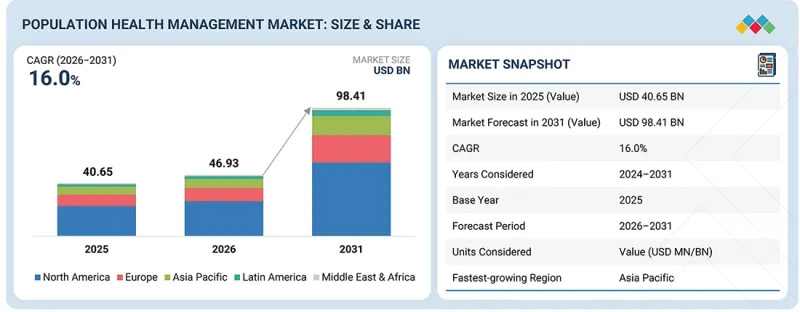
집단건강관리 시장 규모는 2026년 469억 3,000만 달러로 추정되고, 2031년까지 984억 1,000만 달러에 이를 것으로 예측되며, CAGR은 16.0%를 나타낼 전망입니다.
시장 성장은 주로 가치 기반 의료로의 전환이 진행되고 있는 점, 만성 질환 유병률의 상승, 그리고 의료비를 절감하면서도 환자의 치료 성과를 향상시켜야 할 필요성이 커지고 있는 점에 의해 주도되고 있습니다. 의료 제공업체, 보험사, 정부 기관 및 고용주는 고위험 집단을 식별하고, 치료 연계성을 강화하며, 만성 질환을 관리하고, 예방 의료 노력을 지원하기 위해 집단건강관리(Population Health Management) 솔루션 도입을 점점 더 확대되고 있습니다. 임상 데이터, 보험 청구 데이터, 조제 데이터, 검사 데이터 및 건강의 사회적 결정 요인(SDOH) 데이터를 통합함으로써, 조직은 실행 가능한 인사이트력을 도출하고, 위험 계층화를 개선하며, 개인 맞춤형 진료를 제공할 수 있게 됩니다.
| 조사 범위 | |
|---|---|
| 조사 대상 기간 | 2026-2031년 |
| 기준 연도 | 2025년 |
| 예측 기간 | 2026-2031년 |
| 산정 단위 | 금액(10억 달러) |
| 부문 | 컴포넌트별, 기능별, 딜리버리 모드별, 조직 규모별, 최종 사용자별, 지역별 |
| 대상 지역 | 북미, 유럽, 아시아태평양, 라틴아메리카, 중동 및 아프리카 |
또한, 클라우드 기반 플랫폼, 인공지능(AI), 예측 분석, 원격 환자 모니터링, 상호 운용 가능한 의료 시스템의 도입이 진행됨에 따라 집단건강관리(PHM)의 기능이 강화되고 있습니다. 의료 기관들이 데이터 기반 의사 결정, 치료 연계, 가치 기반 보상 모델을 지속적으로 우선시함에 따라, 종합적인 PHM 솔루션에 대한 수요는 예측 기간 동안 가속화될 것으로 전망됩니다.
'2025년에는 소프트웨어 부문이 집단건강관리 시장에서 더 큰 점유율을 차지했습니다.'
구성 요소별로 보면, 집단건강관리 시장은 소프트웨어 및 서비스로 구분됩니다. 2025년에는 위험 계층화, 케어 관리, 예측 분석, 환자 참여 및 임상 의사 결정 지원을 위한 집단건강관리 플랫폼의 보급에 힘입어 소프트웨어 부문이 더 큰 시장 점유율을 차지했습니다. 의료 제공업체와 보험사는 임상 데이터, 보험 청구 데이터, 조제 데이터 및 건강의 사회적 결정 요인(SDOH) 데이터를 통합하기 위한 소프트웨어 솔루션에 대한 투자를 확대하고 있으며, 이를 통해 인구 규모에서의 실시간 인사이트 확보와 치료 연계성 향상이 가능해졌습니다. 가치 기반 의료로의 전환이 진행되고 있으며, 클라우드 기반 PHM 플랫폼의 도입이 증가하고 있고, AI를 활용한 분석 및 상호 운용성에 대한 수요가 높아짐에 따라 집단건강관리 시장에서 소프트웨어 부문의 우위가 더욱 공고해지고 있습니다.
'예측 기간 동안 클라우드 기반 부문이 가장 빠른 성장세를 보일 것으로 예측됩니다.'
제공 형태에 따라 집단건강관리 시장은 클라우드 기반, 온프레미스 기반, 하이브리드 기반으로 분류됩니다. 이 중 클라우드 기반 부문은 예측 기간 동안 가장 빠른 성장률을 나타낼 것으로 예측됩니다. 이러한 급속한 성장은 주로 가치 기반 의료(value-based care) 이니셔티브를 지원하는 확장성이 뛰어나고 비용 효율적이며 상호 운용 가능한 헬스케어 솔루션에 대한 수요 증가에 의해 주도되고 있습니다. 클라우드 기반 PHM 플랫폼은 임상 데이터, 보험 청구 데이터, 조제 데이터, 검사 데이터 및 건강의 사회적 결정 요인(SDOH) 데이터를 원활하게 통합하는 동시에, 실시간 분석, 원격 환자 모니터링, AI를 활용한 인사이트를 제공합니다. 초기 비용이 낮고, 도입이 신속하며, 소프트웨어 자동 업데이트가 가능하고, 여러 의료 현장 간에 데이터를 안전하게 공유할 수 있다는 장점 덕분에 의료 제공업체, 보험사, 공중보건 기관 사이에서 널리 채택되고 있으며, 그 결과 클라우드 기반 도입은 집단건강관리 시장에서 가장 빠르게 성장하는 부문이 되었습니다.
'아시아태평양은 예측 기간 동안 가장 높은 성장률을 나타낼 것으로 전망됩니다.'
아시아태평양은 예측 기간 동안 집단건강관리 시장에서 가장 높은 연평균 성장률(CAGR)을 보일 것으로 예측됩니다. 이러한 높은 성장률은 주로 의료 시스템의 급속한 디지털화, 의료 IT 도입을 촉진하는 정부 주도의 노력 증가, 만성 질환 유병률 상승, 그리고 중국, 인도, 일본, 호주, 한국 등 국가들의 의료 인프라 투자 확대에 힘입은 것입니다. 전자의무기록(EHR), 클라우드 기반 의료 플랫폼, AI를 활용한 분석, 원격 환자 모니터링 솔루션의 도입 확대에 따라 의료 기관은 진료 연계와 지역 주민의 건강 성과 향상을 도모할 수 있게 되었습니다. 또한, 예방 의료에 대한 인식 제고, 건강보험 적용 범위 확대, 가치 기반 의료로의 전환이 해당 지역 전체에서 집단건강관리 솔루션의 도입을 가속화하고 있으며, 이에 따라 아시아태평양은 예측 기간 동안 가장 빠르게 성장하는 지역 시장이 될 전망입니다.
Oracle(미국), Veradigm LLC(미국), Merative(미국), Epic Systems Corporation(미국), Koninklijke Philips N.V.(네덜란드), Health Catalyst(미국) 및 Optum Inc.(미국)는 집단건강관리 시장의 주요 기업 중 일부입니다.
본 조사에서는 이러한 주요 시장 참여자에 대해 기업 프로파일, 최근 동향 및 주요 시장 전략을 포함한 상세한 경쟁 분석을 수행하고 있습니다.
조사 범위
본 조사 보고서에서는 집단건강관리 시장을 컴포넌트(소프트웨어, 서비스), 기능(인구 건강 분석, 치료 관리 및 조정, 위험 계층화 및 예측 분석, 환자 참여, 의사 참여, 품질 및 가치 기반 치료 관리, 상호 운용성 및 데이터 통합, 기타), 제공 형태(클라우드 기반, 온프레미스형, 하이브리드형), 조직 규모(대기업, 중견기업, 중소기업), 최종 사용자(의료 제공업체 (병원·의료 시스템, 의사 진료소·클리닉, 기타 의료 제공업체), 의료 보험자(민간 보험자, 공적 보험자), 정부·공중보건 기관, 고용주, 생명과학), 지역(북미, 유럽, 아시아태평양, 라틴아메리카, 중동 및 아프리카)별로 분류하고 있습니다. 본 보고서의 조사 범위에는 집단건강관리 시장의 성장에 영향을 미치는 주요 요인(촉진요인, 제약 요인, 과제, 기회 등)에 대한 상세한 정보가 포함되어 있습니다. 주요 업계 기업에 대한 상세한 분석을 통해 사업 개요, 소프트웨어, 서비스, 주요 전략은 물론, 계약, 파트너십, 합의 사항, 신제품 및 서비스 출시, 합병·인수, 그리고 집단건강관리 시장과 관련된 최근 동향에 대한 인사이트를 제공합니다. 본 보고서에서는 집단건강관리 시장 생태계 내 신생 기업 및 기존 기업의 경쟁 분석에 대해서도 다루고 있습니다.
본 보고서를 구매해야 하는 이유
본 보고서는 이 시장 시장 선도 기업 및 신규 진출기업에게 집단건강관리 시장 및 그 하위 부문의 매출에 관한 가장 정확한 추정치를 제공합니다. 본 보고서는 이해관계자가 경쟁 구도를 이해하고, 자사의 비즈니스를 더 유리한 위치에 놓으며, 적절한 시장 진출 전략을 수립하기 위한 추가적인 인사이트를 얻는 데 도움이 됩니다. 또한, 본 보고서는 이해관계자가 시장 동향을 파악하는 데 도움을 주며, 주요 시장 성장 촉진요인, 억제요인, 과제 및 기회에 대한 정보를 제공합니다.
본 보고서는 다음 사항에 대한 인사이트를 제공합니다.
- 본 보고서는 다음 사항에 대한 인사이트를 제공합니다. 주요 촉진요인 분석(가치 기반 의료(VBC) 및 위험 기반 보상 모델의 확대, 협력 의료를 통한 재입원 감소에 대한 관심 증가, 의료 기관에서의 AI 기반 예측 분석 도입 확대, 상호 운용 가능한 디지털 헬스 데이터의 가용성 향상), 제약 요인(의료 데이터 상호 운용성과 관련된 뿌리 깊은 과제, 데이터 유출에 대한 우려 증가), 기회(건강의 사회적 결정 요인(SDOH)을 인구 건강 전략에 통합, 원격 환자 모니터링 및 가상 진료 프로그램의 확대, AI를 활용한 진료 관리 자동화에 대한 수요 증가), 과제(측정 가능한 투자 수익률(ROI) 입증, 임상 워크플로우와의 통합, 사용자별 도입)에 대해, 집단건강관리 시장의 성장에 영향을 미치는 요인에 대한 인사이트력을 제공합니다.
- 제품 개발 및 혁신 : 집단건강관리 시장의 향후 기술, 연구 개발 활동 및 신제품 및 서비스 출시에 대한 상세한 인사이트
- 시장 개발 : 수익성이 높은 시장에 대한 종합적인 정보. 본 보고서는 다양한 지역의 집단건강관리 시장을 분석합니다.
- 시장 다각화 : 집단건강관리 시장의 신제품 및 서비스, 미개척 지역, 최근 동향 및 투자에 대한 종합적인 정보
- 경쟁 분석 : Oracle(미국), Veradigm LLC(미국), Merative(미국), Epic Systems Corporation(미국), Koninklijke Philips N.V.(네덜란드), i2i Population Health(미국), Health Catalyst(미국), Optum Inc.(미국) 등, 집단건강관리 시장의 주요 기업들 시장 점유율, 성장 전략 및 소프트웨어 제품 및 서비스에 대한 상세한 평가.
자주 묻는 질문
목차
제1장 서론
제2장 주요 요약
제3장 프리미엄 인사이트
제4장 시장 개요
제5장 업계 동향
제6장 기술, 특허, 디지털 기술, AI 도입에 의한 전략적 파괴
제7장 규제 상황
제8장 고객 현황 및 구매 행동
제9장 집단건강관리 시장 : 컴포넌트별
제10장 집단건강관리 시장 : 기능별
제11장 집단건강관리 시장 : 딜리버리 모드별
제12장 집단건강관리 시장 : 조직 규모별
제13장 집단건강관리 시장 : 최종 사용자별
제14장 집단건강관리 시장 : 지역별
제15장 경쟁 구도
제16장 기업 개요
제17장 조사 방법
제18장 부록
AJY 26.08.18The population health management market is projected to reach USD 98.41 billion by 2031 from USD 46.93 billion in 2026, at a CAGR of 16.0%. Market growth is primarily driven by the increasing shift toward value-based care, the rising prevalence of chronic diseases, and the growing need to improve patient outcomes while reducing healthcare costs. Healthcare providers, payers, government agencies, and employers are increasingly adopting population health management solutions to identify high-risk populations, enhance care coordination, manage chronic conditions, and support preventive care initiatives. The integration of clinical, claims, pharmacy, laboratory, and social determinants of health (SDOH) data enables organizations to generate actionable insights, improve risk stratification, and deliver personalized care.
| Scope of the Report | |
|---|---|
| Years Considered for the Study | 2026-2031 |
| Base Year | 2025 |
| Forecast Period | 2026-2031 |
| Units Considered | Value (USD billion) |
| Segments | Component, Functionality, Delivery Mode, Organization Size, End User |
| Regions covered | North America, Europe, Asia Pacific, Latin America, and Middle East & Africa |
Additionally, the growing adoption of cloud-based platforms, artificial intelligence (AI), predictive analytics, remote patient monitoring, and interoperable healthcare systems is strengthening population health management capabilities. As healthcare organizations continue to prioritize data-driven decision-making, care coordination, and value-based reimbursement models, demand for comprehensive PHM solutions is expected to accelerate throughout the forecast period.
"The software segment accounted for a larger share of the population health management market in 2025."
Based on component, the population health management market has been segmented into software and services. The software segment accounted for a larger market share in 2025, driven by the widespread adoption of population health platforms for risk stratification, care management, predictive analytics, patient engagement, and clinical decision support. Healthcare providers and payers are increasingly investing in software solutions to integrate clinical, claims, pharmacy, and social determinants of health (SDOH) data, enabling real-time population insights and improved care coordination. The growing transition toward value-based care, increasing adoption of cloud-based PHM platforms, and rising demand for AI-enabled analytics and interoperability have further strengthened the dominance of the software segment in the population health management market.
"The cloud-based segment is expected to exhibit the fastest growth during the forecast period."
Based on delivery mode, the population health management market has been segmented into cloud-based, on-premises, and hybrid models. Of these, the cloud-based segment is expected to record the fastest growth during the forecast period. This fast-paced growth is mainly driven by the increasing demand for scalable, cost-effective, and interoperable healthcare solutions that support value-based care initiatives. Cloud-based PHM platforms enable seamless integration of clinical, claims, pharmacy, laboratory, and social determinants of health (SDOH) data while providing real-time analytics, remote patient monitoring, and AI-driven insights. Their lower upfront costs, faster deployment, automatic software updates, and ability to securely share data across multiple care settings are encouraging widespread adoption among healthcare providers, payers, and public health organizations, making cloud-based deployment the fastest-growing segment in the population health management market.
"Asia Pacific is expected to register the highest growth rate during the forecast period."
Asia Pacific is expected to witness the highest CAGR in the population health management market during the forecast period. This high growth rate is mainly supported by the rapid digitalization of healthcare systems, increasing government initiatives promoting healthcare IT adoption, rising prevalence of chronic diseases, and expanding investments in healthcare infrastructure across countries such as China, India, Japan, Australia, and South Korea. The growing adoption of electronic health records (EHRs), cloud-based healthcare platforms, AI-powered analytics, and remote patient monitoring solutions is enabling healthcare organizations to improve care coordination and population health outcomes. Furthermore, increasing awareness of preventive healthcare, expanding health insurance coverage, and the transition toward value-based care are accelerating the adoption of population health management solutions across the region, making Asia Pacific the fastest-growing regional market during the forecast period.
The breakdown of primary participants is as given below:
- By Company Type - Tier 1: 37%, Tier 2: 22%, and Tier 3: 41%
- By Designation - C-level: 55%, Director-level: 20%, and Others: 25%
- By Region - North America: 30%, Europe: 45%, Asia Pacific: 20%, Latin America: 3%, Middle East & Africa: 2%
Oracle (US), Veradigm LLC (US), Merative (US), Epic Systems Corporation (US), Koninklijke Philips N.V. (Netherlands), Health Catalyst (US), and Optum Inc. (US) are some of the key players in the population health management market.
The study includes an in-depth competitive analysis of these key market players, with their company profiles, recent developments, and key market strategies.
Research Coverage
This research report categorizes the population health management market by component (Software, Services), functionality (Population Health Analytics, Care Management & Care Coordination, Risk Stratification & Predictive Analytics, Patient Engagement, Physician Engagement, Quality & Value-based Care Management, Interoperability & Data Integration, Others), delivery mode (Cloud-based, On-premises, Hybrid), organization size (Large Enterprises, Medium Enterprises, Small Enterprises), end user (Healthcare Providers [Hospitals & Health Systems, Physician Practices & Clinics, Other Healthcare Providers], Healthcare Payers [Private Payers, Public Payers], Government & Public Health Agencies, Employers, Life Sciences), and region (North America, Europe, Asia Pacific, Latin America, and Middle East & Africa). The scope of the report covers detailed information regarding the major factors, such as drivers, restraints, challenges, and opportunities, influencing the growth of the population health management market. A detailed analysis of the key industry players has been done to provide insights into their business overview, software, and services; key strategies; and contracts, partnerships, agreements, new product & service launches, mergers & acquisitions, and recent developments associated with the population health management market. Competitive analysis of upcoming and established players in the population health management market ecosystem is covered in this report.
Reasons to Buy this Report
The report will help the market leaders/new entrants in this market with information on the closest approximations of the revenue numbers for the population health management market and the subsegments. This report will help stakeholders understand the competitive landscape and gain more insights to position their businesses better and to plan suitable go-to-market strategies. The report also helps stakeholders understand the pulse of the market and provides them with information on key market drivers, restraints, challenges, and opportunities.
The report provides insights on the following pointers:
- The report provides insights on the following pointers: Analysis of key drivers (Expansion of Value-based Care (VBC) and Risk-based Reimbursement Models, Growing Focus on Reducing Hospital Readmissions through Coordinated Care, Growing Adoption of AI-Driven Predictive Analytics within Healthcare Organizations, Increasing Availability of Interoperable Digital Health Data), restraints (Persistent Healthcare Data Interoperability Challenges, Rising Data Breach Concerns), opportunities (Integration of Social Determinants of Health (SDOH) into Population Health Strategies, Expansion of Remote Patient Monitoring and Virtual Care Programs, Growing Demand for AI-powered Care Management Automation), and challenges (Demonstrating Measurable Return on Investment (ROI), Clinical Workflow Integration and User Adoption) influencing the growth of the population health management market.
- Product Development/Innovation: Detailed insights on upcoming technologies, research & development activities, and new product & service launches in the population health management market
- Market Development: Comprehensive information about lucrative markets; the report analyses the population health management market across varied regions.
- Market Diversification: Exhaustive information about new products & services, untapped geographies, recent developments, and investments in the population health management market
- Competitive Assessment: In-depth assessment of market shares, growth strategies, and software offerings of leading players like Oracle (US), Veradigm LLC (US), Merative (US), Epic Systems Corporation (US), Koninklijke Philips N.V. (Netherlands), i2i Population Health (US), Health Catalyst (US), and Optum Inc. (US), among others, in the population health management market.
TABLE OF CONTENTS
1 INTRODUCTION
- 1.1 STUDY OBJECTIVES
- 1.2 MARKET DEFINITION
- 1.3 MARKET SCOPE
- 1.3.1 MARKET SEGMENTATION & REGIONAL SCOPE
- 1.3.2 INCLUSIONS & EXCLUSIONS
- 1.3.3 YEARS CONSIDERED
- 1.4 CURRENCY CONSIDERED
- 1.5 LIMITATIONS
- 1.6 STAKEHOLDERS
- 1.7 SUMMARY OF CHANGES
2 EXECUTIVE SUMMARY
- 2.1 KEY INSIGHTS AND MARKET HIGHLIGHTS
- 2.2 KEY MARKET PARTICIPANTS: SHARE INSIGHTS AND STRATEGIC DEVELOPMENTS
- 2.3 DISRUPTIVE TRENDS SHAPING THE MARKET
- 2.4 HIGH-GROWTH SEGMENTS & EMERGING FRONTIERS
- 2.5 SNAPSHOT: GLOBAL MARKET SIZE, GROWTH RATE, AND FORECAST
3 PREMIUM INSIGHTS
- 3.1 POPULATION HEALTH MANAGEMENT MARKET OVERVIEW
- 3.2 POPULATION HEALTH MANAGEMENT MARKET, BY COMPONENT AND REGION
- 3.3 POPULATION HEALTH MANAGEMENT MARKET: GEOGRAPHIC SNAPSHOT
4 MARKET OVERVIEW
- 4.1 INTRODUCTION
- 4.2 MARKET DYNAMICS
- 4.2.1 DRIVERS
- 4.2.1.1 Expansion of value-based care (VBC) and risk-based reimbursement models
- 4.2.1.2 Growing focus on reducing hospital readmissions through coordinated care
- 4.2.1.3 Growing adoption of AI-driven predictive analytics within healthcare organizations
- 4.2.1.4 Increasing availability of interoperable digital health data
- 4.2.2 RESTRAINTS
- 4.2.2.1 Persistent healthcare data interoperability challenges
- 4.2.2.2 Rising data breach concerns
- 4.2.3 OPPORTUNITIES
- 4.2.3.1 Integration of Social Determinants of Health (SDOH) into population health strategies
- 4.2.3.2 Expansion of remote patient monitoring and virtual care programs
- 4.2.3.3 Growing demand for AI-powered care management automation
- 4.2.4 CHALLENGES
- 4.2.4.1 Demonstrating measurable return on investment
- 4.2.4.2 Clinical workflow integration and user adoption
- 4.2.1 DRIVERS
- 4.3 UNMET NEEDS AND WHITE SPACES
- 4.4 INTERCONNECTED MARKETS AND CROSS-SECTOR OPPORTUNITIES
- 4.5 STRATEGIC MOVES BY TIER-1/2/3 PLAYERS
5 INDUSTRY TRENDS
- 5.1 PORTER'S FIVE FORCES ANALYSIS
- 5.1.1 BARGAINING POWER OF SUPPLIERS
- 5.1.2 BARGAINING POWER OF BUYERS
- 5.1.3 THREAT OF SUBSTITUTES
- 5.1.4 THREAT OF NEW ENTRANTS
- 5.1.5 INTENSITY OF COMPETITIVE RIVALRY
- 5.2 MACROECONOMIC INDICATORS
- 5.2.1 INTRODUCTION
- 5.2.2 GDP TRENDS AND FORECAST
- 5.2.3 TRENDS IN GLOBAL HEALTHCARE IT INDUSTRY
- 5.3 VALUE CHAIN ANALYSIS
- 5.3.1 RESEARCH & PRODUCT DEVELOPMENT
- 5.3.2 TECHNOLOGY INPUTS & INFRASTRUCTURE
- 5.3.3 PLATFORM DEVELOPMENT & INTEGRATION
- 5.3.4 DISTRIBUTION
- 5.3.5 MARKETING & SALES
- 5.3.6 POST-SALES SERVICES
- 5.4 ECOSYSTEM ANALYSIS
- 5.5 PRICING ANALYSIS
- 5.5.1 INDICATIVE PRICE FOR POPULATION HEALTH MANAGEMENT SOLUTIONS, BY COMPONENT (2025)
- 5.5.2 INDICATIVE PRICE FOR POPULATION HEALTH MANAGEMENT SOLUTIONS, BY REGION (2025)
- 5.6 KEY CONFERENCES AND EVENTS, 2026-2027
- 5.7 TRENDS/DISRUPTIONS IMPACTING CUSTOMER BUSINESS
- 5.8 INVESTMENT AND FUNDING SCENARIO
- 5.9 CASE STUDY ANALYSIS
- 5.10 IMPACT OF 2025 US TARIFF - POPULATION HEALTH MANAGEMENT MARKET
- 5.10.1 INTRODUCTION
- 5.10.2 KEY TARIFF RATES
- 5.10.3 PRICE IMPACT ANALYSIS
- 5.10.4 IMPACT ON COUNTRY/REGION
- 5.10.4.1 US
- 5.10.4.2 Europe
- 5.10.4.3 Asia Pacific
- 5.10.5 IMPACT ON END USERS
- 5.10.5.1 Healthcare providers
- 5.10.5.2 Healthcare payers
- 5.10.5.3 Government & public health agencies
- 5.10.5.4 Employers
- 5.10.5.5 Life sciences
6 STRATEGIC DISRUPTION THROUGH TECHNOLOGY, PATENTS, DIGITAL, AND AI ADOPTION
- 6.1 KEY EMERGING TECHNOLOGIES
- 6.1.1 AI-POWERED PREDICTIVE ANALYTICS & RISK STRATIFICATION
- 6.1.2 GENERATIVE AI & CLINICAL DECISION SUPPORT
- 6.1.3 DIGITAL CARE MANAGEMENT & REMOTE PATIENT MONITORING (RPM)
- 6.2 COMPLEMENTARY TECHNOLOGIES
- 6.2.1 EHR, EMR, AND CLINICAL WORKFLOW INTEGRATION
- 6.2.2 HEALTHCARE DATA PLATFORMS & INTEROPERABILITY (FHIR, HL7, APIS)
- 6.3 ADJACENT TECHNOLOGIES
- 6.3.1 VALUE-BASED CARE & CARE COORDINATION PLATFORMS
- 6.3.2 SOCIAL DETERMINANTS OF HEALTH (SDOH) & COMMUNITY HEALTH PLATFORMS
- 6.4 TECHNOLOGY/PRODUCT ROADMAP
- 6.5 PATENT ANALYSIS
- 6.5.1 PATENT PUBLICATION TRENDS FOR POPULATION HEALTH MANAGEMENT MARKET
- 6.5.2 INSIGHTS: JURISDICTION AND TOP APPLICANT ANALYSIS
- 6.6 FUTURE APPLICATIONS
- 6.6.1 PRECISION POPULATION HEALTH & AI-DRIVEN RISK PREDICTION
- 6.6.2 CONTINUOUS CARE ECOSYSTEMS THROUGH REMOTE MONITORING & DIGITAL THERAPEUTICS
- 6.6.3 SOCIAL DETERMINANTS OF HEALTH (SDOH) INTELLIGENCE & COMMUNITY-BASED CARE ORCHESTRATION
- 6.7 IMPACT OF AI/GEN AI ON POPULATION HEALTH MANAGEMENT MARKET
- 6.7.1 INTRODUCTION
- 6.7.2 MARKET POTENTIAL OF AI/GEN AI IN POPULATION HEALTH MANAGEMENT
- 6.7.3 CASE STUDIES RELATED TO AI/GEN AI IMPLEMENTATION
- 6.7.3.1 AI-powered claims management and revenue cycle optimization at Sentara Health
- 6.7.4 IMPACT OF AI/GEN AI ON INTERCONNECTED AND ADJACENT ECOSYSTEMS
- 6.7.4.1 Healthcare analytics market
- 6.7.4.2 Healthcare interoperability market
- 6.7.4.3 Remote patient monitoring market
- 6.7.5 USER READINESS AND IMPACT ASSESSMENT
- 6.7.5.1 User readiness
- 6.7.5.1.1 Healthcare providers
- 6.7.5.1.2 Healthcare payers
- 6.7.5.2 Impact assessment
- 6.7.5.2.1 User A: Healthcare providers
- 6.7.5.2.2 User B: Healthcare payers
- 6.7.5.1 User readiness
7 REGULATORY LANDSCAPE
- 7.1 REGIONAL REGULATIONS AND COMPLIANCE
- 7.1.1 REGULATORY BODIES, GOVERNMENT AGENCIES, AND OTHER ORGANIZATIONS
- 7.1.2 REGULATORY FRAMEWORK
- 7.1.2.1 North America
- 7.1.2.2 Europe
- 7.1.2.3 Asia Pacific
- 7.1.2.4 Latin America
- 7.1.2.5 Middle East & Africa
- 7.1.3 INDUSTRY STANDARDS
8 CUSTOMER LANDSCAPE & BUYER BEHAVIOR
- 8.1 INTRODUCTION
- 8.2 DECISION-MAKING PROCESS
- 8.3 KEY STAKEHOLDERS AND BUYING EVALUATION CRITERIA
- 8.3.1 KEY STAKEHOLDERS IN BUYING PROCESS
- 8.3.2 BUYING CRITERIA
- 8.4 ADOPTION BARRIERS & INTERNAL CHALLENGES
- 8.5 UNMET NEEDS FROM VARIOUS END USERS
- 8.5.1 UNMET NEEDS
- 8.5.2 END-USER EXPECTATIONS
- 8.6 MARKET PROFITABILITY
9 POPULATION HEALTH MANAGEMENT MARKET, BY COMPONENT
- 9.1 INTRODUCTION
- 9.2 SOFTWARE
- 9.2.1 AI-POWERED ANALYTICS PLATFORMS PROPEL PHM SOFTWARE ADOPTION ACROSS VALUE-BASED ECOSYSTEMS
- 9.3 SERVICES
- 9.3.1 MANAGED CARE COORDINATION SERVICES BRIDGE TECHNOLOGY GAPS ACROSS FRAGMENTED HEALTH SYSTEMS
10 POPULATION HEALTH MANAGEMENT MARKET, BY FUNCTIONALITY
- 10.1 INTRODUCTION
- 10.2 POPULATION HEALTH ANALYTICS
- 10.2.1 REAL-WORLD DATA INTEGRATION FUELS ACTIONABLE ANALYTICS ACROSS ENTIRE PATIENT POPULATIONS
- 10.3 CARE MANAGEMENT & CARE COORDINATION
- 10.3.1 ACO EXPANSION AND RISK-BEARING PAYMENT MODELS DRIVE INVESTMENT
- 10.4 RISK STRATIFICATION & PREDICTIVE ANALYTICS
- 10.4.1 PREDICTIVE AI MODELS ENABLE EARLIER INTERVENTION AND PRECISION RISK MANAGEMENT AT SCALE
- 10.5 PATIENT ENGAGEMENT
- 10.5.1 DIGITAL PATIENT ACTIVATION PROGRAMS CLOSE CARE GAPS AND IMPROVE CHRONIC DISEASE OUTCOMES
- 10.6 PHYSICIAN ENGAGEMENT
- 10.6.1 CLINICAL DECISION SUPPORT AND QUALITY DASHBOARDS EMBEDDING PHM INTO DAILY PHYSICIAN WORKFLOWS
- 10.7 QUALITY & VALUE-BASED CARE MANAGEMENT
- 10.7.1 RECORD ACO SAVINGS AND EXPANDED VBC INCENTIVES ACCELERATE QUALITY MANAGEMENT PLATFORM ADOPTION
- 10.8 INTEROPERABILITY & DATA INTEGRATION
- 10.8.1 TEFCA EXPANSION AND FHIR STANDARDS STRENGTHENING INFRASTRUCTURE FOR PHM DATA EXCHANGE
- 10.9 OTHER FUNCTIONALITIES
- 10.9.1 PUBLIC HEALTH SURVEILLANCE MODERNIZATION AND SDOH INTEGRATION EXPAND MARKET BOUNDARIES
11 POPULATION HEALTH MANAGEMENT MARKET, BY DELIVERY MODE
- 11.1 INTRODUCTION
- 11.2 CLOUD-BASED
- 11.2.1 INTEROPERABILITY MANDATES AND VBC SCALABILITY DEMANDS CEMENT CLOUD AS DOMINANT DELIVERY MODEL
- 11.3 ON-PREMISES
- 11.3.1 DATA SOVEREIGNTY, LEGACY INTEGRATION, AND REGULATORY COMPLIANCE SUSTAIN ON-PREMISES DEPLOYMENT
- 11.4 HYBRID
- 11.4.1 CLINICAL DATA CONTROL AND ANALYTICS SCALABILITY BALANCED THROUGH INTEGRATED HYBRID ARCHITECTURES
12 POPULATION HEALTH MANAGEMENT MARKET, BY ORGANIZATION SIZE
- 12.1 INTRODUCTION
- 12.2 LARGE ENTERPRISES
- 12.2.1 ENTERPRISE-WIDE DIGITAL TRANSFORMATION AND VALUE-BASED CARE INITIATIVES DRIVE MARKET LEADERSHIP
- 12.3 MEDIUM ENTERPRISES
- 12.3.1 INCREASING PARTICIPATION IN VALUE-BASED CARE DRIVES DEMAND FOR SCALABLE PHM SOLUTIONS
- 12.4 SMALL ENTERPRISES
- 12.4.1 SUBSCRIPTION-BASED DEPLOYMENT MODELS IMPROVE PHM ACCESSIBILITY AND MARKET PENETRATION
13 POPULATION HEALTH MANAGEMENT MARKET, BY END USER
- 13.1 INTRODUCTION
- 13.2 HEALTHCARE PROVIDERS
- 13.2.1 HOSPITALS & HEALTH SYSTEMS
- 13.2.1.1 Hospital digital transformation programs accelerate enterprise PHM platform deployment
- 13.2.2 PHYSICIAN PRACTICES & CLINICS
- 13.2.2.1 Independent practice value-based contracting creating scaled demand
- 13.2.3 OTHER HEALTHCARE PROVIDERS
- 13.2.3.1 Post-acute, behavioral health, and FQHC providers expand PHM market reach
- 13.2.1 HOSPITALS & HEALTH SYSTEMS
- 13.3 HEALTHCARE PAYERS
- 13.3.1 RISK-BASED CONTRACTING EXPANSION AND CHRONIC DISEASE COST BURDEN DRIVE SEGMENT
- 13.3.2 PRIVATE PAYERS
- 13.3.2.1 Commercial VBC contracts and rising employer premiums accelerate adoption
- 13.3.3 PUBLIC PAYERS
- 13.3.3.1 CMS ACO expansion and Medicaid managed care growth reshaping public payer infrastructure
- 13.4 GOVERNMENT & PUBLIC HEALTH AGENCIES
- 13.4.1 PUBLIC HEALTH DATA MODERNIZATION AND GLOBAL DIGITAL HEALTH PROGRAMS BOOST GROWTH
- 13.5 EMPLOYERS
- 13.5.1 ESCALATING HEALTH BENEFIT COSTS AND CHRONIC DISEASE BURDEN COMPELLING EMPLOYER PHM PROGRAM INVESTMENT
- 13.6 LIFE SCIENCES
- 13.6.1 REAL-WORLD EVIDENCE GENERATION AND PATIENT RECRUITMENT DRIVE PHM PLATFORM ADOPTION
14 POPULATION HEALTH MANAGEMENT MARKET, BY REGION
- 14.1 INTRODUCTION
- 14.2 NORTH AMERICA
- 14.2.1 MACROECONOMIC OUTLOOK FOR NORTH AMERICA
- 14.2.2 US
- 14.2.2.1 Value-based care and digital health transformation drive population health management adoption
- 14.2.3 CANADA
- 14.2.3.1 Digital health modernization & interoperability accelerate market growth
- 14.3 EUROPE
- 14.3.1 MACROECONOMIC OUTLOOK FOR EUROPE
- 14.3.2 GERMANY
- 14.3.2.1 Health data utilization and digital care reforms advance population health management
- 14.3.3 FRANCE
- 14.3.3.1 National health data ecosystem and preventive healthcare accelerates market growth
- 14.3.4 UK
- 14.3.4.1 Integrated care systems and population health analytics transforming healthcare delivery
- 14.3.5 ITALY
- 14.3.5.1 Community healthcare transformation and digital care continuity strengthen market growth
- 14.3.6 SPAIN
- 14.3.6.1 Regional integrated care networks and chronic disease management drives market expansion
- 14.3.7 REST OF EUROPE
- 14.4 ASIA PACIFIC
- 14.4.1 MACROECONOMIC OUTLOOK FOR ASIA PACIFIC
- 14.4.2 CHINA
- 14.4.2.1 Healthy China 2030 and AI-driven healthcare transformation accelerate market growth
- 14.4.3 JAPAN
- 14.4.3.1 Healthy aging and community-based integrated care drive healthcare transformation
- 14.4.4 INDIA
- 14.4.4.1 Ayushman Bharat and digital public health infrastructure drive integrated care delivery
- 14.4.5 AUSTRALIA
- 14.4.5.1 Primary healthcare networks and digital health initiatives drive preventive care
- 14.4.6 SOUTH KOREA
- 14.4.6.1 AI-enabled healthcare and digital health innovation drive personalized care
- 14.4.7 REST OF ASIA PACIFIC
- 14.5 LATIN AMERICA
- 14.5.1 MACROECONOMIC OUTLOOK FOR LATIN AMERICA
- 14.5.2 BRAZIL
- 14.5.2.1 National Health Data Network (RNDS) and digital health transformation strengthen market
- 14.5.3 MEXICO
- 14.5.3.1 Electronic health record standardization and healthcare digitalization support market growth
- 14.5.4 REST OF LATIN AMERICA
- 14.6 MIDDLE EAST & AFRICA
- 14.6.1 MACROECONOMIC OUTLOOK FOR MIDDLE EAST & AFRICA
- 14.6.2 GCC COUNTRIES
- 14.6.2.1 Saudi Arabia
- 14.6.2.1.1 Vision 2030 and AI-enabled healthcare transformation advancing population health management
- 14.6.2.2 UAE
- 14.6.2.2.1 AI-driven healthcare and national health data platforms accelerating population health management
- 14.6.2.3 Other GCC countries
- 14.6.2.3.1 National healthcare diversification creating opportunities for population health management
- 14.6.2.1 Saudi Arabia
- 14.6.3 SOUTH AFRICA
- 14.6.3.1 National health insurance and primary healthcare reforms drive market
- 14.6.4 REST OF MIDDLE EAST & AFRICA
15 COMPETITIVE LANDSCAPE
- 15.1 INTRODUCTION
- 15.2 KEY PLAYER STRATEGIES/RIGHT TO WIN
- 15.2.1 OVERVIEW OF STRATEGIES ADOPTED BY PLAYERS IN POPULATION HEALTH MANAGEMENT MARKET
- 15.3 REVENUE SHARE ANALYSIS, 2021-2025
- 15.4 MARKET SHARE ANALYSIS, 2025
- 15.5 COMPANY EVALUATION MATRIX: KEY PLAYERS, 2025
- 15.5.1 STARS
- 15.5.2 PERVASIVE PLAYERS
- 15.5.3 EMERGING LEADERS
- 15.5.4 PARTICIPANTS
- 15.5.5 COMPANY FOOTPRINT: KEY PLAYERS, 2025
- 15.5.5.1 Company footprint
- 15.5.5.2 Region footprint
- 15.5.5.3 Component footprint
- 15.5.5.4 Functionality footprint
- 15.5.5.5 Delivery mode footprint
- 15.5.5.6 End user footprint
- 15.6 COMPANY EVALUATION MATRIX: STARTUPS /SMES, 2025
- 15.6.1 PROGRESSIVE COMPANIES
- 15.6.2 DYNAMIC COMPANIES
- 15.6.3 STARTING BLOCKS
- 15.6.4 RESPONSIVE COMPANIES
- 15.6.5 COMPETITIVE BENCHMARKING: STARTUPS/SMES, 2025
- 15.7 COMPANY VALUATION & FINANCIAL METRICS
- 15.7.1 FINANCIAL METRICS
- 15.7.2 COMPANY VALUATION
- 15.8 BRAND/SOFTWARE COMPARISON ANALYSIS
- 15.9 COMPETITIVE SCENARIO
- 15.9.1 PRODUCT LAUNCHES & DEVELOPMENTS
- 15.9.2 DEALS
- 15.9.3 OTHER DEVELOPMENTS
16 COMPANY PROFILES
- 16.1 KEY PLAYERS
- 16.1.1 ORACLE
- 16.1.1.1 Business overview
- 16.1.1.2 Products offered
- 16.1.1.3 Recent developments
- 16.1.1.3.1 Product launches & approvals
- 16.1.1.3.2 Deals
- 16.1.1.3.3 Other developments
- 16.1.1.4 MnM view
- 16.1.1.4.1 Right to win
- 16.1.1.4.2 Strategic choices
- 16.1.1.4.3 Weaknesses & competitive threats
- 16.1.2 OPTUM, INC.
- 16.1.2.1 Business overview
- 16.1.2.2 Products offered
- 16.1.2.3 Recent developments
- 16.1.2.3.1 Deals
- 16.1.2.4 MnM view
- 16.1.2.4.1 Right to win
- 16.1.2.4.2 Strategic choices
- 16.1.2.4.3 Weaknesses & competitive threats
- 16.1.3 KONINKLIJKE PHILIPS N.V.
- 16.1.3.1 Business overview
- 16.1.3.2 Products offered
- 16.1.3.3 Recent developments
- 16.1.3.3.1 Product launches & approvals
- 16.1.3.3.2 Deals
- 16.1.3.4 MnM view
- 16.1.3.4.1 Right to win
- 16.1.3.4.2 Strategic choices
- 16.1.3.4.3 Weaknesses & competitive threats
- 16.1.4 EPIC SYSTEMS CORPORATION
- 16.1.4.1 Business overview
- 16.1.4.2 Products offered
- 16.1.4.3 Recent developments
- 16.1.4.3.1 Product launches & approvals
- 16.1.4.3.2 Deals
- 16.1.4.4 MnM view
- 16.1.4.4.1 Right to win
- 16.1.4.4.2 Strategic choices
- 16.1.4.4.3 Weaknesses & competitive threats
- 16.1.5 MERATIVE
- 16.1.5.1 Business overview
- 16.1.5.2 Products offered
- 16.1.5.3 Recent developments
- 16.1.5.3.1 Deals
- 16.1.5.3.2 Expansions
- 16.1.5.4 MnM view
- 16.1.5.4.1 Right to win
- 16.1.5.4.2 Strategic choices
- 16.1.5.4.3 Weaknesses & competitive threats
- 16.1.6 VERADIGM LLC
- 16.1.6.1 Business overview
- 16.1.6.2 Products offered
- 16.1.6.3 Recent developments
- 16.1.6.3.1 Deals
- 16.1.6.3.2 Other developments
- 16.1.7 I2I POPULATION HEALTH
- 16.1.7.1 Business overview
- 16.1.7.2 Products offered
- 16.1.7.3 Recent developments
- 16.1.7.3.1 Deals
- 16.1.8 HEALTH CATALYST
- 16.1.8.1 Business overview
- 16.1.8.2 Products offered
- 16.1.8.3 Recent developments
- 16.1.8.3.1 Product launches & approvals
- 16.1.8.3.2 Deals
- 16.1.9 CEDAR GATE TECHNOLOGIES
- 16.1.9.1 Business overview
- 16.1.9.2 Products offered
- 16.1.9.3 Recent developments
- 16.1.9.3.1 Product launches & approvals
- 16.1.10 ECLINICALWORKS
- 16.1.10.1 Business overview
- 16.1.10.2 Products offered
- 16.1.10.3 Recent developments
- 16.1.10.3.1 Product launches & approvals
- 16.1.11 ELLIGINT HEALTH
- 16.1.11.1 Business overview
- 16.1.11.2 Products offered
- 16.1.12 MEDECISION
- 16.1.12.1 Business overview
- 16.1.12.2 Products offered
- 16.1.12.3 Recent developments
- 16.1.12.3.1 Product launches & approvals
- 16.1.12.3.2 Deals
- 16.1.13 ARCADIA
- 16.1.13.1 Business overview
- 16.1.13.2 Products offered
- 16.1.13.3 Recent developments
- 16.1.13.3.1 Deals
- 16.1.14 ATHENAHEALTH
- 16.1.14.1 Business overview
- 16.1.14.2 Products offered
- 16.1.14.3 Recent developments
- 16.1.14.3.1 Deals
- 16.1.15 COTIVITI, INC.
- 16.1.15.1 Business overview
- 16.1.15.2 Products offered
- 16.1.15.3 Recent developments
- 16.1.15.3.1 Deals
- 16.1.15.3.2 Other developments
- 16.1.16 NXGN MANAGEMENT, LLC. (NEXTGEN HEALTHCARE)
- 16.1.16.1 Business overview
- 16.1.16.2 Products offered
- 16.1.1 ORACLE
- 16.2 OTHER PLAYERS
- 16.2.1 MEDEANALYTICS, INC.
- 16.2.2 CONIFER HEALTH SOLUTIONS
- 16.2.3 LIGHTBEAM HEALTH SOLUTIONS
- 16.2.4 INNOVACCER
- 16.2.5 LUMERIS
- 16.2.6 ZEOMEGA
- 16.2.7 MILLIMAN MEDINSIGHT (A MILLIMAN COMPANY)
- 16.2.8 PERSIVIA
- 16.2.9 COLOR HEALTH, INC.
17 RESEARCH METHODOLOGY
- 17.1 RESEARCH APPROACH
- 17.1.1 SECONDARY RESEARCH
- 17.1.1.1 Key data from secondary sources
- 17.1.2 PRIMARY RESEARCH
- 17.1.2.1 Primary sources
- 17.1.2.2 Key data from primary sources
- 17.1.2.3 Breakdown of primaries
- 17.1.2.4 Insights from primary experts
- 17.1.1 SECONDARY RESEARCH
- 17.2 RESEARCH METHODOLOGY
- 17.3 MARKET SIZE ESTIMATION
- 17.4 MARKET BREAKDOWN DATA TRIANGULATION
- 17.5 MARKET SHARE ESTIMATION
- 17.6 STUDY ASSUMPTIONS
- 17.7 RESEARCH LIMITATIONS
- 17.7.1 METHODOLOGY-RELATED LIMITATIONS
- 17.8 RISK ASSESSMENT
18 APPENDIX
- 18.1 DISCUSSION GUIDE
- 18.2 KNOWLEDGESTORE: MARKETSANDMARKETS' SUBSCRIPTION PORTAL
- 18.3 CUSTOMIZATION OPTIONS
- 18.4 RELATED REPORTS
- 18.5 AUTHOR DETAILS


