

|
시장보고서
상품코드
2099325
AI 기반 집단건강관리 시장 : 점유율 분석, 업계 동향 및 통계, 성장 예측(2026-2031년)AI In Population Health Management - Market Share Analysis, Industry Trends & Statistics, Growth Forecasts (2026 - 2031) |
||||||
 Mordor Intelligence
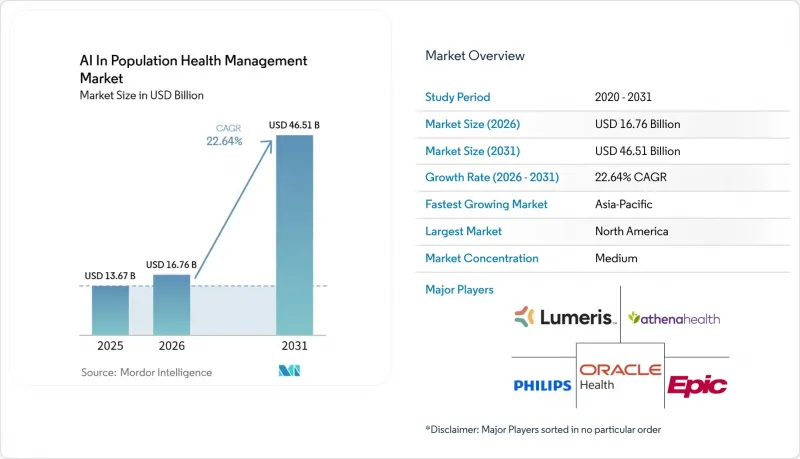
Mordor Intelligence에 의하면, 집단건강관리 AI시장 규모는 2025년 136억 7,000만 달러에서 2026년에는 167억 6,000만 달러로 확대되어 2031년까지 465억 1,000만 달러에 이를 것으로 예상되고 있어 2026년부터 2031년까지 CAGR 22.64%로 성장할 전망입니다.
본 보고서는 구성 요소(소프트웨어 및 서비스), 도입 형태(클라우드 기반, On-Premise형, 하이브리드형), 용도(인구 건강 분석, 환자 참여 유도, 위험 계층화 등), 최종 사용자(의료 제공업체, 의료 보험사 등), 지역(북미, 유럽, 아시아태평양 등)별로 분류되어 있습니다. 시장 규모 및 전망은 금액(달러) 기준으로 제시되어 있습니다.
전 세계 AI 기반 집단건강관리 시장 동향과 인사이트
가치 기반 보상 체계로의 전환
집단건강관리 분야의 AI 시장은 지불 제도 개혁으로부터 직접적인 추진력을 얻고 있습니다. 이는 가치 기반 의료가 더 이상 선택적인 분석 프로젝트가 아니라, 지속적인 성과 측정을 요구하는 운영상의 필요성을 창출하고 있기 때문입니다. TEAM은 2026년에 특정 지역에서 의무화된 정액 지불 모델로 도입될 예정입니다. 이러한 변화로 인해 가치 기반 책임성은 선택적 프로그램에서 많은 의료 제공 기관의 일상적인 요건으로 전환되고 있습니다. 이는 중요한 의미를 지닙니다. 의무화된 모델이 분석, 워크플로우 자동화 또는 케어 관리 도구에 대한 투자가 뒤처졌던 기관을 포함하여, 이전 시범 사업에 참여하지 않았던 의료 시스템까지 확대되기 때문입니다. 따라서 의료 제공업체들은 위험 기반 계약 하에서 이익률을 지키기 위해 더 우수한 예측, 귀속 관리 및 이용 관리가 필요하게 되므로, 집단건강관리 분야의 AI 시장은 더 광범위한 수요 기반의 혜택을 받게 될 것입니다. 또한, ACO REACH를 통해 수혜자 1인당 930달러의 비용을 절감함으로써, 자본 계획이나 이사회 논의에서 더 우수한 인구 수준 모니터링 체계에 대한 투자 대비 효과를 정당화하기가 쉬워질 것입니다. 2027년 이후, 전문 분야에 특화된 가치 기반 모델이 더욱 널리 보급됨에 따라, 인구 수준 AI는 임상 지원의 한 축으로서뿐만 아니라 수익 보호 도구로서도 점점 더 중요한 역할을 수행하게 될 것입니다.
만성 질환 부담 증가
집단건강관리 분야에서 AI 활용이 확대되고 있는 배경에는 만성 질환으로 인해 일회성 진료가 아닌 장기간에 걸친 지속적인 모니터링, 우선순위 설정, 개입이 필요한 환자층이 더욱 대규모화되고 복잡해지고 있다는 점이 있습니다. 2024년 전 세계 당뇨병 유병자 수는 5억 8,870만 명에 달하며, 많은 의료 시스템에서 심혈관 질환, 비만, 다중 질환 병용으로 인해 그 부담이 더욱 가중되고 있습니다. 중국에서는 만성 질환이 사망 원인의 80% 이상, 총 질병 부담의 70% 이상을 차지하고 있으며, 60세 이상 인구의 유병률은 81.1%에 달할 전망입니다. 이러한 상황으로 인해 집단건강관리 시장에서 AI는 장기적인 관점, 다중 질환, 그리고 의료 제공업체 및 의료 현장을 아우르는 치료 패턴을 통합할 수 있는 모델로 발전하고 있습니다. 또한, 단일 의료기관의 데이터 세트만으로는 부족해지고 있으며, 이는 만성 질환 모델링에서 연방 학습(federated learning) 및 여러 의료기관 간의 데이터 연동으로의 전환을 촉진하고 있습니다. 1차 진료의 메디케이드 환경에서 AI 기반 예방적 만성 질환 관리 프로그램을 도입한 결과, 모든 원인으로 인한 급성 사건이 22.9% 감소하고, 외래 진료로 대응 가능한 입원이 48.3% 감소한 것으로 보고되었으며, 이는 집단건강관리 시장에서 보험사 및 의료 제공업체 측이 AI에 투자할 근거를 강화하는 것입니다.
불분명한 AI 보상 및 책임 체계
집단건강관리 시장에서 AI는 소프트웨어 주도형 임상 지원 및 인구 수준 의사결정 시스템에 대한 보상 정책이 아직 완전히 따라잡지 못하고 있어, 여전히 큰 걸림돌에 직면해 있습니다. 『Health Affairs』지는 2026년에 메디케어의 지급 방식이 소프트웨어 기반 AI 서비스에 대응하도록 설계되지 않았다고 지적했습니다. 그 결과, 많은 도구가 기존의 급여 분류에 억지로 끼워 맞추어지면서 불투명한 지급 처리가 발생하고 있습니다. 구매 측이 안정적인 보험급여 지급 경로를 예측할 수 없는 경우, 치료 성과 향상에는 기여하지만 직접적이고 단기적인 청구 메커니즘을 창출하지 못할 가능성이 있는 도구의 도입에 대해서는 더욱 신중해집니다. 이러한 주저함은 계약 체결, 도입 속도, 그리고 조직 내 책임 소재에 영향을 미칩니다. 왜냐하면 재무팀, 법무팀, 그리고 임상 리더는 동일한 제품이라도 서로 다른 위험 관점에서 평가하는 경우가 많기 때문입니다. 특히, 집단건강관리 시장의 AI는 이러한 영향을 받기 쉬우며, 장기적인 임상적 가치가 높은 경우에도 벤더는 의료 제공업체에게 향후 의료 이용을 줄일 가능성이 있는 도구에 대한 자금 지원을 요구하고 있습니다. AI 기반 의사 결정에 관한 보상 처리 및 책임에 대해 정책 차원에서 보다 명확한 지침이 제시되기 전까지는 공식적인 급여 설계나 의료적 필요성 판단과 밀접하게 관련된 도구보다는 관리·운영상의 이용 사례에서의 도입이 계속해서 가속화될 것입니다.
부문 분석
2025년에는 소프트웨어가 72.48%의 점유율을 차지하고, 이는 집단건강관리 시장에서 AI 구매의 중심이 단기적인 컨설팅 업무가 아닌, 여전히 내구성이 있는 플랫폼에 집중되어 있음을 의미합니다. 이러한 경향은 ‘플랫폼 우선’ 조달 모델과 부합합니다. 왜냐하면 의료 제공업체와 보험사는 위험 식별, 아웃리치, 계약 분석 및 이용 관리를 통합적으로 지원할 수 있는 단일 운영 환경을 원하고 있기 때문입니다. 따라서 집단건강관리 시장의 AI 분야에서는 핵심 용도 스택 외부에 AI 기능을 배치하는 대신, 소프트웨어 모듈에 AI를 직접 통합할 수 있는 벤더가 우위를 점하고 있습니다. 이러한 동향으로 인해 도입 초기 단계에서 일회성 자문 업무의 역할은 줄어들고 있습니다. 도입 초기 단계의 가치는 도입된 플랫폼이 일상적으로 어떤 기능을 발휘할 수 있는지에 크게 좌우되기 때문입니다.
서비스 부문은 여전히 가장 빠르게 성장하는 분야로, 2026년부터 2031년까지 연평균 성장률(CAGR) 22.97%로 성장을 지속하고 있습니다. 이는 소프트웨어가 수익 기반의 대부분을 차지하더라도 도입 작업이 여전히 중요함을 보여줍니다. 서비스 부문의 성장은 사내에 데이터 사이언스 팀이나 통합 팀을 보유하지 않은 조직을 대상으로 한 관리형 지원, 도입 관련 전문 지식, 그리고 변경 관리에 기인합니다. 집단건강관리 분야의 AI 시장에서는 여전히 상당한 서비스 수요가 존재합니다. 이는 레거시 EHR 환경, 파편화된 청구 데이터 피드, 그리고 의료 제공업체별 워크플로우의 차이로 인해 소프트웨어 데모에서 보여지는 것보다 도입이 더 어려워지기 때문입니다. 또한, 예측적 의사결정 지원 개입에 대한 규정 준수 요건이 강화되면서, 가동 중인 시스템 전반에 걸친 문서화, 검증 및 거버넌스 지원의 필요성도 확대되고 있습니다. 집단건강관리 AI 업계에서 이로 인해 매출 구성비는 안정적으로 보이지만, 구매자가 시범 운영에서 대규모 운영으로 전환함에 따라 표면 아래에서는 서비스에 대한 의존도가 높아지고 있습니다.
2025년에는 클라우드 기반 도입이 56.27%의 점유율을 차지하고, 이는 집단건강관리 분야의 AI 시장이 여전히 다양한 소스의 데이터 수집 및 거의 실시간 분석에 대응할 수 있는 확장 가능한 환경에 크게 의존하고 있음을 뒷받침합니다. 클라우드 도입은 집단건강관리 워크로드에 적합합니다. 이러한 워크로드는 대규모 속성 기반 집단 전체에 걸친 지속적인 데이터 업데이트, 광범위한 상호 운용성, 그리고 빈번한 모델 업데이트에 의존하기 때문입니다. 또한 이 모델은 조직이 데이터 인프라 전체를 재구축하지 않고도 위험 점수 산정, 치료 격차 분석 로직, 참여 유도 도구를 추가할 수 있게 해주므로, 전체 이용 사례에 걸쳐 신속한 확장이 가능합니다. 실용적인 관점에서 볼 때, 보험사 데이터, 의료 제공업체 데이터, 약국 데이터, 아웃리치 활동을 하나의 뷰로 통합해야 하는 많은 구매자에게 있어 클라우드는 여전히 가장 쉬운 선택지입니다. 따라서 개인정보 보호 및 데이터 주권을 둘러싼 논의가 표면화되고 있음에도 불구하고, 집단건강관리 분야의 AI 시장 현재 수익 기반은 여전히 클라우드에 치우쳐 있습니다.
On-Premise 배포는 2026년부터 2031년까지 연평균 성장률(CAGR) 23.56%를 기록하며 가장 빠르게 성장하는 배포 형태이며, 이는 규제가 엄격한 환경에서 데이터 관리가 더욱 중요한 구매 요인으로 부상하고 있음을 보여줍니다. On-Premise 및 엄격하게 관리되는 로컬 환경에서의 집단건강관리 AI 시장 규모는 확대되고 있으며, 구매자들은 모델 훈련, 기밀성이 높은 환자 기록, 국경을 넘는 데이터 마이그레이션에 대해 더 강력한 감독을 요구하고 있습니다. 중국 국가위생건강위원회(NHSA)는 2026년, ‘개인 의료 보험 클라우드’용 AI 모델은 데이터가 플랫폼 외부로 유출되지 않고 내부에서 훈련되어야 한다고 밝혔습니다. 이는 주권형 또는 경계가 엄격하게 설정된 아키텍처가 지지를 얻고 있는 이유를 여실히 보여줍니다. 따라서 집단건강관리 분야의 AI 시장은 단일한 보편적 호스팅 모델로 향하고 있는 것은 아닙니다. 많은 조직이 클라우드의 유연성과 On-Premise 관리를 동시에 원하고 있기 때문입니다. 클라우드의 경제성을 누리면서도 데이터 저장 위치 및 개인정보 보호 관련 요건도 충족하고자 하는 많은 중견 규모 의료 시스템에게 하이브리드 배포는 현실적인 타협안이 되고 있습니다.
지역별 분석
2025년, 북미는 집단건강관리 분야 AI 시장 점유율의 38.47%를 차지하며, 이 지역은 여전히 현재 상업 활동의 중심지 역할을 하고 있습니다. 미국은 여전히 주요 실증의 장으로 자리 잡고 있습니다. 이는 TEAM, ACO REACH 및 외래 전문 모델(Ambulatory Specialty Model)이 가치 기반의 책임성과 성과 측정을 의료 자금 조달의 핵심으로 삼고 있기 때문입니다. 이러한 일련의 정책으로 인해 의료 제공업체와 보험사는 비용, 품질, 이용 현황 및 귀속 결과를 단일 시스템에서 추적할 명확한 근거를 갖게 되었으며, 이로 인해 집단건강관리 분야의 AI 시장에는 다른 대부분의 지역보다 더 강력한 수요 신호가 나타나고 있습니다. 또한 북미는 성숙한 보험사 및 의료 제공업체 간의 계약 구조와 널리 도입된 전자건강기록(EHR) 인프라의 혜택을 받고 있어, 이를 통해 인구 수준의 분석을 운영에 적용하기가 용이해졌습니다. 이러한 조건 덕분에, 지역 외에서의 성장이 더욱 빠르게 확대되기 시작했음에도 불구하고, 집단건강관리 분야의 AI 시장은 북미에서 상업적으로 가장 견고한 입지를 유지하고 있습니다.
유럽은 더 세분화되어 있지만, 데이터 거버넌스, AI 감독, 2차 데이터 접근 규정이 보다 명확한 프레임워크로 전환됨에 따라 이 지역은 점차 체계화되고 있습니다. 독일의 옵트아웃 방식 전자 환자 기록은 2025년 1월부터 법정 건강보험 가입자 7,300만 명 전원을 포괄하게 되었으며, 2025년 7월부터는 공식적인 감독 하에 국립 연구 데이터센터에 데이터 제공을 시작했습니다. 이를 통해 해당 지역은 이전보다 더 강력한 종단적 데이터베이스를 구축하게 될 것입니다. 프랑스는 ‘ '프랑스 2030' 계획을 통해 의료 데이터 웨어하우스에 1억 1,000만 유로(약 1억 1,900만 달러)를 투자하겠다고 약속했으며, 2025년 7월에는 인구 수준 모니터링과 디지털 트윈 모델링에 초점을 맞춘 국가 AI·의료 데이터 전략을 출범시켰습니다. 영국의 NHS 개혁 의제도, 특히 진료 역량 부족이나 예약 무단 취소로 인해 이미 의료 접근성에 영향을 미치고 있는 분야에서 1차 진료 분야의 AI 활용을 가속화하고 있습니다. 동시에 유럽 의료계 지도자들은 검증 및 거버넌스 프로세스가 지연될 경우, 규모의 우위를 미국이나 중국의 기술 기업들에게 빼앗길 우려가 있다고 경고하고 있습니다. 이것이 도입이 아직 더딘 지역에서도 조달 의향이 높아지고 있는 이유를 설명해 줍니다.
아시아태평양은 가장 빠르게 성장하는 지역이며, 이 지역의 집단건강관리 분야 AI 시장 규모는 2026년부터 2031년까지 연평균 성장률(CAGR) 24.93%로 확대될 것으로 예측됩니다. 이러한 성장 속에서 중국은 가장 두드러진 규모 확대를 보이고 있는 국가입니다. 2026년부터 2030년까지의 제15차 5개년 계획에서 AI 기반 의료가 전략적 우선 과제로 자리매김하고 있을 뿐만 아니라, 2025년 5월 기준으로 국내에 공개된 의료용 대규모 모델은 300건에 육박하며, 현(縣) 단위 원격 영상 진단 서비스는 이미 6,800만 건 이상의 증례를 처리하고 있기 때문입니다. 또한, 중국 국가위생건강위원회(NHSA)는 2026년 2월 ‘개인 의료보험 클라우드’ 시범 사업을 시작하여, 13억 3,000만 명의 피보험자에 대해 치료 전 생애 주기에 걸친 동적 건강 프로파일을 구축하고 있습니다. 따라서 집단건강관리 시장에서 AI는 아시아태평양에서 가장 장기적인 성장 잠재력을 보일 가능성이 높습니다. 이 지역에서는 공공 시스템의 현대화, 만성 질환으로 인한 부담 증가, 그리고 국가 차원의 데이터 플랫폼이 장기적으로 더 광범위한 도입을 뒷받침할 수 있기 때문입니다.
기타 혜택:
- 엑셀 형식 시장 예측(ME) 시트
- 3개월간의 애널리스트 지원
자주 묻는 질문
목차
제1장 서론
제2장 조사 방법
제3장 주요 요약
제4장 시장 구도
제5장 시장 규모와 성장 예측
제6장 경쟁 구도
제7장 시장 기회와 향후 전망
JHS 26.08.05According to Mordor Intelligence, the AI in population health management market size is expected to increase from USD 13.67 billion in 2025 to USD 16.76 billion in 2026 and reach USD 46.51 billion by 2031, growing at a CAGR of 22.64% over 2026-2031.
This report is Segmented by Component (Software and Services), Deployment Mode (Cloud-Based, On-Premises, and Hybrid), Application (Population Health Analytics, Patient Engagement, Risk Stratification, and More), End User (Healthcare Providers, Healthcare Payers, and More), and Geography (North America, Europe, Asia-Pacific, and More). The Market and Forecasted in Terms of Value (USD).
Global AI In Population Health Management Market Trends and Insights
Shift Toward Value-Based Reimbursement
The AI in population health management market is gaining direct support from payment reform because value-based care now creates an operating need for continuous performance measurement rather than a discretionary analytics project. TEAM is active in 2026 as a mandatory bundled payment model in selected geographies. That change moves value-based accountability from an optional program into a daily requirement for many provider organizations. This matters because mandatory models reach health systems that had stayed outside earlier pilots, including organizations that were slower to fund analytics, workflow automation, or care management tools. The AI in the population health management market, therefore, benefits from a broader demand base, since providers now need better forecasting, attribution management, and utilization control to protect margins under risk-based contracts. ACO REACH savings of USD 930 per beneficiary also make the return on better population oversight easier to defend in capital planning and board discussions. As specialty-focused value-based models move closer to wider use from 2027 onward, population-level AI will increasingly function as a revenue protection tool as much as a clinical support layer.
Rising Chronic-Disease Burden
The AI in the population health management market is also expanding because chronic disease is creating a larger and more complex base of patients who need continuous monitoring, prioritization, and intervention over the years, rather than isolated visits. Global diabetes prevalence reached 588.7 million in 2024, and that burden is being compounded by cardiovascular disease, obesity, and multimorbidity across many health systems. In China, chronic diseases accounted for more than 80% of deaths and over 70% of total disease burden, while prevalence among people aged 60 and above reached 81.1%. These conditions are pushing the AI in the population health management market toward models that can combine long time horizons, multiple conditions, and care patterns that span providers and settings. They are also making single-institution datasets less sufficient, which supports the shift toward federated learning and multi-institution data collaboration for chronic disease modeling. In primary care Medicaid settings, proactive AI-enabled chronic disease management programs reported 22.9% fewer all-cause acute events and 48.3% fewer ambulatory care-sensitive hospitalizations, which strengthens the case for payer-side and provider-side investment in AI in the population health management market.
Unclear AI Reimbursement and Liability Frameworks
The AI in the population health management market still faces a meaningful brake because reimbursement policy has not fully caught up with software-led clinical support and population-level decision systems. Health Affairs noted in 2026 that Medicare payment methodology was not built for software-based AI services, which leaves many tools squeezed into older benefit categories and creates uncertain payment treatment. When buyers cannot see a stable reimbursement path, they become more selective about deploying tools that improve outcomes but may not generate a direct and near-term billing mechanism. That hesitation affects contracting, implementation speed, and internal ownership because finance teams, legal teams, and clinical leaders often judge the same product through different risk lenses. The AI in population health management market is especially exposed, where vendors are asking providers to fund tools that may reduce future utilization, even when the long-term clinical value is strong. Until policy gives clearer signals on reimbursement treatment and responsibility for AI-assisted decisions, adoption will continue to move faster in administrative and operational use cases than in tools that sit closer to formal benefit design or medical necessity decisions.
Other drivers and restraints analyzed in the detailed report include:
- AI-Driven Risk Stratification and Care-Gap Closure
- Primary-Care Workforce Shortages Favor Panel Automation
- Model Bias and Drift from Fragmented Longitudinal Data
For complete list of drivers and restraints, kindly check the Table Of Contents.
Segment Analysis
Software held 72.48% share in 2025, which means the buying center of AI in population health management market is still concentrated around durable platforms rather than short-term consulting work. This pattern fits a platform-first procurement model because providers and payers want one operating environment that can support risk identification, outreach, contract analytics, and utilization management together. The AI in the population health management market has therefore favored vendors that can embed AI directly into software modules rather than leaving intelligence outside the core application stack. That dynamic reduces the role of episodic advisory work at the earliest stage of adoption, since the initial value now depends more on what the installed platform can do every day.
Services are still the fastest-growing component at 22.97% CAGR over 2026-2031, which shows that implementation work remains important even when software owns the larger revenue base. Growth in services comes from managed support, deployment expertise, and change management for organizations that do not have internal data science or integration teams. The AI in population health management market still carries meaningful service demand because legacy EHR environments, fragmented claims feeds, and provider workflow differences make deployment harder than software demonstrations often suggest. Compliance expectations around predictive decision-support interventions also expand the need for documentation, validation, and governance support across live installations. Within the AI in population health management industry, that leaves the component mix looking stable at the top line, but more service intensive below the surface as buyers move from pilot use into scaled operations.
Cloud-based deployment held 56.27% share in 2025, which confirms that the AI in population health management market still relies heavily on scalable environments that can handle multi-source ingestion and near real-time analytics. Cloud adoption fits population health workloads because those workloads depend on continuous data refresh, broad interoperability, and frequent model updates across large attributed populations. The model also supports faster expansion across use cases because organizations can add risk scoring, care-gap logic, and engagement tools without rebuilding the entire data foundation. In practical terms, cloud remains the easiest path for many buyers who need to combine payer data, provider data, pharmacy data, and outreach activity in one view. That is why the current revenue base in the AI in population health management market continues to lean toward cloud, even as privacy and sovereignty debates become more visible.
On-premises deployment is the fastest-growing mode at 23.56% CAGR over 2026-2031, which shows that data control is becoming a more important buying factor in regulated settings. The AI in population health management market size for on-premises and tightly controlled local environments is rising where buyers want stronger oversight of model training, sensitive patient records, and data movement across borders. China's NHSA stated in 2026 that AI models for the Personal Medical Insurance Cloud should train internally without data leaving the platform, which illustrates why sovereign or tightly bounded architectures are gaining support. The AI in population health management market is therefore not moving toward one universal hosting model, because many organizations now want cloud flexibility and local control at the same time. Hybrid deployment has become the practical compromise for many mid-market health systems that want the economics of cloud while still meeting residency and privacy expectations.
Complete Report Scope:
- By Component
- Software
- Services
- By Deployment Mode
- Cloud-Based
- On-Premises
- Hybrid
- By Application
- Population Health Analytics
- Patient Engagement
- Risk Stratification
- Care Management & Coordination
- Financial & Network Performance Analytics
- Others
- By End User
- Healthcare Providers
- Healthcare Payers
- Accountable Care Organizations
- Others
- By Geography
- North America
- United States
- Canada
- Mexico
- Europe
- Germany
- United Kingdom
- France
- Italy
- Spain
- Rest of Europe
- Asia-Pacific
- China
- India
- Japan
- Australia
- South Korea
- Rest of Asia-Pacific
- Middle East and Africa
- GCC
- South Africa
- Rest of Middle East and Africa
- South America
- Brazil
- Argentina
- Rest of South America
- North America
Geography Analysis
North America held 38.47% of AI in population health management market share in 2025, which keeps the region at the center of current commercial activity. The United States remains the main proving ground because TEAM, ACO REACH, and the Ambulatory Specialty Model place value-based accountability and performance measurement at the center of care financing. That policy stack gives the AI in population health management market a stronger demand signal than in most other regions, since providers and payers have clearer reasons to track cost, quality, utilization, and attributed outcomes in one system. North America also benefits from mature payer-provider contracting structures and a broad installed EHR infrastructure, which makes population-level analytics easier to operationalize. These conditions keep the AI in population health management market commercially strongest in North America, even as growth begins to broaden more sharply outside the region.
Europe is more fragmented, but the region is becoming more organized as data governance, AI oversight, and secondary data access rules move into a clearer framework. Germany's opt-out electronic patient file covered all 73 million statutory insured people from January 2025 and began feeding the national Research Data Center from July 2025 under formal oversight, which gives the region a stronger longitudinal data base than before. France committed EUR 110 million, around USD 119 million, through France 2030 for health data warehouses and launched a national AI and health data strategy in July 2025 focused on population-level monitoring and digital twin modeling. The UK's NHS reform agenda is also pushing faster AI use in primary care, especially where capacity pressure and missed appointments are already affecting access. At the same time, European medical leadership has warned that slow validation and governance processes could leave scale advantages to U.S. and Chinese technology firms, which explains why procurement intent is rising even where deployment still lags.
Asia-Pacific is the fastest-growing region, with AI in population health management market size in the region projected to expand at 24.93% CAGR over 2026-2031. China is the clearest scale story inside that growth, because the 15th Five-Year Plan for 2026-2030 treats AI healthcare as a strategic priority, and domestic releases had reached nearly 300 medical large models by May 2025 while county-level remote imaging services had already handled more than 68 million cases. China's NHSA also launched the Personal Medical Insurance Cloud pilot in February 2026 to build dynamic health profiles across the full care lifecycle for 1.33 billion insured people. The AI in population health management market is therefore likely to find some of its longest runway in Asia-Pacific, where public system modernization, chronic disease pressure, and national-scale data platforms can all support broader deployment over time.
- Arcadia Solutions, LLC
- Athenahealth
- Cedar Gate Technologies, LLC
- Clarify Health Solutions, Inc.
- Cotiviti, Inc.
- eClinicalWorks
- Epic Systems
- Health Catalyst, Inc.
- HealthEC, LLC
- Innovaccer
- Koninklijke Philips
- Lightbeam Health Solutions, Inc.
- Lumeris, Inc.
- Medecision, Inc.
- Milliman MedInsight, Inc.
- NextGen Healthcare
- Optum
- Oracle Health, Inc.
- Persivia Inc.
- ZeOmega Inc.
Additional Benefits:
- The market estimate (ME) sheet in Excel format
- 3 months of analyst support
TABLE OF CONTENTS
1 Introduction
- 1.1 Study Assumptions & Market Definition
- 1.2 Scope of the Study
2 Research Methodology
3 Executive Summary
4 Market Landscape
- 4.1 Market Overview
- 4.2 Market Drivers
- 4.2.1 Shift Toward Value-Based Reimbursement
- 4.2.2 Rising Chronic-Disease Burden
- 4.2.3 AI-Driven Risk Stratification and Care-Gap Closure
- 4.2.4 Cloud-Native Healthcare Data Platforms
- 4.2.5 Medicaid and Public-Health Data Modernization
- 4.2.6 Primary-Care Workforce Shortages Favor Panel Automation
- 4.3 Market Restraints
- 4.3.1 Data Privacy and Cybersecurity Risks
- 4.3.2 High Implementation and Legacy Integration Costs
- 4.3.3 Unclear AI Reimbursement and Liability Frameworks
- 4.3.4 Model Bias and Drift from Fragmented Longitudinal Data
- 4.4 Value / Supply-Chain Analysis
- 4.5 Regulatory Landscape
- 4.6 Technological Outlook
- 4.7 Porter's Five Forces Analysis
- 4.7.1 Threat of New Entrants
- 4.7.2 Bargaining Power of Buyers
- 4.7.3 Bargaining Power of Suppliers
- 4.7.4 Threat of Substitutes
- 4.7.5 Competitive Rivalry
5 Market Size & Growth Forecasts (Value, USD)
- 5.1 By Component
- 5.1.1 Software
- 5.1.2 Services
- 5.2 By Deployment Mode
- 5.2.1 Cloud-Based
- 5.2.2 On-Premises
- 5.2.3 Hybrid
- 5.3 By Application
- 5.3.1 Population Health Analytics
- 5.3.2 Patient Engagement
- 5.3.3 Risk Stratification
- 5.3.4 Care Management & Coordination
- 5.3.5 Financial & Network Performance Analytics
- 5.3.6 Others
- 5.4 By End User
- 5.4.1 Healthcare Providers
- 5.4.2 Healthcare Payers
- 5.4.3 Accountable Care Organizations
- 5.4.4 Others
- 5.5 By Geography
- 5.5.1 North America
- 5.5.1.1 United States
- 5.5.1.2 Canada
- 5.5.1.3 Mexico
- 5.5.2 Europe
- 5.5.2.1 Germany
- 5.5.2.2 United Kingdom
- 5.5.2.3 France
- 5.5.2.4 Italy
- 5.5.2.5 Spain
- 5.5.2.6 Rest of Europe
- 5.5.3 Asia-Pacific
- 5.5.3.1 China
- 5.5.3.2 India
- 5.5.3.3 Japan
- 5.5.3.4 Australia
- 5.5.3.5 South Korea
- 5.5.3.6 Rest of Asia-Pacific
- 5.5.4 Middle East and Africa
- 5.5.4.1 GCC
- 5.5.4.2 South Africa
- 5.5.4.3 Rest of Middle East and Africa
- 5.5.5 South America
- 5.5.5.1 Brazil
- 5.5.5.2 Argentina
- 5.5.5.3 Rest of South America
- 5.5.1 North America
6 Competitive Landscape
- 6.1 Market Concentration
- 6.2 Market Share Analysis
- 6.3 Company Profiles (includes Global Level Overview, Market Level overview, Core Segments, Financials as Available, Strategic Information, Market Rank/Share for Key Companies, Products & Services, and Recent Developments)
- 6.3.1 Arcadia Solutions, LLC
- 6.3.2 athenahealth, Inc.
- 6.3.3 Cedar Gate Technologies, LLC
- 6.3.4 Clarify Health Solutions, Inc.
- 6.3.5 Cotiviti, Inc.
- 6.3.6 eClinicalWorks, LLC
- 6.3.7 Epic Systems Corporation
- 6.3.8 Health Catalyst, Inc.
- 6.3.9 HealthEC, LLC
- 6.3.10 Innovaccer Inc.
- 6.3.11 Koninklijke Philips N.V.
- 6.3.12 Lightbeam Health Solutions, Inc.
- 6.3.13 Lumeris, Inc.
- 6.3.14 Medecision, Inc.
- 6.3.15 Milliman MedInsight, Inc.
- 6.3.16 NextGen Healthcare, Inc.
- 6.3.17 Optum, Inc.
- 6.3.18 Oracle Health, Inc.
- 6.3.19 Persivia Inc.
- 6.3.20 ZeOmega Inc.
7 Market Opportunities & Future Outlook
- 7.1 White-space & unmet-need assessment


