|
시장보고서
상품코드
2126792
배연 탈황(FGD) 시스템 시장 예측(-2031년) : 유형(습식 FGD 시스템, 건식 및 반건식 FGD 시스템), 도입 형태(그린필드, 브라운필드), 최종사용자 산업(발전, 화학 및 석유화학), 지역별Flue Gas Desulfurization System Market by Type (Wet FGD Systems, Dry & Semi-Dry FGD Systems), Installation (Greenfield, Brownfield), End-Use Industry (Power Generation, Chemicals & Petrochemicals), and Region - Global Forecast To 2031 |
||||||

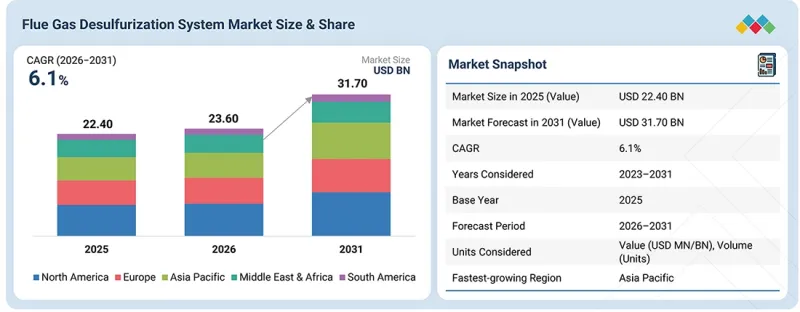
세계의 배연 탈황(FGD) 시스템 시장 규모는 2026년 236억 달러에서 2031년에는 317억 달러에 달할 것으로 예측되고 있으며, 예측 기간 중 CAGR 6.1%를 기록할 전망입니다.
석탄 화력 발전, 시멘트 제조, 산업용 보일러 등에서 배출 기준을 준수하는 배가스 처리 시스템에 대한 수요가 증가하고 있는 것이 시장을 촉진하고 있습니다. 엄격한 SO2 배출 기준에 대응해야 하는 압박이 커지고 있는 데다, 개발도상국에서는 베이스로드 전력원으로 석탄에 대한 의존이 지속되고 있는 점이 시장 성장의 기회를 창출하고 있습니다.
| 조사 범위 | |
|---|---|
| 조사 대상 기간 | 2023-2031년 |
| 기준연도 | 2025년 |
| 예측 기간 | 2026-2031년 |
| 단위 | 금액(달러)·수량(단위) |
| 부문 | 유형, 도입 형태, 최종사용자 산업 |
| 대상 지역 | 북미, 아시아태평양, 유럽, 중동 및 아프리카, 남미 |
건설 단계부터 배연 탈황(FGD) 설비를 갖춘 신규 석탄 화력 발전소의 건설 속도가 가속화되고 있는 데 더해, 기존 발전소를 대상으로 한 대규모 개보수 프로그램도 시장의 성장세를 더욱 지원하고 있습니다.
"2026-2031년에 건식 및 반건식 FGD 시스템 부문이 가장 높은 연평균 성장률(CAGR)을 보일 것으로 예상됩니다."
이 부문의 성장은 습식 FGD 시스템에 비해 물 소비량이 적고, 폐기물 처리가 용이하며, 보조 설비 동력 요구량이 적다는 점 등에 기인합니다. 이러한 시스템은 수자원이 제한된 지역 및 습식 스크러버에 필요한 대규모 인프라를 도입하지 않고도 확실한 SO₂ 제거를 원하는 소규모 설비에서 채택이 확대되고 있습니다. 특히 건조 지역이나 물 부족이 심각한 지역에서 가동되는 석탄 화력 발전소, 산업용 보일러, 시멘트 가마에서는 설비 투자 부담이 비교적 적고, 폐수 처리 필요성이 낮으며, 기존 설비에 통합하기 쉬워 건식·반건식 시스템의 도입이 확대되고 있습니다. 또한 건식·반건식 시스템은 소규모이자 모듈형 구성으로도 도입할 수 있으므로 습식 FGD로는 규모의 경제성을 발휘하기 어려운 중규모 산업 배출 사업자에게 설계상의 유연성이 높다는 장점도 있습니다.
"발전 부문이 2031년에 최대 시장 점유율을 차지할 전망"
최종사용자 산업별로 보면 아시아태평양, 유럽, 북미의 일부 지역에서 베이스로드 전력 공급이 석탄 화력 발전소에 크게 의존하고 있으므로 발전 부문이 2031년에 가장 큰 점유율을 차지할 것으로 예측됩니다. 석탄 화력 발전소는 SO₂ 배출 기준을 준수하고, 규제상의 벌칙이나 강제적인 출력 억제를 피하기 위해 FGD 시스템에 크게 의존하고 있습니다. 석탄에 의존하는 경제권에서의 발전 용량 증가, 초저배출 기준의 시행 강화, 인구 밀집 지역 인근 산업 단지 주변의 대기 환경 감시가 발전 분야의 FGD 수요를 끌어올리고 있습니다. 또한 전 세계에서 가동중인 석탄 화력 발전 설비의 규모가 매우 큰 데다, 각국의 개보수 의무가 단계적으로 시행되고 있는 점도 발전 부문의 최대 점유율을 지원하고 있습니다.
"예측 기간 중 유럽은 세계 시장에서 2위를 차지할 전망"
유럽은 대규모 연소 시설 및 산업 배출을 규제하는 제도적 체계가 오랫동안 구축되어 온 덕분에, 2026-2031년에 2위의 점유율을 차지할 것으로 예상됩니다. 이 지역에는 FGD 시스템 및 배기가스 제어 장비의 주요 제조업체가 여러 곳 존재하며, 이를 통해 첨단인 탈황 기술 분야의 혁신과 공급망의 견고성이 유지되고 있습니다. 산업 배출 지침(Industrial Emissions Directive) 및 이용 가능한 최상의 기술(BAT) 기준의 엄격한 적용, 잔존하는 석탄 화력 발전 설비에 대한 지속적인 규제 준수 의무, 나아가 EU 비회원국인 동남유럽 시장에 대한 FGD 관련 규제 적합 요건의 확대가 지역 시장을 촉진하고 있습니다. 반면, 유럽에서는 석탄 화력 설비의 노후화가 진행되고 있으며, 설비 용량도 점차 축소되고 있으며, 향후 시장 성장 속도는 아시아태평양에 비해 완만해질 것으로 전망됩니다.
이 보고서에서는 전 세계 배연 탈황(FGD) 시스템 시장을 조사하여, 시장 개요, 시장 성장에 영향을 미치는 각종 요인 분석, 기술 및 특허 동향, 법규제 환경, 사례 연구, 시장 규모 추이 및 전망, 각종 분류·지역/주요 국가별 상세 분석, 경쟁 구도, 주요 기업 개요 등을 종합적으로 다루고 있습니다.
자주 묻는 질문
목차
제1장 서론
제2장 개요
제3장 주요 인사이트
제4장 시장 개요
제5장 업계 동향
제6장 기술의 진보, AI에 의한 영향, 특허, 혁신, 향후 응용
제7장 규제 상황과 지속가능성 구상
제8장 고객 상황과 구매 행동
제9장 배연 탈황(FGD) 시스템 시장 : 유형별
제10장 배연 탈황(FGD) 시스템 시장 : 도입 형태별
제11장 배연 탈황(FGD) 시스템 시장 : 용도별
제12장 배연 탈황(FGD) 시스템 시장 : 지역별
제13장 경쟁 구도
제14장 기업 개요
제15장 조사 방법
제16장 부록
KSA 26.09.14The global flue gas desulfurization system market is anticipated to be valued at USD 23.60 billion in 2026 and USD 31.70 billion by 2031, registering a CAGR of 6.1% during the forecast period. Rising demand for compliant emission-control systems across coal-fired power generation, cement manufacturing, and industrial boilers is driving the market. The mounting pressure to meet stringent SO2 emission norms and the continued reliance on coal as a baseload fuel source in developing economies create market growth opportunities.
| Scope of the Report | |
|---|---|
| Years Considered for the Study | 2023-2031 |
| Base Year | 2025 |
| Forecast Period | 2026-2031 |
| Units Considered | Value (USD Million/Billion), Volume (Units) |
| Segments | Type, Installation, and End-use Industry |
| Regions covered | North America, Asia Pacific, Europe, the Middle East & Africa, and South America |
Furthermore, the increasing pace of new-build coal capacity equipped with flue gas desulfurization (FGD) from inception, combined with large-scale retrofit programs targeting existing thermal power fleets, also adds to the momentum of the market.
"Dry & semi-dry FGD systems segment to exhibit the highest CAGR from 2026 to 2031"
In terms of type, the dry & semi-dry FGD systems segment is anticipated to be the fastest-growing in the flue gas desulfurization system market during the forecast period. The segmental growth is attributed to its lower water consumption, simpler waste handling, and reduced auxiliary power requirements compared with wet FGD systems. These systems are increasingly embraced in water-constrained regions and smaller-capacity installations seeking reliable SO2 control without the infrastructure burden of wet scrubbing. Coal-fired power plants, industrial boilers, and cement kilns operating in arid or water-stressed geographies are among the key adopters of these systems, owing to their lower capital footprint, reduced wastewater treatment needs, and simpler retrofit integration. In addition, dry & semi-dry systems can be deployed in smaller, modular configurations, offering design flexibility for mid-sized industrial emitters that wet FGD's scale economics do not favor.
"Power generation segment to account for the largest market share in 2031"
In terms of end-use industry, the power generation segment is projected to capture the largest share of the flue gas desulfurization system market in 2031, owing to the extensive reliance on coal-fired plants for baseload electricity across Asia Pacific, Europe, and parts of North America. Coal-based thermal power stations heavily depend on FGD systems to maintain compliance with SO2 emission standards and avoid regulatory penalties or forced curtailment. Increasing capacity additions in coal-dependent economies, rising enforcement of ultra-low-emission mandates, and growing scrutiny of ambient air quality near densely populated industrial corridors augment the demand for FGD in the power generation industry. Moreover, the sheer scale of the installed coal power fleet globally, combined with the phased nature of national retrofit mandates, solidifies the leadership of the segment.
"Europe to be the second-largest region in the global market during the forecast period"
In terms of region, Europe is anticipated to hold the second-largest share of the flue gas desulfurization system market between 2026 and 2031 due to its long-established regulatory framework governing large combustion plants and industrial emissions. The region houses several prominent manufacturers of FGD systems and emission-control equipment, hence sustaining innovation and supply-chain depth in advanced desulfurization technologies. Strict enforcement of Industrial Emissions Directive and Best Available Techniques standards, continued compliance obligations on the remaining coal fleet, and extension of FGD-accession compliance into non-EU Southeastern European markets are driving the regional market, even as Europe's aging and gradually shrinking coal capacity tempers the pace of forward growth relative to Asia Pacific.
Breakdown of Primary Interviews:
By Company Type: Tier 1: 40%, Tier 2: 30%, and Tier 3: 30%
By Designation: Directors: 30%, Managers: 20%, and Others: 50%
By Region: North America: 20%, Europe: 10%, Asia Pacific: 40%, South America: 10%, and Middle East & Africa: 20%
Notes: Others include sales, marketing, and product managers.
Tier 1: >USD 1 Billion; Tier 2: USD 500 million-1 Billion; and Tier 3: <USD 500 million
Companies Covered: Mitsubishi Heavy Industries, Ltd. (Japan), GE Vernova (US), Doosan Lentjes (Germany), Babcock & Wilcox Enterprises, Inc. (US), ANDRITZ (Austria), Valmet (Finland), Kawasaki Heavy Industries, Ltd. (Japan), Bharat Heavy Electricals Limited (India), Longking Environmental Protection (China), and KC Cottrell (South Korea), among others, are covered in the report.
The study includes an in-depth competitive analysis of these key players in the flue gas desulfurization system market, with their company profiles, recent developments, and key market strategies.
Research Coverage
This research report categorizes the flue gas desulfurization system market based on type (wet FGD systems and dry & semi-dry FGD systems), installation (greenfield and brownfield), and end-use industry (power generation, cement manufacturing, iron & steel, chemicals & petrochemicals, and other end-use industries). The report's scope covers detailed information regarding drivers, restraints, challenges, and opportunities influencing the market growth. A detailed analysis of the key industry players has been done to provide insights into their business overviews, products offered, and key strategies, such as mergers, acquisitions, product launches, and expansions, associated with the market. This report covers a competitive analysis of upcoming startups in the flue gas desulfurization system ecosystem.
Reasons to Buy the Report
The report will offer the market leaders/new entrants with information on the closest approximations of the revenue numbers for the overall flue gas desulfurization system market and the subsegments. This report will help stakeholders understand the competitive landscape, gain more insights into positioning their businesses better, and plan suitable go-to-market strategies. The report will also help stakeholders understand the pulse of the market and provide them with information on key market drivers, restraints, challenges, and opportunities.
The report provides insights into the following points:
- Analysis of key drivers (Stringent environmental regulations to reduce sulfur dioxide (SO2) emission, Growing retrofit installations in aging thermal power plants, Increasing investments in coal-fired power plants in emerging economies), restraints (High capital investment and operating costs, Declining coal-fired power generation in developed economies), opportunities (Expansion of emission control investments in emerging economies, Modernization and digitalization of emission control systems), and challenges (Managing FGD by-products and wastewater, Balancing emission compliance with global energy transition)
- Product Development/Innovation: Detailed insights into upcoming technologies, research & development activities, and product & service launches in the flue gas desulfurization system market
- Market Development: Comprehensive information about profitable markets (the report analyzes the market across varied regions)
- Market Diversification: Exhaustive information about new products & services, untapped geographies, recent developments, and investments in the market
- Competitive Assessment: In-depth assessment of market shares, growth strategies, and service offerings of leading players such as Mitsubishi Heavy Industries, Ltd. (Japan), GE Vernova (US), Doosan Lentjes (Germany), Babcock & Wilcox Enterprises, Inc. (US), ANDRITZ (Austria), Valmet (Finland), Kawasaki Heavy Industries, Ltd. (Japan), Bharat Heavy Electricals Limited (India), Longking Environmental Protection (China), and KC Cottrell (South Korea), among others
TABLE OF CONTENTS
1 INTRODUCTION
- 1.1 STUDY OBJECTIVES
- 1.2 MARKET DEFINITION
- 1.3 MARKET SCOPE
- 1.3.1 MARKET SEGMENTATION AND REGIONAL SCOPE
- 1.3.2 INCLUSIONS AND EXCLUSIONS
- 1.3.3 YEARS CONSIDERED
- 1.3.4 CURRENCY CONSIDERED
- 1.3.5 UNIT CONSIDERED
- 1.4 STAKEHOLDERS
- 1.5 SUMMARY OF CHANGES
2 EXECUTIVE SUMMARY
- 2.1 MARKET HIGHLIGHTS AND KEY INSIGHTS
- 2.2 KEY MARKET PARTICIPANTS: MAPPING OF STRATEGIC DEVELOPMENTS
- 2.3 DISRUPTIVE TRENDS IN FGD SYSTEMS MARKET
- 2.4 HIGH-GROWTH SEGMENTS
- 2.5 REGIONAL SNAPSHOT: MARKET SIZE, GROWTH RATE, AND FORECAST
3 PREMIUM INSIGHTS
- 3.1 ATTRACTIVE OPPORTUNITIES FOR PLAYERS IN THE FGD SYSTEMS MARKET
- 3.2 FGD SYSTEMS MARKET, BY TYPE
- 3.3 FGD SYSTEMS MARKET, BY INSTALLATION
- 3.4 FGD SYSTEMS MARKET, BY END-USE INDUSTRY
- 3.5 FGD SYSTEMS MARKET, BY COUNTRY
4 MARKET OVERVIEW
- 4.1 INTRODUCTION
- 4.2 MARKET DYNAMICS
- 4.2.1 DRIVERS
- 4.2.1.1 Enforcement of stringent environmental regulations to reduce sulfur dioxide emissions
- 4.2.1.2 Growing demand for FGD retrofits in aging thermal power plants
- 4.2.1.3 Expansion of coal-fired power capacity in emerging economies
- 4.2.2 RESTRAINTS
- 4.2.2.1 High capital investment and operating costs of FGD systems
- 4.2.2.2 Declining coal-fired power generation in developed economies
- 4.2.3 OPPORTUNITIES
- 4.2.3.1 Increasing environmental compliance investments across emerging economies
- 4.2.3.2 Escalating need for modernization and digitalization of emission control systems
- 4.2.4 CHALLENGES
- 4.2.4.1 Effective management of FGD byproducts and wastewater
- 4.2.4.2 Tension between stringent SO2 compliance with transition toward lower carbon energy
- 4.2.5 UNMET NEEDS IN FGD SYSTEMS MARKET
- 4.2.6 WHITE SPACE OPPORTUNITIES
- 4.2.1 DRIVERS
- 4.3 INTERCONNECTED MARKETS AND CROSS-SECTOR OPPORTUNITIES
- 4.3.1 INTERCONNECTED/ADJACENT MARKETS AND CROSS-SECTOR OPPORTUNITIES
- 4.4 STRATEGIC MOVES BY TIER 1/2/3 PLAYERS
- 4.4.1 KEY MOVES AND STRATEGIC FOCUS
5 INDUSTRY TRENDS
- 5.1 PORTER'S FIVE FORCES ANALYSIS
- 5.1.1 BARGAINING POWER OF SUPPLIERS
- 5.1.2 BARGAINING POWER OF BUYERS
- 5.1.3 THREAT OF SUBSTITUTES
- 5.1.4 THREAT OF NEW ENTRANTS
- 5.1.5 INTENSITY OF COMPETITIVE RIVALRY
- 5.2 VALUE CHAIN ANALYSIS
- 5.2.1 RAW MATERIAL & COMPONENT SUPPLIERS
- 5.2.2 FGD SYSTEM MANUFACTURERS/TECHNOLOGY PROVIDERS
- 5.2.3 EPC, ENGINEERING, AND SERVICE PROVIDERS
- 5.2.4 END USERS
- 5.3 ECOSYSTEM ANALYSIS
- 5.4 PRICING ANALYSIS
- 5.4.1 AVERAGE SELLING PRICE TREND OF OF FGD SYSTEMS, BY REGION
- 5.4.2 PRICING TREND OF FGD SYSTEMS, BY TYPE, 2023-2025
- 5.5 MACROECONOMIC OUTLOOK
- 5.5.1 GLOBAL GDP TRENDS
- 5.6 IMPACT OF US TARIFFS ON FGD SYSTEMS MARKET
- 5.6.1 INTRODUCTION
- 5.6.2 KEY TARIFF RATES
- 5.6.3 PRICE IMPACT ANALYSIS
- 5.6.4 IMPACT ON COUNTRIES/REGIONS
- 5.6.4.1 US
- 5.6.4.2 Europe
- 5.6.4.3 Asia Pacific
- 5.6.5 IMPACT ON END-USE INDUSTRIES
- 5.7 TRADE ANALYSIS
- 5.7.1 IMPORT SCENARIO (HS CODE 842139)
- 5.7.2 EXPORT SCENARIO (HS CODE 842139)
- 5.8 TRENDS/DISRUPTIONS IMPACTING CUSTOMER BUSINESS
- 5.9 INVESTMENT AND FUNDING SCENARIO
- 5.10 CASE STUDY ANALYSIS
- 5.10.1 MACROTEK INC. IMPLEMENTS HYDROGEN PEROXIDE-BASED FGD SYSTEM FOR SO2 REMOVAL AND SULPHURIC ACID PRODUCTION
- 5.10.2 THERMAX COMMISSIONS FGD SYSTEM FOR COAL-BASED POWER PLANT
- 5.10.3 BABCOCK & WILCOX IMPLEMENTS WET FGD SYSTEMS AT MITCHELL STATION
- 5.11 KEY CONFERENCES AND EVENTS, 2026-2027
6 TECHNOLOGICAL ADVANCEMENTS, AI-DRIVEN IMPACT, PATENTS, INNOVATIONS, AND FUTURE APPLICATIONS
- 6.1 TECHNOLOGY ANALYSIS
- 6.1.1 KEY TECHNOLOGIES
- 6.1.1.1 Advanced wet limestone-gypsum flue gas desulfurization systems
- 6.1.1.2 Dry and semi-dry flue gas desulfurization systems
- 6.1.1.3 AI-enabled FGD systems for process optimization and predictive control
- 6.1.2 COMPLEMENTARY TECHNOLOGIES
- 6.1.2.1 Advanced gypsum dewatering and byproduct recovery systems
- 6.1.2.2 Advanced flue gas monitoring, sensors, and emissions control systems
- 6.1.1 KEY TECHNOLOGIES
- 6.2 TECHNOLOGY/PRODUCT ROADMAP
- 6.2.1 SHORT TERM (2025-2027) | SYSTEM EFFICIENCY & DIGITAL MONITORING
- 6.2.2 MID-TERM (2027-2030) | SMART FGD SYSTEMS & RESOURCE OPTIMIZATION
- 6.2.3 LONG TERM (2030-2030+) | AUTONOMOUS, LOW-RESOURCE & INTEGRATED FGD SYSTEMS
- 6.3 PATENT ANALYSIS
- 6.3.1 LEGAL STATUS OF PATENTS
- 6.3.2 JURISDICTION ANALYSIS
- 6.4 FUTURE APPLICATIONS
- 6.4.1 ADVANCED WET FGD SYSTEMS AND HIGH-EFFICIENCY SO2 REMOVAL
- 6.4.2 DRY & SEMI-DRY FGD SYSTEMS FOR WATER-CONSTRAINED APPLICATIONS
- 6.4.3 AI-ENABLED FGD PROCESS OPTIMIZATION AND PREDICTIVE CONTROL
- 6.4.4 ADVANCED GYPSUM RECOVERY, WASTEWATER TREATMENT, AND RESOURCE MANAGEMENT
- 6.4.5 INTEGRATED MULTI-POLLUTANT CONTROL AND DIGITAL EMISSION MONITORING
- 6.5 IMPACT OF AI/GEN AI ON FGD SYSTEMS MARKET
- 6.5.1 TOP USE CASES AND MARKET POTENTIAL OF FGD SYSTEMS
- 6.5.2 BEST PRACTICES FOLLOWED BY PLAYERS IN FGD SYSTEMS MARKET
- 6.5.3 CASE STUDIES OF AI IMPLEMENTATION IN FGD SYSTEMS MARKET
- 6.5.4 INTERCONNECTED/ADJACENT ECOSYSTEM AND IMPACT ON MARKET PLAYERS
- 6.5.5 CLIENTS' READINESS TO ADOPT GENERATIVE AI IN FGD SYSTEMS MARKET
7 REGULATORY LANDSCAPE AND SUSTAINABILITY INITIATIVES
- 7.1 REGIONAL REGULATIONS AND COMPLIANCE
- 7.1.1 REGULATORY BODIES, GOVERNMENT AGENCIES, AND OTHER ORGANIZATIONS
- 7.1.2 INDUSTRY STANDARDS
- 7.2 IMPACT OF REGULATORY POLICIES ON SUSTAINABILITY INITIATIVES
- 7.3 CERTIFICATIONS, LABELING, AND ECO-STANDARDS
8 CUSTOMER LANDSCAPE AND BUYER BEHAVIOR
- 8.1 INTRODUCTION
- 8.2 DECISION-MAKING PROCESS
- 8.3 KEY STAKEHOLDERS INVOLVED IN BUYING PROCESS AND THEIR BUYING CRITERIA
- 8.3.1 KEY STAKEHOLDERS IN BUYING PROCESS
- 8.3.2 BUYING CRITERIA
- 8.4 ADOPTION BARRIERS AND INTERNAL CHALLENGES
- 8.5 UNMET NEEDS IN VARIOUS END-USE INDUSTRIES
- 8.6 MARKET PROFITABILITY
- 8.6.1 REVENUE POTENTIAL
- 8.6.2 COST DYNAMICS
- 8.6.3 MARGIN OPPORTUNITIES IN KEY END-USE INDUSTRIES
9 FGD SYSTEMS MARKET, BY TYPE
- 9.1 INTRODUCTION
- 9.2 WET FGD SYSTEMS
- 9.2.1 HIGH SULFUR DIOXIDE REMOVAL EFFICIENCY AND LOW OPERATING COST TO BOOST ADOPTION
- 9.2.2 LIMESTONE
- 9.2.3 SEAWATER
- 9.2.4 OTHER WET FGD SYSTEMS
- 9.3 DRY & SEMI-DRY FGD SYSTEMS
- 9.3.1 GROWING USE IN CEMENT, IRON & STEEL MANUFACTURING, AND GAS-FIRED POWER PLANTS TO FUEL SEGMENTAL GROWTH
10 FGD SYSTEMS MARKET, BY INSTALLATION
- 10.1 INTRODUCTION
- 10.2 GREENFIELD
- 10.2.1 DESIGN FLEXIBILITY AND EASIER EMISSION COMPLIANCE IN NEW PLANTS TO SUPPORT SEGMENTAL GROWTH
- 10.3 BROWNFIELD
- 10.3.1 AGING FGD ASSETS AND PLANT LIFE-EXTENSION PROGRAMS TO BOOST BROWNFIELD UPGRADES
11 FGD SYSTEMS MARKET, BY END-USE INDUSTRY
- 11.1 INTRODUCTION
- 11.2 POWER GENERATION
- 11.2.1 SHIFT FROM NEW INSTALLATIONS TO RETROFITS AND UPGRADES IN CHINA TO SHAPE SEGMENTAL DEMAND
- 11.3 CHEMICALS
- 11.3.1 CHEMICAL PROCESSING CAPACITY EXPANSION IN ASIA PACIFIC AND MIDDLE EAST TO CREATE GREENFIELD AND RETROFIT OPPORTUNITIES
- 11.4 IRON & STEEL
- 11.4.1 ULTRA-LOW-EMISSION MANDATES IN CHINA'S STEEL INDUSTRY TO ACCELERATE DESULFURIZATION UPGRADES
- 11.5 CEMENT MANUFACTURING
- 11.5.1 STRINGENT KILN EMISSION STANDARDS AND PLANT MODERNIZATION EFFORTS TO FOSTER SEGMENTAL GROWTH
- 11.6 OTHER END-USE INDUSTRIES
12 FGD SYSTEMS MARKET, BY REGION
- 12.1 INTRODUCTION
- 12.2 NORTH AMERICA
- 12.2.1 US
- 12.2.1.1 Stringent environmental regulations and continued investment in emission control infrastructure to support demand
- 12.2.2 CANADA
- 12.2.2.1 Stringent environmental standards and modernization of power and industrial infrastructure to support market growth
- 12.2.3 MEXICO
- 12.2.3.1 Industrial modernization and environmental regulations to fuel market growth
- 12.2.1 US
- 12.3 EUROPE
- 12.3.1 GERMANY
- 12.3.1.1 Strong industrial base and stringent emission control requirements to facilitate market growth
- 12.3.2 FRANCE
- 12.3.2.1 Continued industrial activity and brownfield projects to stimulate market growth
- 12.3.3 UK
- 12.3.3.1 Stringent emission standards and established industrial base to contribute to market growth
- 12.3.4 ITALY
- 12.3.4.1 Rising need for brownfield retrofits and established cement industry to boost demand
- 12.3.5 SPAIN
- 12.3.5.1 Emphasis on industrial decarbonization, energy efficiency, renewable energy to accelerate market growth
- 12.3.6 REST OF EUROPE
- 12.3.1 GERMANY
- 12.4 SOUTH AMERICA
- 12.4.1 BRAZIL
- 12.4.1.1 Established thermal power capacity to drive market
- 12.4.2 ARGENTINA
- 12.4.2.1 Thermal power generation efforts to create growth opportunities
- 12.4.3 REST OF SOUTH AMERICA
- 12.4.1 BRAZIL
- 12.5 ASIA PACIFIC
- 12.5.1 CHINA
- 12.5.1.1 Strong focus on air-pollution reduction and cleaner industrial production to drive market
- 12.5.2 JAPAN
- 12.5.2.1 Brownfield modernization initiatives to create growth opportunities
- 12.5.3 INDIA
- 12.5.3.1 Make in India, industrial corridors, and infrastructure development initiatives to foster market growth
- 12.5.4 SOUTH KOREA
- 12.5.4.1 Aging industrial infrastructure and stringent emission control requirements to contribute to market growth
- 12.5.5 REST OF ASIA PACIFIC
- 12.5.1 CHINA
- 12.6 MIDDLE EAST & AFRICA
- 12.6.1 GCC
- 12.6.1.1 Saudi Arabia
- 12.6.1.1.1 Large oil & gas and refining base, expanding petrochemical and industrial capacity to support market growth
- 12.6.1.2 UAE
- 12.6.1.2.1 Expanding oil & gas, petrochemical, power generation, and water infrastructure to support market growth
- 12.6.1.3 Rest of GCC
- 12.6.1.4 South Africa
- 12.6.1.4.1 Aging coal-fired power infrastructure and stringent emission-control requirements to drive demand
- 12.6.1.1 Saudi Arabia
- 12.6.2 REST OF MIDDLE EAST & AFRICA
- 12.6.1 GCC
13 COMPETITIVE LANDSCAPE
- 13.1 OVERVIEW
- 13.2 KEY PLAYER COMPETITIVE STRATEGIES/ RIGHT TO WIN, 2022-2026
- 13.3 REVENUE ANALYSIS, 2021-2025
- 13.4 MARKET SHARE ANALYSIS, 2025
- 13.4.1 MITSUBISHI HEAVY INDUSTRIES, LTD.
- 13.4.2 LONGKING ENVIRONMENTAL PROTECTION
- 13.4.3 BHARAT HEAVY ELECTRICALS LIMITED
- 13.4.4 DOOSAN LENTJES
- 13.4.5 BABCOCK & WILCOX ENTERPRISES, INC.
- 13.5 PRODUCT COMPARISON
- 13.6 MITSUBISHI HEAVY INDUSTRIES. (FLUE GAS DESULFURIZATION (FGD))
- 13.6.1 GE VERNOVA (WET & DRY FGD SOLUTIONS)
- 13.6.2 DOOSAN LENTJES (FGD SYSTEM)
- 13.6.3 BABCOCK & WILCOX (WET SCRUBBER FGD)
- 13.6.4 ANDRITZ (MULTI-STAGE FLUE GAS CLEANING SYSTEMS)
- 13.7 COMPANY EVALUATION MATRIX: KEY PLAYERS, 2025
- 13.7.1 STARS
- 13.7.2 EMERGING LEADERS
- 13.7.3 PERVASIVE PLAYERS
- 13.7.4 PARTICIPANTS
- 13.7.5 COMPANY FOOTPRINT: KEY PLAYERS, 2025
- 13.7.5.1 Company footprint
- 13.7.5.2 Region footprint
- 13.7.5.3 Type footprint
- 13.7.5.4 Installation footprint
- 13.7.5.5 End-use industry footprint
- 13.8 COMPANY EVALUATION MATRIX: STARTUPS/SMES, 2025
- 13.8.1 PROGRESSIVE COMPANIES
- 13.8.2 RESPONSIVE COMPANIES
- 13.8.3 DYNAMIC COMPANIES
- 13.8.4 STARTING BLOCKS
- 13.8.5 COMPETITIVE BENCHMARKING: STARTUPS/SMES, 2025
- 13.8.5.1 Detailed list of key startups/SMEs
- 13.8.5.2 Competitive benchmarking of key startups/SMEs
- 13.9 COMPANY VALUATION AND FINANCIAL METRICS
- 13.9.1 FINANCIAL METRICS
- 13.9.2 COMPANY VALUATION
- 13.10 COMPETITIVE SCENARIO
- 13.10.1 DEALS
14 COMPANY PROFILES
- 14.1 KEY PLAYERS
- 14.1.1 MITSUBISHI HEAVY INDUSTRIES, LTD.
- 14.1.1.1 Business overview
- 14.1.1.2 Products/Solutions/Services offered
- 14.1.1.3 MnM view
- 14.1.1.3.1 Right to win
- 14.1.1.3.2 Strategic choices
- 14.1.1.3.3 Weaknesses and competitive threats
- 14.1.2 GE VERNOVA
- 14.1.2.1 Business overview
- 14.1.2.2 Products/Solutions/Services offered
- 14.1.2.3 MnM view
- 14.1.2.3.1 Right to win
- 14.1.2.3.2 Strategic choices
- 14.1.2.3.3 Weaknesses and competitive threats
- 14.1.3 DOOSAN LENTJES
- 14.1.3.1 Business overview
- 14.1.3.2 Products/Solutions/Services offered
- 14.1.3.3 MnM view
- 14.1.3.3.1 Right to win
- 14.1.3.3.2 Strategic choices
- 14.1.3.3.3 Weaknesses and competitive threats
- 14.1.4 BABCOCK & WILCOX ENTERPRISES, INC.
- 14.1.4.1 Business overview
- 14.1.4.2 Products/Solutions/Services offered
- 14.1.4.3 Recent developments
- 14.1.4.3.1 Deals
- 14.1.4.4 MnM view
- 14.1.4.4.1 Right to win
- 14.1.4.4.2 Strategic choices
- 14.1.4.4.3 Weaknesses and competitive threats
- 14.1.5 ANDRITZ
- 14.1.5.1 Business overview
- 14.1.5.2 Products/Solutions/Services offered
- 14.1.5.3 Recent developments
- 14.1.5.3.1 Deals
- 14.1.5.4 MnM view
- 14.1.5.4.1 Right to win
- 14.1.5.4.2 Strategic choices
- 14.1.5.4.3 Weaknesses and competitive threats
- 14.1.6 VALMET
- 14.1.6.1 Business overview
- 14.1.6.2 Products/Solutions/Services offered
- 14.1.6.3 MnM view
- 14.1.7 KAWASAKI HEAVY INDUSTRIES, LTD.
- 14.1.7.1 Business overview
- 14.1.7.2 Products/Solutions/Services offered
- 14.1.7.3 MnM view
- 14.1.8 BHARAT HEAVY ELECTRICALS LIMITED
- 14.1.8.1 Business overview
- 14.1.8.2 Products/Solutions/Services offered
- 14.1.8.3 MnM view
- 14.1.9 LONGKING ENVIRONMENTAL PROTECTION
- 14.1.9.1 Business overview
- 14.1.9.2 Products/Solutions/Services offered
- 14.1.9.3 MnM view
- 14.1.10 KC COTTRELL
- 14.1.10.1 Business overview
- 14.1.10.2 Products/Solutions/Services offered
- 14.1.10.3 MnM view
- 14.1.1 MITSUBISHI HEAVY INDUSTRIES, LTD.
- 14.2 OTHER PLAYERS
- 14.2.1 THERMAX LIMITED
- 14.2.2 MET
- 14.2.3 DUCON
- 14.2.4 CHIYODA CORPORATION
- 14.2.5 CHINA BOQI ENVIRONMENTAL (HOLDING) CO., LTD
- 14.2.6 MACROTEK INC.
- 14.2.7 RUDRIS
- 14.2.8 STEINMULLER ENGINEERING GMBH
- 14.2.9 BAOLAN EP INC.
- 14.2.10 TSUKISHIMA KIKAI CO., LTD.
- 14.2.11 WUHAN KAIDI ELECTRIC POWER ENVIRONMENTAL CO., LTD.
- 14.2.12 RIECO INDUSTRIES LIMITED
- 14.2.13 ACMEFIL ENGINEERING SYSTEMS PVT LTD.
- 14.2.14 TNBI INDUSTRIES PVT. LTD.
- 14.2.15 ERGIL
15 RESEARCH METHODOLOGY
- 15.1 RESEARCH DATA
- 15.1.1 SECONDARY DATA
- 15.1.1.1 Key data from secondary sources
- 15.1.1.2 List of key secondary sources
- 15.1.2 PRIMARY DATA
- 15.1.2.1 Key data from primary sources
- 15.1.2.2 Key industry insights
- 15.1.2.3 Breakdown of primary interviews
- 15.1.1 SECONDARY DATA
- 15.2 MARKET SIZE ESTIMATION
- 15.2.1 BOTTOM-UP APPROACH
- 15.2.2 TOP-DOWN APPROACH
- 15.3 DATA TRIANGULATION
- 15.4 STUDY ASSUMPTIONS
- 15.5 RESEARCH LIMITATIONS AND RISK ANALYSIS
16 APPENDIX
- 16.1 DISCUSSION GUIDE
- 16.2 KNOWLEDGESTORE: MARKETSANDMARKETS' SUBSCRIPTION PORTAL
- 16.3 CUSTOMIZATION OPTIONS
- 16.4 RELATED REPORTS
- 16.5 AUTHOR DETAILS