|
시장보고서
상품코드
2114687
배연 탈황 : 시장 점유율 분석, 산업 동향 및 통계 데이터, 성장 예측(2026-2031년)Flue Gas Desulfurization (FGD) - Market Share Analysis, Industry Trends & Statistics, Growth Forecasts (2026 - 2031) |
||||||
 Mordor Intelligence
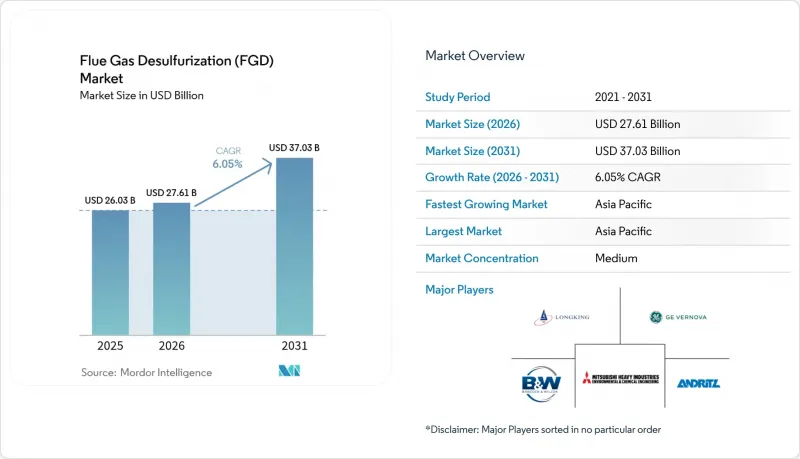
Mordor Intelligence에 의하면, 2026년 배연 탈황 시장 규모는 276억 1,000만 달러로 추정되고 2025년 260억 3,000만 달러에서 확대해, 2031년에는 370억 3,000만 달러에 이를 것으로 예측됩니다.
2026년부터 2031년까지의 연평균 성장률(CAGR)은 6.05%를 나타낼 전망입니다.
본 보고서는 유형별(습식 FGD, 건식·반건식 FGD, 하이브리드·고도 흡착제 주입법), 시약·흡착제별(석회암, 석회, 해수, 나트륨계 및 기타 알칼리), 최종 사용자 산업(발전, 시멘트,철강, 화학제품 및 석유화학제품, 비철금속 등), 지역(북미, 유럽, 아시아태평양, 남미 등)별로 분류되어 있습니다.
세계의 배연 탈황 시장 동향 및 분석
석탄 화력 발전소의 엄격한 SO2 배출 상한선
황산화물 배출 제한에 관한 전 세계적인 기준의 통일로 인해 조달 일정이 재구성되고 있습니다. 중국의 초저배출 기준에서는 SO2를 35 mg/Nm3로 제한하며, 석회석·석고 루프를 통해 99%의 제거율을 달성하고 있습니다. EU의 개정된 ‘산업 배출 지침’은 대규모 연소 시설에 대해 더 엄격한 기준을 부과하고 있어, 구형 설비의 전면적인 갱신을 불가피하게 만들고 있습니다. 미국 환경보호청(EPA)은 남아 있는 석탄 화력 발전소에 대해 시간당 엄격한 황 배출 상한선 준수를 의무화하는 2024년 규정을 최종 확정하여, 중서부 및 애팔래치아 지역의 발전소 개조를 촉진했습니다. 폴란드에서는 설치 의무화로 인해 회수 효율이 90%를 초과함에 따라, 석회석 사용량이 1994년 거의 제로에서 2019년에는 연간 340만 톤으로 증가했습니다. 자동 시약 최적화, 모듈식 흡수기 섹션, 듀얼 알칼리 루프 등 규정 준수를 촉진하는 기술을 통해 가동 중단 시간이 단축되었으며, 석탄 화력 발전의 가동률이 점차 하락하고 있는 상황에서도 설치된 반응 장치의 경제적 수명을 연장하는 갱신 주기가 강화되고 있습니다.
노후화된 산업용 보일러 및 가마의 의무적 개보수
열출력 50MW 미만의 산업용 점오염원은 현재 EU의 중규모 연소 시설 지침의 적용 대상이며, 갈탄 건조기, 가마, 정유시설의 가열 장치 등 대상 시설이 수천 건에 달할 전망입니다. 시멘트 공장에서는 배기가스 속의 수분을 원료 조정 과정에 재활용할 수 있어 유틸리티 비용을 상쇄할 수 있고, 경제적으로 유리한 결과를 얻을 수 있습니다. 인디애나주에서 하이델베르크 머티리얼즈(Heidelberg Materials)가 시행하고 있는 5억 달러 규모의 미첼 공장 개조 프로젝트는 아민 흡수법과 새로운 FGD 전처리 라인을 결합하여 연간 200만 톤의 CO2 포집를 목표로 하고 있습니다. 비철금속 제련소에서도 유사한 사례를 볼 수 있으며, 원소 상태의 황 회수를 통해 수익원과 배출권 판매가 연계되고 있습니다. 따라서 개보수 공사는 수은 및 NOx의 추가 감축을 실현하는 다중 오염 물질 대응 키트로 기울고 있으며, 이를 통해 배연 탈황 시장은 통합적인 오염 방지를 위한 부문 간 플랫폼이 되고 있습니다.
습식 FGD 슬러지의 높은 설비 투자비 및 처리 비용
1MW당 약 1,200만 루피에 달하는 설치 비용은 인도 내 보급을 저해하고 있으며, 자문위원회는 일률적인 의무화에 의문을 제기하고 있습니다. 슬러지의 열건조나 침출수 격리가 필요한 경우, 처리 비용은 더욱 치솟아 신흥국의 전력망에서는 균등화 발전 원가를 최대 1MWh당 3달러까지 끌어올리고 있습니다. ‘폐수 무방류’ 규제로 인해 수처리 설비 투자가 증가하고 있습니다. 펜실베이니아주의 호머 시티 발전소는 2024년 폐쇄에 앞서 규제를 준수하는 증발 결정화 설비에 7억 5,000만 달러를 투자했습니다. 그 결과, 포집 효율은 낮지만 건식 흡착제 주입법에 대한 관심이 높아지고 있으며, 자본 제약이 있는 지역의 배연 탈황 시장에 가격 상한선이 형성되고 있습니다.
부문별 분석
2025년, 습식 석회·석고 반응기는 배연 탈황 시장 점유율의 86.92%를 차지했으며, 이는 중국의 초저배출 규제 하에서 95%를 초과하는 SO2 포집 효율을 달성한 데 기인합니다. 226억 3,000만 달러 규모의 배연 탈황 시장에서 이 방식은 확립된 공급업체 생태계와 안정적인 흡착제 공급망에 힘입어 성장하고 있습니다. 하이브리드형 및 흡착제 주입형은 매출에서 차지하는 비중은 적지만 연평균 성장률(CAGR) 9.65%를 기록하며, 공간이나 수자원 제약으로 인해 습식 설계를 채택할 수 없는 시설의 산업용 개조 프로젝트에서 주목받고 있습니다.
각 사업자는 고황분·대배기량의 굴뚝에 대해서는 실적이 있는 습식 루프를 선호하고 있지만, 입자상 물질 제거 기능을 통합하여 정전기 집진 장치의 설비 투자를 절감하는 순환 유동층 스크러버를 둘러싼 혁신이 가속화되고 있습니다. 예를 들어, Tri-Mer사의 ‘SorbSaver’ 시스템은 건식 흡착제의 분산 기술과 저에너지 백필터를 통합하여 시약의 과다 투여를 최대 40% 절감함으로써, 25MW 미만의 산업용 보일러 예산에 부합합니다. 확립된 설계와 새로운 설계가 공존함으로써, 사용자는 기존 흡수탑에 하이브리드 키트를 추가할 수 있게 되었으며, 공급업체의 잠재적 수익이 확대되는 동시에 배연 탈황 시장 내 건전한 경쟁이 유지되고 있습니다.
지역별 분석
아시아태평양은 2025년 매출의 61.70%를 차지했으며, 2031년까지 연평균 성장률(CAGR) 6.98%를 나타낼 것으로 예측됩니다. 이는 중국의 습식 시스템 보급률이 95%를 초과하고 있으며, 간헐적인 정책 논의가 있음에도 불구하고 인도에서 수 기가와트 규모의 프로젝트가 진행 중이라는 점에 힘입은 것입니다. 베트남, 인도네시아, 필리핀에서는 우대 대출을 통해 SO2 대책 업그레이드를 장려하고 있으며, 이로 인해 지역 내 공급업체 서비스 네트워크가 더욱 충실해지고 있습니다. 일본과 한국은 선박용 스크러버 공급을 전문으로 하며, 조선소 생태계를 활용하여 전 세계 선단을 대상으로 턴키 키트를 수출하고 있습니다.
유럽에서는 세계에서 가장 엄격한 배출 상한선이 시행되고 있어 중소규모 산업 플랜트의 개조가 촉진되고 있습니다. 독일, 벨기에, 폴란드는 EU 혁신 기금 하에서 시행되는 탄소 포집 시범 사업과 연계된 흡수제 업그레이드에 막대한 투자를 하고 있으며, 해당 지역을 기술의 인큐베이터로 자리매김하고 있습니다. 북유럽 국가들의 해양 규제는 폐쇄형 스크러버 도입을 가속화하여 규제 모델을 전 세계로 확산시키고 있으며, 유럽의 장비 수주 잔고를 뒷받침하고 있습니다.
북미에서는 전력용 석탄 화력 발전소의 설비 용량이 구조적으로 감소하고 있음에도 불구하고, 산업 분야에서의 도입이 진행되면서 수주량을 끌어올리고 있습니다. 미국의 시멘트 공장에서는 용제 보호를 위해 FGD 배출물을 활용하는 것을 전제로 한 5억 달러 이상의 CCUS(이산화탄소 포집·활용·저장) 개조 공사가 진행되고 있습니다. 캐나다에서는 오일샌드용 보일러의 황 배출 제한이 강화되면서 신규 패키지 플랜트 입찰이 활발해지고 있습니다. 한편, 멕시코의 전력 회사는 개정된 NOM-085-SEMARNAT 기준을 준수하는 현대화 로드맵을 수립하고 있습니다. 남미 및 중동 및 아프리카의 매출 비중은 한 자릿수에 그치지만, 정유시설 확장, 비료 복합 시설, 구리 제련소와 관련된 산발적인 대형 수주가 있어 전 세계적으로 사업을 전개하는 OEM 제조업체에게 장기적인 비즈니스 기회를 제공합니다.
기타 혜택 :
- 엑셀 형식 시장 예측(ME) 시트
- 3개월간의 애널리스트 지원
자주 묻는 질문
목차
제1장 서론
제2장 분석 방법
제3장 주요 요약
제4장 시장 구도
제5장 시장 규모 및 성장률 예측
제6장 경쟁 구도
제7장 시장 기회 및 향후 전망
KTH 26.08.28According to Mordor Intelligence, the flue gas desulfurization market size in 2026 is estimated at USD 27.61 billion, growing from 2025 value of USD 26.03 billion with 2031 projections showing USD 37.03 billion, growing at 6.05% CAGR over 2026-2031.
This report is Segmented by Type (Wet FGD, Dry and Semi-Dry FGD, and Hybrid and Advanced Sorbent Injection), Reagent/Sorbent (Limestone, Lime, Seawater, and Sodium-Based and Other Alkalis), End-User Industry (Power Generation, Cement, Iron and Steel, Chemical and Petrochemical, Non-Ferrous Metals, and More), and Geography (North America, Europe, Asia-Pacific, South America, and More).
Global Flue Gas Desulfurization (FGD) Market Trends and Insights
Stringent SO2-Emission Caps in Coal-Fired Power Plants
Global alignment on sulfur-oxide limits is reshaping procurement calendars. China's ultra-low emission code caps SO2 at 35 mg/Nm3 and achieves 99% capture through limestone-gypsum loops. The EU's revised Industrial Emissions Directive imposes tighter benchmarks for large combustion plants, compelling upgrades across legacy fleets. The US Environmental Protection Agency finalized a 2024 rule obligating residual coal units to meet stringent hourly sulfur ceilings, catalyzing retrofits in Midwest and Appalachian stations. In Poland, mandated installations lifted limestone use from negligible in 1994 to 3.4 million t/y by 2019 as capture efficiencies passed the 90% mark. Compliance accelerators such as automatic reagent optimization, modular absorber sections, and dual-alkali loops reduce downtime, reinforcing a replacement cycle that lengthens the economic life of installed reactors even as coal dispatch inches downward.
Mandatory Retrofits of Aging Industrial Boilers & Kilns
Industrial point sources below 50 MW thermal capacity now fall under the EU Medium Combustion Plant Directive, multiplying the addressable base by thousands of lignite dryers, kilns, and refinery heaters. Cement plants reveal favorable economics because flue moisture can be reused for raw-meal conditioning, offsetting utility costs. Heidelberg Materials' USD 500 million Mitchell upgrade in Indiana targets a 2 million t/y CO2 capture plateau, pairing amine absorption with a new FGD pretreatment train. Similar archetypes materialize in non-ferrous smelters, where elemental-sulfur recovery couples revenue streams with compliance credit sales. Retrofits therefore gravitate toward multi-contaminant kits delivering incremental mercury and NOx abatement, making the flue gas desulfurization market a cross-sector platform for integrated pollution control.
High CAPEX & Disposal Costs of Wet FGD Sludge
Installation expenses near INR 12 million/MW hinder India's rollout, prompting advisory panels to question blanket mandates. Disposal charges escalate where sludge requires thermal drying or leachate sealing, lifting the levelized cost of electricity by up to USD 3/MWh in emerging grids. Zero-liquid-discharge prescriptions magnify water treatment capital; Pennsylvania's Homer City power station invested USD 750 million in a compliant evaporator crystallizer train before closing in 2024. As a result, dry sorbent injection garners interest despite lower capture efficiency, creating a price ceiling for the flue gas desulfurization market in capital-constrained regions.
Other drivers and restraints analyzed in the detailed report include:
- Rising Demand for FGD-Derived Synthetic Gypsum
- Integration of FGD with Carbon-Capture Retrofits
- Coal-to-Renewables Shift Curbing New Installations
For complete list of drivers and restraints, kindly check the Table Of Contents.
Segment Analysis
Wet limestone-gypsum reactors represented 86.92% of the flue gas desulfurization market share in 2025, cemented by>95% SO2 capture efficiencies under ultra-low emission codes in China. At a flue gas desulfurization market size of USD 22.63 billion, the type thrives on established vendor ecosystems and stable sorbent supply chains. Hybrid and sorbent-injection variants, while accounting for a modest revenue slice, clocked a 9.65% CAGR and attracted industrial retrofits where space or water scarcity constrains wet designs.
Operators favor proven wet loops for high-sulfur, high-volume stacks, yet innovation accelerates around circulating fluidized bed scrubbers that fold in particulate removal, cutting electrostatic precipitator capital outlay. Tri-Mer's SorbSaver system, for example, integrates dry sorbent dispersion with low-energy baghouses and lowers reagent overdosing by up to 40%, aligning with budgets in sub-25 MW industrial boilers. The coexistence of established and novel designs expands supplier addressable revenue as users layer hybrid kits onto legacy absorbers, sustaining healthy competition within the flue gas desulfurization market.
Complete Report Scope:
- By Type
- Wet FGD
- Limestone/Gypsum Wet Scrubbers
- Seawater Scrubbers
- Dry and Semi-Dry FGD
- Spray-Dry Absorbers
- Circulating Fluidized-Bed Dry Scrubbers
- Hybrid and Advanced Sorbent Injection
- Wet FGD
- By Reagent/Sorbent
- Limestone
- Lime
- Seawater
- Sodium-based and Other Alkalis
- By End-User Industry
- Power Generation
- Cement
- Iron and Steel
- Chemical and Petrochemical
- Non-Ferrous Metals
- Waste-to-Energy and Others
- By Geography
- North America
- United States
- Canada
- Mexico
- Europe
- Germany
- United Kingdom
- France
- Italy
- Spain
- Russia
- Rest of Europe
- Asia Pacific
- China
- India
- Japan
- South Korea
- ASEAN Countries
- Rest of Asia Pacific
- South America
- Brazil
- Argentina
- Rest of South America
- Middle East and Africa
- Saudi Arabia
- United Arab Emirates
- South Africa
- Egypt
- Rest of Middle East and Africa
- North America
Geography Analysis
Asia-Pacific commands 61.70% of 2025 revenue and will tack on a 6.98% CAGR through 2031, anchored by China's>95% wet-system penetration and India's multi-gigawatt pipeline despite intermittent policy debate. Vietnam, Indonesia, and the Philippines incentivize SO2 control upgrades via concessional lending, adding density to regional vendor service networks. Japan and South Korea specialize in marine scrubber supply, leveraging shipyard ecosystems to export turnkey kits across global fleets.
Europe enforces the world's strictest emission ceilings, spurring retrofits in small-to-medium industrial plants. Germany, Belgium, and Poland invest heavily in absorber upgrades linked to carbon-capture pilots under the EU Innovation Fund, positioning the region as a technology incubator. Nordic maritime regulations accelerate the adoption of closed-loop scrubbers, export regulatory templates worldwide, and sustain European equipment backlogs.
North America experiences structural attrition in utility coal capacity, yet industrial adopters buoy order intake. Cement plants in the United States advance with USD 500 million-plus CCUS retrofits that assume FGD bleeds for solvent protection. Canada tightens sulfur limits in oil-sands boilers, stimulating fresh package-plant bids, while Mexican utilities outline modernization roadmaps aligning with updated NOM-085-SEMARNAT limits. South America and the Middle East & Africa contribute single-digit revenue shares but deliver sporadic large orders tied to refinery expansions, fertiliser complexes, and copper smelters, offering long-cycle prospects for globally active OEMs.
- Alstom SA
- Andritz AG
- Babcock & Wilcox Enterprises Inc.
- Ducon Technologies Inc.
- Fujian Longking Co. Ltd
- GE Vernova
- Hamon Corporation
- John Wood Group PLC
- Mitsubishi Heavy Industries Environmental & Chemical Engg. Co.
- Thermax Ltd
- Chiyoda Corp.
- Doosan Lentjes GmbH
- Marsulex Environmental Technologies
- Valmet Oyj
- Siemens Energy AG
- FLSmidth A/S
- Carmeuse Group
- Larsen & Toubro-MHI Power Boilers Pvt Ltd
- Clyde Bergemann Power Group
- John Cockerill Environment
Additional Benefits:
- The market estimate (ME) sheet in Excel format
- 3 months of analyst support
TABLE OF CONTENTS
1 Introduction
- 1.1 Study Assumptions & Market Definition
- 1.2 Scope of the Study
2 Research Methodology
3 Executive Summary
4 Market Landscape
- 4.1 Market Overview
- 4.2 Market Drivers
- 4.2.1 Stringent SO2-emission caps in coal-fired power plants
- 4.2.2 Mandatory retrofits of aging industrial boilers & kilns
- 4.2.3 Rising demand for FGD-derived synthetic gypsum
- 4.2.4 Integration of FGD with carbon-capture retrofits
- 4.2.5 IMO rules driving high-sulfur marine fuel scrubbers
- 4.2.6 Predictive-maintenance analytics lowering OPEX
- 4.3 Market Restraints
- 4.3.1 High CAPEX & disposal costs of wet FGD sludge
- 4.3.2 Coal-to-renewables shift curbing new installations
- 4.3.3 Limestone supply chain bottlenecks & price volatility
- 4.3.4 Zero-liquid-discharge (ZLD) rules inflating water-use costs
- 4.4 Supply-Chain Analysis
- 4.5 Regulatory Landscape
- 4.6 Technological Outlook
- 4.7 Porter's Five Forces
- 4.7.1 Bargaining Power of Suppliers
- 4.7.2 Bargaining Power of Buyers
- 4.7.3 Threat of New Entrants
- 4.7.4 Threat of Substitutes
- 4.7.5 Intensity of Competitive Rivalry
5 Market Size & Growth Forecasts
- 5.1 By Type
- 5.1.1 Wet FGD
- 5.1.1.1 Limestone/Gypsum Wet Scrubbers
- 5.1.1.2 Seawater Scrubbers
- 5.1.2 Dry and Semi-Dry FGD
- 5.1.2.1 Spray-Dry Absorbers
- 5.1.2.2 Circulating Fluidized-Bed Dry Scrubbers
- 5.1.3 Hybrid and Advanced Sorbent Injection
- 5.1.1 Wet FGD
- 5.2 By Reagent/Sorbent
- 5.2.1 Limestone
- 5.2.2 Lime
- 5.2.3 Seawater
- 5.2.4 Sodium-based and Other Alkalis
- 5.3 By End-User Industry
- 5.3.1 Power Generation
- 5.3.2 Cement
- 5.3.3 Iron and Steel
- 5.3.4 Chemical and Petrochemical
- 5.3.5 Non-Ferrous Metals
- 5.3.6 Waste-to-Energy and Others
- 5.4 By Geography
- 5.4.1 North America
- 5.4.1.1 United States
- 5.4.1.2 Canada
- 5.4.1.3 Mexico
- 5.4.2 Europe
- 5.4.2.1 Germany
- 5.4.2.2 United Kingdom
- 5.4.2.3 France
- 5.4.2.4 Italy
- 5.4.2.5 Spain
- 5.4.2.6 Russia
- 5.4.2.7 Rest of Europe
- 5.4.3 Asia Pacific
- 5.4.3.1 China
- 5.4.3.2 India
- 5.4.3.3 Japan
- 5.4.3.4 South Korea
- 5.4.3.5 ASEAN Countries
- 5.4.3.6 Rest of Asia Pacific
- 5.4.4 South America
- 5.4.4.1 Brazil
- 5.4.4.2 Argentina
- 5.4.4.3 Rest of South America
- 5.4.5 Middle East and Africa
- 5.4.5.1 Saudi Arabia
- 5.4.5.2 United Arab Emirates
- 5.4.5.3 South Africa
- 5.4.5.4 Egypt
- 5.4.5.5 Rest of Middle East and Africa
- 5.4.1 North America
6 Competitive Landscape
- 6.1 Market Concentration
- 6.2 Strategic Moves (M&A, Partnerships, PPAs)
- 6.3 Market Share Analysis (Market Rank/Share for key companies)
- 6.4 Company Profiles (includes Global level Overview, Market level overview, Core Segments, Financials as available, Strategic Information, Products & Services, and Recent Developments)
- 6.4.1 Alstom SA
- 6.4.2 Andritz AG
- 6.4.3 Babcock & Wilcox Enterprises Inc.
- 6.4.4 Ducon Technologies Inc.
- 6.4.5 Fujian Longking Co. Ltd
- 6.4.6 GE Vernova
- 6.4.7 Hamon Corporation
- 6.4.8 John Wood Group PLC
- 6.4.9 Mitsubishi Heavy Industries Environmental & Chemical Engg. Co.
- 6.4.10 Thermax Ltd
- 6.4.11 Chiyoda Corp.
- 6.4.12 Doosan Lentjes GmbH
- 6.4.13 Marsulex Environmental Technologies
- 6.4.14 Valmet Oyj
- 6.4.15 Siemens Energy AG
- 6.4.16 FLSmidth A/S
- 6.4.17 Carmeuse Group
- 6.4.18 Larsen & Toubro-MHI Power Boilers Pvt Ltd
- 6.4.19 Clyde Bergemann Power Group
- 6.4.20 John Cockerill Environment
7 Market Opportunities & Future Outlook
- 7.1 White-space & Unmet-Need Assessment