|
시장보고서
상품코드
2129348
AI 신뢰성, 리스크, 보안 관리(AI TRiSM) 시장 예측(-2031년) : 오퍼링별, 배포 모드별, 조직 규모별, 용도별, 업계별, 지역별AI Trust, Risk, and Security Management (AI TRiSM) Market by Solution (AI Governance, Risk & Compliance, AI Security & Runtime Protection), Service (Managed AI TRiSM Services), Deployment Mode, Application, Vertical - Global Forecast to 2031 |
||||||

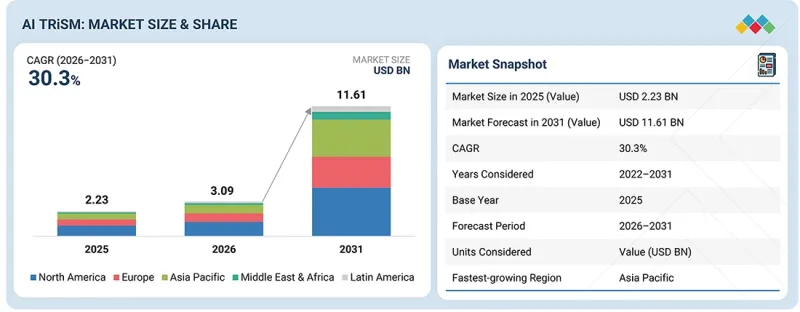
AI 신뢰성, 리스크 및 보안 관리(AI TRiSM) 시장 규모는 예측 기간 중 CAGR 30.3%로 확대하며, 2026년 30억 9,000만 달러에서 2031년에는 116억 1,000만 달러에 달할 것으로 전망되고 있습니다.
이러한 성장은 기업이 점점 더 자율적이고 상호 연결된 AI 시스템을 도입함에 따라 정책 기반의 AI 거버넌스에서 지속적이고 강제력 있는 통제로의 전환에 의해 주도되고 있습니다.
| 조사 범위 | |
|---|---|
| 조사 대상 기간 | 2022-2031년 |
| 기준연도 | 2025년 |
| 예측 기간 | 2026-2031년 |
| 산정 단위 | 금액(100만 달러/10억 달러) |
| 부문 | 오퍼링별, 배포 모드별, 조직 규모별, 용도별, 업계별, 지역별 |
| 대상 지역 | 북미, 유럽, 아시아태평양, 중동 및 아프리카, 라틴아메리카 |
AI가 애플리케이션 및 전체 워크플로우에 통합됨에 따라 에이전트형 시스템은 인간의 개입을 최소화하면서 데이터에 접근하고, 툴을 실행하며, 작업을 수행할 수 있게 됩니다. 이에 따라 정기적인 평가가 아닌 지속적인 가시화, 평가, 모니터링 및 실행시 강제 조치에 대한 필요성이 높아지고 있습니다. 그 결과, 기업은 AI TRiSM 솔루션을 도입하여 거버넌스 정책의 운영화, AI 행동 모니터링, 새로운 위험 식별, 그리고 AI 수명주기 전반에 걸친 설명 책임 유지를 도모하고 있습니다.
"솔루션별로는 AI 보안 및 런타임 보호 플랫폼 부문이 예측 기간 중 가장 높은 연평균 성장률(CAGR)을 기록할 것으로 전망됩니다."
AI 보안 및 런타임 보호 플랫폼 부문은 실제 운영 환경에서의 상호작용에 보안 위험을 초래하는 생성형 및 에이전트형 AI 시스템의 급속한 도입을 배경으로 가장 높은 연평균 성장률(CAGR)을 기록할 것으로 예상됩니다. 기존의 AI 거버넌스와는 달리, 런타임 보호에서는 조직이 프롬프트, 모델 출력, 데이터 흐름 및 에이전트에 의한 툴 호출을 지속적으로 검사하고, 위협이나 정책 위반이 발생할 경우 개입해야 합니다. AI 에이전트는 기업 애플리케이션 및 기밀 데이터와 동적으로 상호작용하므로 도입 전 테스트에서는 탐지할 수 없는 공격 경로를 만들어낼 가능성이 있습니다. 그 결과, 기업에서는 AI 자산의 가시화, 위협 탐지, 가드레일, 정책 적용, 그리고 프롬프트 주입, 데이터 유출, 권한 남용, 악의적인 툴 호출 및 기타 AI 특유의 위협에 대한 실시간 개입을 제공하는 런타임 플랫폼의 도입이 점점 더 확대되고 있습니다.
"조직 규모별로는 2026년에 대기업 부문이 가장 큰 시장 점유율을 차지할 것으로 예측됩니다."
대기업 부문은 AI TRiSM 시장에서 가장 큰 점유율을 차지할 것으로 예측됩니다. 그 주요 이유는 이러한 조직들이 여러 업무 기능, 지역, 애플리케이션, 기술 스택에 걸쳐 다양한 AI 환경을 운영하고 있기 때문입니다. 기업내 AI 도입 규모가 커짐에 따라 통합된 AI 인벤토리, 위험 분류, 액세스 제어, 모델 모니터링, 규정 준수 관리 및 지속적인 모니터링에 대한 요구 사항이 높아지고 있습니다. IBM의 2026년 조사에 따르면 조사 대상인 기술 리더의 70%가 비즈니스 부서의 기술 도입 속도가 IT 부서의 추적 능력을 앞지르고 있다고 응답했으며, 대규모 AI 도입으로 인해 발생하는 가시성 및 제어 문제가 부각되었습니다. 또한 대기업은 AI 결함으로 인한 규제 문제, 평판 하락, 업무상 영향에 대한 노출 위험이 높아짐에 따라 전용 거버넌스 및 보안 인프라에 대한 투자를 강화하고 있습니다. 조직이 AI를 고립된 시범 프로젝트에서 핵심 워크플로우 및 자율형 애플리케이션으로 전환함에 따라 확장 가능한 전사적 AI TRiSM 플랫폼 및 서비스에 대한 수요가 증가하여 이 부문 시장의 주도적 지위가 유지될 것으로 예상됩니다.
"산업별로는 예측 기간 중 헬스케어·생명과학 분야가 가장 높은 연평균 성장률(CAGR)을 기록할 것으로 전망됩니다."
헬스케어·생명과학 분야는 임상 의사결정 지원, 의료 영상 진단, 신약 개발, 진단, 제약 연구에 AI가 급속히 통합됨에 힘입어 가장 빠른 성장이 예상됩니다. 이러한 분야에서는 오류나 편향된 결과가 환자의 안전이나 치료 결과에 직접적인 영향을 미칠 가능성이 있습니다. 또한 AI 탑재 의료기기의 이용 확대에 따라 모델 검증, 투명성, 편향성 평가, 성능 모니터링, 수명 주기 리스크 관리에 대한 요건도 엄격해지고 있습니다. 미국 식품의약국(FDA)은 AI 탑재 의료기기에 대해 수명 주기 관리, 투명성, 편향성 완화 및 도입 후 모니터링을 중시하는 지침을 발표했습니다. 2026년에는 인도도 의료 분야에서 윤리적이고 투명하며 설명 가능한 AI를 추진하기 위해 SAHI 및 BODH 구상을 시작했습니다. 이러한 움직임에 따라 거버넌스, 보증, 평가, 관측 가능성, 보안 및 지속적인 모니터링을 포괄하는 AI TRiSM 솔루션에 대한 수요가 증가하고 있으며, 헬스케어·생명과학 분야는 고성장 분야로서의 입지를 확고히 다지고 있습니다.
1차 조사 대상자 구성
AI TRiSM 시장의 주요 공급업체로는 IBM(미국), Microsoft(미국), Accenture(아일랜드), Palo Alto Networks(미국), Deloitte(영국), NeuralTrust(스페인), Cisco(미국), ServiceNow(미국),PwC(영국), EY(영국), Veeam Software(미국), Cyera(미국), Airia(미국), OneTrust(미국), BigID(미국), Zenity(미국/이스라엘), Credo AI(미국),Arize AI(미국), Fiddler AI(미국), ModelOp(미국), HiddenLayer(미국), AIShield(인도), Daxa(미국), Concentric AI(미국), Grip Security(미국) 등이 있습니다.
본 조사에서는 AI TRiSM 시장의 주요 기업에 대한 상세한 경쟁 분석, 각 기업의 프로필, 최근 동향 및 주요 시장 전략을 포괄적으로 다루고 있습니다.
조사 범위
이 보고서에서는 AI TRiSM 시장을 세분화하여, 제공(솔루션(AI 거버넌스, 리스크·컴플라이언스 플랫폼, AI 어슈어런스, 평가·가시성 플랫폼, AI 보안·런타임 보호 플랫폼)), 서비스(컨설팅, 전략·거버넌스 설계, 구현·통합, 테스트,검증 및 독립 보증, 매니지드 AI TRiSM 서비스), 도입 형태(클라우드, 온프레미스, 하이브리드), 조직 규모(중소기업, 대기업), 용도(거버넌스 및 모니터링, 보증 및 평가, 보안 및 런타임 제어, 모니터링 및 대응, 기타 용도),업종(BFSI, 정부·국방, 헬스케어·생명과학, IT·ITeS, 통신, 소매, E-Commerce·소비재, 제조, 에너지·공공사업, 운송·물류, 미디어·엔터테인먼트, 기타 업종) 및 지역(북미, 유럽,아시아태평양, 중동 및 아프리카, 라틴아메리카)입니다.
또한 본 조사에는 시장의 주요 업체에 대한 상세한 경쟁 분석이 포함되어 있으며, 기업 개요, 제품 및 사업 제공에 대한 주요 발견 사항, 최근 동향, 그리고 주요 시장 전략이 다루어지고 있습니다.
이 보고서를 구매할 때의 주요 이점
이 보고서는 AI TRiSM 시장 전체 및 그 하위 부문의 매출에 대한 가장 정확한 추정치를 제공함으로써, 시장을 선도하는 기업과 신규 진입 기업을 지원합니다. 이 보고서는 이해관계자들이 경쟁 구도를 이해하고, 자사의 비즈니스를 더 나은 위치로 이끌며, 적절한 시장 진입 전략을 수립하는 데 필요한 귀중한 인사이트를 얻는 데 도움이 됩니다. 또한 이 보고서는 이해관계자들이 시장 동향을 파악하는 데 도움을 주며, 주요 시장 촉진요인, 억제요인, 과제 및 기회에 대한 정보를 제공합니다.
이 보고서는 다음 사항에 대한 인사이트를 제공합니다. :
- 주요 촉진요인(기업내 생성형 AI 및 자율형 AI 에이전트의 급속한 도입, 전 세계 AI 규제 및 거버넌스 요건의 증가,AI 특유의 사이버 위협 증가, 신뢰할 수 있고 설명 가능하며 책임 있는 AI에 대한 수요 증가) 및 제약 요인(도입의 복잡성과 AI 생태계의 파편화, 숙련된 AI 거버넌스 및 보안 전문가 부족, 표준화된 거버넌스 프레임워크 및 상호 운용성 부재),기회(에이전트형 AI 및 자율적인 기업 워크플로우의 확대, 주권형 AI 및 국가 차원의 AI 거버넌스 구상 채택 확대, AI 거버넌스 및 보안 서비스에 대한 수요 증가, AI 보안 및 거버넌스 플랫폼에 대한 기업 투자 증가),그리고 과제(급속히 진화하는 AI 위협 및 공격 기법에 대한 대응, AI 혁신과 거버넌스, 보안, 사용자 경험 간의 균형, 복잡한 기반 모델의 설명 가능성 및 검증의 한계)에 대한 인사이트를 제공합니다.
- 제품 개발/혁신: AI TRiSM 시장의 향후 기술, 연구개발 활동, 신제품 및 서비스 출시에 대한 상세 인사이트
- 시장 개발: 수익성이 높은 시장에 대한 포괄적인 정보 - 이 보고서는 다양한 지역에 걸친 AI TRiSM 시장을 분석합니다.
- 시장 다각화: AI TRiSM 시장의 신제품 및 서비스, 미개발 지역, 최근 동향 및 투자에 대한 포괄적인 정보.
- 경쟁 분석: AI TRiSM 시장의 주요 기업(IBM(미국), Microsoft(미국), Accenture(아일랜드), Palo Alto Networks(미국), Deloitte(영국), NeuralTrust(스페인) 등)의 시장 점유율, 성장 전략 및 서비스 제공에 대한 상세한 평가.
자주 묻는 질문
목차
제1장 서론
제2장 개요
제3장 주요 인사이트
제4장 시장 개요
제5장 업계 동향
제6장 기술 진보, AI에 의한 영향, 특허, 혁신, 향후 응용
제7장 규제 상황
제8장 소비자의 상황과 구매 행동
제9장 AI TRiSM 시장(오퍼링별)
제10장 AI TRiSM 시장(배포 모드별)
제11장 AI TRiSM 시장(조직 규모별)
제12장 AI TRiSM 시장(용도별)
제13장 AI TRiSM 시장(업계별)
제14장 AI TRiSM 시장(지역별)
제15장 경쟁 구도
제16장 기업 개요
제17장 조사 방법
제18장 부록
KSA 26.09.17The AI Trust, Risk, and Security Management (AI TRiSM) market is projected to grow from USD 3.09 billion in 2026 to USD 11.61 billion by 2031 at a CAGR of 30.3% during the forecast period. This growth is driven by the shift from policy-based AI governance toward continuous, enforceable controls as enterprises deploy increasingly autonomous and interconnected AI systems.
| Scope of the Report | |
|---|---|
| Years Considered for the Study | 2022-2031 |
| Base Year | 2025 |
| Forecast Period | 2026-2031 |
| Units Considered | Value (USD Million/USD Billion) |
| Segments | Offering, Deployment Mode, Organization Size, Application, Vertical, and Region |
| Regions covered | North America, Europe, Asia Pacific, Middle East & Africa, Latin America |
As AI becomes embedded across applications and workflows, agentic systems can access data, invoke tools, and execute actions with limited human intervention. This is accelerating the need for continuous visibility, evaluation, monitoring, and runtime enforcement rather than periodic assessments. Consequently, enterprises are adopting AI TRiSM solutions to operationalize governance policies, monitor AI behavior, identify emerging risks, and maintain accountability throughout the AI lifecycle.
"By solution, the AI security & runtime protection platforms segment is expected to witness the highest CAGR during the forecast period."
The AI security & runtime protection platforms segment is expected to register the highest CAGR, driven by the rapid deployment of generative and agentic AI systems that introduce security risks during live interactions. Unlike conventional AI governance, runtime protection requires organizations to inspect prompts, model outputs, data flows, and agent tool calls continuously and intervene when threats or policy violations occur. AI agents can dynamically interact with enterprise applications and sensitive data, creating attack paths that may not be visible during pre-deployment testing. Consequently, enterprises are increasingly adopting runtime platforms that provide AI asset visibility, threat detection, guardrails, policy enforcement, and real-time intervention against prompt injection, data leakage, privilege misuse, malicious tool calls, and other AI-specific threats.
"By organization size, the large enterprises segment is projected to hold the largest market share in 2026."
The large enterprises segment is projected to account for the largest share of the AI TRiSM market, primarily because these organizations operate diverse AI environments spanning multiple business functions, geographies, applications, and technology stacks. The scale of enterprise AI deployment creates greater requirements for centralized AI inventories, risk classification, access controls, model oversight, compliance management, and continuous monitoring. IBM's 2026 study found that 70% of surveyed technology leaders said business teams were deploying technology faster than IT could track, highlighting the visibility and control challenges created by large-scale AI adoption. Large enterprises also face greater exposure to regulatory, reputational, and operational consequences from AI failures, strengthening investments in dedicated governance and security infrastructure. As organizations move AI from isolated pilots into critical workflows and autonomous applications, the need for scalable, enterprise-wide AI TRiSM platforms and services is expected to sustain the segment's leading market position.
"By vertical, the healthcare & life sciences segment is expected to grow at the highest CAGR during the forecast period."
The healthcare & life sciences segment is expected to grow the fastest, driven by the rapid integration of AI into clinical decision support, medical imaging, drug discovery, diagnostics, and pharmaceutical research, where errors or biased outputs can directly affect patient safety and treatment outcomes. The increasing use of AI-enabled medical devices is also creating stronger requirements for model validation, transparency, bias assessment, performance monitoring, and lifecycle risk management. The US FDA has issued guidance emphasizing lifecycle management, transparency, bias mitigation, and post-deployment monitoring for AI-enabled medical devices. In 2026, India also launched the SAHI and BODH initiatives to promote ethical, transparent, and accountable AI in healthcare. These developments are increasing demand for AI TRiSM solutions covering governance, assurance, evaluation, observability, security, and continuous monitoring, positioning Healthcare & Life Sciences as a high-growth vertical.
Breakdown of Primaries
The study draws insights from a range of industry experts, including component suppliers, Tier 1 companies, and OEMs. The breakdown of the primaries is as follows:
- By Company Type: Tier 1 - 40%, Tier 2 - 35%, and Tier 3 - 25%
- By Designation: C-level Executives - 50%, Managers and Other Levels - 50%
- By Region: North America - 30%, Europe - 20%, Asia Pacific - 35%, Middle East & Africa - 10%, Latin America - 5%
Major vendors in the AI TRiSM market include IBM (US), Microsoft (US), Accenture (Ireland), Palo Alto Networks (US), Deloitte (UK), NeuralTrust (Spain), Cisco (US), ServiceNow (US), PwC (UK), EY (UK), Veeam Software (US), Cyera (US), Airia (US), OneTrust (US), BigID (US), Zenity (US/Israel), Credo AI (US), Arize AI (US), Fiddler AI (US), ModelOp (US), HiddenLayer (US), AIShield (India), Daxa (US), Concentric AI (US), and Grip Security (US).
The study includes an in-depth competitive analysis of the key players in the AI TRiSM market, their company profiles, recent developments, and key market strategies.
Research Coverage
The report segments the AI TRiSM market and forecasts its size based on offering (solutions (AI governance, risk & compliance platforms, Al assurance, evaluation & observability platforms, Al security & runtime protection platforms)), services (consulting, strategy & governance design, implementation & integration, testing, validation & independent assurance, managed Al TRiSM services), deployment mode (cloud, on-premises, hybrid), organization size (SMEs, large enterprises), application (governance & oversight, assurance & evaluation, security & runtime control, monitoring & response, other applications), vertical (BFSI, government & defense, healthcare & life sciences, IT & ITeS, telecommunications, retail, E-commerce & consumer goods, manufacturing, energy & utilities, transportation & logistics, media & entertainment, other verticals), and region (North America, Europe, Asia Pacific, Middle East & Africa, and Latin America).
The study also includes an in-depth competitive analysis of the market's key players, including company profiles, key observations on product and business offerings, recent developments, and key market strategies.
Key Benefits of Buying the Report
The report will help market leaders/new entrants with information on the closest approximations of revenue numbers for the overall AI TRiSM market and its subsegments. This report will help stakeholders understand the competitive landscape and gain valuable insights to better position their businesses and plan suitable go-to-market strategies. The report also helps stakeholders understand the market pulse and provides information on key market drivers, restraints, challenges, and opportunities.
The report provides insights on the following pointers:
- Analysis of critical drivers (Rapid enterprise adoption of generative Al and autonomous Al agents, Increasing global Al regulations and governance mandates, Rising AI-specific cyber threats, Growing demand for trustworthy, explainable, and responsible Al), restraints (High implementation complexity and fragmented Al ecosystems, Shortage of skilled Al governance and security professionals, Lack of standardized governance frameworks and interoperability), opportunities (Expansion of agentic Al and autonomous enterprise workflows, Growing adoption of sovereign Al and national Al governance initiatives, Rising demand for Al governance and security services, Increasing enterprise investment in Al security and governance platforms), and challenges (Keeping pace with rapidly evolving Al threats and attack techniques, Balancing Al innovation with governance, security, and user experience, Limited explainability and verification of complex foundation models).
- Product Development/Innovation: Detailed insights on upcoming technologies, research and development activities, new products, and service launches in the AI TRiSM market
- Market Development: Comprehensive information about lucrative markets - the report analyzes the AI TRiSM market across varied regions.
- Market Diversification: Exhaustive information about new products and services, untapped geographies, recent developments, and investments in the AI TRiSM market.
- Competitive Assessment: In-depth assessment of market shares, growth strategies, and service offerings of leading players, such as IBM (US), Microsoft (US), Accenture (Ireland), Palo Alto Networks (US), Deloitte (UK), NeuralTrust (Spain), among others, in the AI TRiSM market.
TABLE OF CONTENTS
1 INTRODUCTION
- 1.1 STUDY OBJECTIVES
- 1.2 MARKET DEFINITION
- 1.3 STUDY SCOPE
- 1.3.1 MARKET SEGMENTATION & REGIONAL COVERAGE
- 1.3.2 INCLUSIONS AND EXCLUSIONS
- 1.3.3 YEARS CONSIDERED
- 1.4 CURRENCY CONSIDERED
- 1.5 STAKEHOLDERS
2 EXECUTIVE SUMMARY
- 2.1 MARKET HIGHLIGHTS AND KEY INSIGHTS
- 2.2 KEY MARKET PARTICIPANTS: MAPPING OF STRATEGIC DEVELOPMENTS
- 2.3 DISRUPTIVE TRENDS SHAPING MARKET
- 2.4 HIGH-GROWTH SEGMENTS & EMERGING FRONTIERS
- 2.5 SNAPSHOT: GLOBAL MARKET SIZE, GROWTH RATE, AND FORECAST
3 PREMIUM INSIGHTS
- 3.1 ATTRACTIVE OPPORTUNITIES FOR PLAYERS IN AI TRISM MARKET
- 3.2 AI TRISM MARKET, BY OFFERING
- 3.3 AI TRISM MARKET, BY SOLUTION
- 3.4 AI TRISM MARKET, BY SERVICE
- 3.5 AI TRISM MARKET, BY DEPLOYMENT MODE
- 3.6 AI TRISM MARKET, BY ORGANIZATION SIZE
- 3.7 AI TRISM MARKET, BY APPLICATION
- 3.8 AI TRISM MARKET, BY VERTICAL
- 3.9 AI TRISM MARKET, BY REGION
4 MARKET OVERVIEW
- 4.1 INTRODUCTION
- 4.2 MARKET DYNAMICS
- 4.2.1 DRIVERS
- 4.2.1.1 Rapid enterprise adoption of generative AI and autonomous AI agents
- 4.2.1.2 Increasing global AI regulations and governance mandates
- 4.2.1.3 Rising AI-specific cyber threats
- 4.2.1.4 Growing demand for trustworthy, explainable, and responsible AI
- 4.2.2 RESTRAINTS
- 4.2.2.1 High implementation complexity and fragmented AI ecosystems
- 4.2.2.2 Shortage of skilled AI governance and security professionals
- 4.2.2.3 Lack of standardized governance frameworks and interoperability
- 4.2.3 OPPORTUNITIES
- 4.2.3.1 Expansion of agentic AI and autonomous enterprise workflows
- 4.2.3.2 Growing adoption of sovereign AI and national AI governance initiatives
- 4.2.3.3 Rising demand for AI governance and security services
- 4.2.3.4 Increasing enterprise investment in AI security and governance platforms
- 4.2.4 CHALLENGES
- 4.2.4.1 Keeping pace with rapidly evolving AI threats and attack techniques
- 4.2.4.2 Balancing AI innovation with governance, security, and user experience
- 4.2.4.3 Limited explainability and verification of complex foundation models
- 4.2.1 DRIVERS
- 4.3 UNMET NEEDS AND WHITE SPACES
- 4.4 INTERCONNECTED MARKETS AND CROSS-SECTOR OPPORTUNITIES
- 4.4.1 INTERCONNECTED MARKETS
- 4.4.2 CROSS-SECTOR OPPORTUNITIES
- 4.5 STRATEGIC MOVES BY TIER -1/2/3 PLAYERS
- 4.5.1 CROSS-TIER STRATEGIC PATTERNS
- 4.5.2 STRATEGIC TRENDS
- 4.5.2.1 AI TRiSM shifting from policy-based governance to continuous runtime governance
- 4.5.2.2 Emergence of AI governance platforms as enterprise control planes
- 4.5.2.3 AI governance expanding beyond models to agentic AI ecosystems
5 INDUSTRY TRENDS
- 5.1 PORTER'S FIVE FORCES ANALYSIS
- 5.1.1 THREAT OF NEW ENTRANTS
- 5.1.2 BARGAINING POWER OF SUPPLIERS
- 5.1.3 BARGAINING POWER OF BUYERS
- 5.1.4 THREAT OF SUBSTITUTES
- 5.1.5 INTENSITY OF COMPETITIVE RIVALRY
- 5.2 MACROECONOMIC INDICATORS
- 5.2.1 INTRODUCTION
- 5.2.2 GDP TRENDS AND FORECAST
- 5.2.3 TRENDS IN GLOBAL ICT INDUSTRY
- 5.2.4 TRENDS IN GLOBAL AI TRISM INDUSTRY
- 5.3 VALUE CHAIN ANALYSIS
- 5.3.1 AI INFRASTRUCTURE & FOUNDATION MODEL PROVIDERS
- 5.3.2 ENTERPRISE AI & DATA PLATFORMS
- 5.3.3 AI TRISM PLATFORMS
- 5.3.4 AI GOVERNANCE & INTEGRATION PARTNERS
- 5.3.5 PROFESSIONAL & MANAGED AI GOVERNANCE SERVICES (CROSS-STAGE LAYER)
- 5.3.6 END USER ORGANIZATIONS
- 5.4 ECOSYSTEM ANALYSIS
- 5.5 PRICING ANALYSIS
- 5.5.1 AVERAGE ANNUAL SELLING PRICE OF KEY AI TRISM VENDORS, BY SOLUTION
- 5.5.2 INDICATIVE PRICING ANALYSIS FOR KEY PLAYERS
- 5.6 KEY CONFERENCES & EVENTS, 2026-2027
- 5.7 TRENDS AND DISRUPTIONS IMPACTING CUSTOMER BUSINESS
- 5.8 INVESTMENT AND FUNDING SCENARIO
- 5.9 CASE STUDY ANALYSIS
- 5.9.1 CASE STUDIES
- 5.9.1.1 Banco do Brasil Scales Responsible Enterprise AI Through IBM watsonx.governance
- 5.9.1.2 US Open Delivers Trusted Generative AI Fan Experiences with IBM watsonx.governance
- 5.9.1.3 Mastercard Operationalizes Enterprise AI Governance Through Credo AI's Governance Platform
- 5.9.1.4 US Army Enhances AI-Ready Data Governance Through BigID's Intelligence Platform
- 5.9.1.5 Varonis Strengthens Security and Governance for Low-Code/ No-Code Development Through Zenity
- 5.9.1 CASE STUDIES
- 5.10 IMPACT OF 2025 US TARIFF - AI TRISM MARKET
- 5.10.1 INTRODUCTION
- 5.10.2 KEY TARIFF RATES
- 5.10.3 PRICE IMPACT ANALYSIS
- 5.10.4 IMPACT ON COUNTRY/REGION
- 5.10.4.1 North America
- 5.10.4.2 Europe
- 5.10.4.3 Asia Pacific
- 5.10.5 IMPACT ON END-USE INDUSTRIES
6 TECHNOLOGICAL ADVANCEMENTS, AI-DRIVEN IMPACT, PATENTS, INNOVATIONS, AND FUTURE APPLICATIONS
- 6.1 TECHNOLOGY ANALYSIS
- 6.1.1 KEY EMERGING TECHNOLOGIES
- 6.1.1.1 AI Runtime Governance & Policy Enforcement
- 6.1.1.2 AI Observability & Continuous AI Assurance
- 6.1.1.3 Agentic AI Governance & Guardian Agents
- 6.1.2 COMPLEMENTARY TECHNOLOGIES
- 6.1.2.1 AI Security Posture Management (AI-SPM)
- 6.1.2.2 Privacy-Enhancing Technologies (PETs)
- 6.1.2.3 ModelOps/LLMOps Platforms
- 6.1.3 ADJACENT TECHNOLOGIES
- 6.1.3.1 Data Governance Platforms
- 6.1.3.2 Governance, Risk & Compliance (GRC) Platforms
- 6.1.3.3 Identity & Access Management (IAM)
- 6.1.1 KEY EMERGING TECHNOLOGIES
- 6.2 TECHNOLOGY/PRODUCT ROADMAP
- 6.2.1 SHORT-TERM (2026-2027) | FOUNDATION & EARLY COMMERCIALIZATION
- 6.2.2 MID-TERM (2027-2030) SCALING, CONTINUOUS ASSURANCE & AGENTIC GOVERNANCE
- 6.2.3 LONG-TERM (2030-2035+) | AUTONOMOUS AI GOVERNANCE & CONTINUOUS TRUST ASSURANCE
- 6.3 PATENT ANALYSIS
- 6.4 FUTURE APPLICATIONS
- 6.4.1 AI GOVERNANCE FOR PHYSICAL AI & ROBOTICS
- 6.4.2 SOVEREIGN AI GOVERNANCE FOR NATIONAL AI ECOSYSTEMS
- 6.4.3 AI GOVERNANCE FOR DIGITAL TWINS
- 6.4.4 TRUSTED SYNTHETIC DATA MANAGEMENT
- 6.4.5 AI GOVERNANCE FOR ENTERPRISE DECISION INTELLIGENCE
- 6.5 IMPACT OF AI/GEN AI ON AI TRISM MARKET
- 6.5.1 BEST PRACTICES IN AI TRISM MARKET
- 6.5.2 CASE STUDIES OF AI IMPLEMENTATION IN AI TRISM MARKET
- 6.5.3 INTERCONNECTED ADJACENT ECOSYSTEM AND IMPACT ON MARKET PLAYERS
- 6.5.4 CLIENTS' READINESS TO ADOPT GENERATIVE AI IN AI TRISM MARKET
- 6.6 SUCCESS STORIES AND REAL-WORLD APPLICATIONS
- 6.6.1 MICROSOFT: EY - SECURE GENERATIVE AI GOVERNANCE WITH MICROSOFT PURVIEW
- 6.6.2 CREDO AI: GLOBAL CONSUMER GOODS COMPANY - OPERATIONALIZING RESPONSIBLE AI GOVERNANCE
7 REGULATORY LANDSCAPE
- 7.1 REGIONAL REGULATIONS AND COMPLIANCE
- 7.1.1 REGULATORY BODIES, GOVERNMENT AGENCIES, AND OTHER ORGANIZATIONS
- 7.1.2 INDUSTRY STANDARDS
8 CONSUMER LANDSCAPE & BUYER BEHAVIOR
- 8.1 DECISION-MAKING PROCESS
- 8.2 KEY STAKEHOLDERS & BUYING CRITERIA
- 8.2.1 KEY STAKEHOLDERS IN BUYING PROCESS
- 8.2.2 BUYING CRITERIA
- 8.3 ADOPTION BARRIERS & INTERNAL CHALLENGES
- 8.4 UNMET NEEDS IN VARIOUS END-USE INDUSTRIES
9 AI TRISM MARKET, BY OFFERING
- 9.1 INTRODUCTION
- 9.1.1 OFFERING: AI TRISM MARKET DRIVERS
- 9.2 SOLUTIONS
- 9.2.1 AI TRISM SOLUTIONS ARE EVOLVING INTO UNIFIED CONTROL LAYERS FOR GOVERNING, SECURING, AND OBSERVING COMPLEX ENTERPRISE AI ENVIRONMENTS
- 9.2.2 AI GOVERNANCE, RISK & COMPLIANCE PLATFORMS
- 9.2.2.1 AI governance, risk & compliance platforms are shifting from policy documentation toward continuous, evidence-based control of enterprise Ai
- 9.2.3 AI ASSURANCE, EVALUATION & OBSERVABILITY PLATFORMS
- 9.2.3.1 AI assurance, evaluation & observability platforms are shifting toward continuous evaluation and system-level visibility
- 9.2.4 AI SECURITY & RUNTIME PROTECTION PLATFORMS
- 9.2.4.1 AI security & runtime protection platforms are shifting toward inline, agent-aware protection of enterprise Ai environments
- 9.3 SERVICES
- 9.3.1 GROWING AI COMPLEXITY AND LIMITED SPECIALIZED EXPERTISE ARE DRIVING ADOPTION OF AI TRISM SERVICES
- 9.3.2 CONSULTING, STRATEGY & GOVERNANCE DESIGN
- 9.3.2.1 AI governance consulting is shifting from policy development toward enterprise-wide operating models and continuous governance
- 9.3.3 IMPLEMENTATION & INTEGRATION
- 9.3.3.1 Fragmented AI environments are increasing the need to embed AI trism controls into existing enterprise technology stacks
- 9.3.4 TESTING, VALIDATION & INDEPENDENT ASSURANCE
- 9.3.4.1 AI testing and independent assurance are evolving toward continuous, risk-based validation of AI systems
- 9.3.5 MANAGED AI TRISM SERVICES
- 9.3.5.1 Continuous AI deployment is shifting AI assurance toward outsourced monitoring and ongoing risk management
10 AI TRISM MARKET, BY DEPLOYMENT MODE
- 10.1 INTRODUCTION
- 10.1.1 DEPLOYMENT MODE: AI TRISM MARKET DRIVERS
- 10.2 CLOUD
- 10.2.1 CLOUD DEPLOYMENT IS BECOMING PREFERRED MODEL AS ENTERPRISES SEEK CENTRALIZED GOVERNANCE ACROSS RAPIDLY EXPANDING AI ENVIRONMENTS
- 10.3 ON-PREMISES
- 10.3.1 ON-PREMISES AI TRISM IS GAINING RELEVANCE AS DATA SOVEREIGNTY, CONFIDENTIALITY, AND MISSION-CRITICAL AI REQUIREMENTS LIMIT RELIANCE ON PUBLIC CLOUD ENVIRONMENTS
- 10.4 HYBRID
- 10.4.1 HYBRID DEPLOYMENT IS EMERGING AS A PRACTICAL ARCHITECTURE FOR AI TRISM AS ENTERPRISES BALANCE CLOUD SCALE WITH CONTROL OVER SENSITIVE AI WORKLOADS
11 AI TRISM MARKET, BY ORGANIZATION SIZE
- 11.1 INTRODUCTION
- 11.1.1 ORGANIZATION SIZE: AI TRISM MARKET DRIVERS
- 11.2 LARGE ENTERPRISES
- 11.2.1 ENTERPRISE-SCALE AI ESTATES ARE MAKING CENTRALIZED AI GOVERNANCE AND CONTINUOUS ASSURANCE A PRIORITY FOR LARGE ORGANIZATIONS
- 11.3 SMES
- 11.3.1 RISING ACCESS TO OFF-THE-SHELF AI IS CREATING A NEW GOVERNANCE REQUIREMENT FOR RESOURCE-CONSTRAINED SMES
12 AI TRISM MARKET, BY APPLICATION
- 12.1 INTRODUCTION
- 12.1.1 APPLICATION: AI TRISM MARKET DRIVERS
- 12.2 GOVERNANCE & OVERSIGHT
- 12.2.1 AI INVENTORY, RISK ACCOUNTABILITY, AND REGULATORY CONTROLS ARE BECOMING CENTRAL TO AI GOVERNANCE
- 12.2.2 AI DISCOVERY, INVENTORY & CLASSIFICATION
- 12.2.2.1 AI discovery, inventory, and classification are becoming foundational to enterprise AI visibility
- 12.2.3 AI RISK, POLICY & REGULATORY COMPLIANCE MANAGEMENT
- 12.2.3.1 AI risk, policy, and regulatory compliance management are becoming increasingly structured
- 12.2.4 THIRD-PARTY AI & VENDOR RISK MANAGEMENT
- 12.2.4.1 Third-party AI and vendor risk management are becoming critical as ai supply chains expand
- 12.3 ASSURANCE & EVALUATION
- 12.3.1 AI TESTING AND TRUSTWORTHINESS EVALUATION ARE BECOMING ESSENTIAL FOR VALIDATING AI SYSTEM PERFORMANCE
- 12.3.2 AI TESTING, EVALUATION, VERIFICATION, AND VALIDATION (TEVV)
- 12.3.2.1 AI testing, evaluation, verification, and validation are expanding across the AI lifecycle
- 12.3.3 FAIRNESS, EXPLAINABILITY & TRANSPARENCY ASSURANCE
- 12.3.3.1 Fairness, explainability, and transparency assurance are becoming important for trustworthy AI deployment
- 12.4 SECURITY & RUNTIME CONTROL
- 12.4.1 RUNTIME AI SECURITY AND AGENT ACTION CONTROL ARE BECOMING CRITICAL AS AI SYSTEMS GAIN GREATER ACCESS TO ENTERPRISE ENVIRONMENTS
- 12.4.2 AI SECURITY POSTURE, VULNERABILITY & SUPPLY-CHAIN MANAGEMENT
- 12.4.2.1 Security posture and supply-chain management are becoming important as AI environments become more complex
- 12.4.3 AI RED TEAMING & ADVERSARIAL TESTING
- 12.4.3.1 AI red teaming and adversarial testing are increasingly used to identify ai-specific attack paths
- 12.4.4 RUNTIME GUARDRAILS, THREAT PREVENTION & AGENT ACTION CONTROL
- 12.4.4.1 Runtime guardrails and agent action control are becoming essential as AI systems gain autonomy
- 12.4.5 AI DATA PRIVACY & INFORMATION PROTECTION
- 12.4.5.1 AI data privacy and information protection are becoming critical as ai systems process sensitive information
- 12.5 MONITORING & RESPONSE
- 12.5.1 CONTINUOUS AI OBSERVABILITY AND INCIDENT RESPONSE ARE BECOMING ESSENTIAL FOR MANAGING RISKS IN PRODUCTION
- 12.5.2 AI/AGENT OBSERVABILITY & CONTINUOUS MONITORING
- 12.5.2.1 AI/agent observability and continuous monitoring are becoming essential for managing ai behavior in production
- 12.5.3 AI INCIDENT DETECTION, INVESTIGATION & RESPONSE
- 12.5.3.1 AI incident detection and response are becoming critical as AI risks emerge during operation
- 12.6 OTHER APPLICATIONS
- 12.6.1 EMERGING AI GOVERNANCE REQUIREMENTS ARE EXPANDING TRISM APPLICATIONS BEYOND CORE RISK CONTROLS
- 12.6.2 AI ETHICS COMMITTEE & BOARD REPORTING WORKFLOWS
- 12.6.2.1 AI ethics and board reporting are emerging as formal mechanisms for enterprise AI accountability
- 12.6.3 AI INSURANCE & LIABILITY ASSESSMENT SUPPORT
- 12.6.3.1 AI liability assessment is emerging as organizations seek to quantify financial exposure from AI risks
- 12.6.4 AI SUSTAINABILITY & RESOURCE-USAGE GOVERNANCE
- 12.6.4.1 AI resource consumption and environmental impact are creating new governance requirements
- 12.6.5 OTHER EMERGING USE CASES
- 12.6.5.1 Emerging AI risk requirements are creating new specialized trism applications
13 AI TRISM MARKET, BY VERTICAL
- 13.1 INTRODUCTION
- 13.1.1 VERTICAL: AI TRISM MARKET DRIVERS
- 13.2 BFSI
- 13.2.1 RAPID AI ADOPTION AND GROWING REGULATORY SCRUTINY ARE ACCELERATING AI TRISM ADOPTION ACROSS THE BFSI SECTOR
- 13.3 GOVERNMENT AND DEFENSE
- 13.3.1 RISING AI DEPLOYMENT, MISSION-CRITICAL AI RISKS, AND STRONGER REQUIREMENTS FOR RESPONSIBLE AI ARE ACCELERATING AI TRISM ADOPTION ACROSS GOVERNMENT AND DEFENSE
- 13.4 HEALTHCARE & LIFE SCIENCES
- 13.4.1 GROWING AI ADOPTION, SENSITIVE HEALTH DATA, AND HEIGHTENED REQUIREMENTS FOR CLINICAL AI SAFETY ARE ACCELERATING AI TRISM ADOPTION ACROSS HEALTHCARE AND LIFE SCIENCES
- 13.5 IT & ITES
- 13.5.1 AI AGENT SPRAWL AND COMPLEX ENTERPRISE AI ECOSYSTEMS ARE MAKING TRUST, RISK, AND SECURITY CONTROLS A STRATEGIC PRIORITY FOR IT & ITES
- 13.6 TELECOMMUNICATIONS
- 13.6.1 AUTONOMOUS AND INTENT-DRIVEN NETWORK OPERATIONS ARE MAKING TRUST, RISK, AND SECURITY CONTROLS A STRATEGIC PRIORITY FOR TELECOMMUNICATIONS
- 13.7 RETAIL, E-COMMERCE & CONSUMER GOODS
- 13.7.1 AI-DRIVEN CUSTOMER EXPERIENCES AND AUTONOMOUS COMMERCE ARE EXPOSING RETAILERS TO NEW TRUST, DATA, AND AI GOVERNANCE CHALLENGES
- 13.8 MANUFACTURING
- 13.8.1 TRUST, SAFETY, AND RUNTIME CONTROL ARE BECOMING CORE REQUIREMENTS FOR AI-ENABLED MANUFACTURING
- 13.9 ENERGY & UTILITIES
- 13.9.1 AI-DRIVEN GRID MODERNIZATION AND AUTONOMOUS OPERATIONAL SYSTEMS ARE RAISING THE STAKES FOR AI ASSURANCE, GOVERNANCE, AND RUNTIME CONTROL IN ENERGY & UTILITIES
- 13.10 TRANSPORTATION & LOGISTICS
- 13.10.1 AI TRISM IS BECOMING A CRITICAL CONTROL LAYER FOR AUTONOMOUS MOBILITY, INTELLIGENT LOGISTICS, AND SAFETY-CRITICAL DECISION-MAKING
- 13.11 MEDIA & ENTERTAINMENT
- 13.11.1 AI-GENERATED CONTENT, DIGITAL LIKENESS RISKS, AND COPYRIGHT COMPLEXITIES ARE MAKING AI TRUST AND GOVERNANCE A CRITICAL REQUIREMENT FOR MEDIA & ENTERTAINMENT
- 13.12 OTHER VERTICALS
- 13.12.1 AI ADOPTION ACROSS DIVERSE SERVICE AND ASSET-INTENSIVE INDUSTRIES IS CREATING BROADER REQUIREMENTS FOR TRUST, RISK, AND SECURITY CONTROLS
14 AI TRISM MARKET, BY REGION
- 14.1 INTRODUCTION
- 14.2 NORTH AMERICA
- 14.2.1 NORTH AMERICA: AI TRISM MARKET DRIVERS
- 14.2.2 US
- 14.2.2.1 Accelerating AI commercialization and agentic AI adoption driving demand for continuous AI governance and security
- 14.2.3 CANADA
- 14.2.3.1 Sovereign AI infrastructure and responsible AI readiness creating demand for trusted, secure, and locally governed AI ecosystems
- 14.3 EUROPE
- 14.3.1 EUROPE: AI TRISM MARKET DRIVERS
- 14.3.2 UK
- 14.3.2.1 Expanding AI assurance infrastructure and AI-specific cybersecurity capabilities strengthening the AI TRiSM ecosystem
- 14.3.3 GERMANY
- 14.3.3.1 Industrial AI adoption, digital sovereignty, and emerging AI security capabilities strengthening enterprise AI TRiSM demand
- 14.3.4 FRANCE
- 14.3.4.1 Technological sovereignty and defense-led AI deployment strengthening demand for trusted AI governance and assurance
- 14.3.5 ITALY
- 14.3.5.1 National AI legislation and public-sector governance strengthening demand for accountable and secure AI deployment
- 14.3.6 REST OF EUROPE
- 14.4 ASIA PACIFIC
- 14.4.1 ASIA PACIFIC: AI TRISM MARKET DRIVERS
- 14.4.2 CHINA
- 14.4.2.1 Lifecycle AI governance, content assurance, and algorithm security strengthening domestic AI TRiSM market
- 14.4.3 JAPAN
- 14.4.3.1 Precision manufacturing digitalization and Society 5.0 initiatives strengthening industrial cyber resilience frameworks
- 14.4.4 INDIA
- 14.4.4.1 IndiaAI governance frameworks and sovereign AI initiatives creating demand for responsible, secure, and locally adaptable AI controls
- 14.4.5 REST OF ASIA PACIFIC
- 14.5 MIDDLE EAST & AFRICA
- 14.5.1 MIDDLE EAST & AFRICA: AI TRISM MARKET DRIVERS
- 14.5.2 GULF COOPERATION COUNCIL (GCC)
- 14.5.2.1 Sovereign AI ambitions, national cybersecurity controls, and cross-border digital resilience strengthening AI TRiSM adoption
- 14.5.2.2 KSA
- 14.5.2.2.1 National AI risk management and cybersecurity controls accelerating demand for AI TRiSM capabilities
- 14.5.2.3 UAE
- 14.5.2.3.1 Dedicated AI cybersecurity controls and responsible-AI governance strengthening UAE's AI TRiSM ecosystem
- 14.5.2.4 Rest of GCC
- 14.5.3 REST OF MIDDLE EAST
- 14.5.3.1 Expanding national AI strategies and responsible-AI governance initiatives creating an emerging foundation for AI TRiSM adoption
- 14.5.4 AFRICA
- 14.5.4.1 Continental AI governance initiatives and accelerating national policy development creating broad emerging market for AI TRiSM
- 14.6 LATIN AMERICA
- 14.6.1 LATIN AMERICA: AI TRISM MARKET DRIVERS
- 14.6.2 BRAZIL
- 14.6.2.1 National AI governance, public-sector assurance, and data-protection oversight strengthening the AI TRiSM opportunity
- 14.6.3 MEXICO
- 14.6.3.1 Strengthening AI governance and institutional controls amid accelerating digital transformation
- 14.6.4 REST OF LATIN AMERICA
15 COMPETITIVE LANDSCAPE
- 15.1 ESTABLISHED PLAYER STRATEGIES/RIGHT TO WIN
- 15.2 REVENUE ANALYSIS
- 15.3 MARKET SHARE ANALYSIS
- 15.4 BRAND/PRODUCT COMPARISON
- 15.5 COMPANY VALUATION AND FINANCIAL METRICS
- 15.5.1 COMPANY VALUATION
- 15.5.2 FINANCIAL METRICS USING EV/EBIDTA
- 15.6 COMPANY EVALUATION MATRIX: ESTABLISHED PLAYERS, 2025
- 15.6.1 STARS
- 15.6.2 EMERGING LEADERS
- 15.6.3 PERVASIVE PLAYERS
- 15.6.4 PARTICIPANTS
- 15.6.5 COMPANY FOOTPRINT: ESTABLISHED PLAYERS
- 15.6.5.1 Company footprint
- 15.6.5.2 Solution footprint
- 15.6.5.3 Service footprint
- 15.6.5.4 Vertical footprint
- 15.6.5.5 Regional footprint
- 15.7 COMPANY EVALUATION MATRIX: AI SPECIALIST/STARTUPS, 2025
- 15.7.1 STARS
- 15.7.2 EMERGING LEADERS
- 15.7.3 PERVASIVE PLAYERS
- 15.7.4 PARTICIPANTS
- 15.7.5 COMPETITIVE BENCHMARKING: AI SPECIALIST/STARTUPS
- 15.7.5.1 Detailed list of AI specialist/startups
- 15.7.5.2 Competitive benchmarking of AI specialist/startups
- 15.7.5.2.1 Solution footprint of AI specialist/startups
- 15.7.5.2.2 Service footprint of AI specialist/startups
- 15.7.5.2.3 Vertical footprint of AI specialist/startups
- 15.7.5.2.4 Regional footprint of AI specialist/startups
- 15.8 COMPETITIVE SCENARIO AND TRENDS
- 15.8.1 PRODUCT LAUNCHES
- 15.8.2 DEALS
- 15.8.3 EXPANSIONS
16 COMPANY PROFILES
- 16.1 ESTABLISHED PLAYERS
- 16.1.1 IBM
- 16.1.1.1 Business overview
- 16.1.1.2 Products/Solutions/Services offered
- 16.1.1.3 Recent developments
- 16.1.1.3.1 Product launches/Enhancements
- 16.1.1.3.2 Deals
- 16.1.1.3.3 Expansions
- 16.1.1.4 MnM view
- 16.1.1.4.1 Key strengths
- 16.1.1.4.2 Strategic choices
- 16.1.1.4.3 Weaknesses & competitive threats
- 16.1.2 MICROSOFT
- 16.1.2.1 Business overview
- 16.1.2.2 Products/Solutions/Services offered
- 16.1.2.3 Recent developments
- 16.1.2.3.1 Product launches/Enhancements
- 16.1.2.3.2 Deals
- 16.1.2.3.3 Expansions
- 16.1.2.4 MnM view
- 16.1.2.4.1 Key strengths
- 16.1.2.4.2 Strategic choices
- 16.1.2.4.3 Weaknesses & competitive threats
- 16.1.3 ACCENTURE
- 16.1.3.1 Business overview
- 16.1.3.2 Products/Solutions/Services offered
- 16.1.3.3 Recent developments
- 16.1.3.3.1 Product launches/Enhancements
- 16.1.3.3.2 Deals
- 16.1.3.3.3 Expansions
- 16.1.3.4 MnM view
- 16.1.3.4.1 Key strengths
- 16.1.3.4.2 Strategic choices
- 16.1.3.4.3 Weaknesses & competitive threats
- 16.1.4 PALO ALTO NETWORKS
- 16.1.4.1 Business overview
- 16.1.4.2 Products/Solutions/Services offered
- 16.1.4.3 Recent developments
- 16.1.4.3.1 Product launches/Enhancements
- 16.1.4.3.2 Deals
- 16.1.4.3.3 Expansions
- 16.1.4.4 MnM view
- 16.1.4.4.1 Key strengths
- 16.1.4.4.2 Strategic choices
- 16.1.4.4.3 Weaknesses & competitive threats
- 16.1.5 DELOITTE
- 16.1.5.1 Business overview
- 16.1.5.2 Products/Solutions/Services offered
- 16.1.5.3 Recent developments
- 16.1.5.3.1 Product launches/Enhancements
- 16.1.5.3.2 Deals
- 16.1.5.4 MnM view
- 16.1.5.4.1 Key strengths
- 16.1.5.4.2 Strategic choices
- 16.1.5.4.3 Weaknesses & competitive threats
- 16.1.6 NEURALTRUST
- 16.1.6.1 Business overview
- 16.1.6.2 Products/Solutions/Services offered
- 16.1.6.3 Recent developments
- 16.1.6.3.1 Product launches/Enhancements
- 16.1.6.3.2 Deals
- 16.1.6.3.3 Expansions
- 16.1.7 CISCO
- 16.1.7.1 Business overview
- 16.1.7.2 Products/Solutions/Services offered
- 16.1.7.3 Recent developments
- 16.1.7.3.1 Product launches/Enhancements
- 16.1.7.3.2 Deals
- 16.1.8 SERVICENOW
- 16.1.8.1 Business overview
- 16.1.8.2 Products/Solutions/Services offered
- 16.1.8.3 Recent developments
- 16.1.8.3.1 Product launches/Enhancements
- 16.1.8.3.2 Deals
- 16.1.8.3.3 Expansions
- 16.1.9 PWC
- 16.1.9.1 Business overview
- 16.1.9.2 Products/Solutions/Services offered
- 16.1.9.3 Recent developments
- 16.1.9.3.1 Product launches/Enhancements
- 16.1.9.3.2 Deals
- 16.1.9.3.3 Expansions
- 16.1.10 EY
- 16.1.10.1 Business overview
- 16.1.10.2 Products/Solutions/Services offered
- 16.1.10.3 Recent developments
- 16.1.10.3.1 Product launches/Enhancements
- 16.1.10.3.2 Deals
- 16.1.10.3.3 Expansions
- 16.1.11 VEEAM SOFTWARE
- 16.1.11.1 Business overview
- 16.1.11.2 Products/Solutions/Services offered
- 16.1.11.3 Recent developments
- 16.1.11.3.1 Product launches/Enhancements
- 16.1.11.3.2 Deals
- 16.1.1 IBM
- 16.2 AI SPECIALIST/STARTUPS
- 16.2.1 CYERA
- 16.2.2 AIRIA
- 16.2.3 ONETRUST
- 16.2.4 BIGID
- 16.2.5 ZENITY
- 16.2.6 CREDO AI
- 16.2.7 ARIZE AI
- 16.2.8 FIDDLER AI
- 16.2.9 MODELOP
- 16.2.10 HIDDENLAYER
- 16.2.11 AISHIELD (BOSCH)
- 16.2.12 DAXA
- 16.2.13 CONCENTRIC AI
- 16.2.14 GRIP SECURITY
17 RESEARCH METHODOLOGY
- 17.1 RESEARCH DATA
- 17.1.1 SECONDARY DATA
- 17.1.2 PRIMARY DATA
- 17.1.2.1 Breakup of primary profiles
- 17.1.2.2 Key industry insights
- 17.2 DATA TRIANGULATION
- 17.3 MARKET SIZE ESTIMATION
- 17.4 MARKET FORECAST
- 17.5 RESEARCH ASSUMPTIONS
- 17.6 LIMITATIONS & RISK ASSESSMENT
18 APPENDIX
- 18.1 DISCUSSION GUIDE
- 18.2 KNOWLEDGESTORE: MARKETSANDMARKETS' SUBSCRIPTION PORTAL
- 18.3 CUSTOMIZATION OPTIONS
- 18.4 RELATED REPORTS
- 18.5 AUTHOR DETAILS