

|
시장보고서
상품코드
2117532
IT 거버넌스 프레임워크 교육 : 시장 점유율 분석, 업계 동향 및 통계, 성장 예측(2026-2031년)IT Governance Frameworks Training - Market Share Analysis, Industry Trends & Statistics, Growth Forecasts (2026 - 2031) |
||||||
 Mordor Intelligence
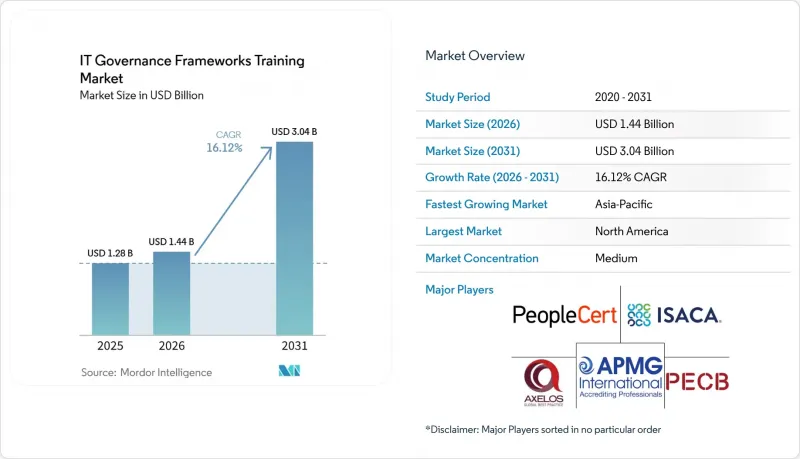
IT 거버넌스 프레임워크 교육 시장 규모는 2025년 12억 8,000만 달러로 평가되었습니다. 2026년에는 14억 4,000만 달러로 확대되어 2031년까지 30억 4,000만 달러에 이를 것으로 예상되고 2026년부터 2031년에 걸쳐 CAGR 16.12%로 성장할 전망입니다.
본 보고서는 교육 유형(인증 시험 대비 과정 등), 제공 형태(강사 주도형 교육 등), 기업 규모(대기업 및 중소기업), 최종 사용자(IT 및 통신, 은행, 금융서비스 및 보험(BFSI), 헬스케어 및 생명과학 등), 그리고 지역별로 분류되어 있습니다. 시장 예측은 금액(미 달러) 기준으로 제시되어 있습니다.
세계의 IT 거버넌스 프레임워크 교육 시장 동향 및 인사이트
COBIT 및 ISO/IEC 38500 역량 구축에 대한 수요 증가
IT 거버넌스 프레임워크 교육 시장은 기업들이 감독과 책임 이행을 수행하기 위한 인증된 프레임워크를 모색함에 따라, COBIT 2019 및 ISO/IEC 38500 역량 구축에 대한 꾸준한 수요의 혜택을 계속 받고 있습니다. 많은 조직이 변혁 활동의 통제 및 감사의 기반으로 COBIT 2019를 활용하고 있기 때문에 이 프레임워크는 운영 거버넌스 프로그램의 중심적인 위치를 계속 차지하고 있습니다. 한편, ISO/IEC 38500은 이사회가 기술 관련 책임을 어떻게 평가, 지시, 감독해야 하는지를 직접적으로 규정하고 있어 경영진 사이에서도 마찬가지로 주목받고 있습니다. 주목할 만한 구매 패턴으로, 기업들은 대개 실행 팀이나 보증 팀을 대상으로 COBIT 교육을 실시하는 한편, 고위 경영진에게는 ISO/IEC 38500 프로그램을 이수하게 하는 경향이 있어, 이로 인해 동일 고객사의 교육 비용이 증가하고 있습니다. 일본에서는 ISO/IEC 38500에 상응하는 국내 규격인 JIS Q 38500이 개정되어, AI 거버넌스를 명시적으로 언급한 11개의 확장된 IT 거버넌스 원칙이 포함됨에 따라 이러한 방향성이 더욱 강화되었습니다. 또한, ISACA는 2026년 2월에 ‘ITAF 제5판’을 발표하고, 그 적용 범위를 AI와 머신러닝(ML), 클라우드, 그리고 세계 커뮤니티 전체에 걸친 지속적인 보증(continuous assurance)까지 확대함으로써 거버넌스 인증 시험 준비의 중요성을 한층 더 높였습니다.
기술 거버넌스에서 이사회 차원의 설명 책임 강화
IT 거버넌스 프레임워크 교육 시장은 기술 거버넌스에 대한 책임을 이사회 및 경영진에게 직접 부과하는 규정에 따라 재편되고 있습니다. ‘디지털 운영 복원력법’은 2025년 1월 17일에 시행되어, 금융기관 경영진에게 관리하에 있는 ICT 위험에 상응하는 지식과 기술을 유지할 것을 의무화하고 있습니다. 또한, NIS2(제2차 네트워크 및 정보 보안 지침)에서는 중요 사업체의 이사에 대한 개인적 설명 책임이 도입됨에 따라, 거버넌스 교육은 단순한 선택적 학습 투자가 아닌 법적 리스크 관리 도구로 변화했습니다. 이러한 변화가 중요한 이유는 컴플라이언스 심사가 단순한 방침 선언이나 명목상의 역할 정의뿐만 아니라, 지속적인 교육에 대한 문서화된 증거에 점점 더 의존하고 있기 때문입니다. 그 영향은 직접적인 규제 대상인 사업체에 그치지 않고, 컴플라이언스 프로그램이 더 광범위한 공급망 전체로 파급됨에 따라 공급업체나 서비스 파트너도 유사한 압박을 느끼는 경우가 많기 때문입니다. 그 결과, IT 거버넌스 프레임워크 교육 시장에서는 공급업체의 신뢰성을 검증하고, 인접한 고객 그룹 전체의 도입에 영향을 미칠 수 있는 규제 대상 구매자를 중심으로 한 수요가 나타나고 있습니다.
대기업 이외의 기업에서 공식 IT 거버넌스 자격에 대한 인식 부족
IT 거버넌스 프레임워크 교육 시장은 대기업 이외의 기업, 특히 거버넌스 교육을 보다 광범위한 보안 인식 제고 교육과 동일시하는 의사결정자들 사이에서 여전히 인지도 격차를 겪고 있습니다. 이러한 오해로 인해 구매자가 일반적인 인식 제고 모듈과 의사결정 구조, 통제 감독, 이사회 책임성을 구축하는 교육을 구분하지 못하여 수요가 감소하고 있습니다. 이 문제는 공식적인 거버넌스 자격증을 통해 직접적인 성과를 입증할 수 있는 동종 업계 경쟁사가 적은 중소기업 및 신흥 시장에서 더욱 두드러집니다. COBIT 2019를 중소기업의 디지털 전환에 적용하는 것에 관한 조사에서는 이 프레임워크가 중소기업에 갖는 의의와 해당 부문에서의 실제 도입 현황 사이에 여전히 격차가 존재함이 밝혀졌습니다. 2026년에 실시된 인도의 중소기업에 관한 또 다른 조사에서는 IT 거버넌스의 성숙도가 높을수록 기업의 실적도 양호한 것으로 나타났으며, 증거는 존재하지만 아직 구매자들의 폭넓은 이해로 이어지지는 못하고 있음을 시사하고 있습니다. 인증 기관이나 제공업체가 중소기업을 대상으로 한 교육에 더 많은 투자를 하기 전까지는 IT 거버넌스 프레임워크 교육 시장이 중소기업 수준에서는 낮은 보급률을 보이는 상태가 지속될 가능성이 높습니다.
부문별 분석
2025년, IT 거버넌스 프레임워크 교육 시장에서 ‘인증 시험 대비 과정’은 32.41%를 차지하며 가장 큰 교육 유형이 되었습니다. 이러한 1위 기록은 감사, 거버넌스, 자문 및 기업 리스크 분야에서 일하는 전문가들 사이에서 특히 COBIT 2019나 CGEIT와 같은 공인 자격에 대한 수요가 지속되고 있음을 반영합니다. ISACA가 2026년 2월에 『ITAF 제5판』을 발표함에 따라 거버넌스와 어슈어런스의 적용 범위가 AI, ML, 클라우드,애자일 감사, 지속적 보증까지 확대되었으며, 학습자와 고용주에게 새로운 업그레이드 주기가 마련됨에 따라 이 부문은 추가적인 추진력을 얻었습니다. CGEIT가 여전히 중요하게 여겨지는 이유는 좁은 범위의 기술적 전문 지식이 아니라 기업 전체의 거버넌스 역량을 보여주기 때문이며, 이를 통해 리더십 및 자문 분야 채용에서 그 중요성이 유지되고 있습니다. 프레임워크 도입 워크숍은 다양한 구매 요구를 충족시킵니다. 이러한 프로그램은 일반적으로 이미 자격증 소지자를 보유하고 있으며 거버넌스 구조 구축에 대한 지침이 필요한 조직에서 구매합니다. 경영진 및 이사회를 위한 거버넌스 프로그램은 매출 면에서는 여전히 규모가 작지만, 규제 대상 부문에서 기술 감독에 대한 직접적인 책임이 경영진에게 부과됨에 따라 그 전략적 중요성이 높아지고 있습니다.
역할 기반의 실무자 교육은 2031년까지 연평균 성장률(CAGR) 19.24%를 나타낼 것으로 예측되며, IT 거버넌스 프레임워크 교육 시장에서 가장 빠르게 성장하는 교육 유형이 될 것입니다. 이러한 변화는 많은 기업 구매자들이 개별 학습자의 일회성 시험 합격보다는 역할 설계에 기반한 거버넌스 역량을 갖춘 팀을 구축하기를 원하고 있음을 보여줍니다. 역할 기반 프로그램은 직무 범위의 변화와 거버넌스 책임이 각 기능으로 확대됨에 따라 지속적인 수강생 확보가 기대되므로, 그 상업적 가치는 분명합니다. 이 점은 특정 자격 취득 주기마다 1인당 1회 구매되는 경우가 많은 인증 시험 대비 과정과는 구조적으로 다른 점입니다. 러닝 트리 인터내셔널이 2025년에 상급 과정 및 역할 특화형 거버넌스 콘텐츠를 포함한 ISACA 인증 프로그램을 확충한 것은 실제 조직 내 역할에 부합하는 교육 아키텍처에 대한 수요가 높아지고 있음을 반영한 것입니다. 더 많은 조직이 거버넌스 인증 도입의 첫 단계를 완료하고 실질적인 구현 단계로 넘어감에 따라, IT 거버넌스 프레임워크 교육 시장에서는 역할 기반 형식이 향후 지출에서 더 큰 비중을 차지하게 될 것입니다.
2025년, 강사 주도형 교육은 IT 거버넌스 프레임워크 교육 시장 점유율의 36.82%를 차지하며, 해당 시장의 주요 제공 형태가 되었습니다. 기업의 구매 담당자들은 거버넌스 분야에서 여전히 대면 형식의 교육을 선호합니다. 이는 많은 순수 기술적 학습 모듈에 비해 토론, 해석, 맥락에 따른 판단이 더 중요시되기 때문입니다. 또한, 이 형식은 주요 거버넌스 시험의 특성에서도 이점을 얻고 있습니다. 수험생들은 시나리오 기반 문제로 구성된 감독 시험 준비 과정에서 체계적인 지도를 선호하는 경향이 있기 때문입니다. 이로 인해 지역에 관계없이 디지털 접근성이 확대되는 상황에서도 강사 주도형 형식에 대한 강력한 수요가 유지되었습니다. 가상 실시간 교육은 과거 대면 수업이 차지하던 수요의 일부를 흡수했습니다. 이는 원격지에 있는 팀이 출장 비용을 들이지 않고도 실시간 상호작용을 원했기 때문입니다. 자기 주도형 이러닝은 갱신 학점 취득, 모듈식 학습, 그리고 프로그램 전체 참여에 대한 약속 없이 특정 콘텐츠만 배우고자 하는 초기 단계의 학습자들에게 여전히 중요한 위치를 차지하고 있습니다.
블렌디드 러닝은 2026년부터 2031년까지 연평균 성장률(CAGR) 18.73%로 확대될 것으로 예측되며, IT 거버넌스 프레임워크 교육 시장에서 가장 빠르게 성장하는 제공 형식이 될 전망입니다. 수강생이 이 형식을 선택하는 이유는 강사 주도 세션의 엄격함과 자기 주도 학습의 편의성을 겸비하고 있으며, 학습자 그룹 전체의 성과 가시성이 향상되기 때문입니다. 프레임워크 소유자들도 제품 설계 및 코스 아키텍처를 통해 이러한 전환을 지원하고 있습니다. 2026년 2월 PeopleCert가 발표한 ITIL 버전 5에는 AI 거버넌스에 관한 간행물과 블렌디드 학습 및 자기 주도형 학습의 진전을 지원하는 업데이트된 학습 경로가 포함되어 있어, 주요 자격 인증 기관들이 일회성 대면 교육 행사를 넘어 학습의 확대를 도모하고 있음을 알 수 있습니다. 이러한 형식은 지속적인 지식 갱신, 수료 현황에 대한 보다 상세한 추적, 그리고 기능 및 지역을 아우르는 팀을 위한 보다 유연한 일정 설정을 원하는 기업 고객에게 특히 유용합니다. 그 결과, IT 거버넌스 프레임워크 교육 시장은 일회성 교육 행사가 아닌, 지속적인 거버넌스 역량 유지를 지원하는 제공 모델로 전환되고 있습니다.
지역별 분석
2025년, 북미는 IT 거버넌스 프레임워크 교육 시장의 34.72%를 차지하며 가장 규모가 큰 지역 부문이 되었습니다. 이 지역은 자격을 갖춘 전문가 기반이 두텁고, 거버넌스 체제가 성숙하며, 미국 및 캐나다 전역에서 인증 교육 기관에 쉽게 접근할 수 있다는 이점이 있습니다. 또한, 주요 프레임워크 소유자의 존재와 규제 대상이며 디지털 환경이 복잡한 기업들의 도입 기반이 광범위하다는 점도 수요를 뒷받침하고 있습니다. 2025년 12월, ISACA가 미국 국방 공급망의 CMMC 프로그램에서 독점적인 평가 기관 및 강사 인증 기관으로 승인됨에 따라 거버넌스 관련 교육 대상층이 대폭 확대되었습니다. 또한, 미국에서는 2026년 HIPAA 보안 규정 준수 갱신에 따라 의료 현장에서 문서화된 역할 기반 거버넌스 교육의 필요성이 강화되어, 해당 부문에 특화된 지원이 이루어졌습니다.
유럽은 규제 환경으로 인해 거버넌스 교육이 실질적인 규정 준수 요건이 되었기 때문에 IT 거버넌스 프레임워크 교육 분야에서 여전히 2위 지역 시장을 유지했습니다. DORA는 2025년 1월부터 ICT 위험에 대한 지식에 대해 경영진에게 직접적인 의무를 부과한 반면, NIS2는 EU 전 회원국의 중요 사업체에서 이사회의 설명 책임을 확대했습니다. 독일, 영국, 프랑스는 계속해서 주요 국내 시장으로 남아 있으며, 독일은 BSI 및 ISO 준수 프로그램을 둘러싼 병행 거버넌스 생태계의 혜택도 누리고 있습니다. PECB는 2026년 3월, 독일의 CTG GmbH와의 제휴를 통해 지역 내 제공 체계를 강화하고, 거버넌스 및 컴플라이언스 과정에 대한 현지화된 접근성을 추가했습니다.
아시아태평양은 2026년부터 2031년까지 연평균 성장률(CAGR) 18.91%를 나타낼 것으로 예측되며, IT 거버넌스 프레임워크 교육 시장에서 가장 빠르게 성장하는 지역이 될 전망입니다. 이 지역은 각국의 디지털 전환(DX) 프로그램, 거버넌스 자격증에 대한 전문가 수요 증가, 그리고 인도, 중국, 일본, 한국, 동남아시아 전역에 걸친 현지 교육 인프라 확충에 힘입어 성장하고 있습니다. 일본에서는 JIS Q 38500 프레임워크 개정안에 AI 거버넌스에 관한 보다 광범위한 규정이 포함되면서 탄력을 받았으며, 공식적인 거버넌스 교육에 대한 수요와 현지 상황 간의 부합성이 강화되었습니다. 또한 인도에서는 2026년 6월 IIT 실린더이와 Simplilearn이 24개월간의 온라인 ‘디지털 거버넌스 대학원 디플로마 과정’을 개설하여 인재 양성의 기반이 더욱 탄탄해졌습니다. 중국에서는 CGEIT 자격 취득 활동이 활발해지고 COBIT 관련 교육이 제공됨에 따라 기업 거버넌스의 성숙도가 지속적으로 높아지고 있습니다. 남미 시장은 여전히 규모는 작지만, 다국적 고객을 대응하기 위해 기업들이 국제적인 거버넌스 기대치에 부응하기 위해 노력함에 따라 그 중요성이 커지고 있습니다. 중동 및 아프리카도 사우디아라비아, 아랍에미리트(UAE), 나이지리아, 남아프리카공화국이 거버넌스 및 컴플라이언스 프로그램과 관련된 인증 교육 체계를 확충함에 따라 존재감을 높이고 있습니다.
기타 혜택 :
- 엑셀 형식 시장 전망(ME) 시트
- 3개월간의 애널리스트 지원
자주 묻는 질문
목차
제1장 서론
제2장 조사 방법
제3장 개요
제4장 시장 구도
제5장 시장 규모 및 성장 예측
제6장 경쟁 구도
제7장 시장 기회 및 향후 전망
KTH 26.09.02According to Mordor Intelligence, the IT governance frameworks training market size is expected to increase from USD 1.28 billion in 2025 to USD 1.44 billion in 2026 and reach USD 3.04 billion by 2031, growing at a CAGR of 16.12% over 2026-2031.
This report is Segmented by Training Type (Certification Preparation Courses, and More), Delivery Mode (Instructor-Led Training, and More), Enterprise Size (Large Enterprises and Small and Medium Enterprises), End User (IT and Telecommunication, BFSI, Healthcare and Life Sciences, and More), and Geography. The Market Forecasts are Provided in Terms of Value (USD).
Global IT Governance Frameworks Training Market Trends and Insights
Rising Demand for COBIT and ISO/IEC 38500 Capability Building
The IT Governance Frameworks Training Market continues to benefit from strong demand for COBIT 2019 and ISO/IEC 38500 capability-building as enterprises seek recognized frameworks to guide oversight and accountability. COBIT 2019 remains central to operational governance programs because many organizations use it as the control and audit backbone for transformation work. ISO/IEC 38500 is gaining parallel traction at the executive layer because it speaks directly to how boards evaluate, direct, and monitor technology responsibilities. A notable buying pattern is that enterprises often train delivery and assurance teams on COBIT while placing senior leaders into ISO/IEC 38500 programs, which lifts training spend within the same account. Japan strengthened this direction when JIS Q 38500, its domestic equivalent of ISO/IEC 38500, was updated to include 11 expanded IT governance principles that explicitly address AI governance. ISACA also widened the relevance of governance certification preparation when it launched ITAF 5th Edition in February 2026, extending the framework to AI and ML, cloud, and continuous assurance across its global community.
Intensifying Board-Level Accountability for Technology Governance
The IT Governance Frameworks Training Market is being reshaped by rules that place the responsibility for technology governance directly on boards and senior management. The Digital Operational Resilience Act became applicable on January 17, 2025, and requires management bodies of financial entities to maintain knowledge and skills that match the ICT risks under their control. NIS2 also introduced personal accountability for board members of essential entities, turning governance training into a legal risk management tool rather than a discretionary learning purchase. This change matters because compliance reviews increasingly depend on documented evidence of ongoing training, not just policy statements or nominal role definitions. The effect extends beyond the directly regulated entity, as suppliers and service partners often feel the same pressure as compliance programs move through the wider chain. As a result, the IT Governance Frameworks Training Market is seeing demand anchored by regulated buyers that can validate provider credibility and influence adoption across adjacent customer groups.
Limited Awareness of Formal IT Governance Credentials Outside Large Enterprises
The IT Governance Frameworks Training Market still faces an awareness gap outside large enterprises, especially among decision-makers who treat governance training as interchangeable with broader security awareness programs. That misunderstanding reduces demand because buyers fail to distinguish between commodity awareness modules and training that builds decision structures, control oversight, and board accountability. The problem is more visible in smaller firms and emerging markets where fewer peers can point to direct outcomes from formal governance credentials. Research on applying COBIT 2019 to SME digital transformation identified a persistent gap between the framework's relevance to smaller enterprises and its actual adoption in that segment. A separate 2026 study on Indian SMEs linked stronger IT governance maturity to better firm performance, suggesting that evidence exists but has not yet translated into broad buyer understanding. Until certification bodies and providers invest more heavily in SME-oriented education, the IT Governance Frameworks Training Market is likely to remain underpenetrated at the SME level.
Other drivers and restraints analyzed in the detailed report include:
- Growing Enterprise Spend on Role-Based Governance Upskilling
- Expansion of Regulated Digital Transformation Programs
- Fragmented Buying Across HR, IT, Risk, and Compliance Budgets
For complete list of drivers and restraints, kindly check the Table Of Contents.
Segment Analysis
Certification Preparation Courses accounted for 32.41% of the IT Governance Frameworks Training market in 2025, making them the largest training type. This lead reflected continued demand for recognized credentials, especially COBIT 2019 and CGEIT, among professionals working in audit, governance, advisory, and enterprise risk roles. ISACA's February 2026 launch of the ITAF 5th Edition gave the segment another boost by expanding governance and assurance coverage to include AI and ML, cloud, agile auditing, and continuous assurance, creating a new upgrade cycle for learners and employers. CGEIT remains important because it signals enterprise-wide governance capability rather than narrow technical expertise, which keeps it relevant in leadership and advisory hiring. Framework Implementation Workshops address a different buyer need, as these programs are usually purchased by organizations that already have credential holders and now need guidance on deploying governance structures. Executive and Board Governance Programs remain smaller in revenue terms, yet they are becoming more strategic as regulated sectors place direct responsibility for technology oversight on management bodies.
Role-Based Practitioner Training is projected to grow at a 19.24% CAGR through 2031, making it the fastest-growing training type in the IT Governance Frameworks Training Market. This shift shows that many enterprise buyers now want governance-capable teams built around role design instead of one-time exam success for individual learners. The commercial value is clear because role-based programs can generate recurring enrollment as job scopes change and governance responsibilities spread across functions. That makes them structurally different from certification preparation, which is often purchased once per person for a specific credential cycle. Learning Tree International's 2025 expansion across ISACA-authorized programs, including advanced and role-specific governance content, reflected the growing need for training architectures that match real organizational roles. As more organizations finish their first wave of governance certification adoption and turn toward applied implementation, the IT Governance Frameworks Training Market is likely to see role-based formats claim a larger share of future spending.
Instructor-Led Training held 36.82% of the IT Governance Frameworks Training market share in 2025, making it the leading delivery mode in the IT Governance Frameworks Training Market. Enterprise buyers still favor live facilitation in governance settings because discussion, interpretation, and contextual judgment matter more here than in many purely technical learning modules. The format also benefits from the nature of major governance exams, since candidates often prefer structured coaching when preparing for proctored assessments built around scenario-based questions. That helped preserve strong demand for instructor-led formats even as digital access widened across regions. Virtual Live Training absorbed part of the volume that once belonged to in-person classes because distributed teams wanted live interaction without travel costs. Self-Paced E-Learning remained important for renewal credits, modular learning, and early-stage learners who wanted targeted content without committing to a full program.
Blended Learning is projected to expand at a 18.73% CAGR from 2026 to 2031, making it the fastest-growing delivery format in the IT Governance Frameworks Training Market. Buyers are choosing it because it combines the rigor of instructor-led sessions with the convenience of self-paced study and stronger performance visibility across learner groups. Framework owners are also supporting this shift through product design and course architecture. PeopleCert's launch of ITIL Version 5 in February 2026 included an AI Governance publication and updated pathways that support blended and self-paced progression, which shows how major credential owners are extending learning beyond a single classroom event. This format is especially useful for enterprise customers who want ongoing refresh, better completion tracking, and more flexible scheduling for teams spread across functions and geographies. As a result, the IT Governance Frameworks Training Market is shifting toward delivery models that support continuous governance capability rather than isolated training events.
Complete Report Scope:
- By Training Type
- Certification Preparation Courses
- Framework Implementation Workshops
- Executive and Board Governance Programs
- Role-Based Practitioner Training
- By Delivery Mode
- Instructor-Led Training
- Virtual Live Training
- Self-Paced E-Learning
- Blended Learning
- By Enterprise Size
- Large Enterprises
- Small and Medium Enterprises
- By End User
- IT and Telecommunication
- BFSI
- Healthcare and Life Sciences
- Retail and E-Commerce
- Industrial Manufacturing
- Education and Research Institutions
- Media and Entertainment
- Government and administration
- Energy and Utilities
- Other end-user industries
- By Geography
- North America
- United States
- Canada
- Mexico
- South America
- Brazil
- Argentina
- Rest of South America
- Europe
- Germany
- United Kingdom
- France
- Russia
- Spain
- Rest of Europe
- Asia-Pacific
- China
- Japan
- India
- South Korea
- Southeast Asia
- Rest of Asia-Pacific
- Middle East and Africa
- Middle East
- Saudi Arabia
- United Arab Emirates
- Rest of Middle East
- Africa
- South Africa
- Nigeria
- Rest of Africa
- Middle East
- North America
Geography Analysis
North America accounted for 34.72% of the IT Governance Frameworks Training market in 2025, making it the largest regional segment. The region benefits from a dense base of credentialed professionals, mature governance structures, and strong access to authorized training organizations across the United States and Canada. Demand is further reinforced by the presence of leading framework owners and a large installed base of regulated and digitally complex enterprises. ISACA's December 2025 authorization as the exclusive assessor and instructor certification organization for the U.S. defense supply chain's CMMC program materially widened the addressable governance-adjacent training base. The United States also gained sector-specific support from the 2026 HIPAA Security Rule compliance updates, which strengthened the need for documented role-based governance training in healthcare settings.
Europe remained the second-largest regional market for IT Governance Frameworks Training because the regulatory environment made governance education a practical compliance requirement. DORA created direct management body obligations for ICT risk knowledge from January 2025, while NIS2 extended board accountability across essential entities in all EU member states. Germany, the United Kingdom, and France remain the leading national markets, and Germany also benefits from a parallel governance ecosystem around BSI and ISO-aligned programs. PECB strengthened regional delivery in March 2026 through its partnership with CTG GmbH in Germany, which added localized access to governance and compliance courses.
Asia-Pacific is projected to expand at a 18.91% CAGR from 2026 to 2031, making it the fastest-growing geography in the IT Governance Frameworks Training Market. The region is supported by national digital transformation programs, rising professional demand for governance credentials, and a growing local training base across India, China, Japan, South Korea, and Southeast Asia. Japan added momentum when its JIS Q 38500 framework update incorporated broader AI governance provisions, which strengthened local alignment with formal governance training demand. India also advanced the talent pipeline when IIT Bombay and Simplilearn launched a 24-month online Post Graduate Diploma in Digital Governance in June 2026. China continues to demonstrate greater enterprise governance maturity through active CGEIT credential activity and the availability of COBIT-related training. South America remains smaller but is gaining relevance as enterprises align with international governance expectations to serve multinational customers. The Middle East and Africa are also moving up as Saudi Arabia, the UAE, Nigeria, and South Africa build more authorized training capacity tied to governance and compliance programs.
- PeopleCert
- ISACA
- AXELOS
- APMG International
- PECB
- Learning Tree International
- QA Limited
- New Horizons Worldwide, LLC
- Global Knowledge Training LLC
- Simplilearn Solutions Private Limited
- Firebrand Training
- IT Governance Ltd
- Good e-Learning
- Infosec Institute, Inc.
- The Knowledge Academy
- NobleProg Limited
- Invensis Learning
- Tonex Training
- GTC Group
- TUV SUD
Additional Benefits:
- The market estimate (ME) sheet in Excel format
- 3 months of analyst support
TABLE OF CONTENTS
1 INTRODUCTION
- 1.1 Study Assumptions and Market Definition
- 1.2 Scope of the Study
2 RESEARCH METHODOLOGY
3 EXECUTIVE SUMMARY
4 MARKET LANDSCAPE
- 4.1 Market Overview
- 4.2 Market Drivers
- 4.2.1 Rising Demand for COBIT and ISO/IEC 38500 Capability Building
- 4.2.2 Intensifying Board-Level Accountability for Technology Governance
- 4.2.3 Growing Enterprise Spend on Role-Based Governance Upskilling
- 4.2.4 Expansion of Regulated Digital Transformation Programs
- 4.2.5 Embedded Training Demand From IT Operating Model Standardization Programs
- 4.2.6 Vendor-Neutral Governance Skills Beating Framework-Specific Cert Prep Demand
- 4.3 Market Restraints
- 4.3.1 Limited Awareness of Formal IT Governance Credentials Outside Large Enterprises
- 4.3.2 Fragmented Buying Across HR, IT, Risk, and Compliance Budgets
- 4.3.3 Shortage of Qualified Instructors With Practical Governance Delivery Experience
- 4.3.4 Low Renewal Urgency for Mature Practitioners After Initial Certification
- 4.4 Impact of Macroeconomic Factors on the Market
- 4.5 Industry Value-Chain Analysis
- 4.6 Technology Outlook
- 4.7 Regulatory Landscape
- 4.8 Porter's Five Forces Analysis
- 4.8.1 Threat of New Entrants
- 4.8.2 Bargaining Power of Suppliers
- 4.8.3 Bargaining Power of Buyers
- 4.8.4 Threat of Substitutes
- 4.8.5 Intensity of Competitive Rivalry
5 MARKET SIZE AND GROWTH FORECASTS (VALUE)
- 5.1 By Training Type
- 5.1.1 Certification Preparation Courses
- 5.1.2 Framework Implementation Workshops
- 5.1.3 Executive and Board Governance Programs
- 5.1.4 Role-Based Practitioner Training
- 5.2 By Delivery Mode
- 5.2.1 Instructor-Led Training
- 5.2.2 Virtual Live Training
- 5.2.3 Self-Paced E-Learning
- 5.2.4 Blended Learning
- 5.3 By Enterprise Size
- 5.3.1 Large Enterprises
- 5.3.2 Small and Medium Enterprises
- 5.4 By End User
- 5.4.1 IT and Telecommunication
- 5.4.2 BFSI
- 5.4.3 Healthcare and Life Sciences
- 5.4.4 Retail and E-Commerce
- 5.4.5 Industrial Manufacturing
- 5.4.6 Education and Research Institutions
- 5.4.7 Media and Entertainment
- 5.4.8 Government and administration
- 5.4.9 Energy and Utilities
- 5.4.10 Other end-user industries
- 5.5 By Geography
- 5.5.1 North America
- 5.5.1.1 United States
- 5.5.1.2 Canada
- 5.5.1.3 Mexico
- 5.5.2 South America
- 5.5.2.1 Brazil
- 5.5.2.2 Argentina
- 5.5.2.3 Rest of South America
- 5.5.3 Europe
- 5.5.3.1 Germany
- 5.5.3.2 United Kingdom
- 5.5.3.3 France
- 5.5.3.4 Russia
- 5.5.3.5 Spain
- 5.5.3.6 Rest of Europe
- 5.5.4 Asia-Pacific
- 5.5.4.1 China
- 5.5.4.2 Japan
- 5.5.4.3 India
- 5.5.4.4 South Korea
- 5.5.4.5 Southeast Asia
- 5.5.4.6 Rest of Asia-Pacific
- 5.5.5 Middle East and Africa
- 5.5.5.1 Middle East
- 5.5.5.1.1 Saudi Arabia
- 5.5.5.1.2 United Arab Emirates
- 5.5.5.1.3 Rest of Middle East
- 5.5.5.2 Africa
- 5.5.5.2.1 South Africa
- 5.5.5.2.2 Nigeria
- 5.5.5.2.3 Rest of Africa
- 5.5.5.1 Middle East
- 5.5.1 North America
6 COMPETITIVE LANDSCAPE
- 6.1 Market Concentration
- 6.2 Strategic Moves
- 6.3 Market Share Analysis
- 6.4 Company Profiles (includes Global Level Overview, Market Level Overview, Core Segments, Financials as available, Strategic Information, Market Rank/Share, Products and Services, Recent Developments)
- 6.4.1 PeopleCert
- 6.4.2 ISACA
- 6.4.3 AXELOS
- 6.4.4 APMG International
- 6.4.5 PECB
- 6.4.6 Learning Tree International
- 6.4.7 QA Limited
- 6.4.8 New Horizons Worldwide, LLC
- 6.4.9 Global Knowledge Training LLC
- 6.4.10 Simplilearn Solutions Private Limited
- 6.4.11 Firebrand Training
- 6.4.12 IT Governance Ltd
- 6.4.13 Good e-Learning
- 6.4.14 Infosec Institute, Inc.
- 6.4.15 The Knowledge Academy
- 6.4.16 NobleProg Limited
- 6.4.17 Invensis Learning
- 6.4.18 Tonex Training
- 6.4.19 GTC Group
- 6.4.20 TUV SUD
7 MARKET OPPORTUNITIES AND FUTURE OUTLOOK
- 7.1 White-Space and Unmet-Need Assessment


