
|
시장보고서
상품코드
2132654
데이터센터용 에너지 저장 시스템 시장 예측(-2032년) : 엔터프라이즈 버티컬/최종사용자별, 용도별, 에너지 저장 기술별, 데이터센터 유형별, 전력 용량별, 컴포넌트 및 관리 시스템별, 지역별Data Center Energy Storage Systems Market by Energy Storage Technology (BESS, FESS, Supercapacitor), Data Center Type (Enterprise, Cloud & Hyperscale, Colocation), Application, Enterprise Vertical, and Region - Global Forecast to 2032 |
||||||

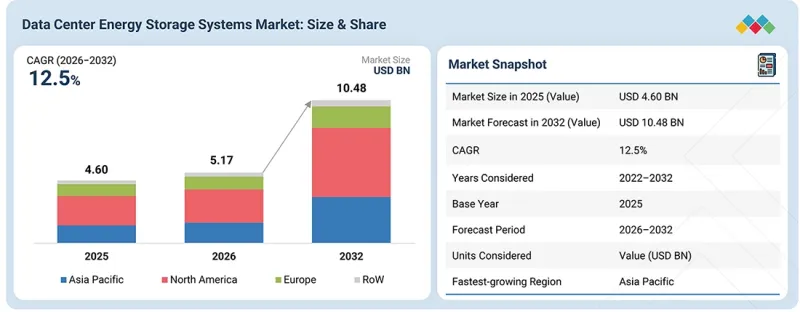
세계의 데이터센터용 에너지 저장 시스템 시장 규모는 2026년 51억 7,000만 달러에서 2032년까지 104억 8,000만 달러로, CAGR 12.5%로 확대할 것으로 예측됩니다.
데이터센터용 에너지 저장 시스템은 필요할 때 사용할 수 있도록 전력을 저장하는 솔루션으로, 데이터센터가 신뢰성 높은 전력 공급을 유지하고 운영 요구 사항에 따라 전력 가용성을 관리하는 데 도움이 됩니다. 이러한 시스템은 데이터센터의 광범위한 전력 인프라의 일부로서 점점 더 중요한 역할을 수행하고 있으며, 장시간 백업 전원(UPS 보완) 및 전력 품질 조정부터 피크 부하 완화, 부하 관리, 재생 가능 에너지 통합, 계통 서비스, 블랙 스타트에 이르기까지 폭넓은 요구 사항을 충족하고 있습니다. 데이터센터가 사업 운영에서 점점 더 중요해지고, 지속적인 가용성이 필요한 워크로드를 처리할 기회가 늘어남에 따라 이러한 시스템에 대한 수요는 증가하고 있습니다.
| 조사 범위 | |
|---|---|
| 조사 대상 기간 | 2022-2032년 |
| 기준연도 | 2025년 |
| 예측 기간 | 2026-2032년 |
| 산정 단위 | 금액(100만 달러) |
| 부문 | 엔터프라이즈 버티컬/최종사용자별, 용도별, 에너지 저장 기술별, 데이터센터 유형별, 전력 용량별, 컴포넌트 및 관리 시스템별, 지역별 |
| 대상 지역 | 북미, 아시아태평양, 유럽 및 세계의 기타 지역 |
이 시장은 클라우드 서비스, AI, 디지털 플랫폼 및 증가하는 데이터 양에 대응하기 위한 데이터센터 인프라의 급속한 확장에 힘입어 성장하고 있습니다. 이러한 확장은 건설되는 시설의 수를 늘릴 뿐만 아니라, 특히 시설 규모가 확대되고 더 높은 부하를 요구하는 컴퓨팅 워크로드를 처리하게 됨에 따라 개별 데이터센터의 전력 수요도 증가시키고 있습니다. 동시에, 기존 데이터센터 입지의 송전망 용량 제한으로 인해 사업자들은 현장 전력 인프라를 강화하고 이용 가능한 전력을 관리하는 능력을 향상시켜야 할 필요성이 대두되고 있습니다. 또한 데이터센터 전력 전략에 재생 가능 에너지가 통합됨에 따라 이용 가능한 재생 가능 에너지를 보다 효과적으로 활용할 수 있는 에너지 저장 시스템에 대한 수요도 발생하고 있습니다. 더욱이 지속적인 디지털 서비스의 중요성이 커짐에 따라 데이터센터 사업자들은 전력 내결함성을 더욱 중시하게 되었으며, 전반적인 전력 인프라의 일환으로 에너지 저장 시스템에 대한 추가적인 수요가 발생하고 있습니다.
"데이터센터 유형별로 보면 예측 기간 중 기업 데이터센터 부문이 두 번째로 큰 점유율을 차지할 것으로 예상됩니다."
데이터센터 유형별로 보면 기업용 데이터센터 부문은 조직이 신뢰성이 높고 중단 없는 디지털 인프라를 지속적으로 유지해야 할 필요성에 힘입어, 데이터센터용 에너지 저장 시스템 시장에서 두 번째로 큰 점유율을 차지하고 있습니다. 기업 데이터센터는 기업이 자사의 애플리케이션, 데이터 스토리지, IT 인프라 및 비즈니스에 필수적인 업무를 지원하기 위해 운영되고 있습니다. 조직이 디지털 시스템 및 데이터베이스 프로세스에 대한 의존도를 높임에 따라 이러한 시설에서 신뢰할 수 있는 전력 공급을 유지하는 것의 중요성은 점점 더 커지고 있습니다. 클라우드 연결형 애플리케이션, 디지털 플랫폼 및 데이터 집약적 업무의 도입 확대 또한 인프라 및 전력 요구 사항의 증가에 기여하고 있습니다. 에너지 저장 시스템(ESS)은 백업 전원을 제공하고, 전력 신뢰성을 향상시키며, 전력 수요를 관리하고, 에너지 활용의 유연성을 높임으로써 기업 데이터센터를 지원하고 있습니다. 따라서 기업이 자사의 핵심 디지털 인프라에 대한 의존도를 지속하고 신뢰할 수 있는 전력에 대한 수요가 증가함에 따라 ESS 도입이 촉진되고 있으며, 이로 인해 기업 데이터센터는 데이터센터 유형 부문에서 2위의 규모를 유지하고 있습니다.
"용도별로는 피크 부하 완화 및 부하 관리 부문이 예측 기간 중 두 번째로 큰 시장 점유율을 차지할 것으로 전망됩니다."
용도별로는 피크 셰이빙 및 부하 관리 부문이 데이터센터용 에너지 저장 시스템 시장에서 2위의 점유율을 차지하고 있습니다. 이는 데이터센터의 전력 수요 증가와 늘어나는 전력 수요를 효율적으로 관리해야 할 필요성에 의해 주도되고 있습니다. 데이터센터가 확장되고 점점 더 높은 부하의 컴퓨팅 워크로드를 처리함에 따라 운영 사업자들은 전력 소비와 이용 가능한 전력 용량을 보다 적절하게 관리할 방법을 모색하고 있습니다. 에너지 저장 시스템(ESS)은 수요가 증가하는 시기에 대비해 에너지를 저장할 수 있으며, 데이터센터 운영자가 피크 부하를 관리하고 사용 가능한 전력을 더 효과적으로 활용하는 데 도움이 됩니다. 또한 데이터센터 운영자가 전력 요구 사항 및 기타 에너지 수요 관리에 있으며, 더 높은 유연성을 추구함에 따라 이 용도의 중요성이 커지고 있습니다. 따라서 데이터센터 시설의 규모와 전력 소비량의 증가, 그리고 효율적인 전력 관리에 대한 관심 고조가 피크 부하 완화 및 부하 관리를 위한 ESS의 지속적인 도입을 촉진하고 있으며, 이 분야는 시장에서 주요 용도 중 하나가 되었습니다.
"아시아태평양은 예측 기간 중 시장 점유율에서 2위를 차지할 것으로 전망됩니다."
지역별로 보면 아시아태평양은 해당 지역의 대규모이며 지속적으로 확장되는 디지털 인프라 기반에 힘입어 데이터센터용 에너지 저장 시스템 시장에서 2위의 점유율을 차지하고 있습니다. 디지털화의 진전, 클라우드 컴퓨팅, AI 도입 및 온라인 서비스에 대한 수요 증가가 해당 지역의 성숙 시장과 신흥 시장에서 데이터센터 개발을 주도하고 있습니다. 데이터센터 용량이 확대됨에 따라 전력 수요도 증가하고 있으며, 신뢰성 높은 전력 인프라에 대한 필요성이 커지고 있습니다. 데이터센터 운영 규모가 확대됨에 따라 사업자들은 전력 신뢰성을 확보하고, 전력 수요를 관리하며, 에너지 이용의 유연성을 높이기 위해 에너지 저장 솔루션 도입을 추진하고 있습니다. 디지털 인프라에 대한 지속적인 투자와 컴퓨팅 요구 사항의 증가로 인해 해당 지역 전체에서 데이터센터용 에너지 저장 시스템에 대한 수요가 지속될 것으로 예상됩니다. 따라서 기존의 방대한 데이터센터 기반과 디지털 및 컴퓨팅 인프라의 지속적인 확장이 맞물려, 아시아태평양은 데이터센터용 에너지 저장 시스템 시장에서 2위 지역 시장으로서의 지위를 유지하고 있습니다.
Tesla(미국), Contemporary Amperex Technology Co., Limited(중국), LG Energy Solution(한국), Samsung SDI(한국), Panasonic Holdings Corporation(일본)은 데이터센터용 에너지 저장 시스템 시장에서 사업을 운영하는 주요 기업 중 일부입니다.
조사 범위:
이 보고서에서는 데이터센터용 에너지 저장 시스템 시장을 에너지 저장 기술, 데이터센터 유형, 용도, 구성 부품 및 관리 시스템, 전력 용량, 엔터프라이즈 버티컬/최종사용자, 지역별로 세분화하고 있습니다. 또한 시장 성장에 영향을 미치는 주요 요인(촉진요인, 제약 요인, 기회, 과제 등)에 대한 상세한 정보를 제공합니다. 더불어, 데이터센터용 에너지 저장 시스템 제조업체를 전략적으로 분석하여 각 기업의 시장 점유율과 핵심 경쟁력을 종합적으로 평가하고 있습니다.
이 보고서를 구매해야 하는 이유:
이 보고서는 데이터센터용 에너지 저장 시스템 시장 및 각 부문의 매출에 대해 가장 정확한 추정치를 제공함으로써, 시장 선도 기업 및 신규 진입 기업의 지원이 될 것으로 기대됩니다. 또한 이 보고서는 이해관계자들이 시장의 경쟁 구도를 더 깊이 이해하고, 자사의 사업 위치를 향상시키기 위한 인사이트를 얻어 적절한 시장 진입 전략을 수립하는 데 도움이 될 것으로 기대됩니다. 더불어, 이해관계자들이 시장 동향을 파악할 수 있도록 돕는 동시에 주요 시장 촉진요인, 제약 요인, 과제 및 기회에 대한 정보를 제공합니다.
이 보고서는 다음 사항에 대한 인사이트를 제공합니다. :
- 주요 촉진요인 분석(AI 기반 및 하이퍼스케일 데이터센터 인프라에 대한 투자 가속화, 백업, 에너지 최적화, 그리드 지원 애플리케이션에서의 ESS 도입 확대, 그리고 데이터센터에 대한 지속가능성 및 에너지 효율 요구 사항 증가), 제약 요인(데이터센터 ESS 도입에 필요한 막대한 초기 투자 비용),기회(전력 밀도 및 내결함성에 대한 개조 수요 증가, 다양한 데이터센터 요구 사항을 충족하는 하이브리드 ESS 아키텍처의 부상, 그리고 ESS를 위한 AI 기반 에너지 관리 및 예측 모니터링), 그리고 과제(기존 데이터센터 인프라와의 ESS 통합 복잡성 및 ESS 기술 전반에 걸친 안전성 및 열 관리)
- 제품 개발/혁신: 데이터센터용 에너지 저장 시스템 시장의 향후 기술 및 연구개발 활동에 대한 상세 인사이트
- 시장 동향: 수익성 높은 시장에 대한 포괄적인 정보--이 보고서는 다양한 지역의 데이터센터용 에너지 저장 시스템 시장을 분석합니다.
- 경쟁 평가: 데이터센터용 에너지 저장 시스템 시장에서 Tesla(미국), Contemporary Amperex Technology Co., Limited(중국), LG Energy Solution(한국), Samsung SDI(한국), Panasonic Holdings Corporation(일본) 등 주요 기업의 시장 점유율, 성장 전략 및 제품 라인업에 대한 상세한 평가
목차
제1장 서론
제2장 개요
제3장 주요 인사이트
제4장 시장 개요
제5장 업계 동향
제6장 기술 진보, AI에 의한 영향, 특허, 혁신, 향후 응용
제7장 규제 상황과 지속가능성 구상
제8장 고객 상황과 구매 행동
제9장 데이터센터용 에너지 저장 시스템 시장(엔터프라이즈 버티컬/최종사용자별)
제10장 데이터센터용 에너지 저장 시스템 시장(용도별)
제11장 데이터센터용 에너지 저장 시스템(에너지 저장 기술별)
제12장 데이터센터용 에너지 저장 시스템 시장(데이터센터 유형별)
제13장 데이터센터용 에너지 저장 시스템 시장(전력 용량별)
제14장 데이터센터용 에너지 저장 시스템 시장(컴포넌트 및 관리 시스템별)
제15장 데이터센터용 에너지 저장 시스템 시장(지역별)
제16장 경쟁 구도
제17장 기업 개요
제18장 조사 방법
제19장 부록
KSAThe global data center energy storage systems market is projected to grow from USD 5.17 billion in 2026 to USD 10.48 billion by 2032, at a CAGR of 12.5%. Data center energy storage systems are solutions that store electricity for use when required, helping data centers maintain a dependable power supply and manage the availability of electricity according to operational requirements. They are increasingly becoming a part of the broader power infrastructure of data centers, supporting requirements ranging from extended backup power (UPS companion) and power quality conditioning to peak shaving & load management, renewable integration & grid services, and black start. The need for these systems is growing as data centers become more critical to business operations and increasingly handle workloads that require continuous availability.
| Scope of the Report | |
|---|---|
| Years Considered for the Study | 2022-2032 |
| Base Year | 2025 |
| Forecast Period | 2026-2032 |
| Units Considered | Value (USD Million) |
| Segments | Energy Storage Technology, Data Center Type, Application, Component and Management System, Power Capacity, and Enterprise Vertical |
| Regions covered | North America, Asia Pacific, Europe, and Rest of the World |
The market is being supported by the rapid expansion of data center infrastructure to accommodate cloud services, AI, digital platforms, and increasing data volumes. This expansion is not only increasing the number of facilities being built but is also raising the power requirements of individual data centers, particularly as facilities become larger and accommodate more intensive computing workloads. At the same time, limited grid capacity in established data center locations is encouraging operators to strengthen their on-site power infrastructure and improve their ability to manage available electricity. The increasing integration of renewable energy into data center power strategies is also creating demand for storage systems that can help operators better utilize available renewable power. Furthermore, the growing importance of continuous digital services is encouraging data center operators to place greater emphasis on power resilience, creating additional demand for energy storage systems as part of their overall power infrastructure.
"By data center type, the enterprise data centers segment is expected to account for the second-largest share during the forecast period."
The enterprise data center segment, by data center type, accounts for the second-largest share of the data center energy storage systems market, supported by the continued need for organizations to maintain reliable and uninterrupted digital infrastructure. Enterprise data centers are operated by businesses to support their own applications, data storage, IT infrastructure, and business-critical operations. As organizations increasingly depend on digital systems and data-driven processes, the importance of maintaining reliable power availability for these facilities continues to increase. The growing adoption of cloud-connected applications, digital platforms, and data-intensive business operations is also contributing to higher infrastructure and power requirements. Energy storage systems support enterprise data centers by providing backup power, improving power reliability, managing electricity demand, and providing greater flexibility in energy use. The continued reliance of businesses on their own critical digital infrastructure and the growing need for reliable power are therefore supporting sustained ESS adoption, enabling enterprise data centers to maintain their position as the second-largest data center type segment.
"By application, the peak shaving and load management segment will account for the second-largest market share during the forecast period."
The peak shaving & load management segment, by application, accounts for the second-largest share of the data center energy storage systems market, driven by the increasing electricity requirements of data centers and the need to manage growing power demand efficiently. As data centers expand and support increasingly intensive computing workloads, operators are seeking ways to better manage their electricity consumption and available power capacity. Energy storage systems can store energy for use during periods of higher demand, helping data center operators manage peak loads and make more effective use of available electricity. The application is also gaining relevance as data center operators seek greater flexibility in managing their power requirements alongside other energy needs. The growing scale and power intensity of data center facilities and the increasing focus on efficient electricity management are, therefore, supporting continued adoption of ESS for peak shaving and load management, making it one of the leading applications in the market.
"Asia Pacific is projected to account for the second-largest market share during the forecast period."
The Asia Pacific segment by region accounts for the second-largest share of the data center energy storage systems market, supported by the region's large and expanding digital infrastructure base. Increasing digitalization, cloud computing, AI adoption, and demand for online services are driving the development of data centers across established and emerging markets in the region. As data center capacity expands, electricity requirements are increasing and creating a greater need for reliable power infrastructure. The growing scale of data center operations is encouraging operators to adopt energy storage solutions to support power reliability, manage electricity demand, and provide greater flexibility in energy use. Continued investment in digital infrastructure and increasing computing requirements are expected to sustain demand for data center energy storage systems across the region. The combination of a substantial existing data center base and continued expansion of digital and computing infrastructure is therefore supporting Asia Pacific's position as the second-largest regional market for data center energy storage systems.
Profile break-up of primary participants for the report:
- By Company Type: Tier 1 - 65%, Tier 2 - 20%, and Tier 3 - 15%
- By Designation: Directors - 25%, C-level Executives - 30%, and Others - 45%
- By Region: North America - 30%, Asia Pacific - 40%, Europe - 20%, and Rest of the World - 10%
Note: Other designations include sales managers, engineers, and regional managers. Tier 1= revenue >USD 5 billion, Tier 2 = revenue between USD 1 and USD 5 billion, and Tier 3 company = revenue <USD 1 billion.
Tesla (US), Contemporary Amperex Technology Co., Limited (China), LG Energy Solution (South Korea), Samsung SDI Co., Ltd. (South Korea), and Panasonic Holdings Corporation (Japan) are some major players operating in the data center energy storage systems market.
Research Coverage:
The report segments the data center energy storage systems market based on energy storage technology, data center type, application, component and management system, power capacity, enterprise vertical/end user, and region. It provides detailed information on the major factors influencing the market's growth, including drivers, restraints, opportunities, and challenges. It strategically profiles data center energy storage systems manufacturers, comprehensively analyzing their market shares and core competencies.
Reasons to Buy the Report:
The report is expected to help market leaders/new entrants by providing the closest approximations of revenue figures for the data center energy storage systems market and its segments. This report is also expected to help stakeholders gain a better understanding of the market's competitive landscape, develop insights to improve their businesses' positions, and develop suitable go-to-market strategies. It also enables stakeholders to understand the market's pulse and provides information on key market drivers, restraints, challenges, and opportunities.
The report provides insights into the following pointers:
- Analysis of critical Drivers (Accelerating Investments in AI-driven and Hyperscale Data Center Infrastructure; Broadening ESS Adoption Across Backup, Energy Optimization, and Grid Support Applications; and Growing Sustainability and Energy-efficiency Requirements for Data Centers), Restraints (High Upfront Capital Requirements for Data Center ESS Deployment), Opportunities (Growing Retrofit Demand for Power Density and Resilience; Emergence of Hybrid ESS Architectures for Diverse Data Center Needs; and AI-enabled Energy Management and Predictive Monitoring for ESS), and Challenges (Complex ESS Integration with Existing Data Center Infrastructure; and Safety and Thermal Management across ESS Technologies)
- Product Development/Innovation: Detailed insights on upcoming technologies and research & development activities in the data center energy storage systems market
- Market Development: Comprehensive information about lucrative markets-the report analyzes the data center energy storage systems market across varied regions.
- Competitive Assessment: In-depth assessment of market shares, growth strategies, and product offerings of leading players such as Tesla (US), Contemporary Amperex Technology Co., Limited (China), LG Energy Solution (South Korea), Samsung SDI Co., Ltd. (South Korea), and Panasonic Holdings Corporation (Japan) in the data center energy storage systems market
TABLE OF CONTENTS
1 INTRODUCTION
- 1.1 STUDY OBJECTIVES
- 1.2 MARKET DEFINITION
- 1.3 MARKET SCOPE
- 1.3.1 MARKET SEGMENTATION AND REGIONAL SCOPE
- 1.3.2 INCLUSIONS AND EXCLUSIONS
- 1.3.3 YEARS CONSIDERED
- 1.4 CURRENCY CONSIDERED
- 1.5 STAKEHOLDERS
2 EXECUTIVE SUMMARY
- 2.1 MARKET HIGHLIGHTS AND KEY INSIGHTS
- 2.2 KEY MARKET PARTICIPANTS: MAPPING OF STRATEGIC DEVELOPMENTS
- 2.3 DISRUPTIVE TRENDS IN DATA CENTER ENERGY STORAGE SYSTEM MARKET
- 2.4 HIGH-GROWTH SEGMENTS
- 2.5 REGIONAL SNAPSHOT: MARKET SIZE, GROWTH RATE, AND FORECAST
3 PREMIUM INSIGHTS
- 3.1 ATTRACTIVE OPPORTUNITIES FOR PLAYERS IN DATA CENTER ENERGY STORAGE SYSTEM MARKET
- 3.2 DATA CENTER ENERGY STORAGE SYSTEM MARKET, BY REGION
- 3.3 DATA CENTER ENERGY STORAGE SYSTEM MARKET, BY ENERGY STORAGE TECHNOLOGY
- 3.4 DATA CENTER ENERGY STORAGE SYSTEM MARKET, BY DATA CENTER TYPE
- 3.5 DATA CENTER ENERGY STORAGE SYSTEM MARKET, BY APPLICATION
- 3.6 DATA CENTER ENERGY STORAGE SYSTEM MARKET, BY ENTERPRISE VERTICAL/END USER
- 3.7 DATA CENTER ENERGY STORAGE SYSTEM MARKET, BY KEY COUNTRY
4 MARKET OVERVIEW
- 4.1 INTRODUCTION
- 4.2 MARKET DYNAMICS
- 4.2.1 DRIVERS
- 4.2.1.1 Accelerating investments in AI-driven and hyperscale data center infrastructure
- 4.2.1.2 Broadening ESS adoption across backup, energy optimization, and grid-support applications
- 4.2.1.3 Growing sustainability and energy-efficiency requirements for data centers
- 4.2.2 RESTRAINTS
- 4.2.2.1 High upfront capital requirements for data center ESS deployment
- 4.2.3 OPPORTUNITIES
- 4.2.3.1 Emergence of hybrid and multi-technology ESS architectures for diverse data center requirements
- 4.2.3.2 AI-enabled energy management and predictive monitoring to improve ESS performance and lifecycle economics
- 4.2.3.3 Growing retrofit demand as existing data centers adapt to higher power density and resilience requirements
- 4.2.4 CHALLENGES
- 4.2.4.1 Complex integration of ESS with existing data center power infrastructure
- 4.2.4.2 Ensuring safety and thermal management across diverse ESS technologies
- 4.2.1 DRIVERS
- 4.3 UNMET NEEDS AND WHITE SPACES
- 4.3.1 UNMET NEEDS IN DATA CENTER ENERGY STORAGE SYSTEM MARKET
- 4.3.2 WHITE SPACE OPPORTUNITIES
- 4.4 INTERCONNECTED MARKETS AND CROSS-SECTOR OPPORTUNITIES
- 4.4.1 INTERCONNECTED MARKETS
- 4.4.2 CROSS-SECTOR OPPORTUNITIES
- 4.5 STRATEGIC MOVES BY TIER-1/2/3 PLAYERS
- 4.5.1 KEY MOVES AND STRATEGIC FOCUS
5 INDUSTRY TRENDS
- 5.1 PORTER'S FIVE FORCES ANALYSIS
- 5.1.1 BARGAINING POWER OF SUPPLIERS
- 5.1.2 BARGAINING POWER OF BUYERS
- 5.1.3 THREAT OF NEW ENTRANTS
- 5.1.4 THREAT OF SUBSTITUTES
- 5.1.5 INTENSITY OF COMPETITIVE RIVALRY
- 5.2 GLOBAL MACROECONOMIC OUTLOOK
- 5.2.1 INTRODUCTION
- 5.2.2 GDP TRENDS AND FORECAST
- 5.2.3 TRENDS IN GLOBAL MEDIA & ENTERTAINMENT INDUSTRY
- 5.2.4 TRENDS IN GLOBAL IT & TELECOMMUNICATIONS INDUSTRY
- 5.3 SUPPLY CHAIN ANALYSIS
- 5.3.1 RAW MATERIAL SUPPLY
- 5.3.2 COMPONENT & MANAGEMENT SYSTEM PRODUCTION
- 5.3.3 ENERGY STORAGE SYSTEM PRODUCTION & ASSEMBLY
- 5.4 DISTRIBUTION & LOGISTICS
- 5.4.1 SYSTEM INTEGRATION & INSTALLATION
- 5.4.2 END USERS/DATA CENTER OPERATORS
- 5.4.3 ECOSYSTEM ANALYSIS
- 5.5 PRICING ANALYSIS
- 5.5.1 AVERAGE SELLING PRICE TREND OF UPS-GRADE BATTERY PACKS, BY REGION, 2022-2025
- 5.5.2 PRICING RANGE OF LITHIUM-ION BATTERY PACKS, BY KEY PLAYER, 2025
- 5.6 TRADE ANALYSIS
- 5.6.1 IMPORT SCENARIO (HS CODE 850760)
- 5.6.2 EXPORT SCENARIO (HS CODE 850760)
- 5.7 KEY CONFERENCES AND EVENTS, 2026-2027
- 5.8 TRENDS/DISRUPTIONS IMPACTING CUSTOMER BUSINESS
- 5.9 INVESTMENT AND FUNDING SCENARIO
- 5.10 CASE STUDY ANALYSIS
- 5.10.1 VERTIV'S LITHIUM-ION BATTERY AND UPS SOLUTIONS ENABLE SPACE-EFFICIENT POWER PROTECTION AT DATAVITA'S DV2 DATA CENTER, SCOTLAND
- 5.10.2 VERTIV ENABLES SCALABLE AND ENERGY-EFFICIENT POWER INFRASTRUCTURE AT FORSYTHE DATA CENTERS
- 5.10.3 EATON ENABLES RENEWABLE ENERGY STORAGE AND INTELLIGENT POWER MANAGEMENT AT WEBAXYS DATA CENTER, FRANCE
- 5.11 IMPACT OF 2026 US TARIFF - DATA CENTER ENERGY STORAGE SYSTEM MARKET
- 5.12 KEY TARIFF RATES IMPACTING MARKET
- 5.13 PRICE IMPACT ANALYSIS
- 5.13.1 KEY IMPACT ON VARIOUS REGIONS
- 5.13.1.1 US
- 5.13.1.2 Europe
- 5.13.1.3 Asia Pacific
- 5.13.1 KEY IMPACT ON VARIOUS REGIONS
- 5.14 IMPACT ON END-USE INDUSTRIES OF DATA CENTER ENERGY STORAGE SYSTEM MARKET
- 5.14.1 BFSI
- 5.14.2 HEALTHCARE & LIFE SCIENCES
- 5.14.3 MANUFACTURING
- 5.14.4 E-COMMERCE & RETAIL
- 5.14.5 MEDIA & ENTERTAINMENT
- 5.14.6 IT & TELECOMMUNICATIONS
- 5.14.7 GOVERNMENT & PUBLIC SECTOR
- 5.14.8 OTHER ENTERPRISE VERTICALS
6 TECHNOLOGICAL ADVANCEMENTS, AI-DRIVEN IMPACT, PATENTS, INNOVATIONS, AND FUTURE APPLICATIONS
- 6.1 KEY EMERGING TECHNOLOGIES
- 6.1.1 GRID-FORMING BATTERY ENERGY STORAGE SYSTEMS FOR DATA CENTERS
- 6.2 COMPLEMENTARY TECHNOLOGIES
- 6.2.1 ADVANCED UPS SYSTEMS SUPPORTING DATA CENTER ENERGY STORAGE
- 6.3 TECHNOLOGY/PRODUCT ROADMAP
- 6.3.1 SHORT-TERM (2025-2027) | TECHNOLOGY OPTIMIZATION & DEPLOYMENT EXPANSION
- 6.3.2 MID-TERM (2027-2030) | SYSTEM INTEGRATION & PERFORMANCE ENHANCEMENT
- 6.3.3 LONG-TERM (2030-2035+) | ADVANCED STORAGE & INTELLIGENT ENERGY MANAGEMENT
- 6.4 PATENT ANALYSIS
- 6.4.1 METHODOLOGY
- 6.5 FUTURE APPLICATIONS
- 6.5.1 POWER QUALITY CONDITIONING: FAST POWER FLUCTUATION MANAGEMENT FOR AI WORKLOADS
- 6.5.2 EXTENDED BACKUP POWER: LONGER-DURATION BACKUP AND REDUCED GENERATOR DEPENDENCE
- 6.5.3 PEAK SHAVING AND LOAD MANAGEMENT: FLEXIBLE POWER DEMAND AND PEAK LOAD MANAGEMENT
- 6.5.4 RENEWABLE INTEGRATION AND GRID SERVICES: RENEWABLE ENERGY MATCHING AND GRID FLEXIBILITY
- 6.5.5 BLACK START: RESILIENT RESTART AND INDEPENDENT DATA CENTER OPERATION
- 6.6 IMPACT OF GENERATIVE AI ON DATA CENTER ENERGY STORAGE SYSTEM MARKET
- 6.6.1 INTRODUCTION
- 6.6.2 RISING POWER DEMAND AND STORAGE REQUIREMENTS
- 6.6.3 INCREASING NEED FOR FLEXIBLE POWER MANAGEMENT
- 6.6.4 DEVELOPMENT OF AI-SUITABLE ESS SOLUTIONS
- 6.6.5 GREATER INTEGRATION WITH RENEWABLE ENERGY AND PEAK MANAGEMENT
- 6.7 OVERALL MARKET IMPACT
7 REGULATORY LANDSCAPE AND SUSTAINABILITY INITIATIVES
- 7.1 REGIONAL REGULATIONS AND COMPLIANCE
- 7.1.1 REGULATORY BODIES, GOVERNMENT AGENCIES, AND OTHER ORGANIZATIONS
- 7.1.2 INDUSTRY STANDARDS
- 7.1.3 CERTIFICATIONS, LABELING, AND ECO-STANDARDS
- 7.2 SUSTAINABILITY INITIATIVES
- 7.2.1 CARBON IMPACT AND ECO-APPLICATIONS OF DATA CENTER ENERGY STORAGE SYSTEMS
- 7.2.1.1 Carbon Impact Reduction
- 7.2.1.2 Eco-applications
- 7.2.1 CARBON IMPACT AND ECO-APPLICATIONS OF DATA CENTER ENERGY STORAGE SYSTEMS
- 7.3 IMPACT OF REGULATORY POLICIES ON SUSTAINABILITY INITIATIVES
8 CUSTOMER LANDSCAPE & BUYER BEHAVIOR
- 8.1 INTRODUCTION
- 8.2 DECISION-MAKING PROCESS
- 8.2.1 KEY STAKEHOLDERS AND BUYING CRITERIA
- 8.2.2 KEY STAKEHOLDERS IN BUYING PROCESS
- 8.2.3 BUYING CRITERIA
- 8.3 ADOPTION BARRIERS & INTERNAL CHALLENGES
- 8.4 UNMET NEEDS IN VARIOUS APPLICATIONS
- 8.5 MARKET PROFITABILITY
- 8.5.1 REVENUE POTENTIAL
- 8.5.2 COST DYNAMICS
- 8.5.3 MARGIN OPPORTUNITIES IN KEY APPLICATIONS
9 DATA CENTER ENERGY STORAGE SYSTEM MARKET, BY ENTERPRISE VERTICAL/END USER
- 9.1 INTRODUCTION
- 9.2 BFSI
- 9.2.1 GROWING DIGITALIZATION AND INCREASING RESILIENCE REQUIREMENTS
- 9.3 HEALTHCARE & LIFE SCIENCES
- 9.3.1 GROWING DIGITAL HEALTHCARE INFRASTRUCTURE AND INCREASING REQUIREMENTS FOR RELIABLE OPERATIONS
- 9.4 MANUFACTURING
- 9.4.1 GROWING INDUSTRIAL DIGITALIZATION AND INCREASING RELIANCE ON DATA-DRIVEN OPERATIONS
- 9.5 E-COMMERCE & RETAIL
- 9.5.1 GROWING DIGITAL COMMERCE AND INCREASING DEPENDENCE ON ALWAYS-ON DATA INFRASTRUCTURE
- 9.6 MEDIA & ENTERTAINMENT
- 9.6.1 GROWING DIGITAL MEDIA CONSUMPTION AND INCREASING DATA INFRASTRUCTURE REQUIREMENTS
- 9.7 IT & TELECOMMUNICATIONS
- 9.7.1 EXPANDING DIGITAL INFRASTRUCTURE AND RISING DATA CENTER POWER REQUIREMENTS
- 9.8 GOVERNMENT & PUBLIC SECTOR
- 9.8.1 GROWING GOVERNMENT DIGITALIZATION AND INCREASING RESILIENCE REQUIREMENTS
- 9.9 OTHER ENTERPRISE VERTICALS/END USERS
10 ENERGY STORAGE SYSTEMS MARKET, BY APPLICATION
- 10.1 INTRODUCTION
- 10.2 POWER QUALITY CONDITIONING
- 10.2.1 RISING DATA CENTER POWER INTENSITY AND GROWING REQUIREMENTS FOR RELIABLE POWER
- 10.3 EXTENDED BACKUP POWER (UPS COMPANION)
- 10.3.1 GROWING DATA CENTER POWER REQUIREMENTS AND INCREASING RESILIENCE NEEDS
- 10.4 PEAK SHAVING AND LOAD MANAGEMENT
- 10.4.1 RISING DATA CENTER ELECTRICITY DEMAND AND GROWING FOCUS ON ENERGY COST AND DEMAND MANAGEMENT
- 10.5 RENEWABLE INTEGRATION AND GRID SERVICES
- 10.5.1 GROWING RENEWABLE ENERGY ADOPTION AND INCREASING FOCUS ON FLEXIBLE ELECTRICITY MANAGEMENT
- 10.6 BLACK START
- 10.6.1 GROWING DATA CENTER RESILIENCE REQUIREMENTS AND INCREASING FOCUS ON RAPID POWER RESTORATION
11 DATA CENTER ENERGY STORAGE SYSTEM MARKET, BY ENERGY STORAGE TECHNOLOGY
- 11.1 INTRODUCTION
- 11.2 BATTERY ENERGY STORAGE SYSTEMS (BESS)
- 11.2.1 GROWING DATA CENTER POWER REQUIREMENTS AND NEED FOR RELIABLE, RESILIENT, AND FLEXIBLE ENERGY MANAGEMENT
- 11.3 FLYWHEEL ENERGY STORAGE SYSTEMS (FESS)
- 11.3.1 GROWING DEMAND FOR RAPID AND RELIABLE POWER SUPPORT IN DATA CENTERS
- 11.4 SUPERCAPACITOR ENERGY STORAGE SYSTEMS
- 11.4.1 GROWING DEMAND FOR RAPID POWER SUPPORT AND IMPROVED POWER QUALITY IN DATA CENTERS
- 11.5 OTHER ENERGY STORAGE TECHNOLOGIES
12 DATA CENTER ENERGY STORAGE SYSTEM MARKET, BY DATA CENTER TYPE
- 12.1 INTRODUCTION
- 12.2 ENTERPRISE DATA CENTERS
- 12.2.1 GROWING ENTERPRISE RELIANCE ON DIGITAL INFRASTRUCTURE AND RISING DATA CENTER POWER REQUIREMENTS
- 12.3 CLOUD & HYPERSCALE DATA CENTERS
- 12.3.1 GROWING CLOUD AND AI-DRIVEN COMPUTING REQUIREMENTS EXPANDING LARGE-SCALE DATA CENTER INFRASTRUCTURE
- 12.4 COLOCATION DATA CENTERS
- 12.4.1 GROWING DEMAND FOR COLOCATION CAPACITY AND INCREASING POWER REQUIREMENTS
13 DATA CENTER ENERGY STORAGE SYSTEM MARKET, BY POWER CAPACITY
- 13.1 INTRODUCTION
- 13.2 BELOW 1 MW
- 13.2.1 GROWING ADOPTION OF ESS ACROSS SMALLER DATA CENTERS AND TARGETED APPLICATIONS
- 13.3 1-5 MW
- 13.3.1 DATA CENTER EXPANSION AND BROADER ESS ADOPTION ACROSS MULTIPLE APPLICATIONS
- 13.4 5-20 MW
- 13.4.1 RISING DATA CENTER POWER REQUIREMENTS AND BROADER USE OF ESS FOR ENERGY MANAGEMENT
- 13.5 ABOVE 20 MW
- 13.5.1 EXPANDING HYPERSCALE AND AI-DRIVEN DATA CENTERS WITH RISING POWER REQUIREMENTS
14 DATA CENTER ENERGY STORAGE SYSTEM MARKET, BY COMPONENT AND MANAGEMENT SYSTEM
- 14.1 INTRODUCTION
- 14.2 ENERGY STORAGE DEVICES
- 14.2.1 RISING DATA CENTER ENERGY REQUIREMENTS AND DEMAND FOR RELIABLE, FLEXIBLE STORAGE
- 14.3 POWER CONVERSION SYSTEMS
- 14.3.1 GROWING ESS DEPLOYMENT AND NEED TO INTEGRATE STORAGE RELIABLY WITH DATA CENTER POWER INFRASTRUCTURE
- 14.4 COOLING AND VENTILATION SYSTEMS
- 14.4.1 INCREASING ESS SCALE AND OPERATING INTENSITY
- 14.5 INTEGRATED FIRE DETECTION AND SUPPRESSION SYSTEMS
- 14.5.1 GROWING ESS DEPLOYMENT AND RISING DATA CENTER SAFETY REQUIREMENTS
- 14.5.2 HEAT, SMOKE, AND GAS SENSORS
- 14.5.3 ANTI-DEFLAGRATION SYSTEMS
- 14.6 ELECTRICAL PROTECTION SYSTEMS
- 14.6.1 GROWING DATA CENTER POWER DEMAND AND NEED FOR RELIABLE ESS INTEGRATION
- 14.6.2 CIRCUIT BREAKERS
- 14.6.3 FUSES
- 14.6.4 SURGE PROTECTORS
- 14.7 CONTROL AND MONITORING SYSTEMS
- 14.7.1 GROWING DATA CENTER POWER COMPLEXITY AND NEED FOR GREATER ESS VISIBILITY AND CONTROL
- 14.8 ENERGY MANAGEMENT SYSTEMS
- 14.8.1 RISING DATA CENTER ENERGY DEMAND AND GROWING FOCUS ON ENERGY OPTIMIZATION
- 14.9 OTHER COMPONENTS AND MANAGEMENT SYSTEMS
15 DATA CENTER ENERGY STORAGE SYSTEM MARKET, BY REGION
- 15.1 INTRODUCTION
- 15.2 NORTH AMERICA
- 15.2.1 US
- 15.2.1.1 Rising electricity demand from AI and expanding data center infrastructure to drive ESS adoption and US market growth
- 15.2.2 CANADA
- 15.2.2.1 Rapid data center expansion and rising electricity requirements to accelerate ESS deployment across Canada
- 15.2.3 MEXICO
- 15.2.3.1 Rapid data center investment driven by digitalization, AI, and nearshoring to spur ESS demand in Mexico
- 15.2.1 US
- 15.3 ASIA PACIFIC
- 15.3.1 CHINA
- 15.3.1.1 Rapid data infrastructure expansion and growing computing capacity to fuel ESS adoption across China
- 15.3.2 JAPAN
- 15.3.2.1 Growing AI adoption and data center infrastructure development to boost energy storage deployment in Japan
- 15.3.3 INDIA
- 15.3.3.1 Rapid data center expansion and rising electricity demand from AI to propel ESS adoption in India
- 15.3.4 SOUTH KOREA
- 15.3.4.1 Rapid AI infrastructure expansion and rising data center electricity demand to strengthen ESS demand in South Korea
- 15.3.5 AUSTRALIA
- 15.3.5.1 Growing data center capacity and rising electricity requirements to lift ESS uptake across Australia
- 15.3.6 REST OF ASIA PACIFIC
- 15.3.1 CHINA
- 15.4 EUROPE
- 15.4.1 GERMANY
- 15.4.1.1 Planned data center expansion and rising electricity requirements driven by AI to underpin ESS market growth in Germany
- 15.4.2 UK
- 15.4.2.1 Growing AI and data center infrastructure and rising electricity requirements to stimulate ESS demand in UK
- 15.4.3 FRANCE
- 15.4.3.1 AI, cloud, and digital services expanding data center infrastructure to advance ESS adoption in France
- 15.4.4 NETHERLANDS
- 15.4.4.1 Rising data center electricity consumption and increasing power requirements to expand ESS deployment in Netherlands
- 15.4.5 SPAIN
- 15.4.5.1 Rising digitalization and computing demand to reinforce ESS demand in Spain
- 15.4.6 ITALY
- 15.4.6.1 Larger, more power-intensive data centers to amplify ESS demand in Italy
- 15.4.7 REST OF EUROPE
- 15.4.1 GERMANY
- 15.5 REST OF THE WORLD
- 15.5.1 MIDDLE EAST & AFRICA
- 15.5.2 SOUTH AMERICA
16 COMPETITIVE LANDSCAPE
- 16.1 INTRODUCTION
- 16.2 KEY PLAYER STRATEGIES/RIGHT TO WIN
- 16.3 REVENUE ANALYSIS
- 16.3.1 TOP 5 PLAYERS' REVENUE ANALYSIS
- 16.4 MARKET SHARE ANALYSIS
- 16.4.1 RANKING OF KEY MARKET PLAYERS, 2025
- 16.4.2 MARKET SHARE OF KEY PLAYERS
- 16.5 PRODUCT COMPARISON
- 16.5.1 ENERGY STORAGE SYSTEM
- 16.5.2 ESS
- 16.5.3 ESS BATTERIES
- 16.5.4 MEGAPACK
- 16.5.5 ENERGY STORAGE SYSTEM
- 16.6 COMPANY EVALUATION MATRIX: KEY PLAYERS, 2025
- 16.6.1 STARS
- 16.6.2 EMERGING LEADERS
- 16.6.3 PERVASIVE PLAYERS
- 16.6.4 PARTICIPANTS
- 16.6.5 COMPANY FOOTPRINT: KEY PLAYERS, 2025
- 16.6.5.1 Company footprint
- 16.6.5.2 Region footprint
- 16.6.5.3 Energy storage technology footprint
- 16.6.5.4 Data center type footprint
- 16.6.5.5 Power capacity footprint
- 16.7 COMPANY EVALUATION MATRIX: STARTUPS/SMES, 2025
- 16.7.1 PROGRESSIVE COMPANIES
- 16.7.2 RESPONSIVE COMPANIES
- 16.7.3 DYNAMIC COMPANIES
- 16.7.4 STARTING BLOCKS
- 16.7.5 COMPETITIVE BENCHMARKING: STARTUPS/SMES, 2025
- 16.7.5.1 DETAILED LIST OF KEY STARTUPS/SMES
- 16.7.6 COMPETITIVE BENCHMARKING OF KEY STARTUPS/SMES
- 16.8 COMPETITIVE SCENARIO
- 16.8.1 PRODUCT LAUNCHES
- 16.8.2 DEALS
- 16.8.3 EXPANSIONS
- 16.9 VALUATION AND FINANCIAL METRICS
17 COMPANY PROFILES
- 17.1 KEY PLAYERS
- 17.1.1 TESLA
- 17.1.1.1 Business overview
- 17.1.1.2 Products/Solutions/Services offered
- 17.1.1.3 Recent developments
- 17.1.1.3.1 Deals
- 17.1.1.4 MnM view
- 17.1.1.4.1 Key strengths
- 17.1.1.4.2 Strategic choices
- 17.1.1.4.3 Weaknesses and competitive threats
- 17.1.2 PANASONIC HOLDINGS CORPORATION
- 17.1.2.1 Business overview
- 17.1.2.2 Products/Solutions/Services offered
- 17.1.2.3 Recent developments
- 17.1.2.3.1 Expansions
- 17.1.2.4 MnM view
- 17.1.2.4.1 Key strengths/Right to win
- 17.1.2.4.2 Strategic choices
- 17.1.2.4.3 Weaknesses and competitive threats
- 17.1.3 SAMSUNG SDI CO., LTD.
- 17.1.3.1 Business overview
- 17.1.3.2 Products/Solutions/Services offered
- 17.1.3.3 Recent developments
- 17.1.3.3.1 Expansions
- 17.1.4 LG ENERGY SOLUTION
- 17.1.4.1 Business overview
- 17.1.4.2 Products/Solutions/Services offered
- 17.1.4.3 Recent developments
- 17.1.4.3.1 Product launches
- 17.1.4.4 MnM view
- 17.1.4.4.1 Key strengths/Right to win
- 17.1.4.4.2 Strategic choices
- 17.1.4.4.3 Weaknesses/Competitive threats
- 17.1.5 CONTEMPORARY AMPEREX TECHNOLOGY CO., LIMITED
- 17.1.5.1 Business overview
- 17.1.5.2 Products/Solutions/Services offered
- 17.1.5.3 Recent developments
- 17.1.5.3.1 Product launches
- 17.1.5.4 MnM view
- 17.1.5.4.1 Key strengths/Right to win
- 17.1.5.4.2 Strategic choices
- 17.1.5.4.3 Weaknesses/Competitive threats
- 17.1.6 BYD COMPANY LTD.
- 17.1.6.1 Business overview
- 17.1.6.2 Products/Solutions/Services offered
- 17.1.6.3 Recent developments
- 17.1.6.3.1 Deals
- 17.1.7 SCHNEIDER ELECTRIC
- 17.1.7.1 Business overview
- 17.1.7.2 Products/Solutions/Services offered
- 17.1.7.3 Recent developments
- 17.1.7.3.1 Product launches
- 17.1.7.3.2 Deals
- 17.1.7.3.3 Expansions
- 17.1.8 VERTIV GROUP CORP.
- 17.1.8.1 Business overview
- 17.1.8.2 Products/Solutions/Services offered
- 17.1.8.3 Recent developments
- 17.1.8.3.1 Product launches
- 17.1.8.3.2 Deals
- 17.1.8.3.3 Expansions
- 17.1.9 EATON
- 17.1.9.1 Business overview
- 17.1.9.2 Products/Solutions/Services Offered
- 17.1.9.3 Recent developments
- 17.1.9.3.1 Product launches
- 17.1.10 ABB
- 17.1.10.1 Business overview
- 17.1.10.2 Products/Solutions/Services offered
- 17.1.10.3 Recent developments
- 17.1.10.3.1 Product launches
- 17.1.10.3.2 Deals
- 17.1.10.3.3 Expansions
- 17.1.11 SIEMENS ENERGY
- 17.1.11.1 Business overview
- 17.1.11.2 Products/Solutions/Services offered
- 17.1.11.3 Recent developments
- 17.1.11.3.1 Deals
- 17.1.11.3.2 Expansions
- 17.1.12 DELTA ELECTRONICS, INC.
- 17.1.12.1 Business overview
- 17.1.12.2 Products/Solutions/Services offered
- 17.1.12.3 Recent developments
- 17.1.12.3.1 Deals
- 17.1.12.3.2 Expansions
- 17.1.13 HITACHI ENERGY LTD
- 17.1.13.1 Business overview
- 17.1.13.2 Products/Solutions/Services offered
- 17.1.13.3 Recent developments
- 17.1.13.3.1 Product launches
- 17.1.13.3.2 Deals
- 17.1.13.3.3 Expansions
- 17.1.14 FLUENCE
- 17.1.14.1 Business overview
- 17.1.14.2 Products/Solutions/Services offered
- 17.1.14.3 Recent developments
- 17.1.14.3.1 Deals
- 17.1.15 SAFT
- 17.1.15.1 Business overview
- 17.1.15.2 Products/Solutions/Services offered
- 17.1.15.3 Recent developments
- 17.1.15.3.1 Deals
- 17.1.16 WARTSILA
- 17.1.16.1 Business overview
- 17.1.16.2 Products/Solutions/Services offered
- 17.1.16.3 Recent developments
- 17.1.16.3.1 Deals
- 17.1.17 ENERSYS
- 17.1.17.1 Business overview
- 17.1.17.2 Products/Solutions/Services offered
- 17.1.17.3 Recent developments
- 17.1.17.3.1 Product launches
- 17.1.17.3.2 Expansions
- 17.1.18 HUAWEI DIGITAL POWER TECHNOLOGIES CO., LTD.
- 17.1.18.1 Business overview
- 17.1.18.2 Products/Solutions/Services offered
- 17.1.19 GS YUASA
- 17.1.19.1 Business overview
- 17.1.19.2 Products/Solutions/Services offered
- 17.1.20 EXIDE TECHNOLOGIES
- 17.1.20.1 Business overview
- 17.1.20.2 Products/Solutions/Services offered
- 17.1.20.3 Recent developments
- 17.1.20.3.1 Product launches
- 17.1.21 TOSHIBA INTERNATIONAL CORPORATION
- 17.1.21.1 Business overview
- 17.1.21.2 Products/Solutions/Services offered
- 17.1.1 TESLA
- 17.2 OTHER PLAYERS
- 17.2.1 EAST PENN MANUFACTURING COMPANY
- 17.2.2 ZINCFIVE, INC.
- 17.2.3 ACTIVE POWER INC.
- 17.2.4 SKELETON TECHNOLOGIES
- 17.2.5 VYCON
18 RESEARCH METHODOLOGY
- 18.1 RESEARCH DATA
- 18.1.1 SECONDARY DATA
- 18.1.2 PRIMARY DATA
- 18.1.2.1 List of primary interview participants (demand and supply sides)
- 18.2 MARKET SIZE ESTIMATION
- 18.2.1 BOTTOM-UP APPROACH
- 18.2.2 TOP-DOWN APPROACH
- 18.2.2.1 Calculations for supply-side analysis
- 18.3 GROWTH FORECAST
- 18.4 DATA TRIANGULATION
19 APPENDIX
- 19.1 DISCUSSION GUIDE
- 19.2 KNOWLEDGESTORE: MARKETSANDMARKETS' SUBSCRIPTION PORTAL
- 19.3 CUSTOMIZATION OPTIONS
- 19.4 RELATED REPORTS
- 19.5 AUTHOR DETAILS


