

|
시장보고서
상품코드
2132780
적외선 이미징 시장 예측(-2032년) : 유형(반사형, 열형), 컴포넌트(카메라, 모듈), 파장(NIR, SWIR, MWIR, LWIR), 기술(냉각식, 비냉각식), 용도별(보안 및 감시, 모니터링 및 검사, 탐지)Infrared Imaging Market by Type (Reflective, Thermal), Component (Cameras, Modules), Wavelength (NIR, SWIR, MWIR, LWIR), Technology (Cooled, Uncooled), Application (Security & Surveillance, Monitoring & Inspection, Detection) - Global Forecast to 2032 |
||||||

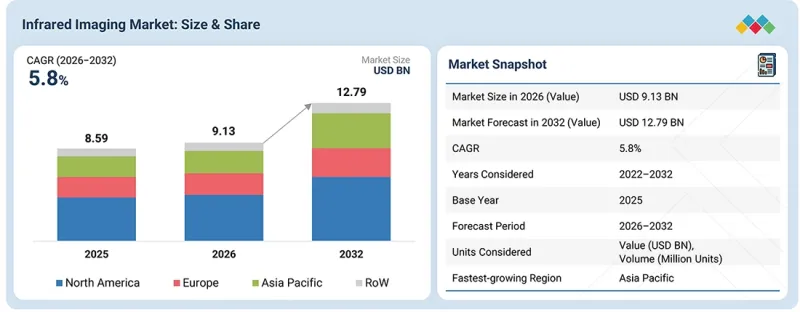
적외선 이미징 시장 규모는 2026년 91억 3,000만 달러에서 2032년에는 127억 9,000만 달러에 달할 것으로 예측되고 있으며, CAGR은 5.8%에 달할 전망입니다.
적외선 이미징 시장은 방위·항공우주, 산업 제조, 자동차, 보안·감시, 의료, 에너지·공공사업 등의 산업 분야에서 열화상, 첨단 적외선 감지 기술, 지능형 감시 솔루션의 도입이 확대되고 있는 것을 배경으로, 예측 기간 중 강력한 성장을 이룰 것으로 전망됩니다.
| 조사 범위 | |
|---|---|
| 조사 대상 기간 | 2022-2032년 |
| 기준연도 | 2025년 |
| 예측 기간 | 2026-2032년 |
| 단위 | 금액(달러) |
| 부문 | 유형, 컴포넌트, 기술, 파장, 용도, 업계, 지역별 |
| 대상 지역 | 북미, 유럽, 아시아태평양, 기타 지역 |
조직들이 설비의 신뢰성, 운영상의 안전성, 위협 탐지, 검사 효율 향상에 지속적으로 주력함에 따라 적외선 이미징 시스템에 대한 수요가 크게 증가하고 있습니다. 이러한 시스템은 열 이상 감지, 설비 상태 모니터링, 감시 및 정찰 지원, 저조도 및 가혹한 환경 조건에서의 영상 획득에 있으며, 매우 중요한 역할을 하고 있습니다. 각 제조사는 탐지 정확도, 실시간 모니터링, 시스템 성능을 향상시키기 위해 고해상도 열화상 카메라, 비냉각형 적외선 검출기, 소형 이미징 모듈, AI 기반 영상 분석 기술의 도입을 추진하고 있습니다.
또한 국방력 현대화, 산업 자동화, 예측 유지보수, 자율 시스템, 스마트 인프라, 첨단 제조에 대한 투자 확대가 시장내 보급을 가속화하고 있습니다. 상황 인식 향상, 장비 가동 중단 시간 단축, 검사 능력 강화, 그리고 신뢰성이 높은 비접촉 모니터링과 같은 장기적인 이점으로 인해 적외선 이미징은 현대의 산업, 국방 및 상업 분야에서 필수적인 기술이 되었습니다.
"용도별로는 보안·감시 분야가 예측 기간 중 가장 큰 시장 점유율을 차지할 것으로 전망됩니다."
보안 및 감시 용도는 저조도나 가혹한 환경 조건 하에서의 지속적인 감시, 주변 경비, 국경 경비, 위협 탐지에 대한 수요가 증가하고 있으며, 예측 기간 중 가장 큰 시장 점유율을 차지할 것으로 예상됩니다.
적외선 이미징 시스템은 공항, 중요 인프라, 산업 시설, 국경, 연안 지역, 기밀성이 높은 시설에서 널리 활용되고 있습니다. 이는 열화상 카메라가 완전한 어둠 속에서도 사람이나 차량을 감지할 수 있고, 연기, 안개, 짙은 안개 등의 조건에서도 가시성을 유지할 수 있기 때문입니다. 또한 추가 조명이 필요 없이 연중무휴 24시간 감시가 가능하다는 점 덕분에 주변 감시 및 정보 수집 용도에 매우 적합합니다. 네트워크 접속형 열화상 카메라, AI를 활용한 영상 분석, 통합형 적외선 감시 시스템의 도입 확대도 수요를 더욱 부추기고 있습니다.
또한 국경 경비, 중요 인프라 보안, 공공안전, 국방 현대화에 대한 투자 증가로 인해 적외선 이미징 솔루션의 도입이 가속화될 것으로 예상됩니다. 이에 따라 전천후 고신뢰성 감시 및 고도화된 상황 인식에 대한 수요가 증가함에 따라 전 세계 적외선 이미징 시장의 보안·감시 부문 1위 자리를 계속해서 지탱할 것으로 전망됩니다.
"기술별로는 비냉각형 부문이 예측 기간 중 가장 큰 시장 점유율을 차지할 전망입니다."
비냉각형 적외선 이미징 시스템은 냉각형 적외선 시스템에 비해 컴팩트한 크기, 낮은 전력 소비, 비용 효율성, 단순한 시스템 아키텍처를 갖추고 있으며, 적외선 이미징 시장에서 가장 큰 점유율을 차지할 것으로 예상됩니다. 주로 마이크로볼로미터 기술을 기반으로 하는 비냉각형 검출기는 극저온 냉각이 필요하지 않고, 주변 온도 또는 그와 유사한 온도에서 작동하므로 콤팩트하고 휴대 가능한 열화상 솔루션에 적합합니다. 이러한 시스템은 보안 및 감시, 산업 검사, 예측 유지보수, 자동차용 야시, 건물 진단, 국방, 그리고 신뢰성 높은 열 감지 및 지속적인 모니터링이 요구되는 기타 용도에 널리 도입되고 있습니다. 크기, 무게, 전력 소비, 비용의 감소로 인해 상업, 산업, 군사 용도로 폭넓게 도입될 수 있게 되었습니다.
또한 마이크로볼로미터 소재, 초점면 어레이, 픽셀 피치의 미세화, CMOS 호환 제조 기술의 발전으로 인해 영상 해상도, 감도, 가성비가 향상되고 있습니다. 스마트 감시 기술, 산업 자동화, 자율 시스템, 첨단 상태 모니터링 솔루션에 대한 투자 확대에 따라 전 세계 적외선 이미징 시장에서 비냉각 부문이 차지하는 상당한 시장 점유율이 더욱 강화될 것으로 예상됩니다.
"아시아태평양이 예측 기간 중 가장 빠르게 성장할 지역이 될 전망"
이는 중국, 인도, 일본, 한국 등 주요 경제권에서의 급속한 산업화, 제조 활동의 확대, 국방비 증가, 첨단 센싱·이미징 기술에 대한 투자 확대에 힘입은 결과입니다. 이 지역의 강력한 전자 및 반도체 제조 기반에 더해, 산업 자동화, 예측 유지보수, 열화상 감시, 자동차 안전 시스템의 도입 확대 또한 적외선 이미징 솔루션에 대한 수요를 크게 끌어올리고 있습니다. 방위 감시, 국경 경비, 스마트 시티, 산업용 검사, 자율 시스템 분야에서 열화상 기술의 도입 확대가 시장 성장을 더욱 가속화하고 있습니다. 또한 반도체 생산, 스마트 인프라, 첨단 제조, AI를 활용한 모니터링에 대한 투자도 적외선 이미징 공급업체들에게 새로운 기회를 창출하고 있습니다.
이 보고서에서는 전 세계 적외선 이미징 시장을 조사하여, 시장 개요, 시장 성장에 영향을 미치는 각종 요인 분석, 기술 및 특허 동향, 법규제 환경, 사례 연구, 시장 규모 추이 및 전망, 각종 분류·지역/주요 국가별 상세 분석, 경쟁 구도, 주요 기업 개요 등을 종합적으로 다루고 있습니다.
자주 묻는 질문
목차
제1장 서론
제2장 개요
제3장 주요 인사이트
제4장 시장 개요
제5장 업계 동향
제6장 기술의 진보, AI의 영향, 특허, 혁신
제7장 규제 상황
제8장 고객 상황과 구매 행동
제9장 적외선 이미징 시장 : 제공별(정성 분석)
제10장 적외선 이미징 시장 : 유형별
제11장 적외선 이미징 시장 : 컴포넌트별
제12장 적외선 이미징 시장 : 기술별
제13장 적외선 이미징 시장 : 파장별
제14장 적외선 이미징 시장 : 용도별
제15장 적외선 이미징 시장 : 업계별
제16장 적외선 이미징 시장 : 지역별
제17장 경쟁 구도
제18장 기업 개요
제19장 조사 방법
제20장 부록
KSA 26.10.01According to MarketsandMarkets, the infrared imaging market is projected to reach USD 12.79 billion by 2032 from USD 9.13 billion in 2026, at a CAGR of 5.8%. The infrared imaging market is projected to witness strong growth during the forecast period, driven by the increasing adoption of thermal imaging, advanced infrared sensing technologies, and intelligent monitoring solutions across industries such as defense & aerospace, industrial manufacturing, automotive, security & surveillance, healthcare, and energy & utilities.
| Scope of the Report | |
|---|---|
| Years Considered for the Study | 2022-2032 |
| Base Year | 2025 |
| Forecast Period | 2026-2032 |
| Units Considered | Value (USD Billion) |
| Segments | By Type, Component, Technology, Wavelength, Application, Vertical, Region |
| Regions covered | North America, Europe, APAC, RoW |
As organizations continue to focus on improving equipment reliability, operational safety, threat detection, and inspection efficiency, demand for infrared imaging systems is increasing significantly. These systems play a critical role in detecting thermal anomalies, monitoring equipment conditions, supporting surveillance and reconnaissance, and enabling imaging in low-light or challenging environmental conditions. Manufacturers are increasingly introducing high-resolution thermal cameras, uncooled infrared detectors, compact imaging modules, and AI-enabled image analytics to improve detection accuracy, real-time monitoring, and system performance. Additionally, growing investments in defense modernization, industrial automation, predictive maintenance, autonomous systems, smart infrastructure, and advanced manufacturing are accelerating market adoption. The long-term benefits of improved situational awareness, reduced equipment downtime, enhanced inspection capabilities, and reliable non-contact monitoring make infrared imaging an essential technology across modern industrial, defense, and commercial applications.
"By application, the security & surveillance segment is expected to capture the largest market share throughout forecast period"
Security & surveillance applications are expected to account for the largest market share during the forecast period due to the increasing demand for continuous monitoring, perimeter protection, border security, and threat detection in low-light and challenging environmental conditions. Infrared imaging systems are widely used across airports, critical infrastructure, industrial facilities, borders, coastlines, and sensitive sites because thermal cameras can detect people and vehicles in complete darkness and maintain visibility in conditions such as smoke, fog, and haze. Their ability to provide 24/7 monitoring without requiring additional illumination makes them highly suitable for perimeter surveillance and intelligence-gathering applications. The growing adoption of networked thermal cameras, AI-enabled video analytics, and integrated infrared surveillance systems is further strengthening demand. Additionally, increasing investments in border protection, critical infrastructure security, public safety, and defense modernization are expected to accelerate the deployment of infrared imaging solutions. The growing need for reliable, all-weather surveillance and enhanced situational awareness is, therefore, expected to support the continued dominance of the security & surveillance segment in the global infrared imaging market.
"By technology, the uncooled segment is likely to capture largest market share throughout forecast period"
Uncooled infrared imaging systems are expected to capture the largest share of the infrared imaging market due to their compact size, lower power consumption, cost efficiency, and simpler system architecture compared to cooled infrared systems. Uncooled detectors, primarily based on microbolometer technology, operate at or near ambient temperature without requiring cryogenic cooling, making them suitable for compact and portable thermal imaging solutions. These systems are widely deployed across security & surveillance, industrial inspection, predictive maintenance, automotive night vision, building diagnostics, defense, and other applications where reliable thermal detection and continuous monitoring are required. Their reduced size, weight, power consumption, and cost support broader deployment across commercial, industrial, and military applications. Furthermore, advancements in microbolometer materials, focal plane arrays, smaller pixel pitches, and CMOS-compatible manufacturing are improving image resolution, sensitivity, and affordability. The increasing investments in smart surveillance technologies, industrial automation, autonomous systems, and advanced condition-monitoring solutions are anticipated to bolster further the substantial market share held by the uncooled segment within the global infrared imaging market.
"Asia Pacific to be fastest-growing region in the infrared imaging market during the forecast period"
Asia Pacific is projected to be the fastest-growing region in the infrared imaging market during the forecast period, driven by rapid industrialization, expanding manufacturing activities, rising defense expenditures, and increasing investments in advanced sensing and imaging technologies across key economies such as China, India, Japan, and South Korea. The region's strong electronics and semiconductor manufacturing base, coupled with growing adoption of industrial automation, predictive maintenance, thermal surveillance, and automotive safety systems, is significantly boosting demand for infrared imaging solutions. Rising deployment of thermal imaging in defense surveillance, border security, smart cities, industrial inspection, and autonomous systems is further accelerating market growth. Additionally, investments in semiconductor production, smart infrastructure, advanced manufacturing, and AI-enabled monitoring are creating new opportunities for infrared imaging providers.
Breakdown of Primaries
A variety of executives from key organizations operating in the infrared imaging market were interviewed in-depth, including CEOs, marketing directors, and innovation and technology directors.
- By Company Type: Tier 1 - 38%, Tier 2 - 28%, and Tier 3 - 34%
- By Designation: C-level Executives - 40%, Directors - 30%, and Others - 30%
- By Region: North America - 35%, Europe - 35, Asia Pacific - 20%, and RoW - 10%
Note: The RoW region includes the Middle East, Africa, and South America. Other designations include product, sales, and marketing managers. Three tiers of companies have been defined based on their total revenues as of 2025: Tier 3: revenue less than USD 100 million; Tier 2: revenue between USD 100 million and USD 1 billion; and Tier 1: revenue more than USD 1 billion.
Major players profiled in this report are as follows: Teledyne FLIR LLC (US), Hikvision Digital Technology Co., Ltd. (China), Fluke Corporation (US), Leonardo DRS (US), Axis Communications AB (Sweden), RTX Corporation (US), L3Harris Technologies (US), EXOSENS (France), OPGAL (Israel), and LYNRED (France), among others.
These companies compete by continuously enhancing infrared imaging performance, focusing on improved thermal sensitivity, image resolution, detection range, portability, and integration capabilities across diverse applications. Strategic emphasis is placed on developing advanced infrared cameras and imaging systems incorporating cooled and uncooled detectors, AI-enabled image analytics, multispectral sensing, digital image processing, and compact imaging modules. Market participants prioritize high-performance solutions tailored for industries such as defense & aerospace, security & surveillance, industrial inspection, automotive, energy & utilities, and healthcare. Strong focus is also placed on improving low-light visibility, thermal anomaly detection, predictive maintenance, situational awareness, and seamless integration with autonomous and digital monitoring systems. Continued investments in sensor miniaturization, advanced detector materials, AI, edge computing, SWIR/MWIR/LWIR technologies, and next-generation thermal imaging platforms, along with collaborations with OEMs, system integrators, defense organizations, and end users, are expected to strengthen competition and accelerate the adoption of infrared imaging solutions globally.
The study provides a detailed competitive analysis of these key players in the market, presenting their company profiles, recent developments, product portfolios, technological capabilities, and key market strategies.
Research Coverage
This report on the infrared imaging market presents a detailed analysis based on type, component, wavelength, application, technology, vertical, and region. By type, the market is segmented into reflective and thermal. By component, it is segmented into cameras, scopes, and modules. By wavelength, the market includes NIR, SWIR, MWIR and LWIR. By technology, it is classified into cooled and uncooled. By vertical, the market covers industrial and non-industrial. The market based on application is segmented into security & surveillance, monitoring & inspection, and detection. The regional analysis includes North America, Europe, Asia Pacific, and RoW, enabling evaluation of demand patterns, growth drivers, and industry trends.
Reasons to Buy the Report
The report will help the leaders/new entrants in this market with information on the closest approximations of the revenue numbers for the overall market and the subsegments. This report will help stakeholders understand the competitive landscape and gain more insights to position their businesses better and plan suitable go-to-market strategies. The report also helps stakeholders understand the infrared imaging market's pulse and provides information on key market drivers, restraints, challenges, and opportunities.
Key Benefits of Buying the Report
- Analysis of key drivers (Increasing use of infrared imaging products in security & surveillance applications, Rising adoption of infrared cameras in quality control and inspection applications), restraints (Stringent import and export regulations for selling infrared cameras in US, Limitations associated with image resolution and sensitivity of infrared cameras), opportunities (Emerging applications of IR imaging technology in automotive sector, Newer application areas of SWIR cameras), and challenges (High cost associated with infrared cameras, and Designing highly accurate IR imaging products) influencing the growth of the infrared imaging market
- Product Development/Innovation: Detailed insights on upcoming technologies, research & development activities, and product launches in the infrared imaging market
- Market Development: Comprehensive information about lucrative markets by analyzing the infrared imaging market across varied regions
- Market Diversification: Exhaustive information about new products/services, untapped geographies, recent developments, and investments in the infrared imaging market
- Competitive Assessment: In-depth assessment of market shares, growth strategies, and service offerings of leading players such as Teledyne FLIR LLC (US), Hikvision Digital Technology Co., Ltd. (China), Fluke Corporation (US), Leonardo DRS (US), Axis Communications AB (Sweden), RTX Corporation (US), L3Harris Technologies (US), EXOSENS (France), OPGAL (Israel), and LYNRED (France), among others.
TABLE OF CONTENTS
1 INTRODUCTION
- 1.1 STUDY OBJECTIVES
- 1.2 MARKET DEFINITION
- 1.3 MARKET SCOPE
- 1.3.1 MARKET SEGMENTATION AND REGIONAL SCOPE
- 1.3.2 YEARS CONSIDERED
- 1.3.3 INCLUSIONS AND EXCLUSIONS
- 1.4 CURRENCY CONSIDERED
- 1.5 UNIT CONSIDERED
- 1.6 LIMITATIONS
- 1.7 STAKEHOLDERS
- 1.8 SUMMARY OF CHANGES
2 EXECUTIVE SUMMARY
- 2.1 MARKET HIGHLIGHTS AND KEY INSIGHTS
- 2.2 KEY MARKET PARTICIPANTS: MAPPING OF STRATEGIC DEVELOPMENTS
- 2.3 DISRUPTIVE TRENDS SHAPING INFRARED IMAGING MARKET
- 2.4 HIGH-GROWTH SEGMENTS
- 2.5 REGIONAL SNAPSHOT: MARKET SIZE, GROWTH RATE, AND FORECAST
3 PREMIUM INSIGHTS
- 3.1 ATTRACTIVE OPPORTUNITIES FOR PLAYERS IN INFRARED IMAGING MARKET
- 3.2 INFRARED IMAGING MARKET SHARE, BY TYPE
- 3.3 INFRARED IMAGING MARKET, BY COMPONENT
- 3.4 INFRARED IMAGING MARKET SHARE, BY TECHNOLOGY
- 3.5 INFRARED IMAGING MARKET, BY VERTICAL
- 3.6 INFRARED IMAGING MARKET, BY COUNTRY/REGION
4 MARKET OVERVIEW
- 4.1 INTRODUCTION
- 4.2 MARKET DYNAMICS
- 4.2.1 DRIVERS
- 4.2.1.1 Increasing use of infrared imaging products in security & surveillance applications
- 4.2.1.2 Rising adoption of infrared cameras in quality control and inspection applications
- 4.2.1.3 Growing popularity of uncooled infrared cameras
- 4.2.1.4 Increasing demand for SWIR cameras in machine vision applications
- 4.2.2 RESTRAINTS
- 4.2.2.1 Stringent import and export regulations for selling infrared cameras in US
- 4.2.2.2 Limitations associated with image resolution and sensitivity of infrared cameras
- 4.2.3 OPPORTUNITIES
- 4.2.3.1 Emerging applications of IR imaging technology in automotive sector
- 4.2.3.2 Newer application areas of SWIR cameras
- 4.2.3.3 Integration of infrared imaging technology into consumer electronics
- 4.2.4 CHALLENGES
- 4.2.4.1 High cost associated with infrared cameras
- 4.2.4.2 Designing highly accurate IR imaging products
- 4.2.4.3 Integration and compatibility challenges pertaining to infrared imaging technology
- 4.2.1 DRIVERS
- 4.3 INTERCONNECTED MARKETS AND CROSS-SECTOR OPPORTUNITIES
- 4.4 STRATEGIC MOVES BY TIER-1/2/3 PLAYERS
5 INDUSTRY TRENDS
- 5.1 PORTER'S FIVE FORCES ANALYSIS
- 5.1.1 THREAT OF NEW ENTRANTS
- 5.1.2 THREAT OF SUBSTITUTES
- 5.1.3 BARGAINING POWER OF SUPPLIERS
- 5.1.4 BARGAINING POWER OF BUYERS
- 5.1.5 INTENSITY OF COMPETITIVE RIVALRY
- 5.2 MACROECONOMIC OUTLOOK
- 5.2.1 INTRODUCTION
- 5.2.2 GDP TRENDS AND FORECAST
- 5.2.3 TRENDS IN GLOBAL AUTOMOTIVE INDUSTRY
- 5.2.4 TRENDS IN GLOBAL MILITARY & DEFENSE INDUSTRY
- 5.3 VALUE CHAIN ANALYSIS
- 5.4 INFRARED IMAGING ECOSYSTEM
- 5.5 PRICING ANALYSIS
- 5.5.1 AVERAGE SELLING PRICE TREND OF INFRARED IMAGING CAMERAS, BY TYPE, 2022-2025
- 5.5.2 AVERAGE SELLING PRICE TREND OF INFRARED IMAGING CAMERAS, BY REGION, 2022-2025
- 5.6 TRADE ANALYSIS
- 5.6.1 IMPORT SCENARIO (HS 902750)
- 5.6.2 EXPORT SCENARIO (HS 902750)
- 5.7 KEY CONFERENCES AND EVENTS, 2026-2027
- 5.8 TRENDS/DISRUPTIONS IMPACTING CUSTOMER BUSINESS
- 5.9 INVESTMENT AND FUNDING SCENARIO
- 5.10 CASE STUDY ANALYSIS
- 5.10.1 INFRATEC SUPPORTS SEMICONDUCTOR FAILURE ANALYSIS USING INFRARED THERMOGRAPHY
- 5.10.2 TELEDYNE FLIR IMPROVES FOOD PROCESSING THROUGH THERMAL AUTOMATION
- 5.10.3 LYNRED ENABLES AUTOMOTIVE THERMAL VISION SOLUTIONS
- 5.11 IMPACT OF 2025 US TARIFF ON INFRARED IMAGING MARKET
- 5.11.1 INTRODUCTION
- 5.11.2 KEY TARIFF RATES
- 5.11.3 PRICE IMPACT ANALYSIS
- 5.11.4 IMPACT ON COUNTRIES/REGIONS
- 5.11.4.1 US
- 5.11.4.2 Europe
- 5.11.4.3 Asia Pacific
- 5.11.5 IMPACT ON INDUSTRIES
6 TECHNOLOGICAL ADVANCEMENTS, AI-DRIVEN IMPACT, PATENTS, AND INNOVATIONS
- 6.1 KEY TECHNOLOGIES
- 6.1.1 AI-ENABLED INFRARED IMAGING AND EDGE ANALYTICS
- 6.1.2 ADVANCED INFRARED DETECTOR AND SENSOR TECHNOLOGIES
- 6.2 COMPLEMENTARY TECHNOLOGIES
- 6.2.1 ARTIFICIAL INTELLIGENCE AND MACHINE LEARNING
- 6.2.2 IOT AND EDGE CONNECTIVITY PLATFORMS
- 6.3 ADJACENT TECHNOLOGIES
- 6.3.1 MULTISENSOR FUSION TECHNOLOGY
- 6.3.2 COMPUTER VISION AND IMAGE PROCESSING TECHNOLOGIES
- 6.4 TECHNOLOGY ROADMAP
- 6.5 PATENT ANALYSIS
- 6.6 IMPACT OF AI ON INFRARED IMAGING MARKET
- 6.6.1 TOP USE CASES AND MARKET POTENTIAL
- 6.6.2 BEST PRACTICES FOLLOWED BY OEMS IN INFRARED IMAGING MARKET
- 6.6.3 CASE STUDIES RELATED TO AI IMPLEMENTATION IN INFRARED IMAGING MARKET
- 6.6.4 INTERCONNECTED ECOSYSTEM AND IMPACT ON MARKET PLAYERS
- 6.6.5 CLIENTS' READINESS TO ADOPT AI-INTEGRATED INFRARED IMAGING
7 REGULATORY LANDSCAPE
- 7.1 REGIONAL REGULATIONS AND COMPLIANCE
- 7.1.1 REGULATORY BODIES, GOVERNMENT AGENCIES, AND OTHER ORGANIZATIONS
- 7.1.2 INDUSTRY STANDARDS
8 CUSTOMER LANDSCAPE AND BUYER BEHAVIOR
- 8.1 DECISION-MAKING PROCESS
- 8.2 KEY STAKEHOLDERS INVOLVED IN BUYING PROCESS AND THEIR EVALUATION CRITERIA
- 8.2.1 KEY STAKEHOLDERS IN BUYING PROCESS
- 8.2.2 BUYING CRITERIA
- 8.3 ADOPTION BARRIERS AND INTERNAL CHALLENGES
- 8.4 UNMET NEEDS OF VARIOUS INDUSTRIES
9 INFRARED IMAGING MARKET, BY OFFERING (QUALITATIVE)
- 9.1 INTRODUCTION
- 9.2 INFRARED DETECTORS
- 9.3 OPTICS AND LENSES
- 9.4 ELECTRONICS AND PROCESSORS
- 9.5 SOFTWARE AND ANALYTICS PLATFORMS
10 INFRARED IMAGING MARKET, BY TYPE
- 10.1 INTRODUCTION
- 10.2 REFLECTIVE
- 10.2.1 RISING USE IN SEMICONDUCTOR INSPECTION AND SECURITY APPLICATIONS TO SUPPORT MARKET GROWTH
- 10.3 THERMAL
- 10.3.1 PRESSING NEED FOR ENHANCED SAFETY AND OPERATIONAL EFFICIENCY ACROSS INDUSTRIES TO BOOST DEMAND
11 INFRARED IMAGING MARKET, BY COMPONENT
- 11.1 INTRODUCTION
- 11.2 CAMERAS
- 11.2.1 SIGNIFICANT USE IN PUBLIC SAFETY, MEDICAL, AND INDUSTRIAL APPLICATIONS TO FUEL SEGMENTAL GROWTH
- 11.3 SCOPES
- 11.3.1 DEFENSE, OUTDOOR SPORTS, AND TACTICAL SURVEILLANCE APPLICATIONS TO CONTRIBUTE TO SEGMENTAL GROWTH
- 11.4 MODULES
- 11.4.1 RISING USE OF MODULAR INFRARED IMAGING SYSTEMS IN DRONES, ROBOTICS, AND SMART DEVICES TO FOSTER SEGMENTAL GROWTH
12 INFRARED IMAGING MARKET, BY TECHNOLOGY
- 12.1 INTRODUCTION
- 12.2 COOLED INFRARED IMAGING
- 12.2.1 NEED TO REDUCE SENSOR NOISE AND IMPROVE SENSITIVITY TO ENCOURAGE ADOPTION
- 12.3 UNCOOLED INFRARED IMAGING
- 12.3.1 INCREASING ADOPTION IN HIGH-VOLUME APPLICATIONS OWING TO LOW COST AND EASY INSTALLATION TO FOSTER SEGMENTAL GROWTH
13 INFRARED IMAGING MARKET, BY WAVELENGTH
- 13.1 INTRODUCTION
- 13.2 NIR
- 13.2.1 HIGH ADOPTION OF NIR CCTV CAMERAS FOR SECURITY & SURVEILLANCE TO DRIVE MARKET
- 13.3 SWIR
- 13.3.1 INCREASED USE OF SWIR IMAGING TECHNOLOGY IN NON-DESTRUCTIVE TESTING TO PROPEL MARKET
- 13.4 MWIR
- 13.4.1 RAPID TECHNOLOGICAL ADVANCEMENTS IN MWIR TO BOOST SEGMENTAL GROWTH
- 13.5 LWIR
- 13.5.1 SIGNIFICANT USE IN WEARABLES, DRONES, AND HANDHELD DEVICES TO FUEL SEGMENTAL GROWTH
14 INFRARED IMAGING MARKET, BY APPLICATION
- 14.1 INTRODUCTION
- 14.2 SECURITY & SURVEILLANCE
- 14.2.1 SURGING DEPLOYMENT OF INFRARED CAMERAS DUE TO INCREASED TERRORISM TO DRIVE MARKET
- 14.3 MONITORING & INSPECTION
- 14.3.1 RISING USE OF INFRARED CAMERAS IN ENERGY AUDITS, BUILDING DIAGNOSTICS, AND INDUSTRIAL FAULT DETECTION TO PROPEL MARKET
- 14.4 DETECTION
- 14.4.1 INCREASING IMPORTANCE OF SITUATIONAL AWARENESS TO DRIVE DEMAND
15 INFRARED IMAGING MARKET, BY VERTICAL
- 15.1 INTRODUCTION
- 15.2 INDUSTRIAL
- 15.2.1 ELEVATING USE OF SWIR CAMERAS TO ENSURE PRECISION IN GLASS, SEMICONDUCTOR, AND METAL PROCESSING TO FAVOR MARKET GROWTH
- 15.3 NON-INDUSTRIAL
- 15.3.1 RISING ADOPTION IN PUBLIC SAFETY, RESEARCH, AND HEALTHCARE TO PROPEL MARKET
16 INFRARED IMAGING MARKET, BY REGION
- 16.1 INTRODUCTION
- 16.2 NORTH AMERICA
- 16.2.1 US
- 16.2.1.1 Government focus on safety and security of country to fuel market growth
- 16.2.2 CANADA
- 16.2.2.1 Growing focus on safeguarding assets and ensuring public safety to boost demand
- 16.2.3 MEXICO
- 16.2.3.1 Increasing challenges related to border security, drug trafficking, and organized crime to increase demand
- 16.2.1 US
- 16.3 EUROPE
- 16.3.1 UK
- 16.3.1.1 Medical and pharmaceutical companies to contribute most to market growth
- 16.3.2 GERMANY
- 16.3.2.1 Booming automotive sector to accelerate demand
- 16.3.3 FRANCE
- 16.3.3.1 Technology advancements in automotive sector to propel market growth
- 16.3.4 ITALY
- 16.3.4.1 Government focus on strengthening military surveillance capabilities to propel market
- 16.3.5 REST OF EUROPE
- 16.3.1 UK
- 16.4 ASIA PACIFIC
- 16.4.1 CHINA
- 16.4.1.1 Border control, critical infrastructure protection, and public safety applications to create opportunities
- 16.4.2 JAPAN
- 16.4.2.1 Consumer electronics, automotive, and healthcare sectors to strengthen market momentum
- 16.4.3 INDIA
- 16.4.3.1 Increasing use in predictive maintenance and quality control applications by industry players to support market growth
- 16.4.4 REST OF ASIA PACIFIC
- 16.4.1 CHINA
- 16.5 ROW
- 16.5.1 SOUTH AMERICA
- 16.5.1.1 BRAZIL
- 16.5.1.1.1 Rising adoption across security, agriculture, and energy to drive market
- 16.5.1.2 REST OF SOUTH AMERICA
- 16.5.1.1 BRAZIL
- 16.5.2 MIDDLE EAST
- 16.5.2.1 Rising defense spending and infrastructure development to accelerate market growth
- 16.5.3 AFRICA
- 16.5.3.1 Increasing security investments and industrial applications to drive adoption
- 16.5.1 SOUTH AMERICA
17 COMPETITIVE LANDSCAPE
- 17.1 OVERVIEW
- 17.2 KEY PLAYER STRATEGIES/RIGHT TO WIN, JANUARY 2023-AUGUST 2026
- 17.3 REVENUE ANALYSIS, 2021-2025
- 17.4 MARKET SHARE ANALYSIS, 2025
- 17.5 COMPANY VALUATION AND FINANCIAL METRICS, 2025
- 17.6 BRAND COMPARISON
- 17.7 COMPANY EVALUATION MATRIX: KEY PLAYERS, 2025
- 17.7.1 STARS
- 17.7.2 EMERGING LEADERS
- 17.7.3 PERVASIVE PLAYERS
- 17.7.4 PARTICIPANTS
- 17.7.5 COMPANY FOOTPRINT: KEY PLAYERS, 2025
- 17.7.5.1 Company footprint
- 17.7.5.2 Region footprint
- 17.7.5.3 Type footprint
- 17.7.5.4 Application footprint
- 17.7.5.5 Vertical footprint
- 17.8 COMPANY EVALUATION MATRIX: STARTUPS/SMES, 2025
- 17.8.1 PROGRESSIVE COMPANIES
- 17.8.2 RESPONSIVE COMPANIES
- 17.8.3 DYNAMIC COMPANIES
- 17.8.4 STARTING BLOCKS
- 17.8.5 COMPETITIVE BENCHMARKING: STARTUPS/SMES, 2025
- 17.8.5.1 Detailed list of key startups/SMEs
- 17.8.5.2 Competitive benchmarking of key startups/SMEs
- 17.9 COMPETITIVE SCENARIO
- 17.9.1 PRODUCT LAUNCHES
- 17.9.2 DEALS
- 17.9.3 EXPANSIONS
18 COMPANY PROFILES
- 18.1 KEY PLAYERS
- 18.1.1 TELEDYNE FLIR LLC
- 18.1.1.1 Business overview
- 18.1.1.2 Products/Services/Solutions offered
- 18.1.1.3 Recent developments
- 18.1.1.3.1 Product launches
- 18.1.1.3.2 Deals
- 18.1.1.3.3 Other developments
- 18.1.1.4 MnM view
- 18.1.1.4.1 Key strengths/Right to win
- 18.1.1.4.2 Strategic choices
- 18.1.1.4.3 Weaknesses/Competitive threats
- 18.1.2 HIKVISION DIGITAL TECHNOLOGY CO., LTD.
- 18.1.2.1 Business overview
- 18.1.2.2 Products/Services/Solutions offered
- 18.1.2.3 Recent developments
- 18.1.2.3.1 Product launches
- 18.1.2.3.2 Deals
- 18.1.2.4 MnM view
- 18.1.2.4.1 Key strengths/Right to win
- 18.1.2.4.2 Strategic choices
- 18.1.2.4.3 Weaknesses/Competitive threats
- 18.1.3 FLUKE CORPORATION
- 18.1.3.1 Business overview
- 18.1.3.2 Products/Services/Solutions offered
- 18.1.3.3 Recent developments
- 18.1.3.3.1 Product launches
- 18.1.3.4 MnM view
- 18.1.3.4.1 Key strengths/Right to win
- 18.1.3.4.2 Strategic choices
- 18.1.3.4.3 Weaknesses/Competitive threats
- 18.1.4 AXIS COMMUNICATIONS AB
- 18.1.4.1 Business overview
- 18.1.4.2 Products/Services/Solutions offered
- 18.1.4.3 Recent developments
- 18.1.4.3.1 Product launches
- 18.1.4.3.2 Deals
- 18.1.4.4 MnM view
- 18.1.4.4.1 Key strengths/Right to win
- 18.1.4.4.2 Strategic choices
- 18.1.4.4.3 Weaknesses/Competitive threats
- 18.1.5 RTX
- 18.1.5.1 Business overview
- 18.1.5.2 Products/Services/Solutions offered
- 18.1.5.3 Recent developments
- 18.1.5.3.1 Product launches
- 18.1.5.3.2 Deals
- 18.1.5.3.3 Expansions
- 18.1.5.4 MnM view
- 18.1.5.4.1 Key strengths/Right to win
- 18.1.5.4.2 Strategic choices
- 18.1.5.4.3 Weaknesses/Competitive threats
- 18.1.6 LEONARDO DRS
- 18.1.6.1 Business overview
- 18.1.6.2 Products/Services/Solutions offered
- 18.1.6.3 Recent developments
- 18.1.6.3.1 Product launches
- 18.1.7 L3HARRIS TECHNOLOGIES, INC.
- 18.1.7.1 Business overview
- 18.1.7.2 Products/Services/Solutions offered
- 18.1.7.3 Recent developments
- 18.1.7.3.1 Deals
- 18.1.7.3.2 Expansions
- 18.1.8 EXOSENS
- 18.1.8.1 Business overview
- 18.1.8.2 Products/Services/Solutions offered
- 18.1.8.3 Recent developments
- 18.1.8.3.1 Product launches
- 18.1.8.3.2 Deals
- 18.1.9 OPGAL
- 18.1.9.1 Business overview
- 18.1.9.2 Products/Services/Solutions offered
- 18.1.10 LYNRED
- 18.1.10.1 Business overview
- 18.1.10.2 Products/Services/Solutions offered
- 18.1.10.3 Recent developments
- 18.1.10.3.1 Product launches
- 18.1.10.3.2 Deals
- 18.1.11 ALLIED VISION TECHNOLOGIES GMBH
- 18.1.11.1 Business overview
- 18.1.11.2 Products/Services/Solutions offered
- 18.1.11.3 Recent developments
- 18.1.11.3.1 Product launches
- 18.1.12 BAE SYSTEMS
- 18.1.12.1 Business overview
- 18.1.12.2 Products/Services/Solutions offered
- 18.1.12.3 Recent developments
- 18.1.12.3.1 Product launches
- 18.1.12.3.2 Deals
- 18.1.13 TESTO SE & CO. KGAA
- 18.1.13.1 Business overview
- 18.1.13.2 Products/Services/Solutions offered
- 18.1.13.3 Recent developments
- 18.1.13.3.1 Product launches
- 18.1.1 TELEDYNE FLIR LLC
- 18.2 OTHER PLAYERS
- 18.2.1 ZHEJIANG DALI TECHNOLOGY CO., LTD.
- 18.2.2 IRCAMERAS LLC
- 18.2.3 HGH
- 18.2.4 RAPTOR PHOTONICS
- 18.2.5 EPISENSORS
- 18.2.6 INFRATEC GMBH
- 18.2.7 SIERRA-OLYMPIA TECH.
- 18.2.8 COX CO., LTD.
- 18.2.9 TONBO IMAGING
- 18.2.10 SEEK THERMAL
- 18.2.11 INFRARED CAMERAS, INC.
- 18.2.12 LAND INSTRUMENTS INTERNATIONAL LTD.
- 18.2.13 DIAS INFRARED GMBH
- 18.2.14 MOVITHERM
- 18.2.15 TEMPSENS INSTRUMENTS INDIA LIMITED
- 18.2.16 SHENZHEN HIFLY TECHNOLOGY COMPANY CO., LTD.
19 RESEARCH METHODOLOGY
- 19.1 RESEARCH DATA
- 19.1.1 SECONDARY AND PRIMARY RESEARCH
- 19.1.2 SECONDARY DATA
- 19.1.2.1 Major secondary sources
- 19.1.2.2 Secondary sources
- 19.1.3 PRIMARY DATA
- 19.1.3.1 Breakdown of primaries
- 19.1.3.2 Key data from primary sources
- 19.1.3.3 Key industry insights
- 19.2 MARKET SIZE ESTIMATION
- 19.2.1 BOTTOM-UP APPROACH
- 19.2.2 TOP-DOWN APPROACH
- 19.3 MARKET FORECAST APPROACH
- 19.3.1 SUPPLY-SIDE
- 19.3.2 DEMAND-SIDE
- 19.4 MARKET BREAKDOWN AND DATA TRIANGULATION
- 19.5 RESEARCH ASSUMPTIONS
- 19.6 RESEARCH LIMITATIONS
- 19.7 RISK ASSESSMENT
20 APPENDIX
- 20.1 DISCUSSION GUIDE
- 20.2 KNOWLEDGESTORE: MARKETSANDMARKETS' SUBSCRIPTION PORTAL
- 20.3 CUSTOMIZATION OPTIONS
- 20.4 RELATED REPORTS
- 20.5 AUTHOR DETAILS


