
|
시장보고서
상품코드
2134053
소매 분석 시장 : 제공별, 애널리틱스 유형별, 용도별, 소매업태별, 지역별 - 세계 예측(-2032년)Retail Analytics Market by Solution, Application, Retail Type, Region - Market Size, Share & Forecast to 2032 |
||||||

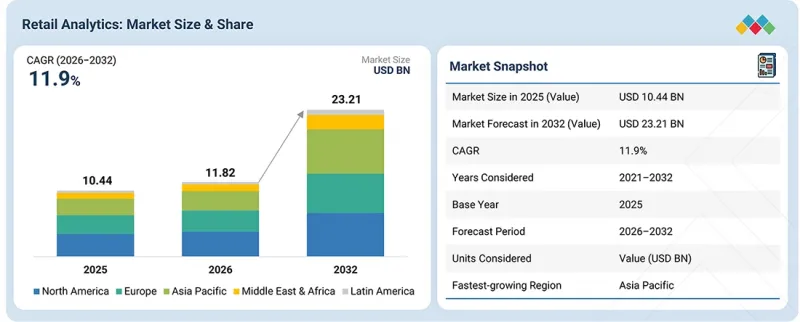
세계의 소매 분석 시장 규모는 2026년 118억 2,000만 달러에서 2032년까지 232억 1,000만 달러로 성장할 것으로 예상되며, CAGR은 11.9%에 달할 것으로 예측됩니다.
이는 AI 기반 분석, 통합된 소매 데이터 및 지능형 의사결정 기능에 대한 투자가 확대되고 있음을 반영합니다.
| 조사 범위 | |
|---|---|
| 조사 대상 기간 | 2021-2032년 |
| 기준 연도 | 2025년 |
| 예측 기간 | 2026-2032년 |
| 산정 단위 | 100만/10억 달러 |
| 부문 | 제공별, 애널리틱스 유형별, 용도별, 소매업태별, 지역별 |
| 대상 지역 | 북미, 유럽, 아시아태평양, 중동 및 아프리카, 라틴아메리카 |
소매업체들은 연결된 시스템 간에 거래, 재고, 가격 책정, 상품 진열, 로열티, E-Commerce, 공급망 정보를 통합하는 추세가 강해지고 있습니다. 고급 분석은 수요 예측, 상품 구성 최적화, 고객 세분화, 가격 책정 인텔리전스, 재고 보충 계획 및 매장 실적 향상을 지원합니다. 머신러닝은 과거 매출, 프로모션, 계절성, 재고 현황 및 외부 신호를 분석하여 예측 정확도를 향상시킵니다.
기업들은 POS, E-Commerce, 로열티, 공급업체, 주문 처리 데이터를 통합하여 옴니채널의 가시성과 대응력을 높이고 있습니다. 실시간 분석을 통해 소매업체는 수요 변화, 재고 불균형, 운영상의 예외 사항 및 고객 행동 변화를 신속하게 감지할 수 있게 됩니다. 클라우드 기반 아키텍처는 대규모 데이터 처리를 간소화하는 동시에, 분산된 소매 업무 및 채널 전반에 걸쳐 더 신속한 인사이트 확보를 가능하게 합니다. AI를 활용한 추천 기능은 자동 가격 책정, 재고 배분, 프로모션 최적화, 지역에 맞춘 상품 전개 및 전사적인 소매 의사결정을 지원합니다.
소매 분석 시장의 각 벤더들은 AI 기반 분석과 통합 데이터 플랫폼을 통해 경쟁력을 강화하고 있습니다. 최신 솔루션은 기술적, 예측적, 처방적 분석을 결합하여 상품 구성, 가격 책정, 재고 관리 및 고객 관련 의사결정을 개선합니다. Oracle은 소매 데이터와 머신러닝을 통합하여 수요 예측, 상품 구성, 가격 책정, 재고 관리 및 소비자 인사이트를 지원합니다. 마이크로소프트는 연계된 소매 환경 전반에 걸쳐 실시간 분석, 예측 분석, 상품 구성 최적화 및 재고 인텔리전스를 결합하고 있습니다. 세일즈포스는 통합된 상거래 데이터, 성과 분석, 고객 인사이트, AI 기반 운영 권장 사항을 통해 소매업체를 지원합니다. 이러한 플랫폼은 매장, E-Commerce, 공급망, 로열티 프로그램 및 기업 애플리케이션 전반에 걸친 소매 정보의 동기화를 점점 더 촉진하고 있습니다. 또한 각 벤더들은 대화형 분석, 자율형 에이전트, 클라우드 간 상호 운용성 및 워크플로 자동화를 추진하여 소매 분야의 의사결정 속도를 높이고 있습니다. 이러한 발전으로 인해 전 세계 소매 기업에서 확장성, 운영 유연성, 데이터 접근성, 의사결정의 일관성 및 도입이 확대되고 있습니다.
“소매업체들이 업무 전반에 걸친 지능적이고 자율적인 의사결정 워크플로우를 우선시함에 따라, 자율형 및 에이전트형 분석이 급속히 확대되고 있습니다.”
소매업체들이 업무 전반에 걸쳐 지능적이고 자율적인 의사결정 워크플로우를 우선시함에 따라, 자율형 및 에이전트형 분석은 급속히 확대되고 있습니다. 소매업체들은 상황을 해석하고, 조치를 권장하며, 비즈니스 기능 전반에 걸쳐 의사결정을 자동화하는 분석 플랫폼을 점점 더 필요로 하고 있습니다. 에이전트형 시스템은 신뢰할 수 있는 기업 데이터를 자동 추론 및 업무 워크플로우와 연계함으로써 기존 분석을 확장합니다. 세일즈포스는 신뢰할 수 있는 인사이트, 대화형 탐색, 선제적 추천, 자율적인 비즈니스 조치를 핵심으로 에이전트형 애널리틱스를 포지셔닝하고 있습니다. 이러한 기능을 통해 소매업체는 실적 이상을 조사하고, 새로운 동향을 파악하며, 분석으로 인한 장시간의 지연 없이 대응할 수 있습니다. NRF는 생산성, 인사이트 및 업무 수행 능력 향상을 목표로 하는 AI 에이전트에 대한 소매업체의 관심이 높아지고 있음을 강조하고 있습니다. 소매 업계에서의 도입은 머천다이징, 재고 관리, 고객 참여, 커머스, 공급망 의사결정 프로세스에 걸쳐 확대되고 있습니다. 자율형 분석은 비즈니스 지표를 지속적으로 모니터링하고, 예외 사항을 감지하며, 대안을 평가하고, 미리 정의된 운영 대응 조치를 시작할 수 있습니다. 이를 통해 소매업체는 정적인 대시보드에 대한 의존도를 낮추면서 관리자 및 현장 팀 전체에 분석에 대한 접근성을 확대할 수 있습니다. 각 벤더사는 생성형 인터페이스, 시맨틱 인텔리전스, 모니터링, 자동화, 거버넌스를 최신 분석 플랫폼에 통합하고 있습니다. 이러한 추세에 따라 자율형 및 에이전트형 분석은 현대 소매 기업에서 급속히 확대되고 있는 카테고리로서의 입지를 확고히 하고 있습니다.
“소매업체들이 실시간 실행을 우선시함에 따라, 2026년에는 운영 및 공급망 애플리케이션이 시장을 주도할 전망입니다.”
소매업체들이 실행 효율성을 중시함에 따라, 운영 및 공급망 애플리케이션이 소매 분석을 주도할 것으로 예상됩니다. 소매업체들은 복잡한 운영 네트워크 전반에 걸친 수요, 재고, 보충, 주문 처리, 운송 및 매장 정보를 지속적으로 분석하고 있습니다. 이러한 애플리케이션은 상품 가용성, 운전 자본, 서비스 수준, 노동 생산성 및 주문 처리 성과에 영향을 미치는 의사결정을 지원합니다. Oracle은 수요 예측, 재고 최적화, 배분, 보충 및 공급망 리스크 관리를 위한 소매 분석에 중점을 두고 있습니다. ‘재고 계획 최적화’는 소매 네트워크 전반에 걸친 수요 예측, 최적화된 배분 및 시간 축에 따른 재고 계획을 생성합니다. 소매업체는 이러한 기능을 활용하여 변화하는 수요에 대응하면서 재고 배치와 상품 가용성을 향상시킵니다. 또한, 운영 분석은 매장, E-Commerce 수요, 창고, 고객 주문을 연계함으로써 옴니채널 주문 처리도 지원합니다. 블루 용더는 점점 더 복잡해지는 소매 공급망 환경에서 예측 인텔리전스와 신속한 의사결정을 강조하고 있습니다. 이러한 요건들이 주문 관리, 주문 이행 조정, 운송, 재고 가시화 및 운영 계획에 대한 수요를 주도하고 있습니다. 공급망의 혼란은 이익률, 재고 가용성, 고객 만족도에 직접적인 영향을 미치기 때문에 소매업체들은 지속적인 분석에 대한 필요성을 점점 더 느끼고 있습니다. 그 결과, 2026년에도 복잡한 옴니채널 소매 환경에서의 분석 투자 중심은 여전히 운영 및 공급망 애플리케이션이 차지할 것입니다.
“북미는 성숙한 디지털 인프라와 도입 현황 덕분에 2026년에도 소매 분석 시장에서 가장 큰 규모를 유지할 것입니다.”
북미는 성숙한 디지털 소매 인프라에 힘입어 2026년에도 계속해서 최대 규모의 소매 분석 시장이 될 것입니다. 소매업체들은 채널 전반에 걸쳐 상품 구성, 재고, 가격 책정, 고객 참여 및 운영상의 의사결정을 위해 분석을 점점 더 많이 도입하고 있습니다. E-Commerce의 확산에 따라 지속적인 분석 처리가 필요한 거래, 행동, 주문 처리, 재고와 관련된 방대한 데이터가 생성되고 있습니다. 클라우드 도입을 통해 소매업체는 매장, 디지털 채널, 창고 및 기업 애플리케이션 전반에 걸쳐 분석 플랫폼을 확장할 수 있게 되었습니다. 인공지능(AI)은 소매 업계 전반에 걸쳐 수요 예측, 개인화, 재고 최적화, 이상 탐지 및 자동화된 의사결정 지원 기능을 강화하고 있습니다. 미국의 소매업체들은 생산성, 분석적 인사이트 및 업무 수행 능력을 대폭 개선하기 위해 에이전틱 AI 도입을 가속화하고 있습니다. 이 지역은 막대한 기술 투자와 주요 클라우드 및 분석 제공업체의 존재라는 이점을 누리고 있습니다. 이러한 요인들로 인해 예측 기간 동안 북미는 전 세계 소매 분석 시장에서 주도적인 입지를 공고히 할 것입니다.
“아시아태평양은 E-Commerce의 확대와 디지털화에 힘입어 소매 분석 시장에서 가장 빠른 성장을 이룰 것으로 예상됩니다.”
아시아태평양은 디지털 상거래의 확대와 기술 투자를 바탕으로 소매 분석 분야에서 가장 빠르게 성장하고 있는 지역입니다. E-Commerce의 급속한 성장으로 인해 상호연결성이 점점 더 강화되는 소매업체들 사이에서 거래, 재고, 고객, 주문 처리, 마켓플레이스에 관한 데이터세트가 확대되고 있습니다. 모바일 우선 구매 행동과 디지털 결제의 보급으로 인해, 다양한 고객 여정 전반에 걸친 실시간 분석에 대한 수요가 더욱 높아지고 있습니다. 중국, 인도, 일본, 한국 및 동남아시아의 소매업체들은 분석 역량의 현대화를 추진하고 있습니다. 클라우드로의 전환을 통해 사업 전반에 걸친 상품 전개, 고객, 재고, 가격 책정 및 공급망 정보를 확장 가능하게 처리할 수 있게 됩니다. 인공지능(AI) 도입을 통해 지역별 수요 예측, 추천, 개인화, 상품 구성 최적화 및 소매 분야의 자동화된 의사결정 능력이 강화됩니다. 지역 소매업체들은 매장 생산성, 재고 가용성, 가격 책정 및 옴니채널 주문 이행 성과를 향상시키기 위해 분석 도구를 점점 더 많이 활용하고 있습니다. 아시아개발은행(ADB)에 따르면, 아시아태평양은 전 세계 E-Commerce 매출의 약 3분의 2를 차지하고 있습니다. 이처럼 확대되는 디지털 경제는 방대한 양의 데이터를 생성하고 있으며, 이에 따라 더욱 견고한 분석 인프라, 거버넌스, 의사결정 인텔리전스가 요구되고 있습니다. 전미소매협회(NRF)는 소매 분석,유통, 수익성 및 매장 내 혁신 과제를 해결하는 아시아태평양에서 부상하고 있는 기술을 파악하고 있습니다. 이러한 동향에 힘입어 아시아태평양은 예측 기간 동안 가장 빠르게 성장하는 지역별 소매 분석 시장으로서의 입지를 확고히 하고 있습니다.
본 보고서에는 소매 분석 솔루션 및 서비스를 제공하는 주요 기업의 조사 결과와 상세한 기업 개요가 포함되어 있습니다. 소매 분석 시장의 주요 기업으로는 Oracle Corporation(미국), Salesforce, Inc.(미국), Microsoft Corporation(미국), SAP SE(독일), Teradata Corporation(미국),Adobe Inc.(미국), Zebra Technologies Corporation(미국), Shopify Inc.(캐나다), Lightspeed Commerce Inc.(캐나다), Manhattan Associates, Inc.(미국), UiPath Inc.(미국), NielsenIQ(NIQ)(미국),Databricks, Inc.(미국), Infor, Inc.(미국), Strategy Incorporated(미국), Domo, Inc.(미국), SAS Institute Inc.(미국), Sensormatic Solutions LLC(미국),Blue Yonder Group, Inc.(미국), Epicor Software Corporation(미국), Circana, LLC(미국), o9 Solutions, Inc.(미국), dunnhumby Limited(영국), QlikTech International AB(Qlik)(미국), Alteryx, Inc.(미국),SymphonyAI Holdings Inc.(미국), RELEX Solutions Oy(핀란드), ADA Data AI Solutions Pte. Ltd.(싱가포르), Aptos, LLC(미국), ThoughtSpot, Inc.(미국), Sigma Computing, Inc.(미국), Sisense Inc.(미국), Placer Labs, Inc.(미국), CommerceIQ, Inc.(미국), SPINS(Datasembly, Inc.)(미국), WORLDAPP, INC.(FORM)(미국), RetailNext, Inc.(미국), DataWeave Software Private Limited(인도),COMPETERA Inc.(미국), Retalon, Inc.(캐나다), Focal Systems, Inc.(미국), Alloy.ai, Inc.(미국), 및 Conjura Ltd.(아일랜드).
조사 범위
본 조사 보고서에서는 소매 분석 시장을 제공 내용(솔루션 및 서비스),분석 유형(기존형 및 규칙 기반 분석, AI 통합형 및 예측 분석, 처방형 및 최적화 분석, 자율형 및 에이전트형 분석), 용도(판매 및 머천다이징 관리, 마케팅 및 고객 관리, 업무 및 공급망, 인력 및 생산성, 재무 및 결제, 기업 의사결정 인텔리전스),소매 업종별(식료품·편의점, 의류·패션·명품 소매, 가전 소매, 약국·건강·웰니스 소매, 미용·퍼스널케어 소매, 홈·리빙·리모델링 소매, 자동차 소매, 기타 소매 업종), 및 지역(북미, 유럽, 아시아태평양, 중동 및 아프리카, 라틴아메리카)에 따라 분류하고 있습니다. 본 보고서에서는 소매 분석 시장의 성장에 영향을 미치는 주요 요인(촉진요인, 제약요인, 과제, 기회 등)에 대한 상세한 정보를 포괄하고 있습니다. 또한, 주요 업계 플레이어에 대해 사업 개요, 솔루션 및 서비스, 주요 전략, 계약, 파트너십, 합의 사항, 제품·서비스 출시, 합병·인수, 그리고 소매 분석 시장의 최근 동향을 포함한 상세한 분석을 제공합니다. 또한, 소매 분석 시장 생태계에서 두각을 나타내고 있는 스타트업 기업의 경쟁 분석에 대해서도 다루고 있습니다.
본 보고서를 구매해야 하는 이유
본 보고서는 시장을 선도하는 기업 및 신규 진입 기업에게 소매 분석 시장 전체 및 그 하위 부문에 대해 입수 가능한 정보 중 가장 정확한 시장 매출 추정치를 제공합니다. 이를 통해 이해관계자들은 경쟁 구도를 이해하고, 자사의 비즈니스를 더 유리한 위치에 놓으며, 적절한 시장 진입 전략을 수립하기 위한 인사이트를 얻을 수 있습니다. 또한 시장 동향을 파악하는 데 도움이 되며, 주요 시장 촉진요인 및 과제에 대한 정보를 제공합니다.
본 보고서는 다음 사항에 대한 인사이트를 제공합니다:
- 주요 촉진요인(AI를 활용한 수요 예측 및 재고 최적화의 도입 확대, 옴니채널 소매 및 디지털 커머스 데이터의 급속한 성장)과 제약요인(POS, E-Commerce,로열티, 공급망 시스템 전반에 걸친 소매 데이터의 파편화, 엔터프라이즈급 소매 분석 플랫폼 통합 시의 높은 비용과 복잡성)과,기회(소매 의사결정 워크플로우 전반에 걸친 생성형 AI 및 대화형 분석의 확대; 하이퍼로컬 수요 및 보충 계획을 위한 예측 분석의 활용 확대), 그리고 과제(오프라인 매장과 디지털 소매 채널을 아우르는 통합된 분석 뷰 구현; 방대한 양의 소매 데이터를 시기적절하고 실행 가능한 의사결정으로 전환하는 것)
- 제품 개발/혁신 : 소매 분석 시장의 향후 기술, 연구 개발 활동 및 제품·서비스 출시에 대한 상세한 인사이트
- 시장 개발 : 수익성 높은 시장에 대한 종합적인 정보 및 각 지역별 소매 분석 시장 분석
- 시장 다각화 : 소매 분석 시장의 새로운 솔루션 및 서비스, 미개척 지역, 최근 동향 및 투자에 대한 종합적인 정보
- 경쟁 분석 : 소매 분석 시장의 주요 기업, 즉 Oracle Corporation(미국), Salesforce, Inc.(미국), Microsoft Corporation(미국),SAP SE(독일), Teradata Corporation(미국), Adobe Inc.(미국), Zebra Technologies Corporation(미국), Shopify Inc.(캐나다), Lightspeed Commerce Inc.(캐나다),Manhattan Associates, Inc.(미국), UiPath Inc(미국), NielsenIQ(NIQ)(미국), Databricks, Inc.(미국), Infor, Inc.(미국), Strategy Incorporated(미국), Domo, Inc(미국),SAS Institute Inc.(미국), Sensormatic Solutions LLC(미국) 등이 있습니다. 또한, 본 보고서는 주요 시장 촉진요인, 시장 억제요인, 과제 및 기회에 대한 정보를 제공함으로써 이해관계자들이 소매 분석 시장의 동향을 파악할 수 있도록 지원합니다.
자주 묻는 질문
목차
제1장 소개
제2장 주요 요약
제3장 주요 인사이트
제4장 시장 개요
제5장 업계 동향
제6장 기술 진보, AI에 의한 영향, 특허, 혁신, 향후 응용
제7장 규제 상황
제8장 소비자 상황과 구매 행동
제9장 소매 분석 시장(제공별)
제10장 소매 분석 시장(애널리틱스 유형별)
제11장 소매 분석 시장(용도별)
제12장 소매 분석 시장(소매업태별)
제13장 소매 분석 시장(지역별)
제14장 경쟁 구도
제15장 기업 개요
제16장 조사 방법
제17장 인접 시장 및 관련 시장
제18장 부록
KSMThe global retail analytics market is projected to grow from USD 11.82 billion in 2026 to USD 23.21 billion by 2032, at a CAGR of 11.9%. This reflects expanding investments in AI-enabled analytics, unified retail data, and intelligent decision-making capabilities.
| Scope of the Report | |
|---|---|
| Years Considered for the Study | 2021-2032 |
| Base Year | 2025 |
| Forecast Period | 2026-2032 |
| Units Considered | USD Million/Billion |
| Segments | Offering, Solution, Service, Analytics Type, Application, Retail Type and Region |
| Regions covered | North America, Europe, Asia Pacific, Middle East & Africa, Latin America |
Retailers increasingly combine transaction, inventory, pricing, merchandising, loyalty, ecommerce, and supply chain information across connected systems. Advanced analytics supports demand forecasting, assortment optimization, customer segmentation, pricing intelligence, replenishment planning, and store performance. Machine learning analyzes historical sales, promotions, seasonality, inventory positions, and external signals to improve forecast accuracy.
Organizations integrate point-of-sale, ecommerce, loyalty, supplier, and fulfillment data to improve omnichannel visibility and responsiveness. Real-time analytics helps retailers quickly detect demand shifts, inventory imbalances, operational exceptions, and changing customer behavior. Cloud-based architectures simplify large-scale data processing while enabling faster insights across distributed retail operations and channels. AI-driven recommendations support automated pricing, inventory allocation, promotion optimization, localized merchandising, and enterprise-wide retail decision-making.
Vendors in the retail analytics market are strengthening competitive capabilities through AI-powered analytics and integrated data platforms. Modern solutions combine descriptive, predictive, and prescriptive analytics to improve merchandising, pricing, inventory, and customer decisions. Oracle integrates retail data with machine learning to support forecasting, assortment, pricing, inventory, and consumer insights. Microsoft combines real-time analytics, predictive forecasting, assortment optimization, and inventory intelligence across connected retail environments. Salesforce supports retailers with unified commerce data, performance analytics, customer intelligence, and AI-assisted operational recommendations. These platforms increasingly synchronize retail information across stores, ecommerce, supply chains, loyalty programs, and enterprise applications. Vendors are also advancing conversational analytics, autonomous agents, cloud interoperability, and workflow automation to enable faster retail decisions. These developments improve scalability, operational responsiveness, data accessibility, decision consistency, and adoption across retail organizations globally.
"Autonomous & agentic analytics is expanding rapidly as retailers prioritize intelligent, self-directed decision workflows across operations"
Autonomous and agentic analytics is expanding rapidly as retailers prioritize intelligent, self-directed decision workflows across operations. Retailers increasingly require analytics platforms that interpret conditions, recommend actions, and automate decisions across business functions. Agentic systems extend traditional analytics by connecting trusted enterprise data with automated reasoning and operational workflows. Salesforce positions agentic analytics around trusted insights, conversational exploration, proactive recommendations, and autonomous business actions. These capabilities help retailers investigate performance anomalies, identify emerging trends, and respond without lengthy analytical delays. NRF highlights growing retailer interest in AI agents for improving productivity, insights, and operational execution. Retail adoption is expanding across merchandising, inventory, customer engagement, commerce, and supply chain decision processes. Autonomous analytics can continuously monitor business metrics, detect exceptions, evaluate alternatives, and initiate predefined operational responses. Retailers therefore reduce dependence on static dashboards while extending analytics access across managers and frontline teams. Vendors are integrating generative interfaces, semantic intelligence, monitoring, automation, and governance into modern analytics platforms. These developments position autonomous and agentic analytics as a rapidly expanding category across modern retail enterprises.
"Operations & supply chain application is likely to lead the market in 2026 as retailers prioritize real-time execution"
Operations and supply chain applications are expected to lead retail analytics as retailers prioritize execution efficiency. Retailers continuously analyze demand, inventory, replenishment, fulfillment, transportation, and store information across complex operating networks. These applications support decisions affecting product availability, working capital, service levels, labor productivity, and fulfillment performance. Oracle emphasizes retail analytics for demand forecasting, inventory optimization, allocation, replenishment, and supply chain risk management. Inventory Planning Optimization generates demand forecasts, optimized allocations, and time-phased inventory plans across retail networks. Retailers use these capabilities to respond to changing demand while improving stock placement and product availability. Operational analytics also supports omnichannel fulfillment by connecting stores, ecommerce demand, warehouses, and customer orders. Blue Yonder highlights predictive intelligence and faster decision-making across increasingly complex retail supply chain environments. These requirements are driving demand for order management, fulfillment orchestration, transportation, inventory visibility, and operational planning. Retailers increasingly need continuous analytics because supply chain disruptions directly affect margins, availability, and customer satisfaction. Consequently, operations and supply chain applications remain central to analytics investment across complex omnichannel retail environments in 2026.
"North America remains the largest retail analytics market in 2026 due to mature digital infrastructure and adoption"
North America remains the largest retail analytics market in 2026, supported by mature digital retail infrastructure. Retailers increasingly deploy analytics for merchandising, inventory, pricing, customer engagement, and operational decision-making across channels. Strong ecommerce penetration generates extensive transaction, behavioral, fulfillment, and inventory data requiring continuous analytical processing. Cloud adoption enables retailers to scale analytics platforms across stores, digital channels, warehouses, and enterprise applications. Artificial intelligence strengthens demand forecasting, personalization, inventory optimization, anomaly detection, and automated decision-support capabilities across retail. US retailers are accelerating agentic AI adoption to significantly improve productivity, analytical insights, and operational execution. The region benefits from substantial technology spending and the presence of leading cloud and analytics providers. These factors reinforce North America's leadership within the global retail analytics market throughout the forecast period.
"Asia Pacific is expected to be the fastest-growing retail analytics market, driven by ecommerce expansion and digitalization"
Asia Pacific represents the fastest-growing retail analytics region, supported by expanding digital commerce and technology investment. Rapid ecommerce growth generates larger transaction, inventory, customer, fulfillment, and marketplace datasets across increasingly connected retailers. Mobile-first shopping behavior and digital payments further increase demand for real-time analytics across diverse customer journeys. Retailers across China, India, Japan, South Korea, and Southeast Asia are modernizing analytical capabilities. Cloud migration enables scalable processing of merchandising, customer, inventory, pricing, and supply chain information across operations. Artificial intelligence adoption strengthens regional forecasting, recommendation, personalization, assortment optimization, and automated retail decision-making capabilities. Regional retailers increasingly use analytics to improve store productivity, inventory availability, pricing, and omnichannel fulfillment performance. The Asian Development Bank identifies Asia Pacific as accounting for approximately two-thirds of global ecommerce sales. This expanding digital economy creates substantial data volumes requiring stronger analytical infrastructure, governance, and decision intelligence. NRF identifies emerging Asia Pacific technologies addressing retail analytics, distribution, profitability, and in-store innovation challenges. These developments position Asia Pacific as the fastest-growing regional retail analytics market throughout the forecast period.
Breakdown of Primaries
In-depth interviews were conducted with chief executive officers (CEOs), innovation and technology directors, system integrators, and executives from various key organizations operating in the retail analytics market.
- By Company: Tier 1 - 38%, Tier 2 - 47%, and Tier 3 - 15%
- By Designation: C-level Executives - 31%, Directors - 46%, and Others - 23%
- By Region: North America - 39%, Europe - 22%, Asia Pacific - 28%, Middle East & Africa - 4%, and Latin America - 7%
Note: Others include sales, marketing, and product managers.
Tier 1 companies' revenues are more than USD 500 million, tier 2 companies' revenues range between USD 500 and 100 million, and tier 3 companies' revenues are equal to or less than USD 100 million.
The report includes the study and in-depth company profiles of key players offering retail analytics solutions and services. The major players in retail analytics market are Oracle Corporation (US), Salesforce, Inc. (US), Microsoft Corporation (US), SAP SE (Germany), Teradata Corporation (US), Adobe Inc. (US), Zebra Technologies Corporation (US), Shopify Inc. (Canada), Lightspeed Commerce Inc. (Canada), Manhattan Associates, Inc. (US), UiPath Inc. (US), NielsenIQ (NIQ) (US), Databricks, Inc. (US), Infor, Inc. (US), Strategy Incorporated (US), Domo, Inc. (US), SAS Institute Inc. (US), Sensormatic Solutions LLC (US), Blue Yonder Group, Inc. (US), Epicor Software Corporation (US), Circana, LLC (US), o9 Solutions, Inc. (US), dunnhumby Limited (UK), QlikTech International AB (Qlik) (US), Alteryx, Inc. (US), SymphonyAI Holdings Inc. (US), RELEX Solutions Oy (Finland), ADA Data AI Solutions Pte. Ltd. (Singapore), Aptos, LLC (US), ThoughtSpot, Inc. (US), Sigma Computing, Inc. (US), Sisense Inc. (US), Placer Labs, Inc. (US), CommerceIQ, Inc. (US), SPINS (Datasembly, Inc.) (US), WORLDAPP, INC. (FORM) (US), RetailNext, Inc. (US), DataWeave Software Private Limited (India), COMPETERA Inc. (US), Retalon, Inc. (Canada), Focal Systems, Inc. (US), Alloy.ai, Inc. (US), and Conjura Ltd. (Ireland).
Research Coverage
This research report categorizes the retail analytics market by offering (solutions and services), analytics type (traditional & rule-based analytics, AI-embedded & predictive analytics, prescriptive & optimization analytics, autonomous & agentic analytics), application (sales and merchandising management, marketing and customer management, operations & supply chain, workforce & productivity, financial & payments, enterprise decision intelligence), retail type (grocery food & convenience retail, apparel fashion & luxury retail, consumer electronics retail, pharmacy health & wellness retail, beauty & personal care retail, home living & improvement retail, automotive retail, other retail types), and region (North America, Europe, Asia Pacific, Middle East & Africa, and Latin America). The report covers detailed information on major factors, such as drivers, restraints, challenges, and opportunities, influencing the growth of the retail analytics market. This report provides a detailed analysis of key industry players, including their business overview, solutions and services, key strategies, contracts, partnerships, agreements, product and service launches, mergers and acquisitions, and recent developments in the retail analytics market. This report also covers a competitive analysis of upcoming startups in the retail analytics market ecosystem.
Reasons to Buy This Report
The report provides market leaders and new entrants with the closest available revenue estimates for the overall retail analytics market and its subsegments. It helps stakeholders understand the competitive landscape and gain insights to better position their business and plan suitable go-to-market strategies. It also helps stakeholders understand the market pulse and provides information on key market drivers, restraints, challenges, and opportunities.
The report provides insights into the following pointers:
- Analysis of key drivers (increasing adoption of AI-driven demand forecasting and inventory optimization; rapid growth of omnichannel retailing and digital commerce data), restraints (fragmented retail data across POS, ecommerce, loyalty, and supply chain systems; high cost and complexity of integrating enterprise-scale retail analytics platforms), opportunities (expansion of generative AI and conversational analytics across retail decision workflows; increasing use of predictive analytics for hyperlocal demand and replenishment planning), and challenges (achieving a unified analytical view across physical and digital retail channels; converting large volumes of retail data into timely and actionable decisions)
- Product development/innovation: Detailed insights into upcoming technologies, research & development activities, and product and service launches in the retail analytics market
- Market development: Comprehensive information about lucrative markets, analysis of the retail analytics market across varied regions
- Market Diversification: Exhaustive information about new solutions and services, untapped geographies, recent developments, and investments in the retail analytics market
- Competitive Assessment: In-depth assessment of market shares, growth strategies and offerings of the major players in retail analytics market, namely, Oracle Corporation (US), Salesforce, Inc. (US), Microsoft Corporation (US), SAP SE (Germany), Teradata Corporation (US), Adobe Inc. (US), Zebra Technologies Corporation (US), Shopify Inc. (Canada), Lightspeed Commerce Inc. (Canada), Manhattan Associates, Inc. (US), UiPath Inc. (US), NielsenIQ (NIQ) (US), Databricks, Inc. (US), Infor, Inc. (US), Strategy Incorporated (US), Domo, Inc. (US), SAS Institute Inc. (US), and Sensormatic Solutions LLC (US). The report also helps stakeholders understand the pulse of the retail analytics market by providing information on key market drivers, restraints, challenges, and opportunities.
TABLE OF CONTENTS
1 INTRODUCTION
- 1.1 STUDY OBJECTIVES
- 1.2 MARKET DEFINITION
- 1.2.1 INCLUSIONS AND EXCLUSIONS
- 1.3 MARKET SCOPE
- 1.3.1 MARKET SEGMENTATION
- 1.3.2 YEARS CONSIDERED
- 1.4 CURRENCY CONSIDERED
- 1.5 STAKEHOLDERS
- 1.6 SUMMARY OF CHANGES
2 EXECUTIVE SUMMARY
- 2.1 MARKET HIGHLIGHTS AND KEY INSIGHTS
- 2.2 KEY MARKET PARTICIPANTS: MAPPING OF STRATEGIC DEVELOPMENTS
- 2.3 DISRUPTIVE TRENDS IN RETAIL ANALYTICS MARKET
- 2.4 HIGH-GROWTH SEGMENTS
- 2.5 REGIONAL SNAPSHOT: MARKET SIZE, GROWTH RATE, AND FORECAST
3 PREMIUM INSIGHTS
- 3.1 ATTRACTIVE OPPORTUNITIES FOR PLAYERS IN RETAIL ANALYTICS MARKET
- 3.2 RETAIL ANALYTICS MARKET, BY REGION
- 3.3 RETAIL ANALYTICS MARKET, BY OFFERING
- 3.4 NORTH AMERICA: RETAIL ANALYTICS MARKET, BY OFFERING AND SERVICE
- 3.5 RETAIL ANALYTICS MARKET, BY REGION
4 MARKET OVERVIEW
- 4.1 INTRODUCTION
- 4.2 MARKET DYNAMICS
- 4.2.1 DRIVERS
- 4.2.1.1 Increasing adoption of AI-driven demand forecasting and inventory optimization
- 4.2.1.2 Rapid growth of omnichannel retailing and digital commerce data
- 4.2.1.3 Growing need for real-time customer and shopper behavior insights
- 4.2.1.4 Growing demand for pricing, merchandising, inventory, and store performance optimization
- 4.2.2 RESTRAINTS
- 4.2.2.1 Fragmented retail data across POS, e-commerce, loyalty, and supply chain systems
- 4.2.2.2 High cost and complexity of integrating enterprise-scale retail analytics platforms
- 4.2.3 OPPORTUNITIES
- 4.2.3.1 Expansion of generative AI and conversational analytics across retail decision workflows
- 4.2.3.2 Increasing use of predictive analytics for hyperlocal demand and replenishment planning
- 4.2.3.3 Growing adoption of item-level analytics enabled by RFID and 2D barcodes
- 4.2.4 CHALLENGES
- 4.2.4.1 Achieving unified analytical view across physical and digital retail channels
- 4.2.4.2 Converting large volumes of retail data into timely and actionable decisions
- 4.2.1 DRIVERS
- 4.3 UNMET NEEDS AND WHITE SPACES
- 4.3.1 WHITE SPACE OPPORTUNITIES
- 4.4 INTERCONNECTED MARKETS AND CROSS-SECTOR OPPORTUNITIES
- 4.4.1 INTERCONNECTED MARKETS
- 4.4.2 CROSS-SECTOR OPPORTUNITIES
- 4.5 STRATEGIC MOVES BY TIER-1/2/3 PLAYERS
5 INDUSTRY TRENDS
- 5.1 EVOLUTION OF RETAIL ANALYTICS
- 5.2 PORTER'S FIVE FORCES ANALYSIS
- 5.2.1 THREAT OF NEW ENTRANTS
- 5.2.2 THREAT OF SUBSTITUTES
- 5.2.3 BARGAINING POWER OF SUPPLIERS
- 5.2.4 BARGAINING POWER OF BUYERS
- 5.2.5 INTENSITY OF COMPETITIVE RIVALRY
- 5.3 MACROECONOMIC INDICATORS
- 5.3.1 INTRODUCTION
- 5.3.2 GDP TRENDS AND FORECAST
- 5.3.3 TRENDS IN AI-POWERED AND AGENTIC RETAIL DECISION INTELLIGENCE
- 5.3.4 TRENDS IN AI-DRIVEN DEMAND FORECASTING AND DYNAMIC INVENTORY OPTIMIZATION
- 5.3.5 TRENDS IN REAL-TIME AND UNIFIED RETAIL DATA ANALYTICS
- 5.3.6 TRENDS IN COMPUTER VISION, EDGE AI, AND SMART-STORE ANALYTICS
- 5.3.7 TRENDS IN GENERATIVE AI AND CONVERSATIONAL SELF-SERVICE RETAIL ANALYTICS
- 5.4 SUPPLY CHAIN ANALYSIS
- 5.4.1 DATA INFRASTRUCTURE & SOURCE SYSTEMS
- 5.4.2 RETAIL ANALYTICS PLATFORM DEVELOPMENT & DEPLOYMENT
- 5.4.3 SYSTEM INTEGRATION & IMPLEMENTATION SUPPORT
- 5.4.4 CONSULTING & CHANNEL PARTNERS AND END USERS
- 5.5 ECOSYSTEM ANALYSIS
- 5.6 PRICING ANALYSIS
- 5.6.1 AVERAGE SELLING PRICE OF RETAIL ANALYTICS SOLUTIONS, BY KEY PLAYER
- 5.6.2 AVERAGE SELLING PRICE, BY PRICING MODEL
- 5.7 KEY CONFERENCES AND EVENTS, 2026-2027
- 5.8 TRENDS/DISRUPTIONS IMPACTING CUSTOMER BUSINESS
- 5.9 INVESTMENT AND FUNDING SCENARIO
- 5.10 CASE STUDY ANALYSIS
- 5.10.1 CAPE UNION MART SCALES MERCHANDISING AND DEMAND PLANNING WITH ORACLE RETAIL
- 5.10.2 CARMAX ACCELERATES DATA-DRIVEN CUSTOMER INSIGHTS USING MICROSOFT AZURE OPENAI SERVICE
- 5.10.3 CHRIST JUWELIERE DRIVES REVENUE AND CUSTOMER RETENTION WITH SAP COMMERCE CLOUD AND SAP EMARSYS
- 5.10.4 THE WORKS IMPROVES STOCK ACCURACY WITH ZEBRA WORKCLOUD INVENTORY VISIBILITY
- 5.10.5 WALGREENS DELIVERS ITS 30-MINUTE ORDER PROMISE WITH BLUE YONDER ORDER MANAGEMENT
6 TECHNOLOGICAL ADVANCEMENTS, AI-DRIVEN IMPACT, PATENTS, INNOVATIONS, AND FUTURE APPLICATIONS
- 6.1 TECHNOLOGY ANALYSIS
- 6.1.1 KEY EMERGING TECHNOLOGIES
- 6.1.1.1 Agentic AI & autonomous retail decision intelligence
- 6.1.1.2 Multimodal generative AI & conversational retail analytics
- 6.1.1.3 Edge AI & computer vision for real-time store intelligence
- 6.1.2 COMPLEMENTARY TECHNOLOGIES
- 6.1.2.1 Real-time retail data fabric, lakehouse & event streaming
- 6.1.2.2 RFID, 2D barcodes, & product-level digital identity
- 6.1.2.3 Privacy-enhancing data collaboration & clean rooms
- 6.1.3 ADJACENT TECHNOLOGIES
- 6.1.3.1 Unified commerce, POS, & distributed order management
- 6.1.3.2 Retail media networks & closed-loop measurement
- 6.1.3.3 Robotics, autonomous supply chains, & intelligent fulfillment
- 6.1.1 KEY EMERGING TECHNOLOGIES
- 6.2 TECHNOLOGY ROADMAP
- 6.2.1 SHORT-TERM (2026-2027) | REAL-TIME DATA UNIFICATION, AI ENABLEMENT, & CONNECTED STORE INTELLIGENCE
- 6.2.2 MID-TERM (2027-2030) | PRESCRIPTIVE OPTIMIZATION, MULTIMODAL ANALYTICS, & ECOSYSTEM EXPANSION
- 6.2.3 LONG-TERM (2030-2035+) | AUTONOMOUS, TRUSTED, & UBIQUITOUS RETAIL DECISION INTELLIGENCE
- 6.3 PATENT ANALYSIS
- 6.3.1 METHODOLOGY
- 6.3.2 PATENTS FILED, BY DOCUMENT TYPE, 2016-2026
- 6.3.3 INNOVATION AND PATENT APPLICATIONS
- 6.4 FUTURE APPLICATIONS
- 6.4.1 AUTONOMOUS & AI-DRIVEN RETAIL DECISION PLATFORMS
- 6.4.2 PREDICTIVE DEMAND, INVENTORY & ASSORTMENT ORCHESTRATION
- 6.4.3 REAL-TIME ADAPTIVE PRICING, PROMOTION, & MARGIN OPTIMIZATION
- 6.4.4 INTELLIGENT STORE & COMPUTER VISION OPERATIONAL ANALYTICS
- 6.4.5 AGENTIC COMMERCE & AUTONOMOUS FULFILLMENT INTELLIGENCE
- 6.5 IMPACT OF AI/GEN AI ON RETAIL ANALYTICS MARKET
- 6.5.1 BEST PRACTICES IN RETAIL ANALYTICS MARKET
- 6.5.2 CASE STUDIES OF AI IMPLEMENTATION IN RETAIL ANALYTICS MARKET
- 6.5.3 CLIENTS' READINESS TO ADOPT GENERATIVE AI IN RETAIL ANALYTICS MARKET
7 REGULATORY LANDSCAPE
- 7.1 REGIONAL REGULATIONS AND COMPLIANCE
- 7.1.1 REGULATORY BODIES, GOVERNMENT AGENCIES, AND OTHER ORGANIZATIONS
- 7.1.2 INDUSTRY STANDARDS
8 CONSUMER LANDSCAPE AND BUYER BEHAVIOR
- 8.1 DECISION-MAKING PROCESS
- 8.2 KEY STAKEHOLDERS IN BUYING PROCESS AND THEIR EVALUATION CRITERIA
- 8.2.1 KEY STAKEHOLDERS IN BUYING PROCESS
- 8.2.2 BUYING CRITERIA
- 8.3 ADOPTION BARRIERS AND INTERNAL CHALLENGES
- 8.4 UNMET NEEDS IN VARIOUS RETAIL TYPES
9 RETAIL ANALYTICS MARKET, BY OFFERING
- 9.1 INTRODUCTION
- 9.1.1 OFFERING: RETAIL ANALYTICS MARKET DRIVERS
- 9.2 SOLUTIONS
- 9.2.1 ENTERPRISE ANALYTICS SUITES
- 9.2.1.1 Enabling unified enterprise-wide retail intelligence across business functions
- 9.2.2 CUSTOMER INTELLIGENCE PLATFORMS
- 9.2.2.1 Strengthening omnichannel personalization through unified customer and behavioral intelligence
- 9.2.3 PLANNING & DECISION INTELLIGENCE PLATFORMS
- 9.2.3.1 Accelerating AI-driven forecasting, inventory, merchandising, and optimization decisions
- 9.2.4 API-FIRST & HEADLESS ANALYTICS PLATFORMS
- 9.2.4.1 Embedding composable analytics directly within modern retail applications and workflows
- 9.2.5 ADVANCED ANALYTICS PLATFORMS
- 9.2.5.1 Expanding real-time retail intelligence through Gen AI, edge AI, and composable decision technologies
- 9.2.1 ENTERPRISE ANALYTICS SUITES
- 9.3 SERVICES
- 9.3.1 PROFESSIONAL SERVICES
- 9.3.1.1 Accelerating retail analytics transformation through integration, data engineering, and implementation expertise
- 9.3.1.2 Consulting & advisory
- 9.3.1.3 Implementation & integration
- 9.3.1.4 Support & training
- 9.3.2 MANAGED SERVICES
- 9.3.2.1 Sustaining analytics performance through continuous operations, model monitoring, and specialized expertise
- 9.3.1 PROFESSIONAL SERVICES
10 RETAIL ANALYTICS MARKET, BY ANALYTICS TYPE
- 10.1 INTRODUCTION
- 10.1.1 ANALYTICS TYPE: RETAIL ANALYTICS MARKET DRIVERS
- 10.2 TRDITIONAL & RULE-BASED ANALYTICS
- 10.2.1 MAINTAINING CONSISTENT RETAIL PERFORMANCE CONTROL THROUGH STANDARDIZED REPORTING AND PREDEFINED BUSINESS RULES
- 10.3 AI-EMBEDDED & PREDICTIVE ANALYTICS
- 10.3.1 ANTICIPATING DEMAND, INVENTORY RISKS, AND CUSTOMER BEHAVIOR THROUGH MACHINE-LEARNING-DRIVEN PREDICTION
- 10.4 PRESCRIPTIVE & OPTIMIZATION ANALYTICS
- 10.4.1 CONVERTING PREDICTIVE INSIGHTS INTO OPTIMIZED PRICING, INVENTORY, ASSORTMENT, AND MERCHANDISING DECISIONS
- 10.5 AUTONOMOUS & AGENTIC ANALYTICS
- 10.5.1 ADVANCING CONTINUOUS RETAIL DECISION EXECUTION THROUGH GOVERNED AI AGENTS AND AUTONOMOUS WORKFLOWS
11 RETAIL ANALYTICS MARKET, BY APPLICATION
- 11.1 INTRODUCTION
- 11.1.1 APPLICATION: RETAIL ANALYTICS MARKET DRIVERS
- 11.2 SALES & MERCHANDISING MANAGEMENT
- 11.2.1 IMPROVING SELL-THROUGH AND MARGINS THROUGH AI-DRIVEN ASSORTMENT, PRICING, PROMOTION, AND MERCHANDISE PLANNING
- 11.2.2 SALES PERFORMANCE MANAGEMENT
- 11.2.3 MERCHANDISING & ASSORTMENT MANAGEMENT
- 11.2.4 PRICING & PROMOTION MANAGEMENT
- 11.2.5 PRODUCT & CATEGORY MANAGEMENT
- 11.2.6 SPACE & PLANOGRAM MANAGEMENT
- 11.2.7 OTHERS
- 11.3 MARKETING & CUSTOMER MANAGEMENT
- 11.3.1 CONVERTING OMNICHANNEL SHOPPER SIGNALS INTO PERSONALIZED ACQUISITION, RETENTION, AND LOYALTY DECISIONS
- 11.3.2 CUSTOMER & SHOPPER MANAGEMENT
- 11.3.3 LOYALTY & RETENTION MANAGEMENT
- 11.3.4 PERSONALIZATION & RECOMMENDATION MANAGEMENT
- 11.3.5 CAMPAIGN & MARKETING MANAGEMENT
- 11.3.6 RETAIL MEDIA MANAGEMENT
- 11.3.7 OTHERS
- 11.4 OPERATIONS & SUPPLY CHAIN
- 11.4.1 STRENGTHENING PRODUCT AVAILABILITY THROUGH PREDICTIVE DEMAND, REPLENISHMENT, ALLOCATION, AND FULFILLMENT INTELLIGENCE
- 11.4.2 DEMAND PLANNING & FORECASTING
- 11.4.3 INVENTORY & REPLENISHMENT MANAGEMENT
- 11.4.4 PROCUREMENT & SUPPLIER MANAGEMENT
- 11.4.5 SUPPLY CHAIN & LOGISTICS MANAGEMENT
- 11.4.6 FULFILLMENT & DISTRIBUTION MANAGEMENT
- 11.4.7 STORE OPERATIONS & EXECUTION MANAGEMENT
- 11.4.8 OTHERS
- 11.5 WORKFORCE & PRODUCTIVITY
- 11.5.1 ALIGNING LABOR CAPACITY WITH STORE DEMAND THROUGH AI-DRIVEN WORKFORCE FORECASTING AND PRODUCTIVITY ANALYTICS
- 11.5.2 WORKFORCE PLANNING & SCHEDULING
- 11.5.3 EMPLOYEE PRODUCTIVITY & PERFORMANCE MANAGEMENT
- 11.5.4 LABOR COST MANAGEMENT & OPTIMIZATION
- 11.5.5 WORKFORCE ENGAGEMENT & RETENTION MANAGEMENT
- 11.5.6 TASK & WORKFORCE OPERATIONS MANAGEMENT
- 11.5.7 OTHERS
- 11.6 FINANCIAL & PAYMENTS
- 11.6.1 ENHANCING PROFITABILITY AND TRANSACTION PERFORMANCE THROUGH INTEGRATED FINANCIAL AND PAYMENT ANALYTICS
- 11.6.2 REVENUE & MARGIN MANAGEMENT
- 11.6.3 PROFITABILITY & COST MANAGEMENT
- 11.6.4 PAYMENT & TRANSACTION MANAGEMENT
- 11.6.5 FINANCIAL PLANNING & FORECASTING
- 11.6.6 WORKING CAPITAL & CASH FLOW MANAGEMENT
- 11.6.7 OTHERS
- 11.7 ENTERPRISE DECISION INTELLIGENCE
- 11.7.1 UNIFYING CROSS-FUNCTIONAL RETAIL SIGNALS FOR PREDICTIVE, PRESCRIPTIVE, AND EXECUTIVE DECISION-MAKING
- 11.7.2 BUSINESS PERFORMANCE & EXECUTIVE MANAGEMENT
- 11.7.3 PREDICTIVE & PRESCRIPTIVE DECISIONING
- 11.7.4 SCENARIO PLANNING & SIMULATION
- 11.7.5 AI-DRIVEN INSIGHTS & CONVERSATIONAL INTELLIGENCE
- 11.7.6 AUTONOMOUS & AGENTIC DECISIONING
- 11.7.7 OTHERS
12 RETAIL ANALYTICS MARKET, BY RETAIL TYPE
- 12.1 INTRODUCTION
- 12.1.1 RETAIL TYPE: RETAIL ANALYTICS MARKET DRIVERS
- 12.2 GROCERY, FOOD, & CONVENIENCE RETAIL
- 12.2.1 HIGH TRANSACTION FREQUENCY, PERISHABILITY, AND STORE-LEVEL DEMAND VARIABILITY TO DRIVE ANALYTICS ADOPTION
- 12.3 APPAREL, FASHION, & LUXURY RETAIL
- 12.3.1 RAPID ASSORTMENT TURNOVER AND SEASONAL FASHION CYCLES TO DRIVE MERCHANDISING ANALYTICS ADOPTION
- 12.4 CONSUMER ELECTRONICS RETAIL
- 12.4.1 SHORT PRODUCT LIFECYCLES AND HIGH PRICE TRANSPARENCY TO DRIVE REAL-TIME PRICING AND INVENTORY ANALYTICS
- 12.5 PHARMACY, HEALTH, & WELLNESS RETAIL
- 12.5.1 INTEGRATED PHARMACY AND FRONT-STORE DATA TO DRIVE AVAILABILITY AND PERSONALIZED WELLNESS ANALYTICS
- 12.6 BEAUTY & PERSONAL CARE RETAIL
- 12.6.1 HYPER-PERSONALIZATION AND FAST-MOVING BEAUTY TRENDS TO DRIVE CUSTOMER AND ASSORTMENT ANALYTICS ADOPTION
- 12.7 HOME LIVING & IMPROVEMENT RETAIL
- 12.7.1 PROJECT-BASED DEMAND AND COMPLEX OMNICHANNEL FULFILLMENT TO DRIVE INVENTORY AND DELIVERY ANALYTICS ADOPTION
- 12.8 AUTOMOTIVE RETAIL
- 12.8.1 INVENTORY PRICING COMPLEXITY AND SERVICE-LIFECYCLE VALUE TO DRIVE DEALER ANALYTICS ADOPTION
- 12.9 OTHER RETAIL TYPES
13 RETAIL ANALYTICS MARKET, BY REGION
- 13.1 INTRODUCTION
- 13.2 NORTH AMERICA
- 13.2.1 NORTH AMERICA: RETAIL ANALYTICS MARKET DRIVERS
- 13.2.2 US
- 13.2.2.1 Scaling enterprise retail analytics through AI-led omnichannel decisioning and real-time operations
- 13.2.3 CANADA
- 13.2.3.1 Growing retail analytics adoption through omnichannel shopper intelligence and value-focused operational optimization
- 13.3 EUROPE
- 13.3.1 EUROPE: RETAIL ANALYTICS MARKET DRIVERS
- 13.3.2 UK
- 13.3.2.1 Accelerating unified commerce and AI-enabled decisioning across highly integrated physical and digital retail channels
- 13.3.3 GERMANY
- 13.3.3.1 Advancing predictive planning and process optimization through data-intensive, efficiency-focused retail operations
- 13.3.4 FRANCE
- 13.3.4.1 Expanding AI-enabled digital commerce and customer intelligence through evolving online shopping journeys
- 13.3.5 SPAIN
- 13.3.5.1 Government-backed retail digitalization accelerating omnichannel management and data-driven operational modernization
- 13.3.6 ITALY
- 13.3.6.1 Modernizing store-centric retail through accessible AI, multichannel analytics, and data-driven operating efficiency
- 13.3.7 REST OF EUROPE
- 13.4 ASIA PACIFIC
- 13.4.1 ASIA PACIFIC: RETAIL ANALYTICS MARKET DRIVERS
- 13.4.2 CHINA
- 13.4.2.1 Accelerating smart retail and digital supply chain modernization across large-scale online and physical commerce
- 13.4.3 INDIA
- 13.4.3.1 Open digital commerce and retail formalization to accelerate analytics adoption across fragmented seller ecosystems
- 13.4.4 JAPAN
- 13.4.4.1 Maturing e-commerce penetration and complex category mix to drive omnichannel performance and inventory analytics
- 13.4.5 SOUTH KOREA
- 13.4.5.1 Mobile-dominant shopping behavior to accelerate real-time customer, product, and fulfillment analytics
- 13.4.6 ASEAN
- 13.4.6.1 Cross-border digital integration and payment interoperability to drive scalable multi-market retail analytics
- 13.4.7 REST OF ASIA PACIFIC
- 13.4.7.1 Expanding AI adoption and distributed retail networks to drive flexible cloud-based analytics deployment
- 13.5 MIDDLE EAST & AFRICA
- 13.5.1 MIDDLE EAST & AFRICA: RETAIL ANALYTICS MARKET DRIVERS
- 13.5.2 SAUDI ARABIA
- 13.5.2.1 Digital payments and national e-commerce infrastructure to accelerate real-time retail analytics adoption
- 13.5.3 UNITED ARAB EMIRATES (UAE)
- 13.5.3.1 Smart commerce and connected payment infrastructure to drive real-time retail and customer intelligence
- 13.5.4 TURKEY
- 13.5.4.1 Rapid e-commerce formalization and marketplace expansion to drive omnichannel retail analytics demand
- 13.5.5 SOUTH AFRICA
- 13.5.5.1 Expanding e-commerce and omnichannel fulfillment to drive inventory, customer, and delivery analytics adoption
- 13.5.6 REST OF MIDDLE EAST & AFRICA
- 13.6 LATIN AMERICA
- 13.6.1 LATIN AMERICA: RETAIL ANALYTICS MARKET DRIVERS
- 13.6.2 BRAZIL
- 13.6.2.1 Pix-led payment digitalization and e-commerce modernization to drive real-time retail analytics adoption
- 13.6.3 MEXICO
- 13.6.3.1 Expanding e-commerce channel diversity and digital payments to drive customer and omnichannel retail intelligence
- 13.6.4 REST OF LATIN AMERICA
14 COMPETITIVE LANDSCAPE
- 14.1 OVERVIEW
- 14.2 KEY PLAYER COMPETITIVE STRATEGIES/RIGHT TO WIN, 2022-2026
- 14.3 REVENUE ANALYSIS, 2021-2025
- 14.4 MARKET SHARE ANALYSIS, 2025
- 14.4.1 MARKET RANKING ANALYSIS, 2025
- 14.5 PRODUCT COMPARISON
- 14.5.1 COMPARATIVE ANALYSIS OF ADVANCED RETAIL ANALYTICS PLATFORMS
- 14.6 COMPANY EVALUATION MATRIX: KEY PLAYERS
- 14.6.1 STARS
- 14.6.2 EMERGING LEADERS
- 14.6.3 PERVASIVE PLAYERS
- 14.6.4 PARTICIPANTS
- 14.6.5 COMPANY FOOTPRINT: KEY PLAYERS, 2025
- 14.6.5.1 Company footprint
- 14.6.5.2 Regional footprint
- 14.6.5.3 Solution footprint
- 14.6.5.4 Application footprint
- 14.6.5.5 Retail type
- 14.7 COMPANY EVALUATION MATRIX: STARTUPS/SMES
- 14.7.1 PROGRESSIVE COMPANIES
- 14.7.2 RESPONSIVE COMPANIES
- 14.7.3 DYNAMIC COMPANIES
- 14.7.4 STARTING BLOCKS
- 14.7.5 COMPETITIVE BENCHMARKING: STARTUPS/SMES, 2025
- 14.7.5.1 Detailed list of key startups/SMEs
- 14.7.5.2 Competitive benchmarking of key startups/SMEs
- 14.8 COMPANY VALUATION AND FINANCIAL METRICS
- 14.9 COMPETITIVE SCENARIO
- 14.9.1 PRODUCT LAUNCHES AND ENHANCEMENTS
15 COMPANY PROFILES
- 15.1 INTRODUCTION
- 15.2 KEY PLAYERS
- 15.2.1 ORACLE CORPORATION
- 15.2.1.1 Business overview
- 15.2.1.2 Products/Solutions/Services offered
- 15.2.1.3 Recent developments
- 15.2.1.3.1 Product launches & enhancements
- 15.2.1.3.2 Deals
- 15.2.1.3.3 Expansions
- 15.2.1.4 MnM view
- 15.2.1.4.1 Key strengths
- 15.2.1.4.2 Strategic choices
- 15.2.1.4.3 Weaknesses and competitive threats
- 15.2.2 SALESFORCE, INC.
- 15.2.2.1 Business overview
- 15.2.2.2 Products/Solutions/Services offered
- 15.2.2.3 Recent developments
- 15.2.2.3.1 Product launches & enhancements
- 15.2.2.3.2 Deals
- 15.2.2.4 MnM view
- 15.2.2.4.1 Key strengths
- 15.2.2.4.2 Strategic choices
- 15.2.2.4.3 Weaknesses and competitive threats
- 15.2.3 MICROSOFT CORPORATION
- 15.2.3.1 Business overview
- 15.2.3.2 Products/Solutions/Services offered
- 15.2.3.3 Recent developments
- 15.2.3.3.1 Product launches & enhancements
- 15.2.3.3.2 Deals
- 15.2.3.4 MnM view
- 15.2.3.4.1 Key strengths
- 15.2.3.4.2 Strategic choices
- 15.2.3.4.3 Weaknesses and competitive threats
- 15.2.4 ADOBE INC.
- 15.2.4.1 Business overview
- 15.2.4.2 Products/Solutions/Services offered
- 15.2.4.3 Recent developments
- 15.2.4.3.1 Product launches & enhancements
- 15.2.4.3.2 Deals
- 15.2.4.4 MnM view
- 15.2.4.4.1 Key strengths
- 15.2.4.4.2 Strategic choices
- 15.2.4.4.3 Weaknesses and competitive threats
- 15.2.5 SAP SE
- 15.2.5.1 Business overview
- 15.2.5.2 Products/Solutions/Services offered
- 15.2.5.3 Recent developments
- 15.2.5.3.1 Product launches & enhancements
- 15.2.5.3.2 Deals
- 15.2.5.4 MnM view
- 15.2.5.4.1 Key strengths
- 15.2.5.4.2 Strategic choices
- 15.2.5.4.3 Weaknesses and competitive threats
- 15.2.6 TERADATA CORPORATION
- 15.2.6.1 Business overview
- 15.2.6.2 Products/Solutions/Services offered
- 15.2.6.3 Recent developments
- 15.2.6.3.1 Product launches & enhancements
- 15.2.6.3.2 Deals
- 15.2.7 ZEBRA TECHNOLOGIES CORPORATION
- 15.2.7.1 Business overview
- 15.2.7.2 Products/Solutions/Services offered
- 15.2.7.3 Recent developments
- 15.2.7.3.1 Product launches & enhancements
- 15.2.7.3.2 Deals
- 15.2.8 SHOPIFY INC.
- 15.2.8.1 Business overview
- 15.2.8.2 Products/Solutions/Services offered
- 15.2.8.3 Recent developments
- 15.2.8.3.1 Product launches & enhancements
- 15.2.8.3.2 Deals
- 15.2.9 LIGHTSPEED COMMERCE INC.
- 15.2.9.1 Business overview
- 15.2.9.2 Products/Solutions/Services offered
- 15.2.9.3 Recent developments
- 15.2.9.3.1 Product launches & enhancements
- 15.2.9.3.2 Deals
- 15.2.10 MANHATTAN ASSOCIATES, INC.
- 15.2.10.1 Business overview
- 15.2.10.2 Products/Solutions/Services offered
- 15.2.10.3 Recent developments
- 15.2.10.3.1 Product launches & enhancements
- 15.2.10.3.2 Deals
- 15.2.11 DOMO, INC.
- 15.2.11.1 Business overview
- 15.2.11.2 Products/Solutions/Services offered
- 15.2.11.3 Recent developments
- 15.2.11.3.1 Product launches & enhancements
- 15.2.11.3.2 Deals
- 15.2.12 NIELSENIQ
- 15.2.13 STRATEGY INCORPORATED
- 15.2.14 SAS INSTITUTE INC.
- 15.2.15 DATABRICKS, INC.
- 15.2.16 INFOR, INC.
- 15.2.17 EPICOR SOFTWARE CORPORATION
- 15.2.18 SENSORMATIC SOLUTIONS
- 15.2.19 BLUE YONDER GROUP, INC.
- 15.2.20 CIRCANA, LLC
- 15.2.1 ORACLE CORPORATION
- 15.3 OTHER PLAYERS
- 15.3.1 ALTERYX, INC.
- 15.3.2 PEAK AI
- 15.3.3 SYMPHONYAI HOLDINGS INC.
- 15.3.4 ALGONOMY
- 15.3.5 FORM
- 15.3.6 RETAILNEXT, INC.
- 15.3.7 PLACER LABS, INC. (PLACER.AI)
- 15.3.8 COMMERCEIQ, INC.
- 15.3.9 RELEX SOLUTIONS OY
- 15.3.10 APTOS, LLC
- 15.3.11 COMPETERA INC.
- 15.3.12 DATAWEAVE SOFTWARE PRIVATE LIMITED
- 15.3.13 RETALON, INC.
- 15.3.14 DATASEMBLY, INC.
- 15.3.15 ALLOY.AI.
- 15.3.16 CONJURA LTD.
- 15.3.17 O9 SOLUTIONS, INC.
- 15.3.18 DUNNHUMBY LIMITED
- 15.3.19 FOCAL SYSTEMS, INC.
- 15.3.20 QLIK TECHNOLOGIES INC.
- 15.3.21 THOUGHTSPOT, INC.
- 15.3.22 SISENSE LTD.
- 15.3.23 SIGMA COMPUTING
16 RESEARCH METHODOLOGY
- 16.1 RESEARCH DATA
- 16.1.1 SECONDARY DATA
- 16.1.2 PRIMARY DATA
- 16.1.2.1 Breakup of primary profiles
- 16.1.2.2 Key industry insights
- 16.2 MARKET BREAKUP AND DATA TRIANGULATION
- 16.3 MARKET SIZE ESTIMATION
- 16.3.1 TOP-DOWN APPROACH
- 16.3.2 BOTTOM-UP APPROACH
- 16.4 MARKET FORECAST
- 16.5 RESEARCH ASSUMPTIONS
- 16.6 RESEARCH LIMITATIONS
17 ADJACENT AND RELATED MARKETS
- 17.1 INTRODUCTION
- 17.2 CUSTOMER EXPERIENCE MANAGEMENT MARKET - GLOBAL FORECAST TO 2028
- 17.2.1 MARKET DEFINITION
- 17.2.2 MARKET OVERVIEW
- 17.2.2.1 Customer experience management market, by offering
- 17.2.2.2 Customer experience management market, by vertical
- 17.2.2.3 Customer experience management market, by region
- 17.3 SUPPLY CHAIN ANALYTICS MARKET - GLOBAL FORECAST TO 2027
- 17.3.1 MARKET DEFINITION
- 17.3.2 MARKET OVERVIEW
- 17.3.2.1 Supply chain analytics market, by component
- 17.3.2.2 Supply chain analytics market, by service
- 17.3.2.3 Supply chain analytics market, by vertical
- 17.3.2.4 Supply chain analytics market, by region
18 APPENDIX
- 18.1 DISCUSSION GUIDE
- 18.2 KNOWLEDGESTORE: MARKETSANDMARKETS' SUBSCRIPTION PORTAL
- 18.3 CUSTOMIZATION OPTIONS
- 18.4 RELATED REPORTS
- 18.5 AUTHOR DETAILS


