

|
시장보고서
상품코드
2136424
엣지 AI 소프트웨어 시장 : 제공별, AI 워크로드별, 엣지 환경별 - 세계 예측(-2032년)Edge AI Software Market by Offering, AI Workload, Edge Environment - Global Forecast to 2032 |
||||||

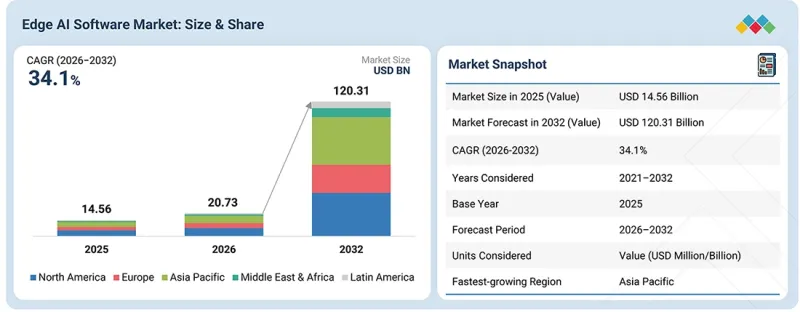
세계의 엣지 AI 소프트웨어 시장 규모는 2026년에 207억 3,000만 달러로 추정되며, 2032년에는 1,203억 1,000만 달러에 달할 것으로 예측됩니다.
예측 기간 동안의 연평균 성장률(CAGR)은 34.1%를 기록할 것으로 예상됩니다.
| 조사 범위 | |
|---|---|
| 조사 대상 기간 | 2021-2032년 |
| 기준 연도 | 2025년 |
| 예측 기간 | 2026-2032년 |
| 단위 | 금액(달러) |
| 부문 | 제공, AI 워크로드, 엣지 환경, 최종사용자, 지역 |
| 대상 지역 | 북미, 유럽, 아시아태평양, 중동 및 아프리카, 라틴아메리카 |
이러한 성장은 저지연 AI 실행에 대한 수요 증가, 기업 데이터 및 운영 데이터에 대한 관리 강화, 간헐적인 연결 환경에서의 내결함성 향상, 클라우드 인프라의 보다 효율적인 활용에 힘입어 이루어지고 있습니다. 반면, 이종 하드웨어 환경, 도입의 복잡성, 모델 수명주기 요구 사항, 레거시 운영 시스템과의 통합은 여전히 대규모 도입에 있어 주요 제약요인으로 작용하고 있습니다.
“고급 모델이 실행 지점 근처로 이동함에 따라, 생성형 AI가 가장 빠르게 성장하는 엣지 AI 워크로드로 부상”
소규모 기반 모델, 양자화, 모델 압축, 최적화된 추론 런타임의 발전으로 로컬 실행이 점점 더 현실화됨에 따라, 생성형 AI는 AI 워크로드 부문에서 가장 빠르게 성장할 것으로 예상됩니다. 시장 기회는 기본적인 텍스트 생성에 그치지 않고, 로컬 AI 어시스턴트, 검색 기능이 통합된 애플리케이션, 자연어 인터페이스, 자율형 소프트웨어 기능으로 확대되고 있습니다. 이러한 기능들은 클라우드에 대한 상시 연결 의존도를 낮추면서도 작동할 수 있습니다. 생성형 워크로드가 분산 환경 전반으로 확대됨에 따라, 모델 효율성, 하드웨어 이식성, 메모리 활용도, 기업 데이터와의 통합을 개선하는 벤더들은 혜택을 볼 수 있는 위치에 있습니다.
“지능형 엔드포인트로의 AI 구현 확대에 따라, 디바이스 에지가 계속해서 가장 큰 환경이 될 것”
카메라, 로봇, 차량, 임베디드 시스템, 가전제품 및 기타 엔드포인트에서 AI를 로컬로 실행하는 능력이 향상되고 있는 것을 배경으로, 2026년에는 디바이스 엣지 환경이 시장에서 가장 큰 점유율을 차지할 것으로 예상됩니다. 이 부문은 즉각적인 의사결정, 대역폭 효율화, 개인정보 보호, 비즈니스 연속성 등의 요건으로부터 혜택을 받고 있습니다. 엔드포인트의 컴퓨팅 성능이 향상됨에 따라, 수요는 기존의 컴퓨터 비전 및 예측형 워크로드에서 음성, 멀티모달, 생성형 AI로 확대되고 있습니다. 이에 따라 경량 런타임, 하드웨어에 최적화된 성능, 다양한 프로세서 아키텍처 전반에 걸쳐 성능을 유지할 수 있는 소프트웨어의 중요성이 커지고 있습니다.
“북미가 현재 도입을 주도하고 있으며, 아시아태평양은 가장 높은 성장이 예상”
북미는 하이퍼스케일러, 반도체 벤더, 엣지 AI 소프트웨어 기업, 엔터프라이즈용 기술 구매자, 성숙한 AI 인프라가 집중되어 있는 것을 배경으로, 계속해서 최대의 지역 시장이 될 것으로 예상됩니다. 또한, 이 지역은 엔터프라이즈 환경과 디바이스 환경 모두에서 분산형 AI의 조기 상용화의 혜택도 받고 있습니다. 한편, 아시아태평양은 중국, 일본, 한국, 인도, 동남아시아의 대규모 전자기기 제조, 산업 자동화, 커넥티드 기기 생산, 통신 인프라 확장, 그리고 확대되는 기업의 AI 투자에 힘입어 가장 빠른 성장이 예상됩니다. 이 지역의 기기 제조 역량과 확대되는 국내 AI 생태계의 결합은 엣지 AI 소프트웨어의 지속적인 도입을 위한 견고한 기반을 제공하고 있습니다.
본 보고서에서는 전 세계 엣지 AI 소프트웨어 시장을 조사하여, 시장 개요, 시장 성장에 영향을 미치는 다양한 요인에 대한 분석, 기술 및 특허 동향, 법규제 환경, 사례 연구, 시장 규모 추정 및 전망, 각종 분류·지역/주요 국가별 상세 분석, 경쟁 구도, 주요 기업 개요 등을 정리하고 있습니다.
목차
제1장 소개
제2장 주요 요약
제3장 주요 인사이트
제4장 시장 개요
제5장 업계 동향
제6장 기술의 진보, 특허, 혁신, 향후 응용
제7장 규제 상황
제8장 고객 상황과 구매 행동
제9장 엣지 AI 소프트웨어 시장 : 제공별
제10장 엣지 AI 소프트웨어 시장 : AI 워크로드별
제11장 엣지 AI 소프트웨어 시장 : 엣지 환경별
제12장 엣지 AI 소프트웨어 시장 : 최종사용자별
제13장 엣지 AI 소프트웨어 시장 : 지역별
제14장 경쟁 구도
제15장 기업 개요
제16장 조사 방법
제17장 인접 시장 및 관련 시장
제18장 부록
KSMThe global edge AI software market is estimated at USD 20.73 billion in 2026 and is projected to reach USD 120.31 billion by 2032, reflecting a 34.1% CAGR over the forecast period.
| Scope of the Report | |
|---|---|
| Years Considered for the Study | 2021-2032 |
| Base Year | 2025 |
| Forecast Period | 2026-2032 |
| Units Considered | Value (USD Billion) |
| Segments | Offering, AI Workload, Edge Environment, End User, and Region |
| Regions covered | North America, Europe, Asia Pacific, Middle East & Africa, and Latin America |
Growth is supported by rising demand for low-latency AI execution, stronger control over enterprise and operational data, greater resilience in intermittently connected environments, and more efficient use of cloud infrastructure. At the same time, heterogeneous hardware environments, deployment complexity, model lifecycle requirements, and integration with legacy operational systems remain key constraints to large-scale adoption.
"Generative AI is emerging as the fastest-growing Edge AI workload as sophisticated models move closer to the point of execution"
Generative AI is expected to grow fastest within the AI workload segment as smaller foundation models, quantization, model compression, and optimized inference runtimes make local execution increasingly practical. The opportunity is moving beyond basic text generation toward local assistants, retrieval-enabled applications, natural-language interfaces, and autonomous software functions that can operate with reduced reliance on continuous cloud connectivity. Vendors that improve model efficiency, hardware portability, memory utilization, and integration with enterprise data are positioned to benefit as generative workloads extend across distributed environments.
"Device edge remains the largest environment as AI execution expands directly across intelligent endpoints"
The device edge environment is expected to account for the largest share of the market in 2026, supported by the growing ability of cameras, robots, vehicles, embedded systems, appliances, and other endpoints to run AI locally. The segment benefits from requirements for immediate decision-making, bandwidth efficiency, privacy, and operational continuity. As endpoint compute capabilities improve, demand is expanding from conventional computer vision and predictive workloads toward speech, multimodal, and generative AI. This increases the importance of lightweight runtimes, hardware-aware optimization, and software that can maintain performance across diverse processor architectures.
"North America leads current adoption, while Asia Pacific is positioned for the strongest expansion"
North America is expected to remain the largest regional market, supported by a concentration of hyperscalers, semiconductor vendors, Edge AI software companies, enterprise technology buyers, and mature AI infrastructure. The region also benefits from the early commercialization of distributed AI across both enterprise and device environments. Asia Pacific is expected to grow fastest, driven by large-scale electronics manufacturing, industrial automation, connected-device production, telecom infrastructure expansion, and growing enterprise AI investment across China, Japan, South Korea, India, and Southeast Asia. The region's combination of device manufacturing capacity and expanding domestic AI ecosystems provides a strong foundation for sustained Edge AI software adoption.
Breakdown of Primaries
In-depth interviews were conducted with chief executive officers (CEOs), innovation and technology directors, system integrators, and executives from key organizations operating in the edge AI software market.
- By Company: Tier 1 - 24%, Tier 2 - 41%, and Tier 3 - 35%
- By Designation: Directors - 31%, Managers - 46%, and Others - 23%
- By Region: North America - 42%, Europe - 21%, Asia Pacific - 25%, Middle East & Africa - 4%, and Latin America - 8%
Key players profiled in the edge AI software market include AWS (US), Microsoft (US), Google (US), IBM (US), Dell Technologies (US), Siemens (Germany), Schneider Electric (France), Intel (US), Red Hat (US), SAS (US), Nutanix (US), Viso.ai (Switzerland), ClearBlade (US), Litmus (US), Honeywell (US), Plumerai (UK), Edge Impulse (US), Latent AI (US), Imagimob (Sweden), SensiML (US), Nota AI (South Korea), Aizip (US), MicroAI (US), Axelera AI (Netherlands), MathWorks (US), Roboflow (US), Picovoice (Canada), Wallaroo.AI (US), ZEDEDA (US), Barbara (Spain), Ekkono (Sweden), Accenture (Ireland), Capgemini (France), HCLTech (India), NTT DATA (Japan), Tata Elxsi (India), Tata Consultancy Services (India), Infosys (India), Wipro (India), eInfochips (US), and Bosch Global Software Technologies (India).
The study includes an in-depth competitive analysis of these key players in the edge AI software market, with their company profiles, recent developments, and key market strategies.
Research Coverage
This research report categorizes the edge AI Software market by offering (software and services), by AI workload (computer vision, speech & audio AI, NLP, predictive & analytical AI, generative AI, and multimodal AI), by edge environment (device edge, enterprise/on-premises edge, and network/telecom edge), by end-user (manufacturing, healthcare & life sciences, energy & utilities, telecommunications, retail, automotive, transportation & logistics, smart cities, BFSI, consumer electronics & devices, and other end users), and by region (North America, Europe, Asia Pacific, Middle East & Africa, and Latin America). The scope of the report covers detailed information on the major factors, such as drivers, restraints, challenges, and opportunities, that influence the growth of the Edge AI Software market. A detailed analysis of key industry players has been conducted to provide insights into their business overview, solutions, and services; key strategies; contracts, partnerships, and agreements; new product & service launches; mergers and acquisitions; and recent developments associated with the Edge AI Software market. The report also covers competitive analysis of upcoming startups in the Edge AI Software market ecosystem.
Reasons to Buy This Report
The report will provide market leaders and new entrants with the closest available estimates of revenue for the overall edge AI software market and its subsegments. It will help stakeholders understand the competitive landscape and gain insights to position their business more effectively and plan suitable go-to-market strategies. It will also help stakeholders gauge the market's pulse and provide information on key market drivers, restraints, challenges, and opportunities.
The report provides insights into the following pointers:
- Analysis of key drivers (Rising demand for low-latency and real-time AI processing; growing need for data privacy, sovereignty, and local decision-making; proliferation of AI-capable edge devices and distributed infrastructure; increasing deployment of computer vision, generative AI, and multimodal workloads at the edge), restraints (Hardware fragmentation and lack of standardized edge AI environments; high deployment and integration complexity across heterogeneous edge estates), opportunities (Growing adoption of on-device generative and multimodal AI; expansion of Edge AI applications and autonomous systems; increasing demand for centralized deployment, lifecycle management, and observability across distributed AI fleets), and challenges (Optimizing increasingly complex AI models for constrained compute, memory, and power environments; and maintaining security, reliability, and model performance across large-scale distributed deployments)
- Product Development/Innovation: Detailed insights into upcoming technologies, research & development activities, and new product & service launches in the edge AI software market
- Market Development: Comprehensive information about lucrative markets - analysis of the edge AI software market across varied regions
- Market Diversification: Exhaustive information about new products & services, untapped geographies, recent developments, and investments in the edge AI software market
- Competitive Assessment: In-depth assessment of market share, growth strategies, and product portfolios of AWS (US), Microsoft (US), Accenture (Ireland), Dell Technologies (US), Google (US), Capgemini (France), IBM (US), Siemens (Germany), Red Hat (US), and NTT Data (Japan), among others, in the edge AI software market
TABLE OF CONTENTS
1 INTRODUCTION
- 1.1 OBJECTIVES OF THE STUDY
- 1.2 MARKET DEFINITION
- 1.2.1 INCLUSIONS AND EXCLUSIONS
- 1.3 MARKET SCOPE
- 1.3.1 MARKET SEGMENTATION
- 1.3.2 YEARS CONSIDERED FOR THE STUDY
- 1.4 CURRENCY CONSIDERED
- 1.5 STAKEHOLDERS
- 1.6 SUMMARY OF CHANGES
2 EXECUTIVE SUMMARY
- 2.1 MARKET HIGHLIGHTS AND KEY INSIGHTS
- 2.2 KEY MARKET PARTICIPANTS: MAPPING OF STRATEGIC DEVELOPMENTS
- 2.3 DISRUPTIVE TRENDS IN EDGE AI SOFTWARE MARKET
- 2.4 HIGH-GROWTH SEGMENTS
- 2.5 REGIONAL SNAPSHOT: MARKET SIZE, GROWTH RATE, AND FORECAST
3 PREMIUM INSIGHTS
- 3.1 ATTRACTIVE OPPORTUNITIES IN EDGE AI SOFTWARE MARKET
- 3.2 EDGE AI SOFTWARE MARKET, BY REGION
- 3.3 EDGE AI SOFTWARE MARKET: TOP THREE AI WORKLOADS
- 3.4 NORTH AMERICA: EDGE AI SOFTWARE MARKET, BY OFFERING
4 MARKET OVERVIEW
- 4.1 INTRODUCTION
- 4.2 MARKET DYNAMICS
- 4.2.1 DRIVERS
- 4.2.1.1 Rising Need for Real-time, Low-latency Inference at the Point of Action
- 4.2.1.2 Growing Requirement for Localized Processing to Improve Privacy, Resilience, and Data Control
- 4.2.1.3 Expanding Use of Visual Intelligence, Automation, Monitoring, and Predictive Analytics Across Physical Operations
- 4.2.1.4 Proliferation of Connected Assets, 5G, IoT, and Distributed Computing Ecosystems
- 4.2.2 RESTRAINTS
- 4.2.2.1 High Complexity of Deploying and Managing AI Across Heterogeneous Edge Infrastructure
- 4.2.2.2 Limited Interoperability Across AI Frameworks, Edge Platforms, Devices, and Enterprise Systems
- 4.2.3 OPPORTUNITIES
- 4.2.3.1 Deployment of Generative AI and Small Language Models at the Edge
- 4.2.3.2 Expansion of Edge MLOps, Orchestration, and Lifecycle Management Platforms
- 4.2.3.3 Growth of Privacy-preserving and Decentralized Edge AI Architectures
- 4.2.4 CHALLENGES
- 4.2.4.1 Maintaining Consistent Model Accuracy, Performance, and Reliability Across Distributed Edge Environments
- 4.2.4.2 Managing Model Updates, Version Control, Drift, Security, and Governance Over Long Edge Lifecycles
- 4.2.1 DRIVERS
- 4.3 UNMET NEEDS AND WHITE SPACES
- 4.3.1 UNMET NEEDS IN THE EDGE AI SOFTWARE MARKET
- 4.3.2 WHITE SPACE OPPORTUNITIES
- 4.4 INTERCONNECTED MARKETS AND CROSS-SECTOR OPPORTUNITIES
- 4.4.1 INTERCONNECTED MARKETS
- 4.4.2 CROSS-SECTOR OPPORTUNITIES
- 4.5 STRATEGIC MOVES BY TIER-1/2/3 PLAYERS
5 INDUSTRY TRENDS
- 5.1 PORTER'S FIVE FORCES ANALYSIS
- 5.1.1 THREAT OF NEW ENTRANTS
- 5.1.2 THREAT OF SUBSTITUTES
- 5.1.3 BARGAINING POWER OF SUPPLIERS
- 5.1.4 BARGAINING POWER OF BUYERS
- 5.1.5 INTENSITY OF COMPETITIVE RIVALRY
- 5.2 MACROECONOMIC OUTLOOK
- 5.2.1 INTRODUCTION
- 5.2.2 GDP TRENDS AND FORECAST
- 5.2.3 TRENDS IN THE GLOBAL EDGE COMPUTING INDUSTRY
- 5.2.4 TRENDS IN THE GLOBAL ARTIFICIAL INTELLIGENCE INDUSTRY
- 5.3 SUPPLY CHAIN ANALYSIS
- 5.4 ECOSYSTEM ANALYSIS
- 5.4.1 ENTERPRISE EDGE AI SOLUTION VENDORS
- 5.4.2 EDGE AI DEVELOPMENT PLATFORM VENDORS
- 5.4.3 EDGE AI SERVICE PROVIDERS
- 5.5 PRICING ANALYSIS
- 5.5.1 INDICATIVE PRICING ANALYSIS, BY OFFERING, 2026
- 5.5.2 INDICATIVE PRICING ANALYSIS, BY EDGE AI ENVIRONMENT, 2026
- 5.6 KEY CONFERENCES AND EVENTS, 2026-2027
- 5.7 TRENDS/DISRUPTIONS INFLUENCING CUSTOMER BUSINESS
- 5.8 INVESTMENT AND FUNDING SCENARIO
- 5.9 CASE STUDY ANALYSIS
- 5.9.1 PROCTER & GAMBLE SCALES EDGE-TO-CLOUD AI OPERATIONS WITH MICROSOFT
- 5.9.2 COLES GROUP USES EDGE INFRASTRUCTURE AND AI TO MODERNIZE STORE OPERATIONS
- 5.9.3 DILIGENT ROBOTICS USES AWS EDGE AND AI SERVICES TO SCALE MOXI HOSPITAL ROBOTS
- 5.9.4 D.M. BOWMAN USES NETRADYNE EDGE AI TO IMPROVE FLEET SAFETY
- 5.9.5 SOUTHERN MINNESOTA BEET SUGAR COOPERATIVE AUTOMATES LOAD INSPECTION
- 5.10 IMPACT OF 2025-2026 US TARIFFS - EDGE AI SOFTWARE MARKET
- 5.10.1 INTRODUCTION
- 5.10.1.1 Tariff/Trade Policy Updates
- 5.10.2 KEY TARIFF RATES
- 5.10.3 PRICE IMPACT ANALYSIS
- 5.10.3.1 Strategic Shifts and Emerging Trends
- 5.10.4 IMPACT ON COUNTRY/REGION
- 5.10.4.1 US
- 5.10.4.2 China
- 5.10.4.3 Europe
- 5.10.4.4 Asia Pacific (Excluding China)
- 5.10.5 IMPACT ON END-USE INDUSTRIES
- 5.10.1 INTRODUCTION
6 TECHNOLOGICAL ADVANCEMENTS, PATENTS, INNOVATIONS, AND FUTURE APPLICATIONS
- 6.1 KEY EMERGING TECHNOLOGIES
- 6.1.1 EDGE-OPTIMIZED FOUNDATION MODELS
- 6.1.2 MULTIMODAL AI
- 6.1.3 FEDERATED LEARNING
- 6.1.4 TINYML
- 6.1.5 MODEL COMPRESSION, QUANTIZATION, AND PRUNING
- 6.2 COMPLEMENTARY TECHNOLOGIES
- 6.2.1 CLOUD AND HYBRID CLOUD COMPUTING
- 6.2.2 5G, PRIVATE 5G, AND MULTI-ACCESS EDGE COMPUTING
- 6.2.3 IOT/IIOT
- 6.2.4 CONTAINERIZATION AND EDGE ORCHESTRATION
- 6.2.5 CONFIDENTIAL COMPUTING AND ZERO-TRUST SECURITY
- 6.3 ADJACENT TECHNOLOGIES
- 6.3.1 EDGE COMPUTING
- 6.3.2 COMPUTER VISION
- 6.3.3 ROBOTICS AND AUTONOMOUS SYSTEMS
- 6.3.4 REAL-TIME AND STREAMING ANALYTICS
- 6.3.5 DIGITAL TWINS
- 6.4 TECHNOLOGY ROADMAP
- 6.5 PATENT ANALYSIS
- 6.5.1 METHODOLOGY
- 6.5.2 PATENTS FILED, BY DOCUMENT TYPE, 2016-2026
- 6.5.3 INNOVATION AND PATENT APPLICATIONS
- 6.6 FUTURE APPLICATIONS
- 6.6.1 AUTONOMOUS INDUSTRIAL OPERATIONS
- 6.6.2 COOPERATIVE AUTONOMOUS MOBILITY
- 6.6.3 REAL-TIME MULTIMODAL HEALTHCARE AT THE POINT OF CARE
- 6.6.4 SELF-OPTIMIZING TELECOM AND CRITICAL INFRASTRUCTURE
- 6.6.5 HYPER-PERSONALIZED ON-DEVICE DIGITAL EXPERIENCES
7 REGULATORY LANDSCAPE
- 7.1 REGIONAL REGULATIONS AND COMPLIANCE
- 7.1.1 REGULATORY BODIES, GOVERNMENT AGENCIES, AND OTHER ORGANIZATIONS
- 7.1.1.1 North America
- 7.1.1.1.1 Executive Order 14179 and the US AI Governance Framework (US)
- 7.1.1.1.2 PIPEDA and the Voluntary Code of Conduct for Advanced Generative AI Systems (Canada)
- 7.1.1.2 Europe
- 7.1.1.2.1 Pro-innovation AI Regulatory Framework and Data Protection Law (UK)
- 7.1.1.2.2 EU AI Act and German AI Market-surveillance Implementation (Germany)
- 7.1.1.2.3 EU AI Act, GDPR, and CNIL AI Guidance (France)
- 7.1.1.2.4 EU AI Act and Supervision by AESIA (Spain)
- 7.1.1.2.5 Law No. 132 of 2025 - Provisions and Delegations to Government Concerning Artificial Intelligence (Italy)
- 7.1.1.3 Asia Pacific
- 7.1.1.3.1 Regulations on Network Data Security Management and China's Data Governance Framework (China)
- 7.1.1.3.2 Act on the Protection of Personal Information and AI Guidelines for Business v1.2 (Japan)
- 7.1.1.3.3 Digital Personal Data Protection Act, 2023 and Digital Personal Data Protection Rules, 2025 (India)
- 7.1.1.3.4 Framework Act on the Development of AI and Establishment of a Foundation for Trustworthiness (South Korea)
- 7.1.1.3.5 Guide on AI Governance and Ethics and Expanded Generative AI Guide (ASEAN)
- 7.1.1.4 Middle East & Africa
- 7.1.1.4.1 Personal Data Protection Law and SDAIA AI Ethics Principles (Saudi Arabia)
- 7.1.1.4.2 Protection of Personal Information Act and Evolving National AI Policy (South Africa)
- 7.1.1.4.3 Federal Decree-law No. 45 of 2021 on the Protection of Personal Data (UAE)
- 7.1.1.5 Latin America
- 7.1.1.5.1 LGPD and ANPD Regulatory Sandbox for AI and Data Protection (Brazil)
- 7.1.1.5.2 Federal Law on Protection of Personal Data Held by Private Parties, 2025 (Mexico)
- 7.1.1.1 North America
- 7.1.2 INDUSTRY STANDARDS
- 7.1.1 REGULATORY BODIES, GOVERNMENT AGENCIES, AND OTHER ORGANIZATIONS
8 CUSTOMER LANDSCAPE & BUYER BEHAVIOR
- 8.1 DECISION MAKING PROCESS
- 8.2 BUYER STAKEHOLDERS AND BUYING EVALUATION CRITERIA
- 8.2.1 BUYING CRITERIA
- 8.3 ADOPTION BARRIERS & INTERNAL CHALLENGES
- 8.4 UNMET NEEDS FROM VARIOUS INDUSTRY VERTICALS
9 EDGE AI SOFTWARE MARKET, BY OFFERING
- 9.1 INTRODUCTION
- 9.1.1 DRIVERS: EDGE AI SOFTWARE MARKET, BY OFFERING
- 9.2 SOFTWARE
- 9.2.1 EDGE AI DEVELOPMENT PLATFORMS
- 9.2.1.1 Model-to-device tool chains to become control point for faster Edge AI product development
- 9.2.2 EDGE AI RUNTIME & INFERENCE SOFTWARE
- 9.2.2.1 Runtime optimization to evolve from performance utility into strategic software layer for heterogeneous edge fleets
- 9.2.3 EDGE AI DEPLOYMENT & LIFECYCLE MANAGEMENT PLATFORMS
- 9.2.3.1 Fleet-scale model operations make deployment, observability, and update control distinct buying requirements
- 9.2.4 EDGE AI APPLICATIONS
- 9.2.4.1 Packaged edge applications shift spending from experimentation toward repeatable operational outcomes
- 9.2.1 EDGE AI DEVELOPMENT PLATFORMS
- 9.3 SERVICES
- 9.3.1 CONSULTING & ADVISORY SERVICES
- 9.3.1.1 Architecture and use-case prioritization to prove decisive as enterprises move beyond isolated Edge AI pilots
- 9.3.2 SOLUTION DEVELOPMENT & INTEGRATION SERVICES
- 9.3.2.1 Rising integration demand as Edge AI connects models with operational systems, sensors, and enterprise applications
- 9.3.3 DEPLOYMENT & IMPLEMENTATION SERVICES
- 9.3.3.1 Production rollouts to drive demand for disciplined site readiness, validation, security hardening, and rollout management
- 9.3.4 MANAGED SERVICES
- 9.3.4.1 Distributed AI estates create recurring services market around uptime, model health, security, and continuous optimization
- 9.3.1 CONSULTING & ADVISORY SERVICES
10 EDGE AI SOFTWARE MARKET, BY AI WORKLOAD
- 10.1 INTRODUCTION
- 10.1.1 DRIVERS: EDGE AI SOFTWARE MARKET, BY AI WORKLOAD
- 10.2 COMPUTER VISION
- 10.2.1 COMPUTER VISION TO REMAIN ANCHOR WORKLOAD AS ENTERPRISES PRIORITIZE REAL-TIME PERCEPTION WITHOUT CLOUD STREAMING
- 10.3 SPEECH & AUDIO AI
- 10.3.1 ON-DEVICE SPEECH AND ACOUSTIC INTELLIGENCE GAIN VALUE WHERE PRIVACY, IMMEDIACY, AND CONTINUOUS LISTENING MATTER
- 10.4 NATURAL LANGUAGE PROCESSING
- 10.4.1 LOCAL NLP TO EXPAND FROM COMMAND RECOGNITION TO OPERATIONAL SEARCH AND HUMAN-MACHINE INTERACTION
- 10.5 PREDICTIVE & ANALYTICAL AI
- 10.5.1 TIME-SERIES PREDICTION & ANOMALY DETECTION EMBEDDED ACROSS INDUSTRIAL AND OPERATIONAL EDGE SYSTEMS
- 10.6 GENERATIVE AI
- 10.6.1 LOCAL INFERENCE STACKS TURN EDGE INTO NEW DEPLOYMENT TIER FOR PRIVATE, RESPONSIVE GENERATIVE AI
- 10.7 MULTIMODAL AI
- 10.7.1 MULTIMODAL MODELS TO BECOME INTELLIGENCE LAYER LINKING SENSOR CONTEXT INTO RICHER EDGE DECISIONS
11 EDGE AI SOFTWARE MARKET, BY EDGE ENVIRONMENT
- 11.1 INTRODUCTION
- 11.1.1 DRIVERS: EDGE AI SOFTWARE MARKET, BY EDGE ENVIRONMENT
- 11.2 DEVICE EDGE
- 11.2.1 AI MOVES DIRECTLY INTO ENDPOINTS AS COMPACT MODELS MAKE LOCAL PERCEPTION AND DECISION-MAKING PRACTICAL AT SCALE
- 11.3 ON-PREMISES EDGE
- 11.3.1 LOCAL SERVERS TO EMERGE AS PREFERRED AGGREGATION TIER FOR MULTI-DEVICE AI, PRIVATE INFERENCE, AND SITE-LEVEL AUTOMATION
- 11.4 NETWORK EDGE
- 11.4.1 AI-NATIVE NETWORK SOFTWARE TURNS TELCO INFRASTRUCTURE INTO BOTH OPTIMIZATION DOMAIN AND DISTRIBUTED INFERENCE PLATFORM
12 EDGE AI SOFTWARE MARKET, BY END USER
- 12.1 INTRODUCTION
- 12.1.1 DRIVERS: EDGE AI SOFTWARE MARKET, BY END USER
- 12.2 MANUFACTURING
- 12.2.1 MANUFACTURING TO SHIFT EDGE AI FROM ISOLATED MACHINE VISION TOWARD PLANT-WIDE INTELLIGENCE
- 12.2.2 PREDICTIVE MAINTENANCE
- 12.2.3 QUALITY INSPECTION
- 12.2.4 PROCESS & YIELD OPTIMIZATION
- 12.2.5 AUTONOMOUS ROBOTICS & INDUSTRIAL AUTOMATION
- 12.2.6 WORKER SAFETY & SITE MONITORING
- 12.2.7 OTHER MANUFACTURING USE CASES
- 12.3 HEALTHCARE & LIFE SCIENCES
- 12.3.1 HEALTHCARE EDGE AI EXPANDS CLINICAL RESPONSIVENESS, PRIVACY, AND DEVICE-LEVEL INTELLIGENCE
- 12.3.2 REMOTE PATIENT MONITORING
- 12.3.3 MEDICAL IMAGING & DIAGNOSTICS
- 12.3.4 SMART MEDICAL DEVICES & WEARABLES
- 12.3.5 REAL-TIME PATIENT & CLINICAL MONITORING
- 12.3.6 ASSISTED SURGERY & CLINICAL PROCEDURES
- 12.3.7 OTHER HEALTHCARE & LIFE SCIENCES USE CASES
- 12.4 ENERGY & UTILITIES
- 12.4.1 UTILITIES ADOPT EDGE AI TO MAKE DISTRIBUTED ASSETS MORE OBSERVABLE AND AUTONOMOUS
- 12.4.2 ASSET MONITORING & PREDICTIVE MAINTENANCE
- 12.4.3 GRID MONITORING & FAULT DETECTION
- 12.4.4 SMART GRID & SUBSTATION INTELLIGENCE
- 12.4.5 DISTRIBUTED ENERGY RESOURCE OPTIMIZATION
- 12.4.6 ENERGY DISTRIBUTION AUTOMATION
- 12.4.7 OTHER ENERGY & UTILITIES USE CASES
- 12.5 TELECOMMUNICATIONS
- 12.5.1 TELCO OPERATORS TO APPLY AI INSIDE NETWORKS WHILE EXPOSING DISTRIBUTED INFRASTRUCTURE FOR NEW AI SERVICES
- 12.5.2 REAL-TIME NETWORK MONITORING & ANOMALY DETECTION
- 12.5.3 RAN & NETWORK OPTIMIZATION
- 12.5.4 NETWORK SECURITY & THREAT DETECTION
- 12.5.5 PREDICTIVE NETWORK MAINTENANCE
- 12.5.6 TRAFFIC & SERVICE QUALITY OPTIMIZATION
- 12.5.7 OTHER TELECOMMUNICATION USE CASES
- 12.6 RETAIL & E-COMMERCE
- 12.6.1 RETAIL EDGE AI: FROM ISOLATED VIDEO ANALYTICS TOWARD INTEGRATED STORE INTELLIGENCE
- 12.6.2 IN-STORE ANALYTICS
- 12.6.3 SMART & AUTONOMOUS CHECKOUT
- 12.6.4 INVENTORY & SHELF MONITORING
- 12.6.5 LOSS PREVENTION & THEFT DETECTION
- 12.6.6 CUSTOMER BEHAVIOR & PERSONALIZATION
- 12.6.7 OTHER RETAIL USE CASES
- 12.7 AUTOMOTIVE
- 12.7.1 AUTOMOTIVE EDGE AI TO BECOME CORE SOFTWARE LAYER AS VEHICLES COMBINE SAFETY AND LOCAL GENERATIVE INTERACTION
- 12.7.2 AUTONOMOUS & SEMI-AUTONOMOUS DRIVING
- 12.7.3 ADAS
- 12.7.4 DRIVER & OCCUPANT MONITORING
- 12.7.5 IN-VEHICLE AI ASSISTANTS & INFOTAINMENT
- 12.7.6 VEHICLE HEALTH & PREDICTIVE MAINTENANCE
- 12.7.7 OTHER AUTOMOTIVE USE CASES
- 12.8 TRANSPORTATION & LOGISTICS
- 12.8.1 TRANSPORTATION AND LOGISTICS OPERATORS TURN TO EDGE AI TO COORDINATE MOVING ASSETS AND AUTOMATE FACILITIES
- 12.8.2 FLEET MONITORING & MANAGEMENT
- 12.8.3 ROUTE & TRAFFIC OPTIMIZATION
- 12.8.4 WAREHOUSE & LOGISTICS AUTOMATION
- 12.8.5 CARGO & CONDITION MONITORING
- 12.8.6 AUTONOMOUS TRANSPORTATION SYSTEMS
- 12.8.7 OTHER TRANSPORTATION & LOGISTICS USE CASES
- 12.9 SMART CITIES
- 12.9.1 SMART-CITY EDGE AI ADVANCES TOWARD DISTRIBUTED URBAN INTELLIGENCE COORDINATED ACROSS CITY SYSTEMS
- 12.9.2 INTELLIGENT TRAFFIC MANAGEMENT
- 12.9.3 PUBLIC SAFETY & SURVEILLANCE
- 12.9.4 EMERGENCY RESPONSE & INCIDENT DETECTION
- 12.9.5 ENVIRONMENTAL MONITORING
- 12.9.6 SMART INFRASTRUCTURE & MUNICIPAL OPERATIONS
- 12.9.7 OTHER SMART CITY USE CASES
- 12.10 BFSI
- 12.10.1 BFSI EDGE AI TO CONCENTRATE ON TRANSACTION-TIME RISK, IDENTITY, AND BRANCH INTELLIGENCE
- 12.10.2 REAL-TIME FRAUD DETECTION
- 12.10.3 BIOMETRIC AUTHENTICATION & IDENTITY VERIFICATION
- 12.10.4 ATM & SELF-SERVICE BANKING INTELLIGENCE
- 12.10.5 BRANCH SECURITY & VIDEO ANALYTICS
- 12.10.6 PAYMENT RISK & TRANSACTION AUTHENTICATION
- 12.10.7 OTHER BFSI USE CASES
- 12.11 CONSUMER ELECTRONICS & DEVICES
- 12.11.1 CONSUMER EDGE AI EVOLVES FROM ISOLATED SMART FEATURES TOWARD PERSISTENT ON-DEVICE INTELLIGENCE
- 12.11.2 ON-DEVICE AI ASSISTANTS
- 12.11.3 COMPUTATIONAL PHOTOGRAPHY & VIDEO
- 12.11.4 BIOMETRIC AUTHENTICATION
- 12.11.5 SMART HOME & DEVICE AUTOMATION
- 12.11.6 AR/VR & SPATIAL INTELLIGENCE
- 12.11.7 OTHER CONSUMER ELECTRONICS & DEVICES USE CASES
- 12.12 OTHER END USERS
13 EDGE AI SOFTWARE MARKET, BY REGION
- 13.1 INTRODUCTION
- 13.2 NORTH AMERICA
- 13.2.1 NORTH AMERICA: EDGE AI SOFTWARE MARKET DRIVERS
- 13.2.2 US
- 13.2.2.1 Industrial AI depth and domestic compute investment anchor US leadership in commercial Edge AI deployment
- 13.2.3 CANADA
- 13.2.3.1 Canada's Edge AI research depth and compute-access funding extend Edge AI into remote, resource-intensive industries
- 13.3 EUROPE
- 13.3.1 EUROPE: EDGE AI SOFTWARE MARKET DRIVERS
- 13.3.2 UK
- 13.3.2.1 Edge computing research, AI hardware policy, and advanced services to strengthen UK's commercial Edge AI base
- 13.3.3 GERMANY
- 13.3.3.1 Industry 4.0 pivot to industrial AI to favor factory-floor inference and lifecycle software
- 13.3.4 FRANCE
- 13.3.4.1 Nationwide AI diffusion and industrial AI policy to carry French enterprise AI into operational environments
- 13.3.5 ITALY
- 13.3.5.1 Italy's manufacturing depth and EU-backed AI infrastructure open pragmatic path to industrial Edge AI
- 13.3.6 SPAIN
- 13.3.6.1 Public AI investment and wide 5G reach to strengthen Spain's foundation for Edge AI adoption
- 13.3.7 REST OF EUROPE
- 13.4 ASIA PACIFIC
- 13.4.1 ASIA PACIFIC: EDGE AI SOFTWARE MARKET DRIVERS
- 13.4.2 CHINA
- 13.4.2.1 Industrial 5G and cloud-network-edge coordination to embed local inference in China's smart manufacturing architecture
- 13.4.3 INDIA
- 13.4.3.1 India's 5G scale, AI mission, and manufacturing push widen addressable base for Edge AI software
- 13.4.4 JAPAN
- 13.4.4.1 Physical AI and robotics strategy to steer Japanese Edge AI toward multimodal autonomous systems
- 13.4.5 SOUTH KOREA
- 13.4.5.1 AI factory targets and M.AX industrial clusters build policy-backed demand for edge inference and orchestration
- 13.4.6 ASEAN
- 13.4.6.1 Manufacturing diversification and national AI programs drive multi-speed but fast-expanding ASEAN Edge AI market
- 13.4.7 REST OF ASIA PACIFIC
- 13.5 MIDDLE EAST & AFRICA
- 13.5.1 MIDDLE EAST & AFRICA: EDGE AI SOFTWARE MARKET DRIVERS
- 13.5.2 SAUDI ARABIA
- 13.5.2.1 National AI push and private 5G to generate high-value Edge AI demand across smart cities, energy, and industrial assets
- 13.5.3 UAE
- 13.5.3.1 Sovereign compute, advanced 5G, and AI-native government agenda accelerate hybrid Edge AI deployment
- 13.5.4 SOUTH AFRICA
- 13.5.4.1 Mining, energy, and telecom needs sustain selective Edge AI opportunities despite uneven adoption
- 13.5.5 REST OF MIDDLE EAST & AFRICA
- 13.6 LATIN AMERICA
- 13.6.1 LATIN AMERICA: EDGE AI SOFTWARE MARKET DRIVERS
- 13.6.2 BRAZIL
- 13.6.2.1 5G scale, industrial digitization, and telecom AI policy to push Edge AI beyond pilot-stage deployments
- 13.6.3 MEXICO
- 13.6.3.1 Nearshoring and dedicated smart-network spectrum to align connectivity investment with factory-floor AI
- 13.6.4 REST OF LATIN AMERICA
14 COMPETITIVE LANDSCAPE
- 14.1 OVERVIEW
- 14.2 KEY PLAYER STRATEGIES, 2025-2026
- 14.3 REVENUE ANALYSIS, 2021-2025
- 14.4 MARKET SHARE ANALYSIS, 2025
- 14.4.1 MARKET RANKING ANALYSIS, 2025
- 14.5 PRODUCT COMPARATIVE ANALYSIS
- 14.5.1 PRODUCT COMPARATIVE ANALYSIS OF EDGE AI DEVELOPMENT PLATFORMS
- 14.5.2 PRODUCT COMPARATIVE ANALYSIS OF ENTERPRISE EDGE AI SOLUTIONS
- 14.6 COMPANY EVALUATION MATRIX: EDGE AI DEVELOPMENT PLATFORM VENDORS
- 14.6.1 STARS
- 14.6.2 EMERGING LEADERS
- 14.6.3 PERVASIVE PLAYERS
- 14.6.4 PARTICIPANTS
- 14.6.5 COMPANY FOOTPRINT: EDGE AI DEVELOPMENT PLATFORM VENDORS, 2025
- 14.6.5.1 Company Footprint (Edge AI Development Platform Vendors)
- 14.6.5.2 Regional Footprint (Edge AI Development Platform Vendors)
- 14.6.5.3 Offering Footprint (Edge AI Development Platform Vendors)
- 14.6.5.4 AI Workload Footprint (Edge AI Development Platform Vendors)
- 14.6.5.5 Edge Environment Footprint (Edge AI Development Platform Vendors)
- 14.6.5.6 End User Footprint (Edge AI Development Platform Vendors)
- 14.7 COMPANY EVALUATION MATRIX: ENTERPRISE EDGE AI SOLUTION VENDORS
- 14.7.1 STARS
- 14.7.2 EMERGING LEADERS
- 14.7.3 PERVASIVE PLAYERS
- 14.7.4 PARTICIPANTS
- 14.7.5 COMPANY FOOTPRINT: ENTERPRISE EDGE AI SOLUTION VENDORS, 2025
- 14.7.5.1 Company Footprint (Enterprise Edge AI Solution Vendors)
- 14.7.5.2 Regional Footprint (Enterprise Edge AI Solution Vendors)
- 14.7.5.3 Offering Footprint (Enterprise Edge AI Solution Vendors)
- 14.7.5.4 AI Workload Footprint (Enterprise Edge AI Solution Vendors)
- 14.7.5.5 Edge Environment Footprint (Enterprise Edge AI Solution Vendors)
- 14.7.5.6 End User Footprint (Enterprise Edge AI Solution Vendors)
- 14.8 COMPANY EVALUATION MATRIX: EDGE AI SERVICE PROVIDERS
- 14.8.1 STARS
- 14.8.2 EMERGING LEADERS
- 14.8.3 PERVASIVE PLAYERS
- 14.8.4 PARTICIPANTS
- 14.8.5 COMPANY FOOTPRINT: EDGE AI SOFTWARE SERVICE PROVIDERS, 2025
- 14.8.5.1 Company Footprint (Edge AI Service Providers)
- 14.8.5.2 Regional Footprint (Edge AI Service Providers)
- 14.8.5.3 Offering Footprint (Edge AI Service Providers)
- 14.8.5.4 AI Workload Footprint (Edge AI Service Providers)
- 14.8.5.5 Edge Environment Footprint (Edge AI Service Providers)
- 14.8.5.6 End User Footprint (Edge AI Service Providers)
- 14.9 COMPANY VALUATION AND FINANCIAL METRICS
- 14.10 COMPETITIVE SCENARIO
- 14.10.1 PRODUCT LAUNCHES AND ENHANCEMENTS
- 14.10.2 DEALS
15 COMPANY PROFILES
- 15.1 INTRODUCTION
- 15.2 ENTERPRISE EDGE AI SOLUTION VENDORS
- 15.2.1 AWS
- 15.2.1.1 Business overview
- 15.2.1.2 Products/Solutions/Services offered
- 15.2.1.3 Recent developments
- 15.2.1.3.1 Product launches & enhancements
- 15.2.1.3.2 Deals
- 15.2.1.4 MnM view
- 15.2.1.4.1 Key strengths
- 15.2.1.4.2 Strategic choices
- 15.2.1.4.3 Weaknesses and competitive threats
- 15.2.2 MICROSOFT
- 15.2.2.1 Business overview
- 15.2.2.2 Products/Solutions/Services offered
- 15.2.2.3 Recent developments
- 15.2.2.3.1 Product launches & enhancements
- 15.2.2.3.2 Deals
- 15.2.2.4 MnM view
- 15.2.2.4.1 Key strengths
- 15.2.2.4.2 Strategic choices
- 15.2.2.4.3 Weaknesses and competitive threats
- 15.2.3 GOOGLE
- 15.2.3.1 Business overview
- 15.2.3.2 Products/Solutions/Services offered
- 15.2.3.3 Recent developments
- 15.2.3.3.1 Product launches & enhancements
- 15.2.3.3.2 Deals
- 15.2.3.4 MnM view
- 15.2.3.4.1 Key strengths
- 15.2.3.4.2 Strategic choices
- 15.2.3.4.3 Weaknesses and competitive threats
- 15.2.4 IBM
- 15.2.4.1 Business overview
- 15.2.4.2 Products/Solutions/Services offered
- 15.2.4.3 Recent developments
- 15.2.4.3.1 Product launches & enhancements
- 15.2.4.3.2 Deals
- 15.2.4.4 MnM view
- 15.2.4.4.1 Key strengths
- 15.2.4.4.2 Strategic choices
- 15.2.4.4.3 Weaknesses and competitive threats
- 15.2.5 DELL TECHNOLOGIES
- 15.2.5.1 Business overview
- 15.2.5.2 Products/Solutions/Services offered
- 15.2.5.3 Recent developments
- 15.2.5.3.1 Product launches & enhancements
- 15.2.5.3.2 Deals
- 15.2.5.4 MnM view
- 15.2.5.4.1 Key strengths
- 15.2.5.4.2 Strategic choices
- 15.2.5.4.3 Weaknesses and competitive threats
- 15.2.6 SIEMENS
- 15.2.6.1 Business overview
- 15.2.6.2 Products/Solutions/Services offered
- 15.2.6.3 Recent developments
- 15.2.6.3.1 Product launches & enhancements
- 15.2.6.3.2 Deals
- 15.2.6.4 MnM view
- 15.2.6.4.1 Key strengths
- 15.2.6.4.2 Strategic choices
- 15.2.6.4.3 Weaknesses and competitive threats
- 15.2.7 SCHNEIDER ELECTRIC
- 15.2.7.1 Business overview
- 15.2.7.2 Products/Solutions/Services offered
- 15.2.7.3 Recent developments
- 15.2.7.3.1 Product launches & enhancements
- 15.2.7.3.2 Deals
- 15.2.7.4 MnM view
- 15.2.7.4.1 Key strengths
- 15.2.7.4.2 Strategic choices
- 15.2.7.4.3 Weaknesses and competitive threats
- 15.2.8 NUTANIX
- 15.2.8.1 Business overview
- 15.2.8.2 Products/Solutions/Services offered
- 15.2.8.3 Recent developments
- 15.2.8.3.1 Product launches & enhancements
- 15.2.8.3.2 Deals
- 15.2.8.4 MnM view
- 15.2.8.4.1 Key strengths
- 15.2.8.4.2 Strategic choices
- 15.2.8.4.3 Weaknesses and competitive threats
- 15.2.9 RED HAT
- 15.2.10 SAS
- 15.2.11 INTEL
- 15.2.12 VISO.AI
- 15.2.13 CLEARBLADE
- 15.2.14 LITMUS
- 15.2.15 HONEYWELL
- 15.2.1 AWS
- 15.3 EDGE AI DEVELOPMENT PLATFORM VENDORS
- 15.3.1 AXELERA AI
- 15.3.1.1 Business overview
- 15.3.1.2 Products/Solutions/Services offered
- 15.3.1.3 Recent developments
- 15.3.1.3.1 Product launches & enhancements
- 15.3.1.3.2 Deals
- 15.3.1.4 MnM view
- 15.3.1.4.1 Key strengths
- 15.3.1.4.2 Strategic choices
- 15.3.1.4.3 Weaknesses and competitive threats
- 15.3.2 EDGE IMPULSE
- 15.3.3 LATENT AI
- 15.3.4 IMAGIMOB
- 15.3.5 SENSIML
- 15.3.6 NOTA AI
- 15.3.7 AIZIP
- 15.3.8 MICROAI
- 15.3.9 PLUMERAI
- 15.3.10 MATHWORKS
- 15.3.11 ROBOFLOW
- 15.3.12 PICOVOICE
- 15.3.13 WALLAROO.AI
- 15.3.14 ZEDEDA
- 15.3.15 BARBARA
- 15.3.16 EKKONO
- 15.3.1 AXELERA AI
- 15.4 EDGE AI SERVICES PROVIDERS
- 15.4.1 ACCENTURE
- 15.4.1.1 Business overview
- 15.4.1.2 Products/Solutions/Services offered
- 15.4.1.3 Recent developments
- 15.4.1.3.1 Product launches & enhancements
- 15.4.1.3.2 Deals
- 15.4.1.4 MnM view
- 15.4.1.4.1 Key strengths
- 15.4.1.4.2 Strategic choices
- 15.4.1.4.3 Weaknesses and competitive threats
- 15.4.2 CAPGEMINI
- 15.4.3 HCLTECH
- 15.4.4 NTT DATA
- 15.4.5 TATA ELXSI
- 15.4.6 TATA CONSULTANCY SERVICES (TCS)
- 15.4.7 INFOSYS
- 15.4.8 WIPRO
- 15.4.9 EINFOCHIPS
- 15.4.10 BOSCH GLOBAL SOFTWARE TECHNOLOGIES
- 15.4.1 ACCENTURE
16 RESEARCH METHODOLOGY
- 16.1 RESEARCH DATA
- 16.1.1 SECONDARY DATA
- 16.1.2 PRIMARY DATA
- 16.1.2.1 Breakup of primary profiles
- 16.1.2.2 Key industry insights
- 16.2 MARKET BREAKUP AND DATA TRIANGULATION
- 16.3 MARKET SIZE ESTIMATION
- 16.3.1 TOP-DOWN APPROACH
- 16.3.2 BOTTOM-UP APPROACH
- 16.4 MARKET FORECAST
- 16.5 RESEARCH ASSUMPTIONS
- 16.6 LIMITATIONS OF THE STUDY
17 ADJACENT AND RELATED MARKETS
- 17.1 INTRODUCTION
- 17.2 ARTIFICIAL INTELLIGENCE (AI) MARKET - GLOBAL FORECAST TO 2033
- 17.2.1 MARKET DEFINITION
- 17.2.2 MARKET OVERVIEW
- 17.2.2.1 Artificial Intelligence Market, By Offering
- 17.2.2.2 Artificial Intelligence Market, By Technology
- 17.2.2.3 Artificial Intelligence Market, By Business Function
- 17.3 EDGE COMPUTING MARKET - GLOBAL FORECAST TO 2031
- 17.3.1 MARKET DEFINITION
- 17.3.2 MARKET OVERVIEW
- 17.3.2.1 Edge Computing Market, By Offering
- 17.3.2.2 Edge Computing Market, By Application
- 17.3.2.3 Edge Computing Market, By Vertical
18 APPENDIX
- 18.1 DISCUSSION GUIDE
- 18.2 KNOWLEDGESTORE: MARKETSANDMARKETS' SUBSCRIPTION PORTAL
- 18.3 CUSTOMIZATION OPTIONS
- 18.4 RELATED REPORTS
- 18.5 AUTHOR DETAILS


