

|
시장보고서
상품코드
2152964
해충 기피제 유효 성분 시장 : 유형, 농도, 해충 유형, 최종 용도, 지역별 - 세계 예측(-2035년)Insect Repellent Active Ingredients Market by Type (DEET, Picaridin, IR 3535, P-Methane-3,8-Diol, DEPA), Concentration (Less Than 15%, 15% to 30%, More Than 30%), Insect Type (Mosquitoes, Bugs), End Application, and Region - Global Forecast to 2035 |
||||||

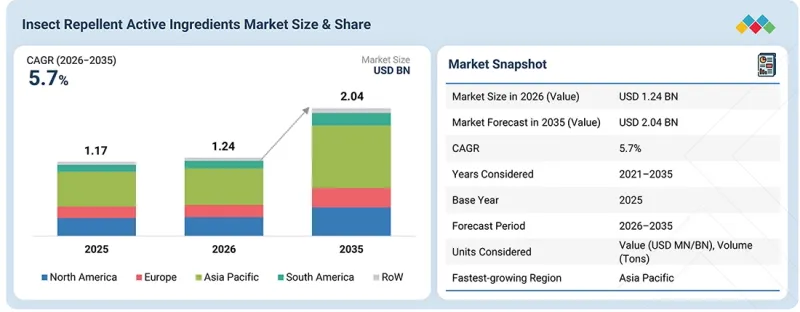
세계 해충 기피제 유효 성분 시장은 2026년 12억 4,000만 달러에서 2035년까지 20억 4,000만 달러로 확대될 것으로 예상되며, 예측 기간 동안 연평균 성장률(CAGR)은 5.7%에 달할 것으로 전망됩니다.
| 조사 범위 | |
|---|---|
| 조사 기간 | 2021-2035년 |
| 기준 연도 | 2025년 |
| 예측 기간 | 2026-2035년 |
| 산정 단위 | 금액(백만/십억 달러), 톤 |
| 부문 | 유형별, 농도별, 해충 유형별, 최종 용도별 및 지역별 |
| 대상 지역 | 북미, 유럽, 아시아태평양, 남미 및 기타 지역 |
정부 및 보건 기관은 특히 곤충 매개성 질병의 발생률이 높은 지역에서 방충제 사용에 관한 지침과 권장 사항을 자주 발표하고 있습니다. 이러한 규제 및 권장 사항은 소비자의 행동과 제품 성분에 영향을 미치므로, 방충제의 유효 성분에 대한 수요에 큰 영향을 미칠 가능성이 있습니다.
“2026년부터 2035년 사이에 15%-30%의 부문이 가장 높은 연평균 성장률(CAGR)을 보일 것으로 예측됩니다.”
농도별로 보면 15%-30% 부문은 예측 기간 동안 모기 퇴치 시장에서 가장 높은 연평균 성장률(CAGR)을 기록할 것으로 전망됩니다. 이는 효과적인 모기 퇴치 효과와 소비자의 사용 편의성이 균형을 이룬 제형에 대한 수요가 증가하고 있는 것이 배경입니다. 이 농도 범위의 제품은 모기, 진드기 및 기타 흡혈 곤충으로부터 몸을 보호하기에 충분한 유효 성분 함량을 갖추고 있으면서도, 일반적으로 고농도 제품보다 순한 제형 특성을 제공합니다. 소비자들이 야외 활동이나 여행 시 신뢰할 수 있는 방충 효과를 요구함에 따라, 개인용 제품, 특히 스프레이, 로션, 크림에 대한 수요가 증가할 것으로 예상됩니다. 또한, DEET나 피카리진과 같이 널리 사용되는 유효 성분을 기반으로 한 제제가 이용 가능하다는 점도 이 부문을 뒷받침하고 있으며, 선진국 및 신흥 시장에서 채택이 확대되고 있습니다.
“2035년에는 에어로졸 부문이 해충 기피제 유효 성분 시장에서 가장 큰 점유율을 차지할 전망”
최종 용도별로는 예측 기간 동안 에어로졸 부문이 시장 점유율을 주도할 것으로 전망됩니다. 에어로졸형 방충제는 휴대성이 뛰어나 외출 시 사용하기에 적합합니다. 컴팩트한 크기와 편리한 포장으로 여행 시에도 최적이며, 가방이나 배낭, 주머니 등에 간편하게 수납할 수 있습니다. 이러한 뛰어난 휴대성 덕분에 에어로졸 제품은 아웃도어 애호가나 여행자, 모기나 곤충에 노출될 가능성이 있는 활동을 하는 사람들에게 선호되는 선택지가 되고 있습니다.
“북미는 2026년 및 2035년에 성장률이 두 번째로 높은 지역이 될 전망”
지역별로 보면 북미는 개인용 방충제 제품의 정착된 사용 현황과 모기나 진드기에 노출될 기회가 많은 점을 배경으로, 예측 기간 동안 해충 기피제 유효 성분 시장에서 2위의 점유율을 차지할 전망입니다. 미국에서는 흡혈 곤충으로부터 보호하기 위해 방충제가 널리 사용되고 있으며, DEET가 주요 유효 성분으로 자리 잡고 있습니다. 미국 환경보호청(EPA)에 따르면, 미국 인구의 약 3분의 1이 DEET 함유 제품을 사용하고 있습니다. 수요는 하이킹, 캠핑, 낚시, 사냥 등의 야외 활동과 기타 레크리에이션 및 직업적 노출에 의해 뒷받침되고 있으며, 이러한 활동들이 모기나 진드기로부터의 보호 필요성을 높이고 있습니다. 또한, 이 지역 시장은 스프레이, 로션, 처리된 소재 등 광범위한 등록 제형의 혜택도 받고 있습니다. 유효 성분으로는 DEET, 피카리딘, IR3535, OLE/PMD, 2-운데카논 등이 미국 규제 당국 및 공중보건 당국에 의해 승인되었습니다. 모기 퇴치제 유효 성분 시장의 주요 참여자 구성은 다음과 같습니다:
- 기업 유형별 : Tier 1 - 25%, Tier 2 - 45%, Tier 3 - 30%
- 직책별 : 이사 - 20%, 관리자 - 50%, 기타 - 30%
- 지역별 : 아시아태평양 - 20%, 유럽 - 30%, 북미 - 25%, 남미 - 15%, 기타 지역 - 10%
대표적인 기업들은 제품 포트폴리오 확충, 생산능력 증강, 전략적 제휴, 인수, 신제품 개발 및 신흥 지역 시장 진출을 통해 시장 내 입지를 강화하고 있습니다.
조사 범위
본 조사 보고서에서는 해충 기피제 유효 성분 시장을 종류(DEET, 피카리딘/이카리딘/살티딘, EBAAP/IR3535, P-메탄-3,8-디올[PMD], OLE/EC 오일 H/C[천연 유래 PMD를 풍부하게 함유한 식물성 유효 성분], 합성 PMD, DEPA, 기타), 농도(15% 미만, 15%-30%, 30% 초과), 대상 곤충의 종류(모기, 벌레, 진드기, 파리), 최종 용도(펌프식 스프레이, 젤, 물티슈, 크림·로션, 에어로졸, 기타 최종 용도), 및 지역(북미, 유럽, 아시아태평양, 남미, 기타 지역)별로 분류하고 있습니다. 본 보고서의 조사 범위에는 시장 성장에 영향을 미치는 주요 요인(촉진요인, 제약요인, 과제 및 기회 등)에 대한 상세 정보가 포함되어 있습니다. 주요 업계 플레이어에 대해 상세한 분석을 수행하여, 해당 기업의 사업 개요, 솔루션, 서비스, 주요 전략, 계약, 파트너십 및 합의 사항에 대한 인사이트를 제공합니다. 또한, 해충 기피제 유효 성분 시장과 관련된 신제품 및 서비스 출시, 합병 및 인수, 그리고 최근 동향에 대해서도 다루고 있습니다. 본 보고서에서는 해충 기피제 유효 성분 생태계에서 두각을 나타내고 있는 스타트업 기업에 대한 경쟁 분석도 다루고 있습니다.
본 보고서를 구매해야 하는 이유:
본 보고서는 해충 기피제 유효 성분 시장 전체 및 각 하위 부문의 매출에 대한 가장 정확한 추정치를 제공함으로써, 이 시장의 시장 선도 기업과 신규 진입 기업을 지원합니다. 본 보고서는 이해관계자가 경쟁 구도를 이해하고, 자사의 비즈니스를 더 나은 위치로 이끌며, 적절한 시장 진입 전략을 수립하기 위한 추가적인 인사이트를 얻는 데 도움이 됩니다. 또한, 본 보고서는 이해관계자가 시장 동향을 파악할 수 있도록 지원하며, 주요 시장 촉진요인, 억제요인, 과제 및 기회에 대한 정보를 제공합니다.
본 보고서는 다음 사항에 대한 인사이트를 제공합니다:
- 시장 역학 : 주요 촉진요인 분석(매개성 질환 발생률 증가, 기후 변화가 곤충 번식에 미치는 영향), 제약요인(유효 성분 및 제품 승인까지의 장기화, 방충제와 관련된 건강 및 환경적 위험), 기회(야외 활동용 방충제 수요 증가, 화학 방충제 대체품), 및 과제(유효 성분에 포함된 화학제품의 낮은 효과에 대한 우려, 엄격한 규제 요건 및 안전성 우려)에 대한 분석. 이러한 요인들은 해충 기피제 유효 성분 시장의 성장에 영향을 미치고 있습니다
- 제품 개발/혁신 : 시장의 향후 기술, 연구 개발 활동 및 신제품·서비스 출시에 대한 상세한 인사이트
- 시장 개발 : 수익성이 높은 시장에 대한 종합적인 정보 - 본 보고서는 다양한 지역에 걸친 시장을 분석하고 있습니다
- 시장 다각화 : 신제품 및 서비스, 미개척 지역, 최근 동향, 그리고 시장 투자에 관한 종합적인 정보
- 경쟁 분석 : 주요 기업들의 시장 점유율, 성장 전략 및 제공 서비스에 대한 상세한 평가
자주 묻는 질문
목차
제1장 서론
제2장 요약
제3장 주요 인사이트
- 해충 기피제 유효 성분 시장에서 사업자에게 매력적인 비즈니스 기회
- 해충 기피제 유효 성분 시장 : 농도별·지역별
- 해충 기피제 유효 성분 시장 : 최종 용도별
- 해충 기피제 유효 성분 시장 : 해충 유형별
- 해충 기피제 유효 성분 시장 : 유형별
- 해충 기피제 유효 성분 시장 : 국가별
제4장 시장 개요
- 시장 역학
- 성장 촉진요인
- 성장 억제요인
- 기회
- 과제
- 미충족 수요 및 미개척 분야
- 해충 기피제 유효 성분 시장의 미충족 수요
- 미개척 시장의 기회
- 상호 연관된 시장 및 부문 간 기회
- 상호 연관된 시장
- 부문 간 기회
- 새로운 비즈니스 모델과 생태계의 변화
- 새로운 비즈니스 모델
- 생태계의 변화
- Tier 1/2/3 기업들의 전략적 움직임
- 주요 동향 및 전략적 초점
제5장 업계 동향
- Porter's Five Forces 분석
- 신규 진입자의 위협
- 대체품의 위협
- 공급업체의 협상력
- 구매자의 협상력
- 경쟁 기업 간의 적대적 관계
- 거시경제 지표
- 인구가 밀집된 도시의 빈민가에서 비위생적인 생활 환경으로 인한 해충 발생 증가
- 밸류체인 분석
- 원자재 및 화학제품 공급업체
- 유효 성분의 연구 개발
- 유효 성분의 제조·가공업체
- 제제·제품 개발
- 유통 및 다운스트림 네트워크
- 기술 및 규제 측면의 지원
- 생태계 분석
- 수요 측면
- 공급 측면
- 가격 분석
- 주요 기업의 평균 판매 가격(제품 유형별)
- 지역별 평균 판매 가격 동향
- 유형별 평균 판매 가격 동향
- 무역 분석
- HS 코드 3808의 수출 시나리오
- HS 코드 3808의 수입 동향
- 2026-2027년 주요 회의 및 행사
- 고객의 비즈니스에 영향을 미치는 동향 및 변화
- 사례 연구 분석
- 고드레이 컨슈머 프로덕츠(Godley Consumer Products) - 레노플루트린의 상품화
- 미미카이(Mimikai) - 새로운 DEET 무함유 유효 성분 출시
- 랑세스(Lanxess) - 살티진(피카리진)의 상업화 확대
- SC 존슨 - ‘가디언’ 공간용 방충제 생산 확대
- 2026년 미국 관세가 미치는 영향 - 해충 기피제 유효 성분 시장
- 가격에 미치는 영향 분석
- 국가·지역별 영향
- 최종 이용 산업에 미치는 영향
제6장 기술 발전, AI의 영향, 특허, 혁신 및 향후 응용
- 주요 신흥 기술
- 마이크로캡슐화 및 서방형 기피제 기술
- 새로운 바이오 기반 및 천연 유래 해충 기피제 유효 성분
- 새로운 공간용 방충제 전달 기술
- 보완 기술
- 첨단 제형 및 용해 기술
- 디지털 제형 및 예측 모델링 기술
- 첨단 분석 및 효능 시험 기술
- 관련 기술
- 살충제 처리된 섬유 제품 및 방충 가공 원단
- 웨어러블 및 스마트 방충 기기
- 매개 생물 감시 및 디지털 해충 모니터링 기술
- 기술·제품 로드맵
- 단기(2025-2027년) | 기반 구축 및 초기 상용화
- 중기(2027-2030년) | 확대 및 표준화
- 장기(2030-2035년 이후) | 대규모 상용화 및 업계 혁신
- 특허 분석
- 미래 응용
- AI를 활용한 기피제 발굴
- 고급 기피제 조합
- 정밀한 기피제 적용
- 스마트한 제제 설계 및 제어된 방출
- 통합형 디지털 해충 방제
- 생성형 AI가 해충 기피제 유효 성분 시장에 미치는 영향
- 해충 기피제 유효 성분 시장에서 생성형 AI의 활용
- 주요 사용 사례 및 시장 잠재력
- 해충 기피제 유효 성분 업계의 모범 사례
- 해충 기피제 유효 성분 시장에서의 AI 도입 사례 연구
- 상호 연관된 인접 생태계 및 시장 참여자에 미치는 영향
- 해충 기피제 유효 성분 시장에서 생성형 AI 도입에 대한 고객의 준비 현황
제7장 규제 현황 및 지속가능성 노력
- 지역별 규제 및 규정 준수
- 업계 기준
- 지속가능성 활동
- 규제 정책이 지속가능성 활동에 미치는 영향
- 인증, 표시, 환경 기준
제8장 고객 동향과 구매 행동
- 의사결정 과정
- 구매 과정에 관여하는 주요 이해관계자와 그 평가 기준
- 구매 과정의 주요 이해관계자
- 구매 기준
- 도입 장벽 및 사내 과제
- 다양한 최종사용자/최종 사용 산업 분야의 미충족 수요
- 퍼스널케어·스킨케어
- 가정용 해충 방제
- 야외 레크리에이션·여행
- 매개생물에 의한 질병 예방
- 상업 농업 및 농업 경영
- 시장의 수익성
제9장 해충 기피제 유효 성분 시장 : 유형별
- DEET
- 피카리딘/이카리딘/살티딘
- EBAAP/IR3535
- p-메탄-3,8-디올
- DEPA
- 기타 종류
제10장 해충 기피제 유효 성분 시장 : 해충 유형별
- 모기
- 곤충
- 파리
- 진드기
- 기타 곤충
제11장 해충 기피제 유효 성분 시장 : 농도별
- 15% 미만
- 15-30%
- 30% 초과
제12장 해충 기피제 유효 성분 시장 : 최종 용도별
- 펌프식 스프레이
- 젤
- 물티슈
- 크림·로션
- 에어로졸
- 기타 용도
제13장 해충 기피제 유효 성분 시장 : 지역별
- 북미
- 미국
- 캐나다
- 멕시코
- 유럽
- 북유럽
- 남유럽
- 동유럽
- 서유럽
- 독일
- 프랑스
- 영국
- 스페인
- 이탈리아
- 기타 유럽
- 아시아태평양
- 중국
- 인도
- 일본
- 호주·뉴질랜드
- 기타 아시아태평양
- 남미
- 브라질
- 아르헨티나
- 기타 남미
- 세계의 기타 지역
- 아프리카
- 중동
제14장 경쟁 현황
- 개요
- 주요 진입 기업의 전략/강점, 2021-2026년
- 수익 분석, 2021-2025년
- 시장 점유율 분석(2025년)
- 브랜드·제품·서비스 비교
- 기업 평가 매트릭스 : 주요 기업, 2025년
- 스타 기업
- 신흥 리더
- 광범위한 업체
- 진출 기업
- 기업 사업 전개 : 주요 기업, 2026년
- 기업 평가 매트릭스 : 스타트업/중소기업, 2025년
- 선도적인 기업
- 대응력이 뛰어난 기업
- 역동적인 기업
- 출발점
- 경쟁사 벤치마킹 : 스타트업/중소기업, 2025년
- 기업 평가 및 재무 지표
- 경쟁 시나리오
- 거래
- 사업 확장
제15장 기업 개요
- 주요 기업
- GNMI(SUSONITY)
- LANXESS
- SUMITOMO CHEMICAL CO., LTD.
- CLARIANT
- CITREFINE
- CANGZHOU PANOXI CHEMICAL CO., LTD.(JIANGSU PANOXI CHEMICAL CO., LTD.)
- QINGDAO SANLI BENNO NEW MATERIALS CO., LTD.
- HEFEI TNJ CHEMICAL INDUSTRY CO., LTD.
- ZHUHAI COPE NEW MATERIALS CO., LTD.
- AURORIUM
- SAFEX CHEMICALS INDIA LTD.
- PELGAR INTERNATIONAL LTD.
- SINOCHEM NANJING CORPORATION
- YASHNEE AGROCHEMICALS INDIA PVT. LTD.
- 기타 주요 기업
- HUNAN XUETIAN FINE CHEMICAL INDUSTRY CO., LTD.
- SOROS MOLECULES INDIA
- OASIS CHEMICAL
- ASCENT PETROCHEM HOLDINGS CO., LIMITED
- OTTO CHEMIE PVT. LTD.
- AUTECH INDUSTRY
- CHEMIAN TECHNOLOGY LIMITED
- FULLTEC GMBH
- PAT IMPEX INDIA
- SIMSON PHARMA LIMITED
- BIOARGE
- EVERGREENSINO CHEMICAL CO., LTD.
- TOCOPHARM CO., LTD.
제16장 조사 방법론
제17장 인접 시장 및 관련 시장
- 본 조사의 한계
- 살쥐제 시장
- 시장의 정의
- 시장 개요
- 살쥐제 시장 : 유형별
- 살쥐제 시장 : 지역별
- 해충 방제 시장
- 시장 정의
- 시장 개요
- 곤충 해충 방제 시장 : 해충 유형별
- 곤충 해충 방제 시장 : 지역별
제18장 부록
KSM 26.10.26The global insect repellent active ingredients market is expected to grow from USD 1.24 billion in 2026 to USD 2.04 billion by 2035, at a CAGR of 5.7% during the forecast period.
| Scope of the Report | |
|---|---|
| Years Considered for the Study | 2021-2035 |
| Base Year | 2025 |
| Forecast Period | 2026-2035 |
| Units Considered | Value (USD Million/Billion), Volume (Tons) |
| Segments | By Type, Concentration, Insect Type, End Application, and Region |
| Regions covered | North America, Europe, Asia Pacific, South America, and RoW |
Governments and health organizations often issue guidelines and recommendations regarding the use of insect repellents, particularly in areas with a high prevalence of insect-borne diseases. Such regulations and recommendations can significantly impact the demand for insect repellent active ingredients, as they influence consumer behavior and product formulations.
"15% to 30% segment to exhibit the highest CAGR between 2026 and 2035"
By concentration, the 15% to 30% segment is projected to register the highest CAGR in the insect repellent market during the forecast period, supported by the increasing preference for formulations that provide a balance between effective insect protection and consumer usability. Products within this concentration range offer sufficient active-ingredient levels for protection against mosquitoes, ticks, and other biting insects while generally providing a more moderate formulation profile than higher-concentration products. Demand is expected to increase across personal-use applications, particularly sprays, lotions, and creams, as consumers seek reliable protection for outdoor activities and travel. The segment is also supported by the availability of formulations based on widely used actives such as DEET and picaridin, strengthening its adoption across developed and emerging markets.
"Aerosols segment to hold the largest share of the insect repellent active ingredients market in 2035"
By end application, the aerosols segment is projected to dominate the market share during the forecast period. Aerosol repellents are portable and suitable for on-the-go use. Their compact size and convenient packaging make them travel-friendly, allowing individuals to carry them in bags, backpacks, or pockets easily. This portability makes aerosols a preferred choice for outdoor enthusiasts, travelers, and individuals engaged in activities where mosquito or insect exposure is expected.
"North America to be the second-largest growing region in 2026 and 2035"
By region, North America is likely to account for the second-largest share of the insect repellents active ingredients market during the forecast period, underpinned by established consumer adoption of personal insect-protection products and the prevalence of mosquito- and tick-related exposure. In the US, insect repellents are widely used for protection against biting insects, with DEET being a major active ingredient. The US EPA notes that approximately one-third of the US population uses DEET-containing products. Demand is supported by outdoor activities such as hiking, camping, fishing, hunting, and other recreational and occupational exposure, which increase the need for mosquito and tick protection. The regional market also benefits from a broad range of registered formulations, including sprays, lotions, and treated materials, with DEET, picaridin, IR3535, OLE/PMD, and 2-undecanone among the active ingredients recognized by US regulatory and public-health authorities. The breakdown of the profile of primary participants in the insect repellent active ingredients market:
- By Company Type: Tier 1 - 25%, Tier 2 - 45%, and Tier 3 - 30%
- By Designation: Directors - 20%, Manager - 50%, and Others - 30%
- By Region: Asia Pacific - 20%, Europe - 30%, North America - 25%, South America - 15%, and RoW - 10%
Prominent companies include Global New Material International Holdings Limited (GNMI) (China), LANXESS AG (Germany), Sumitomo Chemical Co., Ltd. (Japan), Clariant AG (Switzerland), Citrefine International Ltd. (UK), Cangzhou Panoxi Chemical Co., Ltd. (China), Qingdao Sanli Benno New Material Co., Ltd. (China), Hefei Chemical Industry Co., Ltd. (China), Zhuhai Cope New Material Co., Ltd. (China), and Aurorium (US). These companies are strengthening their market positions through product portfolio expansion, capacity enhancement, strategic partnerships, acquisitions, new product development, and expansion into emerging geographic markets.
Research Coverage
This research report categorizes the insect repellent active ingredients market by type (DEET, picaridin/icaridin/saltidin, EBAAP/IR3535, P-methane-3,8-diol [PMD], OLE/EC oil H/C [naturally derived PMD-rich botanical active], synthetic PMD, DEPA, and other types), concentration (less than 15, 15% to 30%, and more than 30%), insect type (mosquitoes, bugs, ticks, and flies), end application (pump-sprays, gel, wet wipes, creams & lotions, aerosols, and other end applications), and region (North America, Europe, Asia Pacific, South America, and RoW). The scope of the report covers detailed information regarding the major factors, such as drivers, restraints, challenges, and opportunities, influencing the market growth. A detailed analysis of the key industry players has been done to provide insights into their business overview, solutions, and services; key strategies; Contracts, partnerships, and agreements. New product & service launches, mergers and acquisitions, and recent developments associated with the insect repellent active ingredients market are covered. Competitive analysis of upcoming startups in the insect repellent active ingredients ecosystem is covered in this report.
Reasons to buy this report:
The report will help the market leaders/new entrants in this market with information on the closest approximations of the revenue numbers for the overall insect repellent active ingredients market and the subsegments. This report will help stakeholders understand the competitive landscape and gain more insights to position their businesses better and to plan suitable go-to-market strategies. The report also helps stakeholders understand the pulse of the market and provides them with information on key market drivers, restraints, challenges, and opportunities.
The report provides insights on the following pointers:
- Market Dynamics: Analysis of key drivers (Rise in vector-borne disease prevalence, Effects of climate change on insect proliferation), restraints (Lengthy approval timelines for active ingredients and products, Health and environmental hazards related to insect repellents), opportunities (Increase in demand for insect repellent products for outdoor activities, Alternatives to chemical-based insect repellents), and challenges (Concerns regarding low effectiveness of chemicals in active ingredients, Stringent regulatory requirements and safety concerns) influencing the growth of the insect repellent active ingredients market
- Product Development/Innovation: Detailed insights on upcoming technologies, research & development activities, and new product & service launches in the market
- Market Development: Comprehensive information about lucrative markets-the report analyzes the market across varied regions
- Market Diversification: Exhaustive information about new products & services, untapped geographies, recent developments, and investments in the market
- Competitive Assessment: In-depth assessment of market shares, growth strategies and service offerings of leading players such as Global New Material International Holdings Limited (GNMI) (China), LANXESS AG (Germany), Sumitomo Chemical Co., Ltd. (Japan), Clariant AG (Switzerland), Citrefine International Ltd. (UK), Cangzhou Panoxi Chemical Co., Ltd. (China), Qingdao Sanli Benno New Material Co., Ltd. (China), Hefei Chemical Industry Co., Ltd. (China), Zhuhai Cope New Material Co., Ltd. (China), Aurorium (US), Shogun Organics Ltd. (India), PelGar International Ltd. (UK), Sinochem Nanjing Corporation (China), Yashnee Agrochemical India Pvt. Ltd. (India), and Hunan XueTian Fine Chemical Industry Co., Ltd. (China) in the market
TABLE OF CONTENTS
1 INTRODUCTION
- 1.1 STUDY OBJECTIVES
- 1.2 MARKET DEFINITION
- 1.3 STUDY SCOPE
- 1.3.1 MARKETS COVERED
- 1.4 INCLUSIONS AND EXCLUSIONS
- 1.5 YEARS CONSIDERED
- 1.6 CURRENCY CONSIDERED
- 1.6.1 UNIT CONSIDERED
- 1.7 STAKEHOLDERS
- 1.8 SUMMARY OF CHANGES
2 EXECUTIVE SUMMARY
- 2.1 MARKET HIGHLIGHTS AND KEY INSIGHTS
- 2.2 KEY MARKET PARTICIPANTS: MAPPING OF STRATEGIC DEVELOPMENTS
- 2.3 DISRUPTIVE TRENDS IN INSECT REPELLENT ACTIVE INGREDIENTS MARKET
- 2.4 HIGH-GROWTH SEGMENTS AND EMERGING FRONTIERS
- 2.5 REGIONAL SNAPSHOT: MARKET SIZE, GROWTH RATE, AND FORECAST
3 PREMIUM INSIGHTS
- 3.1 ATTRACTIVE OPPORTUNITIES FOR PLAYERS IN INSECT REPELLENT ACTIVE INGREDIENTS MARKET
- 3.2 INSECT REPELLENT ACTIVE INGREDIENTS MARKET, BY CONCENTRATION AND REGION
- 3.3 INSECT REPELLENT ACTIVE INGREDIENTS MARKET, BY END APPLICATION
- 3.4 INSECT REPELLENT ACTIVE INGREDIENTS MARKET, BY INSECT TYPE
- 3.5 INSECT REPELLENT ACTIVE INGREDIENTS MARKET, BY TYPE
- 3.6 INSECT REPELLENT ACTIVE INGREDIENTS MARKET, BY COUNTRY
4 MARKET OVERVIEW
- 4.1 INTRODUCTION
- 4.2 MARKET DYNAMICS
- 4.2.1 DRIVERS
- 4.2.1.1 Rising demand for effective vector-borne disease prevention
- 4.2.1.2 Growing adoption of high-efficacy active ingredients
- 4.2.1.3 Expansion of repellent product applications
- 4.2.1.4 Increasing demand for botanical and bio-based active ingredients
- 4.2.2 RESTRAINTS
- 4.2.2.1 Stringent regulatory requirements for active ingredients
- 4.2.2.2 Safety concerns associated with certain synthetic active ingredients
- 4.2.2.3 Limited availability of approved high-efficacy alternatives
- 4.2.2.4 Limited stability and persistence of volatile naturally derived repellent actives
- 4.2.3 OPPORTUNITIES
- 4.2.3.1 Development of novel low-toxicity active ingredients
- 4.2.3.2 Expansion of naturally derived and bio-based repellent active ingredients
- 4.2.3.3 Development of long-lasting and controlled-release technologies
- 4.2.4 CHALLENGES
- 4.2.4.1 Balancing efficacy, safety, and concentration requirements
- 4.2.4.2 Maintaining efficacy against diverse insect species and changing behavior
- 4.2.4.3 Regulatory variation across countries
- 4.2.1 DRIVERS
- 4.3 UNMET NEEDS AND WHITE SPACES
- 4.3.1 UNMET NEEDS IN INSECT REPELLENT ACTIVE INGREDIENTS MARKET
- 4.3.2 WHITE SPACE OPPORTUNITIES
- 4.4 INTERCONNECTED MARKETS AND CROSS-SECTOR OPPORTUNITIES
- 4.4.1 INTERCONNECTED MARKETS
- 4.4.2 CROSS-SECTOR OPPORTUNITIES
- 4.5 EMERGING BUSINESS MODELS AND ECOSYSTEM SHIFTS
- 4.5.1 EMERGING BUSINESS MODELS
- 4.5.2 ECOSYSTEM SHIFTS
- 4.6 STRATEGIC MOVES BY TIER-1/2/3 PLAYERS
- 4.6.1 KEY MOVES AND STRATEGIC FOCUS
5 INDUSTRY TRENDS
- 5.1 PORTER'S FIVE FORCES ANALYSIS
- 5.1.1 THREAT OF NEW ENTRANTS
- 5.1.2 THREAT OF SUBSTITUTES
- 5.1.3 BARGAINING POWER OF SUPPLIERS
- 5.1.4 BARGAINING POWER OF BUYERS
- 5.1.5 INTENSITY OF COMPETITIVE RIVALRY
- 5.2 MACROECONOMIC INDICATORS
- 5.2.1 RISE IN INSECT INFESTATIONS DUE TO UNSANITARY LIVING CONDITIONS IN DENSELY POPULATED URBAN SLUMS
- 5.3 VALUE CHAIN ANALYSIS
- 5.3.1 RAW MATERIAL & CHEMICAL INPUT SUPPLIERS
- 5.3.2 ACTIVE INGREDIENT R&D & DEVELOPMENT
- 5.3.3 ACTIVE INGREDIENT MANUFACTURERS & PROCESSORS
- 5.3.4 FORMULATION & PRODUCT DEVELOPMENT
- 5.3.5 DISTRIBUTION & DOWNSTREAM NETWORK
- 5.3.6 TECHNICAL & REGULATORY SUPPORT
- 5.4 ECOSYSTEM ANALYSIS
- 5.4.1 DEMAND SIDE
- 5.4.2 SUPPLY SIDE
- 5.5 PRICING ANALYSIS
- 5.5.1 AVERAGE SELLING PRICE OF KEY PLAYERS, BY TYPE
- 5.5.2 AVERAGE SELLING PRICE TREND, BY REGION
- 5.5.3 AVERAGE SELLING PRICE TREND, BY TYPE
- 5.6 TRADE ANALYSIS
- 5.6.1 EXPORT SCENARIO OF HS CODE 3808
- 5.6.2 IMPORT SCENARIO OF HS CODE 3808
- 5.7 KEY CONFERENCES AND EVENTS, 2026-2027
- 5.8 TRENDS/DISRUPTIONS IMPACTING CUSTOMER BUSINESS
- 5.9 CASE STUDY ANALYSIS
- 5.9.1 GODREJ CONSUMER PRODUCTS - COMMERCIALIZATION OF RENOFLUTHRIN
- 5.9.2 MIMIKAI - LAUNCH OF NOVEL DEET-FREE ACTIVE INGREDIENT
- 5.9.3 LANXESS - EXPANDING COMMERCIALIZATION OF SALTIDIN (PICARIDIN)
- 5.9.4 SC JOHNSON - SCALING GUARDIAN SPATIAL REPELLENT MANUFACTURING
- 5.10 IMPACT OF 2026 US TARIFF - INSECT REPELLENT ACTIVE INGREDIENTS MARKET
- 5.10.1 INTRODUCTION
- 5.10.2 PRICE IMPACT ANALYSIS
- 5.10.3 IMPACT ON COUNTRIES/REGIONS
- 5.10.3.1 China
- 5.10.3.2 India
- 5.10.3.3 European Union
- 5.10.3.4 Japan and South Korea
- 5.10.4 IMPACT ON END-USE INDUSTRIES
6 TECHNOLOGICAL ADVANCEMENTS, AI-DRIVEN IMPACT, PATENTS, INNOVATIONS, AND FUTURE APPLICATIONS
- 6.1 KEY EMERGING TECHNOLOGIES
- 6.1.1 MICROENCAPSULATION AND CONTROLLED-RELEASE REPELLENT TECHNOLOGY
- 6.1.2 NOVEL BIO-BASED AND NATURE-DERIVED REPELLENT ACTIVES
- 6.1.3 NOVEL SPATIAL REPELLENT DELIVERY TECHNOLOGIES
- 6.1.3.1 Liquid diffusers
- 6.1.3.2 Passive emanators
- 6.1.3.3 Others
- 6.1.3.4 Active ingredient-level innovations
- 6.1.3.5 Product- and device-level innovations
- 6.2 COMPLEMENTARY TECHNOLOGIES
- 6.2.1 ADVANCED FORMULATION AND SOLUBILIZATION TECHNOLOGIES
- 6.2.2 DIGITAL FORMULATION AND PREDICTIVE MODELING TECHNOLOGIES
- 6.2.3 ADVANCED ANALYTICAL AND EFFICACY-TESTING TECHNOLOGIES
- 6.3 ADJACENT TECHNOLOGIES
- 6.3.1 INSECTICIDE-TREATED TEXTILES AND REPELLENT FABRICS
- 6.3.2 WEARABLE AND SMART REPELLENT DEVICES
- 6.3.3 VECTOR SURVEILLANCE AND DIGITAL PEST-MONITORING TECHNOLOGIES
- 6.4 TECHNOLOGY/PRODUCT ROADMAP
- 6.4.1 SHORT-TERM (2025-2027) | FOUNDATION & EARLY COMMERCIALIZATION
- 6.4.2 MID-TERM (2027-2030) | EXPANSION & STANDARDIZATION
- 6.4.3 LONG-TERM (2030-2035+) | MASS COMMERCIALIZATION & DISRUPTION
- 6.5 PATENT ANALYSIS
- 6.6 FUTURE APPLICATIONS
- 6.6.1 AI-POWERED REPELLENT DISCOVERY
- 6.6.2 ADVANCED REPELLENT COMBINATIONS
- 6.6.3 PRECISION REPELLENT APPLICATION
- 6.6.4 SMART FORMULATION & CONTROLLED DELIVERY
- 6.6.5 INTEGRATED DIGITAL INSECT PROTECTION
- 6.7 IMPACT OF GENERATIVE AI ON INSECT REPELLENT ACTIVE INGREDIENTS MARKET
- 6.7.1 INTRODUCTION
- 6.7.2 USE OF GENERATIVE AI ON INSECT REPELLENT ACTIVE INGREDIENTS MARKET
- 6.7.3 TOP USE CASES AND MARKET POTENTIAL
- 6.7.4 BEST PRACTICES IN INSECT REPELLENT ACTIVE INGREDIENTS INDUSTRY
- 6.7.5 CASE STUDIES OF AI IMPLEMENTATION IN INSECT REPELLENT ACTIVE INGREDIENTS MARKET
- 6.7.6 INTERCONNECTED ADJACENT ECOSYSTEM AND IMPACT ON MARKET PLAYERS
- 6.7.7 CLIENTS' READINESS TO ADOPT GENERATIVE AI IN INSECT REPELLENT ACTIVE INGREDIENTS MARKET
7 REGULATORY LANDSCAPE AND SUSTAINABILITY INITIATIVES
- 7.1 REGIONAL REGULATIONS AND COMPLIANCE
- 7.1.1 INDUSTRY STANDARDS
- 7.2 SUSTAINABILITY INITIATIVES
- 7.3 IMPACT OF REGULATORY POLICIES ON SUSTAINABILITY INITIATIVES
- 7.4 CERTIFICATIONS, LABELING, ECO-STANDARDS
8 CUSTOMER LANDSCAPE AND BUYER BEHAVIOR
- 8.1 DECISION-MAKING PROCESS
- 8.2 KEY STAKEHOLDERS INVOLVED IN BUYING PROCESS AND THEIR EVALUATION CRITERIA
- 8.2.1 KEY STAKEHOLDERS IN BUYING PROCESS
- 8.2.2 BUYING CRITERIA
- 8.3 ADOPTION BARRIERS AND INTERNAL CHALLENGES
- 8.4 UNMET NEEDS OF VARIOUS END-USER/END-USE INDUSTRIES
- 8.4.1 PERSONAL CARE & SKINCARE
- 8.4.2 HOUSEHOLD PEST CONTROL
- 8.4.3 OUTDOOR RECREATION & TRAVEL
- 8.4.4 VECTOR-BORNE DISEASE PREVENTION
- 8.4.5 COMMERCIAL FARMING & AGRICULTURAL OPERATIONS
- 8.5 MARKET PROFITABILITY
9 INSECT REPELLENT ACTIVE INGREDIENTS MARKET, BY TYPE
- 9.1 INTRODUCTION
- 9.2 DEET
- 9.2.1 COST-EFFECTIVE ACTIVE INGREDIENT WITH EXEMPLARY PROTECTION PROPERTIES
- 9.3 PICARIDIN/ICARIDIN/SALTIDIN
- 9.3.1 PROTECTIVE ADVANTAGES OVER OTHER ACTIVE INGREDIENTS TO FUEL GLOBAL DEMAND
- 9.4 EBAAP/IR3535
- 9.4.1 EFFECTIVE PROTECTION FROM MOSQUITOES AND TICKS
- 9.5 P-METHANE-3,8-DIOL
- 9.5.1 PLANT-DERIVED ORIGIN COMBINED WITH PROVEN MOSQUITO AND TICK PROTECTION
- 9.5.2 OLE/EC OIL H/C (NATURALLY DERIVED PMD-RICH BOTANICAL ACTIVE)
- 9.5.3 SYNTHETIC PMD
- 9.6 DEPA
- 9.6.1 EFFECTIVE IN TROPICAL REGIONS AGAINST INSECT BITES AND DISEASES
- 9.7 OTHER TYPES
10 INSECT REPELLENT ACTIVE INGREDIENTS MARKET, BY INSECT TYPE
- 10.1 INTRODUCTION
- 10.2 MOSQUITOES
- 10.2.1 GROWING PREVALENCE OF VIRUSES AND INFECTIONS TO DRIVE USAGE OF INSECT REPELLENTS
- 10.3 BUGS
- 10.3.1 GROWING HOUSEHOLD TO PROPEL USAGE OF BUG REPELLENTS
- 10.4 FLIES
- 10.4.1 RISING INCIDENCES OF BACTERIAL AND ENTERIC DISEASES TO DRIVE USAGE OF INSECT REPELLING FLY PRODUCTS
- 10.5 TICKS
- 10.5.1 INSECT REPELLENTS WITH MORE THAN 20% CONCENTRATIONS TO BE EFFECTIVE IN WARDING OFF TICKS
- 10.6 OTHER INSECTS
11 INSECT REPELLENT ACTIVE INGREDIENTS MARKET, BY CONCENTRATION
- 11.1 INTRODUCTION
- 11.2 LESS THAN 15%
- 11.2.1 REPELLENTS WITH LESS THAN 15% CONCENTRATION CONSIDERED SAFE FOR INFANTS AND CHILDREN
- 11.3 15-30%
- 11.3.1 PRODUCTS WITH 10-50% CONCENTRATION DEEMED EFFECTIVE FOR USE IN TICK-INFESTED AREAS
- 11.4 MORE THAN 30%
- 11.4.1 HEALTH CONCERNS ASSOCIATED WITH REPELLENTS WITH HIGHER CONCENTRATION TO POSE CHALLENGES
12 INSECT REPELLENT ACTIVE INGREDIENTS MARKET, BY END APPLICATION
- 12.1 INTRODUCTION
- 12.2 PUMP SPRAYS
- 12.2.1 PREFERRED AMONG CUSTOMERS DUE TO EASE OF USE
- 12.2.1.1 Water-based formulations
- 12.2.1.2 Ethanol-free formulations
- 12.2.1.3 Microencapsulated formulations
- 12.2.1 PREFERRED AMONG CUSTOMERS DUE TO EASE OF USE
- 12.3 GELS
- 12.3.1 GELS INFUSED WITH NATURAL INGREDIENTS TO RISE IN DEMAND
- 12.4 WET WIPES
- 12.4.1 PROTECTION AGAINST INSECTS WITH SMOOTH AFTEREFFECTS
- 12.5 CREAMS & LOTIONS
- 12.5.1 STRONG BARRIER BETWEEN SKIN AND INSECTS TO DRIVE USAGE OF CREAMS AND LOTIONS
- 12.5.1.1 Water-based formulations
- 12.5.1.2 Ethanol-free formulation
- 12.5.1.3 Personal insect repellents with sun protection
- 12.5.1 STRONG BARRIER BETWEEN SKIN AND INSECTS TO DRIVE USAGE OF CREAMS AND LOTIONS
- 12.6 AEROSOLS
- 12.6.1 PREFERRED INSECT REPELLENT IN TERMS OF RAPID AND CONVENIENT APPLICATION
- 12.7 OTHER END APPLICATIONS
13 INSECT REPELLENTS ACTIVE INGREDIENTS MARKET, BY REGION
- 13.1 INTRODUCTION
- 13.2 NORTH AMERICA
- 13.2.1 US
- 13.2.1.1 Rising temperatures to increase demand for insect repellent active ingredients
- 13.2.2 CANADA
- 13.2.2.1 Increase in reported cases of Lyme disease and ongoing risk of West Nile virus to drive market
- 13.2.3 MEXICO
- 13.2.3.1 High temperature and increasing urbanization to drive demand for insect repellent active ingredients
- 13.2.1 US
- 13.3 EUROPE
- 13.3.1 NORTHERN EUROPE
- 13.3.1.1 Expanding tick habitats and seasonal outdoor recreation to drive demand
- 13.3.2 SOUTHERN EUROPE
- 13.3.2.1 Expansion of invasive mosquito species and longer mosquito seasons to drive demand
- 13.3.3 EASTERN EUROPE
- 13.3.3.1 Growing tick-borne disease risk and expansion of outdoor activity to drive demand
- 13.3.4 WESTERN EUROPE
- 13.3.4.1 Expansion of invasive mosquitoes and international travel to drive demand
- 13.3.5 GERMANY
- 13.3.5.1 Increasing government initiatives to control insect infestation to drive market
- 13.3.6 FRANCE
- 13.3.6.1 High domestic demand for insect repellent products to drive market
- 13.3.7 UK
- 13.3.7.1 Increasing hygiene standards, awareness level, and health consciousness to drive market
- 13.3.8 SPAIN
- 13.3.8.1 Rising population and temperature to promote insect growth
- 13.3.9 ITALY
- 13.3.9.1 Increasing mosquito-borne disease risk and expanding vector activity to drive market
- 13.3.10 REST OF EUROPE
- 13.3.1 NORTHERN EUROPE
- 13.4 ASIA PACIFIC
- 13.4.1 CHINA
- 13.4.1.1 Rising temperatures and persistent mosquito-borne disease risk to drive market
- 13.4.2 INDIA
- 13.4.2.1 Increasing mosquito-borne disease burden and expanding need for personal and household protection to drive market
- 13.4.3 JAPAN
- 13.4.3.1 Rising temperatures and increasing mosquito-borne disease exposure to drive market
- 13.4.4 AUSTRALIA & NEW ZEALAND
- 13.4.4.1 Awareness about importance of outdoor insect barriers to drive market
- 13.4.5 REST OF ASIA PACIFIC
- 13.4.1 CHINA
- 13.5 SOUTH AMERICA
- 13.5.1 BRAZIL
- 13.5.1.1 High dengue burden and greater emphasis on personal mosquito protection to drive market
- 13.5.2 ARGENTINA
- 13.5.2.1 Recurring dengue transmission and seasonal mosquito exposure to drive market
- 13.5.3 REST OF SOUTH AMERICA
- 13.5.1 BRAZIL
- 13.6 REST OF THE WORLD
- 13.6.1 AFRICA
- 13.6.1.1 High mosquito-borne disease burden and expanding awareness of bite prevention to drive market
- 13.6.2 MIDDLE EAST
- 13.6.2.1 Large-scale religious tourism and international travel to drive demand for insect repellent active ingredients
- 13.6.1 AFRICA
14 COMPETITIVE LANDSCAPE
- 14.1 OVERVIEW
- 14.2 KEY PLAYER COMPETITIVE STRATEGIES/RIGHT TO WIN, 2021-2026
- 14.3 REVENUE ANALYSIS, 2021-2025
- 14.4 MARKET SHARE ANALYSIS, 2025
- 14.5 BRAND/PRODUCT/SERVICE COMPARISON
- 14.6 COMPANY EVALUATION MATRIX: KEY PLAYERS, 2025
- 14.6.1 STARS
- 14.6.2 EMERGING LEADERS
- 14.6.3 PERVASIVE PLAYERS
- 14.6.4 PARTICIPANTS
- 14.6.5 COMPANY FOOTPRINT: KEY PLAYERS, 2026
- 14.6.5.1 Company footprint
- 14.6.5.2 Region footprint
- 14.6.5.3 Type footprint
- 14.6.5.4 Concentration footprint
- 14.6.5.5 End application footprint
- 14.6.5.6 Insect type footprint
- 14.7 COMPANY EVALUATION MATRIX: STARTUPS/SMES, 2025
- 14.7.1 PROGRESSIVE COMPANIES
- 14.7.2 RESPONSIVE COMPANIES
- 14.7.3 DYNAMIC COMPANIES
- 14.7.4 STARTING BLOCKS
- 14.7.5 COMPETITIVE BENCHMARKING: STARTUPS/SMES, 2025
- 14.7.5.1 Detailed list of key startups/SMEs
- 14.7.5.2 Competitive benchmarking of key startups/SMEs
- 14.8 COMPANY VALUATION AND FINANCIAL METRICS
- 14.9 COMPETITIVE SCENARIO
- 14.9.1 DEALS
- 14.9.2 EXPANSIONS
15 COMPANY PROFILES
- 15.1 KEY PLAYERS
- 15.1.1 GNMI (SUSONITY)
- 15.1.1.1 Business overview
- 15.1.1.2 Products/Solutions/Services offered
- 15.1.1.3 Recent developments
- 15.1.1.3.1 Deals
- 15.1.1.3.2 Expansions
- 15.1.1.4 MnM View
- 15.1.1.4.1 Key strengths
- 15.1.1.4.2 Strategic choices
- 15.1.1.4.3 Weaknesses and competitive threats
- 15.1.2 LANXESS
- 15.1.2.1 Business overview
- 15.1.2.2 Products/Solutions/Services offered
- 15.1.2.3 Recent developments
- 15.1.2.4 MnM View
- 15.1.2.4.1 Key strengths
- 15.1.2.4.2 Strategic choices
- 15.1.2.4.3 Weaknesses and competitive threats
- 15.1.3 SUMITOMO CHEMICAL CO., LTD.
- 15.1.3.1 Business overview
- 15.1.3.2 Products/Solutions/Services offered
- 15.1.3.3 Recent developments
- 15.1.3.3.1 Deals
- 15.1.3.4 MnM View
- 15.1.3.4.1 Key strengths
- 15.1.3.4.2 Strategic choices
- 15.1.3.4.3 Weaknesses and competitive threats
- 15.1.4 CLARIANT
- 15.1.4.1 Business overview
- 15.1.4.2 Products/Solutions/Services offered
- 15.1.4.3 Recent developments
- 15.1.4.3.1 Key strengths
- 15.1.4.3.2 Strategic choices
- 15.1.4.3.3 Weaknesses and competitive threats
- 15.1.5 CITREFINE
- 15.1.5.1 Business overview
- 15.1.5.2 Products/Solutions/Services offered.
- 15.1.5.3 Recent developments
- 15.1.5.3.1 Expansions
- 15.1.5.3.2 Other developments
- 15.1.5.4 MnM View
- 15.1.5.4.1 Key strengths
- 15.1.5.4.2 Strategic choices
- 15.1.5.4.3 Weaknesses and competitive threats
- 15.1.6 CANGZHOU PANOXI CHEMICAL CO., LTD. (JIANGSU PANOXI CHEMICAL CO., LTD.)
- 15.1.6.1 Business overview
- 15.1.6.2 Products/Solutions/Services offered.
- 15.1.6.3 Recent developments
- 15.1.6.3.1 Expansions
- 15.1.6.4 MnM view
- 15.1.7 QINGDAO SANLI BENNO NEW MATERIALS CO., LTD.
- 15.1.7.1 Business overview
- 15.1.7.2 Products/Solutions/Services offered.
- 15.1.7.3 Recent developments
- 15.1.7.4 MnM view
- 15.1.8 HEFEI TNJ CHEMICAL INDUSTRY CO., LTD.
- 15.1.8.1 Business overview
- 15.1.8.2 Products/Solutions/Services offered.
- 15.1.8.3 Recent developments
- 15.1.8.4 MnM view
- 15.1.9 ZHUHAI COPE NEW MATERIALS CO., LTD.
- 15.1.9.1 Business overview
- 15.1.9.2 Products/Solutions/Services offered
- 15.1.9.3 Recent developments
- 15.1.9.4 MnM View
- 15.1.10 AURORIUM
- 15.1.10.1 Business overview
- 15.1.10.2 Products/Solutions/Services offered
- 15.1.10.3 Recent developments
- 15.1.10.3.1 Deals
- 15.1.10.4 MnM View
- 15.1.11 SAFEX CHEMICALS INDIA LTD.
- 15.1.11.1 Business overview
- 15.1.11.2 Products/Solutions/Services offered
- 15.1.11.3 Recent developments
- 15.1.11.3.1 Deals
- 15.1.11.4 MnM View
- 15.1.12 PELGAR INTERNATIONAL LTD.
- 15.1.12.1 Business overview
- 15.1.12.2 Products/Solutions/Services offered
- 15.1.12.3 Recent developments
- 15.1.12.3.1 Expansions
- 15.1.12.3.2 Other developments
- 15.1.12.4 MnM View
- 15.1.13 SINOCHEM NANJING CORPORATION
- 15.1.13.1 Business overview
- 15.1.13.2 Products/Solutions/Services offered
- 15.1.13.3 MnM View
- 15.1.14 YASHNEE AGROCHEMICALS INDIA PVT. LTD.
- 15.1.14.1 Business overview
- 15.1.14.2 Products/Solutions/Services offered
- 15.1.14.3 MnM View
- 15.1.1 GNMI (SUSONITY)
- 15.2 OTHER PLAYERS
- 15.2.1 HUNAN XUETIAN FINE CHEMICAL INDUSTRY CO., LTD.
- 15.2.1.1 Business overview
- 15.2.1.2 Products/Solutions/Services offered
- 15.2.1.3 MnM View
- 15.2.2 SOROS MOLECULES INDIA
- 15.2.2.1 Business overview
- 15.2.2.2 Products/Solutions/Services offered
- 15.2.2.3 MnM View
- 15.2.3 OASIS CHEMICAL
- 15.2.3.1 Business overview
- 15.2.3.2 Products/Solutions/Services offered
- 15.2.3.3 MnM View
- 15.2.4 ASCENT PETROCHEM HOLDINGS CO., LIMITED
- 15.2.4.1 Business overview
- 15.2.4.2 Products/Solutions/Services offered
- 15.2.4.3 MnM View
- 15.2.5 OTTO CHEMIE PVT. LTD.
- 15.2.5.1 Business overview
- 15.2.5.2 Products/Solutions/Services offered
- 15.2.5.3 MnM View
- 15.2.6 AUTECH INDUSTRY
- 15.2.6.1 Business overview
- 15.2.6.2 Products/Solutions/Services offered
- 15.2.6.3 MnM View
- 15.2.7 CHEMIAN TECHNOLOGY LIMITED
- 15.2.7.1 Business overview
- 15.2.7.2 Products/Solutions/Services offered
- 15.2.7.3 MnM View
- 15.2.8 FULLTEC GMBH
- 15.2.8.1 Business overview
- 15.2.8.2 Products/Solutions/Services offered
- 15.2.8.3 MnM View
- 15.2.9 PAT IMPEX INDIA
- 15.2.10 SIMSON PHARMA LIMITED
- 15.2.11 BIOARGE
- 15.2.12 EVERGREENSINO CHEMICAL CO., LTD.
- 15.2.13 TOCOPHARM CO., LTD.
- 15.2.1 HUNAN XUETIAN FINE CHEMICAL INDUSTRY CO., LTD.
16 RESEARCH METHODOLOGY
- 16.1 RESEARCH DATA
- 16.1.1 SECONDARY DATA
- 16.1.1.1 List of major secondary sources
- 16.1.1.2 Key data from secondary sources
- 16.1.2 PRIMARY DATA
- 16.1.2.1 Key data from primary sources
- 16.1.2.2 Key industry insights
- 16.1.2.3 Breakdown of primaries
- 16.1.1 SECONDARY DATA
- 16.2 MARKET SIZE ESTIMATION
- 16.2.1 BOTTOM-UP APPROACH
- 16.2.2 TOP-DOWN APPROACH
- 16.2.2.1 Approach to estimate market size using top-down analysis
- 16.3 DATA TRIANGULATION
- 16.4 RESEARCH ASSUMPTIONS
- 16.5 RESEARCH LIMITATIONS AND RISK ASSESSMENT
17 ADJACENT & RELATED MARKETS
- 17.1 INTRODUCTION
- 17.2 LIMITATIONS
- 17.3 RODENTICIDES MARKET
- 17.3.1 MARKET DEFINITION
- 17.3.2 MARKET OVERVIEW
- 17.3.3 RODENTICIDES MARKET, BY TYPE
- 17.3.3.1 Introduction
- 17.3.4 RODENTICIDES MARKET, BY REGION
- 17.3.4.1 Introduction
- 17.4 INSECT PEST CONTROL MARKET
- 17.4.1 MARKET DEFINITION
- 17.4.2 MARKET OVERVIEW
- 17.4.3 INSECT PEST CONTROL MARKET, BY INSECT TYPE
- 17.4.3.1 Introduction
- 17.4.4 INSECT PEST CONTROL MARKET, BY REGION
- 17.4.4.1 Introduction
18 APPENDIX
- 18.1 KNOWLEDGESTORE: MARKETSANDMARKETS' SUBSCRIPTION PORTAL
- 18.2 CUSTOMIZATION OPTIONS
- 18.3 RELATED REPORTS


