
|
시장보고서
상품코드
1432613
헬스케어 재무 분석 시장 : 점유율 분석, 산업 동향 및 통계, 성장 동향 예측(2024-2029년)Global Healthcare Financial Analytics - Market Share Analysis, Industry Trends & Statistics, Growth Forecasts (2024 - 2029) |
||||||
 Mordor Intelligence
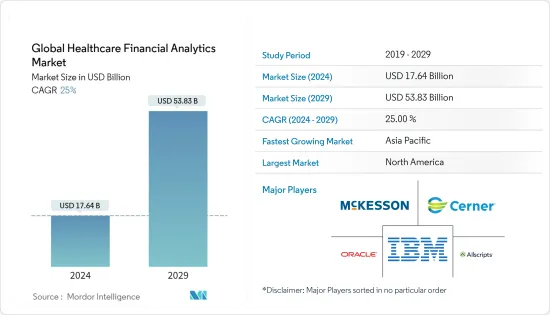
세계의 헬스케어 재무 분석(Healthcare Financial Analytics) 시장 규모는 2024년에 176억 4,000만 달러로 추정되며, 2029년에는 538억 3,000만 달러에 달할 것으로 예상되며, 예측 기간 중(2024-2029년) CAGR은 25%로 추이하며 성장할 것으로 예측됩니다.
팬데믹은 헬스케어 재무 분석 시장에 악영향을 미쳤습니다. 2020년 4월에 게시된 'COVID-19 팬데믹 기간 중 RCM 프로세스 간소화를 위한 팁'이라는 제목의 기사에 따르면, 헬스케어 분석은 여러 가지 이유로 압박을 받고 있습니다. 우선, 이전에 기록되지 않았던 질환을 가진 환자를 기록해야 하는 요구 사항으로 인해 많은 오해와 절차적 혼란이 발생했습니다. 둘째, 청구 담당자와 코더는 평균적인 학습 곡선보다 훨씬 빠른 속도로 변화하는 지불자의 요구와 코딩 표준을 따라잡아야 합니다. 셋째, COVID-19 환자 청구는 시장에 영향을 미치는 수많은 규제 기관의 제약이 수반되는 팬데믹과 관련이 있기 때문에 표준 청구와 달라야 합니다. 하지만 COVID-19 상황에서 원격 의료는 환자와 헬스케어 제공자 간의 효과적인 소통 수단으로 부상했습니다. 원격 진료 예약을 통해 초기 검진을 제공하고, 2차 소견을 제시하고, 환자와 후속 조치를 취할 수 있는 유연성을 제공함으로써 바이러스 확산을 방지할 수 있게 되었습니다. 디지털화 프로세스의 증가는 보다 투명한 청구 절차에 대한 수요를 증가시켜 시장을 주도하고 있습니다. 유럽위원회는 2021년 4월에 발표한 "COVID-19 이후 유럽의 디지털 의료 혁명"이라는 제목의 기사에서 COVID-19 회복 대응 프로그램의 구성 요소로 EU4Health 프로그램을 제안했습니다. 이 노력은 유럽 보건 부문의 디지털 전환을 위해 51억 유로를 조달하고 향후 잠재적인 국제 보건 문제에 대한 대비를 보장하기 위한 것입니다. 따라서 연구 기간 동안 시장 확대는 의료의 디지털 전환에 대한 정부 투자 증가에 의해 주도될 것입니다. 따라서 COVID-19는 의료 분석 수요에 부정적인 영향을 미쳤으나 입원 환자 수와 외래 환자 수가 증가하면서 회복될 것으로 예상됩니다.
빅 데이터 분석은 의료 분석 분야에서 빠르게 떠오르는 주제입니다. 생물정보학과 의료정보학의 새로운 결합으로 인해 표적 약물, 개인 맞춤형 의료, 임상 의사 결정 지원, 인구 건강 관리 등 모든 의료 분야에서 연구가 활발히 진행되고 있습니다. 2020년 9월 영국 총리는 제13차 일반 업무 프로그램에 명시된 WHO의 모든 활동을 지원하기 위해 4년간 3억 4천만 유로의 핵심 자발적 기부(CVC)를 시작했습니다. 그 결과, 여러 정부 조치로 인해 RCM 플랫폼이 채택되어 시장 확대에 기여하고 있습니다. 2020년 영국 국민보건서비스(NHS)는 지역 차원에서 헬스케어를 관리하고 비용을 지불하는 191개의 임상 커미셔닝 그룹에 자금을 할당했습니다. NHS는 모든 국민에게 병원, 의사, 정신 건강 치료를 포함한 무료 공공 헬스케어를 자동으로 제공합니다. NHS는 온라인 진료 예약 시스템 구축, 처방 및 의료 기록 보관 소프트웨어의 품질 표준 수립 등 의료 정보 기술의 전략적 방향을 결정할 책임이 있습니다. 따라서 연구 중인 시장은 더 나은 환급 프로세스를 위한 수익 주기 관리 소프트웨어의 사용에 의해 주도될 것입니다. 또한 주요 시장 플레이어의 이니셔티브도 시장 성장의 또 다른 요인입니다. 예를 들어, 2020년 8월 Quantzig는 의료, 제약 및 생명 과학 기업이 데이터 기반 인사이트를 통해 팬데믹에서 벗어날 수 있도록 지원하는 고급 임상 데이터 분석 솔루션을 출시했습니다. 따라서 위에서 언급한 요인들이 시장 성장을 촉진할 것으로 예상됩니다.
그러나 헬스케어는 적절한 훈련을 받은 IT 전문가가 부족하기 때문에 시장 성장을 방해할 것으로 예상됩니다.
헬스케어 재무 분석 시장 동향
클라우드 기반 부문이 예측 기간 동안 큰 성장을 보일 것으로 예상
도입 형태에 따라 시장은 온프레미스형과 클라우드 기반으로 구분됩니다. 클라우드 기반 부문은 클라우드 플랫폼 채택이 증가함에 따라 예측 기간 동안 큰 성장이 예상됩니다. 클라우드 애널리틱스는 모든 소스의 데이터를 캡처할 수 있기 때문에 클라우드 애널리틱스의 애플리케이션이 확대됨에 따라 재무 분석 시장을 이끌고 있습니다. 또한, 헬스케어에 있어서 보다 우수한 청구·수익 관리 시스템 수요나, 다양한 업계에서 클라우드 컴퓨팅이 받아들여지고 있는 것이, 재무 계획을 새로운 레벨로 밀어 올리고 있어 헬스 케어 재무 분석 시장에 플러스의 효과를 가져올 것으로 예상됩니다. 일부 유럽 국가에서는 정부가 헬스케어에서 정보 기술의 발전을 장려하는 이니셔티브를 제시하고 있습니다. 예를 들어, 완전히 연결된 클라우드 중심의 헬스케어를 채택한 영국 정부의 이니셔티브의 일환으로 2021년 2월에 200만개 이상의 NHS(국민 보건 서비스) 사서함이 Microsoft의 Azure Cloud 구성 요소입니다. Exchange Online으로 마이그레이션되었습니다. 그 결과 NHS 조직과 부문 직원 간의 의사소통이 보다 쉽고 효과적이 되고 이용 가능한 정보도 늘어납니다. 이로 인해 시장 확대가 개선되고 영국의 의료 정보 기술(HCIT) 변경 관리 서비스 이용이 증가합니다. 또한 지역 시장 진출 기업과 정부 기관의 복합적인 노력도 이 분야의 확대에 기여하고 있습니다. 예를 들어, 독일 텔레콤의 T-Systems는 Google 클라우드와 제휴하여 2021년 9월부터 독일 기업, 의료 제공자, 일반 소비자를 위한 주권 클라우드 서비스를 개발·전개합니다. 양사는 협력하여 차세대 소블린 클라우드 인프라와 제품을 폭넓게 제공하기 위한 기술 혁신을 실시합니다. 이 사업은 오스트리아와 스위스에서도 동등한 소블린 클라우드를 구축하는 것을 생각하고 있습니다. 따라서 위와 같은 요인이 시장 성장을 높일 것으로 예상됩니다.
북미가 헬스케어 재무 분석 시장을 독점
북미의 헬스케어 인프라는 기술 진보와 병원 및 기타 의료시설에서 생성되는 빅데이터 관리에 대한 높은 요건 등 요인으로 인해 재무 분석 영역에 플러스의 동향을 반영할 것으로 예상됩니다. 또한, 데이터 관리에서 소프트웨어의 보급은 헬스케어 재무 분석 채택 확대로 이어지는 맨 파워의 감소로 이어집니다. 그러므로 다양한 업종에 걸친 선진기술에 대한 수요 증가는 조사 대상 시장의 성장을 가속할 것으로 예상됩니다. 연방 정부는 여러 법률과 프로그램을 통해 의료 데이터의 이용을 촉진하고 있습니다. 건강복지부는 미국에서 가장 중요한 의료법인 의료비 부담 적정화법(ACA)에 근거해 헬스케어와 의료보험 시장의 투명성을 촉진하는 데이터의 공개가 허가되고 있습니다. 정부는 메디케어 메디케이드 서비스 센터, 식품의약국, 질병관리센터 등 조직의 데이터를 공개하기 위해 필요한 조치를 취하고 있습니다. 또한 헬스케어 제공업체가 전자 의료 기록을 사용하기 위한 경제적인센티브를 제공합니다. 이와 마찬가지로 헬스케어 애널리틱스 시장은 의료 수준을 높이려는 시장 진출기업 전략적 이니셔티브에 의해 견인되고 있습니다. 2020년 3월, 수료 헬스케어와 ESRI는 공동으로 미국 지역별로 병상 용량과 발생할 수 있는 COVID-19 위험을 조사하고 모니터링할 수 있는 플랫폼을 구축했습니다. 그 결과, 이 분야 시장이 발전할 가능성이 높습니다. 메디케어와 메디케이드를 포함한 정부 지급 기관은 결과를 추적하고 보상이 지급되는 가치 기반 구매와 인두 지급 모델을 빠르게 도입하고 있습니다. 예측 분석은 이 새로운 모델의 성공을 위해 공급업체와 마찬가지로 중요할 것으로 보입니다. 그 결과 분석 툴과 솔루션에 대한 수요가 높아지고 그 이용이 시장 확대를 촉진할 것으로 예상됩니다.
헬스케어 재무 분석 산업 개요
헬스케어 재무 분석 시장은 부분적으로 단편화되어 있으며 여러 주요 기업으로 구성되어 있습니다. 헬스케어 재무 분석 시장의 세계 플레이어는 IBM, Allscripts Healthcare Solutions, Cerner Corporation, Health Catalyst, Mckesson Corporation, Optum Inc, Oracle Corporation, SAS Institute Inc., Verisk Analytics, Inc. 등입니다.
기타 혜택 :
- 엑셀 형식 시장 예측(ME) 시트
- 3개월간의 애널리스트 서포트
목차
제1장 서론
- 조사 전제 조건 및 시장 정의
- 조사 범위
제2장 조사 방법
제3장 주요 요약
제4장 시장 역학
- 시장 개요
- 시장 성장 촉진 요인
- 빅데이터의 출현
- 디지털 기술에 대한 의식 증가
- 데이터의 취급을 용이하게 하는 기술 진보
- 시장 성장 억제 요인
- 적절한 훈련을 받은 IT 전문가의 부족
- Porter's Five Forces 분석
- 신규 참가업체의 위협
- 구매자/소비자의 협상력
- 공급기업의 협상력
- 대체품의 위협
- 경쟁 기업간 경쟁 관계의 강도
제5장 시장 세분화
- 유형별
- 클레임 분석
- 수익주기 관리
- 리스크 관리 분석
- 기타
- 구성별
- 하드웨어
- 소프트웨어&서비스
- 전개별
- 온프레미스
- 클라우드 기반
- 지역별
- 북미
- 미국
- 캐나다
- 멕시코
- 유럽
- 독일
- 영국
- 프랑스
- 이탈리아
- 스페인
- 기타 유럽
- 아시아 태평양
- 중국
- 일본
- 인도
- 호주
- 한국
- 기타 아시아 태평양
- 중동 및 아프리카
- GCC
- 남아프리카공화국
- 기타 중동 및 아프리카
- 남미
- 브라질
- 아르헨티나
- 기타 남미
- 북미
제6장 경쟁 구도
- 기업 개요
- IBM
- Allscripts Healthcare Solutions
- Cerner Corporation
- Health Catalyst
- Mckesson Corporation
- Optum Inc
- Oracle Corporation
- SAS Institute Inc.
- Verisk Analytics, Inc
- CitiusTech Inc
- CVS Health
- Inovalon
제7장 시장 기회 및 향후 동향
LYJThe Global Healthcare Financial Analytics Market size is estimated at USD 17.64 billion in 2024, and is expected to reach USD 53.83 billion by 2029, growing at a CAGR of 25% during the forecast period (2024-2029).
The pandemic had an adverse effect on the healthcare financial analytics market. Healthcare analytics is under pressure for a number of reasons, according to an article titled "Tips to Streamline Your RCM Process During COVID-19 Pandemic" which was published in April 2020. First of all, the requirement to record patients with previously unrecorded conditions has caused a great deal of misunderstanding and procedural chaos. Second, billers and coders must keep up with shifting payer needs and coding standards at a rate far faster than the average learning curve. Thirdly, charging for COVID-19 patients must differ from standard billing because the therapy is linked to a pandemic with numerous accompanying regulatory body constraints that have an effect on the market. However, with COVID-19 in the scenario, Telehealth has emerged as an effective method for patients to interact between patients and healthcare providers. This has provided the flexibility to schedule remote appointments to provide initial screenings, offer second opinions, and follow-up with patients which will prevent the spread of the virus. The increase in the digitalization process has increased the demand for more transparent billing procedures, thus driving the market. The European Commission suggested the EU4Health program as a component of a COVID-19 recovery response program, according to an article titled "The European digital health revolution in the wake of COVID-19" that was published in April 2021. The effort intends to raise EUR 5.1 billion for the European health sector's digital transformation and to assure readiness for potential future international health concerns. Therefore, the market expansion throughout the study period will be driven by rising government investments in the digital transformation of healthcare. Thus, COVID-19 has impacted adversely the demand for healthcare analytics, but it is expected to recover with the increase in the number of inpatients and outpatients number.
Big data analytics is a fast-emerging topic in healthcare analytics. The emerging blend of bioinformatics and health informatics has encouraged research in all the healthcare segments, such as target drug, personalized medicine, clinical decision support, and population health management. A core voluntary contribution (CVC) of EUR 340 million over four years was initiated by the Prime Minister of the United Kingdom in September 2020 to support all of the WHO's activities in the nation as outlined in the 13th General Programme of Work. As a result, a number of government measures are to blame for the adoption of RCM platforms, which contribute to the market's expansion. In 2020, National Health Service (NHS) England allocates funds to 191 Clinical Commissioning Groups, which govern and pay for care delivery at the local level. The NHS provides free public health care, including hospital, physician, and mental health treatment, to all national residents on an automatic basis. The NHS is responsible for determining the strategic direction of health information technology, including the creation of online appointment booking systems and the establishment of quality standards for prescription and medical record-keeping software. As a result, the market under study will be driven by the usage of revenue cycle management software for better reimbursement processes. Additionally, initiatives by key market players are another factor in market growth. For instance, in August 2020, Quantzig launched advanced clinical data analytics solutions to help healthcare, pharma, and life science companies lead their way out of the pandemic with data-driven insights. Thus, the abovementioned factors are expected to increase market growth.
However, the lack of properly trained IT professionals in healthcare is expected to hinder the market growth.
Healthcare Financial Analytics Market Trends
Cloud Based Segment is Expected to Show Significant Growth over the Forecast Period
Based on deployment, the market is segmented into on-premise, and cloud-based. The cloud-based segment is expected to show better growth during the forecast period, owing to the Increasing adoption of cloud platforms. The financial analytics market is driven by the rising application of cloud analytics as it allows organizations to incorporate data from all sources. In addition, the demand for better claims and revenue management systems in healthcare and cloud computing acceptance across various industries has pushed financial planning to a new level and is expected to have a positive effect on the healthcare financial analytics market. Governments in several European nations are launching initiatives to encourage the development of information technology in healthcare. For example, over two million National Health Services (NHS) mail mailboxes were transferred to Exchange Online, a component of Microsoft's Azure Cloud, in February 2021 as part of the United Kingdom government's initiative to adopt a fully connected cloud-driven health service. As a result, communication between staff members of NHS organizations and departments will be easier and more effective, and the information available will be increased. This will improve market expansion and increase the use of Health Information Technology (HCIT) Change Management services in the United Kingdom. The combined actions undertaken by regional market participants and governmental agencies are also contributing to the sector's expansion. For instance, Deutsche Telekom's T-Systems has teamed with Google Cloud to develop and deploy sovereign cloud services to German businesses, healthcare providers, and the general public starting in September 2021. Together, the businesses will innovate to provide a wide range of next-generation sovereign cloud infrastructure and products. The business is thinking of constructing a comparable sovereign cloud for Austria and Switzerland. Thus, the abovementioned factors are expected to increase the market growth.
North America Dominates the Healthcare Financial Analytics Market
The healthcare infrastructure in North America is expected to reflect positive trends in the financial analytics domain, owing to factors such as technological advancements, and high requirements for management of big data generated from hospitals and other healthcare facilities. Furthermore, the growing popularity of software in the management of data reduces the manpower leading to increased adoption of healthcare financial analytics. Hence, the rising demand for advanced technologies across various verticals is expected to enhance the growth of the studied market. Through several laws and programs, the federal government promotes the use of its healthcare data. The Department of Health and Human Services is permitted to publish data that encourages transparency in the markets for healthcare and medical insurance under the terms of the Affordable Care Act (ACA), the most significant piece of healthcare legislation in the United States. The government has taken the necessary steps to release data from organizations like the Centers for Medicare and Medicaid Services, the Food and Drug Administration, and the Centers for Disease Control. It is also providing financial incentives for healthcare providers to use electronic medical records. Similar to this, the healthcare analytics market is being driven by strategic initiatives taken by major market participants to improve the standard of healthcare. In March 2020, Definitive Healthcare and ESRI collaborated to create a platform that allows for the study and monitoring of hospital bed capacity and possible COVID-19 risk by geographic regions in the United States. As a result, the market in the area is likely to develop. Government payers, including Medicare and Medicaid, are quickly embracing value-based purchasing and capitated payment models where outcomes will be tracked and rewarded. Predictive analytics will become just as important to the success of this new model as the suppliers. As a result, the increased demand for and use of analytical tools and solutions is anticipated to fuel market expansion.
Healthcare Financial Analytics Industry Overview
The healthcare financial analytics market is partially fragmented and consists of several major players. The global players in the healthcare financial analytics market are IBM, Allscripts Healthcare Solutions, Cerner Corporation, Health Catalyst, Mckesson Corporation, Optum Inc, Oracle Corporation, SAS Institute Inc., and Verisk Analytics, Inc. among others.
Additional Benefits:
- The market estimate (ME) sheet in Excel format
- 3 months of analyst support
TABLE OF CONTENTS
1 INTRODUCTION
- 1.1 Study Assumptions and Market Definition
- 1.2 Scope of the Study
2 RESEARCH METHODOLOGY
3 EXECUTIVE SUMMARY
4 MARKET DYNAMICS
- 4.1 Market Overview
- 4.2 Market Drivers
- 4.2.1 Emergence of Big Data in Healthcare
- 4.2.2 Growing Awareness For Digital Technologies
- 4.2.3 Technological Advancements Making Data Handling Easy
- 4.3 Market Restraints
- 4.3.1 Lack of Properly Trained IT Professionals in Healthcare
- 4.4 Porter's Five Forces Analysis
- 4.4.1 Threat of New Entrants
- 4.4.2 Bargaining Power of Buyers/Consumers
- 4.4.3 Bargaining Power of Suppliers
- 4.4.4 Threat of Substitute Products
- 4.4.5 Intensity of Competitive Rivalry
5 MARKET SEGMENTATION (Market Size by Value - USD million)
- 5.1 By Type
- 5.1.1 Claim Analytics
- 5.1.2 Revenue Cycle Management
- 5.1.3 Risk Management Analytics
- 5.1.4 Others
- 5.2 By Component
- 5.2.1 Hardware
- 5.2.2 Software & Services
- 5.3 By Deployment
- 5.3.1 On-premise
- 5.3.2 Cloud-based
- 5.4 Geography
- 5.4.1 North America
- 5.4.1.1 United States
- 5.4.1.2 Canada
- 5.4.1.3 Mexico
- 5.4.2 Europe
- 5.4.2.1 Germany
- 5.4.2.2 United Kingdom
- 5.4.2.3 France
- 5.4.2.4 Italy
- 5.4.2.5 Spain
- 5.4.2.6 Rest of Europe
- 5.4.3 Asia-Pacific
- 5.4.3.1 China
- 5.4.3.2 Japan
- 5.4.3.3 India
- 5.4.3.4 Australia
- 5.4.3.5 South Korea
- 5.4.3.6 Rest of Asia-Pacific
- 5.4.4 Middle-East and Africa
- 5.4.4.1 GCC
- 5.4.4.2 South Africa
- 5.4.4.3 Rest of Middle-East and Africa
- 5.4.5 South America
- 5.4.5.1 Brazil
- 5.4.5.2 Argentina
- 5.4.5.3 Rest of South America
- 5.4.1 North America
6 COMPETITIVE LANDSCAPE
- 6.1 Company Profiles
- 6.1.1 IBM
- 6.1.2 Allscripts Healthcare Solutions
- 6.1.3 Cerner Corporation
- 6.1.4 Health Catalyst
- 6.1.5 Mckesson Corporation
- 6.1.6 Optum Inc
- 6.1.7 Oracle Corporation
- 6.1.8 SAS Institute Inc.
- 6.1.9 Verisk Analytics, Inc
- 6.1.10 CitiusTech Inc
- 6.1.11 CVS Health
- 6.1.12 Inovalon