|
시장보고서
상품코드
1432656
일본의 피임 기구 시장 : 점유율 분석, 산업 동향 및 통계, 성장 예측(2024-2029년)Japan Contraceptive Devices - Market Share Analysis, Industry Trends & Statistics, Growth Forecasts (2024 - 2029) |
||||||
 Mordor Intelligence
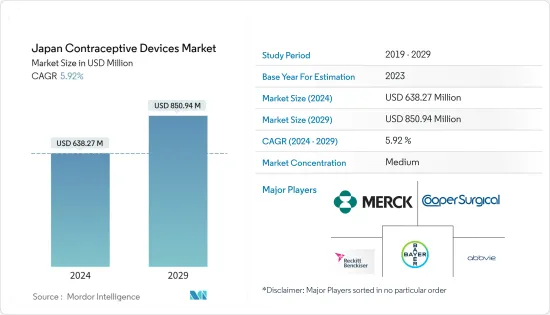
일본의 피임 기구(Contraceptive Devices) 시장 규모는 2024년 6억 3,827만 달러로 추정되며, 2029년 8억 5,094만 달러에 이를 것으로 예측 되며, 예측기간(2024-2029년)의 CAGR은 5.92%로 추이하며 성장할 것으로 예측됩니다.

시장 성장을 가속하는 요인으로는 성감염증(STD)에 대한 의식이 높아지거나 의도하지 않은 임신률 상승 등이 있습니다.
COVID-19의 발생은 피임 기구 시장의 가치에 큰 영향을 미쳤습니다. COVID-19의 발생은 경제에 영향을 미친 재정적 역경과 함께 상당한 질병 부담을 주었습니다. COVID-19 팬데믹 기간 동안 전 세계 수백만 명의 여성과 소녀들이 피임 및 낙태 서비스를 이용할 수 없게 되었습니다. 봉쇄, 여행 제한, 공급망 중단, COVID-19 대응을 위한 보건 자원의 대규모 이동, 감염에 대한 두려움 등이 모두 의도치 않은 임신의 증가에 기여했습니다. 여행 제한 조치로 인해 피임약 부족으로 인해 안전하지 않은 낙태가 기하급수적으로 증가하면서 임신이 기하급수적으로 증가했습니다. 콘돔 얼라이언스 2020의 보고서에 따르면, 2020년 봉쇄 기간 동안 콘돔 판매량은 52% 감소했으며, 2021 회계연도에는 연간 31% 감소할 것으로 예상됩니다. 이처럼 COVID-19는 피임 기구 시장에 큰 영향을 미쳤습니다.
유엔경제사회국에 따르면 2020년 일본 여성 인구의 피임률은 약 56.6%로, 이 비율은 2030년에는 62.5%에 이를 것으로 추정됩니다. 또한, 정부의 피임과 가족계획에 대한 의식향상에 대한 노력도 시장 성장을 뒷받침하고 있습니다. 따라서 위와 같은 요인은 시장 성장을 가속할 것으로 예상됩니다. 한편, 일본에서는 성감염증의 부담이 증가하고 있어 시장의 성장을 더욱 뒷받침하고 있습니다. 예를 들어, 2020년 4월에 일본 의료기관에서 보고된 클라미디아 환자 수는 약 2만 8,400명으로 지난 10년간 가장 많으며 동시에 일본에서 가장 흔한 성병이 되고 있습니다. 같은 해, 생식기 헤르페스 환자 수는 9,000명이었습니다.
따라서 앞에서 설명한 이유는 시장 성장을 이끌고 있습니다.
일본 피임 기구 시장 동향
예측기간 동안 콘돔이 시장을 독점할 전망
콘돔은 성관계 시 임신이나 성병(STI) 감염 가능성을 줄이기 위해 사용하는 덮개 모양의 차단 장치입니다. 시중에는 남성용과 여성용 콘돔이 모두 판매되고 있습니다. 콘돔을 사용하면 임질, 클라미디아, 트리코모나스, B형 간염 및 HIV/AIDS의 위험을 크게 줄일 수 있습니다. 또한 생식기 헤르페스, 인유두종 바이러스(HPV), 매독에 대한 예방 효과도 어느 정도 있습니다.
또한 일본에서는 Okamoto Industries이 가장 폭넓은 콘돔 라인업을 가지고 있습니다. 2020년에는 Okamoto Industries는 Condomania와 공동으로 일본을 테마로 한 콘돔이나 의학적 연구로 HIV, HSV, HPV를 최대 99.9% 불활성화하는 것으로 나타난 특수 살균제 도포한 세계 최초의 콘돔도 출시 할 예정입니다. 따라서 위의 요인을 고려하면 곧 큰 성장을 보일 것으로 예상됩니다.
일본 정부는 청소년의 의식을 향상시키고 성병 대책이나 원치 않는 임신을 예방하기 위해 피임 기구의 사용을 장려하기 위해 다양한 캠페인과 종합적인 성교육 프로그램을 도입하고 있습니다. 일본에서는 후생성이 콘돔을 조달하고 NACO/SACS가 HIV/AIDS 예방을 위해 TI NGO/ICTC/ART 센터를 통해 고위험 그룹(HRG)에 배포하고 있습니다. 한편, 국립보건부(NDOH)는 남성용 콘돔을 지역 전체의 모든 지역사회에서 쉽게 입수할 수 있도록 노력하고 있습니다.
따라서 앞서 언급한 요인은 시장 성장을 가속합니다.
기타 혜택 :
- 엑셀 형식 시장 예측(ME) 시트
- 3개월간의 애널리스트 서포트
목차
제1장 서론
- 조사 전제 조건 및 시장 정의
- 조사 범위
제2장 조사 방법
제3장 주요 요약
제4장 시장 역학
- 시장 개요
- 시장 성장 촉진 요인
- 성감염증(STD)에 대한 의식이 높아짐
- 의도하지 않은 임신률 상승
- 시장 성장 억제 요인
- 피임 기구 사용에 따른 부작용
- Porter's Five Forces 분석
- 신규 참가업체의 위협
- 구매자/소비자의 협상력
- 공급기업의 협상력
- 대체품의 위협
- 경쟁 기업간 경쟁 관계의 강도
제5장 시장 세분화
- 유형별
- 콘돔
- 다이어프램
- 자궁 경관 캡
- 스폰지
- 질 링
- 자궁내 피임 기구(IUD)
- 기타 유형
- 성별
- 남성
- 여성
제6장 경쟁 구도
- 기업 개요
- Reckitt Benckiser
- Cooper Surgical Inc.
- Abbvie Inc(Allergan PLC)
- Merck&Co., Inc
- Bayer AG
- Mylan Laboratories
- Okamoto Industries, Inc
- Pfizer Inc.
제7장 시장 기회 및 향후 동향
LYJThe Japan Contraceptive Devices Market size is estimated at USD 638.27 million in 2024, and is expected to reach USD 850.94 million by 2029, growing at a CAGR of 5.92% during the forecast period (2024-2029).
Certain factors that are driving the market growth include the increasing awareness about sexually transmitted diseases (STDs) and the rising rate of unintended pregnancies.
The outbreak of COVID-19 has significantly impacted the contraceptives market value. The outbreak inflicted a substantial disease burden along with financial adversities that have impacted the economy. While during the coronavirus pandemic, millions of women and girls worldwide lost access to contraception and abortion services. Lockdowns, travel restrictions, supply chain disruptions, a massive shift of health resources to combat COVID-19, and the fear of infection had all contributed to an increase in the number of unintended pregnancies in the country. As a result of travel restrictions, the incidence of unsafe abortions in the country had led to rising pregnancy exponentially due to a lack of contraceptives. According to a report by the Condom Alliance 2020, condom sales in the country fell 52 percent during the lockdown period in 2020, with a projected full-year decline of 31 percent for FY2021. Thus, Covid-19 has had a significant impact on the market for contraceptive devices.
According to the United Nations Department of Economic and Social Affairs, estimated that in 2020, the contraception usage among the female Japanese population stood at around 56.6 percent and this percentage is expected to reach 62.5 percent by 2030. Moreover, initiatives by the government to raise awareness regarding contraceptives and family planning have also helped the growth of the market. Thus, owing to the above-mentioned factors it is expected to drive market growth. While the increasing burden of sexually transmitted diseases in Japan is further propelling the market growth. For instance , In April 2020, around 28.4 thousand cases of chlamydia were reported by medical institutions in Japan, representing the highest number in the last decade, and at the same time making it the most common STD of Japan. In the same year, the recorded cases of herpes genitalis amounted to exactly nine thousand.
Thus, the aforementioned reasons are driving the market growth.
Japan Contraceptive Devices Market Trends
Condoms are Expected to Dominate the Market Over the Forecast Period
A condom is a sheath-shaped barrier device that is being used during sexual intercourse to reduce the probability of pregnancy or a sexually transmitted infection (STI). There are both male and female condoms available in the market. Their use greatly decreases the risk of gonorrhea, chlamydia, trichomoniasis, hepatitis B, and HIV/AIDS. They also to a lesser extent protect against genital herpes, human papillomavirus (HPV), and syphilis.
Moreover, in Japan, Okamoto Industries has the widest condom range. In 2020, Okamoto in collaboration with Condomania is also debuting Japanese-themed condoms, as well as the world's first condoms coated with a special microbicide that has been shown in medical studies to inactivate up to 99.9 percent of HIV, HSV, and HPV. Thus, considering the above-mentioned factors it is expected to show significant growth shortly.
The government in Japan is introducing different campaigns and comprehensive sex education programs to improve awareness among youth and encourage them to use contraceptives in order to combat STDs and prevent unwanted pregnancies. In Japan, the Ministry of Health and Family Welfare procures condoms that are distributed by NACO/SACS to high-risk groups (HRGs) via TI NGOs/ICTC/ART centres for HIV/AIDS prevention. Whereas, in the National Department of Health (NDOH) is working to ensure that male condoms are readily available in all communities throughout the region.
Thus, the aforementioned factors are propelling the growth of the market.
Japan Contraceptive Devices Industry Overview
The Japan Contraceptive Devices Market is fragmented in nature. Moreover, Japan has been witnessing the emergence of some small players due to presence of high awareness. This has also helped the studied market to grow. Some of the market players include Reckitt Benckiser, Cooper Surgical Inc., Abbvie Inc (Allergan PLC), Merck & Co., Inc, Mylan Laboratories, Okamoto Industries, Inc, Pfizer Inc., and Bayer AG.
Additional Benefits:
- The market estimate (ME) sheet in Excel format
- 3 months of analyst support
TABLE OF CONTENTS
1 INTRODUCTION
- 1.1 Study Assumptions and Market Definition
- 1.2 Scope of the Study
2 RESEARCH METHODOLOGY
3 EXECUTIVE SUMMARY
4 MARKET DYNAMICS
- 4.1 Market Overview
- 4.2 Market Drivers
- 4.2.1 Increasing Awareness about Sexually Transmitted Diseases (STDs)
- 4.2.2 Rising Rate of Unintended Pregnancies
- 4.3 Market Restraints
- 4.3.1 Side Effects Associated with the Use of Contraceptive Devices
- 4.4 Porter's Five Force Analysis
- 4.4.1 Threat of New Entrants
- 4.4.2 Bargaining Power of Buyers/Consumers
- 4.4.3 Bargaining Power of Suppliers
- 4.4.4 Threat of Substitute Products
- 4.4.5 Intensity of Competitive Rivalry
5 MARKET SEGMENTATION (Market Size by Value - USD million)
- 5.1 By Type
- 5.1.1 Condoms
- 5.1.2 Diaphragms
- 5.1.3 Cervical Caps
- 5.1.4 Sponges
- 5.1.5 Vaginal Rings
- 5.1.6 Intra Uterine Device (IUD)
- 5.1.7 Other Types
- 5.2 By Gender
- 5.2.1 Male
- 5.2.2 Female
6 COMPETITIVE LANDSCAPE
- 6.1 Company Profiles
- 6.1.1 Reckitt Benckiser
- 6.1.2 Cooper Surgical Inc.
- 6.1.3 Abbvie Inc (Allergan PLC)
- 6.1.4 Merck & Co., Inc
- 6.1.5 Bayer AG
- 6.1.6 Mylan Laboratories
- 6.1.7 Okamoto Industries, Inc
- 6.1.8 Pfizer Inc.