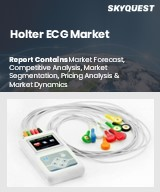
|
시장보고서
상품코드
1441698
세계 심장 부정맥 모니터링 기기 시장 : 점유율 분석, 업계 동향과 통계, 성장 예측(2024-2029년)Cardiac Arrhythmia Monitoring Devices - Market Share Analysis, Industry Trends & Statistics, Growth Forecasts (2024 - 2029) |
||||||
 Mordor Intelligence
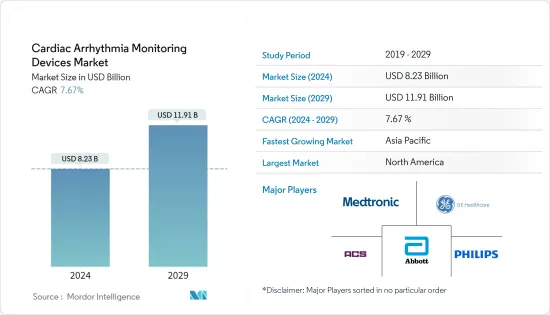
심장 부정맥 모니터링 기기 시장 규모는 2024년에 82억 3,000만 달러로 추정되며, 2029년까지 119억 1,000만 달러에 이를 것으로 예측되며, 예측 기간(2024-2029년) 동안 7.67%의 연평균 복합 성장률(CAGR)로 성장할 전망입니다.

신형 코로나바이러스 감염(COVID-19)의 유행은 몇몇 입원 및 외래 환자의 심장 치료가 연기되거나 연기되었기 때문에 부정맥 모니터링 시장에 큰 영향을 미쳤습니다. 그 결과 부정맥으로 고통받는 환자의 진단이 크게 감소했습니다. 그러나 신형 COVID-19 감염과 관련된 심장 합병증의 발생으로 부정맥 모니터링 기기 수요가 향후 증가할 것으로 예상됩니다. 예를 들어, 2020년 7월에 공개된 "COVID-19 감염과 심혈관 질환: 기본 메커니즘에서 임상적 관점까지"라는 제목의 기사에 따르면, 기본 심혈관 질환의 병존 질환을 가진 COVID-19 감염증 환자의 사망률은 높습니다. 이 정보 근육은 부정맥과 갑작스런 심정지가 COVID-19증의 일반적인 증상이라고도 보고했습니다. 2020년 12월 공개된 ``COVID-19 후 부정맥 발생률과 임상적 영향: 17,435명의 환자의 체계적인 검토 및 메타분석''이라는 제목의 기사에 따르면, 부정맥은 COVID-19의 잠재적 심혈관 합병증입니다. 연구에 따르면 COVID-19 감염으로 입원한 환자들의 16.7%가 원인 불명의 부정맥을 일으켰습니다. 따라서 심장 부정맥 모니터링 기기 수요는 향후 수년간 증가할 것으로 예상됩니다.
또한 시장 성장은 원격 심장학 사용 증가, 부정맥 모니터링 기기의 사용 편의성과 휴대성, 스마트 심장 모니터 개발에 크게 기여할 수 있습니다.
원격 심장병의 사용 증가는 시장 성장을 가속하는 주요 요인입니다. 원격 심장학은 일반적으로 부정맥으로 고통받는 환자의 가슴에 고정 할 수있는 모니터링 기기를 제공합니다. 원격 심장학은 심부전으로 고통받는 노인에게 비용 효율적인 개입입니다. 따라서 원격 심장학의 채용이 증가하고 있습니다. 일부 기업은 원격 심장 병학 서비스를 시작하고 시장 성장을 가속하고 있습니다. 예를 들어, Coala Life는 2020년 12월에 환자에게 직접 원격 심장병학 서비스를 시작했습니다. 이 제품은 패치가 필요 없는 스마트폰에서 작동하는 심전도(ECG) 모니터로 진단 품질과 가장 흔한 부정맥의 실시간 감지를 제공합니다.
부정맥 모니터링 기기의 사용 편의성과 휴대성은 시장 성장을 가속하는 주요 요인 중 하나입니다. 예를 들어, RhythMedix는 2021년 2월에 부정맥 검출을 위한 4G 셀룰러 연결을 내장한 차세대 웨어러블한 새로운 심장 원격 측정 모니터를 출시했습니다. 따라서, 이러한 개발은 휴대가 용이하고 휴대용 유사한 심장 모니터의 더 많은 유형의 개발을 촉진하여 시장 성장을 가속할 수 있습니다.
그럼에도 불구하고, 신흥 시장에서의 원격측정기술의 도입이 불충분하고, 원격심장부정맥 모니터링기기의 비용이 높아 시장의 성장을 방해하고 있습니다.
심장 부정맥 모니터링 기기 시장 동향
홀터 모니터링 기기가 시장을 독점할 것으로 예상
홀터 심전도 기기가 시장을 독점할 것으로 예상됩니다.
홀터 모니터링 기기 부서는 크게 성장할 것으로 예상됩니다. 홀터 심전도 모니터링 기기는 환자의 산발성 증상의 진단에 장기간 사용할 수 있기 때문에 시장을 독점하고 있습니다. 또한 보다 빠르고 편리한 모니터링을 제공하여 환자의 컴플라이언스를 높이고 치료 결과를 향상시킵니다.
이 부문의 성장을 가속하는 주요 요인은 부정맥으로 고통받는 사람의 수가 증가하고 심장 부정맥 모니터링 장비 시장에서 몇 가지 진보입니다. 예를 들어, 2021년 2월 RhythMedix는 부정맥 검출을 위한 웨어러블 심장 모니터를 출시했습니다. RhythMedix는 이 일체형 기기는 홀터 모니터링을 제공하는 최초의 웨어러블 멀티모달리티 심장 모니터로 환자와 임상의를 연결하여 더 나은 환자 관리를 실현할 것이라고 말합니다.
또한, 비정상적인 심박 리듬(부정맥) 또는 부정맥을 일으킬 수있는 상태의 일반적인 원인은 선천성 심장 질환, 관상 동맥 질환, 고혈압 및 기타 유형의 심혈관 질환(CVD)을 포함합니다. 됩니다. 이러한 기초 질환의 발병률 증가도 이 부문의 성장을 보완할 것으로 예상됩니다. 예를 들어 2021년 9월 국민보건서비스의 최신 정보에 따르면 영국에서는 200만 명 이상이 부정맥과 심박 리듬 문제를 경험하고 있다고 합니다. 이러한 통계는 홀터 모니터링 기기 수요가 더욱 증가할 것으로 예상된다는 것을 보여줍니다.
따라서 위의 요인은 홀터 모니터링 기기 수요를 높이고 이 부서의 성장에 긍정적인 영향을 미칠 수 있습니다.
북미는 심장 부정맥 모니터링 기기 시장을 독점할 것으로 예상
북미 내에서 미국의 부정맥 모니터링 장비 시장은 첨단 심장혈관 솔루션과 첨단 건강 관리 인프라 채택 증가로 견조한 성장을 이룰 것으로 추정됩니다.
미국 질병관리예방센터(CDC)는 2030년까지 미국에서 1,210만 명이 심방세동(AFib)이 될 것으로 추정하고 있습니다. AFib는 환자 집단 사이에서 진단되는 가장 일반적인 유형의 부정맥이기 때문에 이러한 통계는 부정맥 모니터링 기기 수요가 증가할 수 있으므로 시장 성장에 기여합니다.
또한 미국에서는 모바일 심장 외래 텔레메트리(MCOT)의 도입률이 우수합니다. 예를 들어, 2022년 1월 미국 FDA는 ECG 및 부정맥 모니터링을 위한 Biotricity의 Biotres 심장 모니터링 기기에 510(k) 인가를 부여했습니다. Biotres Cardiac Monitoring Device는 ECG 데이터의 연속 3채널 기록을 제공하는 웨어러블 홀터 패치 기기를 제공합니다. 이 전략은 미국 내 회사의 무선 기기 시장 제품 포트폴리오를 확대하는 데 도움이 되었습니다.
따라서, 이러한 요인을 고려하면, 시장은 예측 기간 동안 높은 성장을 이룰 것으로 예상됩니다.
심장 부정맥 모니터링 기기 산업 개요
심장 부정맥 모니터링 시장은 세계 및 국제 시장 기업이 여러 개 존재하고 적당한 경쟁이 계속되고 있습니다. 주요 기업은 파트너십, 협정, 협업, 신제품 출시, 지리적 확대, 합병, 인수 등 시장에서의 존재감을 높이기 위해 다양한 성장 전략을 채택하고 있습니다. 시장의 주요 기업으로는 Abbott, GE Healthcare, Medtronic PLC, Koninklijke Philips NV, ACS Diagnostics 등이 있습니다.
기타 혜택
- 엑셀 형식 시장 예측(ME) 시트
- 3개월의 애널리스트 서포트
목차
제1장 서론
- 조사의 성과
- 조사의 전제조건
- 조사 범위
제2장 조사 방법
제3장 주요 요약
제4장 시장 역학
- 시장 개요
- 시장 성장 촉진요인
- 원격 심장학 사용 증가
- 부정맥 모니터링 기기의 사용의 용이성과 휴대성
- 스마트 심장 모니터 개발
- 시장 성장 억제요인
- 신흥 시장에서의 원격 측정 기술 도입 지연
- 고액의 비용이 드는 부정맥의 원격 감시
- Porter's Five Forces 분석
- 신규 참가업체의 위협
- 구매자의 협상력
- 공급기업의 협상력
- 대체 제품의 위협
- 경쟁 기업간 경쟁 관계의 격렬
제5장 시장 세분화
- 기기별
- 이벤트 모니터링 기기
- 지속 리듬 모니터링 기기
- 홀터 모니터링 기기
- 기타 기기
- 서비스 제공업체별
- 모바일 심장 텔레메트리 모니터링 서비스 제공업체
- 독립 진단 검사 시설/진료소
- 지역별
- 북미
- 미국
- 캐나다
- 멕시코
- 유럽
- 독일
- 영국
- 프랑스
- 이탈리아
- 스페인
- 기타
- 아시아태평양
- 중국
- 일본
- 인도
- 호주
- 한국
- 기타
- 중동 및 아프리카
- GCC
- 남아프리카
- 기타
- 남미
- 브라질
- 아르헨티나
- 기타
- 북미
제6장 경쟁 구도
- 기업 프로파일
- ACSDiagnostics
- AliveCor Inc.
- Abbott Laboratories
- Biotronik
- GE Healthcare
- iRhythm Technologies Inc.
- Medi-Lynx
- Medtronic PLC
- Koninklijke Philips NV
- Welch Allyn
- Spacelabs Healthcare Inc.
- Fukuda Denshi
제7장 시장 기회와 미래 동향
JHS 24.03.08The Cardiac Arrhythmia Monitoring Devices Market size is estimated at USD 8.23 billion in 2024, and is expected to reach USD 11.91 billion by 2029, growing at a CAGR of 7.67% during the forecast period (2024-2029).
The COVID-19 pandemic has significantly impacted the cardiac arrhythmia monitoring market as several inpatient and outpatient cardiac procedures were postponed or delayed. As a result, the diagnosis of patients suffering from arrhythmias was substantially reduced. However, due to the emerging cardiac complications associated with COVID-19, the demand for arrhythmia monitoring devices is set to increase in the future. For instance, as per a July 2020 published article titled "COVID-19 and cardiovascular disease: from basic mechanisms to clinical perspectives", COVID-19 patients with underlying cardiovascular comorbidities have high mortality. The same source also reported that arrhythmias and sudden cardiac arrest are common manifestations of COVID-19. As per a December 2020 published article titled "Incidence rate and clinical impacts of arrhythmia following COVID-19: a systematic review and meta-analysis of 17,435 patients", arrhythmia is a potential cardiovascular complication of COVID-19. As per the study, in one case series of patients hospitalized with COVID-19, 16.7% developed unspecified arrhythmia. Thus, the demand for cardiac arrhythmia monitoring devices is anticipated to increase over the coming years.
Further, the market's growth can be largely attributed to the increasing use of telecardiology, ease of use and portability of cardiac arrhythmia monitoring devices, and the development of smart cardiac monitors.
Increasing usage of telecardiology is a major factor driving the market's growth. Telecardiology, in general, provides a monitoring device that can be fixed on the chest area of patients suffering from cardiac arrhythmia. Telecardiology is a cost-effective intervention for the elderly population affected by heart failure. Thus, the adoption of telecardiology is increasing. Several companies are launching their telecardiology services, propelling the market's growth. For instance, in December 2020, Coala Life launched a direct-to-patient telecardiology service. The product is a patch-free, smartphone-powered electrocardiogram (ECG) monitor that provides diagnostic quality and real-time detection of the most common cardiac arrhythmias.
The ease of use and portability of cardiac arrhythmia monitoring devices is one of the major factors driving the market's growth. For instance, in February 2021, RhythMedix launched its next-generation wearable novel cardiac telemetry monitor with built-in 4G cellular connectivity for arrhythmia detection. Thus, such developments may fuel the development of more types of similar cardiac monitors that are easy to carry and portable, thereby fueling the market's growth.
Nonetheless, poor adoption of telemetry technology in emerging markets and the high cost of remote cardiac arrhythmia monitoring devices are hindering the market's growth.
Cardiac Arrhythmia Monitoring Devices Market Trends
Holter Monitoring Devices is Expected to Dominate the Market
Holter Monitoring Devices Expected to Dominate the Market
The Holter monitoring devices segment is expected to witness significant growth. Holter monitoring devices are dominating the market as they can be used for longer durations in diagnosing sporadic symptoms among patients. They also offer faster and more convenient monitoring to increase patient compliance and enhance treatment outcomes.
The major factors fueling the segment's growth are the increasing number of people suffering from arrhythmias and several advancements in the cardiac arrhythmia monitoring devices market. For instance, in February 2021, RhythMedix launched a wearable cardiac monitor for arrhythmia detection. RhythMedix stated that the one-piece device is the first wearable multi-modality cardiac monitor offering Holter monitoring and connects patients and clinicians for better patient care.
In addition, common causes of abnormal heart rhythms (arrhythmias) or conditions that can lead to arrhythmias include congenital heart defects, coronary artery disease, high blood pressure, and other types of cardiovascular diseases (CVD). Increasing incidences of these underlying diseases are also anticipated to supplement the segment growth. For instance, as per a September 2021 update by the National Health Service, in the United Kingdom, more than 2 million people experience arrhythmias or heart rhythm problems. Such statistics indicate that the demand for Holter monitoring devices is further anticipated to increase.
Hence, the above-mentioned factors may boost the demand for Holter monitoring devices and positively impact the segment's growth.
North America is Expected to Dominate the Cardiac Arrhythmia Monitoring Devices Market
Within North America, the US cardiac arrhythmia monitoring devices market is estimated to witness robust growth due to the increasing adoption of advanced cardiovascular solutions and sophisticated healthcare infrastructure.
The Centers for Disease Control and Prevention (CDC) estimates that 12.1 million people in the United States will have atrial fibrillation (AFib) by 2030. As AFib is the most common type of cardiac arrhythmia diagnosed among the patient population, such statistics indicate that the demand for cardiac arrhythmia monitoring devices is likely to increase, thereby contributing to the market's growth.
Moreover, in the United States, Mobile Cardiac Outpatient Telemetry (MCOT) is witnessing a good adoption rate. For instance, in January 2022, the US FDA granted 510(k) clearance to Biotricity's Biotres Cardiac Monitoring Device for ECG and arrhythmia monitoring. Biotres Cardiac Monitoring Device offers a wearable Holter patch device to provide continuous three-channel recording of ECG data. This strategy has helped expand the company's wireless devices market product portfolio within the United States.
Thus, considering such factors, the market is expected to witness high growth over the forecast period.
Cardiac Arrhythmia Monitoring Devices Industry Overview
The cardiac arrhythmia monitoring market is moderately competitive, with the presence of several global and international market players. The key players are adopting different growth strategies to enhance their market presence, such as partnerships, agreements, collaborations, new product launches, geographical expansions, mergers, and acquisitions. Some of the key players in the market are Abbott, GE Healthcare, Medtronic PLC, Koninklijke Philips NV, and ACS Diagnostics.
Additional Benefits:
- The market estimate (ME) sheet in Excel format
- 3 months of analyst support
TABLE OF CONTENTS
1 INTRODUCTION
- 1.1 Study Deliverables
- 1.2 Study Assumptions
- 1.3 Scope of the Study
2 RESEARCH METHODOLOGY
3 EXECUTIVE SUMMARY
4 MARKET DYNAMICS
- 4.1 Market Overview
- 4.2 Market Drivers
- 4.2.1 Increasing Use of Telecardiology
- 4.2.2 Ease of Use and Portability of Cardiac Arrhythmia Monitoring Devices
- 4.2.3 Development of Smart Cardiac Monitors
- 4.3 Market Restraints
- 4.3.1 Poor Adoption of Telemetry Technology in Emerging Markets
- 4.3.2 High Cost of Remote Cardiac Arrhythmia Monitoring
- 4.4 Porter's Five Forces Analysis
- 4.4.1 Threat of New Entrants
- 4.4.2 Bargaining Power of Buyers/Consumers
- 4.4.3 Bargaining Power of Suppliers
- 4.4.4 Threat of Substitute Products
- 4.4.5 Intensity of Competitive Rivalry
5 MARKET SEGMENTATION (Market Size by Value - USD million)
- 5.1 By Devices
- 5.1.1 Event Monitoring Devices
- 5.1.2 Continuous Rhythm Monitoring Devices
- 5.1.3 Holter Monitoring Devices
- 5.1.4 Other Devices
- 5.2 By Service Providers
- 5.2.1 Mobile Cardiac Telemetry Monitoring Service Providers
- 5.2.2 Independent Diagnostic Testing Facilities/Clinics
- 5.3 By Geography
- 5.3.1 North America
- 5.3.1.1 United States
- 5.3.1.2 Canada
- 5.3.1.3 Mexico
- 5.3.2 Europe
- 5.3.2.1 Germany
- 5.3.2.2 United Kingdom
- 5.3.2.3 France
- 5.3.2.4 Italy
- 5.3.2.5 Spain
- 5.3.2.6 Rest of Europe
- 5.3.3 Asia-Pacific
- 5.3.3.1 China
- 5.3.3.2 Japan
- 5.3.3.3 India
- 5.3.3.4 Australia
- 5.3.3.5 South Korea
- 5.3.3.6 Rest of Asia-Pacific
- 5.3.4 Middle-East and Africa
- 5.3.4.1 GCC
- 5.3.4.2 South Africa
- 5.3.4.3 Rest of Middle-East and Africa
- 5.3.5 South America
- 5.3.5.1 Brazil
- 5.3.5.2 Argentina
- 5.3.5.3 Rest of South America
- 5.3.1 North America
6 COMPETITIVE LANDSCAPE
- 6.1 Company Profiles
- 6.1.1 ACSDiagnostics
- 6.1.2 AliveCor Inc.
- 6.1.3 Abbott Laboratories
- 6.1.4 Biotronik
- 6.1.5 GE Healthcare
- 6.1.6 iRhythm Technologies Inc.
- 6.1.7 Medi-Lynx
- 6.1.8 Medtronic PLC
- 6.1.9 Koninklijke Philips NV
- 6.1.10 Welch Allyn
- 6.1.11 Spacelabs Healthcare Inc.
- 6.1.12 Fukuda Denshi