|
시장보고서
상품코드
1848168
체외 폐 모델 시장 : 시장 점유율 분석, 산업 동향, 통계, 성장 예측(2025-2030년)In Vitro Lung Model - Market Share Analysis, Industry Trends & Statistics, Growth Forecasts (2025 - 2030) |
||||||
 Mordor Intelligence
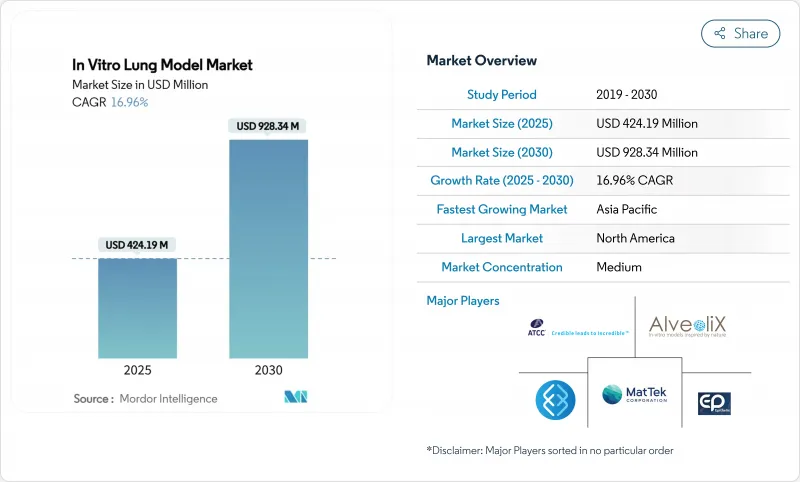
체외 폐 모델 시장 규모는 2025년에 4억 2,419만 달러로 추정되고, 2030년에는 9억 2,834만 달러에 이를 것으로 예측되며, 예측 기간(2025-2030년) CAGR 16.96%로 성장이 전망됩니다.
FDA의 2024년 신규 대체법 지침으로 대표되는 바와 같이, 규제 기관은 체외 대체법을 공공연히 지지하고 있어, 장기 온칩이나 오가노이드 플랫폼에 대한 기업 투자가 가속화되고 있습니다. 팬데믹 후 흡입 치료제의 급성장, Horizon Europe의 지속적인 보조금, 신축 가능한 미세 유체 시스템의 지속적인 발전은 의약품 개발자 및 학술 연구소 모두 수요를 강화하고 있습니다. 동시에 밸리데이션 병목과 자본 집약적인 하드웨어가 채용률을 억제하고 있으며, 공급업체는 기술 혁신 및 엄격한 규제 당국과의 연계를 강요하고 있습니다.
세계의 체외 폐 모델 시장 동향 및 인사이트
세계 동물 실험의 단계적 폐지가 폐 대체물질에 대한 수요 증가
3대륙 입법부는 척추동물 시험의 체계적인 감축을 의무화하고 있으며, 의약품 개발자는 파이프라인 워크플로우를 검증된 체외 폐 구조에 맞추도록 촉구하고 있습니다. FDA 지침은 현재 허용되는 독성 엔드포인트에 장기 온칩 데이터를 포함하고 있으며, 이 견해는 유럽 의회의 로드맵에도 반영되어 있습니다. 제약회사는 전임상시험의 예산을 인간의 약동학을 보다 잘 예측하는 마이크로플루이딕스칩으로 향하게 하여 완전 일체형 호흡시스템의 주문량을 늘리고 있습니다. 의약품 안전성 시험 실시 기준(GLP) 데이터 패키지를 작성할 수 있는 공급업체는 규제 당국 신청이 칩 기반 독성 측정치를 참조하게 되어 즉시 경쟁력을 높일 수 있습니다. 중기적으로는 여러 기관이 협력함으로써 검증 주기가 단축되고 비용에 민감한 제네릭 의약품 제조업체에도 고객층이 확산될 것으로 예측됩니다.
팬데믹 후 흡입 치료제의 급증이 호흡기 시스템의 연구 개발 뒷받침
COVID-19 위기는 호흡기계 약물 전달을 보편적인 전략적 우선순위로 재정의하여 항바이러스제, 섬유증 치료제, COPD 생물학적 제형과 같은 흡입 치료제 파이프라인을 확대했습니다. 정교한 3D 기도 구조물은 현재 다양한 호흡 체계 하에서 에어로졸 침착 프로파일의 세밀한 추적을 가능하게 하고, 제제 과학자에게 동물 및 임상 단계 전에 실용적인 지표를 제공합니다. 이 실시간 인사이트는 리드 최적화 루프를 단축시켜 폐 타겟팅 불량과 관련된 소모를 줄입니다. 기도 특이적 약리학과 팬데믹 내성 사이의 뚜렷한 연관성은 벤처 자본을 유치하고 있으며, 트랜스레이셔널 개선을 위한 신흥 공급업체에 충분한 자금을 공급하고 있습니다. 단기적인 이익은 주로 북미와 유럽에서 실현되지만, 아시아태평양에서는 현지 제약 회사가 호흡기 프랜차이즈로 축족을 옮기고 있기 때문에 흡수가 가속화되고 있습니다.
폐 구조의 표준화된 OECD 검증 부족
피부, 눈, 간의 생체 외 분석을 다루는 OECD 지침은 폐 전문 테스트 배터리와 아직 일치하지 않으므로 스폰서는 분석을 수행할 때마다 맞춤형 검증 패키지를 협상해야 합니다. 이 부재는 규제 위험을 증가시키고 상업적 전개를 늦추는 중복된 실험실 간 링 테스트를 강력하게 합니다. 한편, 각국의 수용 기준이 다르기 때문에 특히 국제적인 다시설 공동 연구에서는 패치워크와 같은 컴플라이언스 상의 장애물이 발생하고 있습니다. 현재 진행 중인 부처 횡단 워킹그룹은 프로토콜의 조화를 약속하고 있지만, 컨센서스 타임라인은 여전히 수년에 걸쳐 있으며, 많은 중견 CRO는 복잡한 칩에 대한 투자를 앞두고 있습니다.
부문 분석
체외 폐 모델 2D 정적 단층 시스템 시장 규모는 2024년에도 53.63%로 최대 시장 점유율을 유지했는데, 이 카테고리의 CAGR은 동적 마이크로플루이딕스 플랫폼에 크게 뒤처져 있습니다. 장기 온칩 시스템은 호흡 운동과 유체 전단을 통합하여 인간에 대한 노출 결과를 보다 정확하게 예측하는 데이터를 가져오고, 이 특징이 18.05%의 성장 궤도를 견인하고 있습니다. ALI의 트랜스웰 인서트는 높은 처리량의 독성 스크리닝을 위한 실용적인 브리지 역할을 하며 소비자 제품 안전 연구소의 대량 수요를 지원합니다. 반면에, 3D 세포 응집체는 종양의 산소 구배를 더 잘 반영하는 종양학 연구에서 중요한 틈새를 충족시켜, 스페로이드 형태가 있습니다.
자동 3D 프린팅은 역사적인 비용 장벽을 침식하기 시작했습니다. 연구기관에서는 점액을 농축한 바이오잉크를 이용하여 기도의 점성을 재현하여 섬모의 박동 동기와 병원체의 침입 모델링을 강화하고 있습니다. 바이오메디컬 엔지니어 및 독물학자 간에 반복되는 피드백은 혁신을 가속화하고 장기 온칩 공급업체를 동향을 능가하는 수익 실현을 향해 자리매김하게 됩니다.
체외 폐 모델 보고서는 모델 유형별(2D 정적 단분자막 모델, 기액 계면 트랜스웰 모델 등), 용도별(창약 및 리드 최적화, 기타), 최종 사용자별(제약 및 바이오 기업, 기타), 지역별(북미, 유럽, 아시아태평양, 중동 및 아프리카, 남미)로 구분됩니다. 시장 예측은 금액(달러)으로 제공됩니다.
지역별 분석
북미는 FDA에 의한 규제의 명확화 및 IND 신청에서 칩 기반 분석을 정규화한 바이오벤처 기업의 밀집에 의해 2024년 매출액이 42.05%로 체외 폐 모델 시장을 선도하고 있습니다. 연방 정부의 보조금과 벤처 캐피탈은 트랜스레이셔널 프로젝트에 공동 출자하여 꾸준한 제품 업그레이드와 견조한 국내 수요를 확보하고 있습니다.
그러나 아시아태평양은 26.32%의 연평균 복합 성장률(CAGR)을 기록해 중국과 한국의 조성금 제도에 밀려 현지 칩 제조 라인을 구축하는 학술 및 기업 컨소시엄을 지원하고 있습니다. CN 바이오의 서울에 본사를 둔 새로운 리셀러 계약은 외국인 공급업체가 인간 관련 검사에 대한 지역의 열정을 이용하여 선행자 이익을 보장하는 방법을 보여줍니다.
유럽은 호라이즌 보조금 및 동물실험 폐지를 위한 지역 전체의 로드맵에 지지되어 10%대 중반의 성장을 유지하고 OECD에 따른 검증시험의 정기적인 수주를 자극하고 있습니다. 독일과 네덜란드의 정밀 공학 기업의 존재는 미세 유체 부품 공급의 현지화를 지원하고 유럽 구매자의 리드 타임을 단축합니다.
라틴아메리카와 중동 및 아프리카는 아직 발전 도상이지만 기회는 풍부합니다. 현지 CRO는 주로 단층 또는 ALI 인서트를 도입하고 있지만, Horizon과 연계한 시험 교육 프로그램은 장기 온칩 노하우의 파종을 목표로 하고 있습니다. 화학물질 안전 개혁을 둘러싼 정책의 수렴으로 인프라 보조금이 교부되면 신속한 도입을 기대할 수 있습니다.
기타 혜택 :
- 엑셀 형식 시장 예측(ME) 시트
- 3개월간의 애널리스트 서포트
목차
제1장 서론
- 조사의 전제조건 및 시장의 정의
- 조사 범위
제2장 조사 방법
제3장 주요 요약
제4장 시장 상황
- 시장 개요
- 시장 성장 촉진요인
- 세계 동물 실험의 단계적 폐지에 의해 폐 대체품 수요 증가
- 팬데믹 후 흡입 치료제의 급증이 호흡기계 연구개발을 뒷받침
- EU 자금에 의한 호라이즌 프로젝트에 의한 확장 가능한 폐 미세 생리학의 추진
- 신축성 마이크로플루이딕스 폐 시스템의 상업화
- 정밀 시험을 위한 iPSC 유래의 환자 특이적 폐 모델로의 이행
- 호흡기 질환의 부담 증가가 흡입 독성학 플랫폼 추진
- 시장 성장 억제요인
- 폐 구조에 대한 표준화된 OECD 검증 부족
- CRO용 다이나믹 폐 온칩 플랫폼의 자본 집약도
- 인간 기도 1차 세포 공급망의 변동성
- 기존 고처리량 스크리닝 시스템과의 상호 운용성 과제
- 규제 상황
- Porter's Five Forces 분석
- 신규 참가업체의 위협
- 구매자의 협상력
- 공급기업의 협상력
- 대체품의 위협
- 경쟁 기업간 경쟁 관계
제5장 시장 규모 및 성장 예측 : 금액(달러)
- 모델 유형별
- 2D 정적 단층 모델
- 기액 계면(ALI) 트랜스웰 모델
- 3D 세포 응집체 및 스페로이드
- 오르간 온칩 마이크로플루이딕스 모델
- 3D 바이오프린트 폐 조직
- 용도별
- 창약 및 리드 최적화
- 흡입독성학 및 안전성 평가
- 질병 모델링
- 맞춤형 의료 및 바이오마커 발견
- 최종 사용자별
- 제약 및 바이오테크놀러지 기업
- 계약연구기관
- 학술연구기관
- 기타 최종 사용자
- 지역별
- 북미
- 미국
- 캐나다
- 멕시코
- 유럽
- 독일
- 영국
- 프랑스
- 이탈리아
- 스페인
- 기타 유럽
- 아시아태평양
- 중국
- 일본
- 인도
- 호주
- 한국
- 기타 아시아태평양
- 중동 및 아프리카
- GCC
- 남아프리카
- 기타 중동 및 아프리카
- 남미
- 브라질
- 아르헨티나
- 기타 남미
- 북미
제6장 경쟁 구도
- 시장 집중도
- 시장 점유율 분석
- 기업 프로파일
- Emulate Inc.
- Mimetas BV
- CN Bio Innovations Ltd.
- AlveoliX AG
- TissUse GmbH
- InSphero AG
- Epithelix Sarl
- MatTek Corporation
- ATCC Global
- Lonza Group AG
- Thermo Fisher Scientific Inc.
- SynVivo Inc.
- BEOnChip SL
- React4Life Srl
- AxoSim Technologies LLC
- Kirkstall Ltd.
- Advanced BioMatrix Inc.
- Charles River Laboratories Intl.
- StemBioSys Inc.
- Hesperos Inc.
제7장 시장 기회 및 향후 전망
AJY 25.11.03The In Vitro Lung Model Market size is estimated at USD 424.19 million in 2025, and is expected to reach USD 928.34 million by 2030, at a CAGR of 16.96% during the forecast period (2025-2030).
Regulatory agencies are openly endorsing in-vitro alternatives most notably the FDA's 2024 guidance on New Alternative Methods thereby accelerating corporate investment in organ-on-chip and organoid platforms. Rapid post-pandemic growth in inhaled therapeutics, sustained Horizon Europe grants, and continuing advances in stretchable microfluidic systems are reinforcing demand from both drug developers and academic laboratories. At the same time, validation bottlenecks and capital-intensive hardware temper adoption rates, obliging suppliers to pair technical innovation with rigorous regulatory engagement.
Global In Vitro Lung Model Market Trends and Insights
Global phase-out of animal testing enhancing demand for lung alternatives
Legislatures on three continents are mandating systematic reductions in vertebrate testing, prompting drug developers to align pipeline workflows with validated in-vitro lung constructs. FDA guidance now lists organ-on-chip data among acceptable toxicity endpoints, a position echoed by the European Parliament's roadmap, creating a policy-driven tailwind that reclassifies lung models as compliance necessities rather than exploratory tools. Pharmaceutical firms are reallocating preclinical budgets toward microfluidic chips that better anticipate human pharmacokinetics, thereby boosting order volumes for full-integrated breathing systems. Vendors capable of generating Good Laboratory Practice data packages see an immediate competitive lift as regulatory filings increasingly reference chip-based toxicity read-outs. Over the medium term, multi-agency alignment is expected to cut validation cycles, widening the customer base to cost-sensitive generics manufacturers.
Surge in inhaled therapeutics post-pandemic boosting respiratory R&D
The COVID-19 crisis reframed respiratory drug delivery as a universal strategic priority, expanding inhaled modality pipelines across antivirals, fibrosis agents, and COPD biologics. Sophisticated 3D airway constructs now enable granular tracking of aerosol deposition profiles under variable breathing regimes, giving formulation scientists actionable metrics before animal or clinical stages. This real-time insight shortens lead optimisation loops and lowers attrition linked to poor pulmonary targeting. The clear linkage between airway-specific pharmacology and pandemic resilience continues to attract venture capital, keeping start-up suppliers well-funded for translational improvements. Short-term gains materialise mainly in North America and Europe; Asia-Pacific uptake accelerates as local pharma pivots toward respiratory franchises.
Lack of standardised OECD validation for lung constructs
OECD guidelines covering skin, eye, and hepatic in-vitro assays are yet to be matched by a lung-specific test battery, leaving sponsors to negotiate bespoke validation packages for every assay run. The absence heightens regulatory risk and forces duplicative inter-lab ring trials that slow commercial roll-outs. Meanwhile, divergent national acceptance criteria create patchwork compliance hurdles, particularly for global multi-centre studies. Ongoing cross-agency working groups promise harmonised protocols, but consensus timelines still run multiple years, leading many mid-tier CROs to defer investment in complex chips.
Other drivers and restraints analyzed in the detailed report include:
- EU-funded Horizon projects advancing scalable lung micro-physiology
- Commercialisation of stretchable microfluidic lung systems
- Capital intensity of dynamic lung-on-chip platforms for CROs
For complete list of drivers and restraints, kindly check the Table Of Contents.
Segment Analysis
The in vitro lung model market size for 2D Static Monolayer systems remains the largest market share of 53.63% in 2024, yet the category's CAGR lags markedly behind dynamic microfluidic platforms. organ-on-chip systems integrate breathing motions and fluid shear, yielding data that more accurately forecasts human exposure outcomes, a feature driving their 18.05% growth trajectory. ALI Transwell inserts function as a pragmatic bridge for high-throughput toxicology screens, sustaining volume demand from consumer-product safety labs. Meanwhile, 3D cell aggregates fill a crucial niche in oncology research where spheroid geometry better reflects tumour oxygen gradients.
Automated 3D printing has begun to erode historical cost barriers: BMF Biotechnology's nano-resolution printers fabricate chip housings within hours, cutting per-unit expenditure by double-digit percentages. Research institutions exploit mucus-enriched bioinks to recreate airway viscosity, enhancing cilia beat synchrony and pathogen entry modelling. The iterative feedback between biomedical engineers and toxicologists is set to accelerate innovation, positioning organ-on-chip suppliers for above-trend revenue realisation.
The in Vitro Lung Model Report is Segmented by Model Type (2D Static Monolayer Models, Air-Liquid Interface Transwell Models, and More), Application (Drug Discovery & Lead Optimisation, and More), End User (Pharmaceutical & Biotechnology Companies, and More), and Geography (North America, Europe, Asia Pacific, Middle East & Africa, South America). The Market Forecasts are Provided in Terms of Value (USD).
Geography Analysis
North America leads the in vitro lung model market with 42.05% revenue in 2024, anchored by FDA regulatory clarity and a dense cluster of biotech start-ups that have normalised chip-based assays in IND submissions. Federal grants and venture capital co-fund translational projects, ensuring steady product upgrades and robust domestic demand.
Asia-Pacific, however, posts the steepest 26.32% CAGR, propelled by Chinese and South Korean funding schemes that subsidise academic-corporate consortia building local chip manufacturing lines. CN Bio's new Seoul-based distribution pact exemplifies how foreign suppliers leverage regional enthusiasm for human-relevant testing to secure first-mover gains.
Europe maintains mid-teens growth underwritten by Horizon grants and a region-wide roadmap to retire animal studies, stimulating recurring orders for OECD-aligned validation studies. The presence of precision-engineering firms in Germany and the Netherlands supports the localisation of microfluidic component supply, reducing lead times for European buyers.
Latin America and the Middle East & Africa remain nascent but opportunity-rich. Local CROs predominantly deploy monolayer or ALI inserts, yet pilot Horizon-linked training programs aim to seed organ-on-chip know-how. Policy convergence around chemical-safety reform could fast-track uptake once infrastructure grants are unlocked.
- Emulate
- Mimetas BV
- CN Bio Innovations Ltd.
- AlveoliX
- TissUse
- InSphero
- Epithelix Sarl
- MatTek Corporation
- ATCC Global
- Lonza Group
- Thermo Fisher Scientific
- SynVivo Inc.
- BEOnChip SL
- React4Life Srl
- AxoSim Technologies LLC
- Kirkstall Ltd.
- Advanced BioMatrix Inc.
- Charles River Laboratories Intl.
- StemBioSys Inc.
- Hesperos
Additional Benefits:
- The market estimate (ME) sheet in Excel format
- 3 months of analyst support
TABLE OF CONTENTS
1 Introduction
- 1.1 Study Assumptions & Market Definition
- 1.2 Scope of the Study
2 Research Methodology
3 Executive Summary
4 Market Landscape
- 4.1 Market Overview
- 4.2 Market Drivers
- 4.2.1 Global Phase-out of Animal Testing Enhancing Demand for Lung Alternatives
- 4.2.2 Surge in Inhaled Therapeutics Post-Pandemic Boosting Respiratory R&D
- 4.2.3 EU-Funded Horizon Projects Advancing Scalable Lung Micro-Physiology
- 4.2.4 Commercialization of Stretchable Microfluidic Lung Systems
- 4.2.5 Shift to iPSC-Derived, Patient-Specific Lung Models for Precision Trials
- 4.2.6 Increasing Respiratory Disease Burden Driving Inhalation Toxicology Platforms
- 4.3 Market Restraints
- 4.3.1 Lack of Standardized OECD Validation for Lung Constructs
- 4.3.2 Capital Intensity of Dynamic Lung-on-Chip Platforms for CROs
- 4.3.3 Supply Chain Variability of Primary Human Airway Cells
- 4.3.4 Interoperability Challenges with Legacy High-Throughput Screening Systems
- 4.4 Regulatory Landscape
- 4.5 Porter's Five Forces Analysis
- 4.5.1 Threat of New Entrants
- 4.5.2 Bargaining Power of Buyers
- 4.5.3 Bargaining Power of Suppliers
- 4.5.4 Threat of Substitutes
- 4.5.5 Competitive Rivalry
5 Market Size & Growth Forecasts (Value in USD)
- 5.1 By Model Type
- 5.1.1 2D Static Monolayer Models
- 5.1.2 Air-Liquid Interface (ALI) Transwell Models
- 5.1.3 3D Cell Aggregates & Spheroids
- 5.1.4 Organ-on-Chip Microfluidic Models
- 5.1.5 3D Bioprinted Lung Tissues
- 5.2 By Application
- 5.2.1 Drug Discovery & Lead Optimisation
- 5.2.2 Inhalation Toxicology & Safety Assessment
- 5.2.3 Disease Modelling
- 5.2.4 Personalised Medicine & Biomarker Discovery
- 5.3 By End User
- 5.3.1 Pharmaceutical & Biotechnology Companies
- 5.3.2 Contract Research Organisations
- 5.3.3 Academic & Research Institutes
- 5.3.4 Other End Users
- 5.4 By Geography
- 5.4.1 North America
- 5.4.1.1 United States
- 5.4.1.2 Canada
- 5.4.1.3 Mexico
- 5.4.2 Europe
- 5.4.2.1 Germany
- 5.4.2.2 United Kingdom
- 5.4.2.3 France
- 5.4.2.4 Italy
- 5.4.2.5 Spain
- 5.4.2.6 Rest of Europe
- 5.4.3 Asia Pacific
- 5.4.3.1 China
- 5.4.3.2 Japan
- 5.4.3.3 India
- 5.4.3.4 Australia
- 5.4.3.5 South Korea
- 5.4.3.6 Rest of Asia-Pacific
- 5.4.4 Middle East & Africa
- 5.4.4.1 GCC
- 5.4.4.2 South Africa
- 5.4.4.3 Rest of Middle East & Africa
- 5.4.5 South America
- 5.4.5.1 Brazil
- 5.4.5.2 Argentina
- 5.4.5.3 Rest of South America
- 5.4.1 North America
6 Competitive Landscape
- 6.1 Market Concentration
- 6.2 Market Share Analysis
- 6.3 Company Profiles (includes Global level Overview, Market level overview, Core Segments, Financials as available, Strategic Information, Market Rank/Share for key companies, Products & Services, and Recent Developments)
- 6.3.1 Emulate Inc.
- 6.3.2 Mimetas BV
- 6.3.3 CN Bio Innovations Ltd.
- 6.3.4 AlveoliX AG
- 6.3.5 TissUse GmbH
- 6.3.6 InSphero AG
- 6.3.7 Epithelix Sarl
- 6.3.8 MatTek Corporation
- 6.3.9 ATCC Global
- 6.3.10 Lonza Group AG
- 6.3.11 Thermo Fisher Scientific Inc.
- 6.3.12 SynVivo Inc.
- 6.3.13 BEOnChip SL
- 6.3.14 React4Life Srl
- 6.3.15 AxoSim Technologies LLC
- 6.3.16 Kirkstall Ltd.
- 6.3.17 Advanced BioMatrix Inc.
- 6.3.18 Charles River Laboratories Intl.
- 6.3.19 StemBioSys Inc.
- 6.3.20 Hesperos Inc.
7 Market Opportunities & Future Outlook
- 7.1 White-space & Unmet-need Assessment