

|
시장보고서
상품코드
2122624
마이크로 LED 시장 : 시장 점유율 분석, 업계 동향 및 통계, 성장 예측(2026-2031년)Micro LED - Market Share Analysis, Industry Trends & Statistics, Growth Forecasts (2026 - 2031) |
||||||
 Mordor Intelligence
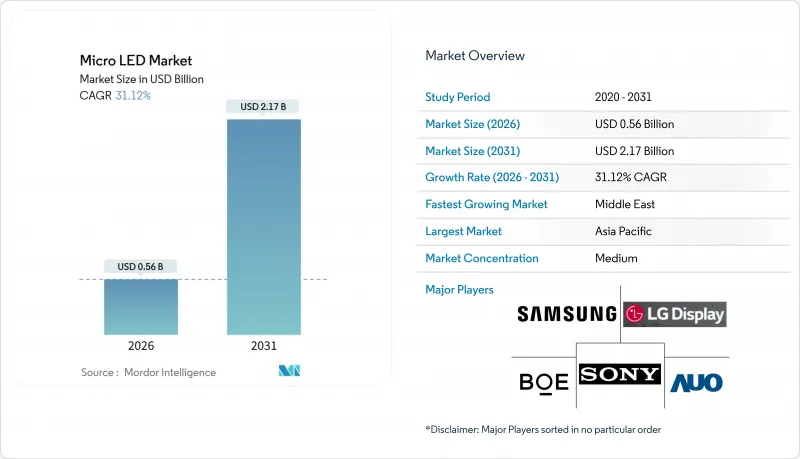
Mordor Intelligence에 의하면, 마이크로 LED 시장 규모는 2026년에 5억 6,000만 달러로 추정되고, 예측 기간(2026-2031년) CAGR 31.12%로 확대될 전망이며, 2031년에는 21억 7,000만 달러에 이를 전망입니다.
본 보고서는 용도별(스마트 워치 등), 최종 이용 산업별(자동차 등), 패널 크기별(50인치 이상 등), 픽셀 피치별(2.5mm 초과 대형 등), 기술별(흑백 등), 구성 요소별(백플레인 등), 제조 공정별(매스 전사 등), 제품 형태별(디스플레이 모듈 등), 지역별로 분류되어 있습니다. 시장 예측은 금액(달러) 기준으로 제시되어 있습니다.
세계의 마이크로 LED 시장 동향 및 인사이트
마이크로 LED가 탑재된 웨어러블 기기를 위한 애플과 삼성의 로드맵이 소형 디스플레이 수요를 가속화하고 있습니다.
삼성이 CES 2025에서 발표한 콘셉트 스마트 워치는 피크 밝기가 약 4,000니트에 달했으며, 이는 현재 OLED 웨어러블 기기의 밝기보다 4배 높은 수치로, 실외 가시성 목표를 달성했음을 입증합니다. 애플은 워치 프로젝트를 중단한 대신, 산타클라라 캠퍼스에서 마이크로 LED 연구 개발을 근거리 AR 안경으로 전환하고 있습니다. 메타는 2025년 하반기 출시 예정인 스마트글라스를 위해 플레시(Plessey)사의 GaN-on-Si 생산 능력을 모두 확보한 반면, JBD사는 Tier 1 헤드셋 OEM을 위해 흑백 및 RGB 패널을 양산하고 있습니다. 이러한 로드맵 전반을 보면, 수요가 손목 착용형에서 3,000 PPI가 필요한 1인치 미만의 마이크로 디스플레이로 이동하고 있으며, 이러한 밀도를 실현하기 위해서는 OLED로는 실용적인 수율을 확보하기 어렵습니다. 이러한 동향은 향후 4년 동안 마이크로 LED 시장이 다양한 웨어러블 기기 형태로 다각화될 것임을 시사합니다.
걸프협력회의(GCC) 국가 및 동아시아에서의 투명·유연형 소매용 사이니지 보급
사우디아라비아, 아랍에미리트, 도쿄, 상하이의 매장 및 공항에서는 픽셀이 꺼진 상태에서 70-85%의 투명도를 실현하는 모듈이 도입되어, 영상 컨텐츠를 방영하면서도 시야를 확보하고 있습니다. LG디스플레이와 BOE는 곡면 유리에 감을 수 있는 두께 5mm 미만의 프로토타입을 공개했으며, 이는 새로운 스마트시티 지역의 유리 파사드 건축 요건을 충족합니다. 이 지역에서는 10만 룩스를 넘는 극심한 주변광으로 인해 실외에서는 투명 OLED 솔루션이 가독성을 잃게 되어, 마이크로 LED가 본질적인 성능적 우위를 점하고 있습니다. 시야 확보를 중시하는 규제와 구역 지정이 보급을 더욱 가속화함에 따라, 소매용 사이니지는 마이크로 LED 시장에서 파인 피치 패널의 조기 보급을 견인하는 요인이 되고 있습니다.
4인치를 초과하는 웨이퍼에서 10µm 미만의 LED 물질 이동 수율은 60% 미만
『Nature』지 2025년 9월호 총설에서는 픽셀 피치가 10µm 미만이 되면 사이드월 재결합이나 오주 효과로 인해 수율이 저하된다는 사실이 확인되었습니다. AR 마이크로디스플레이에 요구되는 5µm 미만의 LED는 픽 앤 플레이스(pick-and-place)나 레이저 리프트오프(laser lift-off) 전사 과정에서 치명적인 다이 손실을 겪어, 상업적 실현 가능성이 제한되고 있습니다. PlayNitride사가 2025년 3월에 발표한 칩 온 캐리어(Chip-on-Carrier) 관련 연구에서는 수율이 개선되었으나, 여전히 산업 규모에서의 과제가 남아 있다고 보고되었습니다. 그 결과, 북미 및 유럽의 고PPI 마이크로디스플레이는 여전히 고가이며, 하이브리드 본딩 및 기타 웨이퍼 레벨 공정이 성숙해질 때까지는 소비자 보급이 더뎌지고 마이크로LED 시장의 성장세가 주춤하게 될 것입니다.
부문 분석
2031년까지 근거리용 디바이스 시장은 연평균 성장률(CAGR) 32.61%로 확대될 전망이며, Apple, Meta 및 방위 분야 시스템 통합사업자들이 3,000 PPI 밀도를 가진 1인치 미만의 마이크로디스플레이를 위한 로드맵을 조율하고 있는 만큼, 다른 모든 용도를 능가하는 성장세를 보일 것으로 예측됩니다. AR 헤드셋이 흑백 프로토타입에서 풀컬러로, 햇빛 아래에서도 식별 가능한 광학 시스템으로 전환됨에 따라, 니어 투 아이(Near-to-Eye) 기기용 마이크로 LED 시장 규모는 확대될 것으로 예측됩니다. 2025년 매출의 28.43%를 차지한 스마트 워치 디스플레이는 출하 대수 면에서는 여전히 최대 규모를 유지하고 있지만, 성장률 면에서는 AR 아이웨어에 그 자리를 내주게 될 것입니다. TV로의 채택은 다이 수에 따른 경제성 문제로 인해 지연되고 있습니다. 100인치 패널에는 여전히 약 2,500만 개의 다이가 필요합니다. 모니터와 노트북은 중간 경로를 따르고 있으며, OLED의 번인 위험을 용납할 수 없는 의료용 영상 진단 및 HDR 컨텐츠 그레이딩 분야에서 마이크로 LED를 활용하고 있습니다.
이러한 용도의 분화로 인해 두 개의 병행된 공급망이 형성되고 있습니다. 웨어러블 기기 제조업체들은 10µm 미만의 정렬 정밀도를 실현하는 하이브리드 본딩을 선호하는 반면, 대형 사이니지에서는 50µm 피치의 엘라스토머 스탬프를 이용한 대량 전사가 계속해서 채택되고 있습니다. 의료 분야는 제3의 틈새 시장을 형성하고 있으며, 1만 달러 이상의 진단용 디스플레이가 구매되고 있습니다. 이는 마이크로 LED의 높은 가격을 정당화할 뿐만 아니라, 로봇 수술에서 모션 블러가 전혀 발생하지 않는 특성을 활용하고 있습니다. 이러한 세분화의 다양성은 수익 변동을 완화하고, 마이크로 LED 시장 전반에 걸친 다각적인 혁신을 뒷받침하고 있습니다.
2025년 매출 중 소비자 가전 부문이 40.12%를 차지한 것으로 평가되었으며, 이는 프리미엄 TV, 게이밍 모니터, 스마트 워치가 주도하고 있습니다. 그러나 의료 분야는 33.37%라는 가장 높은 연평균 성장률(CAGR)을 나타낼 전망이며, 이는 수 시간에 걸친 수술 중에도 발열을 최소화하면서 10,000니트의 밝기가 필요한 수술실 수요에 힘입은 것입니다. 진단용 방사선 워크스테이션 역시 밝은 실내에서 그레이스케일 식별성을 높여주는 마이크로 LED의 1,000,000:1 대비 비율의 혜택을 받고 있습니다. 자동차 OEM 각사는 UNECE(유엔 유럽 경제 위원회)의 일광 하 가시성 기준에 힘입어, 인증 요건을 충족하는 대로 헤드업 디스플레이(HUD) 도입을 가속화하고 있습니다. 한편, 항공우주 및 방위 분야공급 경로는 내환경성이 뛰어난 마이크로 디스플레이에 관한 미국 및 EU의 계약에 힘입어 확대되고 있습니다.
OLED가 스마트폰 시장에서 지배적인 위치를 유지하고 있으며, 중형 모니터에서는 미니 LED가 비용 면에서 우위를 점하고 있어, 소비자용 전자기기 시장의 성장은 완만해지고 있습니다. 반면, 의료 분야에서는 수년에 걸친 감가상각 일정에 따라 대당 1만 달러의 단가를 예산 내에서 흡수할 수 있어, 마이크로 LED의 수율 저하로 인한 손실을 상쇄할 수 있는 이익률을 창출하고 있습니다. 자동차 분야의 프로그램도 마찬가지로 견조한 모습을 보이고 있으며, 이 부문에서는 검증이 완료되면 대당 500-1,000달러의 수익이 예상되며, 인증 프로토콜이 통일되면 지속적인 수익이 확보될 것입니다. 방위 프로젝트에서는 더 높은 가격도 허용되므로, 마이크로 LED 시장 내에는 다층적인 비즈니스 기회의 계층이 형성되어 있습니다.
10인치 미만 패널은 2025년 매출의 46.78%를 차지한 것으로 평가되었으며, 스마트 워치, AR 글래스, 헤드업 디스플레이가 컴팩트함과 배터리 수명을 우선시함에 따라 32.83%의 연평균 성장률(CAGR)을 유지할 것으로 예측됩니다. 따라서 기존 기술로는 실현 불가능한 화소 밀도에 힘입어, 10인치 미만 제품의 마이크로 LED 시장 규모는 가장 빠르게 확대될 것입니다. 중형 패널(10-50인치)은 고휘도 모니터나 노트북 워크스테이션에서 수요가 있지만, 성숙기에 접어든 미니 LED 백라이트와의 경쟁을 피할 수 없습니다. 50인치 이상의 패널은 여전히 10만 달러가 넘는 고가 제품이며, 그 채택은 플래그십급 상업용 사이니지로 제한되어 있습니다.
마이크로 스케일의 발광 아키텍처는 특히 1그램이나 1밀리암페어 단위의 무게와 전류가 중요한 상황에서 그 위력을 발휘합니다. JBD의 5µm 미만의 픽셀 피치는 3,000 PPI를 실현하여, 낮에도 끊김 없는 AR 오버레이를 가능하게 합니다. 대조적으로, 대형 유닛은 여전히 막대한 다이 수와 60% 미만의 수율이라는 과제에 직면해 있으며, TV 시장에서 주류로 자리 잡는 것은 2028년부터 2030년까지 지연될 전망입니다. 그 결과 발생하는 크기별 계층화는 마이크로 LED 시장 전체에서 듀얼 툴링 전략을 더욱 공고히 하고 있습니다.
지역별 분석
아시아태평양은 2025년 매출의 66.42%를 차지했으며, 에피택셜 웨이퍼, TFT 백플레인 및 양산용 툴의 제조 거점으로서의 입지를 유지하고 있습니다. 중국의 BOE와 Tianma는 정부의 우대 조치를 활용하여 게이밍 모니터 및 자동차용 클러스터의 생산 규모를 확대하고 있는 반면, 대만의 PlayNitride와 Epistar는 6인치 에피택셜 웨이퍼 생산 라인을 확장하고 있습니다. 한국의 삼성과 LG디스플레이는 CES 2025에서 공개된 모듈형 TV와 투명 유리 프로토타입에 주력하고 있습니다. 이 지역의 수직 통합형 공급망은 보다 신속한 제품 개선 주기와 비용 감소를 보장하여 마이크로 LED 시장에서 이 지역의 경제적 영향력을 강화하고 있습니다.
중동은 사우디아라비아의 NEOM 프로젝트와 두바이의 소매가에 사막의 10만 룩스 햇빛 아래에서도 식별 가능한 투명 마이크로 LED 파사드가 도입됨에 따라 연평균 성장률(CAGR) 32.21%라는 가장 높은 성장률을 나타낼 것으로 예측됩니다. 정부계 펀드의 자금 지원이 설비 투자의 장벽을 해소하며 본격적인 시범 도입을 가속화하고 있습니다. 규제 기준이 ‘유리 우선’ 아키텍처를 권장하고 있어, OLED로는 충족할 수 없는 투명성을 갖춘 사이니지에 대한 예측 가능한 수요가 발생하고 있습니다.
북미의 성장은 방위 분야와 AR 웨어러블 기기를 중심으로 전개되고 있습니다. 미 육군 및 DARPA(국방고등연구계획국)의 계약을 통해 상용 안경의 사실상의 표준이 될 성능 지표가 수립되었습니다. 애플의 산타클라라 연구소는 워치 프로그램을 종료한 후에도 1인치 미만의 마이크로 디스플레이 개발을 지속하고 있으며, 국내 연구개발(R&D) 지출을 뒷받침하고 마이크로 LED에 특화된 기술 클러스터 형성을 촉진하고 있습니다. 유럽에서는 햇빛 아래에서도 가시성이 확보되는 HUD에 대한 자동차 OEM 수요가 원동력이 되어 발전하고 있으며, UNECE(유엔 유럽 경제 위원회)의 적합성 기준을 전환의 촉매로 활용하고 있습니다. 남미와 아프리카는 6억 달러에 달하는 팹 건설 비용이라는 장벽과 현지에서 에피택셜 웨이퍼 공급원이 부족하여 뒤처지고 있으며, 수입 모듈에 의존할 수밖에 없어 세계 마이크로 LED 시장에 대한 기여도는 제한적입니다.
기타 혜택 :
- 엑셀 형식 시장 예측(ME) 시트
- 3개월간의 애널리스트 지원
자주 묻는 질문
목차
제1장 서론
제2장 조사 방법
제3장 주요 요약
제4장 시장 구도
제5장 시장 규모 및 성장 예측
제6장 경쟁 구도
제7장 시장 기회 및 향후 전망
AJY 26.09.09According to Mordor Intelligence, the micro LED market size is estimated at USD 0.56 billion in 2026, and is expected to reach USD 2.17 billion by 2031, at a CAGR of 31.12% during the forecast period (2026-2031).
This report is Segmented by Application (Smartwatch, and More), End-Use Industry (Automotive, and More), Panel Size (Above 50-Inch, and More), Pixel Pitch (Large Above 2. 5 Mm, and More), Technology (Monochrome, and More), Component (Backplanes, and More), Manufacturing Process (Mass Transfer, and More), Offering (Display Modules, and More), and Geography. The Market Forecasts are Provided in Terms of Value (USD).
Global Micro LED Market Trends and Insights
Apple and Samsung Roadmaps For Micro-LED Wearables Accelerating Small-Display Demand
Samsung's CES 2025 concept smartwatch features a peak luminance of roughly 4,000 nits, quadrupling the luminance of today's OLED wearables and confirming outdoor readability targets. Apple's canceled watch project shifts micro-LED R&D toward near-eye AR glasses at its Santa Clara campus. Meta has locked in Plessey's full GaN-on-Si capacity for late-2025 smart glasses, while JBD mass-produces monochrome and RGB panels for tier-one headset OEMs. Collectively, these roadmaps pivot demand from wrist-worn to sub-1-inch microdisplays requiring 3,000 PPI, a density OLED struggles to achieve at viable yield. Their trajectories signal that the micro LED market will diversify across multiple wearable form factors over the next four years.
Transparent and Flexible Retail Signage Uptake In Gulf Cooperation Council Countries and East Asia
Storefront and airport installations in Saudi Arabia, the United Arab Emirates, Tokyo, and Shanghai are deploying modules that deliver 70-85% transparency once pixels are off, maintaining sightlines while broadcasting video content. LG Display and BOE publicized prototypes under 5 mm thick that wrap around curved glass, addressing architectural mandates for glass facades in new smart-city districts. The region's extreme ambient light-exceeding 100,000 lux-renders transparent OLED solutions unreadable outdoors, giving micro LED an intrinsic performance moat. Regulatory zoning that favors sightline preservation further accelerates uptake, making retail signage an early-scale driver of fine-pitch panels in the micro LED market.
Mass-Transfer Yield Below 60 % For Sub-10 µm LEDs Beyond 4-Inch Wafers
Nature's September 2025 review confirms sidewall recombination and Auger effects erode yields once pixel pitch falls below 10 µm. Sub-5 µm LEDs demanded by AR microdisplays face catastrophic die loss during pick-and-place or laser lift-off transfer, limiting their commercial viability. PlayNitride's March 2025 chip-on-carrier study improved yields but still documented industrial-scale gaps. High-PPI microdisplays in North America and Europe, therefore, remain expensive, slowing consumer adoption and subtracting momentum from the micro LED market until hybrid bonding or other wafer-level processes mature.
Other drivers and restraints analyzed in the detailed report include:
- Defense-Grade Micro-Displays Funded By United States and EU Governments
- Taiwanese Mini-LED Cost Decline Enabling Pilot Micro-LED Lines
- Non-Standardized Automotive Qualification Protocols
For complete list of drivers and restraints, kindly check the Table Of Contents.
Segment Analysis
Near-to-eye devices expanded at a 32.61% CAGR through 2031, outpacing all other uses as Apple, Meta, and defense integrators align roadmaps to sub-1-inch microdisplays with 3,000 PPI densities. The micro LED market size for near-to-eye devices is projected to compound as AR headsets transition from monochrome prototypes to full-color, sunlight-readable optics. Smartwatch displays, which commanded 28.43% of 2025 revenue, remain the largest shipped volume, yet will concede growth ranking to AR eyewear. Television adoption lags due to die-count economics; a 100-inch panel still requires about 25 million dies. Monitors and laptops carve a middle path, tapping micro LED for medical imaging and HDR content grading where OLED burn-in risks are unacceptable.
The application bifurcation gives rise to two parallel supply chains. Wearable vendors favor hybrid bonding for sub-10 µm alignment accuracy, whereas large-format signage continues to use elastomer-stamp mass transfer at a 50 µm pitch. Medical theaters form a third niche, purchasing USD 10,000-plus diagnostic displays that justify micro-LED premiums and leverage zero-motion-blur characteristics for robotic surgery. This segmentation diversity cushions revenue volatility and sustains multi-node innovation across the micro LED market.
Consumer electronics accounted for 40.12% of 2025 revenue, driven by premium televisions, gaming monitors, and smartwatches. Yet, healthcare will post the fastest 33.37% CAGR, propelled by surgical suites that demand 10,000-nit luminance with minimal heat rise over multi-hour procedures. Diagnostic radiology workstations also benefit from micro-LED's 1,000,000:1 contrast ratio, which enhances grayscale discernment in bright rooms. Automotive OEMs, driven by UNECE sun-readability thresholds, accelerate the integration of head-up displays once qualification hurdles are cleared, while the aerospace and defense supply streams grow on U.S. and EU contracts for ruggedized micro-displays.
Consumer electronics growth moderates as OLED retains smartphone dominance and mini-LED undercuts cost in mid-size monitors. Conversely, healthcare budgets can absorb USD 10,000 unit pricing due to multi-year depreciation schedules, yielding margins that offset the micro-LED yield penalty. Automotive programs offer similar resilience-the segment commands USD 500-1,000 per vehicle once validated, ensuring durable revenue once qualification protocols converge. Defense projects tolerate even higher pricing, creating a layered opportunity ladder within the micro LED market.
Sub-10-inch panels captured 46.78% of 2025 revenue and are expected to maintain a 32.83% CAGR, as smartwatches, AR glasses, and head-up displays prioritize compactness and battery life. The micro LED market size for sub-10-inch products will therefore expand the fastest, driven by pixel densities that are impossible for legacy technologies. Medium panels (10-50 inches) appeal to high-brightness monitors and laptop workstations, yet must compete with mature mini-LED backlights. Panels beyond 50 inches remain luxury items priced above USD 100,000, confining adoption to flagship commercial signage.
Micro-scale emissive architecture, especially when it comes to devices, favors those where every gram and milliamp counts. JBD's sub-5 µm pixel pitch achieves 3,000 PPI, enabling uninterrupted AR overlays in daylight. Large-format units, by contrast, still face prohibitive die-counts and sub-60% yields, delaying mainstream television adoption until 2028-2030. The resulting size stratification reinforces dual tooling strategies across the micro LED market.
Complete Report Scope:
- By Application
- Smartwatch
- Near-to-Eye Devices (AR/VR)
- Television
- Smartphone and Tablet
- Monitor and Laptop
- Head-up Display
- Digital Signage
- Micro-Projector
- Medical and Surgical Displays
- Industrial Inspection Panels
- By End Use Industry
- Consumer Electronics
- Automotive
- Aerospace and Defense
- Healthcare
- Advertising and Retail
- Industrial and Manufacturing
- Others End Use Industries
- By Panel Size
- Less than 10-inch (Small and Micro-Displays)
- 10- to 50-inch (Medium)
- Above 50-inch (Large)
- By Pixel Pitch
- Fine Pitch (Less than 1.5 mm)
- Standard (1.5 - 2.5 mm)
- Large (Above 2.5 mm)
- By Technology (Color)
- RGB Full-Color
- Monochrome
- By Component
- Epitaxial Wafers
- Backplanes
- Driver ICs
- Transfer and Bonding Equipment
- Inspection and Repair Tools
- By Manufacturing Process
- Mass Transfer
- Epitaxial Wafer Bonding
- Hybrid Bonding
- By Offering
- Display Modules
- Lighting Modules
- By Geography
- North America
- United States
- Canada
- Mexico
- South America
- Brazil
- Argentina
- Rest of South America
- Europe
- United Kingdom
- Germany
- France
- Spain
- Italy
- Rest of Europe
- Asia Pacific
- China
- India
- Japan
- Australia
- South Korea
- Rest of Asia-Pacific
- Middle East and Africa
- Middle East
- Saudi Arabia
- United Arab Emirates
- Turkey
- Rest of Middle East
- Africa
- South Africa
- Kenya
- Rest of Africa
- Middle East
- North America
Geography Analysis
Asia Pacific generated 66.42% of 2025 revenue and remains the manufacturing backbone for epitaxial wafers, TFT backplanes, and mass-transfer tooling. China's BOE and Tianma leverage government incentives to scale gaming monitors and automotive clusters, while Taiwan's PlayNitride and Epistar extend six-inch epi-wafer lines. South Korea's Samsung and LG Display concentrate on modular televisions and transparent glass prototypes showcased at CES 2025. The region's vertically integrated supply chain ensures faster iteration cycles and cost degression, reinforcing its economic gravity inside the micro LED market.
The Middle East is projected to chart the fastest 32.21% CAGR, as Saudi Arabia's NEOM project and Dubai's retail corridors install transparent micro-LED facades readable under 100,000 lux of desert daylight. Sovereign wealth funding offsets capex hurdles and accelerates full-scale pilot deployments. Regulatory codes favor glass-first architecture, creating a predictable pull for transparency-enabled signage that OLED cannot satisfy.
North America's growth centers on defense and AR wearables. U.S. Army and DARPA contracts finance performance matrices that serve as de facto standards for commercial glasses. Apple's Santa Clara lab continues developing sub-1-inch microdisplays after ending its watch program, anchoring domestic R&D spending and seeding a specialized micro-LED competency cluster. Europe advances through automotive OEM demand for sun-readable HUDs, leveraging UNECE conformity as a conversion catalyst. South America and Africa trail due to USD 600 million fab cost thresholds and absent local epi-wafer sources, confining them to imported modules and tempering their contribution to the global micro LED market.
- Samsung Electronics Co. Ltd.
- Sony Corporation
- LG Display Co. Ltd.
- BOE Technology Group Co. Ltd.
- AU Optronics Corp.
- Epistar Corporation
- PlayNitride Inc.
- Innolux Corporation
- Apple Inc. (LuxVue Technology)
- Tianma Microelectronics Co. Ltd.
- Nichia Corporation
- Sharp Corporation
- VueReal Inc.
- Plessey Semiconductors Ltd.
- Aledia SA
- Ostendo Technologies Inc.
- JBD (Jade Bird Display)
- Leyard Optoelectronics Co. Ltd.
- Seoul Semiconductor Co. Ltd.
- San'an Optoelectronics Co. Ltd.
- Allos Semiconductors GmbH
- Optovate Ltd.
- Foxconn (Hon Hai Precision)
- Aledia SA
Additional Benefits:
- The market estimate (ME) sheet in Excel format
- 3 months of analyst support
TABLE OF CONTENTS
1 INTRODUCTION
- 1.1 Study Assumptions and Market Definition
- 1.2 Scope of the Study
2 RESEARCH METHODOLOGY
3 EXECUTIVE SUMMARY
4 MARKET LANDSCAPE
- 4.1 Market Overview
- 4.2 Market Drivers
- 4.2.1 Apple and Samsung Road-maps for Micro-LED Wearables Accelerating Small-Display Demand
- 4.2.2 Transparent and Flexible Retail Signage Uptake in Gulf Cooperation Council Countries and East Asia
- 4.2.3 Defense-grade Micro-Displays Funded by United States and EU Governments
- 4.2.4 Taiwanese Mini-LED Cost Decline Enabling Pilot Micro-LED Lines
- 4.2.5 European Automotive Sun-Readability Norms Boosting Micro-LED HUD Integration
- 4.2.6 Quantum-Dot Color-Conversion Efficiency Breakthroughs Reducing Manufacturing Steps
- 4.3 Market Restraints
- 4.3.1 Mass-Transfer Yield Below 60% for Sub-10 µm LEDs Beyond 4-inch Wafers
- 4.3.2 Non-standardised Automotive Qualification Protocols
- 4.3.3 GaN-on-Si Wafer Supply Concentration in Asia
- 4.3.4 More than USD 600 Million Capex Requirement Limiting Expansion in South America and Africa
- 4.4 Industry Value Chain Analysis
- 4.5 Impact of Macroeconomic Factors on the Market
- 4.6 Technological Outlook
- 4.7 Porter's Five Forces Analysis
- 4.7.1 Bargaining Power of Suppliers
- 4.7.2 Bargaining Power of Buyers
- 4.7.3 Threat of New Entrants
- 4.7.4 Threat of Substitutes
- 4.7.5 Intensity of Competitive Rivalry
5 MARKET SIZE AND GROWTH FORECASTS (VALUES)
- 5.1 By Application
- 5.1.1 Smartwatch
- 5.1.2 Near-to-Eye Devices (AR/VR)
- 5.1.3 Television
- 5.1.4 Smartphone and Tablet
- 5.1.5 Monitor and Laptop
- 5.1.6 Head-up Display
- 5.1.7 Digital Signage
- 5.1.8 Micro-Projector
- 5.1.9 Medical and Surgical Displays
- 5.1.10 Industrial Inspection Panels
- 5.2 By End Use Industry
- 5.2.1 Consumer Electronics
- 5.2.2 Automotive
- 5.2.3 Aerospace and Defense
- 5.2.4 Healthcare
- 5.2.5 Advertising and Retail
- 5.2.6 Industrial and Manufacturing
- 5.2.7 Others End Use Industries
- 5.3 By Panel Size
- 5.3.1 Less than 10-inch (Small and Micro-Displays)
- 5.3.2 10- to 50-inch (Medium)
- 5.3.3 Above 50-inch (Large)
- 5.4 By Pixel Pitch
- 5.4.1 Fine Pitch (Less than 1.5 mm)
- 5.4.2 Standard (1.5 - 2.5 mm)
- 5.4.3 Large (Above 2.5 mm)
- 5.5 By Technology (Color)
- 5.5.1 RGB Full-Color
- 5.5.2 Monochrome
- 5.6 By Component
- 5.6.1 Epitaxial Wafers
- 5.6.2 Backplanes
- 5.6.3 Driver ICs
- 5.6.4 Transfer and Bonding Equipment
- 5.6.5 Inspection and Repair Tools
- 5.7 By Manufacturing Process
- 5.7.1 Mass Transfer
- 5.7.2 Epitaxial Wafer Bonding
- 5.7.3 Hybrid Bonding
- 5.8 By Offering
- 5.8.1 Display Modules
- 5.8.2 Lighting Modules
- 5.9 By Geography
- 5.9.1 North America
- 5.9.1.1 United States
- 5.9.1.2 Canada
- 5.9.1.3 Mexico
- 5.9.2 South America
- 5.9.2.1 Brazil
- 5.9.2.2 Argentina
- 5.9.2.3 Rest of South America
- 5.9.3 Europe
- 5.9.3.1 United Kingdom
- 5.9.3.2 Germany
- 5.9.3.3 France
- 5.9.3.4 Spain
- 5.9.3.5 Italy
- 5.9.3.6 Rest of Europe
- 5.9.4 Asia Pacific
- 5.9.4.1 China
- 5.9.4.2 India
- 5.9.4.3 Japan
- 5.9.4.4 Australia
- 5.9.4.5 South Korea
- 5.9.4.6 Rest of Asia-Pacific
- 5.9.5 Middle East and Africa
- 5.9.5.1 Middle East
- 5.9.5.1.1 Saudi Arabia
- 5.9.5.1.2 United Arab Emirates
- 5.9.5.1.3 Turkey
- 5.9.5.1.4 Rest of Middle East
- 5.9.5.2 Africa
- 5.9.5.2.1 South Africa
- 5.9.5.2.2 Kenya
- 5.9.5.2.3 Rest of Africa
- 5.9.5.1 Middle East
- 5.9.1 North America
6 COMPETITIVE LANDSCAPE
- 6.1 Market Concentration
- 6.2 Strategic Moves
- 6.3 Market Share Analysis
- 6.4 Company Profiles
- 6.4.1 Samsung Electronics Co. Ltd.
- 6.4.2 Sony Corporation
- 6.4.3 LG Display Co. Ltd.
- 6.4.4 BOE Technology Group Co. Ltd.
- 6.4.5 AU Optronics Corp.
- 6.4.6 Epistar Corporation
- 6.4.7 PlayNitride Inc.
- 6.4.8 Innolux Corporation
- 6.4.9 Apple Inc. (LuxVue Technology)
- 6.4.10 Tianma Microelectronics Co. Ltd.
- 6.4.11 Nichia Corporation
- 6.4.12 Sharp Corporation
- 6.4.13 VueReal Inc.
- 6.4.14 Plessey Semiconductors Ltd.
- 6.4.15 Aledia SA
- 6.4.16 Ostendo Technologies Inc.
- 6.4.17 JBD (Jade Bird Display)
- 6.4.18 Leyard Optoelectronics Co. Ltd.
- 6.4.19 Seoul Semiconductor Co. Ltd.
- 6.4.20 San'an Optoelectronics Co. Ltd.
- 6.4.21 Allos Semiconductors GmbH
- 6.4.22 Optovate Ltd.
- 6.4.23 Foxconn (Hon Hai Precision)
- 6.4.24 Aledia SA
7 MARKET OPPORTUNITIES AND FUTURE OUTLOOK
- 7.1 White-space and Unmet-Need Assessment


