|
시장보고서
상품코드
1851242
플라스틱 뚜껑 및 마개 시장 : 점유율 분석, 산업 동향, 통계, 성장 예측(2025-2030년)Plastic Caps And Closures - Market Share Analysis, Industry Trends & Statistics, Growth Forecasts (2025 - 2030) |
||||||
 Mordor Intelligence
세계의 플라스틱 뚜껑 및 마개 시장 규모는 2025년 782만 톤에 이르고, 2030년까지 989만 톤에 이를 것으로 예상되며, CAGR 4.83%를 보일 것으로 예측됩니다.
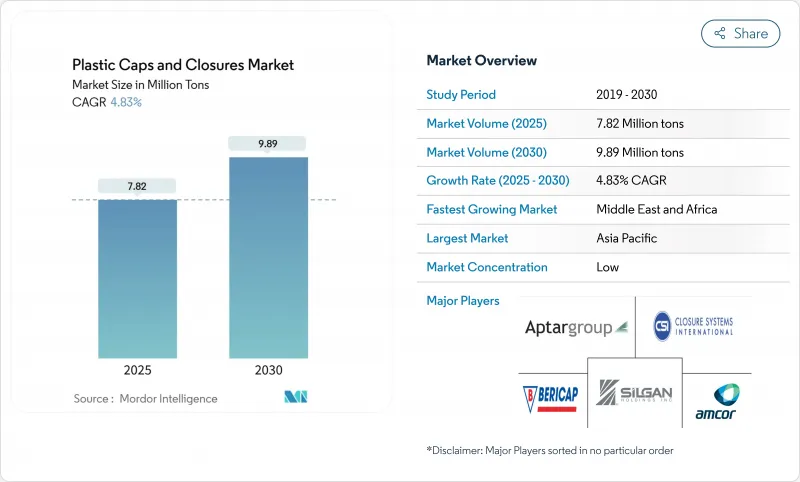
유럽에서의 테더 캡 의무화, ASEAN 전역에서의 무균 PET 보틀링 라인의 급증, 어린이 보호용 폴리프로필렌 마개의 급속한 의약품 수요 등이 성장의 요인입니다. Amcor와 Berry Global의 합병으로 대표되는 통합은 경쟁 역학을 재구성하고 있으며 제조업체는 더 엄격한 EPR(European Evolution) 책임 체계를 충족시키려고 경쟁하고 있습니다. 프로파일렌과 에틸렌의 원재료 가격 변동은 당분간 역풍이지만, 압축 성형의 자동화와 재활용 소재에 대한 지속적인 투자가 비용 압력을 완화하고 있습니다. 지역별로는 아시아태평양이 가장 큰 점유율을 차지하고 중동 및 아프리카가 가장 빠른 CAGR을 기록하고 북미는 고가치의 마개 성형에 유리한 엄격한 안전 규제를 활용하고 있습니다.
세계의 플라스틱 뚜껑 및 마개 시장 동향과 통찰
테더 캡의 채용을 의무화하는 EU 일회용 플라스틱 지침
2024년 7월, EU는 3리터 이하의 음료 용기에 테더 캡을 장착할 것을 의무화했습니다. 선도적인 시스템 공급업체는 라인 속도를 손상시키지 않고 캡을 연결하고 소비자의 인체공학을 보호하면서 쓰레기 감소 목표를 강화하는 여러 어태치먼트 컨셉을 도입했습니다. 북미의 브랜드 소유자는 보류중인 캘리포니아 주 규칙을 앞두고 동일한 솔루션을 시도했으며 부착 기술에 대한 세계 축족을 보여줍니다.
ASEAN의 음료 공장에서 아셉틱 PET 보틀링 라인이 급증
새로운 무균 충전 기계는 유통 기한을 12개월까지 연장하여 플라스틱 사용량을 60.1% 줄입니다. 베트남과 인도네시아의 프로젝트는 그 규모를 보여주며, 한 시설에서 연간 2만 톤 이상의 마개 수요가 순환 경제 목표를 뒷받침하는 재활용 PET 이니셔티브와 연결되어 있습니다.
불안정한 프로파일렌과 에틸렌의 계약 가격이 PP/PE 마진에 영향
원료의 변동은 폴리프로필렌과 폴리에틸렌에 크게 의존하는 마개 제조업체의 마진 안정성을 손상시킵니다. 기업은 헤지, 재활용 수지 혼합 및 변환 비용을 압축하는 지속적인 자동화 프로그램을 통해 비용 충격에 대응하고 있습니다.
부문 분석
스크류 마개는 고속 음료, 식품, 의약품 라인과의 보편적인 적합성으로 2024년 플라스틱 뚜껑 및 마개 시장 점유율의 65.56%를 획득했습니다. 2030년까지 연평균 복합 성장률(CAGR)은 6.45%이지만, 낮은 단가와 신뢰할 수 있는 씰이 우위를 유지합니다. 조미료나 퍼스널케어 SKU에서는 분량 관리와 위생 관리가 소비자에게의 어필을 높이는 디스펜서 방식이 지지되고 있습니다. 부정 개봉 방지와 어린이 보호는 시판 약물 패키지의 모양을 바꾸는 안전 규제의 엄격화로 이익을 얻습니다.
크라운 및 ROPP 마개는 전통과 선반의 존재감이 중요한 맥주와 프리미엄 스피릿으로 관련성을 유지하고 있습니다. 스냅 온 디자인은 신속한 재폐쇄 기능을 요구하는 가정용 화학제품에 적합합니다. 테더 캡의 요구 사항이 증가함에 따라 모든 스크류의 변형에서 재 설계 프로젝트를 촉진하고 마개 혁신을 컴플라이언스에 직접 연결합니다. 경량 병을 채택한 최종 사용자는 씰 무결성을 손상시키지 않고 수지 사용량을 줄이는 고급 나사 프로파일을 선호하며 플라스틱 뚜껑 및 마개 시장에서 스크류 형식의 장기 전망을 지원합니다.
2024년 플라스틱 뚜껑 및 마개 시장 규모에서는 폴리프로필렌이 56.23%의 점유율을 차지했습니다. 내약품성, 열안정성, 가공성이 우수하므로 식품 및 의약품의 용도에 적합합니다. 고밀도 폴리에틸렌은 내충격성이 필요한 산업용 화학 팩을 지원하며 저밀도 폴리에틸렌은 유연한 스냅 마개에 사용됩니다. 저밀도 폴리에틸렌은 유연한 스냅식 마개에 사용됩니다. PET는 재활용 시스템을 단순화하고 EU 규정을 준수하는 테더 디자인을 가능하게 하는 단일 소재 패키지로 성장하고 있습니다.
바이오베이스 및 화학 재활용 수지는 CAGR 7.95%로 확대됩니다. 브랜드는 EPR 수수료 조정과 소비자의 지속가능성에 대한 기대에 부응하기 위해 투자합니다. 식물 유래 폴리프로필렌을 사용한 초기 상업 라인은 저탄소 마개로 가는 길을 부각시킵니다. 공급망 적격성, 색상 안정성, 비용 동등성은 여전히 장애물이지만, 화학 개선을 확대함으로써 플라스틱 뚜껑 및 마개 업계에서는 2030년 이후 채용이 가속화될 전망입니다.
플라스틱 뚜껑 및 마개 시장은 제품 유형(스크류 마개, 디스펜싱 마개 등), 원료(폴리프로필렌(PP), 고밀도 폴리에틸렌(HDPE) 등), 제조 기술(압축 성형, 사출 성형, 포스트몰드 TE 밴드 용도), 최종 이용 산업(식음료 및 기타), 지역별로 분류됩니다. 시장 규모와 예측은 수량(백만 톤)으로 제공됩니다.
지역별 분석
아시아태평양은 2024년 세계 판매량의 40.34%를 차지했으며 중국 규모, 일본 품질 기준, 인도 음료 및 제약 부문 확대가 이를 지원합니다. ASEAN의 아셉틱 투자의 물결이 지역의 마개 소비를 더욱 강화하는 한편, 순환 경제 정책은 재활용 PET의 보급을 가속화하고 있습니다. 호주는 국제 의약품 안전 규칙과 일치하여 지역 무역을 조화시키고 소아용 내성이 있는 특수 형식에 대한 수요를 촉진합니다.
중동 및 아프리카는 2030년까지 연평균 복합 성장률(CAGR)이 가장 빠른 8.01%로 예상되며사우디아라비아와 아랍에미리트(UAE)의 다각화 이니셔티브는 패키징에 대한 외국 투자를 유치하고 튀르키예는 전략적 수출 입지를 활용합니다. 나이지리아 인구 증가와 남아프리카의 제조거점은 음료 및 가정용 제품의 폐쇄 수요를 증가시킵니다. 현지 부가가치 향상을 장려하는 지역 개혁은 플라스틱 뚜껑 및 마개 시장에서 미래의 능력 구축을 지원합니다.
유럽은 규제에 의한 역풍과 지속가능성의 기회를 양립시키고 있습니다. 테더 캡 규제는 고가의 라인 리노베이션을 강력하면서도 디자인의 차별화를 풀어 놓고 있습니다. 독일은 기술 컴플라이언스 프로젝트를 주도하고 프랑스는 프리미엄 디자인을 추진하고 영국의 EPR 요금 체계는 비용 모델을 재구성하고 있습니다. 스페인과 이탈리아는 확립된 식음료 수출을 활용하여 폐쇄 수요를 유지합니다. 순환형 경제 목표에 중점을 두는 것으로, 단일 소재나 리사이클 콘텐트 캡으로의 시프트가 가속해, 거시 경제의 성장 둔화에도 불구하고 시장의 관련성이 유지되고 있습니다.
기타 혜택:
- 엑셀 형식 시장 예측(ME) 시트
- 3개월간의 애널리스트 서포트
목차
제1장 서론
- 조사의 전제조건과 시장의 정의
- 조사 범위
제2장 조사 방법
제3장 주요 요약
제4장 시장 상황
- 시장 개요
- 시장 성장 촉진요인
- 테더 캡의 채용을 의무화하는 EU의 일회용 플라스틱 지령
- ASEAN 음료 공장에서 무균 PET 보틀링 라인의 급증
- 미국 및 캐나다 제약회사에서 어린이 보호 PP 마개로의 시프트
- 중남미 유제품이 스크류 캡 부착 게이블탑 카톤으로 전환
- 시장 성장 억제요인
- 불안정한 프로파일렌과 에틸렌의 계약 가격이 PP/PE 마진에 영향
- 프리미엄 스피릿에서 알루미늄 ROPP 대체가 증가, 플라스틱의 카니발리제이션
- 업계 밸류체인 분석
- 규제 전망
- 기술의 전망
- Porter's Five Forces 분석
- 신규 참가업체의 위협
- 구매자의 협상력
- 공급기업의 협상력
- 대체품의 위협
- 경쟁 기업간 경쟁 관계
제5장 시장 규모와 성장 예측
- 제품 유형별
- 스크류 마개
- 조제용 마개
- 어린이 보호 폐쇄
- 부정 개봉 방지 마개
- 크라운 마개
- ROPP(롤온 필퍼 프루프)
- 스냅 및 프레스 온 마개
- 원재료별
- 폴리프로필렌(PP)
- 고밀도 폴리에틸렌(HDPE)
- 저밀도 폴리에틸렌(LDPE)
- 폴리에틸렌테레프탈레이트(PET)
- 폴리염화비닐(PVC)
- 기타 원재료
- 제조 기술별
- 압축 성형
- 사출 성형
- 포스트 몰드 TE 밴드 용도
- 최종 이용 산업별
- 음료
- 식품
- 의약품
- 퍼스널케어 및 화장품
- 가정용 및 공업용 화학제품
- 기타 최종 이용 산업
- 지역별
- 북미
- 미국
- 캐나다
- 멕시코
- 유럽
- 영국
- 독일
- 프랑스
- 이탈리아
- 스페인
- 기타 유럽
- 아시아태평양
- 중국
- 일본
- 인도
- 한국
- 호주
- 기타 아시아태평양
- 중동 및 아프리카
- 중동
- 아랍에미리트(UAE)
- 사우디아라비아
- 튀르키예
- 기타 중동
- 아프리카
- 남아프리카
- 나이지리아
- 기타 아프리카
- 남미
- 브라질
- 아르헨티나
- 기타 남미
- 북미
제6장 경쟁 구도
- 시장 집중도
- 전략적 동향
- 시장 점유율 분석
- 기업 프로파일
- Silgan Holdings Inc.
- Amcor PLC
- Crown Holdings Inc.
- AptarGroup Inc.
- BERICAP GmbH & Co. KG
- Guala Closures Group
- Closure Systems International
- United Caps
- Tecnocap SpA
- Blackhawk Molding Co.
- Evergreen Packaging LLC
- Tetra Pak International SA
- ALPLA Group
- Pact Group
- Ball Corporation
- Smurfit Westrock
- Gerresheimer AG
- O.Berk Company
- Karl H. Burkle GmbH(Burkle)
제7장 시장 기회와 장래의 전망
JHS 25.11.21The plastic caps and closures market size reached 7.82 million tons in 2025 and is forecast to attain 9.89 million tons by 2030, advancing at a 4.83% CAGR.
Growth stems from tethered-cap mandates in Europe, surging aseptic PET bottling lines across ASEAN, and rapid pharmaceutical demand for child-resistant polypropylene closures. Consolidation, led by the Amcor-Berry Global combination, is reshaping competitive dynamics while manufacturers race to meet tougher Extended Producer Responsibility (EPR) fee structures. Raw-material volatility for propylene and ethylene remains a near-term headwind, yet sustained investment in compression-molding automation and recycled content is mitigating cost pressure. Across geographies, Asia-Pacific holds the largest share, Middle East and Africa records the fastest CAGR, and North America capitalizes on stringent safety regulations that favor high-value closure formats.
Global Plastic Caps And Closures Market Trends and Insights
EU Single-Use Plastics Directive Mandating Tethered Caps Adoption
The July 2024 EU requirement that beverage containers below 3 liters carry tethered closures rewired design norms and forced widespread capital upgrades. Leading system suppliers introduced multiple attachment concepts that keep caps connected without compromising line speeds, enhancing litter-reduction goals while safeguarding consumer ergonomics. Brand owners in North America are trialing the same solutions ahead of pending Californian rules, signalling a global pivot toward attachment technology.
Surge in Aseptic PET Bottling Lines Across ASEAN Beverage Plants
New aseptic fillers extend shelf life up to 12 months and use 60.1% less plastic, driving demand for lightweight yet sterile closures. Projects in Vietnam and Indonesia illustrate the scale, with single facilities adding more than 20,000 tons of annual closure demand tied to recycled PET initiatives that back circular-economy targets.
Volatile Propylene and Ethylene Contract Prices Impacting PP/PE Margins
Feedstock swings erode margin stability for closure manufacturers that rely heavily on polypropylene and polyethylene. Firms counter the cost shock through hedging, recycled-resin blends, and ongoing automation programs that compress conversion costs.
Other drivers and restraints analyzed in the detailed report include:
- Pharma Shift to Child-Resistant PP Closures in U.S. and Canada
- Latin American Dairy Pivot Toward Gable-Top Cartons with Screw Caps
- Rising Aluminum ROPP Substitution in Premium Spirits, Cannibalising Plastic
For complete list of drivers and restraints, kindly check the Table Of Contents.
Segment Analysis
Screw closures captured 65.56% of plastic caps and closures market share in 2024 thanks to universal compatibility with high-speed beverage, food, and pharmaceutical lines. Their low unit cost and dependable seal underpin enduring dominance, even as dispensing variants post a 6.45% CAGR through 2030. Dispensing formats gain favor in condiments and personal-care SKUs where portion control and hygiene boost consumer appeal. Tamper-evident and child-resistant formats benefit from stricter safety regulations that reshape over-the-counter drug packaging.
Crown and ROPP closures retain relevance in beer and premium spirits where tradition and shelf presence matter. Snap-on designs serve household chemicals seeking quick reclose functionality. Rising tethered-cap requirements are catalyzing redesign projects across all screw variants, linking closure innovation directly to compliance. End-users adopting light-weight bottles favor advanced thread profiles that cut resin use without compromising seal integrity, supporting the long-term outlook for screw formats in the plastic caps and closures market.
Polypropylene held 56.23% share of the plastic caps and closures market size in 2024. Its chemical resistance, heat stability, and processability secure its place in food and pharmaceutical applications. High-density polyethylene supports industrial chemical packs that need impact tolerance, while low-density polyethylene is used in flexible snap closures. PET variants grow as single-material packages simplify recycling systems and enable tethered designs compliant with EU rules.
Bio-based and chemically recycled resins expand at 7.95% CAGR. Brands invest to meet EPR fee modulation and consumer sustainability expectations. Early commercial lines running plant-based polypropylene highlight the pathway to lower-carbon closures. Supply chain qualification, color stability, and cost parity remain hurdles, yet scaling chemistry improvements portend faster adoption beyond 2030 in the plastic caps and closures industry.
Plastic Caps and Closures Market is Segmented by Product Type (Screw Closures, Dispensing Closures, and More), Raw Material (Polypropylene (PP), High-Density Polyethylene (HDPE), and More), Manufacturing Technology (Compression Molding, Injection Molding, and Post-Mold TE-Band Application), End-Use Industry (Beverages, Food, and More), and Geography. The Market Sizes and Forecasts are Provided in Terms of Volume (Million Tons).
Geography Analysis
Asia-Pacific accounted for 40.34% of global volumes in 2024, anchored by China's scale, Japan's quality standards, and India's expanding beverage and pharma sectors. ASEAN's aseptic investment wave further intensifies regional closure consumption, while circular-economy policies fast-track recycled PET uptake. Australia's alignment with international pharma safety rules harmonizes regional trade and drives demand for specialized child-resistant formats.
Middle East and Africa post the fastest 8.01% CAGR to 2030. Diversification initiatives in Saudi Arabia and the United Arab Emirates invite foreign investment in packaging, while Turkey leverages its strategic export location. Nigeria's population growth and South Africa's manufacturing base increase closure demand for beverages and household products. Regional reforms encouraging local value addition support future capacity builds in the plastic caps and closures market.
Europe balances regulatory headwinds and sustainability opportunities. Tethered-cap rules enforce expensive line retrofits yet unlock design differentiation. Germany leads technical compliance projects, France drives premium design, and the United Kingdom's EPR fee schedules reshape cost models. Spain and Italy utilize established food and beverage exports to sustain closure demand. Collective emphasis on circular-economy targets accelerates the shift toward mono-material and recycled-content caps, preserving market relevance despite slower macro growth.
- Silgan Holdings Inc.
- Amcor PLC
- Crown Holdings Inc.
- AptarGroup Inc.
- BERICAP GmbH & Co. KG
- Guala Closures Group
- Closure Systems International
- United Caps
- Tecnocap S.p.A.
- Blackhawk Molding Co.
- Evergreen Packaging LLC
- Tetra Pak International S.A.
- ALPLA Group
- Pact Group
- Ball Corporation
- Smurfit Westrock
- Gerresheimer AG
- O.Berk Company
- Karl H. Burkle GmbH (Burkle)
Additional Benefits:
- The market estimate (ME) sheet in Excel format
- 3 months of analyst support
TABLE OF CONTENTS
1 INTRODUCTION
- 1.1 Study Assumptions and Market Definition
- 1.2 Scope of the Study
2 RESEARCH METHODOLOGY
3 EXECUTIVE SUMMARY
4 MARKET LANDSCAPE
- 4.1 Market Overview
- 4.2 Market Drivers
- 4.2.1 EU Single-Use Plastics Directive Mandating Tethered Caps Adoption
- 4.2.2 Surge in Aseptic PET Bottling Lines Across ASEAN Beverage Plants
- 4.2.3 Pharma Shift to Child-Resistant PP Closures in U.S. and Canada
- 4.2.4 Latin American Dairy Pivot Toward Gable-Top Cartons with Screw Caps
- 4.3 Market Restraints
- 4.3.1 Volatile Propylene and Ethylene Contract Prices Impacting PP/PE Margins
- 4.3.2 Rising Aluminum ROPP Substitution in Premium Spirits, Cannibalising Plastic
- 4.4 Industry Value Chain Analysis
- 4.5 Regulatory Outlook
- 4.6 Technological Outlook
- 4.7 Porter's Five Forces Analysis
- 4.7.1 Threat of New Entrants
- 4.7.2 Bargaining Power of Buyers
- 4.7.3 Bargaining Power of Suppliers
- 4.7.4 Threat of Substitutes
- 4.7.5 Competitive Rivalry
5 MARKET SIZE AND GROWTH FORECASTS (VOLUME)
- 5.1 By Product Type
- 5.1.1 Screw Closures
- 5.1.2 Dispensing Closures
- 5.1.3 Child-Resistant Closures
- 5.1.4 Tamper-Evident Closures
- 5.1.5 Crown Closures
- 5.1.6 ROPP (Roll-On Pilfer-Proof)
- 5.1.7 Snap / Press-on Closures
- 5.2 By Raw Material
- 5.2.1 Polypropylene (PP)
- 5.2.2 High-Density Polyethylene (HDPE)
- 5.2.3 Low-Density Polyethylene (LDPE)
- 5.2.4 Polyethylene Terephthalate (PET)
- 5.2.5 Polyvinyl Chloride (PVC)
- 5.2.6 Other Raw Material
- 5.3 By Manufacturing Technology
- 5.3.1 Compression Molding
- 5.3.2 Injection Molding
- 5.3.3 Post-Mold TE-Band Application
- 5.4 By End-Use Industry
- 5.4.1 Beverages
- 5.4.2 Food
- 5.4.3 Pharmaceuticals
- 5.4.4 Personal Care and Cosmetics
- 5.4.5 Household and Industrial Chemicals
- 5.4.6 Other End-Use Industry
- 5.5 By Geography
- 5.5.1 North America
- 5.5.1.1 United States
- 5.5.1.2 Canada
- 5.5.1.3 Mexico
- 5.5.2 Europe
- 5.5.2.1 United Kingdom
- 5.5.2.2 Germany
- 5.5.2.3 France
- 5.5.2.4 Italy
- 5.5.2.5 Spain
- 5.5.2.6 Rest of Europe
- 5.5.3 Asia-Pacific
- 5.5.3.1 China
- 5.5.3.2 Japan
- 5.5.3.3 India
- 5.5.3.4 South Korea
- 5.5.3.5 Australia
- 5.5.3.6 Rest of Asia-Pacific
- 5.5.4 Middle East and Africa
- 5.5.4.1 Middle East
- 5.5.4.1.1 United Arab Emirates
- 5.5.4.1.2 Saudi Arabia
- 5.5.4.1.3 Turkey
- 5.5.4.1.4 Rest of Middle East
- 5.5.4.2 Africa
- 5.5.4.2.1 South Africa
- 5.5.4.2.2 Nigeria
- 5.5.4.2.3 Rest of Africa
- 5.5.5 South America
- 5.5.5.1 Brazil
- 5.5.5.2 Argentina
- 5.5.5.3 Rest of South America
- 5.5.1 North America
6 COMPETITIVE LANDSCAPE
- 6.1 Market Concentration
- 6.2 Strategic Moves
- 6.3 Market Share Analysis
- 6.4 Company Profiles (includes Global level Overview, Market level overview, Core Segments, Financials as available, Strategic Information, Market Rank/Share for key companies, Products and Services, and Recent Developments)
- 6.4.1 Silgan Holdings Inc.
- 6.4.2 Amcor PLC
- 6.4.3 Crown Holdings Inc.
- 6.4.4 AptarGroup Inc.
- 6.4.5 BERICAP GmbH & Co. KG
- 6.4.6 Guala Closures Group
- 6.4.7 Closure Systems International
- 6.4.8 United Caps
- 6.4.9 Tecnocap S.p.A.
- 6.4.10 Blackhawk Molding Co.
- 6.4.11 Evergreen Packaging LLC
- 6.4.12 Tetra Pak International S.A.
- 6.4.13 ALPLA Group
- 6.4.14 Pact Group
- 6.4.15 Ball Corporation
- 6.4.16 Smurfit Westrock
- 6.4.17 Gerresheimer AG
- 6.4.18 O.Berk Company
- 6.4.19 Karl H. Burkle GmbH (Burkle)
7 MARKET OPPORTUNITIES AND FUTURE OUTLOOK
- 7.1 White-Space and Unmet-Need Assessment