
|
시장보고서
상품코드
1906883
북미의 자동차 : 시장 점유율 분석, 업계 동향 및 통계, 성장 예측(2026-2031년)North America Automotive - Market Share Analysis, Industry Trends & Statistics, Growth Forecasts (2026 - 2031) |
||||||
 Mordor Intelligence
북미의 자동차 시장은 2025년 1조 400억 달러로 평가되었으며, 2026년 1조 957억 달러에서 2031년까지 1조 4,222억 달러에 이를 것으로 예상됩니다.
예측 기간(2026-2031년)의 CAGR은 5.36%를 나타낼 것으로 전망됩니다.
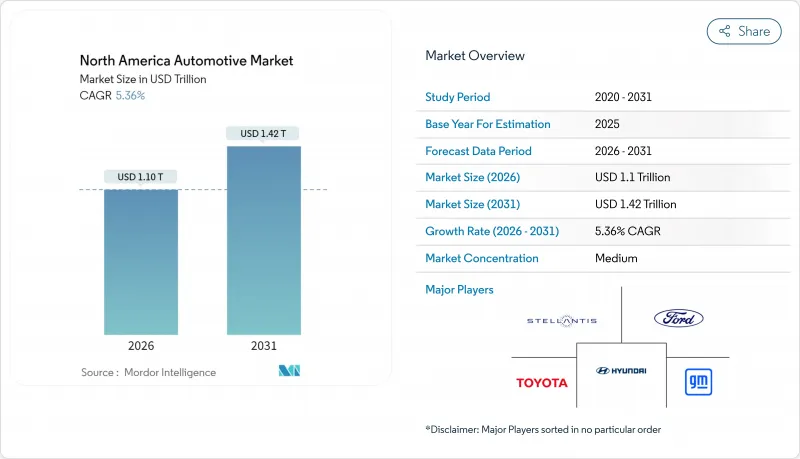
연방 및 주정부의 강력한 제로 방출 차량 규제와 인플레이션 억제법에 근거한 재정적 우대 조치가 예상되는 확대를 지원합니다. 자동차 제조업체는 가벼운 트럭과 SUV 판매를 통한 단기 수익성과 장기 전동화 노력의 균형을 유지하면서 전례 없는 속도로 배터리 및 차량 생산을 현지화하고 있습니다. 함대 사업자가 총소유비용 절감을 선호하는 가운데 상용차의 전기화가 가속화되고 있는 한편, 소비자용 직접 판매 모델이 기존의 딜러 네트워크에 압력을 가하고 있습니다. 관세정책 강화와 중요광물 공급 병목은 계속 단기적인 역풍요인이 되고 있습니다.
북미의 자동차 시장 동향과 인사이트
연방 및 주 제로 방출 차량(ZEV) 규정
캘리포니아의 '선진 클린카 II 규제'에서는 2026년까지 제로 방출 차량 판매 비율 35%, 2035년까지 100%를 의무화하고 있습니다. 이와 동등한 타임라인을 11주와 워싱턴 DC가 채용하고 있습니다. 캐나다의 연방 ZEV 규제도 2035년을 최종 목표로 삼았으며, 2026년까지 20%, 2030년까지 60%의 중간 목표를 세웠습니다. 미국 환경보호청(EPA)이 제안하는 규제에서는 2030년까지 중형·대형 트럭의 제로 방출 차량 판매 비율을 30%로, 2040년까지 100%로 끌어올릴 것을 요구하고 있습니다. 신용 뱅킹 제도를 통해 선행 기업은 컴플라이언스를 수익화할 수 있는 반면, 지연된 기업은 벌칙 강화에 직면하게 됩니다. 따라서 이 규제 프레임워크는 적극적인 전기화 투자를 장려하고 북미의 자동차 시장에서 공급업체의 재조합을 가속화합니다.
배터리 "자동 어레이"의 지역 집적
북미의 배터리 공급망에 대한 누적 투자액은 2023년 말 기준으로 2,500억 달러를 초과했고, 배터리 공장은 최종 조립 공장에서 중앙값으로 284마일(약 457km)의 위치에 위치했습니다. 배터리 제조는 투자액의 약 절반을 차지하며, 업스트림 광물 처리와 하류 EV 조립이 나머지를 분담하고 있습니다. 캐나다는 2028년 가동 예정인 혼다에 의한 150억 캐나다 달러 규모의 통합 복합 시설을 배경으로 리튬 이온 배터리 공급망 순위에서 선두에 뛰어들었습니다. 한편, BMW에 의한 8억 달러 규모의 산루이스 포토시 확장 프로젝트 등 멕시코의 병행 프로젝트는 USMCA(미국·멕시코·캐나다 협정)의 무역 적격성을 유지하면서 비용 경쟁력 있는 생산 능력을 확보하고 있습니다. 지역에 뿌리를 둔 클러스터 형성은 북미의 자동차 시장 전체에서 물류 비용과 관세 위험을 줄입니다.
차량 가격 부담 증가
기록적인 거래 가격으로 인해 월별 평균 지불액이 과거 최고 수준에 도달하고 많은 일반 구매층이 구매를 포기할 수 없는 상황입니다. 인센티브 증가는 이익률을 압박하는 것, 구매 가능성의 회복에 이르지 않습니다. 2023년 이후 리스 비용이 급등함에 따라 소비자는 중고차에 대한 대체를 검토하는 경향이 강해지고 있습니다. 이 영향이 가장 심각한 것은 배터리형 전기자동차(BEV) 모델로, 초기 비용의 높이가 많은 가구에 있어서 평생 비용 절감 효과를 웃돌고 있습니다. 금리 저하 예상이 완화 재료가 되는 것, 가격 감응도의 높이가 북미의 자동차 시장에 있어서 단기적인 판매 대수 증가를 억제할 전망입니다.
부문 분석
중형·대형 상용차는 절대 수량이야말로 작은 것, 2031년까지 연평균 복합 성장률(CAGR) 8.22%로 확대되어 북미의 자동차 시장에 있어서 승용차의 우위성을 크게 웃돌고 있습니다. 규제 측면에서는 캘리포니아 주 선진적 클린 트럭 규제와 미국 환경보호청(EPA)의 제안에 의해 2040년까지 트럭 판매의 100%를 제로 방출화하는 것이 목표로 되어 있습니다. 충전을 집중적으로 관리할 수 있고 가동 사이클을 예측할 수 있는 플릿 구매자는 전동화를 적극적으로 채용하고 있습니다.
승용차는 2025년 시점에서 수익의 68.63%를 차지했지만, 저렴한 가격에 대한 압력과 규제 대응 비용 증가에 직면했습니다. 복수의 파워트레인에 대응 가능한 공장 설비로의 전환에 의해 제조업체는 수요 변동에 따른 생산 조정이 가능하게 됩니다. 2035년까지 제로 방출 트럭의 총소유비용이 승용차와 동등한 수준에 이르면 상용 분야에 대한 투자가 더욱 촉진되고 북미의 자동차 시장에서의 이 부문의 구조적 성장이 강화될 전망입니다.
2025년 시점에서는 내연기관 파워트레인이 82.11%의 점유율을 차지했지만, 최대 7,500달러의 클린 차량 세액 공제를 배경으로 배터리 전기자동차(BEV)가 CAGR 9.58%를 나타낼 것으로 전망됩니다. 하이브리드 모델은 브리지 기술로 작동하며 포드는 2024년 하이브리드 자동차 판매가 두 자릿수 성장했다고 보고했습니다.
플러그인 하이브리드 자동차는 장거리 드라이버의 항속 거리 보증을 제공하는 동시에 부분적인 전기화 목표 달성에 기여합니다. 연료전지 차량은 수소 인프라 부족으로 제한적인 틈새 시장에 머물고 있습니다. 추진 시스템의 다양화를 통해 OEM 제조업체는 자본 배분의 위험을 줄이면서 진화하는 북미의 자동차 시장 규모의 핵심을 이루는 배터리와 소프트웨어 플랫폼의 확대를 도모할 수 있습니다.
북미의 자동차 시장 보고서는 차량 유형(승용차, 소형 상용차 등), 추진 방식(내연 기관 등), 판매 채널(OEM 직영 딜러 등), 자동화 레벨(레벨 0-1, 레벨 2, 레벨 3, 레벨 4-5), 국가별(미국, 캐나다, 기타 북미)으로 세분화되어 있습니다. 시장 예측은 금액(달러) 및 수량(대수)으로 제공됩니다.
기타 혜택 :
- 엑셀 형식 시장 예측(ME) 시트
- 애널리스트 지원(3개월간)
자주 묻는 질문
목차
제1장 서론
- 조사 전제조건 및 시장 정의
- 조사 범위
제2장 조사 방법
제3장 주요 요약
제4장 시장 상황
- 시장 개요
- 시장 성장 촉진요인
- 연방 및 주 제로 방출 차량(ZEV) 의무화
- 자동차 대출 금리 하락과 수요 축적
- NEVI 자금에 의한 EV 충전 인프라 확충
- 이익률을 높이는 라이트 트랙/SUV의 구성 비율 변화
- 배터리 「자동차 산업 집적지」의 지역화
- 소프트웨어 정의 차량의 수익 모델
- 시장 성장 억제요인
- 자동차의 가격 부담 능력의 희박함
- 반도체·전지용 광물공급 제약
- USMCA 검토 하에서의 관세 세토 당 전략
- 피크시의 「충전 대기 행렬」에의 불안
- 가치/공급망 분석
- 규제 상황
- 기술의 전망
- Porter's Five Forces
- 신규 참가업체의 위협
- 구매자의 협상력
- 공급기업의 협상력
- 대체품의 위협
- 경쟁 기업 간 경쟁 관계
제5장 시장 규모와 성장 예측
- 차량 유형별
- 승용차
- 소형 상용차
- 중대형 상용차
- 이륜차
- 추진 유형별
- 내연기관(ICE)
- 하이브리드 전기자동차(HEV)
- 플러그인 하이브리드 자동차(PHEV)
- 배터리 전기자동차(BEV)
- 연료전지 전기자동차(FCEV)
- 천연가스 자동차(NGV)
- 판매 채널별
- OEM 프랜차이즈 딜러 판매
- D2C(온라인)
- 플릿 및 렌탈 판매
- 자동화 레벨별
- 레벨 0-1(기본/ADAS 비탑재)
- 레벨 2(부분 자동화)
- 레벨 3(조건부 자동화)
- 레벨 4-5(고도/완전 자동화)
- 국가별
- 미국
- 캐나다
- 기타 북미
제6장 경쟁 구도
- 시장 집중도
- 전략적 동향
- 시장 점유율 분석
- 기업 프로파일
- General Motors Company
- Toyota Motor Corporation
- Ford Motor Company
- Stellantis NV
- 현대자동회사
- Honda Motor Co., Ltd.
- Nissan Motor Co., Ltd.
- BMW AG
- Tesla, Inc.
- Volkswagen AG
- Mercedes-Benz Group AG
- Kia Corporation
- Subaru Corporation
- Mazda Motor Corporation
- Rivian Automotive, Inc.
- Lucid Group, Inc.
- BYD Company Ltd.
- Volvo Car Corporation
- Mitsubishi Motors Corporation
- Daimler Truck Holding AG
- PACCAR Inc.
- Navistar International Corp.
- Harley-Davidson, Inc.
- Yamaha Motor Co., Ltd.
제7장 시장 기회와 향후 전망
KTH 26.01.20The North America automotive market was valued at USD 1040 billion in 2025 and estimated to grow from USD 1095.7 billion in 2026 to reach USD 1422.2 billion by 2031, at a CAGR of 5.36% during the forecast period (2026-2031).
Robust federal and provincial zero-emission vehicle mandates and fiscal incentives in the Inflation Reduction Act underpin the projected expansion. Automakers are localizing battery and vehicle production at unprecedented speed, balancing short-term profitability from light-truck and SUV sales with long-term electrification commitments. Commercial vehicle electrification is accelerating as fleet operators prioritize total cost-of-ownership gains, while direct-to-consumer sales models pressure entrenched dealer networks. Intensifying tariff policies and critical-mineral bottlenecks remain near-term headwinds.
North America Automotive Market Trends and Insights
Federal and State ZEV Mandates
California's Advanced Clean Cars II regulation requires 35% zero-emission sales by 2026 and 100% by 2035; eleven additional states and Washington, D.C. have adopted identical timelines. Canada's federal ZEV rule mirrors the 2035 deadline with interim 20% and 60% milestones for 2026 and 2030, respectively. Proposed U.S. EPA limits push 30% zero-emission medium- and heavy-truck sales by 2030, rising to 100% by 2040. Credit banking lets early movers monetize compliance, whereas laggards face increasing penalties. The mandate architecture, therefore, rewards proactive electrification investments and accelerates supplier realignment across North America automotive market participants.
Battery "Auto-Alley" Localization
Cumulative North American battery supply-chain commitments topped USD 250 billion by end-2023, with cell plants positioned a median 284 miles from final assembly sites. Cell fabrication absorbs roughly half of the outlays, with upstream mineral processing and downstream EV assembly splitting the remainder. Canada rose first in the lithium-ion supply-chain ranking, buoyed by Honda's CAD 15 billion integrated complex slated for 2028. Parallel Mexican projects, such as BMW's USD 800 million San Luis Potosi expansion, secure cost-competitive capacity while preserving USMCA trade eligibility. Localized clusters mitigate logistics expense and tariff risk across the North America automotive market.
Vehicle Affordability Squeeze
Record transaction prices have pushed average monthly payments to historic highs, sidelining a swath of mainstream buyers. Rising incentives strain margins yet fail to restore affordability. Leasing costs have climbed sharply since 2023, nudging consumers toward used-vehicle substitutes. The pinch is most acute for battery-electric models whose upfront premiums outweigh lifetime savings for many households. Although falling interest-rate expectations offer relief, price sensitivity will cap near-term volume upside in the North America automotive market.
Other drivers and restraints analyzed in the detailed report include:
- NEVI-Funded EV-Charging Build-Out
- Software-Defined-Vehicle Revenue Model
- Peak-Hour "Charging-Queue" Anxiety
For complete list of drivers and restraints, kindly check the Table Of Contents.
Segment Analysis
Medium-and heavy-commercial vehicles, though smaller in absolute volume, expand at 8.22% CAGR through 2031, materially outpacing passenger cars' dominion in the North American automotive market. A regulatory push-California's Advanced Clean Trucks rule and U.S. EPA proposals-targets 100% zero-emission truck sales by 2040. Fleet buyers embrace electrification, where charging can be centralized and duty cycles predictable.
Passenger cars still anchor 68.63% 2025 revenue but contend with affordability pressures and rising compliance outlays. Plant retooling for multi-powertrain flexibility enables manufacturers to modulate output amid shifting demand. Total cost-of-ownership parity for zero-emission trucks by 2035 will further tilt investment toward commercial applications, reinforcing structural growth in this segment of the North America automotive market.
Internal-combustion powertrains command an 82.11% share in 2025; however, battery-electric vehicles will capture incremental gains at 9.58% CAGR, supported by up to USD 7,500 clean-vehicle tax credits. Hybrid models act as a bridge technology, with Ford reporting double-digit hybrid sales gains in 2024.
Plug-in hybrids provide range assurance for long-distance drivers while meeting partial electrification quotas. Fuel-cell offerings remain niche, limited by hydrogen infrastructure gaps. Propulsion diversification allows OEMs to de-risk capital allocation while scaling batteries and software platforms central to the evolving North America automotive market size.
The North America Automotive Market Report is Segmented by Vehicle Type (Passenger Cars, Light Commercial Vehicles, and More), Propulsion Type (ICE, and More), Sales Channel (OEM-Franchised Dealer, and More), Level of Automation (Level 0-1, Level 2, Level 3, and Level 4-5), and Country (United States, Canada, Rest of North America). The Market Forecasts are Provided in Terms of Value (USD) and Volume in Units.
List of Companies Covered in this Report:
- General Motors Company
- Toyota Motor Corporation
- Ford Motor Company
- Stellantis N.V.
- Hyundai Motor Company
- Honda Motor Co., Ltd.
- Nissan Motor Co., Ltd.
- BMW AG
- Tesla, Inc.
- Volkswagen AG
- Mercedes-Benz Group AG
- Kia Corporation
- Subaru Corporation
- Mazda Motor Corporation
- Rivian Automotive, Inc.
- Lucid Group, Inc.
- BYD Company Ltd.
- Volvo Car Corporation
- Mitsubishi Motors Corporation
- Daimler Truck Holding AG
- PACCAR Inc.
- Navistar International Corp.
- Harley-Davidson, Inc.
- Yamaha Motor Co., Ltd.
Additional Benefits:
- The market estimate (ME) sheet in Excel format
- 3 months of analyst support
TABLE OF CONTENTS
1 Introduction
- 1.1 Study Assumptions and Market Definition
- 1.2 Scope of the Study
2 Research Methodology
3 Executive Summary
4 Market Landscape
- 4.1 Market Overview
- 4.2 Market Drivers
- 4.2.1 Federal and State ZEV Mandates
- 4.2.2 Falling Auto-Loan Rates and Pent-Up Demand
- 4.2.3 NEVI-Funded EV-Charging Build-Out
- 4.2.4 Light-Truck/SUV Mix Shift Lifts Margins.
- 4.2.5 Battery "Auto-Alley" Localization
- 4.2.6 Software-Defined-Vehicle Revenue Model
- 4.3 Market Restraints
- 4.3.1 Vehicle Affordability Squeeze
- 4.3.2 Chip and Battery-Grade Mineral Bottlenecks
- 4.3.3 Tariff Brinkmanship Under USMCA Review
- 4.3.4 Peak-Hour "Charging-Queue" Anxiety
- 4.4 Value / Supply-Chain Analysis
- 4.5 Regulatory Landscape
- 4.6 Technological Outlook
- 4.7 Porter's Five Forces
- 4.7.1 Threat of New Entrants
- 4.7.2 Bargaining Power of Buyers
- 4.7.3 Bargaining Power of Suppliers
- 4.7.4 Threat of Substitutes
- 4.7.5 Intensity of Competitive Rivalry
5 Market Size and Growth Forecasts
- 5.1 By Vehicle Type
- 5.1.1 Passenger Cars
- 5.1.2 Light Commercial Vehicles
- 5.1.3 Medium & Heavy Commercial Vehicles
- 5.1.4 Two-Wheelers
- 5.2 By Propulsion Type
- 5.2.1 Internal Combustion Engine (ICE)
- 5.2.2 Hybrid Electric Vehicles (HEV)
- 5.2.3 Plug-in Hybrid Vehicles (PHEV)
- 5.2.4 Battery Electric Vehicles (BEV)
- 5.2.5 Fuel-Cell Electric Vehicles (FCEV)
- 5.2.6 Natural-Gas Vehicles (NGV)
- 5.3 By Sales Channel
- 5.3.1 OEM-Franchised Dealer Sales
- 5.3.2 Direct-to-Consumer (Online)
- 5.3.3 Fleet and Rental Sales
- 5.4 By Level of Automation (Value)
- 5.4.1 Level 0 - 1 (Basic / No ADAS)
- 5.4.2 Level 2 (Partial Automation)
- 5.4.3 Level 3 (Conditional Automation)
- 5.4.4 Level 4 - 5 (High / Full Automation)
- 5.5 By Country
- 5.5.1 United States
- 5.5.2 Canada
- 5.5.3 Rest of North America
6 Competitive Landscape
- 6.1 Market Concentration
- 6.2 Strategic Moves
- 6.3 Market Share Analysis
- 6.4 Company Profiles (includes Global level Overview, Market level overview, Core Segments, Financials as available, Strategic Information, Market Rank/Share for key companies, Products & Services, and Recent Developments)
- 6.4.1 General Motors Company
- 6.4.2 Toyota Motor Corporation
- 6.4.3 Ford Motor Company
- 6.4.4 Stellantis N.V.
- 6.4.5 Hyundai Motor Company
- 6.4.6 Honda Motor Co., Ltd.
- 6.4.7 Nissan Motor Co., Ltd.
- 6.4.8 BMW AG
- 6.4.9 Tesla, Inc.
- 6.4.10 Volkswagen AG
- 6.4.11 Mercedes-Benz Group AG
- 6.4.12 Kia Corporation
- 6.4.13 Subaru Corporation
- 6.4.14 Mazda Motor Corporation
- 6.4.15 Rivian Automotive, Inc.
- 6.4.16 Lucid Group, Inc.
- 6.4.17 BYD Company Ltd.
- 6.4.18 Volvo Car Corporation
- 6.4.19 Mitsubishi Motors Corporation
- 6.4.20 Daimler Truck Holding AG
- 6.4.21 PACCAR Inc.
- 6.4.22 Navistar International Corp.
- 6.4.23 Harley-Davidson, Inc.
- 6.4.24 Yamaha Motor Co., Ltd.