

|
시장보고서
상품코드
1910830
MaaS(서비스형 모빌리티) 시장 : 점유율 분석, 업계 동향 및 통계, 성장 예측(2026-2031년)Mobility As A Service - Market Share Analysis, Industry Trends & Statistics, Growth Forecasts (2026 - 2031) |
||||||
 Mordor Intelligence
MaaS(서비스형 모빌리티) 시장은 2025년의 3,289억 8,000만 달러에서 2026년에는 3,745억 5,000만 달러로 성장하고 2026-2031년에 걸쳐 CAGR 13.85%로 성장을 지속하여, 2031년에는 7,163억 달러를 달성할 전망입니다.
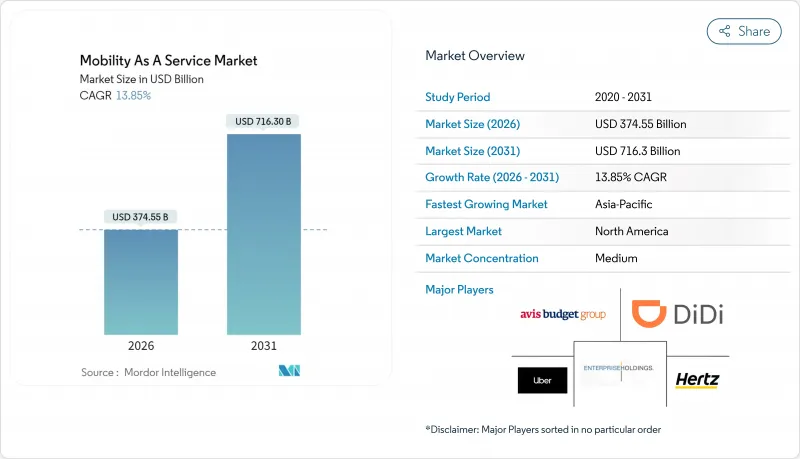
도시의 인구 증가, 스마트폰의 보급 지속화, 환경 의식의 고조에 의해 소비자는 자가용 차량의 소유에서 통합 공유형 멀티모달 교통 서비스로 이행하고 있습니다. API 표준화, 전기 및 수소 추진 기술의 도입, 원활한 결제 혁신이 플랫폼 간의 상호 운용성을 가속화하고 고객 경험을 향상시키는 동시에 공급자의 수익 다양화를 추진하고 있습니다. 시책 수립자는 민관 제휴를 우선시해 전기자동차의 대규모 도입을 촉진하는 제로 에미션 목표를 추진하고 있습니다. 한편, 5G와 IoT의 업그레이드로 실시간 차량 관리와 예측형 이동 관리가 실현되었습니다. 기존의 카셰어링 대기업과 신흥 전문 MaaS(서비스형 모빌리티) 사업자 간의 경쟁 격화로 기업은 차별화를 도모하기 위해 인공지능, 데이터 수익화, 구독 모델에 적극적인 투자를 추진하고 있습니다.
세계의 MaaS(서비스형 모빌리티) 시장의 동향 및 인사이트
유럽 도시의 마이크로 모빌리티와 대중교통의 통합
유럽의 도시에서는 마이크로 모빌리티와 전통적인 대중교통 시스템을 원활하게 통합하여 멀티모달 교통망을 구축하고 퍼스트마일-라스트마일 연결성을 크게 향상시킵니다. 헬싱키 및 비엔나와 같은 유럽 도시들이 이 통합을 주도하고 있으며, 교통당국은 자전거 공유 및 전동 스쿠터 서비스를 통합 모빌리티 플랫폼에 적극적으로 통합하고 있습니다. 이 통합은 현저한 성과를 가져왔으며, 국제 교통 포럼의 보고에 따르면, 적절하게 통합된 마이크로 모빌리티는 도시 회랑에서 대중교통 사용자 수를 최대 35%까지 높일 수 있습니다. 가장 성공적인 사례는 교통 허브 근처에 전략적으로 배치된 표준 도킹 스테이션, 통합 결제 시스템 및 실시간 사용 가능 데이터를 특징으로 합니다. 교통 접근성의 개선 외에도 이 통합은 도시 계획의 우선순위를 재구성합니다. 바르셀로나와 같은 도시에서는 대중교통 거점에 직접 연결되는 마이크로 모빌리티 전용 레인을 정비하기 위해 도로 인프라의 재설계가 진행되고 있습니다.
정부의 제로 에미션 목표가 EV 중심의 MaaS 패키지를 추진
아시아태평양을 비롯한 각 지역의 엄격한 배출 저감 목표가 EV 배차, 전기자동차 셰어링 및 전동 자전거 렌탈을 종합적인 모빌리티 패키지에 통합한 전기자동차 중심의 MaaS 서비스 개발을 촉진하고 있습니다. 중국은 2030년까지 자동차의 40%를 전기자동차로 하는 의무화를 지정했으며, Didi 등의 기업은 제로 에미션 수송수단만을 제공하는 '그린 얼라이언스' MaaS 패키지를 시작했습니다. 이러한 EV 중심의 서비스는 큰 주목을 받고 있으며, TUV SUD의 보고에 의하면, 전기 모빌리티 서비스는 종래의 자동차 이용에 비해 도시 교통의 배출량을 최대 70% 저감하는 것으로 나타났습니다.
미국 각 주의 규제 체제 세분화
미국 각 주의 교통 규제가 서로 다른 패치워크 형태로 되어 있기 때문에 전국적인 전개를 목표로 하는 MaaS 제공자는 큰 운영상의 과제에 직면하고 있습니다. 이는 각 주가 서로 다른 라이선싱 요건, 보험 의무, 운영 제한을 부과하고 있기 때문입니다. 이 규제의 세분화로 인해 기업은 주별로 특화된 운영 모델을 개발할 수밖에 없으며 규정 준수 비용이 크게 증가하고 시장 침투가 지연됩니다. 연방고속도로관리국은 이 규제 조화의 부족으로 여러 주에서 사업을 전개하는 MaaS 제공자의 운영비가 보다 통일된 규제환경에서 사업을 수행하는 제공자에 비해 최대 35% 높다는 것을 지적하고 있습니다.
부문 분석
라이드 헤일링은 확립된 사용자 기반과 광범위한 드라이버 네트워크를 활용하여 2025년 45.85%의 점유율로 MaaS 시장을 독점하고 시장 리더십을 유지하고 있습니다. 그러나 마이크로 모빌리티 서비스(스쿠터 및 자전거 공유)는 퍼스트마일-라스트마일 연결 문제에 대한 효과로 인해 2026-2031년까지 연평균 복합 성장률(CAGR) 19.12%로 예측되는 가장 빠른 성장 부문으로 부상하고 있습니다. IAA의 모빌리티 보고서에 따르면 IoT 연결성과 고성능 배터리가 장착된 마이크로 모빌리티 솔루션은 안정성 향상과 실시간 사용 상황 추적을 통해 사용자 경험을 크게 향상시킵니다. 이 성장은 지자체에 의한 마이크로 모빌리티 전용 레인과 주차구역의 인프라 정비 확대에 의해 더욱 뒷받침되고 있습니다.
카셰어링 부문은 고정 픽업 및 드롭오프 위치를 필요로 하지 않는 유연한 자유 플로팅 모델을 도입하여 상당한 혁신을 추진하고 있습니다. 한편, 버스 공유 서비스는 기업 환경과 캠퍼스 환경에서 주목을 받고 있습니다. 스쿠터 공유 부문은 일부 시장에서 규제상 어려움을 겪었지만 낮은 도입 비용과 높은 사용자 보급률로 빠르게 확대되고 있습니다.
기술 플랫폼은 2025년에 37.72% 시장 점유율을 차지하였고 서비스 통합과 사용자 인터페이스를 가능하게 하는 기반 인프라로 이 부문을 견인하고 있습니다. 한편, 결제 및 월렛 솔루션은 멀티모달 이동체험에서 중요한 마찰점을 해소하면서 2026-2031년에 걸쳐 20.95%의 연평균 복합 성장률(CAGR)로 가장 급속한 성장을 이룰 전망입니다. 특히 오픈 루프 결제 시스템의 등장이 혁신적이며, PaymentGenes의 보고에 따르면, 이 시스템을 도입한 MaaS 플랫폼은 클로즈드 루프 시스템 이용 플랫폼에 비해 최대 40% 높은 사용자 정착률을 달성하고 있습니다. 이러한 시스템을 통해 사용자는 미리 자금을 충전하거나 다른 서비스 간에 여러 결제 수단을 유지할 필요가 없습니다.
여정 계획 및 내비게이션 솔루션은 혼란을 예측하고 실시간으로 대안을 제안할 수 있는 인공지능의 통합을 통해 진화를 계속하고 있습니다. 연결성과 텔레매틱스 솔루션은 차량 추적 및 플릿 관리 기능의 강화를 실현하고 보험 지원 서비스는 공유 모빌리티 이용자 고유의 요구에 대응하면서 확대하고 있습니다.
승용차는 2025년 시점에서 56.63% 시장 점유율을 유지했으며, 이는 라이드 헤일링과 카셰어링 서비스가 MaaS 생태계에서 중요한 위치를 차지하고 있음을 보여줍니다. 그러나 자율주행 포드는 관리된 환경과 퍼스트마일-라스트마일 연결에 대한 강력한 솔루션을 제공하기 때문에 2026-2031년에 걸쳐 22.74%의 연평균 복합 성장률(CAGR)로 가장 높은 성장률을 달성할 것으로 예측됩니다. IEEE Intelligent Transportation Systems Magazine에 게재된 설문 조사에 따르면 자율적인 모듈형 차량 기술은 기존의 고정 노선 교통에 비해 운영 비용을 최대 40% 절감하면서 서비스 유연성을 향상시키는 것으로 입증되었습니다. 이러한 자율주행 포드는 자율주행을 위한 인프라를 최적화할 수 있는 캠퍼스 환경, 비즈니스 파크 및 계획 커뮤니티에서 특히 효과적입니다.
마이크로 모빌리티 차량(전동 자전거, 전동 스쿠터)은 뛰어난 기동성과 주차 편리성을 제공하면서 밀집 도시를 중심으로 시장 점유율을 계속 확대하고 있습니다. 셔틀과 버스는 승차율을 최적화하고 대기 시간을 줄이는 온디맨드 채널 알고리즘의 도입으로 진화하고 있습니다.
지역별 분석
아시아태평양은 밀집한 도시, 고급 디지털 결제, 협력적인 인프라 투자를 활용하여 2025년 MaaS(서비스형 모빌리티) 시장 점유율의 34.12%를 차지했습니다. 중국에서는 주요 도시권에서의 자동차 등록 제한이 통근자를 공유 플랫폼으로 유도하고, 인도에서는 확대하는 중산층이 라이드 셰어링을 적극적으로 이용하고 있습니다. 싱가포르의 '스마트네이션 구상'은 대중교통, 마이크로 모빌리티, 통합 결제를 단일 공공 앱으로 통합하여 모범적인 통합 사례를 보여줍니다.
북미는 시장 규모로는 2위이며 높은 소유 비용, 도시 지역 재밀집화, 기업 출장의 지속가능성 의무가 공유 모빌리티의 성장을 추진하고 있지만, 국가별 규제 차이로 인해 전국적인 플랫폼의 규모 확대가 지연되고 있습니다. 샌프란시스코, 오스틴, 토론토의 기술적 리더십은 예측 분석과 자율주행 파일럿의 조기 도입을 뒷받침합니다. 전기자동차 플릿에 대한 정부의 우대조치가 이 지역의 모빌리티 전환을 더욱 강화하고 있습니다.
중동 및 아프리카는 2031년까지 14.05%의 연평균 복합 성장률(CAGR)로 가장 급속히 확대할 것으로 전망되고 있습니다. 걸프협력회의(GCC) 회원국 정부는 NEOM 및 엑스포시티와 같은 스마트 시티 메가 프로젝트에서 MaaS를 선호하고 자율주행 셔틀 및 통합 운임 시스템에 자본을 할당하고 있습니다. 압둘 라티프 자밀과 조비 에비에이션은 최대 200기의 전기 수직 이착륙기를 도입하는 각서를 체결하여 지상 서비스를 확충하고 멀티모달 네트워크를 강화함으로써 새로운 항공 모빌리티에 대한 높은 목표를 보여줍니다.
기타 혜택
- 시장 예측(ME) 엑셀 시트
- 3개월 애널리스트 서포트
자주 묻는 질문
목차
제1장 서론
- 조사 전제조건 및 시장 정의
- 조사 범위
제2장 조사 방법
제3장 주요 요약
제4장 시장 상황
- 시장 개요
- 촉진요인
- 유럽 도시에서 마이크로 모빌리티와 대중 교통의 통합
- 정부의 제로 에미션 목표가 EV 중심의 MaaS 패키지를 촉진(아시아태평양)
- API 표준화(NeTEx, GTFS-RT)에 의한 계정 기반 티켓 발행
- 라틴아메리카의 MaaS 슈퍼 앱에 대한 벤처 캐피탈의 자금 조달 급증
- 5G/IoT에 의한 실시간 모빌리티 오케스트레이션
- 북미 법인용 출장의 지속가능성 요건
- 억제요인
- 미국 각 주에서 분단된 규제 프레임워크
- GDPR(EU 개인정보보호규정)/CCPA에 의한 데이터 프라이버시 컴플라이언스 비용
- 운전자 및 사업자 보조금에 의한 수익성 과제
- 레거시 교통 IT 시스템에 의한 통합 심도 제한
- 가치 및 공급망 분석
- 규제의 전망
- 기술 전망
- Porter's Five Forces 분석
- 구매자 및 소비자의 협상력
- 공급자의 협상력
- 신규 참가업체의 위협
- 대체품의 위협
- 경쟁 기업 간 경쟁 관계
제5장 시장 규모 및 성장 예측(금액, 달러)
- 서비스 유형별
- 라이드 공유
- 카셰어링
- 자전거 공유
- 스쿠터 공유
- 버스 공유
- 솔루션별
- 기술 플랫폼
- 결제 및 월렛
- 여정 및 내비게이션
- 연결성 및 텔레매틱스
- 보험 및 지원 서비스
- 차종별
- 승용차
- 마이크로 모빌리티 차량(전동 자전거, 전동 스쿠터)
- 셔틀버스 및 노선버스
- 자율주행 포드
- 운송수단별
- 일반
- 민간
- 비즈니스 모델별
- 구독(모빌리티 패키지, 법인용 플랜)
- 종량 과금제
- 피어 투 피어
- 티켓 판매 전용 통합자
- 용도별
- 개인용 모빌리티
- 비즈니스 및 법인용 모빌리티
- 물류 및 라스트마일 배송
- 최종 사용자별
- 개인
- 기업
- 정부 및 지자체 기관
- 운영체제별
- iOS
- Android
- 기타
- HarmonyOS
- KaiOS
- Windows/PWA
- 추진력별
- 내연기관(ICE)
- 전기자동차
- 하이브리드
- 수소 연료전지
- 지역별
- 북미
- 미국
- 캐나다
- 멕시코
- 기타 북미
- 유럽
- 독일
- 영국
- 프랑스
- 스페인
- 이탈리아
- 북유럽 국가
- 기타 유럽
- 아시아태평양
- 중국
- 인도
- 일본
- 한국
- 호주
- 기타 아시아
- 남미
- 브라질
- 칠레
- 기타 남미
- 중동 및 아프리카
- 사우디아라비아
- 아랍에미리트(UAE)
- 이집트
- 튀르키예
- 남아프리카
- 기타 중동 및 아프리카
- 북미
제6장 경쟁 구도
- 시장 집중도
- 전략적 동향
- 시장 점유율 분석
- 기업 프로파일
- Uber Technologies Inc.
- Didi Chuxing
- Lyft Inc.
- Grab Holdings Ltd.
- FREE NOW(GMBH)
- Bolt Technology OU
- MaaS Global(Whim)
- Moovit Inc.
- Citymapper Ltd.
- Via Transportation Inc.
- Beeline Mobility
- UbiGo AB
- 티어 Mobility SE
- Lime Technology Inc.
- Bird Global Inc.
- Bridj Technology Pty Ltd.
- Zipcar(AVIS Budget Group)
- The Hertz Corporation
- Enterprise Holdings Inc.
- Free2Move(STELLANTIS)
- BlaBlaCar(Comuto SA)
- Gojek(GoTo Group)
- Uber Technologies Inc.
- 시장 기회 및 전망
- 기회 영역 및 미충족 요구 평가
- 저소득층 통근자를 위한 정부의 MaaS 보조금
- 데이터 사용량과 연계한 탄소크레딧 거래
- AI 기반 동적 요금 패키지 및 맞춤형 구독
- OEM과의 B2B 플릿 전기화 파트너십
- 2028년 이후 자율 온디맨드 셔틀 네트워크
- MaaS 운영자를 위한 서비스형 보험 플랫폼
- 기회 영역 및 미충족 요구 평가
The mobility as a service market is expected to grow from USD 328.98 billion in 2025 to USD 374.55 billion in 2026 and is forecast to reach USD 716.3 billion by 2031 at 13.85% CAGR over 2026-2031.
Strong urban population growth, continuous smartphone adoption, and heightened environmental awareness are shifting consumers from private vehicle ownership toward integrated, shared, and multimodal transport offerings. API standardization, electric and hydrogen propulsion adoption, and seamless payment innovation are accelerating platform interoperability, improving customer experience, and driving provider revenue diversification. Policymakers are pushing zero-emission goals that prioritize public-private partnerships and stimulate large-scale deployments of electric fleets, while 5G and IoT upgrades enable real-time fleet orchestration and predictive journey management. Intensifying competition between incumbent ride-hailing leaders and emerging specialized MaaS orchestrators is prompting aggressive investment in artificial intelligence, data monetization, and subscription models as companies seek defensible differentiation.
Global Mobility As A Service Market Trends and Insights
Integration of Micro-Mobility and Public Transit Across European Cities
The seamless integration of micro-mobility options with traditional public transit systems creates multimodal transportation networks that significantly enhance first-mile/last-mile connectivity. European cities like Helsinki and Vienna are pioneering this integration, with public transport authorities actively incorporating bike-sharing and e-scooter services into unified mobility platforms. This integration is yielding remarkable results, with the International Transport Forum reporting that properly integrated micro-mobility can increase public transit ridership by up to 35% in urban corridors.The most successful implementations feature standardized docking stations strategically positioned near transit hubs, unified payment systems, and real-time availability data. Beyond improving transit accessibility, this integration is reshaping urban planning priorities, with cities like Barcelona redesigning street infrastructure to accommodate micro-mobility lanes that connect directly to transit stations.
Government Zero-Emission Targets Fueling EV-Centric MaaS Bundles
Stringent emission reduction targets across regions such as Asia-Pacific are catalyzing the development of electric vehicle-focused MaaS offerings that combine EV ride-hailing, electric car-sharing, and e-bike rentals into comprehensive mobility packages. China's mandate for 40% of vehicles to be electric by 2030 has prompted companies like Didi to launch "Green Alliance" MaaS bundles that exclusively feature zero-emission transportation options. These EV-centric services are gaining significant traction, with TUV SUD reporting that electric mobility services can reduce urban transport emissions by up to 70% compared to conventional vehicle usage
Fragmented Regulatory Frameworks Across U.S. States
The inconsistent patchwork of transportation regulations across U.S. states is creating significant operational challenges for MaaS providers attempting to scale nationally. Each state imposes different licensing requirements, insurance mandates, and operational restrictions. This regulatory fragmentation forces companies to develop state-specific operational models, substantially increasing compliance costs and slowing market penetration. The Federal Highway Administration highlights that this lack of regulatory harmonization has resulted in up to 35% higher operational costs for multi-state MaaS providers than those operating in more unified regulatory environments.
Other drivers and restraints analyzed in the detailed report include:
- API Standardization (NeTEx, GTFS-RT) Enabling Account-Based Ticketing
- Surge in VC Funding for South America MaaS Super-Apps
- GDPR/CCPA-Driven Data-Privacy Compliance Costs
For complete list of drivers and restraints, kindly check the Table Of Contents.
Segment Analysis
Ride-hailing dominates the MaaS market with a 45.85% share in 2025, leveraging its established user base and extensive driver networks to maintain market leadership. However, micro-mobility services (scooter/bike sharing) are emerging as the fastest-growing segment with a projected CAGR of 19.12% from 2026 to 2031, driven by their effectiveness in addressing first-mile/last-mile connectivity challenges. The IAA Mobility report indicates that micro-mobility solutions equipped with IoT connectivity and high-performance batteries significantly enhance user experience through improved stability and real-time availability tracking. This growth is further supported by city governments increasingly allocating dedicated infrastructure for micro-mobility lanes and parking zones.
The car sharing segment is witnessing substantial innovation through the introduction of flexible, free-floating models that eliminate fixed pickup and drop-off locations, while bus sharing services are gaining traction in corporate environments and campus settings. The scooter sharing segment, despite regulatory challenges in some markets, is expanding rapidly due to its low implementation costs and high user adoption rates.
Technology platforms lead this segment with 37.72% market share in 2025, serving as the foundational infrastructure that enables service integration and user interface. Meanwhile, payment and wallet solutions are experiencing the fastest growth at a 20.95% CAGR (2026-2031), as they address a critical friction point in the multimodal journey experience. The emergence of open-loop payment systems is particularly transformative, with PaymentGenes reporting that MaaS platforms implementing these systems see up to 40% higher user retention compared to those using closed-loop systems. These systems eliminate the need for users to preload funds or maintain multiple payment methods across different services.
Trip planning and navigation solutions continue to evolve with the integration of artificial intelligence that can predict disruptions and suggest alternatives in real-time. Connectivity and telematics solutions are enabling enhanced vehicle tracking and fleet management capabilities, while insurance and support services are expanding to address the unique needs of shared mobility users.
Passenger cars maintain their dominance with 56.63% market share in 2025, reflecting the continued importance of ride-hailing and car-sharing services in the MaaS ecosystem. However, autonomous pods are projected to achieve the highest growth rate at 22.74% CAGR from 2026-2031, as they offer a compelling solution for controlled environments and first/last-mile connectivity. Research published in the IEEE Intelligent Transportation Systems Magazine demonstrates that autonomous modular vehicle technology can reduce operational costs by up to 40% compared to traditional fixed-route transit while improving service flexibility.These self-driving pods are particularly effective in campus environments, business parks, and planned communities where infrastructure can be optimized for autonomous operation.
Micro-mobility vehicles (e-bikes, e-scooters) continue to gain market share, particularly in dense urban areas where they offer superior maneuverability and parking convenience. Shuttles and buses are evolving with the introduction of on-demand routing algorithms that optimize occupancy rates and reduce wait times.
The Mobility As A Service Market Report is Segmented by Service Type (Ride-Hailing, Car Sharing, and More), Solution (Technology Platform, Payment and Wallet, and More), Vehicle Type (Passenger Cars, Shuttles and Buses, and More), Transportation Type (Public and Private), Business Model, Application, End-User, Operating System, Propulsion, and Geography. The Market Forecasts are Provided in Terms of Value (USD).
Geography Analysis
Asia-Pacific contributed 34.12% of the mobility as a service market share in 2025, capitalizing on dense cities, advanced digital payments, and coordinated infrastructure investments. China's restriction on vehicle registrations in major metros nudges commuters toward shared platforms, while India's expanding middle class embraces affordable ride-hailing. Singapore's Smart Nation blueprint integrates public transit, micro-mobility, and unified payments into a single citizen app that exemplifies best-practice integration.
North America ranks second in market size. High ownership costs, renewed urban densification, and corporate travel sustainability mandates propel shared mobility growth, though state-by-state regulatory divergence slows national platform scale. Technology leadership in San Francisco, Austin, and Toronto supports early adoption of predictive analytics and autonomous pilots. Government incentives for electric vehicle fleets further strengthen the region's mobility shift.
The Middle East and Africa presents the fastest regional expansion at 14.05% CAGR through 2031. Gulf Cooperation Council governments prioritize MaaS within smart-city megaprojects like NEOM and Expo City, allocating capital for autonomous shuttles and integrated fare systems. The Memorandum of Understanding between Abdul Latif Jameel and Joby Aviation to deploy up to 200 electric vertical take-off aircraft signals nascent aerial mobility ambition, augmenting ground-based services and reinforcing multimodal networks.
- Uber Technologies Inc.
Additional Benefits:
- The market estimate (ME) sheet in Excel format
- 3 months of analyst support
TABLE OF CONTENTS
1 Introduction
- 1.1 Study Assumptions and Market Definition
- 1.2 Scope of the Study
2 Research Methodology
3 Executive Summary
4 Market Landscape
- 4.1 Market Overview
- 4.2 Market Drivers
- 4.2.1 Integration of Micro-Mobility and Public Transit Across European Cities
- 4.2.2 Government Zero-Emission Targets Fueling EV-Centric MaaS Bundles (Asia-Pacific)
- 4.2.3 API Standardization (NeTEx, GTFS-RT) Enabling Account-Based Ticketing
- 4.2.4 Surge in VC Funding for LatAm MaaS Super-Apps
- 4.2.5 5G/IoT-Driven Real-Time Mobility Orchestration
- 4.2.6 Corporate Travel Sustainability Mandates in North America
- 4.3 Market Restraints
- 4.3.1 Fragmented Regulatory Frameworks Across U.S. States
- 4.3.2 GDPR/CCPA-Driven Data-Privacy Compliance Costs
- 4.3.3 Profitability Challenges from Driver/Provider Subsidies
- 4.3.4 Legacy Transit IT Systems Limiting Integration Depth
- 4.4 Value / Supply-Chain Analysis
- 4.5 Regulatory Outlook
- 4.6 Technological Outlook
- 4.7 Porter's Five Forces Analysis
- 4.7.1 Bargaining Power of Buyers/Consumers
- 4.7.2 Bargaining Power of Suppliers
- 4.7.3 Threat of New Entrants
- 4.7.4 Threat of Substitute Products
- 4.7.5 Intensity of Competitive Rivalry
5 Market Size and Growth Forecasts (Value (USD))
- 5.1 By Service Type
- 5.1.1 Ride-Hailing
- 5.1.2 Car Sharing
- 5.1.3 Bike Sharing
- 5.1.4 Scooter Sharing
- 5.1.5 Bus Sharing
- 5.2 By Solution
- 5.2.1 Technology Platform
- 5.2.2 Payment and Wallet
- 5.2.3 Trip Planning and Navigation
- 5.2.4 Connectivity and Telematics
- 5.2.5 Insurance and Support Services
- 5.3 By Vehicle Type
- 5.3.1 Passenger Cars
- 5.3.2 Micro-Mobility Vehicles (E-Bikes, E-Scooters)
- 5.3.3 Shuttles and Buses
- 5.3.4 Autonomous Pods
- 5.4 By Transportation Type
- 5.4.1 Public
- 5.4.2 Private
- 5.5 By Business Model
- 5.5.1 Subscription (Mobility Bundles, Corporate Plans)
- 5.5.2 Pay-As-You-Go
- 5.5.3 Peer-to-Peer
- 5.5.4 Ticketing-Only Aggregator
- 5.6 By Application
- 5.6.1 Personal Mobility
- 5.6.2 Business/Corporate Mobility
- 5.6.3 Logistics and Last-Mile Delivery
- 5.7 By End-User
- 5.7.1 Individuals
- 5.7.2 Enterprises
- 5.7.3 Government and Municipal Agencies
- 5.8 By Operating System
- 5.8.1 iOS
- 5.8.2 Android
- 5.8.3 Others
- 5.8.3.1 HarmonyOS
- 5.8.3.2 KaiOS
- 5.8.3.3 Windows/PWAs
- 5.9 By Propulsion
- 5.9.1 Internal Combustion Engine (ICE)
- 5.9.2 Electric
- 5.9.3 Hybrid
- 5.9.4 Hydrogen Fuel-Cell
- 5.10 By Geography
- 5.10.1 North America
- 5.10.1.1 United States
- 5.10.1.2 Canada
- 5.10.1.3 Mexico
- 5.10.1.4 Rest of North America
- 5.10.2 Europe
- 5.10.2.1 Germany
- 5.10.2.2 United Kingdom
- 5.10.2.3 France
- 5.10.2.4 Spain
- 5.10.2.5 Italy
- 5.10.2.6 Nordics
- 5.10.2.7 Rest of Europe
- 5.10.3 Asia-Pacific
- 5.10.3.1 China
- 5.10.3.2 India
- 5.10.3.3 Japan
- 5.10.3.4 South Korea
- 5.10.3.5 Australia
- 5.10.3.6 Rest of Asia
- 5.10.4 South America
- 5.10.4.1 Brazil
- 5.10.4.2 Chile
- 5.10.4.3 Rest of South America
- 5.10.5 Middle East and Africa
- 5.10.5.1 Saudi Arabia
- 5.10.5.2 United Arab Emirates
- 5.10.5.3 Egypt
- 5.10.5.4 Turkey
- 5.10.5.5 South Africa
- 5.10.5.6 Rest of Middle East and Africa
- 5.10.1 North America
6 Competitive Landscape
- 6.1 Market Concentration
- 6.2 Strategic Moves
- 6.3 Market Share Analysis
- 6.4 Company Profiles (Includes Global Level Overview, Market Level Overview, Core Segments, Financials as Available, Strategic Information, Market Rank/Share for Key Companies, Products and Services, SWOT Analysis, and Recent Developments)
- 6.4.1 Uber Technologies Inc.
- 6.4.1.1 Didi Chuxing
- 6.4.1.2 Lyft Inc.
- 6.4.1.3 Grab Holdings Ltd.
- 6.4.1.4 FREE NOW (GMBH)
- 6.4.1.5 Bolt Technology OU
- 6.4.1.6 MaaS Global (Whim)
- 6.4.1.7 Moovit Inc.
- 6.4.1.8 Citymapper Ltd.
- 6.4.1.9 Via Transportation Inc.
- 6.4.1.10 Beeline Mobility
- 6.4.1.11 UbiGo AB
- 6.4.1.12 Tier Mobility SE
- 6.4.1.13 Lime Technology Inc.
- 6.4.1.14 Bird Global Inc.
- 6.4.1.15 Bridj Technology Pty Ltd.
- 6.4.1.16 Zipcar (AVIS Budget Group)
- 6.4.1.17 The Hertz Corporation
- 6.4.1.18 Enterprise Holdings Inc.
- 6.4.1.19 Free2Move (STELLANTIS)
- 6.4.1.20 BlaBlaCar (Comuto SA)
- 6.4.1.21 Gojek (GoTo Group)
- 6.4.1 Uber Technologies Inc.
- 6.5 Market Opportunities and Future Outlook
- 6.5.1 White-Space and Unmet-Need Assessment
- 6.5.1.1 Government-Funded MaaS Vouchers for Low-Income Commuters
- 6.5.1.2 Carbon-Credit Trading Linked to MaaS Usage Data
- 6.5.1.3 AI-Driven Dynamic Fare Bundling and Personalised Subscriptions
- 6.5.1.4 B2B Fleet Electrification Partnerships with OEMs
- 6.5.1.5 Autonomous On-Demand Shuttle Networks Post-2028
- 6.5.1.6 Insurance-as-a-Service Platforms Tailored for MaaS Operators
- 6.5.1 White-Space and Unmet-Need Assessment


