

|
시장보고서
상품코드
2124032
장식용 라미네이트 시장 : 시장 점유율 분석, 업계 동향 및 통계, 성장 예측(2026-2031년)Decorative Laminates - Market Share Analysis, Industry Trends & Statistics, Growth Forecasts (2026 - 2031) |
||||||
 Mordor Intelligence
Mordor Intelligence에 의하면, 장식용 라미네이트 시장 규모는 2025년에 86억 2,000만 달러로 평가되었고, 2026년 88억 8,000만 달러에서 2031년까지 103억 달러에 이를 것으로 예측되며, 예측 기간(2026-2031년) CAGR은 3.01%를 나타낼 전망입니다.
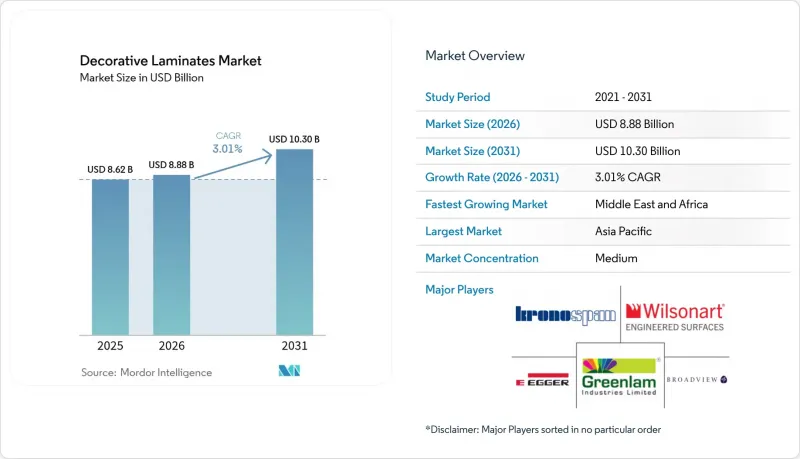
본 보고서는 원자재별(플라스틱 수지, 오버레이, 접착제, 목재 기판, 기타 원자재), 용도별(가구, 캐비닛, 바닥재, 벽 패널, 기타 용도), 최종 사용자 산업별(주거용, 비주거용, 운송), 지역별(아시아태평양, 북미, 유럽, 기타)로 분류되어 있습니다. 시장 예측은 금액(달러) 기준으로 제시되어 있습니다.
세계의 장식용 라미네이트 시장 동향 및 인사이트력
아시아태평양의 주택 건설 급증
인도의 주택 시장은 지속적인 성장세를 보이고 있습니다. 2025년 상반기에는 고급 주택 부문의 판매가 급증하여 주방, 옷장, 벽 패널용 라미네이트 수요가 증가했습니다. 반면, 중국에서는 경기 침체가 나타났습니다. 부동산 투자가 급감하고 완공 주택의 인도량이 감소함에 따라, 해당 지역의 라미네이트 수요가 둔화되었습니다. 그 결과, 각 제조업체는 재고 재분배를 추진하며 인도의 1급 도시 및 신흥 2급 도시에 집중하는 한편, 공급 과잉 상태에 있는 중국의 주요 연안 도시에서의 사업 규모를 축소하고 있습니다. 인도에서는 사무실 임대 계약이 사상 최고치를 기록했고, 소매 프로젝트 파이프라인이 2028년까지 이어지고 있어 상업시설 인테리어 공사 분야의 비즈니스 기회가 확대되고 있습니다. 또한, 동남아시아의 주택 경기 부양책이 시장에 긍정적인 신호를 주고 있는 반면, 공급망 단절로 인해 당분간 공급량은 제한되고 있습니다.
비용 대비 효과가 높은 미관이 리모델링 수요를 견인
2024 회계연도, 일본의 리노베이션 지출은 특히 인구 고령화를 배경으로 주택 소유자나 개발업자가 신축 착공보다 기존 자산의 개보수를 선호하는 추세를 여실히 드러냈습니다. 나무 무늬 표면재 중에서도 장식용 라미네이트는 가성비가 뛰어나기 때문에 예산을 중시하는 리모델링 프로젝트에서 선호되는 선택지가 되고 있습니다. 인도 및 동남아시아에서는 DIY용 전자상거래 플랫폼이 전국으로 미리 절단된 패널의 출하를 시작했으나, 시공자의 교육 부족이 성장 가능성을 저해하고 있어 재주문 감소로 이어지고 있습니다. 북미에서는 주택 재고의 노후화가 계속해서 리모델링 활동을 견인하고 있습니다. 그러나 2025년에 주택 담보 대출 금리가 상승할 전망인 만큼, 소비자들은 고급 등급의 라미네이트보다는 중급 등급의 라미네이트를 선택하는 경향을 보이고 있습니다. 서유럽에서도 유사한 절약 지향적 경향이 나타나고 있지만, 에너지 효율 개선과 관련된 임대인에 대한 규제가 이러한 등급 하향 조정 경향을 어느 정도 완화하고 있습니다.
엔지니어드 스톤, LVT, 써모포일을 통한 대체
내수성이 뛰어나고 클릭 잠금 방식으로 신속하게 시공할 수 있어, 현재 럭셔리 비닐 타일(LVT)이 습기가 많은 바닥 공간에서 주류를 이루고 있습니다. 엔지니어드 스톤으로 제작된 조리대는 라미네이트를 ‘재판매 시 타협점’으로 여기는 구매자가 많은 고급 주방 및 욕실 리모델링 시장을 휩쓸고 있습니다. 써모포일로 제작된 문은 이음매 없는 가장자리를 구현하고 있으며, 유럽의 구매자들로부터 가장자리 밴딩 처리가 된 라미네이트 문보다 고품질로 인식되고 있습니다. 시장 점유율을 되찾기 위해 라미네이트 제조업체들은 미적 격차를 좁히는 고해상도 인쇄와 깊은 질감의 엠보싱 가공에 주력하고 있지만, 대량 판매 부문에서 가격 경쟁력을 확보하는 것은 여전히 어려운 상황입니다. 신흥 시장에서는 여전히 비용 측면에서 라미네이트가 선택되고 있으며, 전 세계적인 대체 압력은 완화되고 있지만 그 흐름을 역전시키지는 못하고 있습니다.
부문 분석
2025년 시점에서 플라스틱 수지는 장식용 라미네이트 시장의 40.96%를 차지했으며, 이는 멜라민 및 페놀 수지 접착에서 중심적인 역할을 하고 있음을 반영합니다. 그러나 오버레이 용지는 2031년까지 연평균 성장률(CAGR) 3.43%를 기록할 전망이며, 이는 원자재 구성 중 가장 높은 성장률입니다. 이러한 추세는 건축가들의 고해상도 인쇄 및 동기화된 엠보싱 가공에 대한 수요에 힘입은 것으로, 오버레이 용지는 두께를 늘리지 않고도 이러한 특징을 제공할 수 있기 때문입니다. 장기 계약이 일반적이지 않은 아시아태평양에서는 화석 원료에 연동되는 플라스틱 수지의 가격 책정으로 인해 비용 전가에 신중한 대응이 요구되고 있습니다.
오버레이 시장의 성장은 EU가 중국의 장식용 종이에 부과한 반덤핑 관세로 인해 더욱 가속화되고 있습니다. 이 조치로 인해 유럽의 가공업체들은 안정적인 공급을 확보하기 위해 자체적인 함침 공정을 도입하게 되었습니다. 한편, 접착제 공급업체들은 바이오이며 포름알데히드가 포함되지 않은 시스템을 도입하고 있습니다. 이러한 시스템은 가격이 다소 비싸지만, 생산자들이 엄격한 상한 기준을 준수하는 데 도움이 되고 있습니다. 목재 기판은 여전히 필수적이지만, EU의 ‘산림 파괴 규제’로 인해 감사 비용이 상승하고 있습니다. 그러나 FSC 또는 PEFC 인증을 취득한 제재소는 현재 가격 면에서 우위를 점하고 있습니다. 인증 물량이 증가함에 따라, 재생 목재를 포함한 장식용 라미네이트 시장 부문은 버진 섬유 시장 규모의 성장률을 상회하는 성장이 예상됩니다.
지역별 분석
아시아태평양은 2025년 매출의 38.24%를 차지했으나, 그 성장 양상에는 양극화가 나타나고 있습니다. 인도에서는 주택 시장이 급성장할 조짐을 보이고 있으며, 상업용 임대 물건도 사상 최고치를 기록하고 있어 가구 및 벽 패널에 라미네이트를 적용하는 사례가 급속히 증가하고 있습니다. 대조적으로, 중국에서는 2024년 1월부터 10월까지 완공 주택 인도 건수가 대폭 감소했습니다. 이러한 부진으로 인해 공급업체들은 수출 수주 확보와 리모델링 분야 집중 중 하나를 선택해야 하는 상황에 직면해 있습니다. 한편, 일본에서 리모델링에 대한 막대한 지출은 신축에서 개보수로의 전환이라는 보다 광범위한 추세를 여실히 보여주고 있습니다. 이러한 추세는 한국에서도 두드러지며, 주택 재고의 노후화가 유사한 변화를 촉진하고 있습니다.
북미에서는 시장이 안정적이며, 리모델링과 조립식 주택이 신축 시장의 둔화를 상쇄하고 있습니다. 그러나 2025년 주택담보대출 금리의 급등으로 인해 일부 선택적 리모델링이 위축되었습니다. 유럽에서는 2026년 8월 포름알데히드 규제 도입을 앞두고 준비가 진행 중이며, 이는 장식용 라미네이트 시장에 영향을 미치고 있습니다. 규제 대응에 필요한 자본 규모를 보여주는 대표적인 사례가 EGGER사가 독일에 신설한 생산 라인입니다. 또한, 중국의 장식용지에 대한 반덤핑 관세가 유럽 전역의 가공업체에 압박을 가하고 있어, 현지 함침 설비에 대한 관심이 높아지고 있습니다.
중동 및 아프리카는 2031년까지 3.49%라는 지역별 최고 수준의 연평균 성장률(CAGR)을 나타낼 전망입니다. 사우디아라비아와 UAE에서는 메가 프로젝트에 라미네이트 마감 내장 솔루션이 채택되면서, 엄격한 납기 준수의 필요성이 강조되고 있습니다. 동시에 1인당 소득 증가가 주택 리모델링의 급증에 박차를 가하고 있습니다. 남미는 공급량이 비교적 적은 편이지만, 브라질의 도시화 추세가 호재로 작용하고 있습니다. 규제 환경의 변화와 건설 업계의 주기적인 특성을 고려할 때, 지역 공급업체들은 규제 준수에 필요한 자본과 생산 능력 확장에 필요한 기동성 사이의 균형을 맞추는 미묘한 균형을 유지해야 하는 상황에 직면해 있습니다.
기타 혜택 :
- 엑셀 형식 시장 예측(ME) 시트
- 3개월간의 애널리스트 지원
자주 묻는 질문
목차
제1장 서론
제2장 조사 방법
제3장 주요 요약
제4장 시장 구도
제5장 시장 규모 및 성장 예측
제6장 경쟁 구도
제7장 시장 기회 및 향후 전망
AJY 26.09.11According to Mordor Intelligence, the decorative laminates market size was valued at USD 8.62 billion in 2025 and is estimated to grow from USD 8.88 billion in 2026 to reach USD 10.30 billion by 2031, at a CAGR of 3.01% during the forecast period (2026-2031).

This report is Segmented by Raw Material (Plastic Resin, Overlays, Adhesives, Wood Substrate, and Other Raw Materials), Application (Furniture, Cabinets, Flooring, Wall Panels, and Other Applications), End-User Industry (Residential, Non-Residential, and Transportation), and Geography (Asia-Pacific, North America, Europe, and More). The Market Forecasts are Provided in Terms of Value (USD).
Global Decorative Laminates Market Trends and Insights
Residential Construction Surge in Asia-Pacific
India's residential market is growing. In H1 2025, premium-segment home sales surged, leading to increased demand for laminates in kitchens, wardrobes, and wall paneling. Conversely, China experienced a downturn: real-estate investments plummeted, and finished-home deliveries dropped, dampening the demand for laminates in the region. As a result, producers are reallocating their inventory, focusing on India's tier-I and emerging tier-II cities, while reducing their presence in the oversaturated coastal hubs of China. With record office leasing in India and a retail pipeline extending through 2028, opportunities in commercial fit-outs are expanding. Additionally, while Southeast Asian housing stimulus packages cast a positive light on the market, supply-chain fragmentation is moderating immediate volumes.
Cost-Effective Aesthetics Fueling Renovation Demand
In FY 2024, Japan's renovation expenditure underscored a trend where homeowners and developers lean towards refurbishing existing assets rather than embarking on new constructions, especially in light of the nation's aging demographic. Among wood-look surfaces, decorative laminates stand out for their cost-effectiveness, making them a favored choice in budget-sensitive remodeling endeavors. While DIY e-commerce platforms in India and Southeast Asia have begun shipping cut-to-size panels across the nation, their growth potential is hampered by a lack of installer training, leading to fewer repeat orders. North America's aging housing stock continues to drive remodeling activities. However, with mortgage rates set to rise in 2025, consumers are gravitating towards mid-tier laminate grades instead of premium ones. Western Europe exhibits a similar trend of thriftiness, but the push from landlord regulations on energy retrofits somewhat mitigates this down-trading.
Substitution by Engineered Stone, LVT, and Thermofoils
Luxury vinyl tile now dominates moisture-prone floor zones because it resists water and installs quickly with click-lock systems. Engineered stone countertops capture upmarket kitchen and bath remodels where buyers view laminates as a resale compromise. Thermofoil doors create seamless edges that European buyers perceive as higher quality than edge-banded laminate fronts. To regain share, laminate producers bank on high-resolution prints and deep-textured embossing that narrows the aesthetic gap, but price parity remains elusive in volume segments. Developing markets still opt for laminates on cost grounds, softening global substitution pressure yet not reversing it.
Other drivers and restraints analyzed in the detailed report include:
- Advances in Digital Printing and Emboss-in-Register Tech
- Prefab Single-Family Housing with Laminate-Integrated Panels
- European Union Formaldehyde-Emission Compliance Costs
For complete list of drivers and restraints, kindly check the Table Of Contents.
Segment Analysis
Plastic resin accounted for 40.96% of the decorative laminates market in 2025, reflecting its central role in melamine and phenolic bonding. Yet overlay papers are on track to post a 3.43% CAGR to 2031, the fastest in the raw-material mix. This trend is driven by architects' demand for high-definition prints and synchronized embossing, features that overlays provide without increasing thickness. In Asia-Pacific, where long-term contracts are uncommon, the pricing of plastic resin-tied to fossil feedstocks-necessitates careful cost pass-throughs.
The growth of overlays is further fueled by the EU's imposition of an anti-dumping duty on Chinese decor paper. This move has nudged European converters to adopt in-house impregnation methods, ensuring a steady supply. Meanwhile, adhesive suppliers are introducing bio-based, formaldehyde-free systems. These systems, while commanding a premium, assist producers in adhering to the stringent ceiling. Wood substrates continue to be vital, but the EU's Deforestation Regulation has escalated audit costs. However, mills boasting FSC or PEFC licenses are now positioned to capitalize on a pricing advantage. With an uptick in certified volumes, the segment of the decorative laminates market linked to recycled wood content is anticipated to outpace the growth of virgin-fiber volumes.
Complete Report Scope:
- By Raw Material
- Plastic Resin
- Overlays
- Adhesives
- Wood Substrate
- Other Raw Materials
- By Application
- Furniture
- Cabinets
- Flooring
- Wall Panels
- Other Applications
- By End-user Industry
- Residential
- Non-residential
- Transportation
- By Geography
- Asia-Pacific
- China
- India
- Japan
- South Korea
- Rest of Asia-Pacific
- North America
- United States
- Canada
- Mexico
- Europe
- Germany
- United Kingdom
- France
- Italy
- Rest of Europe
- South America
- Brazil
- Argentina
- Rest of South America
- Middle-East and Africa
- Saudi Arabia
- South Africa
- Rest of Middle-East and Africa
- Asia-Pacific
Geography Analysis
Asia-Pacific commanded 38.24% of revenue in 2025, but growth is bimodal. India is on the brink of a booming housing market, and with record commercial leasing, the country is witnessing a swift adoption of laminates in furniture and wall panels. In contrast, China is grappling with a significant drop in finished-unit deliveries from January to October 2024. This downturn has compelled suppliers to either pursue export orders or shift their focus to refurbishment niches. Meanwhile, Japan's substantial expenditure on renovations highlights a broader trend: a move away from new constructions towards upgrades. This trend is also evident in South Korea, where the aging housing stock is prompting similar shifts.
In North America, a stable market sees remodeling and prefab housing balancing out the slowdown in new builds. However, a spike in mortgage rates in 2025 has curtailed some discretionary upgrades. Europe is bracing for a formaldehyde cap in August 2026, impacting its decorative laminates market. A testament to the capital needed for compliance is EGGER's new production line in Germany. Additionally, anti-dumping duties on Chinese decor paper are putting pressure on converters across the continent, leading to heightened interest in local impregnation assets.
The Middle East and Africa are projected to post the fastest regional CAGR at 3.49% through 2031. In Saudi Arabia and the UAE, megaprojects are turning to laminate-clad interior solutions, emphasizing the need for tight delivery schedules. Concurrently, rising per-capita incomes are fueling a surge in residential refurbishments. While South America may contribute smaller volumes, urbanization trends in Brazil are providing a boost. Given the evolving regulatory landscapes and cyclical nature of construction, regional suppliers are finding themselves in a delicate dance: balancing the capital needed for compliance with the agility required for capacity deployment.
- Abet Laminati
- Aica Kogyo Co., Ltd.
- Airolam Decorative Laminates
- Archidply
- Bell Laminates
- Broadview Holding
- Durianlam
- Egger
- Greenlam Industries Limited
- Kronoplus Limited
- Laminex
- Merino Industries Limited
- Rushil Decor Limited
- Sonae Arauco
- Stylam
- The Diller Corporation
- Wilsonart LLC
Additional Benefits:
- The market estimate (ME) sheet in Excel format
- 3 months of analyst support
TABLE OF CONTENTS
1 Introduction
- 1.1 Study Assumptions and Market Definition
- 1.2 Scope of the Study
2 Research Methodology
3 Executive Summary
4 Market Landscape
- 4.1 Market Overview
- 4.2 Market Drivers
- 4.2.1 Residential construction surge in Asia-Pacific
- 4.2.2 Cost-effective aesthetics fuelling renovation demand
- 4.2.3 Advances in digital printing and emboss-in-register tech
- 4.2.4 Prefab single-family housing with laminate-integrated panels
- 4.2.5 Tier-II/III city e-commerce DIY cut-sheet adoption
- 4.3 Market Restraints
- 4.3.1 Substitution by engineered stone, LVT and thermofoils
- 4.3.2 Supply-chain traceability costs for wood substrates
- 4.3.3 European Union E1/E0 formaldehyde-emission compliance costs
- 4.4 Value Chain Analysis
- 4.5 Porter's Five Forces
- 4.5.1 Threat of New Entrants
- 4.5.2 Bargaining Power of Buyers
- 4.5.3 Bargaining Power of Suppliers
- 4.5.4 Threat of Substitute Products
- 4.5.5 Degree of Competition
5 Market Size and Growth Forecasts (Value)
- 5.1 By Raw Material
- 5.1.1 Plastic Resin
- 5.1.2 Overlays
- 5.1.3 Adhesives
- 5.1.4 Wood Substrate
- 5.1.5 Other Raw Materials
- 5.2 By Application
- 5.2.1 Furniture
- 5.2.2 Cabinets
- 5.2.3 Flooring
- 5.2.4 Wall Panels
- 5.2.5 Other Applications
- 5.3 By End-user Industry
- 5.3.1 Residential
- 5.3.2 Non-residential
- 5.3.3 Transportation
- 5.4 By Geography
- 5.4.1 Asia-Pacific
- 5.4.1.1 China
- 5.4.1.2 India
- 5.4.1.3 Japan
- 5.4.1.4 South Korea
- 5.4.1.5 Rest of Asia-Pacific
- 5.4.2 North America
- 5.4.2.1 United States
- 5.4.2.2 Canada
- 5.4.2.3 Mexico
- 5.4.3 Europe
- 5.4.3.1 Germany
- 5.4.3.2 United Kingdom
- 5.4.3.3 France
- 5.4.3.4 Italy
- 5.4.3.5 Rest of Europe
- 5.4.4 South America
- 5.4.4.1 Brazil
- 5.4.4.2 Argentina
- 5.4.4.3 Rest of South America
- 5.4.5 Middle-East and Africa
- 5.4.5.1 Saudi Arabia
- 5.4.5.2 South Africa
- 5.4.5.3 Rest of Middle-East and Africa
- 5.4.1 Asia-Pacific
6 Competitive Landscape
- 6.1 Market Concentration
- 6.2 Strategic Moves
- 6.3 Market Share(%)/Ranking Analysis
- 6.4 Company Profiles (includes Global Overview, Market Overview, Core Segments, Financials, Strategic Information, Products and Services, Recent Developments)
- 6.4.1 Abet Laminati
- 6.4.2 Aica Kogyo Co., Ltd.
- 6.4.3 Airolam Decorative Laminates
- 6.4.4 Archidply
- 6.4.5 Bell Laminates
- 6.4.6 Broadview Holding
- 6.4.7 Durianlam
- 6.4.8 Egger
- 6.4.9 Greenlam Industries Limited
- 6.4.10 Kronoplus Limited
- 6.4.11 Laminex
- 6.4.12 Merino Industries Limited
- 6.4.13 Rushil Decor Limited
- 6.4.14 Sonae Arauco
- 6.4.15 Stylam
- 6.4.16 The Diller Corporation
- 6.4.17 Wilsonart LLC
7 Market Opportunities and Future Outlook
- 7.1 White-space and Unmet-need Assessment


