|
시장보고서
상품코드
2119266
PVC 프리 벽지 : 시장 점유율 분석, 업계 동향 및 통계, 성장 예측(2026-2031년)PVC-Free Wall Coverings - Market Share Analysis, Industry Trends & Statistics, Growth Forecasts (2026 - 2031) |
||||||
 Mordor Intelligence
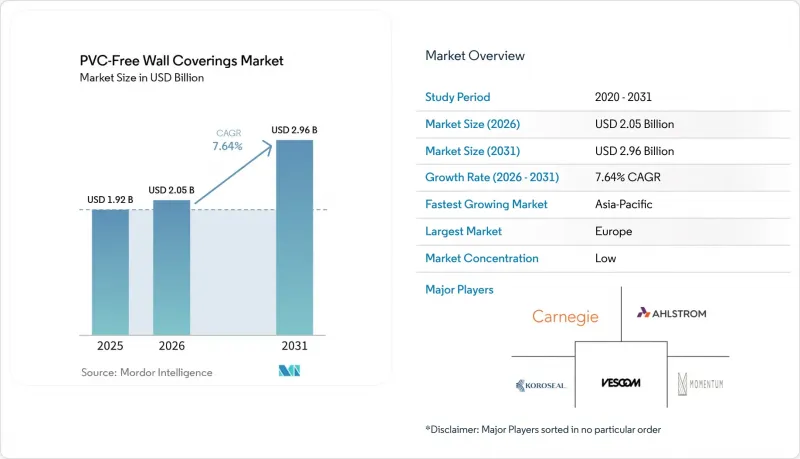
Mordor Intelligence에 의하면, PVC 프리 벽지 시장 규모는 2025년 19억 2,000만 달러로 평가되었습니다. 2026년 20억 5,000만 달러에서 2031년까지 29억 6,000만 달러로 확대되며 2026년부터 2031년까지 연평균 성장률(CAGR)은 7.6%를 나타낼 전망입니다.
본 보고서는 제품 유형(벽지, 벽 패널, 벽용 타일 및 슬래브, 금속 및 보호용 벽 시스템), 건설 유형(신축, 개보수·리모델링),최종 사용자(주거용, 상업용), 유통 채널(B2C, B2B), 지역(북미, 남미, 유럽, 아시아태평양, 중동 및 아프리카)별로 분류되어 있습니다. 예측치는 금액(달러) 단위로 제시되어 있습니다.
세계의 PVC 프리 벽지 시장 동향 및 인사이트
건강 지향적인 상업시설 인테리어에서의 PVC 대체
의료, 고등교육, 노인 주거 시설의 구매자들은 벽 마감재를 선정할 때 실내 공기질과 소재의 투명성을 더욱 중시하고 있습니다. 이에 따라 일부 상업용 사양에서는 기존의 비닐에서 인증된 PVC 프리 대체품으로의 전환이 진행되고 있습니다. ANSI/NSF 342 규격은 미국에서 채택된 벽지 전용 지속가능성 평가 기준입니다. 2024년, Wallcoverings Association 및 Wolf-Gordon에 따르면 2025년 개정 과정에서 인체 건강 및 웰빙에 관한 기준이 더욱 강화되었습니다. 승인 제품 목록은 제품 심사가 완료된 후에도 많은 프로젝트의 지침이 되기 때문에 이러한 전환을 정착시키는 역할을 합니다. 카네기 패브릭스(Carnegie Fabrics)에 따르면, 이 회사의 ‘노라기 스트라이프(Noragi Stripe)’라는 대체 제품은 80%의 올레핀 복합재와 20%의 산업 폐기물 유래 재활용 올레핀을 포함하며, PVC, PFAS 및 할로겐계 난연제를 일절 포함하지 않는다고 합니다. 비닐에 의존하지 않고도 더 많은 제품이 상업적 성능 요건을 충족할 수 있게 된다면, PVC 프리 벽지 시장은 그 혜택을 누리게 될 것입니다.
친환경 건축에서의 저VOC 및 레드리스트 자재 사양
친환경 건축 프로그램은 환경 목표를 수많은 프로젝트의 문서화된 자재 요구 사항으로 전환합니다. 2025년에는 전 세계적으로 1억 4,700만 제곱미터에 달하는 7,500건의 상업 프로젝트가 LEED 인증을 획득했으며, 중국 본토, 인도, 캐나다가 주요 국제 거점이 되었습니다. 이러한 프로젝트들은 저배출형 인테리어 자재 및 제품 문서화에 중요한 기반을 마련하고 있습니다. PVC가 함유되지 않은 벽지 시장은 선언서나 공인된 인증을 통해 프로젝트 요건을 충족할 수 있는 경우 그 수요가 뒷받침됩니다. LEED v4에는 적격 벽지를 규정 준수 수단으로 인정하는 NSF/ANSI 342 파일럿 크레딧이 포함되어 있습니다. 이를 통해 제조업체는 배출량 관련 문서화, 자재 정보 공개 및 검증된 제품 특성에 대한 투자 동기를 얻을 수 있습니다. 이러한 효과는 지속가능성 요건이 단순한 선택적 구매 기준이 아닌 설계 요건의 일부로 자리 잡은 프로젝트에서 가장 두드러지게 나타납니다.
일반 비닐 제품에 비해 높은 공급 비용
PVC 프리 제품은 올레핀, 부직포, 바이오 원자재가 서로 다른 비용 구조를 가지고 있기 때문에 기존 비닐보다 비쌀 수 있습니다. 이러한 가격 차이는 동남아시아의 중급 시장을 겨냥한 호텔 프로젝트나 남미의 주택 건설에서 중요한 요소가 됩니다. 이러한 상황에서는 계약이나 프로젝트 요건에 명시적으로 요구되지 않는 한, 구매자가 대체품을 선택하지 않을 가능성이 있습니다. 또한, 범용 비닐은 확립된 석유화학제품 공급망과 시공업체 간의 폭넓은 인지도라는 이점도 누리고 있습니다. 따라서 PVC 프리 벽지 시장은 내구성과 디자인을 저해하지 않으면서 공급업체가 비용 격차를 줄일 수 있느냐에 달려 있습니다. Momentum Textiles와 Versa는 특정 용도에서 시판되는 비닐과 동등한 가격을 실현한 바이오 유래 유형 II 기판 ‘Circon’을 발표했습니다. 필요한 성능을 충족하면서도 더 저렴한 가격으로 제공되는 제품이라면, 예산이 제한된 프로젝트에서의 채택도 확대될 수 있을 것입니다.
부문별 분석
2025년, 벽지는 PVC 프리 벽지 시장의 48.6%를 차지했습니다. 이러한 위상은 소비자 대상 소매 채널과 상업용 사양 채널 모두에서 제품을 구할 수 있음을 반영합니다. 부직포 제품은 치수 안정성, 박리성, 그리고 저VOC 수성 접착제와의 호환성을 모두 갖추고 있습니다. 또한 일부 종이 뒷면 코팅 제품에서 볼 수 있는 침지 시간을 생략할 수도 있습니다. 이러한 사용상의 이점으로 인해 상업시설 리노베이션 시 시공의 번거로움을 줄일 수 있습니다. 이 카테고리는 현재 실용적인 취급 및 교체 용이성 덕분에 기존에는 비닐을 선호하던 프로젝트에도 대응하고 있습니다.
벽 패널은 가장 빠르게 성장하는 제품 유형이며, 이 부문에서 PVC가 포함되지 않은 벽재 시장 규모는 2026년부터 2031년까지 연평균 성장률(CAGR) 7.8%로 확대될 것으로 예측됩니다. 목재 및 식물 섬유로 만든 패널은 천연 소재를 선호하는 호텔·리조트 업계와 웰니스 시설의 인테리어를 뒷받침하고 있습니다. 2026년 6월, Spinneybeck사는 덴마크산 해초 자투리를 사용한 모듈식 흡음 벽 타일 ‘Sould Fragments’를 발표했습니다. 패브릭이나 텍스타일 소재의 벽지는 질감 있는 마감이 중시되는 고급 호텔 시설이나 사무실 프로젝트에서 사용되고 있습니다. 흡음 패널은 음향 제어가 중요한 오픈 플랜 사무실이나 의료시설에서 사용되고 있습니다. 벽 타일, 슬래브, 금속 마감재, 보호 시스템은 위생 및 표면 내구성이 주요 요구 사항인 복도, 식음료 공간, 요양 시설 등에서 사용되고 있습니다.
2025년, PVC 프리 벽지 시장 중 리모델링 및 개조 공사가 61.3%를 차지했습니다. 이는 유럽에서 지속적인 상업시설 리모델링과 정책 주도의 건물 개보수 계획이 진행되고 있음을 반영합니다. 유동 인구가 많은 상업 공간의 벽재는 보통 7년에서 10년마다 교체됩니다. 교체 주기마다 새로운 소재나 시공 방법이 선정됩니다. 시설 관리자나 인테리어 디자이너는 일반적으로 정해진 리모델링 예산 범위 내에서 이러한 결정을 내립니다. 이를 통해 공급업체는 완공된 프로젝트에서 비비닐 제품이 어떻게 기능하고 있는지 보여줄 수 있습니다.
신축 시장은 2026년부터 2031년에 걸쳐 연평균 성장률(CAGR) 7.7%로 확대될 것으로 예측됩니다. 설계 팀은 조달이 시작되기 전에 프로젝트 문서에 사용할 자재를 확정할 수 있습니다. 따라서 건강 제품 선언서, 선언 라벨 및 환경 제품 문서는 초기 단계부터 제품 라인업에 영향을 미칠 가능성이 있습니다. 프로젝트가 입찰 단계에 도달하기 전에 공급업체가 이러한 요건을 충족할 수 있다면, PVC가 포함되지 않은 벽지 업계에 이점이 될 것입니다. 기업들이 자사의 기준을 반복적으로 적용함에 따라, 인증 및 문서는 여러 프로젝트에 걸쳐 가치를 지닐 가능성이 있습니다. 따라서 사양서에 대한 장기적인 접근성을 확보하기 위해서는 설계 단계에서의 규정 준수가 중요합니다.
지역별 분석
2025년, 유럽은 PVC 프리 벽지 시장의 37.1%를 차지했습니다. 이 지역에는 대규모 상업용 리모델링 프로젝트가 존재하며, 건축물 인증 제도의 활용도 활발합니다. 유럽연합 집행위원회의 리모델링 계획에 대한 평가에 따르면, 회원국 전반에 걸쳐 건축물 리모델링에 대한 정책적 관심이 계속해서 높은 것으로 나타났습니다. 독일, 영국 및 북유럽 국가들은 부직포 벽지와 고급 벽지에 대한 수요를 뒷받침하고 있습니다. A.S. Creation Tapeten사와 Marburger Tapetenfabrik사는 부직포 벽지 생산 분야에서 확고한 입지를 구축하고 있습니다. Graham &Brown사와 Sanderson Design Group사는 고급 주택 및 호스피탈리티 업계의 바이어들에게 제품을 공급하고 있습니다. 리모델링, 인증 및 자재 문서화가 서로를 보완하는 경우가 많기 때문에 유럽은 여전히 중요한 시장으로 남아 있습니다.
북미는 PVC 프리 벽지 시장에서 두 번째로 큰 지역 기여도를 차지하고 있습니다. 수요는 상업용 사무실 및 호텔·리조트 업계의 리노베이션, LEED 도입, 그리고 프탈레이트를 함유한 비닐 소재에 대한 관심 증가에 힘입어 지지를 받고 있습니다. 캘리포니아주에서는 2025년에 470건의 LEED 인증 프로젝트가 기록되었으며, 인증 면적은 9,830만 제곱피트에 달했습니다. PVC 프리 벽지의 가치는 방화 및 건강 관련 시험 결과의 문서화와 청소가 용이함을 요구하는 기관계 바이어들에 의해서도 뒷받침되고 있습니다. 주목받는 리모델링 프로젝트는 인증된 자재의 인지도를 높일 가능성이 있습니다. 이 지역공급업체들은 성능, 투명성, 문서화, 그리고 상업 유통업체를 통한 공급 체계에서 경쟁을 펼치고 있습니다.
아시아태평양은 가장 빠르게 성장하는 지역이며, PVC 프리 벽지 시장 규모는 2026년부터 2031년까지 연평균 성장률(CAGR) 8.5%로 확대될 것으로 예측됩니다. 이러한 성장은 건설 활동, 상업용 부동산의 확대, 그리고 그린 빌딩의 보급과 밀접한 관련이 있습니다. 남미 일부 지역의 주택 및 중규모 상업 프로젝트에서는 가격 민감도가 도입을 제한하고 있습니다. 중동 및 아프리카에서는 호텔·관광, 의료, 복합 애플리케이션 개발이 고성능 상업용 제품 시장 진입 기회를 창출하고 있습니다.
기타 혜택 :
- 엑셀 형식 시장 예측(ME) 시트
- 3개월간의 애널리스트 지원
자주 묻는 질문
목차
제1장 서론
제2장 조사 방법
제3장 개요
제4장 시장 구도
제5장 시장 규모 및 성장 예측
제6장 경쟁 구도
제7장 시장 기회 및 향후 전망
KTH 26.09.02According to Mordor Intelligence, the PVC-free wall coverings market size is projected to expand from USD 1.92 billion in 2025 and USD 2.05 billion in 2026 to USD 2.96 billion by 2031, registering a CAGR of 7.6% between 2026 and 2031.
This report is Segmented by Product Type (Wallpapers, Wall Panels, Wall Tiles and Slabs, Metal and Protective Wall Systems), Construction Type (New Construction, Renovation/Retrofit), End-User (Residential, Commercial), Distribution Channel (B2C, B2B), and Geography (North America, South America, Europe, Asia-Pacific, Middle East and Africa). Forecasts are Provided in Terms of Value (USD).
Global PVC-Free Wall Coverings Market Trends and Insights
PVC Substitution in Health-Conscious Commercial Interiors
Healthcare, higher education, and senior living buyers are placing greater weight on indoor air quality and material transparency when selecting wall finishes. This is moving some commercial specifications away from conventional vinyl and toward verified PVC-free alternatives. The ANSI/NSF 342 standard is the wallcovering-specific sustainability assessment used in the United States. It's 2024, and the 2025 revision process considered stronger human health and wellness criteria, according to the Wallcoverings Association and Wolf-Gordon. Approved product lists make this shift durable because the list can guide many projects after a product has been reviewed. Carnegie Fabrics states that its Noragi Stripe alternative contains 80% olefin composite and 20% post-industrial recycled olefin, and is free of PVC, PFAS, and halogenated flame retardants. The PVC-free wall coverings market benefits when more products can meet commercial performance needs without relying on vinyl.
Low-VOC and Red-List Material Specifications in Green Buildings
Green building programs turn environmental targets into documented material requirements for many projects. In 2025, 7,500 commercial projects received LEED certification across 147 million square meters globally, with mainland China, India, and Canada among the leading international locations. These projects create a substantial setting for low-emitting interior materials and product documentation. The PVC-free wall coverings market is supported when such coverings can meet project requirements through declarations and recognized certifications. LEED v4 includes an NSF/ANSI 342 pilot credit that recognizes qualifying wallcoverings as a compliance route. This gives manufacturers a reason to invest in emissions documentation, material disclosure, and verified product attributes. The effect is strongest in projects where sustainability requirements are part of the design brief rather than an optional purchasing preference.
Higher Delivered Cost Versus Commodity Vinyl
PVC-free products can cost more than conventional vinyl because olefin, non-woven, and bio-based inputs have different cost structures. The gap is important in mid-market hospitality projects in Southeast Asia and residential construction in South America. In these settings, buyers may choose alternatives only when a contract or project requirement calls for them. Commodity vinyl also benefits from established petrochemical supply chains and broad familiarity among installers. The PVC-free wall coverings market, therefore, depends on suppliers narrowing cost gaps without compromising durability or design. Momentum Textiles and Versa presented Circon as a bio-sourced Type II substrate with commercial vinyl price equivalence in selected applications. Products that meet the required performance at a more accessible price can extend adoption to budget-constrained projects.
Other drivers and restraints analyzed in the detailed report include:
- Commercial Renovation and Hospitality Brand Differentiation
- Digital Printing and Short-Run Customization on PVC-Free Substrates
- Fire, Cleanability, and Impact-Performance Qualification Barriers
For complete list of drivers and restraints, kindly check the Table Of Contents.
Segment Analysis
Wallpapers accounted for 48.6% of the value of PVC-free wall coverings in 2025. Their position reflects availability across consumer retail and commercial specification channels. Non-woven products combine dimensional stability, strippability, and compatibility with low-VOC water-based adhesives. They can also eliminate the soak time for some paper-backed products. These application advantages can reduce installation effort during commercial renovation. The category now serves projects that previously favored vinyl for practical handling and replacement needs.
Wall panels are the fastest-growing product type, with the value of PVC-free wall coverings for this segment forecast to grow at a 7.8% CAGR from 2026 to 2031. Wood and plant-fiber panels support hospitality and wellness interiors that favor natural materials. In June 2026, Spinneybeck introduced Sould Fragments, a modular acoustic wall tile made from Danish eelgrass offcuts. Fabric and textile wallpapers are used in premium hospitality and office projects where tactile finishes are valued. Acoustic panels are used in open-plan workplaces and healthcare settings where sound control matters. Wall tiles, slabs, metal finishes, and protective systems are used in corridors, food service spaces, and care facilities where hygiene and surface life are central requirements.
Renovation and retrofit accounted for 61.3% of the PVC-free wall coverings market in 2025. This reflects ongoing commercial refurbishment and the policy-led pipeline of building upgrades in Europe. Wallcoverings in high-traffic commercial spaces are commonly replaced every 7 to 10 years. Each replacement cycle creates a new material and installation decision. Facility managers and interior designers typically make these decisions within defined renovation budgets. This allows suppliers to show how non-vinyl products perform in completed projects.
New construction is forecast to grow at a 7.7% CAGR from 2026 to 2031. Design teams can lock material choices into project documents before procurement begins. Health product declarations, declare labels, and environmental product documentation can therefore influence the product set at an early stage. The PVC-free wall coverings industry benefits when suppliers can meet these requirements before a project reaches the tender stage. Certification and documentation can have value across multiple projects because firms apply their standards repeatedly. This makes design-stage compliance important for long-term access to specifications.
Complete Report Scope:
- By Product Type
- Wallpapers
- Bio-Based Composite and Plant-Fiber Wallpapers
- Non-Woven Cellulose and Synthetic Fiber Wallpapers
- Paper and Recycled-Fiber Wallpapers
- Fabric and Textile Wallpapers
- Other Materials
- Wall Panels
- Acoustic Wall Panels
- Decorative 3D Wall Panels
- Textile and Felt Wall Panels
- Wood and Plant-Fiber Wall Panels
- Wall Tiles and Slabs
- Metal Wall Coverings
- Protective and Impact-Resistant Wall Systems
- Other Product Types
- Wallpapers
- By Construction Type
- New Construction
- Renovation/Retrofit
- By End-user
- Residential
- Commercial
- By Distribution Channel
- B2C Channels
- Hypermarkets and Supermarkets
- Specialty Wallpaper Stores
- Home Centers
- Online
- Local Shops (unorganized channels)
- Other Distribution Channels
- B2B Channels (Contractors and Installers, Interior Designers and Architects, Project Procurement and Institutional Sales)
- B2C Channels
- By Geography
- North America
- Canada
- United States
- Mexico
- South America
- Brazil
- Peru
- Chile
- Argentina
- Rest of South America
- Europe
- United Kingdom
- Germany
- France
- Spain
- Italy
- BENELUX (Belgium, Netherlands, Luxembourg)
- NORDICS (Denmark, Finland, Iceland, Norway, Sweden)
- Rest of Europe
- Asia-Pacific
- India
- China
- Japan
- Australia
- South Korea
- South-East Asia
- Rest of Asia-Pacific
- Middle East & Africa
- United Arab Emirates
- Saudi Arabia
- South Africa
- Nigeria
- Rest of Middle East & Africa
- North America
Geography Analysis
Europe accounted for 37.1% of the PVC-free wall coverings market in 2025. The region has a substantial commercial retrofit base and strong use of building certification systems. The European Commission's assessment of renovation plans shows continued policy attention to building upgrades across member states. Germany, the United Kingdom, and the Nordic countries support demand for non-woven and premium wallcoverings. A.S. Creation Tapeten and Marburger Tapetenfabrik have established positions in non-woven wallpaper production. Graham & Brown and Sanderson Design Group serve premium residential and hospitality buyers. Europe remains important because renovation, certification, and materials documentation often reinforce one another.
North America is the second-largest regional contributor to the PVC-free wall coverings market. Demand is supported by commercial office and hospitality renovations, the adoption of LEED, and greater attention to phthalate-containing vinyl. California recorded 470 LEED-certified projects in 2025, representing 98.3 million square feet of certified space. The value of PVC-free wall coverings is also supported by institutional buyers who require documented fire and health testing, as well as cleanability. High-profile renovation projects can raise the visibility of certified materials. Suppliers in the region compete on performance, transparency, documentation, and availability through commercial distributors.
Asia-Pacific is the fastest-growing region, with the value of PVC-free wall coverings forecast to rise at an 8.5% CAGR from 2026 to 2031. Growth is linked to construction activity, the expansion of commercial real estate, and the broader adoption of green building. Price sensitivity limits adoption in some South American residential and mid-market commercial projects. In the Middle East and Africa, hospitality, healthcare, and mixed-use developments create entry points for performance-grade commercial products.
- Carnegie Fabrics, LLC
- Momentum Textiles and Wallcovering
- Koroseal Interior Products, LLC
- Designtex, Inc.
- Vescom B.V.
- Ahlstrom Oyj
- Monadnock Paper Mills, Inc.
- Ultraflex Systems Inc.
- Len-Tex Corporation
- A.S. Creation Tapeten AG
- Asian Paints Limited
- Brewster Home Fashions LLC
- F. Schumacher and Co.
- Graham and Brown Limited
- Grandeco Wallfashion Group NV
- Marburger Tapetenfabrik J.B. Schaefer GmbH and Co. KG
- Rasch GmbH and Co. KG
- Sangetsu Corporation
- Sanderson Design Group plc
- The Romo Group
Additional Benefits:
- The market estimate (ME) sheet in Excel format
- 3 months of analyst support
TABLE OF CONTENTS
1 Introduction
- 1.1 Study Assumptions & Market Definition
- 1.2 Scope of the Study
2 Research Methodology
3 Executive Summary
4 Market Landscape
- 4.1 Market Overview
- 4.2 Market Drivers
- 4.2.1 PVC Substitution in Health-Conscious Commercial Interiors
- 4.2.2 Low-VOC and Red-List Material Specifications in Green Buildings
- 4.2.3 Commercial Renovation and Hospitality Brand Differentiation
- 4.2.4 Digital Printing and Short-Run Customization on PVC-Free Substrates
- 4.2.5 Type II Performance Parity Expanding Non-Vinyl Specification
- 4.2.6 Recycled-Fiber and Bio-Based Substrate Innovation
- 4.3 Market Restraints
- 4.3.1 Higher Delivered Cost Versus Commodity Vinyl
- 4.3.2 Fire, Cleanability, and Impact-Performance Qualification Barriers
- 4.3.3 Limited End-of-Life Collection for Multi-Material Wallcoverings
- 4.3.4 Installer Familiarity and Application-Quality Risk
- 4.4 Industry Value Chain Analysis
- 4.5 Porter's Five Forces Analysis
- 4.5.1 Threat of New Entrants
- 4.5.2 Bargaining Power of Suppliers
- 4.5.3 Bargaining Power of Buyers
- 4.5.4 Threat of Substitutes
- 4.5.5 Competitive Rivalry
- 4.6 Insights into the Latest Trends and Innovations in the Industry
- 4.7 Insights into the Recent Developments (New Product Launches, Strategic Initiatives, Investments, Partnerships, JVs, Expansion, M&As, etc.) in the Industry
- 4.8 Insights into the Technological Landscape for PVC-free Wallcovering Market (Digital Printing, Low-VOC Inks, Bio-Based Substrates, Antimicrobial Finishes, Peel-and-Stick Adhesives, AR Visualization)
5 Market Size & Growth Forecasts (Value)
- 5.1 By Product Type
- 5.1.1 Wallpapers
- 5.1.1.1 Bio-Based Composite and Plant-Fiber Wallpapers
- 5.1.1.2 Non-Woven Cellulose and Synthetic Fiber Wallpapers
- 5.1.1.3 Paper and Recycled-Fiber Wallpapers
- 5.1.1.4 Fabric and Textile Wallpapers
- 5.1.1.5 Other Materials
- 5.1.2 Wall Panels
- 5.1.2.1 Acoustic Wall Panels
- 5.1.2.2 Decorative 3D Wall Panels
- 5.1.2.3 Textile and Felt Wall Panels
- 5.1.2.4 Wood and Plant-Fiber Wall Panels
- 5.1.3 Wall Tiles and Slabs
- 5.1.4 Metal Wall Coverings
- 5.1.5 Protective and Impact-Resistant Wall Systems
- 5.1.6 Other Product Types
- 5.1.1 Wallpapers
- 5.2 By Construction Type
- 5.2.1 New Construction
- 5.2.2 Renovation/Retrofit
- 5.3 By End-user
- 5.3.1 Residential
- 5.3.2 Commercial
- 5.4 By Distribution Channel
- 5.4.1 B2C Channels
- 5.4.1.1 Hypermarkets and Supermarkets
- 5.4.1.2 Specialty Wallpaper Stores
- 5.4.1.3 Home Centers
- 5.4.1.4 Online
- 5.4.1.5 Local Shops (unorganized channels)
- 5.4.1.6 Other Distribution Channels
- 5.4.2 B2B Channels (Contractors and Installers, Interior Designers and Architects, Project Procurement and Institutional Sales)
- 5.4.1 B2C Channels
- 5.5 By Geography
- 5.5.1 North America
- 5.5.1.1 Canada
- 5.5.1.2 United States
- 5.5.1.3 Mexico
- 5.5.2 South America
- 5.5.2.1 Brazil
- 5.5.2.2 Peru
- 5.5.2.3 Chile
- 5.5.2.4 Argentina
- 5.5.2.5 Rest of South America
- 5.5.3 Europe
- 5.5.3.1 United Kingdom
- 5.5.3.2 Germany
- 5.5.3.3 France
- 5.5.3.4 Spain
- 5.5.3.5 Italy
- 5.5.3.6 BENELUX (Belgium, Netherlands, Luxembourg)
- 5.5.3.7 NORDICS (Denmark, Finland, Iceland, Norway, Sweden)
- 5.5.3.8 Rest of Europe
- 5.5.4 Asia-Pacific
- 5.5.4.1 India
- 5.5.4.2 China
- 5.5.4.3 Japan
- 5.5.4.4 Australia
- 5.5.4.5 South Korea
- 5.5.4.6 South-East Asia
- 5.5.4.7 Rest of Asia-Pacific
- 5.5.5 Middle East & Africa
- 5.5.5.1 United Arab Emirates
- 5.5.5.2 Saudi Arabia
- 5.5.5.3 South Africa
- 5.5.5.4 Nigeria
- 5.5.5.5 Rest of Middle East & Africa
- 5.5.1 North America
6 Competitive Landscape
- 6.1 Market Concentration
- 6.2 Strategic Moves
- 6.3 Market Share Analysis
- 6.4 Company Profiles {(includes Global level Overview, Market level overview, Core Segments, Financials as available, Strategic Information, Market Rank/Share for key companies, Products & Services, and Recent Developments)}
- 6.4.1 Carnegie Fabrics, LLC
- 6.4.2 Momentum Textiles and Wallcovering
- 6.4.3 Koroseal Interior Products, LLC
- 6.4.4 Designtex, Inc.
- 6.4.5 Vescom B.V.
- 6.4.6 Ahlstrom Oyj
- 6.4.7 Monadnock Paper Mills, Inc.
- 6.4.8 Ultraflex Systems Inc.
- 6.4.9 Len-Tex Corporation
- 6.4.10 A.S. Creation Tapeten AG
- 6.4.11 Asian Paints Limited
- 6.4.12 Brewster Home Fashions LLC
- 6.4.13 F. Schumacher and Co.
- 6.4.14 Graham and Brown Limited
- 6.4.15 Grandeco Wallfashion Group NV
- 6.4.16 Marburger Tapetenfabrik J.B. Schaefer GmbH and Co. KG
- 6.4.17 Rasch GmbH and Co. KG
- 6.4.18 Sangetsu Corporation
- 6.4.19 Sanderson Design Group plc
- 6.4.20 The Romo Group
7 Market Opportunities & Future Outlook
- 7.1 PVC-Free Type II Products for Healthcare and Senior Living
- 7.2 Recycled-Fiber Wall Graphics for Retail and Hospitality