|
시장보고서
상품코드
1938988
유럽의 건설 화학제품 : 시장 점유율 분석, 업계 동향과 통계, 성장 예측(2026-2031년)Europe Construction Chemicals - Market Share Analysis, Industry Trends & Statistics, Growth Forecasts (2026 - 2031) |
||||||
 Mordor Intelligence
유럽의 건설용 화학제품 시장 규모는 2026년에 209억 4,000만 달러에 달할 것으로 예측되고 있습니다. 이는 2025년 200억 9,000만 달러에서 성장한 수치이며, 2031년에는 257억 6,000만 달러에 달할 것으로 전망되고 있습니다. 2026-2031년의 연평균 성장률(CAGR)은 4.23%로 예측되고 있습니다.
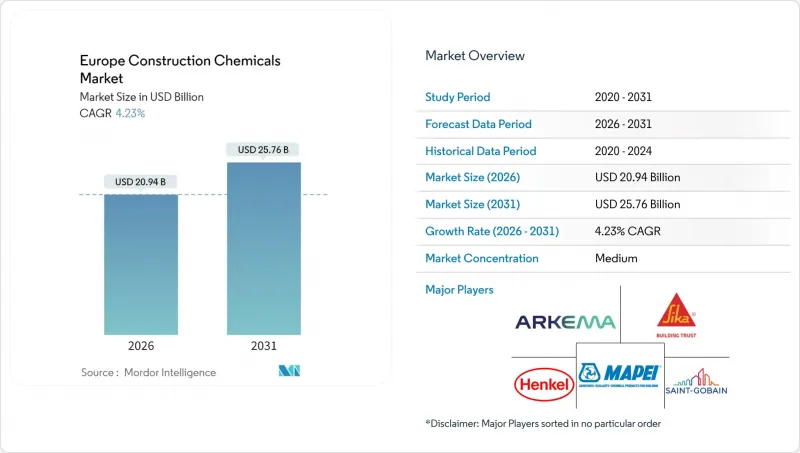
EU 그린딜, 건축물의 에너지 성능 지침(EPBD), 유럽 연결 시설(CEF)에 기반한 공공 부문 부양책이 저탄소 자재 및 인프라 갱신에 대한 지출을 촉진하고 있으므로 건설업의 경기 순환 둔화에도 불구하고 확대가 지속되고 있습니다. 프로젝트 소유자가 환경 제품 선언(EPD) 의무화를 채택함에 따라 특수 배합 기술과 검증 가능한 환경 인증을 결합한 공급업체가 사양서를 획득할 가능성이 높아지고 있습니다. 산고반의 10억 2,500만 달러 규모의 포스락 인수에서 알 수 있듯이, 업계 재편이 가속화되고 있습니다. 한편, 시카 등 주요 기업은 지역적 다각화와 특수 제품 포트폴리오를 활용하여 이익률을 유지하고 있습니다. 에폭시 수지 및 폴리우레탄 원료를 중심으로 한 원자재 가격 변동이 수익성을 압박하는 반면, 바이오, 퍼플루오로알킬물질(PFAS) 프리, 카본 네거티브 화학 기술의 혁신은 새로운 수입원을 창출하고 유럽 건설화학 시장 전체의 규제 대응력을 강화하고 있습니다.
유럽 건설화학 시장 동향과 인사이트
EU 그린딜 자금으로 지속가능한 건설 수요 가속화
1조 유로 규모의 그린딜 투자 프레임워크는 2030년까지 3,500만 채의 건물에 대한 저탄소 개보수를 의무화하고 있으며, 이는 유럽 건설화학 시장을 지원하는 바이오 혼화제, 재생재 함유 방수재, 탄소 네거티브 첨가제에 대한 수요를 직접적으로 확대할 것입니다. BASF가 2024년 말 출시한 바이오 에틸아크릴레이트는 성능을 유지하면서 제품 탄소발자국을 30% 감소시켜 건설 제품 규정 2024/3110에 따른 환경 제품 선언 의무화를 위한 공급업체들의 재조합을 보여줍니다. 재정적 인센티브와 그린본드 자격은 투명한 수명주기 데이터를 가진 제품에 대한 고객 선호도를 높여 유럽 건설화학 시장 내에서 프리미엄 부문을 형성하고 있습니다. 정부의 개보수 보조금으로 인해 고성능 실란트, 단열 접착제, 액상 방수포는 지자체 주택 운영자의 핵심 조달 우선순위가 되었습니다. 2026년에는 사회기후기금의 자금 유입이 증가할 것으로 예상되며, 에너지 절약형 화학제품에 대한 시장 수요가 기존 대체품을 계속 능가할 것으로 예상에 따라 이 촉진요인의 중기적 중요성은 더욱 확고해질 것입니다.
EU 유럽연계시설(CEF)은 국경 간 인프라 지출을 촉진
총 337억 유로 규모의 CEF 2021-2027 프로그램은 철도, 터널, 항만 프로젝트에 자본을 투입하여 철도, 터널, 항만 프로젝트에 대한 수요를 증가시키고, 레일발티카, 지중해 연결선 등의 회랑에서 고성능 혼화제, 속경화 모르타르, 터널 방수재 등 특수 화학제품에 대한 수요를 증가시킬 것입니다. 기후 변화에 강한 자산기준에 대한 적합성은 구조물의 수명을 연장하는 탄소섬유 강화 시스템이나 자기 치유 콘크리트를 유리하게 만듭니다. CEF의 공동 출자로 진행되는 그랑 파리 익스프레스 프로젝트만 해도 스프레이식 방수포와 저배출형 콘크리트 경화 촉진제가 대량으로 소비됩니다. 여러 국가 표준에 부합하는 다목적 시스템 인증을 획득한 공급업체는 입찰 우위를 확보할 수 있으며, 본 프로그램 종료 후 2028년으로 예정된 차기 계획까지 유럽 건설화학 시장의 성장 모멘텀을 강화할 수 있을 것으로 예측됩니다.
에폭시, PU, 아크릴 원료의 가격변동
2025년 1월 에폭시 수지 현물 가격은 재고 부족과 아시아산 수입품에 대한 10.8%-40.8%의 반덤핑 관세 부과로 인해 1.73% 상승했습니다. 폴리우레탄 전구체는 유가 변동을 반영하고, 에너지 집약형 아크릴 모노머 체인은 유럽의 전력 비용 상승에 직면해 있습니다. 소규모 제약사들은 헤지 및 후방 통합이 부족한 경우가 많아 이익률을 압박하고 혁신 투자를 늦추고 있습니다. 일부 고객들은 비필수적인 개보수 공사를 연기하여 유럽 건설용 화학제품 시장의 물량을 약간 억제하고 있습니다. 주요 제조업체들은 장기 계약을 체결하고 있지만, 조달 측면의 불확실성은 2026년까지 가격 상승의 역풍으로 작용할 것으로 예측됩니다.
부문 분석
방수 시스템은 2025년 유럽 건설용 화학제품 시장에서 31.62%의 점유율을 차지할 것으로 예측됩니다. 이는 터널, 지하실, 교량 상판에 대한 엄격한 내구성 요구사항에 의해 지원됩니다. 이 부문의 우위는 높은 고장 비용 회피 효과에 기인하며, 최종사용자는 가격 프리미엄에도 불구하고 고급 타포린과 액상 도포형 코팅을 선호하고 있습니다. 방수 분야의 유럽 건설용 화학제품 시장 규모는 2024년에 꾸준히 확대되었습니다. 이는 공공 부문의 개보수 보조금이 습기 대책 업그레이드에 우선순위를 두었기 때문입니다. 하천 유역의 홍수 위험 완화 조치 강화도 수요를 촉진하고, 음압 측 슬러리 모르타르 및 엘라스토머 오버레이의 채택을 촉진하고 있습니다. 제품 혁신은 PFAS 프리 폴리머, 바이오 아스팔트 개질제, 열 사이클에서도 접착력을 유지하는 나노 실리카 강화 코팅에 초점을 맞추었습니다. SOPREMA의 인수 전략은 아스팔트, 폴리메틸메타크릴레이트(PMMA), 폴리우레탄 기술을 통합하고 시스템 보증을 제공함으로써 고객 인클로저를 강화하는 것입니다. 한편, 공급업체들은 BIM 워크플로우와 통합되는 디지털 상세 설계 툴의 개발에 박차를 가하고 있으며, 이를 통해 사양 준수율을 높이고 시공 오류를 줄이고 있습니다.
콘크리트 혼화제는 2031년까지 연평균 복합 성장률(CAGR) 5.05%로 가장 빠르게 성장하는 제품군으로, 인프라 소유자가 저탄소 목표에 부합하는 고성능 혼화제를 요구함에 따라 2031년까지 연평균 복합 성장률(CAGR) 5.05%로 가장 빠르게 성장할 것으로 예측됩니다. 고감수제, 자기충진제, 수축보정제는 프리미엄 가격이 책정되어 있으며, 유럽 건설화학 시장에서 혼화제의 규모는 물량 성장과 함께 확대되고 있습니다. 규제 압력으로 인해 저알칼리성 혼화제 및 6가 크롬 저감 가소제에 대한 수요가 증가하고 있으며, 연구개발 파이프라인에서는 시멘트 강도비를 향상시키는 나노 클레이 분산 기술에 초점을 맞추었습니다. 접착제 및 실란트는 커튼월, 바닥재, 파사드 응용 분야에서 안정적인 수요를 유지하고 있지만, PFAS의 단계적 폐지로 인해 실리콘 및 실란 말단 폴리머 대체품의 물결이 촉진되어 유럽 건설 화학 산업내 경쟁 환경을 재구성하고 있습니다. 바닥용 수지는 정전기 소산성과 내화학성이 미션 크리티컬한 데이터센터와 물류 허브에서 주목받고 있습니다. 한편, 앵커 및 그라우트는 풍력발전소 기초공사 및 산업 플랜트 개보수 공사에서 완만한 성장세를 유지하고 있습니다.
기타 특전:
- 엑셀 형식 시장 예측(ME) 시트
- 애널리스트의 3개월간 지원
자주 묻는 질문
목차
제1장 서론
제2장 조사 방법
제3장 개요
제4장 시장 구도
제5장 시장 규모와 성장 예측
제6장 경쟁 구도
제7장 시장 기회와 향후 전망
제8장 CEO을 위한 주요 전략적 과제
KSA 26.03.05Europe Construction Chemicals market size in 2026 is estimated at USD 20.94 billion, growing from 2025 value of USD 20.09 billion with 2031 projections showing USD 25.76 billion, growing at 4.23% CAGR over 2026-2031.
Expansion continues despite cyclical construction slowdowns because public-sector stimulus under the EU Green Deal, the Energy Performance of Buildings Directive (EPBD), and the Connecting Europe Facility steers spending toward low-carbon materials and infrastructure upgrades. Suppliers that combine specialty formulations with verifiable environmental credentials are more likely to win specifications as project owners adopt mandatory Environmental Product Declarations (EPDs). Consolidation accelerates, illustrated by Saint-Gobain's USD 1.025 billion acquisition of FOSROC, while leaders such as Sika leverage geographic diversification and specialty product portfolios to protect margins. Raw-material cost volatility, chiefly in epoxy and polyurethane feedstocks, pressures profitability, yet innovation in bio-based, Per- and Polyfluoroalkyl Substances (PFAS)-free, and carbon-negative chemistries creates new revenue streams and improves regulatory resilience across the Europe Construction Chemicals market.
Europe Construction Chemicals Market Trends and Insights
EU Green Deal funding accelerates sustainable construction demand
The EUR 1 trillion Green Deal investment framework mandates low-carbon renovation across 35 million buildings by 2030, directly increasing volumes for bio-based admixtures, recycled-content waterproofing, and carbon-negative additives that underpin the Europe Construction Chemicals market. BASF's bio-based ethyl acrylate launch in late 2024 cut product carbon footprints by 30% while maintaining performance, signaling supplier realignment toward mandatory environmental product declarations under Construction Products Regulation 2024/3110. Financial incentives and green bond eligibility heighten customer preference for products with transparent life-cycle data, creating a premium segment within the Europe Construction Chemicals market. Government renovation subsidies make high-performance sealants, insulation adhesives, and liquid-applied membranes core purchasing priorities for municipal housing operators. As more funding flows from the Social Climate Fund in 2026, market demand for energy-efficient chemistries continues to outpace conventional alternatives, cementing the driver's medium-term importance.
EU Connecting Europe Facility boosts trans-border infrastructure spend
The EUR 33.7 billion CEF 2021-2027 program channels capital into rail, tunnel, and port projects, thereby increasing demand for specialty chemicals such as high-performance admixtures, rapid-setting mortars, and tunnel waterproofing along corridors like Rail Baltica and the Mediterranean link. Compliance with climate-resilient asset criteria favors carbon-fiber-reinforced systems and self-healing concrete, which extend the structure's lifespan. The Grand Paris Express, co-funded through CEF, alone consumes sizable volumes of spray-applied membranes and low-emission concrete accelerators. Suppliers able to certify multipurpose systems across several national standards secure bid advantages, reinforcing growth momentum for the Europe Construction Chemicals market until the program's close and anticipated sequel in 2028.
Volatile prices of epoxy, PU, and acrylic feedstocks
January 2025 spot epoxy resin prices increased by 1.73% as inventories tightened and anti-dumping duties of 10.8%-40.8% were imposed on Asian imports. Polyurethane precursors mirror crude volatility, while energy-intensive acrylic monomer chains face elevated European power costs. Smaller formulators often lack hedging or backward integration, which erodes margins and delays innovation spending. Some customers defer nonessential renovations, marginally dampening volumes in the Europe Construction Chemicals market. Although major producers negotiate long-term contracts, procurement uncertainty is expected to remain a pricing headwind through 2026.
Other drivers and restraints analyzed in the detailed report include:
- Stricter EPBD energy-efficiency codes increase demand for high-performance admixtures
- Carbon-neutral concrete initiatives adopt novel supplementary cementitious materials
- Stringent VOC and PFAS phase-out regulations restrict solvent-borne chemistries
For complete list of drivers and restraints, kindly check the Table Of Contents.
Segment Analysis
Waterproofing systems secured a 31.62% Europe Construction Chemicals market share in 2025, underpinned by stringent durability requirements for tunnels, basements, and bridge decks. The segment's dominance stems from high failure-cost avoidance, which makes end-users favor premium membranes and liquid-applied coatings despite the price premiums. The Europe Construction Chemicals market size for waterproofing grew steadily in 2024 as public-sector renovation grants prioritized moisture-control upgrades. Demand also benefits from rising flood-risk mitigation in riverine regions, encouraging uptake of negative-side slurry mortars and elastomeric overlays. Product innovation focuses on PFAS-free polymers, bio-based asphalt modifiers, and nano-silica-enhanced coatings that maintain adhesion under thermal cycling. SOPREMA's acquisition strategy combines bitumen, Polymethyl methacrylate (PMMA), and polyurethane technologies, offering system warranties that tighten customer lock-in. Meanwhile, suppliers are accelerating the development of digital detailing tools that integrate with BIM workflows, thereby improving specification compliance and reducing installation errors.
Concrete admixtures represent the fastest-growing product line, with a 5.05% CAGR to 2031, as infrastructure owners demand high-performance mixes that are compatible with low-carbon objectives. High-range water reducers, self-consolidating agents, and shrinkage-compensating additives command premium pricing, lifting the Europe Construction Chemicals market size for admixtures alongside volume growth. Regulatory pressure boosts demand for low-alkali accelerators and chromium-VI-reduced plasticizers, while R&D pipelines focus on nano-clay dispersion technologies that enhance the strength-to-cement ratio. Adhesives and sealants maintain stable demand across curtain-wall, flooring, and facade applications, yet PFAS phase-outs catalyze a wave of silicone and silane-terminated polymer replacements, reshaping competitive positioning inside the Europe Construction Chemicals industry. Flooring resins are gaining traction in data centers and logistics hubs, where static-dissipative and chemical-resistant surfaces are mission-critical. In contrast, anchors and grouts are securing moderate growth in wind-farm foundations and industrial plant retrofits.
The Europe Construction Chemicals Market Report is Segmented by Product (Adhesives, Anchors and Grouts, Concrete Admixtures, Concrete Protective Coatings, Flooring Resins, Sealants, and More), End-User Sector (Commercial, Industrial and Institutional, Infrastructure, and Residential), and Geography (France, Germany, Italy, Russia, Spain, United Kingdom, and Rest of Europe). The Market Forecasts are Provided in Terms of Value (USD).
List of Companies Covered in this Report:
- Ardex Group
- Arkema (Bostik)
- CEMEX S.A.B de C.V
- HA-BE BETONCHEMIE
- Henkel AG and Co. KGaA
- Kao Chemicals Europe, S.L.U.
- Kingspan Group
- MAPEI S.p.A.
- MC-Bauchemie
- PCI Augsburg GmbH
- RPM International Inc.
- Saint-Gobain
- Schomburg
- Selena Group
- Sika AG
- SOPREMA Group
Additional Benefits:
- The market estimate (ME) sheet in Excel format
- 3 months of analyst support
TABLE OF CONTENTS
1 Introduction
- 1.1 Study Assumptions and Market Definition
- 1.2 Scope of the Study
2 Research Methodology
3 Executive Summary
4 Market Landscape
- 4.1 Market Overview
- 4.2 Market Drivers
- 4.2.1 EU Green Deal funding accelerates sustainable construction demand
- 4.2.2 EU Connecting Europe Facility boosts trans-border infrastructure spend
- 4.2.3 Stricter EPBD energy-efficiency codes increase demand for high-performance admixtures
- 4.2.4 Carbon-neutral concrete initiatives adopt novel supplementary cementitious materials
- 4.2.5 Growth of green-hydrogen mega-plants drives specialty grouts for cryogenic tanks
- 4.3 Market Restraints
- 4.3.1 Volatile prices of epoxy, PU, and acrylic feedstocks
- 4.3.2 Stringent VOC and PFAS phase-out regulations restrict solvent-borne chemistries
- 4.3.3 Shortage of certified applicators for advanced flooring and repair systems
- 4.4 Regulatory Landscape
- 4.5 Value Chain Analysis
- 4.6 Porter's Five Forces
- 4.6.1 Threat of New Entrants
- 4.6.2 Bargaining Power of Suppliers
- 4.6.3 Bargaining Power of Buyers
- 4.6.4 Threat of Substitutes
- 4.6.5 Competitive Rivalry
- 4.7 End-use Sector Trends
5 Market Size and Growth Forecasts (Value)
- 5.1 By Product
- 5.1.1 Adhesives
- 5.1.1.1 Hot-Melt
- 5.1.1.2 Reactive
- 5.1.1.3 Solvent-borne
- 5.1.1.4 Water-borne
- 5.1.2 Anchors and Grouts
- 5.1.2.1 Cementitious Fixing
- 5.1.2.2 Resin Fixing
- 5.1.3 Concrete Admixtures
- 5.1.3.1 Accelerator
- 5.1.3.2 Air-Entraining
- 5.1.3.3 Super-plasticizer
- 5.1.3.4 Retarder
- 5.1.3.5 Shrinkage-Reducer
- 5.1.3.6 Viscosity-Modifier
- 5.1.3.7 Plasticizer
- 5.1.3.8 Other Types
- 5.1.4 Concrete Protective Coatings
- 5.1.4.1 Acrylic
- 5.1.4.2 Alkyd
- 5.1.4.3 Epoxy
- 5.1.4.4 Polyurethane
- 5.1.4.5 Other Resins
- 5.1.5 Flooring Resins
- 5.1.5.1 Acrylic
- 5.1.5.2 Epoxy
- 5.1.5.3 Polyaspartic
- 5.1.5.4 Polyurethane
- 5.1.5.5 Other Resins
- 5.1.6 Repair and Rehabilitation Chemicals
- 5.1.6.1 Fiber-Wrapping Systems
- 5.1.6.2 Injection Grouting
- 5.1.6.3 Micro-concrete Mortars
- 5.1.6.4 Modified Mortars
- 5.1.6.5 Rebar Protectors
- 5.1.7 Sealants
- 5.1.7.1 Acrylic
- 5.1.7.2 Epoxy
- 5.1.7.3 Polyurethane
- 5.1.7.4 Silicone
- 5.1.7.5 Other Resins
- 5.1.8 Surface-Treatment Chemicals
- 5.1.8.1 Curing Compounds
- 5.1.8.2 Mold-Release Agents
- 5.1.8.3 Other Types
- 5.1.9 Waterproofing Solutions
- 5.1.9.1 Chemicals
- 5.1.9.2 Membranes
- 5.1.1 Adhesives
- 5.2 By End-User Sector
- 5.2.1 Commercial
- 5.2.2 Industrial and Institutional
- 5.2.3 Infrastructure
- 5.2.4 Residential
- 5.3 By Geography
- 5.3.1 France
- 5.3.2 Germany
- 5.3.3 Italy
- 5.3.4 Russia
- 5.3.5 Spain
- 5.3.6 United Kingdom
- 5.3.7 Rest of Europe
6 Competitive Landscape
- 6.1 Market Concentration
- 6.2 Strategic Moves
- 6.3 Market Share**(%)/Ranking Analysis
- 6.4 Company Profiles (includes Global level Overview, Market level overview, Core Segments, Financials as available, Strategic Information, Market Rank/Share for key companies, Products and Services, and Recent Developments)
- 6.4.1 Ardex Group
- 6.4.2 Arkema (Bostik)
- 6.4.3 CEMEX S.A.B de C.V
- 6.4.4 HA-BE BETONCHEMIE
- 6.4.5 Henkel AG and Co. KGaA
- 6.4.6 Kao Chemicals Europe, S.L.U.
- 6.4.7 Kingspan Group
- 6.4.8 MAPEI S.p.A.
- 6.4.9 MC-Bauchemie
- 6.4.10 PCI Augsburg GmbH
- 6.4.11 RPM International Inc.
- 6.4.12 Saint-Gobain
- 6.4.13 Schomburg
- 6.4.14 Selena Group
- 6.4.15 Sika AG
- 6.4.16 SOPREMA Group
7 Market Opportunities and Future Outlook
- 7.1 White-space and Unmet-need Assessment