
|
시장보고서
상품코드
1939035
미국의 재생에너지 : 시장 점유율 분석, 업계 동향과 통계, 성장 예측(2026-2031년)United States Renewable Energy - Market Share Analysis, Industry Trends & Statistics, Growth Forecasts (2026 - 2031) |
||||||
 Mordor Intelligence
미국의 재생에너지 시장은 2025년 507.67기가와트 규모였으며, 2026년 545.16기가와트에서 2031년 778.78기가와트로 성장할 것으로 예상되며, 예측 기간(2026-2031년) 동안 CAGR은 7.38%로 추정되고 있습니다.
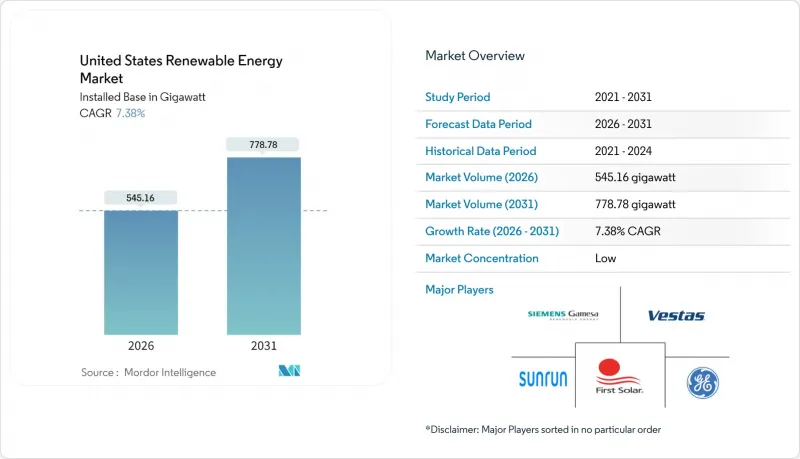
물가상승률 감소법에 따른 연방 정부의 인센티브, 태양광 및 풍력발전 시설의 급격한 비용 하락, 그리고 사상 최고 수준의 기업 청정 전력 도입 목표가 더 이상 보조금에만 의존하지 않는 투자 사이클을 주도하고 있습니다. 태양광 발전은 41.2%의 점유율로 선두를 차지했으며, 풍력발전은 여전히 핵심적인 에너지원으로서의 역할을 하고있고, 에너지 저장 솔루션은 전력망의 유연성을 높이고 있습니다. 전력회사의 설비 용량 지배는 여전히 지속되고 있지만, 가정과 기업의 분산형 자원이 빠르게 성장하면서 수익 모델을 재구성하고 미국 재생에너지 시장 전체에서 서비스 혁신을 촉진하고 있습니다.
미국 재생에너지 시장 동향과 인사이트
연방 투자세액공제 및 생산세액공제 연장 연장
태양광에 대한 30%의 투자세액공제와 풍력발전에 대한 1MWh당 26달러의 생산세액공제가 2032년까지 장기적으로 보장됨에 따라 미국 재생에너지 시장은 안정적인 건설 일정을 유지하며 과거의 급격한 성장과 급격한 감속을 반복하는 패턴을 피할 수 있게 되었습니다. 국내 조달 요건에 따른 보너스로 인해 실질 세액공제율이 10% 포인트 상승하여 2024년 미국내 태양전지판 생산량이 이미 40% 증가했습니다. 태양전지 셀에 대해 와트당 최대 0.07달러의 다층적 제조 세액공제는 프로젝트의 경제성을 더욱 향상시키고, 전통적 산업 주에 새로운 공장 유치를 촉진하여 미국 재생에너지 시장의 세수 기반 확대에 기여하고 있습니다.
태양광·풍력발전의 LCOE(평균발전단가) 급격한 하락
2024년 대규모 태양광발전의 LCOE는 0.048달러/kWh, 육상 풍력발전은 0.033달러/kWh로 모두 보조금 없이 복합화력 발전의 가격보다 낮습니다. 대형 터빈, 고밀도 셀 구조, 공급망 최적화를 통해 자본 비용을 절감하고, 에너지 저장 장치를 추가하여 변동하는 출력을 조정 가능한 전력으로 변환합니다. 기업 구매자들은 이러한 가격 하락을 화석연료 가격 변동에 대한 헤지 수단으로 보고 미국 재생에너지 시장의 프로젝트 파이프라인에 모멘텀을 추가하여 투자자들에게 예측 가능한 수입원을 창출하고 있습니다.
전력망 병목 현상 및 상호 연결 대기열
2024년까지 계통연계 대기 백로그는 2.6TW에 달하고, 2020년 대비 4배로 늘어났으며, 프로젝트가 4-5년 지연되고 있습니다. FERC 지침 2023에 따라 클러스터 조사 규정과 상업적 타당성 검토가 도입되었으나, 미처리된 신청의 대부분은 여전히 MW당 100만 달러 이상의 네트워크 증설이 필요한 상황입니다. 풍력 자원이 풍부한 그레이트플레인즈 지역에서는 부하센터로 가는 송전선로가 정비되지 않아 개발이 저해되고 있으며, 이는 미국 재생에너지 시장의 단기적인 신규 도입량 감소로 이어지고 있습니다.
부문 분석
태양광 기술은 2025년 미국 재생에너지 시장 점유율의 40.80%를 차지할 것으로 예상되며, 2031년까지 연평균 복합 성장률(CAGR) 12.05%로 가장 빠르게 성장할 것으로 예측됩니다. 축전지와 결합하여 신규 대규모 태양광발전설비의 85%에 축전시스템이 도입되어 낮 시간대 발전량을 피크 전력 공급 능력으로 전환하여 수익성을 높이고 있습니다. Agriboltix는 농작물 생산과 태양광발전을 융합하여 토지 제약을 완화하고 농가의 수익성을 향상시킵니다. 풍력발전은 여전히 많은 포트폴리오의 기반이 되고 있으며, 더 높은 타워와 대형 로터로 인한 설치 가능 지역 확대가 장점입니다. 해상풍력은 연방정부 임대 입찰과 주정부 공모를 통해 총 15GW 규모로 성장하고 있습니다. 수력 발전과 지열 에너지는 신뢰할 수 있는 용량을 제공하지만, 자원 제약과 높은 초기 비용으로 인해 상대적으로 발전이 지연되고 있습니다. 기술 믹스 결정은 kW시 당 단가뿐만 아니라 계통 서비스 가치도 반영하게 되면서 미국 재생에너지 시장의 투자 논리를 재구성하고 있습니다.
미국의 태양광발전만 놓고 보면 2031년까지 326.4기가와트 규모에 달할 것으로 예측되고 있습니다. 한편, 육상 풍력발전은 지역 송전망 강화에 따라 253.1기가와트까지 확대될 것으로 예측됩니다. 강화지열 시스템이나 해양에너지와 같은 신흥 자원은 현재 기반이 작지만, 파일럿 프로젝트에서 비용 최적화 후 확장성을 보여주고 있습니다. 전반적으로 기술 다양화는 날씨로 인한 출력 변동을 완화하고, 주요 주에서 보급률이 50%를 초과함에 따라 신뢰성을 강화합니다.
미국 재생에너지 시장 보고서는 기술별(태양광, 풍력, 수력, 바이오에너지, 지열, 해양에너지) 및 최종사용자별(유틸리티, 상업/산업, 주거용)로 분류되어 있습니다. 시장 규모와 예측은 설치 용량(GW) 단위로 제공됩니다.
기타 특전:
- 엑셀 형식 시장 예측(ME) 시트
- 애널리스트의 3개월간 지원
자주 묻는 질문
목차
제1장 서론
- 조사 전제조건 및 시장의 정의
- 조사 범위
제2장 조사 방법
제3장 개요
제4장 시장 구도
- 시장 개요
- 시장 촉진 요인
- 연방투자세액공제 및 생산세액공제연장
- 태양광 발전·풍력 발전의 LCOE(레벨화 발전 비용)의 급격한 저하
- 기업의 넷 제로 및 RE100 조달 목표
- 인플레이션 억제법과 관련된 제조업 회복 경향
- 재생 가능 에너지의 보급률 향상을 가능하게 하는 송전망 강화 기술
- 시장 억제 요인
- 송전망의 병목과 계통 연계 대기 행렬
- 터빈 및 패널의 원재료 가격 변동성
- 대규모 발전 프로젝트에 대한 지역 주민의 반대
- 가치/공급망 분석
- 규제 상황
- 기술 전망
- Porter's Five Forces
- 신규 참가업체의 위협
- 공급기업의 협상력
- 구매자의 협상력
- 대체품의 위협
- 경쟁 기업간 경쟁 관계
제5장 시장 규모와 성장 예측
- 기술별
- 태양광 에너지(PV 및 CSP)
- 풍력 에너지(육상 및 해상)
- 수력 발전 (소규모, 대규모, PSH)
- 바이오 에너지
- 지열
- 해양 에너지(조류·파력)
- 최종 사용자별
- 전력 회사
- 상업·산업용
- 주택용
제6장 경쟁 구도
- 시장 집중도
- 전략적 동향
- 시장 점유율 분석
- 기업 프로파일
- NextEra Energy, Inc.
- Invenergy LLC
- Orsted US Offshore Wind
- General Electric Company
- Vestas Wind Systems A/S
- First Solar, Inc.
- Canadian Solar Inc.
- Sunrun Inc.
- Enphase Energy, Inc.
- Siemens Gamesa Renewable Energy SA
- Brookfield Renewable Partners LP
- Pattern Energy Group LP
- AES Clean Energy
- Dominion Energy, Inc.
- Duke Energy Renewables
- EDF Renewables North America
- EDP Renewables North America LLC
- Clearway Energy Group LLC
- Mitsubishi Power Americas, Inc.
- Trina Solar Co., Ltd.
제7장 시장 기회 및 향후 전망
KSA 26.03.05The United States Renewable Energy Market was valued at 507.67 gigawatt in 2025 and estimated to grow from 545.16 gigawatt in 2026 to reach 778.78 gigawatt by 2031, at a CAGR of 7.38% during the forecast period (2026-2031).
Federal incentives under the Inflation Reduction Act, steep cost declines in solar photovoltaic and wind equipment, and record-high corporate clean-electricity commitments are driving an investment cycle that no longer depends solely on subsidies. Transmission reforms, battery-plus-renewable project structures, and domestic manufacturing expansion further strengthen the economics of the US renewable energy market. Solar holds the leading 41.2% technology share, while wind remains a foundational resource, and storage solutions accelerate grid flexibility. Utilities still dominate installed capacity, yet distributed resources in homes and businesses grow quickly, reshaping revenue models and spurring service innovation across the US renewable energy market.
United States Renewable Energy Market Trends and Insights
Extension of Federal Investment & Production Tax Credits
Long-term certainty through 2032 for the 30% investment tax credit on solar and USD 26 per MWh production tax credit for wind keeps the US renewable energy market on a steady build schedule, avoiding the historical boom-bust pattern.Domestic-content bonuses lift effective credits by 10 percentage points and have already encouraged a 40% increase in US solar panel output during 2024. Layered manufacturing credits, worth up to USD 0.07 per watt for solar cells, further improve project economics and anchor new factories in traditional industrial states, broadening the tax base benefits of the US renewable energy market.
Rapid Decline in Solar-PV & Wind LCOE
Utility-scale solar reached USD 0.048 per kWh and onshore wind USD 0.033 per kWh in 2024, both undercutting combined-cycle gas prices without subsidies. Larger turbines, high-density cell architectures, and supply-chain optimization compress capital costs, while energy storage attachments convert variable output into dispatchable power. Corporate buyers treat these falling prices as a hedge against fossil-fuel volatility, adding momentum to the US renewable energy market's project pipeline and creating predictable revenue streams for investors.
Transmission Bottlenecks & Interconnection Queues
The interconnection backlog hit 2.6 TW by 2024, quadrupling 2020 levels and delaying projects by 4-5 years. Although FERC Order 2023 imposes cluster-study rules and commercial readiness screens, most pending applications still face network upgrades valued at more than USD 1 million per MW. The Great Plains, rich in wind, sees development stymied without conduits to load centers, resulting in trimmed near-term additions in the US renewable energy market.
Other drivers and restraints analyzed in the detailed report include:
- Corporate Net-Zero & RE100 Procurement Targets
- Inflation Reduction Act-linked Manufacturing Upswing
- Volatility in Commodity Prices for Turbines & Panels
For complete list of drivers and restraints, kindly check the Table Of Contents.
Segment Analysis
Solar technology accounted for 40.80% of the US renewable energy market share in 2025 and is projected to grow at the fastest rate, with a 12.05% CAGR, to 2031. Pairing with batteries means that 85% of new utility solar installations include storage, turning midday generation into peaking capacity and raising revenue certainty. Agrivoltaics blends crop production and photovoltaics, easing land constraints while improving farmer economics. Wind still anchors many portfolios and benefits from taller towers and larger rotors that expand viable terrain. Offshore wind gains momentum through federal lease auctions and state solicitations totaling 15 GW. Hydropower and geothermal energy offer dependable capacity, yet resource limitations and higher upfront costs slow their relative advancement. Technology mix decisions now reflect grid-service value in addition to kilowatt-hour prices, reshaping investment logic inside the US renewable energy market.
The US renewable energy market size for solar alone is expected to reach 326.4 GW by 2031, while onshore wind is projected to expand to 253.1 GW amid regional transmission upgrades. Emerging resources, such as enhanced geothermal systems and marine energy, exhibit modest baselines, but pilot projects reveal scalability once costs are optimized. In aggregate, technology diversification cushions weather-related output swings and strengthens reliability as penetration rises beyond 50% in leading states.
The United States Renewable Energy Market Report is Segmented by Technology (Solar Energy, Wind Energy, Hydropower, Bioenergy, Geothermal, and Ocean Energy) and End-User (Utilities, Commercial and Industrial, and Residential). The Market Sizes and Forecasts are Provided in Terms of Installed Capacity (GW).
List of Companies Covered in this Report:
- NextEra Energy, Inc.
- Invenergy LLC
- Orsted US Offshore Wind
- General Electric Company
- Vestas Wind Systems A/S
- First Solar, Inc.
- Canadian Solar Inc.
- Sunrun Inc.
- Enphase Energy, Inc.
- Siemens Gamesa Renewable Energy S.A.
- Brookfield Renewable Partners L.P.
- Pattern Energy Group LP
- AES Clean Energy
- Dominion Energy, Inc.
- Duke Energy Renewables
- EDF Renewables North America
- EDP Renewables North America LLC
- Clearway Energy Group LLC
- Mitsubishi Power Americas, Inc.
- Trina Solar Co., Ltd.
Additional Benefits:
- The market estimate (ME) sheet in Excel format
- 3 months of analyst support
TABLE OF CONTENTS
1 Introduction
- 1.1 Study Assumptions & Market Definition
- 1.2 Scope of the Study
2 Research Methodology
3 Executive Summary
4 Market Landscape
- 4.1 Market Overview
- 4.2 Market Drivers
- 4.2.1 Extension of Federal Investment & Production Tax Credits
- 4.2.2 Rapid Decline in Solar-PV & Wind LCOE
- 4.2.3 Corporate Net-Zero & RE100 Procurement Targets
- 4.2.4 Inflation Reduction Act-linked Manufacturing Upswing
- 4.2.5 Grid-enhancing Technologies enabling higher renewable penetration
- 4.3 Market Restraints
- 4.3.1 Transmission Bottlenecks & Interconnection Queues
- 4.3.2 Volatility in Commodity Prices for Turbines & Panels
- 4.3.3 Community Opposition to Utility-Scale Projects
- 4.4 Supply-Chain Analysis
- 4.5 Regulatory Outlook
- 4.6 Technological Outlook
- 4.7 Porters Five Forces
- 4.7.1 Threat of New Entrants
- 4.7.2 Bargaining Power of Suppliers
- 4.7.3 Bargaining Power of Buyers
- 4.7.4 Threat of Substitutes
- 4.7.5 Competitive Rivalry
- 4.8 PESTLE Analysis
5 Market Size & Growth Forecasts
- 5.1 By Technology
- 5.1.1 Solar Energy (PV and CSP)
- 5.1.2 Wind Energy (Onshore and Offshore)
- 5.1.3 Hydropower (Small, Large, PSH)
- 5.1.4 Bioenergy
- 5.1.5 Geothermal
- 5.1.6 Ocean Energy (Tidal and Wave)
- 5.2 By End-User
- 5.2.1 Utilities
- 5.2.2 Commercial and Industrial
- 5.2.3 Residential
6 Competitive Landscape
- 6.1 Market Concentration
- 6.2 Strategic Moves (M&A, JVs, Funding, PPAs)
- 6.3 Market Share Analysis (Market Rank/Share for key companies)
- 6.4 Company Profiles (includes Global-level Overview, Market-level Overview, Core Segments, Financials, Strategic Information, Products & Services, Recent Developments)
- 6.4.1 NextEra Energy, Inc.
- 6.4.2 Invenergy LLC
- 6.4.3 Orsted US Offshore Wind
- 6.4.4 General Electric Company
- 6.4.5 Vestas Wind Systems A/S
- 6.4.6 First Solar, Inc.
- 6.4.7 Canadian Solar Inc.
- 6.4.8 Sunrun Inc.
- 6.4.9 Enphase Energy, Inc.
- 6.4.10 Siemens Gamesa Renewable Energy S.A.
- 6.4.11 Brookfield Renewable Partners L.P.
- 6.4.12 Pattern Energy Group LP
- 6.4.13 AES Clean Energy
- 6.4.14 Dominion Energy, Inc.
- 6.4.15 Duke Energy Renewables
- 6.4.16 EDF Renewables North America
- 6.4.17 EDP Renewables North America LLC
- 6.4.18 Clearway Energy Group LLC
- 6.4.19 Mitsubishi Power Americas, Inc.
- 6.4.20 Trina Solar Co., Ltd.
7 Market Opportunities & Future Outlook
- 7.1 White-space & Unmet-Need Assessment