|
시장보고서
상품코드
1939107
알레르기 진단 : 시장 점유율 분석, 업계 동향과 통계, 성장 예측(2026-2031년)Allergy Diagnostics - Market Share Analysis, Industry Trends & Statistics, Growth Forecasts (2026 - 2031) |
||||||
 Mordor Intelligence
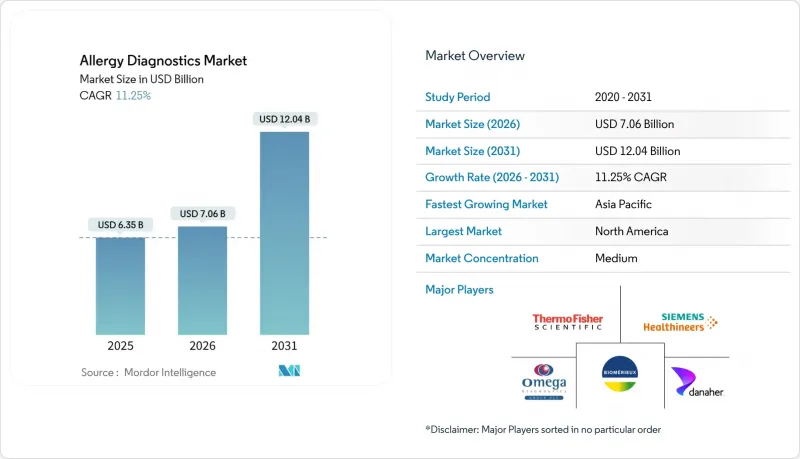
알레르기 진단 시장은 2025년에 63억 5,000만 달러로 평가되며, 2026년 70억 6,000만 달러에서 2031년까지 120억 4,000만 달러에 달할 것으로 예측됩니다. 예측 기간(2026-2031년)의 CAGR은 11.25%로 전망됩니다.
강력한 상환 정책, 기후 변화에 따른 꽃가루 시즌의 장기화, 자동화된 다중 검사 플랫폼의 급속한 보급이 이러한 성장 궤도를 지원하고 있습니다. 소아의 다감작성 증가, 현장 치료용 미세 유체 장치의 보급 확대, 원격 면역학의 주류화는 의료 서비스 프로바이더에게 새로운 기회를 창출하고 있습니다. 기존 기업은 지속적인 제품 업그레이드, 인공지능을 활용한 통역 소프트웨어, 전략적 유통 제휴를 통해 경쟁력을 강화하고 있습니다. 한편, 신흥 지역의 숙련된 알레르기 전문의 부족, 클라우드 연결 기기의 데이터 프라이버시 요구 사항으로 인해 단기적인 확장을 억제하고, 전 세계에서 증가하는 알레르기 부담을 관리하는 데 있으며, 진단이 중요한 역할을 하고 있으므로 전반적인 전망은 여전히 긍정적입니다.
세계 알레르기 진단 시장 동향 및 인사이트
소아 인구의 다감작증 증가 추세
학령기 아동의 다감작률은 현재 40-50%에 달하며, 임상의는 단일 알레르겐 검사에서 호흡기, 음식, 환경유발인자를 포괄하는 멀티플렉스 패널로 전환할 수밖에 없습니다. 멀티플렉스 IgE 검사는 채혈 횟수와 내원 횟수를 줄이고, 치료 시작까지의 대기 시간을 단축합니다. 성분 분해형 진단은 단백질 수준의 감작물질을 규명하여 개별 면역치료의 지침이 되는 단백질 수준의 감작물질을 규명함으로써 소아과 의료를 한 단계 더 고도화합니다. 최근 소아 아나필락시스로 인한 진료가 147% 증가했고, 그 추세가 다감작 환자에 집중되어 있으므로 의료 시스템은 이러한 패널을 적극적으로 채택하고 있습니다. 어린이에 대한 강한 초점은 지속적인 수요 증가로 이어집니다. 조기 진단은 응급실 비용 절감과 장기적인 삶의 질 향상에 직결되며, 알레르기 진단 시장 전망을 강화하기 때문입니다.
OECD 국가에서의 특이적 IgE 혈액검사 보험 적용 범위 확대
OECD 회원국의 보험사들은 기존 CPT 코드에 기반한 자동화된 특정 IgE 면역측정법의 적용 범위를 확대하여 검사기관과 기기 제조업체 모두에게 예측 가능한 매출 기반을 구축하고 있습니다. 메디케어가 패치 테스트 및 분자 알레르기 패널에 대한 보험 적용을 시작하면서 민간 보험사들도 이에 따라 알레르기 진단 시장에서의 의사 채용이 가속화되고 있습니다. 급여가 명확해짐에 따라 주치의가 진료현장에서 직접 검사를 지시할 수 있게 되어 전문의의 병목현상이 완화되고 있습니다. 또한 지불자의 다양화로 인해 자동화 플랫폼이 검사 결과 보고 시간을 단축하고 노동 생산성을 향상시킴으로써 검사 기관은 가격 하락의 영향을 덜 받게 되었습니다. 의료진은 정확한 진단이 통제할 수 없는 알레르기 반응으로 인한 병원 방문을 줄임으로써 다운스트림 비용 절감으로 이어진다고 강조합니다.
신흥 시장에서 훈련된 알레르기 전문의의 부족
많은 신흥 경제국에서는 인구 100만 명당 알레르기 전문의가 1명 미만으로, 최신 분석장비가 도입되어도 진단 해석이 부족한 실정입니다. 전문의 네트워크가 제한적이기 때문에 복잡한 멀티플렉스 검사 패널의 도입이 늦어지고 있습니다. 이는 1차 진료 의사가 완전히 해독할 수 없는 검사를 미루기 때문이며, 알레르기 진단 시장의 성장 장벽으로 작용하고 있습니다. 원격진료가 잠정적인 해결책이 될 수 있지만, 라이선스 제약과 브로드밴드 환경의 불균일성으로 인해 규모 확대에 어려움을 겪고 있습니다. 정부와 NGO는 일반 개업의들을 위한 단기 알레르기 관리 프로그램에 자금을 지원하기 시작했으나, 그 효과는 여전히 제한적입니다. 이에 기기 제조업체들은 분석기 내에 AI 기반 해석 가이던스를 내장하여 사람의 전문 지식에 대한 의존도를 낮추기 위한 대응을 진행하고 있습니다.
부문 분석
흡입 알레르겐 분야는 도시 대기오염과 관련된 지속성 호흡기 질환을 배경으로 2025년 기준 알레르기 진단 시장 점유율 50.92%를 유지했습니다. 풀, 나무, 잡초, 잡초, 곰팡이 포자를 아우르는 멀티플렉스 패널은 중앙검사기관에 안정적이고 지속적인 매출을 가져다주고 있습니다. 한편, 식품 알레르겐 분야는 학부모, 학교, 규제 당국의 안전 기준 강화에 따라 13.2%의 연평균 복합 성장률(CAGR)로 급성장하고 있습니다. 이 속도는 오말리주맙의 다식품 탈감작 요법 승인을 배경으로 2031년까지 알레르기 진단 시장 규모 44억 5,000만 달러에 해당하는 점유율 확대가 예상됩니다.
정밀한 성분 분해형 진단은 양성 교차 반응과 위험한 감작을 구분하여 임상적 가치를 높이고 보험 적용 범위를 확대할 수 있습니다. 기후 변화로 인한 매개체 서식지 확대와 약물 치료의 복잡성으로 인해 곤충독 및 약물 알레르겐 패널은 틈새 시장이자 성장 중인 수입원이 되고 있습니다. 의료 현장에서는 비라텍스 장갑으로의 전환으로 라텍스 검사가 꾸준히 감소하고 있지만, 산업 분야에서의 노출로 인해 잔존 시장이 유지되고 있습니다. 전반적으로 알레르겐의 구성비가 식품 및 의약품 카테고리로 이동하고 있으며, 알레르기 진단 시장에서 개인별 맞춤 치료가 주목받고 있습니다.
소모품은 2025년 알레르기 진단 시장 규모의 61.74%를 차지하며 높은 검사량과 안정적인 시약 사용량을 반영하여 매출을 견인했습니다. 그러나 기기 부문은 CAGR 12.35%로 가장 빠르게 성장하고 있으며, 핸즈프리 작동, 액체 레벨 감지, 바코드 기반 추적성을 갖춘 고처리량 분석기기로의 실험실 업그레이드가 이를 주도하고 있습니다. 그 결과, 설치 기반이 확대됨에 따라 공급업체는 다년간 고정된 시약 판매를 확보할 수 있으며, 안정적인 매출 전망을 확보할 수 있습니다.
차세대 기기는 치료 효과를 모니터링하는 사이토카인 패널을 포함한 다양한 검사 메뉴를 실행할 수 있으며, 기기 1대당 평생 가치를 확대할 수 있습니다. SaaS(Software as a Service) 플랫폼은 원격 교정, 가동 시간 모니터링, AI 지원 분석을 통합하여 지속적인 구독 매출을 창출합니다. 1차의료 현장의 현장 진료 방식이 점진적으로 변화함에 따라 환자 주변 검사용 마이크로플루이딕스 카트리지와 같은 보조 소모품의 중요성이 커지고 있습니다.
지역별 분석
북미는 2025년 기준 알레르기 진단 시장 점유율의 37.68%를 차지할 것으로 예상되며, 이는 성숙한 상환 제도와 높은 임상의의 인지도를 배경으로 합니다. 대규모 검사기관에서는 완전 자동화된 멀티플렉스 플랫폼을 도입하여 근거에 기반한 진료 가이드라인을 지원하는 당일 결과의 호흡기 및 식품 패널을 제공합니다. 규제 명확화가 제품 혁신을 촉진하고, 최근 출시된 비강 점적형 아나필락시스 치료제는 이 지역의 치료와 진단의 시너지를 입증하고 있습니다.
유럽에서는 체외진단용 의료기기 규정(IVDR)에 따른 조화가 진행되어 품질 기준의 향상과 국경 간 거래가 원활하게 이루어지고 있습니다. 독일, 프랑스 등 주요 시장에서는 1차의료에서 종합적인 IgE 검사를 지원하고 있으며, 알레르기 진단 시장에서 완만한 성장세가 지속되고 있습니다. 브렉시트 관련 차이로 인해 영국 공급업체들은 추가적인 컴플라이언스 대응이 필요하지만, 수요 기반은 여전히 건전합니다.
아시아태평양은 급속한 도시화, 가처분 소득 증가, 대기오염의 심각성을 배경으로 2031년까지 연평균 복합 성장률(CAGR) 13.75%로 가장 빠르게 성장하는 지역으로 부상하고 있습니다. 인도와 중국의 주요 도시권에서는 증가하는 호흡기 및 식품 알레르기에 대응하기 위해 민관 협력을 통한 현대식 검사 시설에 대한 투자가 진행되고 있으며, 이는 알레르기 진단 시장의 확대를 가속화하고 있습니다. 지방 정부는 결석과 결근에 따른 간접적인 경제적 손실을 억제하기 위해 조기 발견을 우선 과제로 삼고 있습니다.
남미에서는 특히 브라질, 멕시코, 칠레에서 민간 보험사가 다중 IgE 검사의 적용 범위를 확대하고 있으며, 꾸준한 보급이 이루어지고 있습니다. 공공 부문의 프로그램은 늦어지고 있지만, 중산층 수요 증가로 인해 자동 분석기를 도입하는 민간 검사 체인이 지원되고 있습니다.
중동 및 아프리카에서는 아직 시작 단계이지만 관심이 높아지고 있습니다. 걸프협력회의(GCC) 회원국들은 경제 다변화와 국민 건강 증진을 위한 광범위한 노력의 일환으로 진단에 많은 예산을 배정하고 있습니다. 사하라 사막 이남 아프리카에서는 전문의 부족으로 인해 진전이 제한적이지만, 원격 면역학 시범 프로그램을 통해 농촌 지역으로 지원을 확대할 수 있는 모델을 제시하고 있습니다.
기타 특전:
- 엑셀 형식 시장 예측(ME) 시트
- 3개월간의 애널리스트 지원
자주 묻는 질문
목차
제1장 서론
제2장 조사 방법
제3장 개요
제4장 시장 구도
제5장 시장 규모와 성장 예측
제6장 경쟁 구도
제7장 시장 기회와 향후 전망
KSA 26.03.05The Allergy Diagnostics Market was valued at USD 6.35 billion in 2025 and estimated to grow from USD 7.06 billion in 2026 to reach USD 12.04 billion by 2031, at a CAGR of 11.25% during the forecast period (2026-2031).
Strong reimbursement policies, longer pollen seasons linked to climate change, and the rapid adoption of automated multiplex testing platforms anchor this growth trajectory. Rising polysensitization among children, broader access to point-of-care microfluidic devices, and the mainstreaming of tele-immunology create fresh opportunities for providers. Market incumbents strengthen competitive positions through continuous product upgrades, artificial-intelligence-enabled interpretation software, and strategic distribution alliances. At the same time, shortages of trained allergists in emerging regions and data-privacy requirements for cloud-connected instruments temper near-term expansion, although the overall outlook remains positive due to the essential role of diagnostics in managing a widening global allergy burden.
Global Allergy Diagnostics Market Trends and Insights
Rising Prevalence of Polysensitization in Pediatric Populations
School-age children now record polysensitization rates between 40% and 50%, forcing clinicians to abandon single-allergen testing in favor of multiplex panels that cover respiratory, food, and environmental triggers. Multiplex IgE assays lower the number of blood draws and clinic visits, a shift that cuts waiting times for treatment initiation. Component-resolved diagnostics further refine pediatric care by isolating protein-level sensitizers that guide individualized immunotherapy. Health systems adopt these panels proactively because pediatric anaphylaxis visits climbed 147% in recent years, a trend concentrated among polysensitized patients. The strong pediatric focus translates into durable volume growth because early diagnosis ties directly to reduced emergency-department costs and better long-term quality-of-life outcomes, strengthening the allergy diagnostics market outlook.
Expansion of Reimbursement for Specific IgE Blood Tests in OECD Countries
OECD payers broaden coverage for automated specific IgE immunoassays under established CPT codes, cementing predictable revenue streams for laboratories and device makers alike. Medicare's inclusion of patch testing and molecular allergology panels has prompted private insurers to follow suit, accelerating physician adoption within the allergy diagnostics market. Reimbursement clarity encourages primary-care physicians to order tests directly at the point of care, reducing specialist bottlenecks. An expanded payer mix also shields laboratories from price erosion because automated platforms shorten turnaround times and improve labor productivity. Providers emphasize that precise diagnosis curbs downstream costs by lowering hospital visits for uncontrolled allergic reactions.
Shortage of Trained Allergists in Emerging Markets
Many emerging economies have fewer than one allergist per million residents, causing interpretation gaps even when modern analyzers are present. Limited specialist networks slow adoption of complex multiplex panels because primary-care physicians defer testing they cannot fully decode, creating growth barriers within the allergy diagnostics market. Tele-consultation offers interim relief, yet licensing constraints and inconsistent broadband limit scale. Governments and NGOs have begun funding short-course allergy-management programs for general practitioners, but impact remains modest. Device makers respond by embedding AI-driven interpretation guidance within analyzers to reduce reliance on human expertise.
Other drivers and restraints analyzed in the detailed report include:
- Technological Shift to Fully Automated Multiplex Allergy Platforms
- Integration of Point-of-Care Microfluidic Allergy Testing in Primary Care
- High False-Positive Rates Requiring Confirmatory Tests
For complete list of drivers and restraints, kindly check the Table Of Contents.
Segment Analysis
The inhaled-allergen segment retained 50.92% of allergy diagnostics market share in 2025 on the back of persistent respiratory conditions linked to urban air pollution. Multiplex panels covering grass, tree, weed, and mold spores generate stable, recurring revenue for central laboratories. Yet the food-allergen category is accelerating at 13.2% CAGR as parents, schools, and regulators elevate safety standards. That pace translates into a projected USD 4.45 billion slice of allergy diagnostics market size by 2031, supported by recent FDA approval of omalizumab for multi-food desensitization.
Precision component-resolved diagnostics strengthen clinical value by distinguishing between benign cross-reactions and hazardous sensitization, encouraging broader payor coverage. Insect-venom and drug-allergen panels add niche but growing streams as climate change expands vector ranges and pharmacotherapy complexity rises. Latex testing steadily declines in healthcare settings that switch to non-latex gloves, although industrial exposure maintains a residual market. Overall, the allergen mix increasingly tilts toward food and drug categories where personalized therapies are gaining traction within the allergy diagnostic market.
Consumables dominated revenue with 61.74% share of allergy diagnostics market size in 2025, reflecting high test volumes and steady reagent usage. Yet instruments represent the fastest-expanding line at 12.35% CAGR, propelled by labs upgrading to high-throughput analyzers featuring hands-free operation, liquid-level sensing, and barcode-driven traceability. As a result, installed-base expansion positions vendors for locked-in reagent sales over multiyear cycles, smoothing revenue visibility.
New-generation instruments run broader assay menus, including cytokine panels that monitor treatment efficacy, thereby enlarging lifetime value per device. Software-as-a-service platforms bundle remote calibration, uptime monitoring, and AI-assisted interpretation, creating sticky subscription revenue. Ancillary disposables, such as microfluidic cartridges for near-patient applications, gain relevance as primary-care practices adopt point-of-care formats.
The Allergy Diagnostics Market Report is Segmented by Allergen (Inhaled Allergens, Food Allergens, Drug Allergens, Insect Venom Allergens, and More), Product (Instruments, Consumables, and Software & Services), Test Type (In Vivo Tests and in Vitro Tests), End-User (Diagnostic Laboratories, Hospitals, and More), and Geography (North America, Europe, and More). The Market Forecasts are Provided in Terms of Value (USD).
Geography Analysis
North America held 37.68% of allergy diagnostics market share in 2025, backed by mature reimbursement and high clinician awareness. Large reference laboratories deploy fully automated multiplex platforms, offering same-day respiratory and food panels that support evidence-based care guidelines. Regulatory clarity encourages continued product innovation, and recent launches of nasal-spray anaphylaxis treatments underscore the region's therapeutic-diagnostic synergy.
Europe benefits from harmonization under the In Vitro Diagnostic Regulation, which raises quality standards and facilitates cross-border commerce. While reimbursement varies, key markets such as Germany and France support comprehensive IgE testing in primary care, sustaining moderate growth within the allergy diagnostics market. Brexit-related divergence imposes incremental compliance steps for UK suppliers, but demand fundamentals remain intact.
Asia-Pacific emerges as the fastest-growing region, advancing at 13.75% CAGR through 2031 on the back of rapid urbanization, rising disposable incomes, and intensifying air pollution. Major metropolitan areas in India and China invest in modern laboratory infrastructure, often via public-private partnerships, to manage mounting respiratory and food allergies, accelerating expansion of the allergy diagnostics market. Local governments prioritize early detection to curb indirect economic losses linked to missed school and workdays.
South America records steady adoption as private insurers expand coverage for multiplex IgE testing, particularly in Brazil, Mexico, and Chile. Public-sector programs lag, but rising middle-class demand supports private laboratory chains installing automated analyzers.
The Middle East and Africa witness nascent but accelerating interest. Gulf Cooperation Council states allocate significant budgets to diagnostics as part of broader efforts to diversify economies and improve population health. Sub-Saharan Africa's progress is constrained by specialist shortages, yet pilot tele-immunology programs hint at a scalable model for rural outreach.
- Thermo Fisher Scientific
- Danaher Corp. (Beckman Coulter Diagnostics)
- Siemens Healthineers
- bioMerieux
- Omega Diagnostics Group
- Stallergenes Greer
- Revvity Inc.
- Hycor Biomedical LLC
- Lincoln Diagnostics
- Abionic SA
- R-Biopharm
- Eurofins
- Minaris Medical
- Zhuhai HOB Biotech Group Co., Ltd
- Immunodiagnostic Systems Holdings PLC
- Mindray
- Werfen S.A.
- BUHLMANN Laboratories
- AllerGenis LLC
- ZenTech
Additional Benefits:
- The market estimate (ME) sheet in Excel format
- 3 months of analyst support
TABLE OF CONTENTS
1 Introduction
- 1.1 Study Assumptions & Market Definition
- 1.2 Scope of the Study
2 Research Methodology
3 Executive Summary
4 Market Landscape
- 4.1 Market Overview
- 4.2 Market Drivers
- 4.2.1 Rising Prevalence Of Polysensitization In Pediatric Populations
- 4.2.2 Expansion Of Reimbursement For Specific Ige Blood Tests In OECD Countries
- 4.2.3 Technological Shift To Fully Automated Multiplex Allergy Platforms
- 4.2.4 Integration Of Point-Of-Care Microfluidic Allergy Testing In Primary Care
- 4.2.5 Adoption Of Tele-Immunology Boosting Remote Testing Kit Demand
- 4.2.6 Climate-Induced Changes Lengthening Pollen Seasons
- 4.3 Market Restraints
- 4.3.1 Shortage Of Trained Allergists In Emerging Markets
- 4.3.2 High False-Positive Rates Requiring Confirmatory Tests
- 4.3.3 Data-Privacy Hurdles For Cloud-Connected Diagnostics
- 4.3.4 Plateauing Birth Rates Reducing Pediatric Test Volumes In East Asia
- 4.4 Technological Outlook
- 4.5 Porter's Five Forces
- 4.5.1 Threat of New Entrants
- 4.5.2 Bargaining Power of Buyers
- 4.5.3 Bargaining Power of Suppliers
- 4.5.4 Threat of Substitutes
- 4.5.5 Intensity of Competitive Rivalry
5 Market Size & Growth Forecasts (Value, USD)
- 5.1 By Allergen
- 5.1.1 Inhaled Allergens
- 5.1.2 Food Allergens
- 5.1.3 Drug Allergens
- 5.1.4 Insect Venom Allergens
- 5.1.5 Latex Allergens
- 5.1.6 Other Allergens
- 5.2 By Product
- 5.2.1 Instruments
- 5.2.1.1 Automated Immunoassay Analyzers
- 5.2.1.2 Luminometers
- 5.2.1.3 Microarray Platforms
- 5.2.2 Consumables
- 5.2.2.1 Assay Kits & Reagents
- 5.2.2.2 Controls & Calibrators
- 5.2.2.3 Ancillary Supplies
- 5.2.3 Software & Services
- 5.2.1 Instruments
- 5.3 By Test Type
- 5.3.1 In Vivo Tests
- 5.3.1.1 Skin Prick Tests
- 5.3.1.2 Patch Tests
- 5.3.1.3 Intradermal Tests
- 5.3.2 In Vitro Tests
- 5.3.2.1 ELISA
- 5.3.2.2 Radioallergosorbent / ImmunoCAP
- 5.3.2.3 Multiplex Array Tests
- 5.3.1 In Vivo Tests
- 5.4 By End-User
- 5.4.1 Diagnostic Laboratories
- 5.4.2 Hospitals
- 5.4.3 Physician Offices & Primary Care Settings
- 5.4.4 Academic & Research Institutes
- 5.4.5 Others
- 5.5 Geography
- 5.5.1 North America
- 5.5.1.1 United States
- 5.5.1.2 Canada
- 5.5.1.3 Mexico
- 5.5.2 Europe
- 5.5.2.1 Germany
- 5.5.2.2 United Kingdom
- 5.5.2.3 France
- 5.5.2.4 Italy
- 5.5.2.5 Spain
- 5.5.2.6 Rest of Europe
- 5.5.3 Asia-Pacific
- 5.5.3.1 China
- 5.5.3.2 Japan
- 5.5.3.3 India
- 5.5.3.4 South Korea
- 5.5.3.5 Australia
- 5.5.3.6 Rest of Asia-Pacific
- 5.5.4 Middle East and Africa
- 5.5.4.1 GCC
- 5.5.4.2 South Africa
- 5.5.4.3 Rest of Middle East and Africa
- 5.5.5 South America
- 5.5.5.1 Brazil
- 5.5.5.2 Argentina
- 5.5.5.3 Rest of South America
- 5.5.1 North America
6 Competitive Landscape
- 6.1 Market Concentration
- 6.2 Market Share Analysis
- 6.3 Company Profiles (includes Global level Overview, Market level overview, Core Segments, Financials as available, Strategic Information, Market Rank/Share for key companies, Products & Services, and Recent Developments)
- 6.3.1 Thermo Fisher Scientific Inc.
- 6.3.2 Danaher Corp. (Beckman Coulter Diagnostics)
- 6.3.3 Siemens Healthineers AG
- 6.3.4 BioMerieux SA
- 6.3.5 Omega Diagnostics Group Plc
- 6.3.6 Stallergenes Greer Ltd
- 6.3.7 Revvity Inc.
- 6.3.8 Hycor Biomedical LLC
- 6.3.9 Lincoln Diagnostics Inc.
- 6.3.10 Abionic SA
- 6.3.11 R-Biopharm AG
- 6.3.12 Eurofins Scientific SE
- 6.3.13 Minaris Medical
- 6.3.14 Zhuhai HOB Biotech Group Co., Ltd
- 6.3.15 Immunodiagnostic Systems Holdings PLC
- 6.3.16 Shenzhen Mindray Bio-Medical Electronics Co., Ltd.
- 6.3.17 Werfen S.A.
- 6.3.18 BUHLMANN Laboratories AG
- 6.3.19 AllerGenis LLC
- 6.3.20 ZenTech SA
7 Market Opportunities & Future Outlook
- 7.1 White-space & Unmet-Need Assessment