|
시장보고서
상품코드
1939716
중유럽 및 동유럽의 화물 및 물류 : 시장 점유율 분석, 업계 동향과 통계, 성장 예측(2026-2031년)Central And Eastern Europe Freight And Logistics - Market Share Analysis, Industry Trends & Statistics, Growth Forecasts (2026 - 2031) |
||||||
 Mordor Intelligence
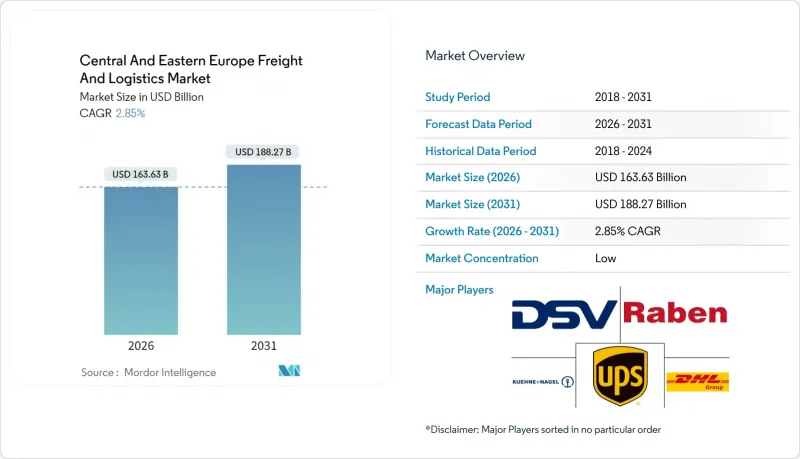
중유럽·동유럽의 화물 및 물류 시장은 2025년 1,590억 9,000만 달러에서 2026년에는 1,636억 3,000만 달러로 성장하며, 2026-2031년에 CAGR 2.85%로 추이하며, 2031년까지 1,882억 7,000만 달러에 달할 것으로 예측됩니다.
독일 OEM 업체들의 니어쇼어링, TEN-T 회랑의 개발 가속화, 지역내 디지털 전환이 주요 물류 기능 전반에 걸쳐 지속적인 수요를 촉진하고 있습니다. 중국-유럽 철도 회랑에서 폴란드의 허브 지위, 주요 물류단지의 5G 도입 확대, 철도 및 수로에 대한 EU 그린딜 인센티브 정책은 중부 및 동유럽의 화물 및 물류 시장을 서유럽 국가들과 더욱 차별화시키고 있습니다. DSV의 DB쉥커 인수와 같은 통합 활동은 규모에 따른 효율성을 높이고 있으며, 한편으로는 기술을 활용한 포워더들이 경쟁의 활성화를 가져오고 있습니다. 주요 리스크는 전문 운전자 부족 확대, EU 외부 국경의 간헐적인 국경 정체, 성장 모멘텀을 둔화시킬 수 있는 콜드체인 역량 지연 등이 있습니다.
중부 및 동유럽의 화물 및 물류 시장 동향과 인사이트
유럽연합(EU)의 TEN-T 회랑 정비로 복합운송 효율화 촉진
최근 유럽횡단교통망(TEN-T) 자금조달 라운드에서 2024년 중부 및 동유럽 프로젝트에 25억 유로(27억 5,000만 달러)가 배정되어 유럽철도교통관리시스템(ERTMS) 도입 가속화와 국경 간 철도 체류시간 최대 30% 단축을 목표로 하고 있습니다. 하고 있습니다. 바르샤바-베를린 및 부다페스트-비엔나 노선의 사업자들은 15-20%의 효율성 향상을 보고하고 있으며, 이는 중부 및 동유럽의 화물 및 물류 시장의 멀티모달 기능을 강화하는 새로운 철도-도로 복합운송 서비스의 기반이 되고 있습니다. 연결성 향상으로 폴란드 터미널은 중국-유럽 간 철도 물동량을 인접한 체코와 슬로바키아의 허브로 효율적으로 유도할 수 있으며, 계절적 성수기에도 운임 안정성을 유지할 수 있는 네트워크 효과를 창출하고 있습니다. 개정된 복합운송지침의 목표는 중거리 운송을 도로에서 철도로 전환하는 화주에게 추가적인 인센티브를 제공하여 장기적인 탄소배출량 감축과 비용 절감을 촉진할 것입니다.
독일 자동차 공급망, 폴란드와 슬로바키아를 중심으로 국내 회귀 가속화
현대자동차, Vitesco Technologies, Chassix는 총 5억 7,600만 유로(6억 3,569만 달러) 이상을 중부 및 동유럽의 새로운 공장에 투자하여 배터리 시스템 및 파워트레인 현지 생산 생태계를 강화하고 있습니다. 헝가리에서만 188억 달러의 전동화 분야 외국간접투자(FDI)를 유치하며 유럽의 배터리 거점으로서의 입지를 구축했습니다. 이전한 1차 공급업체는 보세 및 온도 관리 화물 운송과 전문 창고를 필요로 하고 있으며, 중부 및 동유럽 화물 및 물류 시장에서 도로, 철도, 항공 등 운송 모드 수요 탄력성을 높이고 있습니다. 슬로바키아의 유리한 세제 체계와 폴란드의 확립된 자동차 클러스터는 독일 조립 공장에 정시 배송을 전문으로 하는 운송업체에게 이익이 되는 촘촘한 유통 경로를 육성하고 있습니다.
중부 및 동유럽의 만성적인 운전자 부족 현상이 두드러짐
2024년 기준 EU 전체의 운전자 부족은 23만 3천 명을 넘어섰으며, 체코의 교통 관련 단체는 국내 2만 5천 명의 결원이 있다고 보고했습니다. 운전자의 평균 연령은 현재 50세를 넘어섰고, EU 모빌리티 패키지의 엄격한 휴식 시간 규제가 차량 가동률을 압박하고 있습니다. 연간 15-20%의 임금 상승은 도로 화물 운임을 상승시켜 화주들을 철도나 복합운송 옵션으로 유도할 수 있습니다. 폴란드의 여러 운송업체들이 ADAS(첨단운전자지원시스템)를 도입하고 통제된 회랑에서 자율주행 테스트를 진행하고 있지만, 본격적인 상용화는 아직 몇 년이 더 걸릴 것으로 예측됩니다. 만성적인 인력 부족은 중부 및 동유럽의 화물 및 물류 시장의 용량 상한과 서비스 신뢰성에 큰 영향을 미치고 있습니다.
부문 분석
도매 및 소매업은 2025년 30.12%의 점유율로 가장 큰 부문을 차지할 것으로 예상되며, 2024년 E-Commerce 총 상품 가치(GMV)가 429억 달러에 달할 것으로 예상되며, 2026-2031년 연평균 3.08% 성장할 것으로 예측됩니다. 대형 유통업체와 식료품 체인은 당일 배송 목표를 달성하기 위해 물류 센터를 개편하고 있으며, 중부 및 동유럽의 화물 및 물류 시장에 자동화 투자를 확대하고 있습니다.
제조업은 자동차 및 전자기기 클러스터를 주축으로 괄목할 만한 성장세를 보이고 있습니다. 폴란드와 헝가리의 배터리 기가팩토리는 ADR 준수 온도 관리 운송이 필요한 리튬이온 배터리를 포함한 특수 인바운드 물류를 주도하며 사업자에게 고매출 기회를 창출하고 있습니다.
화물 운송은 2025년 매출의 64.72%를 차지할 것으로 예상되며, 중부 및 동유럽의 화물 및 물류 시장에서 제조 및 유통 수요를 충족시키는 데 있으며, 화물 운송이 핵심적인 역할을 담당할 것으로 보입니다. 도로, 철도, 복합운송 사업자들은 특히 폴란드-독일 노선의 견고한 국경 간 무역의 혜택을 누리고 있습니다. 중부 및 동유럽의 화물 및 물류 시장 규모는 자동차 산업의 니어쇼어링과 유라시아 철도 운송의 흐름에 힘입어 성장할 것으로 예측됩니다. CEP(소량화물)는 규모가 작지만 가장 빠르게 성장하고 있으며, 소포 허브의 자동화와 집하장 네트워크의 확장으로 배송 주기가 단축되며, 2026-2031년 연평균 복합 성장률(CAGR) 3.32%(CAGR)를 기록할 것으로 예측됩니다. 디지털 플랫폼은 실시간 가격 검색 및 용량 매칭을 가능하게 하고, 포워더가 통합 대시보드에서 화물 운송과 CEP 서비스를 통합할 수 있도록 합니다. 이러한 서비스의 상호 작용은 탄력성을 추구하는 다국적 화주들을 끌어들이는 유연한 엔드투엔드 솔루션의 기반이 됩니다.
역사적 회복력은 분명합니다. 주권 관련 이슈와 팬데믹으로 인한 충격으로 2020년 활동이 둔화되었지만, E-Commerce의 성장은 2024년 CEP 부문의 점유율 확대를 이끌었습니다. 창고/보관 분야는 옴니채널 소매업체들의 높은 재고 버퍼 요구로 인해 안정적인 한 자릿수 중반의 성장세를 기록했습니다. 화물 운송은 무역 경로의 다변화를 통해 부가가치를 높이고, 디지털 브로커는 항공사 및 철도 사업자와의 API 연결을 활용하여 중부 및 동유럽의 화물 및 물류 산업에서 새로운 차별화 요소로 자리 잡고 있습니다.
기타 특전:
- 엑셀 형식 시장 예측(ME) 시트
- 애널리스트 지원(3개월)
자주 묻는 질문
목차
제1장 서론
제2장 조사 방법
제3장 개요
제4장 시장 구도
제5장 시장 규모와 성장 예측
제6장 경쟁 구도
제7장 시장 기회와 향후 전망
KSA 26.03.06The Central and Eastern Europe freight and logistics market is expected to grow from USD 159.09 billion in 2025 to USD 163.63 billion in 2026 and is forecast to reach USD 188.27 billion by 2031 at 2.85% CAGR over 2026-2031.
Nearshoring by German OEMs, accelerated TEN-T corridor upgrades, and the region's digital transformation are reinforcing sustained demand across all major logistics functions. Poland's hub status along the China-Europe rail corridor, rising 5G deployments in core logistics parks, and EU Green Deal incentives for rail and waterways further differentiate the Central and Eastern Europe freight and logistics market from Western European peers. Consolidation activity, such as DSV's purchase of DB Schenker, is elevating scale-driven efficiencies, while technology-enabled forwarders inject competitive dynamism. Key risks include a widening professional driver deficit, intermittent border congestion at EU external frontiers, and lagging cold-chain capacity that could temper growth momentum.
Central And Eastern Europe Freight And Logistics Market Trends and Insights
European Union TEN-T Corridor Upgrades Enabling Intermodal Efficiencies
The latest Trans-European transport network (TEN-T) financing round earmarked EUR 2.5 billion (USD 2.75 billion) for CEE projects in 2024, accelerating European rail traffic management system (ERTMS) deployment and cutting cross-border rail dwell times by up to 30%. Operators on the Warsaw-Berlin and Budapest-Vienna routes report 15-20% efficiency gains, underpinning new rail-road service offerings that deepen the Central and Eastern Europe freight and logistics market's multimodal capabilities. Improved connectivity allows Polish terminals to funnel higher China-Europe rail volumes into adjacent Czech and Slovak hubs, creating network effects that sustain rate stability during seasonal peaks. Revised Combined Transport Directive targets further incentivize shippers to shift medium-distance traffic from road to rail, fostering long-run carbon and cost savings.
German Auto Supply Chains Shift Closer to Home with Poland and Slovakia in Focus
Hyundai, Vitesco Technologies, and Chassix have collectively slated more than EUR 576 million (USD 635.69 million) toward new CEE plants, reinforcing the local production ecosystem for battery systems and powertrains. Hungary alone secured USD 18.8 billion in electromobility FDI, positioning the country among Europe's battery capitals. Relocated tier-1 suppliers require bonded, temperature-controlled freight and specialized warehousing, with lifting demand elasticity across road, rail, and air modes within the Central and Eastern Europe freight and logistics market. Slovakia's favorable tax framework and Poland's established automotive clusters cultivate dense distribution lanes that benefit freight forwarders specializing in time-critical deliveries to German assembly plants.
Chronic Driver Shortage Noticed in CEE Road Haulage
EU-wide driver gaps topped 233,000 positions in 2024, with Czech transport associations citing 25,000 vacancies locally. The average driver age now exceeds 50, and stricter rest-time mandates under the EU Mobility Package squeeze fleet productivity. Wage inflation of 15-20% annually elevates road freight tariffs, potentially nudging shippers toward rail and intermodal options. Several Polish carriers have introduced advanced driver assistance Systems (ADAS) and autonomous trials on controlled corridors, though full commercial roll-out remains years away. Persistent shortages weigh on the Central and Eastern Europe freight and logistics market's capacity ceiling and service reliability.
Other drivers and restraints analyzed in the detailed report include:
- China-Europe Rail Freight Growth Witnessed via New Silk Road
- European Union Green Deal Modal Shift Funding to Rail and Waterways
- Border Congestion Witnessed at EU External Frontiers
For complete list of drivers and restraints, kindly check the Table Of Contents.
Segment Analysis
Wholesale and retail trade dominated with a 30.12% share in 2025 and is projected to grow at a 3.08% CAGR (2026-2031) as e-commerce gross merchandise value (GMV) hits USD 42.9 billion in 2024. Big-box and grocery chains are overhauling distribution centers to meet same-day delivery benchmarks, injecting automation spending into the Central and Eastern Europe freight and logistics market.
Manufacturing is growing significantly, largely on the back of auto and electronics clusters. Battery gigafactories in Poland and Hungary drive specialized inbound flows, including lithium-ion cells that demand ADR-compliant, temperature-controlled transport, boosting premium yields for operators.
Freight transport captured 64.72% of 2025 revenue, underscoring its foundational role in meeting manufacturing and distribution needs across the Central and Eastern Europe Freight and Logistics market. Road, rail, and intermodal carriers benefit from robust cross-border trade, particularly along Poland-Germany lanes. The Central and Eastern Europe freight and logistics market size is projected to grow, supported by automotive nearshoring and Eurasian rail flows. CEP, although smaller, is rising fastest; automation in parcel hubs and expansion of pick-up point networks shorten delivery cycles and fuel a 3.32% CAGR (2026-2031). Digital platforms enable real-time price discovery and capacity matching, allowing forwarders to integrate Freight Transport and CEP services under unified dashboards. The interplay of these services underpins flexible, end-to-end solutions that attract multinational shippers seeking resilience.
Historical resilience is evident: sovereignty-related challenges and pandemic shocks slowed activity in 2020, yet e-commerce growth spurred the CEP segment's share in 2024. Warehousing and storage posted stable, mid-single-digit growth as omnichannel retailers demanded higher inventory buffers. Freight Forwarding added value through trade route diversification, with digital brokers exploiting API connectivity to airlines and rail operators, an emerging differentiator in the Central and Eastern Europe freight and logistics industry.
The Central and Eastern Europe Freight and Logistics Market Report is Segmented by End User Industry (Construction, Manufacturing, Wholesale and Retail Trade, and More), by Logistics Function (Courier, Express, and Parcel (CEP), Freight Forwarding, Freight Transport, Warehousing and Storage, and More) and by Geography (Albania, Bulgaria, Croatia, Czech Republic, and More). The Market Forecasts are Provided in Terms of Value (USD).
List of Companies Covered in this Report:
- Cargus
- CMA CGM Group (Including CEVA Logistics)
- DACHSER
- DHL Group
- DSV A/S (Including DB Schenker)
- Expeditors International
- FedEx
- Gebruder Weiss
- GEODIS
- Hamburger Hafen und Logistik AG (Including METRANS)
- Kuehne+Nagel
- La Poste Group (Including GeoPost)
- Magyar Posta Zrt
- NYK (Nippon Yusen Kaisha) Line
- OBB-Holding AG (Including Rail Cargo Group)
- PKP CARGO SA
- Raben Group
- Rhenus Group
- ROHLIG SUUS Logistics SA
- United Parcel Service of America, Inc. (UPS)
- Waberer's International Nyrt.
- Walter Group
Additional Benefits:
- The market estimate (ME) sheet in Excel format
- 3 months of analyst support
TABLE OF CONTENTS
1 Introduction
- 1.1 Study Assumptions and Market Definition
- 1.2 Scope of the Study
2 Research Methodology
3 Executive Summary
4 Market Landscape
- 4.1 Market Overview
- 4.2 Demographics
- 4.3 GDP Distribution by Economic Activity
- 4.4 GDP Growth by Economic Activity
- 4.5 Inflation
- 4.6 Economic Performance and Profile
- 4.6.1 Trends in E-Commerce Industry
- 4.6.2 Trends in Manufacturing Industry
- 4.7 Transport and Storage Sector GDP
- 4.8 Export Trends
- 4.9 Import Trends
- 4.10 Fuel Price
- 4.11 Logistics Performance
- 4.12 Modal Share
- 4.13 Freight Pricing Trends
- 4.14 Freight Tonnage Trends
- 4.15 Infrastructure
- 4.16 Regulatory Framework (Road and Rail)
- 4.17 Regulatory Framework (Sea and Air)
- 4.18 Value Chain and Distribution Channel Analysis
- 4.19 Market Drivers
- 4.19.1 European Union TEN-T Corridor Upgrades Enabling Intermodal Efficiencies
- 4.19.2 German Auto Supply Chains Shift Closer to Home with Poland and Slovakia in Focus
- 4.19.3 European Union Green Deal Modal Shift Funding to Rail and Waterways
- 4.19.4 Energy Security Initiatives and Supply Route Diversification
- 4.19.5 China-Europe Rail Freight Growth Witnessed via New Silk Road
- 4.19.6 5G / ITS Roll-Out Witnessed in Key Logistics Hubs
- 4.20 Market Restraints
- 4.20.1 Chronic Driver Shortage Noticed in CEE Road Haulage
- 4.20.2 Border Congestion Witnessed at EU External Frontiers
- 4.20.3 Under-Developed Cold-Chain Infrastructure Curtailing Growth
- 4.20.4 Fragmented Grade-A Warehousing Supply in the Region
- 4.21 Technology Innovations in the Market
- 4.22 Porter's Five Forces Analysis
- 4.22.1 Threat of New Entrants
- 4.22.2 Bargaining Power of Suppliers
- 4.22.3 Bargaining Power of Buyers
- 4.22.4 Threat of Substitutes
- 4.22.5 Competitive Rivalry
5 Market Size and Growth Forecasts (Value, USD)
- 5.1 End User Industry
- 5.1.1 Agriculture, Fishing, and Forestry
- 5.1.2 Construction
- 5.1.3 Manufacturing
- 5.1.4 Oil and Gas, Mining and Quarrying
- 5.1.5 Wholesale and Retail Trade
- 5.1.6 Others
- 5.2 Logistics Function
- 5.2.1 Courier, Express, and Parcel (CEP)
- 5.2.1.1 By Destination Type
- 5.2.1.1.1 Domestic
- 5.2.1.1.2 International
- 5.2.1.1 By Destination Type
- 5.2.2 Freight Forwarding
- 5.2.2.1 By Mode of Transport
- 5.2.2.1.1 Air
- 5.2.2.1.2 Sea and Inland Waterways
- 5.2.2.1.3 Others
- 5.2.2.1 By Mode of Transport
- 5.2.3 Freight Transport
- 5.2.3.1 By Mode of Transport
- 5.2.3.1.1 Air
- 5.2.3.1.2 Pipelines
- 5.2.3.1.3 Rail
- 5.2.3.1.4 Road
- 5.2.3.1.5 Sea and Inland Waterways
- 5.2.3.1 By Mode of Transport
- 5.2.4 Warehousing and Storage
- 5.2.4.1 By Temperature Control
- 5.2.4.1.1 Non-Temperature Controlled
- 5.2.4.1.2 Temperature Controlled
- 5.2.4.1 By Temperature Control
- 5.2.5 Other Services
- 5.2.1 Courier, Express, and Parcel (CEP)
- 5.3 Geography
- 5.3.1 Albania
- 5.3.2 Bulgaria
- 5.3.3 Croatia
- 5.3.4 Czech Republic
- 5.3.5 Estonia
- 5.3.6 Hungary
- 5.3.7 Latvia
- 5.3.8 Lithuania
- 5.3.9 Poland
- 5.3.10 Romania
- 5.3.11 Slovak Republic
- 5.3.12 Slovenia
- 5.3.13 Rest of CEE
6 Competitive Landscape
- 6.1 Market Concentration
- 6.2 Key Strategic Moves
- 6.3 Market Share Analysis
- 6.4 Company Profiles (Includes Global Level Overview, Market Level Overview, Core Segments, Financials as Available, Strategic Information, Market Rank/Share for Key Companies, Products and Services, and Recent Developments)
- 6.4.1 Cargus
- 6.4.2 CMA CGM Group (Including CEVA Logistics)
- 6.4.3 DACHSER
- 6.4.4 DHL Group
- 6.4.5 DSV A/S (Including DB Schenker)
- 6.4.6 Expeditors International
- 6.4.7 FedEx
- 6.4.8 Gebruder Weiss
- 6.4.9 GEODIS
- 6.4.10 Hamburger Hafen und Logistik AG (Including METRANS)
- 6.4.11 Kuehne+Nagel
- 6.4.12 La Poste Group (Including GeoPost)
- 6.4.13 Magyar Posta Zrt
- 6.4.14 NYK (Nippon Yusen Kaisha) Line
- 6.4.15 OBB-Holding AG (Including Rail Cargo Group)
- 6.4.16 PKP CARGO SA
- 6.4.17 Raben Group
- 6.4.18 Rhenus Group
- 6.4.19 ROHLIG SUUS Logistics SA
- 6.4.20 United Parcel Service of America, Inc. (UPS)
- 6.4.21 Waberer's International Nyrt.
- 6.4.22 Walter Group
7 Market Opportunities and Future Outlook
- 7.1 White-Space and Unmet-Need Assessment