

|
시장보고서
상품코드
1940835
수용성 비료 : 시장 점유율 분석, 업계 동향과 통계, 성장 예측(2026-2031년)Water Soluble Fertilizer - Market Share Analysis, Industry Trends & Statistics, Growth Forecasts (2026 - 2031) |
||||||
 Mordor Intelligence
수용성 비료 시장은 2025년 207억 2,000만 달러에서 2026년에는 220억 1,000만 달러로 성장하여 2026년부터 2031년까지 CAGR 6.22%를 기록하며 2031년까지 297억 7,000만 달러에 달할 것으로 예측됩니다.
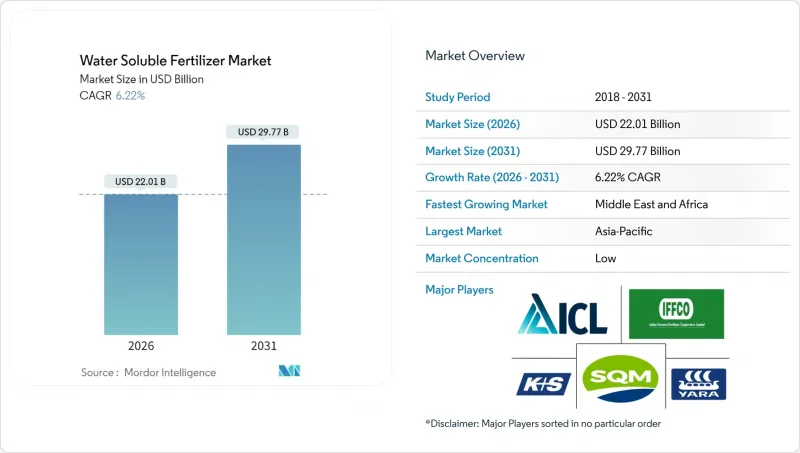
수요 증가는 건조화가 진행되는 지역에서 수자원을 절약하면서 수확량을 유지하는 정밀한 영양 공급으로 전환하는 농가의 전환에 기인하고 있습니다. 마이크로 관개 시스템에 대한 정부 보조금 증가, 온실 재배 면적 확대, 탄소배출권 기회 증가는 전체 수용성 비료 시장에서 특수 배합 제품의 채택을 더욱 가속화하고 있습니다. 경쟁 압력으로 인해 공급업체들은 농학적 조언과 디지털 도구를 결합한 솔루션을 제공하여 생산자가 영양소 흡수를 실시간으로 모니터링할 수 있도록 돕고 있습니다. 이 전략은 수용성 비료 시장에서 브랜드 충성도를 강화하는 결과를 가져왔습니다. 특히 킬레이트화된 미량영양소의 원료 가격 변동과 흡습성 염류로 인한 물류상의 문제가 성장을 저해하는 요인으로 작용하여 수용성 비료 시장의 장기적인 확대 추세를 저해하고 있습니다.
세계 수용성 비료 시장 동향 및 인사이트
고부가가치 작물에서 시비 관개 시스템 보급 확대
규제 당국의 물 사용량 기준 강화와 농가의 헥타르당 수익성 향상 추구에 따라 전 세계 비료 관개 시설 설치는 매년 23%씩 증가하고 있습니다. 이스라엘의 사례에 따르면, 시비관개는 감귤류와 아보카도의 수확량을 최대 40%까지 향상시키면서 동시에 물 소비량을 30%까지 줄일 수 있는 것으로 나타났습니다. 자동 투여 플랫폼은 노동력을 절감하고, 식물의 성장 단계에 맞춰 영양분을 공급하기 때문에 효율성과 캘리포니아 주 '지속가능한 지하수 관리법'과 같은 규제 준수를 모두 향상시킵니다. 전체 시스템 도입 비용은 헥타르당 2,000-4,000달러이지만, 융자 프로그램 및 성과 연동형 보조금을 통해 초기 부담을 줄이고, 수용성 비료 시장에서 중규모 생산자의 접근성 확대에 기여하고 있습니다.
온실 재배에서 정밀한 영양 관리의 필요성
생산자들이 연중 공급 안정성을 추구하는 가운데, 전 세계 온실 면적은 연간 8.2%의 속도로 확대되고 있습니다. 네덜란드의 한 사업자는 폐루프식 시비관개를 통해 양분 이용 효율 95% 이상을 상시 달성하여 토마토 수확량을 헥타르당 500-600톤(노지재배의 6배)으로 끌어올렸습니다. 이러한 실적은 작물의 생육 단계에 맞게 조정된 수용성 비료 블렌드의 높은 가격 구매를 정당화합니다. 아시아태평양 국가들은 식량안보 강화를 위해 이 모델을 도입하고 있으며, 싱가포르는 2030년까지 국내 생산비중 30% 달성을 목표로 하고 있습니다. 영양 관리 프로토콜의 문서화를 의무화하는 인증 제도는 수용성 비료 시장에서 추적 가능한 제품에 대한 수요를 더욱 촉진하고 있습니다.
기존 과립형 비료에 비해 초기 비용이 높음
가격에 민감한 생산자 계층에서는 40-60%의 가격 프리미엄이 도입 장벽으로 작용하고 있습니다. 예를 들어, 브라질의 콩 농가는 수확량 증가 효과에도 불구하고 사용 면적을 15% 미만으로 제한하고 있습니다. 그러나 노동력 절감 효과와 10-20%의 수율 증가를 고려하면 라이프사이클 비용에서는 수용성 소재가 유리할 수 있습니다. 현재 공급업체들은 수확시기에 맞춰 대금 지급 일정을 제공하고 있으며, 아시아태평양의 여러 프로그램에서는 보조금을 통해 비용 차이를 일부 해소하고 있습니다.
부문 분석
2025년 기준, 단일 성분 제품은 수용성 비료 시장의 52.74%를 차지했으며, 이는 비용 효율성과 다양한 작물에 대한 범용성을 반영합니다. 질산칼륨과 황산칼륨은 일반적인 시비 관개 시스템과의 호환성 때문에 이 카테고리를 주도하고 있습니다. 단일 성분 부문은 유연한 용량 조절이 가능하다는 점에서 장점이 있습니다. 이를 통해 생산자는 수용성 비료 시장에서 중요한 실천 방법인 실시간 토양 검사 결과에 따라 개별 영양소를 조정할 수 있습니다. 가격 민감도가 높음에도 불구하고 밭작물 작물에서 지속적인 채용으로 판매량은 높은 수준을 유지하고 있습니다.
복합 배합 제품은 생산자의 편의성과 작물에 특화된 영양 프로파일에 대한 수요에 힘입어 2031년까지 CAGR 6.38%로 확대될 것으로 예상됩니다. 미량영양소 강화 블렌드는 가장 빠르게 성장하는 하위 카테고리로, 서방형 코팅 기술을 활용하여 영양소의 지속적인 공급을 실현하고 있습니다. 유럽연합의 등록 규정은 표준화된 복합제품을 우대하고, 브랜드 솔루션으로의 통합을 촉진합니다. 이를 통해 20-30%의 프리미엄 가격을 실현하여 수용성 비료 시장의 수익률 향상에 기여하고 있습니다.
본 수용성 비료 시장 보고서는 유형별(복합 비료, 단일비료), 적용방법별(관개비료, 엽면 살포), 작물별(밭작물, 원예작물, 잔디, 관상식물), 지역별(아시아태평양, 유럽, 중동 및 아프리카, 아메리카)로 구분하여 조사하였습니다. 시장 예측은 금액(달러) 및 미터톤으로 제공됩니다.
지역별 분석
아시아태평양은 2025년 수용성 비료 시장 점유율의 41.05%를 차지했으며, 2031년까지 CAGR 6.55%로 성장할 것으로 예상됩니다. 중국의 통제된 환경 하에서 경작 면적은 연간 25%의 속도로 증가하고 있으며, 인도는 수용성 영양소 수요를 충족시키기 위해 18억 달러의 예산을 마이크로 관개 확대에 투입하고 있습니다. 킹엔터, 코로만델 인터내셔널 등 현지 업체들은 생산능력을 지속적으로 확대하여 가격경쟁력을 유지하면서 공급의 연속성을 확보하고 있습니다.
유럽은 네덜란드, 스페인, 이탈리아를 필두로 한 유럽이 2위를 차지하고 있습니다. 네덜란드의 온실 재배는 고순도 수용성 자재를 많이 사용하여 95%의 양분 이용 효율을 달성하고 있습니다. 스페인에서는 올리브 및 감귤 농장에 점적관개 시스템 도입이 의무화되어 칼륨 수요를 뒷받침하고 있습니다. 또한 이탈리아의 유기농 농가들은 지속가능한 생산에 대한 소비자의 선호에 부응하기 위해 인증된 수용성 제품을 선택하는 경향이 강해지고 있습니다. 비료 사용량 20% 감축을 목표로 하는 '농장에서 식탁까지' 이니셔티브는 수용성 비료 시장에서 고효율 솔루션을 간접적으로 촉진하고 있습니다.
북미에서는 정밀농업의 도입을 견인차 삼아 견조한 성장세가 지속되고 있습니다. 캘리포니아주의 영양 관리 의무화와 탄소상쇄 프로그램의 결합으로 검증된 수용성 비료 관리 방법을 도입하는 농부들에게 보상이 주어지고 있습니다. 캐나다의 곡물 생산자들은 가변 시비 기술을 활용하여 시비량을 미세 조정하고, 멕시코의 온실 채소 수출은 네덜란드식 구조용으로 특별히 설계된 프리미엄 블렌드 비료에 대한 수요를 주도하고 있습니다. 충실한 보급 서비스와 디지털 자문 플랫폼은 수용성 비료 시장에서 고도의 사용 패턴을 뒷받침하고 있습니다.
기타 특전:
- 엑셀 형식의 시장 예측(ME) 시트
- 애널리스트의 3개월간 지원
자주 묻는 질문
목차
제1장 소개
제2장 보고서 제공
제3장 주요 요약 및 주요 조사 결과
제4장 주요 업계 동향
제5장 시장 규모와 성장 예측(금액 및 수량)
제6장 경쟁 구도
제7장 CEO에 대한 주요 전략적 질문
KSM 26.03.10The water soluble fertilizer market is expected to grow from USD 20.72 billion in 2025 to USD 22.01 billion in 2026 and is forecast to reach USD 29.77 billion by 2031 at 6.22% CAGR over 2026-2031.
Strong demand stems from farmers' shift to precision nutrient delivery that conserves water while sustaining yield in increasingly arid regions. Mounting government subsidies for micro-irrigation systems, expanding greenhouse acreage, and rising carbon-credit opportunities further accelerate the adoption of specialized formulations across the water soluble fertilizer market. Competitive pressure pushes suppliers to bundle agronomic advice with digital tools so growers can monitor nutrient uptake in real time, a tactic that strengthens brand loyalty within the water soluble fertilizer market. Volatile raw-material pricing, especially for chelated micronutrients, and logistical challenges posed by hygroscopic salts temper growth but have not derailed the long-term expansion trajectory of the water soluble fertilizer market.
Global Water Soluble Fertilizer Market Trends and Insights
Rising Adoption of Fertigation Systems in High-Value Crops
Global installations of fertigation equipment are growing 23% each year as regulators tighten water use thresholds and farmers aim for higher returns per hectare. Israel's experience shows that fertigation boosts citrus and avocado yields by up to 40% while lowering water consumption by 30%. Automated dosing platforms cut labor requirements and synchronize nutrient release with plant development, enhancing both efficiency and compliance with mandates such as California's Sustainable Groundwater Management Act. Although a full system costs USD 2,000-4,000 per hectare, financing programs and performance-linked subsidies help offset the upfront burden, widening access for mid-size producers across the water soluble fertilizer market.
Need for Precise Nutrient Management in Greenhouse Farming
The global greenhouse area is expanding at an annual rate of 8.2% as growers pursue year-round supply resilience. Dutch operators routinely achieve nutrient use efficiency above 95% through closed-loop fertigation, enabling tomato yields of 500-600 tonnes per hectare, which is six times the output of open-field farming. Such performance validates the premium purchases of soluble blends, which are customized for specific crop stages. Asia-Pacific countries are replicating the model to bolster food security, with Singapore aiming to achieve 30% domestic output by 2030. Certification schemes that require documented nutrient protocols further boost demand for traceable products within the water soluble fertilizer market.
High Initial Cost Versus Conventional Granular Fertilizers
Price premiums of 40-60% deter adoption among price-sensitive growers. Brazilian soybean farmers, for instance, limit their usage to below 15% of the acreage despite the yield benefits. However, when labor savings and 10-20% yield gains are factored in, lifecycle economics can tip in favor of soluble inputs. Suppliers now offer harvest-aligned payment schedules, and subsidies partially close the cost gap in several Asia-Pacific programs.
Other drivers and restraints analyzed in the detailed report include:
- Expansion of Drip Irrigation Acreage Worldwide
- Government Subsidies Promoting Water-Efficient Fertilizers
- Volatility in Chelated Micronutrient Raw Material Supply
For complete list of drivers and restraints, kindly check the Table Of Contents.
Segment Analysis
Straight products accounted for 52.74% of the water-soluble fertilizer market in 2025, reflecting their cost-effectiveness and versatility across various crops. Potassium nitrate and potassium sulfate dominate this category due to their compatibility with typical fertigation setups. The straight segment benefits from flexible dosing, which allows growers to adjust individual nutrients in response to real-time soil tests, a key practice within the water-soluble fertilizer market. Despite pricing sensitivity, sustained adoption in field crops continues to keep volumes high.
Complex formulations are gaining ground at a 6.38% CAGR through 2031 as growers demand convenience and crop-specific nutrient profiles. Micronutrient-enriched blends are the fastest-growing subset, leveraging controlled-release coatings to extend nutrient availability. European Union registration rules favor standardized complex products, encouraging consolidation around branded solutions that command 20-30% premiums and boost margins within the water-soluble fertilizer market.
The Water Soluble Fertilizer Market Report is Segmented by Type (Complex and Straight), Application Mode (Fertigation and Foliar), Crop Type (Field Crops, Horticultural Crops, and Turf and Ornamental), and Geography (Asia-Pacific, Europe, Middle East and Africa, North America, South America). The Market Forecasts are Provided in Terms of Value (USD) and Volume (Metric Tons).
Geography Analysis
Asia-Pacific commanded 41.05% of the water soluble fertilizer market share in 2025 and is projected to post a 6.55% CAGR to 2031. China's controlled environment acreage has grown at a 25% annual rate, while India has budgeted USD 1.8 billion for micro-irrigation expansion that addresses soluble nutrition demand. Local manufacturers, such as Kingenta and Coromandel International, continue to expand their capacity, keeping prices competitive and ensuring supply continuity.
Europe ranks second, driven by the Netherlands, Spain, and Italy. Dutch greenhouse operations achieve 95% nutrient use efficiency, relying heavily on high-purity soluble inputs. Spain's mandated drip systems in olive and citrus groves sustain potassium demand, and Italy's organic farmers increasingly choose certified water soluble products to meet consumer preference for sustainable production. The Farm to Fork initiative, targeting a 20% fertilizer-use reduction, indirectly favors high-efficiency solutions in the water soluble fertilizer market.
North America maintains robust momentum, led by the adoption of precision agriculture. California's nutrient management mandates, combined with carbon offset programs, reward farmers who deploy validated soluble regimens. Canadian grain producers utilize variable-rate technologies to fine-tune their applications, while Mexico's greenhouse vegetable exports drive demand for premium blends specifically designed for Dutch-style structures. Strong extension services and digital advisory platforms support sophisticated usage patterns within the water soluble fertilizer market.
- Yara International ASA
- Sociedad Quimica y Minera de Chile SA
- Nutrien Ltd.
- Haifa Chemicals Ltd.
- ICL Group Ltd.
- K+S Aktiengesellschaft
- EuroChem Group AG
- Omnia Holdings Ltd.
- AgroLiquid Inc.
- Coromandel International Ltd.
- Grupa Azoty S.A.
- Valagro S.p.A. (Syngenta Group)
- Kingenta Ecological Engineering Group Co., Ltd.
- Helena Agri-Enterprises, LLC (Marubeni Corporation)
- FoxFarm Soil and Fertilizer Company
Additional Benefits:
- The market estimate (ME) sheet in Excel format
- 3 months of analyst support
TABLE OF CONTENTS
1 INTRODUCTION
- 1.1 Study Assumptions & Market Definition
- 1.2 Scope of the Study
- 1.3 Research Methodology
2 REPORT OFFERS
3 EXECUTIVE SUMMARY AND KEY FINDINGS
4 KEY INDUSTRY TRENDS
- 4.1 Acreage Of Major Crop Types
- 4.1.1 Field Crops
- 4.1.2 Horticultural Crops
- 4.2 Average Nutrient Application Rates
- 4.2.1 Micronutrients
- 4.2.1.1 Field Crops
- 4.2.1.2 Horticultural Crops
- 4.2.2 Primary Nutrients
- 4.2.2.1 Field Crops
- 4.2.2.2 Horticultural Crops
- 4.2.3 Secondary Macronutrients
- 4.2.3.1 Field Crops
- 4.2.3.2 Horticultural Crops
- 4.2.1 Micronutrients
- 4.3 Agricultural Land Equipped For Irrigation
- 4.4 Regulatory Framework
- 4.5 Value Chain & Distribution Channel Analysis
- 4.6 Market Drivers
- 4.6.1 Rising adoption of fertigation systems in high-value crops
- 4.6.2 Need for precise nutrient management in greenhouse farming
- 4.6.3 Expansion of drip irrigation acreage worldwide
- 4.6.4 Government subsidies promoting water-efficient fertilizers
- 4.6.5 Surge in soluble specialty blends for hydroponics
- 4.6.6 Carbon-credit linked fertilizer programs
- 4.7 Market Restraints
- 4.7.1 High initial cost versus conventional granular fertilizers
- 4.7.2 Logistical challenges in bulk handling of soluble salts
- 4.7.3 Ion-specific salinity build-up in closed irrigation loops
- 4.7.4 Volatility in chelated micronutrient raw-material supply
5 MARKET SIZE & GROWTH FORECASTS (VALUE AND VOLUME)
- 5.1 Type
- 5.1.1 Complex
- 5.1.2 Straight
- 5.1.2.1 By Nutrient
- 5.1.2.1.1 Micronutrients
- 5.1.2.1.2 Nitrogenous
- 5.1.2.1.3 Phosphatic
- 5.1.2.1.4 Potassic
- 5.1.2.1.5 Secondary Macronutrients
- 5.1.2.1 By Nutrient
- 5.2 Application Mode
- 5.2.1 Fertigation
- 5.2.2 Foliar
- 5.3 Crop Type
- 5.3.1 Field Crops
- 5.3.2 Horticultural Crops
- 5.3.3 Turf & Ornamental
- 5.4 Region
- 5.4.1 Asia-Pacific
- 5.4.1.1 Australia
- 5.4.1.2 Bangladesh
- 5.4.1.3 China
- 5.4.1.4 India
- 5.4.1.5 Indonesia
- 5.4.1.6 Japan
- 5.4.1.7 Pakistan
- 5.4.1.8 Philippines
- 5.4.1.9 Thailand
- 5.4.1.10 Vietnam
- 5.4.1.11 Rest of Asia-Pacific
- 5.4.2 Europe
- 5.4.2.1 France
- 5.4.2.2 Germany
- 5.4.2.3 Italy
- 5.4.2.4 Netherlands
- 5.4.2.5 Russia
- 5.4.2.6 Spain
- 5.4.2.7 Ukraine
- 5.4.2.8 United Kingdom
- 5.4.2.9 Rest of Europe
- 5.4.3 Middle East & Africa
- 5.4.3.1 Nigeria
- 5.4.3.2 Saudi Arabia
- 5.4.3.3 South Africa
- 5.4.3.4 Turkey
- 5.4.3.5 Rest of Middle East & Africa
- 5.4.4 North America
- 5.4.4.1 Canada
- 5.4.4.2 Mexico
- 5.4.4.3 United States
- 5.4.4.4 Rest of North America
- 5.4.5 South America
- 5.4.5.1 Argentina
- 5.4.5.2 Brazil
- 5.4.5.3 Rest of South America
- 5.4.1 Asia-Pacific
6 COMPETITIVE LANDSCAPE
- 6.1 Key Strategic Moves
- 6.2 Market Share Analysis
- 6.3 Company Landscape
- 6.4 Company Profiles
- 6.4.1 Yara International ASA
- 6.4.2 Sociedad Quimica y Minera de Chile SA
- 6.4.3 Nutrien Ltd.
- 6.4.4 Haifa Chemicals Ltd.
- 6.4.5 ICL Group Ltd.
- 6.4.6 K+S Aktiengesellschaft
- 6.4.7 EuroChem Group AG
- 6.4.8 Omnia Holdings Ltd.
- 6.4.9 AgroLiquid Inc.
- 6.4.10 Coromandel International Ltd.
- 6.4.11 Grupa Azoty S.A.
- 6.4.12 Valagro S.p.A. (Syngenta Group)
- 6.4.13 Kingenta Ecological Engineering Group Co., Ltd.
- 6.4.14 Helena Agri-Enterprises, LLC (Marubeni Corporation)
- 6.4.15 FoxFarm Soil and Fertilizer Company


