
|
시장보고서
상품코드
2035141
중국의 이륜차 시장 : 점유율 분석, 업계 동향 및 통계, 성장 예측(2026-2031년)China Two Wheeler - Market Share Analysis, Industry Trends & Statistics, Growth Forecasts (2026 - 2031) |
||||||
 Mordor Intelligence
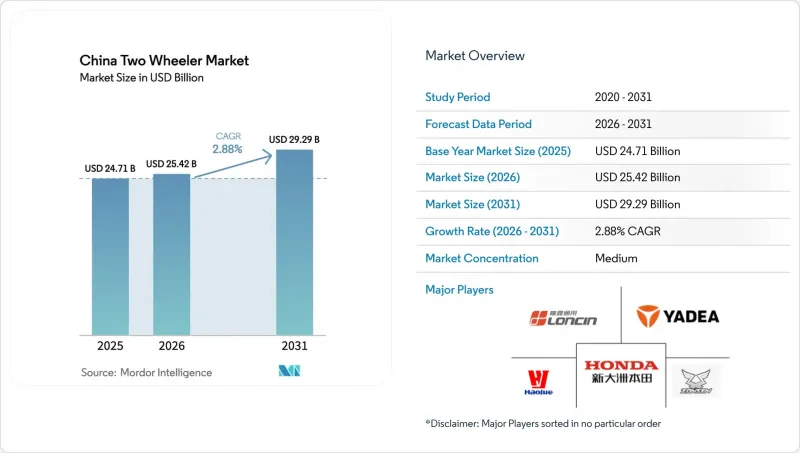
2026년 중국의 이륜차 시장 규모는 254억 2,000만 달러 라고 추계되고 있어 2025년 247억 1,000만 달러에서 확대해, 2031년에는 292억 9,000만 달러에 이를 것으로 예측됩니다.
2026년부터 2031년까지 연평균 복합 성장률(CAGR) 2.88%를 나타낼 것으로 예측됩니다.
이러한 확대는 주로 소유주들이 더 안전하고 고성능 차량으로 교체하는 것에 의해 주도되고 있지만, 전동화 및 안전 규제 강화로 인해 경쟁 전략이 재편되고 있습니다. 중국 동부는 도시가 밀집되어 있고 공급망이 성숙하여 가장 광범위한 고객 기반을 유지하고 있습니다. 그러나 인프라 투자로 인해 언덕이 많은 지역에서도 전기 모빌리티를 이용할 수 있게 되면서 중국 남서부 지역이 가장 빠른 판매량 증가를 기록하고 있습니다. 다목적 교통수단으로는 오토바이가 여전히 주류이지만, 통근자들이 소형 프레임과 보조금 지원 대상 배터리를 선호하기 때문에 스쿠터와 전기 모델이 성장률을 앞지르고 있습니다. 가격 민감도는 여전히 강하고, 출하량의 4분의 3은 여전히 1,000달러 미만이지만, 1,501-2,000달러 가격대에서는 리튬 이온 배터리, 커넥티드 대시보드, 브랜드 신뢰성에 대해 라이더가 대가를 지불하는 점진적인 프리미엄화 추세를 보이고 있습니다.
중국의 이륜차 시장 동향과 인사이트
정부의 전기 이륜차 보조금 및 구매세 면제 혜택 제공
인센티브 제도를 통해 전기자전거의 소매가격이 대폭 인하되어 내연기관차(ICE)와 경쟁할 수 있는 대안으로 자리 잡았습니다. 이는 연료비 절감 효과만으로는 도저히 따라잡을 수 없는 속도로 실현된 것입니다. 2024년 봄에 많은 도시에서 도입된 보상판매 제도는 소비자들이 더 새롭고 안전한 자전거 모델로 교체하도록 장려하고 있습니다. 한편, 규정의 변화, 특히 업데이트된 국가 배터리 안전 표준으로 인해 보조금 수령 요건이 변경되었습니다. 이번 개정안은 안전과 규정 준수를 우선시하며, 재정 지원을 일반적인 인센티브에서 노후 또는 기준 미달 차량 교체에 초점을 맞춘 보다 타겟화된 접근 방식으로 전환하고 있습니다.
정부의 지원 기간이 단축되는 가운데, 그 시급성을 감지한 제조업체들은 생산 체제를 강화하고 있습니다. 그러나 지역별로 정책 전개에 차이가 있기 때문에 각 업체들은 현지 자금 지원 기간에 맞추어 제품 출시 시기를 전략적으로 조정하고 있습니다. 이를 통해 경제적으로 활기찬 해안 지역에서는 기술 혁신의 보급이 가속화되어 전국적인 보급을 위한 벤치마킹 대상이 되고 있습니다.
도심 교통체증이 라스트마일 수요를 견인합니다.
상하이와 심천과 같은 활기찬 도시에서는 러시아워 교통 체증으로 인해 차량의 평균 속도는 거의 정지 상태에 이르렀습니다. 이러한 배경 속에서 이륜차, 특히 전기 오토바이와 스쿠터가 단거리 이동을 위한 최적의 선택으로 부상하고 있으며, 종종 밴을 훨씬 능가하는 경우가 많습니다. 교통 체증 요금 면제 정책으로 인해 이륜차는 더욱 빠르고 경제적이며, 그 우위는 더욱 커지고 있습니다. 도시 물류의 핵심으로 급성장하고 있는 즉시 배송 산업은 그 속도와 적응성 때문에 이륜차에 크게 의존하고 있습니다. 또한, 배터리 교체 서비스의 인기가 높아짐에 따라 라이더는 하루 종일 원활한 서비스를 이용할 수 있고, 집에서 충전하는 번거로움을 줄여 생산성을 향상시킬 수 있습니다.
도시의 인프라는 이러한 이륜차의 우위에 맞추어 변화하고 있습니다. 도로 갓길에 자전거 전용 주차 공간과 전용 차선을 시험적으로 도입하는 등의 노력은 라스트마일 배송에서 이륜차의 매우 중요한 역할을 강조하고 있습니다. 그러나 도크리스 자전거와 같은 공유 모빌리티 솔루션이 주목을 받고 있는 반면, 전문 택배업체에게는 부족한 점이 많습니다. 더 큰 적재 능력과 신뢰성을 필요로 하는 이들 택배업체에게 도크리스 자전거는 부족한 점이 많습니다.
라이더의 높은 사고율과 사망률
2023년 실내에서 배터리 충전과 관련된 화재 사고가 21,000건을 넘어섰고, 이에 따라 2024년 11월부터 모든 신형 전기자전거 시스템에 대해 보다 엄격한 검사와 CCC 인증이 의무화됩니다. 주행거리 1km당 부상률은 여전히 자동차 탑승자에 비해 15-20배 높은 수준입니다. 지자체는 전기 이륜차 헬멧 착용 의무화, 전용차선 도입 등을 시범적으로 시행하고 있으며, 안전 감독을 강화하려는 움직임을 보이고 있습니다. 보험사는 제3자 배상책임보험 옵션을 도입하고 있으며, 고속 모델의 보험료는 소폭 상승했습니다. 각 제조업체들은 차체 프레임과 배터리 안전에 관한 새로운 국가 표준을 준수하기 위해 증가하는 생산 비용을 부담하고 있습니다. 이러한 조정은 비용 증가로 이어지지만, 소비자의 신뢰를 높이고 안전과 신뢰성을 우선시하는 시장의 변화를 강조하고 있습니다.
부문 분석
2025년 중국의 이륜차 시장 규모에서 오토바이는 69.12%를 차지했으며, 스쿠터는 혼잡한 도로에서 선호되는 계단식 인체공학적 디자인 덕분에 2031년까지 연평균 복합 성장률(CAGR) 4.12%로 급성장할 것으로 예측됩니다. 고배기량 레저용 모터사이클은 소득 증가와 함께 주말 투어링이 이용 사례에 추가됨에 따라 2024년 초에 큰 폭의 성장이 예상됩니다. AI 음성 어시스턴트와 OTA 업데이트가 가능한 디지털 클러스터는 자동차 대시보드와 마찬가지로 현재 미들급 모델에는 표준으로 장착되어 있습니다. 지방 라이더들 사이에서는 연료 탱크의 항속거리와 견고한 프레임으로 인해 오토바이가 여전히 주류이지만, 도심에서는 스쿠터의 주차 혜택과 자동 변속기가 통근자들의 지지를 받고 있습니다.
도심에서의 스쿠터 보급은 대형 오토바이의 도심 진입을 금지하는 지역 규제의 수혜를 받고 있으며, 교체 수요는 더 가벼운 프레임으로 이동하고 있습니다. 각 브랜드는 시트 아래 리튬 이온 배터리와 NFC 스타트키를 기본 장착하고 평균판매가격(ASP)을 1,501-2,000달러대까지 끌어올렸습니다. 스마트 헬멧에서 앱 구독에 이르기까지 다양한 액세서리 매출은 성숙한 이륜차 부문의 판매량 성장 둔화에도 불구하고 수익률을 더욱 끌어올리고 있습니다.
2025년에도 중국의 이륜차 시장 규모의 71.84%는 여전히 내연기관차가 차지했지만, 보조금, 충전 네트워크, 배출가스 규제 지역 확대에 따라 전기차는 2031년까지 연평균 복합 성장률(CAGR) 7.05%로 성장하고 있습니다. Yadea와 Tailg의 나트륨 이온 배터리 프로토타입이 2024년에 등장하여 3,000 사이클의 수명을 달성하고 배터리 팩의 비용을 10-15% 절감했습니다. 연안 도시에서는 낮은 운영 비용과 도시 접근성 개선을 배경으로 전기 배송 차량의 급속한 확장을 볼 수 있습니다. 반면, 지방의 경우 인프라 부족과 배터리 가격의 추가 인하가 필요하기 때문에 여전히 휘발유 차량에 대한 의존도가 높은 실정입니다. 이러한 도시와 지방의 격차는 전기화의 진전과 전국적인 전환을 위해 여전히 극복해야 할 과제를 부각시키고 있습니다.
전기차 제조업체들은 배터리 교환 스테이션 설치, 앱에 실시간 위치 추적 기능 통합 등을 통해 주행거리에 대한 불안감을 해소하기 위해 노력하고 있습니다. 기존 내연기관(ICE) 제조업체들은 더욱 강화된 배출가스 규제에 대응하기 위해 연비 향상과 엔진 개선을 추진하고 있지만, 탄소 규제 강화로 시장이 축소되고 있습니다. 하이브리드 자동차는 구조가 복잡하고 보조금이 부족해 여전히 틈새 시장에 머물러 있습니다.
기타 특전:
- 엑셀 형식 시장 예측(ME) 시트
- 3개월간 애널리스트 지원
자주 묻는 질문
목차
제1장 서론
제2장 조사 방법
제3장 주요 요약
제4장 주요 업계 동향
제5장 시장 구도
제6장 시장 규모와 성장 예측(금액(달러) 및 수량(받침대))
제7장 경쟁 구도
제8장 시장 기회와 향후 전망
제9장 CEO을 위한 중요 전략적 과제 :
JHS 26.05.20China two-wheeler market size in 2026 is estimated at USD 25.42 billion, growing from 2025 value of USD 24.71 billion with 2031 projections showing USD 29.29 billion, growing at 2.88% CAGR over 2026-2031.
Expansion is driven mainly by owners upgrading to safer, more capable machines, while electrification and tighter safety rules reshape competitive strategy. East China retains the most extensive customer base because of dense cities and mature supply chains. Yet, Southwest China posts the fastest volume gains as infrastructure investments open hilly terrain to electric mobility. Motorcycles stay dominant for mixed-use transport, but scooters and electric variants outpace them in growth as commuters favor compact frames and subsidy-eligible batteries. Price sensitivity remains acute-three-quarters of deliveries are still below USD 1,000-but gradual premiumization is visible in the USD 1,501-2,000 bracket where riders pay for lithium packs, connected dashboards, and brand reliability.
China Two Wheeler Market Trends and Insights
Government e-2W Subsidies and Purchase-Tax Exemption
Incentive programs have slashed the retail prices of electric bikes, positioning them as a competitive alternative to internal combustion engine (ICE) vehicles, and doing so much sooner than fuel savings would allow. A spring 2024 trade-in initiative, embraced by numerous cities, is nudging consumers towards upgrading to newer, safer bike models. Meanwhile, regulatory shifts, especially the updated national battery safety standards, alter subsidy eligibility criteria. These revisions prioritize safety and compliance, redirecting financial support from generalized incentives to a more targeted approach, focusing on replacing outdated or non-compliant units.
Sensing the urgency as the window for government aid tightens, manufacturers are ramping up operations. However, regional policy rollout disparities mean companies strategically timing product launches to coincide with local funding windows. This has led to a quicker dissemination of technological advancements in the economically vibrant coastal regions, setting a benchmark for national adoption.
Urban Congestion Driving Last-mile Demand
In bustling cities such as Shanghai and Shenzhen, peak-hour traffic congestion has brought average vehicle speeds to a standstill. Amidst this backdrop, two-wheelers-particularly electric motorcycles and scooters-have emerged as the preferred choice for short-distance travel, often leaving vans in the dust. Their edge is heightened by policies exempting motorcycles from congestion charges, making them swifter and more economical. The surging instant-delivery sector, a linchpin of urban logistics, heavily leans on two-wheelers for their speed and adaptability. Moreover, the rising popularity of battery-swap services ensures riders enjoy seamless service throughout the day, sidestepping the hassle of home charging and boosting productivity.
Urban infrastructure is adapting to this two-wheeler dominance. Initiatives like dedicated curbside parking and exclusive lane pilot programs underscore the pivotal role of two-wheelers in last-mile delivery. Yet, while shared mobility solutions, such as dockless bikes, have made waves, they've fallen short for professional couriers. These couriers, needing greater payload capacity and reliability, find dockless bikes lacking.
High Accident and Fatality Rates among Riders
Fire incidents linked to indoor battery charging topped 21,000 cases in 2023, prompting tougher inspections and CCC certification for every new e-bike system from November 2024. Injury rates remain 15-20 times higher than car occupants per kilometer. Municipal governments are piloting helmet mandates and dedicated lanes for electric two-wheelers, marking a move towards heightened safety oversight. Insurance firms are rolling out third-party coverage options, marginally bumping costs for swifter models. Manufacturers are shouldering increased production costs to align with new national standards on vehicle frames and battery safety. Although these adjustments increase expenses, they enhance consumer trust and underscore a market shift prioritizing safety and reliability.
Other drivers and restraints analyzed in the detailed report include:
- E-commerce Delivery Boom
- Low Total Cost of Ownership
- Lithium and Graphite Supply-chain Volatility
For complete list of drivers and restraints, kindly check the Table Of Contents.
Segment Analysis
Motorcycles account for 69.12% of the China two-wheeler market size in 2025, yet scooters are surging ahead at a 4.12% CAGR through 2031, thanks to step-through ergonomics that are favored in crowded streets. Large-displacement leisure bikes are expected to experience significant growth in early 2024, as rising incomes add weekend touring to the use-case mix. Digital clusters with AI voice assistants and OTA updates are now standard on mid-tier models, mirroring car dashboards. Rural riders keep motorcycles in front through fuel-tank range and robust frames, but in downtown cores, scooter parking privileges and automatic gearboxes are winning commuters.
Urban scooter uptake also benefits from local rules barring full-size motorcycles from central districts, tilting replacement cycles toward lighter frames. Brands package under-seat lithium packs and NFC start keys, pushing ASPs into the USD 1,501-2,000 band. Accessory revenue-from smart helmets to app subscriptions-deepens margins even as unit growth moderates in the mature motorcycle segment.
Internal combustion engines still account for 71.84% of the China two-wheeler market size in 2025, but electric vehicles are growing at a compound annual rate of 7.05% to 2031, as subsidies, charging networks, and emission zones expand. Sodium-ion prototypes from Yadea and Tailg debuted in 2024, offering 3,000-cycle life while trimming 10-15% off pack cost. Coastal cities are witnessing a rapid expansion of electric delivery fleets, driven by low operating costs and improved urban access. Meanwhile, rural regions rely heavily on gasoline vehicles, hindered by limited infrastructure and the need for further reductions in battery prices. This urban-rural disparity underscores the progress in electrification and the hurdles that still need to be addressed for a nationwide shift.
Electric vehicle manufacturers are addressing range anxiety by deploying battery swap stations and integrating real-time location tracking into their apps. Traditional internal combustion engine (ICE) makers are improving fuel efficiency and updating engines to meet stricter emissions standards, though tightening carbon regulations are shrinking their market. Hybrid vehicles remain a niche market due to their added complexity and the lack of subsidies.
The China Two Wheeler Market Report is Segmented by Vehicle Type (Motorcycles and Scooters), Propulsion (ICE and Electric), Engine Capacity/Motor Power (Up To 110cc, and More), Price Band (Up To USD 1, 000, and More), End User (B2C and B2B), Sales Channel (Online and Offline), and by Region. The Market Forecasts are Provided in Terms of Value (USD) and Volume (Units).
List of Companies Covered in this Report:
- Yadea Group Holdings Ltd.
- Jiangsu Xinri E-Vehicle Co., Ltd. (SUNRA)
- Zhejiang Luyuan Electric Vehicle Co., Ltd.
- NIU Technologies
- Tailing Electric Vehicle Co., Ltd.
- Wuyang-Honda Motors (Guangzhou) Co., Ltd.
- Sundiro Honda Motorcycle Co., Ltd.
- Guangzhou Dayun Motorcycle Co., Ltd.
- Jiangmen Dachangjiang Group Co., Ltd. (Haojue)
- Loncin Motor Co., Ltd.
- Lifan Technology (Group) Co., Ltd.
- Chongqing Zongshen Industrial Group Co., Ltd.
- Qingqi Group Co., Ltd.
- Chongqing Huansong Industries (HSUN)
- Tayo Motorcycle Technology (Qingdao) Co., Ltd.
- Zhe Jiang Qianjiang Motorcycle Co., Ltd. (QJMotor)
Additional Benefits:
- The market estimate (ME) sheet in Excel format
- 3 months of analyst support
TABLE OF CONTENTS
1 Introduction
- 1.1 Study Assumptions and Market Definition
- 1.2 Scope of the Study
2 Research Methodology
3 Executive Summary
4 Key Industry Trends
- 4.1 Population and Urbanization Rate
- 4.2 GDP per Capita (PPP) and Median Disposable Income
- 4.3 Consumer Spend on Vehicle Purchase/Transport (CVP)
- 4.4 Fuel Prices
- 4.5 Interest Rate for 2W/Auto Loans and Credit Access
- 4.6 2W Penetration (units/1,000) and Parc
- 4.7 Dealer/Service Network Density
- 4.8 Two-Wheeler Trade and Revenue (Imports/Exports)
- 4.9 Electrification Readiness (Infrastructure and Power)
- 4.10 Battery Pack Price and Chemistry Mix
- 4.11 Battery Swapping Stations (Density and Utilization)
- 4.12 New Model Pipeline and OEM Coverage
- 4.13 Value-Chain Localization and Assembly Capacity
- 4.14 Regulatory Framework
- 4.14.1 Vehicle Standards, Safety and Roadworthiness
- 4.14.2 CBU/CKD/SKD Duties, VAT and Local-content Rules
- 4.14.3 Electrification, Energy and Environmental Policy
- 4.14.4 Rules for Bike-taxis, Delivery Fleets and Financing
5 Market Landscape
- 5.1 Market Overview
- 5.2 Market Drivers
- 5.2.1 Government e-2W Subsidies and Purchase Tax Exemption
- 5.2.2 Urban Congestion Driving Last-mile Demand
- 5.2.3 Low Total Cost of Ownership vs. Cars and Public Transit
- 5.2.4 E-commerce Delivery Boom
- 5.2.5 Tier-3/4 City Battery-Swapping Ecosystem Expansion
- 5.2.6 AI-enabled Telematics Optimising Fleet Utilisation
- 5.3 Market Restraints
- 5.3.1 High Accident and Fatality Rates among Riders
- 5.3.2 Lithium and Graphite Supply-chain Volatility
- 5.3.3 Stricter Classification Rules for Low-speed E-bikes
- 5.3.4 Competition from Shared Micromobility Platforms
- 5.4 Value / Supply-Chain Analysis
- 5.5 Technological Outlook
- 5.6 Porter's Five Forces
- 5.6.1 Threat of New Entrants
- 5.6.2 Bargaining Power of Suppliers
- 5.6.3 Bargaining Power of Buyers
- 5.6.4 Threat of Substitutes
- 5.6.5 Competitive Rivalry
6 Market Size and Growth Forecasts (Value (USD) and Volume (Units))
- 6.1 By Vehicle Type
- 6.1.1 Motorcycles
- 6.1.2 Scooters
- 6.2 By Propulsion
- 6.2.1 Internal Combustion Engine
- 6.2.2 Electric
- 6.3 By Engine Capacity / Motor Power
- 6.3.1 Internal Combustion Engine
- 6.3.1.1 Up to 110 cc
- 6.3.1.2 111-125 cc
- 6.3.1.3 126-150 cc
- 6.3.1.4 151-200 cc
- 6.3.1.5 201-250 cc
- 6.3.1.6 250-350 cc
- 6.3.1.7 350-500 cc
- 6.3.1.8 Above 500 cc
- 6.3.2 Electric
- 6.3.2.1 Up to 1.0 kW
- 6.3.2.2 1.1-3.0 kW
- 6.3.2.3 3.1-5.0 kW
- 6.3.2.4 Above 5.0 kW
- 6.3.1 Internal Combustion Engine
- 6.4 By Price Band
- 6.4.1 Up to USD 1,000
- 6.4.2 USD 1,000-1,500
- 6.4.3 USD 1,501-2,000
- 6.4.4 USD 2,001-3,000
- 6.4.5 USD 3,001-5,000
- 6.4.6 Above USD 5,000
- 6.5 By End User
- 6.5.1 B2C
- 6.5.2 B2B
- 6.5.2.1 Ride-hail / Bike-Taxi / Rental / Tourism
- 6.5.2.2 Delivery and Logistics
- 6.5.2.3 Corporate and SME Fleets
- 6.5.2.4 Others (Govt., NGO, Institutional)
- 6.6 Sales Channel
- 6.6.1 Online
- 6.6.2 Offline
- 6.7 By Region
- 6.7.1 East China
- 6.7.2 South-Central China
- 6.7.3 North China
- 6.7.4 Northeast China
- 6.7.5 Southwest China
- 6.7.6 Northwest China
7 Competitive Landscape
- 7.1 Market Concentration
- 7.2 Strategic Moves
- 7.3 Market Share Analysis
- 7.4 Company Profiles (Includes Global level Overview, Market level overview, Core Segments, Financials as available, Strategic Information, Market Rank/Share for key companies, Products and Services, and Recent Developments)
- 7.4.1 Yadea Group Holdings Ltd.
- 7.4.2 Jiangsu Xinri E-Vehicle Co., Ltd. (SUNRA)
- 7.4.3 Zhejiang Luyuan Electric Vehicle Co., Ltd.
- 7.4.4 NIU Technologies
- 7.4.5 Tailing Electric Vehicle Co., Ltd.
- 7.4.6 Wuyang-Honda Motors (Guangzhou) Co., Ltd.
- 7.4.7 Sundiro Honda Motorcycle Co., Ltd.
- 7.4.8 Guangzhou Dayun Motorcycle Co., Ltd.
- 7.4.9 Jiangmen Dachangjiang Group Co., Ltd. (Haojue)
- 7.4.10 Loncin Motor Co., Ltd.
- 7.4.11 Lifan Technology (Group) Co., Ltd.
- 7.4.12 Chongqing Zongshen Industrial Group Co., Ltd.
- 7.4.13 Qingqi Group Co., Ltd.
- 7.4.14 Chongqing Huansong Industries (HSUN)
- 7.4.15 Tayo Motorcycle Technology (Qingdao) Co., Ltd.
- 7.4.16 Zhe Jiang Qianjiang Motorcycle Co., Ltd. (QJMotor)
8 Market Opportunities and Future Outlook
- 8.1 White-space and Unmet-need Assessment