
|
시장보고서
상품코드
2043860
자동차 물류 : 시장 점유율 분석, 업계 동향 및 통계, 성장 예측(2026-2031년)Automotive Logistics - Market Share Analysis, Industry Trends & Statistics, Growth Forecasts (2026 - 2031) |
||||||
 Mordor Intelligence
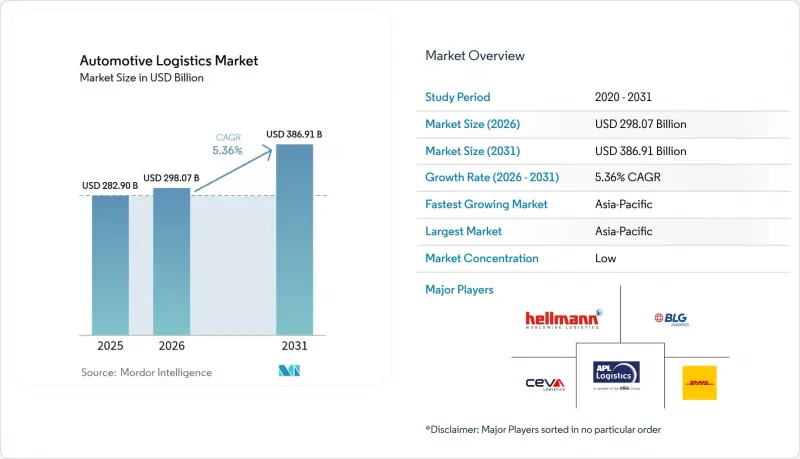
자동차 물류 시장 규모는 2025년 2,829억 달러로 평가되었습니다. 2026년 2,980억 7,000만 달러로 확대되어 2026년부터 2031년에 걸쳐 CAGR 5.36%를 나타내, 2031년에는 3,869억 1,000만 달러에 이를 것으로 예측됩니다.
승용차 및 상용차의 전동화, 애프터마켓 풀필먼트의 급속한 디지털화, 서비스형 모빌리티(Mobility-as-a-Service, MaaS) 프로그램의 확산으로 인해 물류 사업자의 계약 범위가 확대되고 운송의 복잡성이 증가하고 있습니다. 기업의 지속가능성 목표가 강화되면서 도로에서 철도와 해상으로 운송 수단의 전환이 가속화되는 한편, 세계 3PL(제3자 물류) 기업 간 합병으로 경쟁 구도를 재편하는 규모의 경제가 생겨나고 있습니다. 동시에 전자상거래의 당일/익일 배송에 대한 기대가 높아지면서 마이크로 풀필먼트에 대한 자동화 투자가 진행되고 있으며, 통합 가시화 플랫폼은 장기적인 자동차 관련 계약을 따내기 위한 필수 조건이 되고 있습니다.
세계의 자동차 물류 시장 동향 및 인사이트
배터리 전기자동차 보급 가속화로 완성차 유통량 증가 전망
세계 전기차(EV) 보급률은 2025년 20%를 넘어섰으며, 이는 전문 배터리 공급망과 새로운 완성차 운송 경로에 대한 수요를 견인하고 있습니다. DHL은 아시아태평양과 유럽에 EV 우수 센터를 설립하여 온도 관리 보관, 위험물(DG) 취급 및 복합운송 솔루션을 제공합니다. Maersk의 'EV 배터리 플렉스 플로우(EV Battery Flex Flow)' 프로그램은 재사용 가능한 컨테이너와 첨단 소화 시스템을 활용하여 창고 면적을 절반으로 줄이고, 셀 제조업체의 물류 비용을 30% 절감하고 있습니다. 중국이 양극재 생산의 70%, 음극재 생산의 85%를 차지함에 따라 유럽과 북미의 3PL 업체들도 중국 운송 경로의 운송 능력에 투자하고 있으며, 유럽과 북미의 OEM 업체들에게 완충재 재고의 니어쇼어링이 매우 중요해졌습니다. 배터리 취급 거점의 자본집약도가 높기 때문에 운송회사와 에너지 기업 간 합작회사가 결성되어 인프라 투자를 공동으로 진행하는 움직임이 진행되고 있습니다.
애프터마켓 부품의 전자상거래의 급격한 성장으로 당일 및 익일 배송에 대한 기대가 높아지고 있습니다.
현재 온라인 부품 판매는 전 세계 애프터마켓 매출의 두 자릿수 점유율을 차지하고 있으며, 지역 물류센터에서 도시 지역 운전자와 가까운 마이크로 풀필먼트 거점으로의 전환이 진행되고 있습니다. 대형 자동차 부품 도매업체에서 AutoStore를 도입하여 보관 밀도가 300% 향상되고 가동률이 99.6%를 달성했습니다. 이를 통해 3만 SKU의 상품구색에 대해 2시간의 주문 마감 시간을 실현하고 있습니다. 기아 이스라엘의 하드웨어가 필요 없는 추적 시스템을 통해 차량 검색 시간을 몇 시간에서 몇 분으로 단축하여 인건비를 50% 절감하고 처리 시간을 최대 40%까지 단축했습니다. 물류 제공 업체는 현재 예측 재고 관리 도구와 라스트 마일 네트워크를 결합하여 장기 계약을 보장하기 위해 교외 크로스 도크에서 주말 서비스 보증을 충족시키기 위해 야간까지 지방 노선에 보충하고 있습니다.
거시경제의 불확실성, 자동차의 임의 구매 및 출하 억제
세계의 자동차 생산은 신용경색과 소비심리 위축으로 2024년 0.8% 성장으로 둔화되었고, 유럽의 완성차 항만 물동량은 9.4% 감소했습니다. 포드는 수요 변동에도 리드타임을 유지하면서 비용을 절감하기 위해 멕시코 구아이마스 항구에서 철도 및 단거리 해상 운송을 통한 대체 경로를 시범적으로 도입하고 있습니다. 가동률 하락으로 로로(Ro-Ro) 터미널의 수익률은 압박을 받고 있지만, 사업자들은 경기 회복에 대비하여 잉여 수송 능력을 확보해야 하며, 가격 책정 규율이 시험대에 오르고 있습니다. 중국의 EV 수출은 유럽과 미국의 매크로 사이클과 무관하게 새로운 브랜드가 생산을 확대하고 있기 때문에 예측을 복잡하게 만들고 있습니다.
부문 분석
2025년, 운송 부문은 세계의 자동차 물류 시장에서 58.34%의 점유율을 유지했습니다. 육상 운송은 여전히 핵심적인 역할을 하고 있지만, 화주들이 저탄소 옵션을 추구함에 따라 철도 및 해상 운송의 처리량이 증가하고 있습니다. 독일 국내 노선을 운행하는 BMW의 수소 트럭은 탱크에서 바퀴까지의 배기가스 배출량을 줄여 운송 모드의 혁신을 보여주고 있습니다. 부가가치 서비스는 커스터마이징, 소프트웨어 작성, 차량 인도 전 검사에 대한 수요에 힘입어 CAGR 6.94%로 시장을 견인할 것으로 예측됩니다. 각 공급업체들은 기존 창고를 로봇 기술을 접목한 멀티클라이언트 조립 허브로 전환하여 기존의 고정비 부담 없이 프로그램 출시 기간을 단축할 수 있도록 하고 있습니다.
자동화는 창고의 경제성을 재구성하고 있습니다. 오토스토어의 'Goods-to-Person(Goods-to-Person)' 시스템은 부피 이용률을 3배로 높이고, 피킹 오류를 0.1% 미만으로 낮추며, 애프터마켓 주문에 대해 2시간 이내로 대응할 수 있도록 합니다. OEM이 모듈형 EV 플랫폼으로 전환하는 가운데, 서브 어셈블리의 키트화 및 배터리 팩의 시퀀싱은 서비스 전문업체에게 새로운 수익원을 창출하고 있습니다. 그 결과, 계약 수익의 균형이 장거리 운송에서 고부가가치 부가가치 서비스로 이동하고 있으며, 공급자의 수입원을 다양화하고 장기적인 계약의 정착을 강화하고 있습니다.
2025년 OEM 물류는 복잡한 부품 수입 흐름과 완성차 수출에 힘입어 전 세계의 자동차 물류 시장 규모의 72.55%를 차지했습니다. 전기화가 진행됨에 따라 ADR을 준수하는 배터리 보관 시설, 온도 관리 트레일러 및 비상 대응 프로토콜에 대한 투자가 증가하고 있습니다. 테슬라가 현대글로비스와 체결한 상하이에서 로테르담까지 모델3 운송에 대한 장기 용선 계약은 새로운 대륙 횡단 EV 운송 경로의 형성을 반영합니다.
자동차 물류 시장에서 애프터마켓 물류는 차량 노후화와 소비자 직접 부품 판매 증가를 배경으로 CAGR 6.28%로 가장 빠르게 성장하고 있습니다. DHL의 인머 공급망 인수를 통해 14개의 리턴 센터를 추가함으로써 DHL은 북미에서 증가하는 역물류 수요를 충족시킬 준비를 갖추게 되었습니다. 라틴아메리카의 차량 평균연령이 18-20년으로 수입부품에 대한 지역적 수요가 증가하고 있으며, 항만 혼잡을 피하기 위해 보세자유무역허브에 3PL 투자를 유치하고 있습니다.
지역별 분석
아시아태평양은 2025년 세계의 자동차 물류 시장에서 47.35%의 점유율을 차지했으며, 2031년까지 연평균 복합 성장률(CAGR) 6.55%를 나타낼 것으로 예측됩니다. EV 생산 및 배터리 재료 정제에서 중국의 우위는 높은 역내 경로 밀도를 유지하고 있는 반면, 인도의 생산 연동형 인센티브는 부품 제조의 이전을 유도하고 있습니다. DHL은 2025년 호주에 EV 센터 오브 엑설런스(EV Center of Excellence)를 개설하여 온도 관리형 배터리 운송을 위한 지역 네트워크를 확장했습니다. 일본의 물류 사업자들은 고속도로에서 자동 플래토닝을 선도적으로 도입하여 운전자 부족 해소와 자산 활용률 향상에 힘쓰고 있습니다. 주요 항만 운영사는 RO-RO 선석 확장을 추진하고 있으며, 가오슝항의 37만 TEU 규모의 확장은 완성차 선박의 선박 처리 속도를 향상시키는 좋은 예입니다.
북미는 자동차 물류 시장의 전략적 요충지이지만, 수입 차량 및 부품에 대한 관세 인상으로 인해 운송 경로 결정에 압박을 받고 있습니다. 애널리스트들의 추정에 따르면, 2026년까지 관세가 유지될 경우, 하루 2만대의 운송량이 감소할 수 있으며, OEM 업체들은 멕시코와 캐나다에서 니어쇼어링을 더욱 추진해야할 것으로 보입니다. 조지아 항만청은 2026년까지 미국 내 RO-RO 처리량 1위를 목표로 콜로넬스 아일랜드 개보수에 2억 6,200만 달러를 투자할 예정입니다. 서해안의 혼잡을 완화하고 육상 운송 비용의 균형을 맞추기 위해, 과이마스 등 태평양 측의 대체 게이트에 시범적으로 도입이 추진되고 있습니다.
자동차 물류 시장에서 유럽은 지정학적 혼란과 엄격한 탄소 규제에 직면해 있습니다. 완성차 터미널의 처리량은 2024년 9.4% 감소했으며, 아시아에서 전기차 수출이 급증하는 가운데 이 지역은 순수입국으로 전환했습니다. 그러나 유럽연합(EU)은 녹색물류에 대한 노력에 있어 선도적인 위치에 있습니다. 아우디는 배터리 모듈 운송을 위해 재생에너지로 구동되는 열차를 도입하여 연간 2,600톤의 CO2 배출량을 절감하고 있습니다. 피엘포트가 셰어니스에 건설 중인 3,000만 파운드 규모의 RO-RO 부두(2025년 가동 예정)는 처리량이 감소하고 있음에도 불구하고 투자가 계속되고 있음을 보여줍니다.
기타 혜택 :
- 엑셀 형식 시장 예측(ME) 시트
- 3개월간 애널리스트 지원
자주 묻는 질문
목차
제1장 서론
제2장 조사 방법
제3장 주요 요약
제4장 시장 구도
제5장 시장 규모와 성장 예측
제6장 경쟁 구도
제7장 시장 기회와 향후 전망
KTH 26.05.29The Automotive Logistics Market size is expected to grow from USD 282.90 billion in 2025 to USD 298.07 billion in 2026 and is forecast to reach USD 386.91 billion by 2031 at 5.36% CAGR over 2026-2031.
Continued electrification of passenger and commercial fleets, the rapid digitalization of aftermarket fulfillment, and the spread of mobility-as-a-service programs are expanding contract scope and shipment complexity for logistics providers. Modal shifts from road to rail and sea are accelerating as corporate sustainability targets tighten, while mergers among global 3PLs are creating scale advantages that reshape competitive dynamics. At the same time, same-day and next-day delivery expectations in e-commerce are pushing automation investments in micro-fulfillment, and integrated visibility platforms are becoming a prerequisite for winning long-term automotive contracts.
Global Automotive Logistics Market Trends and Insights
Acceleration of Battery-Electric Vehicle Adoption Raising Finished-Vehicle Flows
Global electric vehicle penetration is forecast to top 20% in 2025, driving demand for specialized battery supply chains and new finished-vehicle corridors. DHL has opened EV Centers of Excellence in Asia-Pacific and Europe, providing temperature-controlled storage, DG-compliant handling, and multimodal outbound solutions. Maersk's EV Battery Flex Flow program halves warehouse footprints by using reusable containers and advanced fire-suppression, cutting logistics costs by 30% for cell manufacturers. Western 3PLs are also investing in Chinese corridor capacity as the country maintains 70% cathode and 85% anode output, making near-shoring of buffer stocks crucial for European and North American OEMs. The capital intensity of battery handling depots is prompting joint ventures between carriers and energy firms to pool infrastructure spending.
E-commerce Boom in Aftermarket Parts Creating Same-Day/Next-Day Delivery Expectations
Online parts revenue now accounts for double-digit share of global aftermarket sales, prompting a shift from regional distribution centers to micro-fulfillment nodes closer to urban drivers. AutoStore deployments at leading spare-parts distributors raise storage density by 300% and deliver 99.6% uptime, enabling two-hour cut-off times for 30,000 SKU assortments. Kia Israel's hardware-less tracking reduced vehicle search time from hours to minutes, freeing 50% of labor and trimming processing time by up to 40%. Logistics providers now bundle predictive inventory tools with last-mile networks to secure long-term contracts, while suburban cross-docks replenish rural routes overnight to meet weekend service guarantees.
Macroeconomic Uncertainty Suppressing Discretionary Vehicle Purchases and Shipments
Global automotive output slowed to 0.8% growth in 2024 on tighter credit and weak consumer sentiment, reducing finished-vehicle port throughput by 9.4% in Europe. Ford is testing rail-short-sea alternatives from Mexico's Guaymas port to cut costs while maintaining lead-times under demand volatility. Lower utilization presses margins at ro-ro terminals, yet operators must retain surge capacity for recovery, straining pricing discipline. Chinese EV exports add forecasting complexity, as new brands scale output regardless of Western macrocycles.
Other drivers and restraints analyzed in the detailed report include:
- Growth of Vehicle Subscription & Mobility-as-a-Service Increasing Fleet Turnover Logistics
- Consumer Demand for End-to-End Shipment Visibility Fostering Platform-Enabled 3PL Contracts
- Freight-Rate Volatility Eroding Budget Predictability for Automotive Shippers
For complete list of drivers and restraints, kindly check the Table Of Contents.
Segment Analysis
Transportation retained 58.34% share of the global automotive logistics market in 2025. Road haulage remains pivotal, yet rail and sea volumes are rising as shippers seek lower-carbon options. BMW's hydrogen trucks on German lanes lower tank-to-wheel emissions and illustrate modal innovation. Value-added services are forecast to outpace with a 6.94% CAGR, buoyed by customization, software flashing, and pre-delivery inspection demands. Providers are converting brown-field warehouses into multi-client assembly hubs that embed robotics, enabling shorter program launches without legacy overhead.
Automation reshapes storage economics: AutoStore's goods-to-person systems triple cubic utilization and cut pick errors below 0.1%, supporting two-hour aftermarket order windows. As OEMs migrate to modular EV platforms, sub-assembly kitting and battery-pack sequencing generate new margin pools for service specialists. The balance of contract revenue is therefore tilting from line-haul to high-touch add-ons, diversifying provider income and reinforcing sticky multiyear agreements.
OEM logistics accounted for 72.55% of the global automotive logistics market size in 2025, driven by complex inbound component flows and finished-vehicle exports. Electrification increases capital expenditure on ADR-compliant battery depots, temperature-controlled trailers, and emergency response protocols. Tesla's long-term charter with Hyundai Glovis to ship Model 3 from Shanghai to Rotterdam reflects new transcontinental EV corridors.
In the automotive logistics market, Aftermarket logistics is growing faster at 6.28% CAGR, underpinned by rising vehicle age and direct-to-consumer parts sales. DHL's purchase of Inmar Supply Chain adds 14 return centers, positioning the company to capture escalating reverse-logistics volumes in North America. Latin American fleets averaging 18-20 years heighten regional demand for import parts, attracting 3PL investment in bonded free-trade hubs that bypass port congestion.
The Automotive Logistics Market is Segmented by Service (Transportation, Warehousing, Distribution & Inventory Management and More), by Type (OEM and Aftermarket), by Cargo Type (Finished Vehicles, Auto Components, and More), by Delivery Time (Standard and Express / Critical), and by Geography (North America, South America, Asia-Pacific, Europe, Middle East and Africa). The Market Forecasts are Provided in Terms of Value (USD).
Geography Analysis
Asia-Pacific held 47.35% share of the global automotive logistics market in 2025 and is forecast to grow at 6.55% CAGR to 2031. China's dominance in EV output and battery material refining sustains high intra-regional lane density, while India's production-linked incentives attract component manufacturing migrations. DHL added an EV Centre of Excellence in Australia in 2025, expanding its regional network for temperature-controlled battery flows. Japanese providers pioneer autonomous platooning on expressways, addressing driver shortages and lifting asset utilization. Major port operators are enlarging ro-ro berths, evidenced by Kaohsiung's 370,000-TEU expansion that boosts vessel turnaround for finished vehicles.
North America remains a strategic hub in the automotive logistics market, but tariff hikes on imported vehicles and components are pressuring routing decisions. Analysts estimate potential reductions of 20,000 units per day if tariffs hold through 2026, compelling OEMs to deepen Mexico and Canada near-shoring. Georgia Ports will invest USD 262 million to upgrade Colonel's Island, targeting top position in United States ro-ro throughput by 2026. Alternative Pacific gate entries such as Guaymas are under trial to limit west-coast congestion and balance drayage costs.
In the automotive logistics market, Europe grapples with geopolitical disruptions and stringent carbon regulation. Throughput at finished-vehicle terminals fell 9.4% in 2024, shifting the region to net-importer status as Asian EV exports surge. Yet the bloc leads in green logistics mandates: Audi deploys renewable-powered trains for battery modules, shaving 2,600 tonnes of annual CO2. Peel Ports' GBP 30 million ro-ro berth at Sheerness, operational in 2025, underscores continued investment despite softer volumes.
- DHL Group
- Kuehne + Nagel International AG
- CEVA Logistics
- DSV A/S
- Hellmann Worldwide Logistics SE & Co. KG
- BLG Logistics Group AG & Co. KG
- Kerry Logistics Network Ltd
- APL Logistics Ltd
- Ryder System Inc.
- Penske Logistics Inc.
- XPO Logistics Inc.
- Expeditors International
- TIBA Group
- CFR Rinkens
- NYK Line (Auto Logistics Division)
- SNCF Geodis
- Wallenius Wilhelmsen Logistics
- UPS Supply Chain Solutions
- Maersk Logistics & Services
- Nippon Express Holdings
- CJ Logistics*
Additional Benefits:
- The market estimate (ME) sheet in Excel format
- 3 months of analyst support
TABLE OF CONTENTS
1 Introduction
- 1.1 Scope of the Study
- 1.2 Study Deliverables
2 Research Methodology
3 Executive Summary
4 Market Landscape
- 4.1 Current Market Scenario & Automotive Logistics Value Proposition
- 4.2 Global Logistics Sector Benchmarking (LPI, Freight KPIs)
- 4.3 Automotive Production & Sales Trend Analysis
- 4.4 Impact of E-commerce on Automotive Logistics
- 4.5 Reverse Logistics: Challenges & Best Practices
- 4.6 Market Drivers
- 4.6.1 Acceleration of Battery-Electric Vehicle Adoption Raising Global Finished-Vehicle Flows
- 4.6.2 E-commerce Boom in Aftermarket Parts Creating Same-Day/Next-Day Delivery Expectations
- 4.6.3 Growth of Vehicle Subscription & Mobility-as-a-Service Increasing Fleet Turnover Logistics
- 4.6.4 Consumer Demand for End-to-End Shipment Visibility Fostering Platform-Enabled 3PL Contracts
- 4.6.5 Rising Global Average Vehicle Age Elevating Aftermarket Parts Replacement Frequency
- 4.6.6 Corporate Sustainability Targets Steering Modal Shift Toward Rail & Sea Transport
- 4.7 Market Restraints
- 4.7.1 Macroeconomic Uncertainty Suppressing Discretionary Vehicle Purchases and Shipments
- 4.7.2 Freight-Rate Volatility Eroding Budget Predictability for Automotive Shippers
- 4.7.3 Stringent Carbon-Emission Caps Increasing Cost of Long-Distance Vehicle Transport
- 4.7.4 Global Logistics Talent Shortage Constraining Capacity During Peak Demand Cycles
- 4.8 Porter's Five Forces
- 4.8.1 Bargaining Power of Buyers
- 4.8.2 Bargaining Power of Suppliers
- 4.8.3 Threat of New Entrants
- 4.8.4 Threat of Substitutes
- 4.8.5 Competitive Rivalry
- 4.9 Value / Supply-Chain Analysis
- 4.10 Industry Regulations and Policies
- 4.11 Technological Outlook (IoT, RFID, ADAS Handling)
- 4.12 Impact of Geopolitical Events on the Market
5 Market Size & Growth Forecasts (Value, USD)
- 5.1 By Service
- 5.1.1 Transportation
- 5.1.1.1 Road
- 5.1.1.2 Rail
- 5.1.1.3 Sea / Ro-Ro / Short-Sea
- 5.1.1.4 Air
- 5.1.2 Warehousing, Distribution & Inventory Management
- 5.1.3 Value-Added Services
- 5.1.1 Transportation
- 5.2 By Type
- 5.2.1 OEM
- 5.2.2 Aftermarket
- 5.3 By Cargo Type
- 5.3.1 Finished Vehicles
- 5.3.2 Auto Components
- 5.3.3 EV Batteries & Power-Electronics
- 5.3.4 Other Cargo
- 5.4 By Delivery Time
- 5.4.1 Standard
- 5.4.2 Express / Critical
- 5.5 By Geography
- 5.5.1 North America
- 5.5.1.1 United States
- 5.5.1.2 Canada
- 5.5.1.3 Mexico
- 5.5.2 South America
- 5.5.2.1 Brazil
- 5.5.2.2 Peru
- 5.5.2.3 Chile
- 5.5.2.4 Argentina
- 5.5.2.5 Rest of South America
- 5.5.3 Asia-Pacific
- 5.5.3.1 India
- 5.5.3.2 China
- 5.5.3.3 Japan
- 5.5.3.4 Australia
- 5.5.3.5 South Korea
- 5.5.3.6 South East Asia (Singapore, Malaysia, Thailand, Indonesia, Vietnam, and Philippines)
- 5.5.3.7 Rest of Asia-Pacific
- 5.5.4 Europe
- 5.5.4.1 United Kingdom
- 5.5.4.2 Germany
- 5.5.4.3 France
- 5.5.4.4 Spain
- 5.5.4.5 Italy
- 5.5.4.6 BENELUX (Belgium, Netherlands, and Luxembourg)
- 5.5.4.7 NORDICS (Denmark, Finland, Iceland, Norway, and Sweden)
- 5.5.4.8 Rest of Europe
- 5.5.5 Middle East And Africa
- 5.5.5.1 United Arab Emirates
- 5.5.5.2 Saudi Arabia
- 5.5.5.3 South Africa
- 5.5.5.4 Nigeria
- 5.5.5.5 Rest of Middle East And Africa
- 5.5.1 North America
6 Competitive Landscape
- 6.1 Strategic Moves (M&A, JVs, Capacity Adds)
- 6.2 Market Share Analysis
- 6.3 Company Profiles {(includes Global level Overview, Market level overview, Core Segments, Financials as available, Strategic Information, Market Rank/Share for key companies, Products & Services, and Recent Developments)}
- 6.3.1 DHL Group
- 6.3.2 Kuehne + Nagel International AG
- 6.3.3 CEVA Logistics
- 6.3.4 DSV A/S
- 6.3.5 Hellmann Worldwide Logistics SE & Co. KG
- 6.3.6 BLG Logistics Group AG & Co. KG
- 6.3.7 Kerry Logistics Network Ltd
- 6.3.8 APL Logistics Ltd
- 6.3.9 Ryder System Inc.
- 6.3.10 Penske Logistics Inc.
- 6.3.11 XPO Logistics Inc.
- 6.3.12 Expeditors International
- 6.3.13 TIBA Group
- 6.3.14 CFR Rinkens
- 6.3.15 NYK Line (Auto Logistics Division)
- 6.3.16 SNCF Geodis
- 6.3.17 Wallenius Wilhelmsen Logistics
- 6.3.18 UPS Supply Chain Solutions
- 6.3.19 Maersk Logistics & Services
- 6.3.20 Nippon Express Holdings
- 6.3.21 CJ Logistics*
7 Market Opportunities & Future Outlook
- 7.1 White-space & Unmet-Need Assessment