

|
시장보고서
상품코드
2044042
LED 에피택시 MOCVD 장비 : 시장 점유율 분석, 업계 동향 및 통계, 성장 예측(2026-2031년)LED Epitaxy MOCVD Equipment - Market Share Analysis, Industry Trends & Statistics, Growth Forecasts (2026 - 2031) |
||||||
 Mordor Intelligence
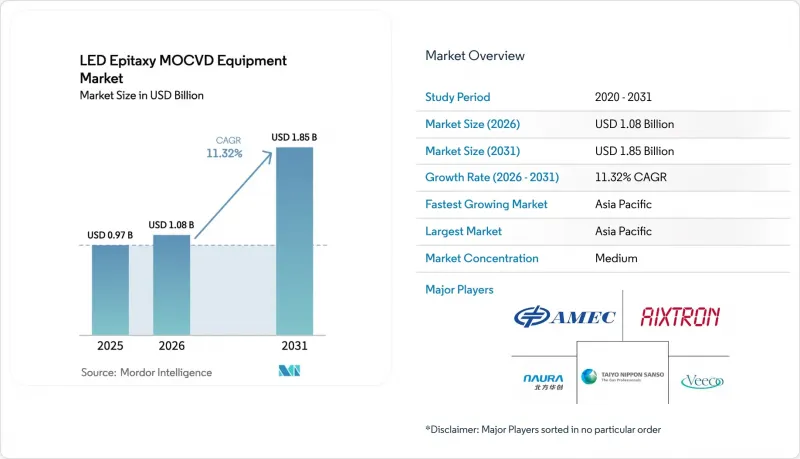
LED 에피택시 MOCVD 장비 시장 규모는 2025년 9억 7,000만 달러로 평가되었습니다. 2026년 10억 8,000만 달러로 확대되어 2026년부터 2031년에 걸쳐 CAGR 11.32%를 나타내, 2031년에는 18억 5,000만 달러에 이를 것으로 예측됩니다.
디스플레이 제조업체들은 엣지라이트형 LCD 백라이트에서 직접 라이트형 미니 LED 및 마이크로 LED 아키텍처로 전환하고 있으며, TV 및 대시보드 1대당 웨이퍼 수요가 증가하고 있습니다. 화합물 반도체 팹은 파워일렉트로닉스와 장비를 공유할 수 있는 200mm GaN-on-Si 기판으로 전환하고 있으며, 이로 인해 비용 곡선이 낮아져 진입장벽이 높아지고 있습니다. 미국의 'CHIPS and Science Act', EU의 'Chips Act', 중국의 여러 성(省)급 기금의 보조금 프로그램은 중국 내 새로운 에피택시 생산 능력의 확장을 촉진하고 있습니다. LED 에피택시 MOCVD 장비 시장은 광범위한 웨이퍼 제조 장비의 사이클과는 다른 추세를 보이고 있습니다. 이는 메모리와 로직에 대한 투자가 일시적으로 주춤하더라도 멸균, 자동차 안전, 에너지 효율과 같은 규제적 요인이 수요를 뒷받침하고 있기 때문입니다.
세계의 LED 에피택시 MOCVD 장비 시장 동향 및 인사이트
미니 LED 및 마이크로 LED 백라이트의 대중화
패널 제조업체들은 엣지라이트 방식의 어셈블리를 TV 1대당 1만 개 이상의 디밍 존을 가능하게 하는 직접 라이트 방식의 미니 LED 및 마이크로 LED 매트릭스로 대체하고 있습니다. 각 프리미엄 모델은 기존 백라이트에 할당된 에피택시 웨이퍼 면적의 최대 10배에 달하는 에피택시 웨이퍼 면적을 사용하여 리액터의 정상 가동률을 향상시켰습니다. 자동차 대시보드, 헤드업 디스플레이, 증강현실(AR) 웨어러블 기기에서 마이크로 LED가 햇빛 아래에서 가시성을 확보하기 위해 채택되면서 대상 시장 규모가 더욱 확대되고 있습니다. 산안광전(San'an Optoelectronics)은 고객 감사를 통과한 후 2025년 마이크로 LED 생산능력을 월 1,400장 이상의 6인치 웨이퍼로 끌어올려 마이크로 LED가 상업적 규모에 진입했음을 보여주었습니다. 파운드리 업체들은 하이퍼스케일 데이터센터 내 광 인터커넥트를 지원하는 청색 및 녹색 다이에 대한 수요 증가를 지적하고 있으며, 이는 디스플레이 외의 또 다른 성장 분야를 제공합니다. 남은 병목현상은 GaN-on-Si의 효율적인 적색 발광이며, 이에 따라 각 업체들은 교차 오염 없이 AlInGaP 공정으로 전환할 수 있는 챔버 설계를 개선하고 있습니다.
200mm GaN-on-Si 플랫폼으로의 전환 가속화
LED 제조업체들은 파워 디바이스 생산 라인과 감가상각비를 분담하고, 다이 1개당 에피택시 비용을 약 1/3로 절감하기 위해 200mm GaN-on-Si 템플릿의 인증을 추진하고 있습니다. Ennostar와 ALLOS Semiconductors는 공통 기판을 공동 개발하고 있으며, 이를 통해 동일한 리액터 그룹으로 전조등용 LED와 650V 트랜지스터를 모두 생산할 수 있게 되었습니다. IQE는 영국 뉴포트와 미국 매사추세츠주에 멀티 웨이퍼 장비를 도입하여 마이크로 LED 웨이퍼를 공급하는 동일한 챔버에서 자동차용 파워 디바이스를 성장시킬 수 있음을 입증했습니다. 200mm 웨이퍼의 휨(바우) 관리가 여전히 어렵기 때문에 멀티존 가열 및 실시간 온도 측정 기능을 갖춘 유성형 리액터는 높은 가격대에 거래되고 있습니다. 평균 가동률이 70% 이상일 때, 팹 소유주들은 150mm 라인 대비 루멘당 비용이 30% 감소했다고 보고하고 있으며, 이는 2027년 이후 두 번째 전환의 물결을 주도하고 있습니다.
일반 조명 투자의 주기성
일반 조명은 여전히 웨이퍼 생산의 약 40%를 차지하고 있지만, 건설 주기, 보조금 제도 종료, 금리 변동에 따라 최종 시장 수요는 변동이 심합니다. 산안광전(San'an Optoelectronics)은 2025년 이익률은 상승했지만, LED 웨이퍼 매출이 전년 대비 약 4% 감소했습니다. 이는 제조업체들이 생산 능력을 자동차나 디스플레이와 같은 틈새 시장으로 전환했음을 시사합니다. 아이큐스트론의 제출 서류에 따르면, 고객이 재고 조정을 위해 주문을 자제하면서 2025년 LED 부문 점유율은 두 자릿수 감소를 기록했다고 합니다. 램프의 수명이 5만 시간을 넘어섰기 때문에 교체 수요가 둔화되고 성장의 축이 스마트 조명으로 전환되고 있지만, 경기 침체기에는 이 움직임도 주춤합니다. 따라서 주택 착공 건수 및 상업용 임대 부동산 수요가 감소하면 LED 에피택시 MOCVD 장비 시장은 단기적으로 침체될 것으로 예측됩니다.
부문 분석
GaN 플랫폼은 일반 조명 및 자동차 램프용 청색 및 백색 다이오드를 지원하는 기반이기 때문에 2025년 LED 에피택시 MOCVD 장비 시장에서 67.86%의 점유율을 유지했습니다. AlGaN 자외선용 장비는 기반 규모는 작지만, 규제 당국의 수은계 멸균장치 단계적 폐지에 따라 2031년까지 연평균 복합 성장률(CAGR) 12.53%로 확대될 것으로 예상되며, 이는 재료 시스템 중 가장 높은 성장률입니다. AlGaN 라인용 LED 에피택시 MOCVD 장비 시장 규모는 가시광선 스펙트럼의 생산 능력에 비해 여전히 작지만, 설치된 각 반응기는 평균 판매 가격이 높은 웨이퍼를 생산하기 때문에 벤더에게 우수한 총이익률을 가져다 줍니다. 최근 유럽 대학에 대한 출하량은 초기 단계의 복잡성을 상쇄하는 공중 보건 분야의 자금 조달 모멘텀을 반영합니다.
대부분의 팹에서는 알루미늄 함량이 50%를 넘으면 효율이 떨어지기 때문에 전위 형성을 줄이기 위한 펄스식 전구체 공급, 현장 응력 모니터링, 기판 미스컷에 대한 연구개발을 추진하고 있습니다. IQE는 두 가지 전략을 추구하고 있으며, 현재 GaAs의 적색 발광을 유지하면서 차세대를 위한 질화갈륨 대체 기술을 개발하고 있습니다. 장비 제조업체는 1회 예방 유지보수 주기 내에 GaN, AlGaN, AlInGaP를 전환할 수 있는 하이브리드 챔버로 이에 대응하고 있으며, 다색 마이크로 LED 고객을 대응해야 하는 파운드리 업체는 설비 투자를 최대 30%까지 절감할 수 있습니다.
2025년에는 잘 디버깅된 레시피와 기존 팹 인프라에 힘입어 150mm 웨이퍼 대응 리액터가 47.39%의 시장 점유율을 차지했습니다. 200mm 툴 관련 LED 에피택시 MOCVD 장비 시장 규모는 IDM 업체들이 휴면 실리콘 생산 라인을 개조하고 규모의 경제를 추구함에 따라 2031년까지 연평균 복합 성장률(CAGR) 12.38%로 가장 빠르게 성장할 것으로 예측됩니다. 뒤틀림 제어의 과제는 여전히 남아있지만, 구역 가열을 갖춘 행성형 구성으로 수율이 85% 이상이며, 소형 웨이퍼와의 차이를 좁히고 있습니다.
파운드리 업체들은 파워 디바이스에 최적화된 다운스트림 다이싱 및 패키징 라인에 맞추어 이 대형 포맷을 활용하여 루멘당 비용을 크게 절감하고 있습니다. PwC는 직경 전환에서 광전자가 로직에 뒤쳐져 있다고 지적했습니다. 하지만 연간 생산량이 공구당 1만 개가 넘어가면 200mm로 전환점이 생깁니다. 자동차용 제품의 비중이 높고, 마이크로 LED 로드맵을 가진 IDM은 이미 생산량을 돌파했지만, 범용 램프 공급업체는 여전히 감가상각이 완료된 100mm 및 150mm 장비에 의존하고 있습니다.
지역별 분석
아시아태평양은 2025년 LED 에피택시 MOCVD 장비 시장 매출의 48.42%를 차지하며 2031년까지 연평균 복합 성장률(CAGR) 12.98%를 나타낼 것으로 예측됩니다. 중국의 지방정부와 국가 기금은 화합물 반도체 자급자족을 위해 총 8억 4,000만 달러 이상의 예산을 책정하여 장비 구매와 전구체 공장에 보조금을 지급하고 있습니다. 대만에서는 기존 100mm 라인이 150mm 및 200mm 포맷으로 전환하고 있으며, 신규 건설 없이 생산량을 확대되고 있습니다. San'an Optoelectronics는 삼성의 인증 획득 후 6인치 마이크로 LED의 생산 능력을 강화하여 디스플레이 등급의 대량 생산을 위한 에코시스템이 준비되었음을 보여주고 있습니다. 일본과 한국에서는 Nichia Chemical Industry와 Seoul Semiconductor가 더 높은 발광 효율 요구 사항에 대응하기 위해 설비를 업그레이드하고 있으며, 견조한 업데이트 수요가 유지되고 있습니다.
2025년 기준 북미와 유럽의 총 점유율은 약 35-40%를 차지하며, 생산량 증가는 램프 판매보다는 보조금 제도의 도입에 따라 좌우되었습니다. 미국 정부는 IntelliEPI, Coherent, Macom, GlobalWafers에 각각 수백만 달러 규모의 보조금을 지급하여 국내 웨이퍼 생산 시작을 지원했습니다. 브뤼셀은 IMEC의 파일럿 라인에 7억 유로(7억 5,600만 달러)를 투자하여 수입 질화물 웨이퍼에 대한 의존도를 절반으로 줄이겠다는 목표를 세웠습니다. 수출 허가로 인해 중국향 고성능 원자로의 리드타임이 길어지고 있으며, 유럽과 미국 벤더들은 제한된 생산 물량을 지역 내 고객에게 우선 배정하도록 유도하고 있으며, 그 결과 현지의 수주 잔고가 증가하고 있습니다.
남미, 중동 및 아프리카를 포함한 '세계 기타 지역'은 2025년 매출의 약 10분의 1을 차지했습니다. 호주는 2026년 3월, 최소 140루멘/와트 기준을 제정하여 간접적으로 웨이퍼의 품질 요건을 높이고, 고균일성 다이스의 수입을 촉진했습니다. 걸프 지역 지자체들은 스마트시티 계획의 일환으로 적응형 가로등을 도입하고 있지만, 칩 공급처는 여전히 주로 한국 및 중국 업체들이 공급하고 있습니다. 아프리카 농촌지역 상하수도 시범사업에서 태양광 패널로 구동되는 UV-C 모듈이 채택되어 소규모이지만 전략적인 수요층이 형성되어 현재 아시아 상사계 에피택셜 제조업체들이 이에 대응하고 있습니다.
기타 혜택 :
- 엑셀 형식 시장 예측(ME) 시트
- 3개월간 애널리스트 지원
자주 묻는 질문
목차
제1장 서론
제2장 조사 방법
제3장 주요 요약
제4장 시장 구도
제5장 시장 규모와 성장 예측
제6장 경쟁 구도
제7장 시장 기회와 향후 전망
KTH 26.05.29The LED epitaxy MOCVD equipment market size is expected to grow from USD 0.97 billion in 2025 to USD 1.08 billion in 2026 and is forecast to reach USD 1.85 billion by 2031 at 11.32% CAGR over 2026-2031.
Display makers are shifting from edge-lit LCD backlighting to direct-lit mini-LED and micro-LED architectures, multiplying wafer demand per television and dashboard. Compound-semiconductor fabs are migrating to 200 mm GaN-on-Si substrates that can share tool sets with power electronics, lowering cost curves and raising the barrier to entry. Subsidy programs under the United States CHIPS and Science Act, the EU Chips Act, and several Chinese provincial funds are underwriting new domestic epitaxy capacity. The LED epitaxy MOCVD equipment market diverges from the broader wafer-fab equipment cycle because regulatory drivers in sterilization, automotive safety, and energy efficiency underpin demand when memory and logic investments pause.
Global LED Epitaxy MOCVD Equipment Market Trends and Insights
Proliferation of Mini and Micro LED Backlighting
Panel makers are replacing edge-lit assemblies with direct-lit mini-LED and micro-LED matrices that allow more than 10 000 dimming zones per television. Each premium set uses up to ten times the epitaxy wafer area once allocated to legacy backlights, raising steady-state reactor utilization. Automotive dashboards, head-up displays, and augmented-reality wearables now specify micro-LED for sunlight readability, further expanding addressable volume. San'an Optoelectronics lifted micro-LED capacity above 1 400 six-inch wafers a month in 2025 after passing customer audits, signalling that micro-LED has entered commercial scale. Foundries note rising demand for blue and green dice that support optical interconnects inside hyperscale data centers, providing a non-display growth lane. The remaining bottleneck is efficient red emission on GaN-on-Si, which has prompted equipment vendors to refine chamber designs that can switch to AlInGaP recipes without cross-contamination.
Accelerated Transition to 200 mm GaN-On-Si Platforms
LED producers are qualifying 200 mm GaN-on-Si templates to share depreciation with power-device lines and to cut per-die epitaxy cost by roughly one-third. Ennostar and ALLOS Semiconductors are co-developing common substrates so the same reactor fleet can serve headlamp LEDs and 650 V transistors. IQE added multiwafer tools in Newport, United Kingdom, and Massachusetts, United States, demonstrating automotive-grade power devices grown on the identical chambers that supply micro-LED wafers. Managing wafer bow on 200 mm silicon remains difficult, therefore planetary reactors with multi-zone heating and real-time pyrometry command premium pricing. Once average utilizations surpass 70%, fab owners report thirty percent lower cost per lumen than on 150 mm lines, driving a second wave of conversions after 2027.
Cyclicality in General Lighting Investments
General lighting still commands roughly forty percent of wafer runs, yet end-market demand yo-yos with construction cycles, rebate expirations, and interest-rate shifts. San'an Optoelectronics saw LED wafer revenue drop almost four percent year over year in 2025 even as margins rose, signalling that producers pushed capacity toward automotive and display niches. Aixtron's filings confirmed a double-digit share contraction for its LED segment in 2025 as customers paused orders during inventory corrections. Because lamps now exceed 50 000-hour lifetime, replacement sales decelerate and growth shifts to smart-lighting retrofits, which stall during downturns. The LED epitaxy MOCVD equipment market therefore faces near-term softness when housing starts or commercial tenancy dip.
Other drivers and restraints analyzed in the detailed report include:
- Government Subsidies for Compound-Semiconductor Fabs
- Rising Demand for UV-C LED Sterilization Systems
- High Capital Intensity for 200 mm Planetary Tools
For complete list of drivers and restraints, kindly check the Table Of Contents.
Segment Analysis
GaN platforms retained 67.86% of the LED epitaxy MOCVD equipment market in 2025 because they underpin blue and white diodes for general illumination and automotive lamps. AlGaN ultraviolet tools, though starting from a smaller base, are forecast to rise at 12.53% CAGR through 2031, the fastest among material systems, as regulators phase out mercury-based sterilizers. The LED epitaxy MOCVD equipment market size for AlGaN lines is still modest compared with visible-spectrum capacity, yet each installed reactor produces higher average selling price wafers and therefore delivers superior gross margin for equipment vendors. Recent shipments to European universities reflect public-health funding momentum that offsets early-stage process complexity.
Most fabs wrestle with efficiency loss when aluminum fractions exceed fifty percent, which drives R&D into pulsed precursor flows, in-situ stress monitoring, and substrate miscuts that mitigate dislocation formation. IQE pursues a dual track, keeping red emission on GaAs today while developing gallium-nitride alternatives for future generations. Tool makers answer with hybrid chambers capable of switching between GaN, AlGaN, and AlInGaP within a single preventive-maintenance cycle, trimming capex by up to thirty percent for foundries that must serve multi-color micro-LED customers.
Reactors configured for 150 mm wafers accounted for 47.39% of the market share in 2025, buoyed by well-debugged recipes and legacy fab infrastructure. The LED epitaxy MOCVD equipment market size tied to 200 mm tools is projected to increase fastest, tracking a 12.38% CAGR into 2031 as IDMs retrofit mothballed silicon lines and chase scale economies. Bow control challenges persist, yet planetary configurations with zoned heating raise yield above eighty-five percent, closing the gap with smaller wafers.
Foundries leverage the larger format to align with downstream dicing and packaging lines already optimized for power devices, slashing cost per lumen. PwC observes that optoelectronics lags logic on diameter migration; nevertheless, 200 mm tipping points emerge whenever annual output crosses ten thousand wafers per tool. IDMs with high automotive mix and micro-LED roadmaps have already breached that volume, whereas commodity lamp suppliers still depend on fully depreciated 100 mm and 150 mm fleets.
The LED Epitaxy MOCVD Equipment Market Report is Segmented by LED Material System (GaN-Based LED Epitaxy Systems, and More), Wafer Size Capability (Up To 100mm, 150mm, and 200mm and Above), Reactor Configuration (Planetary Reactors, and Showerhead Reactors), End User (Integrated LED Manufacturers, and Epitaxy Foundries and Merchant Epi Suppliers), and Geography. The Market Forecasts are Provided in Terms of Value (USD).
Geography Analysis
Asia-Pacific accounted for 48.42% of LED epitaxy MOCVD equipment market revenue in 2025 and is projected to grow at 12.98% CAGR to 2031. Chinese municipal and national funds together exceed USD 840 million earmarked for compound-semiconductor self-reliance, subsidizing both tool purchases and precursor plants. Taiwan's legacy 100 mm lines transition to 150 mm and 200 mm formats, adding volume without greenfield construction. San'an Optoelectronics ramped six-inch micro-LED capacity after Samsung qualification, illustrating ecosystem readiness for display-grade volumes. Japan and South Korea sustain healthy replacement demand as Nichia and Seoul Semiconductor upgrade fleets for higher luminous-efficacy mandates.
North America and Europe together held roughly 35-40% share in 2025, with unit growth tethered to subsidy rollouts rather than lamp sales. Washington dispersed multi-million-dollar grants to IntelliEPI, Coherent, Macom, and GlobalWafers, each targeting domestic wafer starts. Brussels backed IMEC's pilot line with EUR 700 million (USD 756 million) and set an ambition to halve dependency on imported nitride wafers. Export licences lengthen lead times for high-spec reactors into China, nudging Western vendors to allocate scarce slots to regional customers first, thereby inflating local order backlogs.
The Rest of the World, covering South America, Middle East, and Africa, contributed about one-tenth of revenue in 2025. Australia enacted minimum 140 lumen-per-watt standards in March 2026, indirectly lifting wafer quality requirements and driving imports of high-uniformity dice. Gulf municipalities deploy adaptive streetlights within smart-city programs, yet chips still ship mainly from Korean and Chinese vendors. Water-sanitation pilots in rural Africa adopt UV-C modules powered by solar panels, creating small but strategic demand pockets that Asian merchant epi houses presently serve.
- Veeco Instruments Inc.
- Aixtron SE
- Taiyo Nippon Sanso Corp.
- Advanced Micro-Fabrication Equipment Inc. China
- Jiangsu Huantian Science and Technology Co. Ltd.
- Tempress Technologies B.V.
- Jusung Engineering Co. Ltd.
- Guangzhou China-Topstar Technology Co. Ltd.
- Pro-M Tec GmbH
- EpiGaN N.V.
- LPE S.p.A.
- Piotech Inc.
- Samco Inc.
- NuFlare Technology Inc.
- Epiluvac AB
- Naura Technology Group Co. Ltd.
- Wuhan Pactech Microelectronics Equipment Co. Ltd.
- CVD Equipment Corporation
- Taiyo Nippon Sanshin Electronic Co. Ltd.
- Intellion Semiconductor Equipment Ltd.
Additional Benefits:
- The market estimate (ME) sheet in Excel format
- 3 months of analyst support
TABLE OF CONTENTS
1 INTRODUCTION
- 1.1 Study Assumptions and Market Definition
- 1.2 Scope of the Study
2 RESEARCH METHODOLOGY
3 EXECUTIVE SUMMARY
4 MARKET LANDSCAPE
- 4.1 Market Overview
- 4.2 Market Drivers
- 4.2.1 Proliferation of Mini and Micro LED Backlighting
- 4.2.2 Accelerated Transition to 200 mm GaN-on-Si Platforms
- 4.2.3 Rising Demand for UV-C LED Sterilization Systems
- 4.2.4 Government Subsidies for Compound-Semiconductor Fabs
- 4.2.5 Automotive OEM Shift to Adaptive LED Headlamps
- 4.2.6 Sustainability Push Toward High-Efficiency Lighting
- 4.3 Market Restraints
- 4.3.1 Cyclicality in General Lighting Investments
- 4.3.2 Complex Process Control Versus HVPE Alternatives
- 4.3.3 IP Litigation Risk in Epitaxy Process Recipes
- 4.3.4 High Capital Intensity for 200 mm Planetary Tools
- 4.4 Industry Supply Chain Analysis
- 4.5 Technological Outlook
- 4.6 Regulatory Landscape
- 4.7 Impact of Macroeconomic Factors on the Market
- 4.8 Porter's Five Forces Analysis
- 4.8.1 Threat of New Entrants
- 4.8.2 Bargaining Power of Suppliers
- 4.8.3 Bargaining Power of Buyers
- 4.8.4 Threat of Substitutes
- 4.8.5 Intensity of Competitive Rivalry
5 MARKET SIZE AND GROWTH FORECASTS (VALUE)
- 5.1 By LED Material System
- 5.1.1 GaN-based LED Epitaxy Systems
- 5.1.2 AlGaN UV LED Epitaxy Systems
- 5.1.3 AlInGaP LED Epitaxy Systems
- 5.2 By Wafer Size Capability
- 5.2.1 Upto 100 mm
- 5.2.2 150 mm
- 5.2.3 200 mm and Above
- 5.3 By Reactor Configuration
- 5.3.1 Planetary Reactors
- 5.3.2 Showerhead Reactors
- 5.4 By End User
- 5.4.1 Integrated LED Manufacturers (IDMs)
- 5.4.2 Epitaxy Foundries and Merchant Epi Suppliers
- 5.5 By Geography
- 5.5.1 North America
- 5.5.2 Europe
- 5.5.3 Asia-Pacific
- 5.5.4 Rest of the World
6 COMPETITIVE LANDSCAPE
- 6.1 Market Concentration
- 6.2 Strategic Moves
- 6.3 Market Share Analysis
- 6.4 Company Profiles (Includes Global Level Overview, Market Level Overview, Core Segments, Financials as Available, Strategic Information, Market Rank/Share, Products and Services, and Recent Developments)
- 6.4.1 Veeco Instruments Inc.
- 6.4.2 Aixtron SE
- 6.4.3 Taiyo Nippon Sanso Corp.
- 6.4.4 Advanced Micro-Fabrication Equipment Inc. China
- 6.4.5 Jiangsu Huantian Science and Technology Co. Ltd.
- 6.4.6 Tempress Technologies B.V.
- 6.4.7 Jusung Engineering Co. Ltd.
- 6.4.8 Guangzhou China-Topstar Technology Co. Ltd.
- 6.4.9 Pro-M Tec GmbH
- 6.4.10 EpiGaN N.V.
- 6.4.11 LPE S.p.A.
- 6.4.12 Piotech Inc.
- 6.4.13 Samco Inc.
- 6.4.14 NuFlare Technology Inc.
- 6.4.15 Epiluvac AB
- 6.4.16 Naura Technology Group Co. Ltd.
- 6.4.17 Wuhan Pactech Microelectronics Equipment Co. Ltd.
- 6.4.18 CVD Equipment Corporation
- 6.4.19 Taiyo Nippon Sanshin Electronic Co. Ltd.
- 6.4.20 Intellion Semiconductor Equipment Ltd.
7 MARKET OPPORTUNITIES AND FUTURE OUTLOOK
- 7.1 White-space and Unmet-need Assessment


