|
시장보고서
상품코드
2044141
데이터센터 랙 : 시장 점유율 분석, 업계 동향 및 통계, 성장 예측(2026-2031년)Data Center Rack - Market Share Analysis, Industry Trends & Statistics, Growth Forecasts (2026 - 2031) |
||||||
 Mordor Intelligence
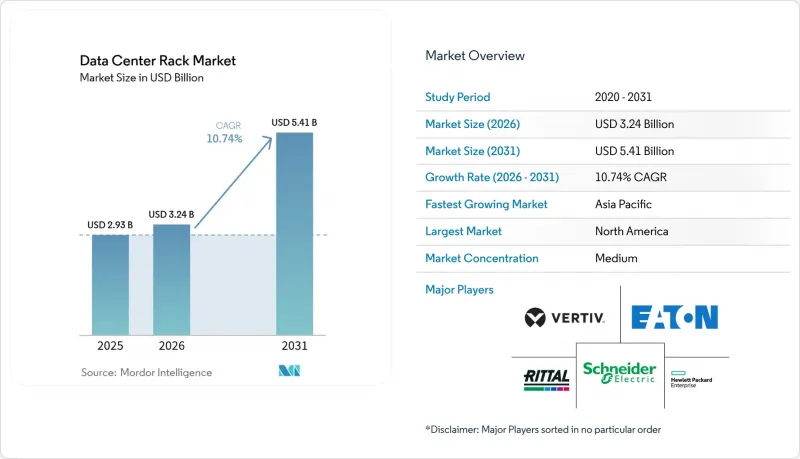
데이터센터 랙 시장 규모는 2025년에 29억 3,000만 달러로 평가되었습니다. 2026년 32억 4,000만 달러에서 2031년까지 54억 1,000만 달러에 이를 것으로 예상되며, 예측 기간(2026-2031년) CAGR은 10.74%를 나타낼 전망입니다.
데이터센터 랙 시장은 하이퍼스케일 사업자, 클라우드 서비스 제공업체 및 엣지 구축에서 40kW 이상의 부하를 지원하는 랙 레벨의 액체 냉각 및 전력 공급 시스템이 표준화된 덕분에 성장하고 있습니다. 사업자들은 랙 인프라를 인공지능(AI) 워크로드, 고성능 컴퓨팅 클러스터, 지연에 민감한 엣지 노드를 위한 물리적 기반이라고 보고 있습니다. 기업들이 열 관리를 개선하면서 컴퓨팅 밀도를 극대화하기 위해 노력하는 가운데, 키가 큰 48U 구성, 캐비닛형 밀폐 구조, 액체 냉각을 지원하는 구조 설계가 주류가 되고 있습니다. 지역 전반에 걸쳐 자국 주도의 AI, 재생에너지 기반 시설, 더 엄격한 에너지 효율 규제로의 전환이 진행됨에 따라 규제, 지속가능성 및 유지보수성 목표를 충족시킬 수 있는 고급 랙 솔루션에 대한 수요가 더욱 증가하고 있습니다.
세계의 데이터센터 랙 시장 동향 및 인사이트
하이퍼스케일 및 코로케이션 확장 급증
2025년 미국의 하이퍼스케일 설비투자 규모는 270억 달러를 넘어 전년 대비 69% 성장했습니다. 이를 통해 데이터센터 건설은 비주거 부문에서 가장 빠르게 성장하고 있는 분야로 확고히 자리매김하고 있습니다. 개별 GPU 클러스터는 현재 랙당 10-140kW의 전력을 필요로 하며, 이로 인해 사업자들은 기존의 공조 시스템 대신 액체 냉각 매니폴드를 중심으로 화이트스페이스 레이아웃을 재설계해야 합니다. 디지털 리얼티(Digital Realty)와 같은 대형 코로케이션 업체들은 캐비닛당 70kW에 달하는 AI 지원 스위트를 도입하여 프리미엄 랙 인프라가 경쟁 차별화 요소로 작용하고 있습니다. 공냉식 홀의 리노베이션 비용이 신축 예산을 초과할 수 있기 때문에 이러한 확장은 캐비닛급 랙에 대한 다년간의 주문 주기를 촉진하고 있습니다. 이러한 추세는 하이퍼스케일러가 교육 및 추론 환경의 통제권을 유지하기 위해 하이퍼스케일러가 시설 소유로 전환하고 있다는 것을 보여줍니다.
클라우드 및 엣지 도입 확대에 따른 랙 수요 증가 전망
기업들은 공장, 창고, 소매점 근처에 컴퓨팅 노드를 설치하고 있으며, 벤더들은 환경 친화적인 랙을 개발해야 하는 상황에 직면해 있습니다. 페덱스는 델과 스위치의 협업을 통해 물류 허브 내에 엣지 모듈을 도입했는데, 이를 위해서는 진동에 강한 인클로저와 원격으로 관리 가능한 PDU가 필요했습니다. Etisalat과 같은 통신 사업자들은 거리 시설에 설치된 밀폐형 캐비닛에 장착할 수 있는 소형 에지 서버를 배포하고 있으며, 이는 5G가 랙의 폼팩터를 기존 데이터 플로어 밖으로 확장하고 있음을 보여줍니다. 3M과 같은 제조업체는 산업 현장에서 Azure SQL Edge를 활용하고 있으며, 먼지와 온도 변화에 견딜 수 있는 NEMA 표준을 준수하는 랙을 필요로 합니다. 그 결과, 수천 개의 분산된 사이트에 적합한 사전 통합된 모듈형 솔루션을 제공하는 부문에서 데이터센터 랙 시장이 가속화되고 있습니다.
에너지 효율 규정(EU 행동강령/ASHRAE)
유럽연합(EU)의 개정된 에너지 효율 지침은 IT 부하가 100kW를 초과하는 시설에 대해 연례 보고를 의무화하고 있으며, PUE를 1.03까지 낮출 수 있는 액체 냉각에 대한 인센티브를 강화하고 있습니다. ASHRAE는 허용 흡기 온도 범위를 확대하여 랙이 엄격한 기류 봉쇄를 유지할 수 있는 경우 냉각기 없는 이코노마이저 모드를 허용했습니다. 독일 에너지 효율법은 데이터센터에 폐열 재사용을 의무화하고 있으며, 고급 열 에너지를 지역 난방 루프로 전송할 수 있는 후방 도어형 액체 냉각기를 권장하고 있습니다. 규제 준수 랙을 통합하는 벤더들은 사업자들이 공시 기한을 맞추기 위해 서두르는 가운데 조달 주기가 빨라지는 혜택을 누리고 있습니다.
부문 분석
2025년에는 풀랙이 데이터센터 랙 시장의 56.90%를 차지했으며, 2031년까지 연평균 복합 성장률(CAGR) 12.55%로 다른 규모를 앞지를 것으로 전망됩니다. 이 점유율은 데이터센터 랙 시장 규모에서 압도적인 비중을 차지하며, 하이퍼스케일러들이 배선, 공기 흐름, PDU의 표준화를 효율화하는 42U 실적를 선호하는 추세를 반영하고 있습니다. AI 클러스터는 광범위한 PCIe 및 NVLink 상호 연결이 필요하며, 100Gbps 이상의 신호 품질을 유지하기 위한 깔끔한 케이블 배선에는 풀랙이 필수적입니다. 이미 개조된 홀의 경우, 대형 프레임은 기존 콜드 아일의 형태에 맞게 설계되어 바닥 타일의 재배치 비용을 최소화할 수 있습니다.
액체 냉각은 풀 랙의 장점을 더욱 확대합니다. 왜냐하면, 더 높은 수직 공간으로 인해 공급용과 회수용 냉각수 채널을 쉽게 분리할 수 있기 때문입니다. 슈나이더일렉트릭의 GB200 NVL72 설계는 42U 서버 영역 아래에 배치된 맞춤형 매니폴드를 통해 전체 랙당 132kW를 달성했습니다. 따라서 데이터센터 랙 시장에서는 전체 높이의 캐비닛에 공장에서 통합된 냉각수 루프, 이중화 펌프 및 퀵 디스커넥트 커플링을 사전 설치하여 제공하는 벤더가 평가받고 있습니다. 하프 랙 및 쿼터 랙 형식은 여전히 엣지 클로젯 및 네트워크 룸에서 사용되고 있지만, 이러한 환경에서는 대규모 GPU 클러스터가 필요한 경우가 드물기 때문에 CAGR이 낮게 유지되고 있습니다.
2025년에는 42U 프레임이 매출 점유율의 53.10%를 차지하며 주류가 되었지만, 2031년까지 연평균 복합 성장률(CAGR)이 11.78%로 가장 높은 성장률을 보이는 것은 48U 모델입니다. 운영자에게는 서버 슬롯을 희생하지 않고도 액체 매니폴드, 버스웨이 또는 탑 오브 랙 스위치를 수용할 수 있는 6U의 추가 공간은 큰 가치가 있습니다. 높이를 높이면 통로 수를 줄일 수 있으며, 대형 홀의 경우 최대 12%의 바닥 면적을 절약할 수 있습니다. 또한, 프레임이 높아지면 캐스터에 대한 무게 배분이 균등해져 냉각액을 채웠을 때 캐비닛의 무게가 1,500kg을 초과하는 경우 매우 중요합니다.
리탈의 VX IT 시리즈는 기술자가 42U와 48U 프레임을 공통 레일에 혼합하여 예산 주기에 맞추어 단계적으로 전환할 수 있도록 지원합니다. 천장이 높은 창고 등 수직 공간 여유가 있는 곳에서는 맞춤형 52U, 54U 모델도 등장하고 있지만, 그 채택은 여전히 틈새 시장에 머물러 있습니다. 액체 냉각 기술로 인해 밀도의 한계가 높아지는 가운데, 데이터센터 랙 시장에서는 48U가 전통적인 호환성과 미래 지향적인 용량의 균형을 갖춘 최적의 선택으로 여겨지고 있습니다.
데이터센터 랙 시장은 랙 크기(쿼터 랙, 하프 랙, 풀 랙), 랙 높이(42U, 45U 이상), 랙 유형(캐비닛(밀폐형) 랙, 오픈 프레임 랙, 벽걸이 랙), 데이터센터 유형(코로케이션 시설, 하이퍼스케일, 클라우드 서비스 제공업체 데이터센터, 엔터프라이즈, 엣지), 재료(스틸, 알루미늄, 기타 합금 및 복합재), 지역별로 분류됩니다. 하이퍼스케일 및 클라우드 서비스 제공업체 데이터센터, 엔터프라이즈 및 엣지), 재질(스틸, 알루미늄, 기타 합금 및 복합재), 지역별로 분류되어 있습니다. 시장 예측은 금액(USD) 기준으로 제공됩니다.
지역별 분석
북미는 탄탄한 하이퍼스케일 생태계, 확립된 공급망, 명확한 규제 환경으로 인해 2025년 매출의 32.10%를 차지했습니다. 2025년 미국 데이터센터 설비투자는 270억 달러를 넘어섰지만, 북버지니아 및 실리콘밸리의 전력 공급 부족으로 인해 성장세가 둔화될 것으로 예측됩니다. 캐나다에서는 수력발전을 활용한 지속가능성 중심의 건설이 가속화되고 있으며, 멕시코에서는 미국의 레이턴시 목표를 지원하는 니어쇼어링형 엣지 노드를 유치하고 있습니다. 슈나이더 일렉트릭의 테네시 주에 1억 4,000만 달러 규모의 배전반 공장 등 현지 생산 확대는 공급업체들이 관세로 인한 역풍을 피하는 데 도움이 되고 있습니다.
아시아태평양은 CAGR 12.82%로 성장하고 있으며, 데이터센터 랙 시장에서 지역별로 가장 높은 성장률을 보이고 있습니다. 중국은 국가 AI 기금을 대규모 GPU 인프라에 투입하고, 인도는 디지털 서비스 붐을 배경으로 2급 도시에 5-20MW 규모의 캠퍼스가 속속 들어서고 있으며, 일본은 공장 자동화를 위한 엣지 클러스터를 추진하고 있습니다. 지역별 제조 거점은 랙의 물류 리드타임을 크게 단축시키지만, 구리 공급 부족이 비용 변동 요인으로 작용할 수 있습니다. Vertiv의 설비를 도입한 iGenius AI 센터와 같은 프로젝트는 지역별로 컴퓨팅 수요를 충족시키기 위해 국내 공급망이 어떻게 발전하고 있는지를 보여줍니다.
기타 혜택 :
- 엑셀 형식 시장 예측(ME) 시트
- 3개월간 애널리스트 지원
자주 묻는 질문
목차
제1장 서론
제2장 조사 방법
제3장 주요 요약
제4장 시장 구도
제5장 시장 규모와 성장 예측
제6장 경쟁 구도
제7장 시장 기회와 향후 전망
KTH 26.05.29The Data Center Rack Market size was valued at USD 2.93 billion in 2025 and is estimated to grow from USD 3.24 billion in 2026 to reach USD 5.41 billion by 2031, at a CAGR of 10.74% during the forecast period (2026-2031).
The data center rack market is expanding because hyperscale operators, cloud service providers, and edge deployments are standardizing on rack-level liquid cooling and power delivery systems that support loads above 40 kW. Operators view rack infrastructure as the physical foundation for artificial intelligence (AI) workloads, high-performance computing clusters, and latency-sensitive edge nodes. Taller 48U configurations, cabinet-style containment, and liquid-ready structural designs are becoming mainstream as companies seek to maximize compute density while improving thermal management. The region-wide pivot toward sovereign AI, renewable-powered facilities, and stricter energy-efficiency rules further intensifies demand for advanced rack solutions capable of meeting regulatory, sustainability, and serviceability targets.
Global Data Center Rack Market Trends and Insights
Hyperscale and Colocation Build-outs Surge
Hyperscale capital spending topped USD 27 billion in the United States during 2025, reflecting 69% year-over-year growth that cements data-center construction as the fastest-expanding non-residential segment. Individual GPU clusters now demand 10-140 kW per rack, pushing operators to redesign white-space layouts around liquid manifolds versus legacy air handling. Colocation leaders such as Digital Realty introduced AI-ready suites that sustain 70 kW per cabinet, signalling that premium rack infrastructure is a competitive differentiator. Because retrofit costs for air-cooled halls can eclipse new-build budgets, these expansions fuel multiyear ordering cycles for cabinet-class racks. The trend also illustrates hyperscalers' shift toward owning facilities to preserve control of training and inference environments.
Rising Cloud and Edge Adoption Boosts Rack Demand
Enterprises are placing compute nodes next to factories, warehouses, and retail stores, compelling vendors to engineer ruggedized racks. FedEx deployed edge modules inside logistics hubs through a Dell-Switch collaboration that requires vibration-resistant enclosures and remote-management PDUs. Telecom operators like Etisalat are rolling out compact edge servers that mount in sealed cabinets installed on street furniture, illustrating how 5G pushes rack form factors beyond traditional data floors. Manufacturers such as 3M leverage Azure SQL Edge on industrial shop floors, demanding NEMA-rated racks that tolerate dust and temperature swings. Consequently, the data center rack market accelerates in segments that supply pre-integrated, modular solutions suitable for thousands of distributed sites.
Energy-Efficiency Regulations (EU Code of Conduct / ASHRAE)
The European Union's revised Energy Efficiency Directive mandates yearly reporting for facilities over 100 kW IT load, aligning incentives toward liquid cooling that can achieve PUE as low as 1.03. ASHRAE widened allowable inlet temperatures, enabling chiller-less economiser modes when racks maintain tight airflow containment. Germany's Energy Efficiency Act compels data centers to reuse waste heat, favouring rear-door liquid coolers that can transfer high-grade thermal energy to district-heating loops. Vendors integrating compliant racks enjoy accelerated procurement cycles as operators race to meet disclosure deadlines.
Other drivers and restraints analyzed in the detailed report include:
- High-Density Server Deployment (Greater Than 40 kW/rack)
- High Upfront Capex for Advanced Cabinets
- Power and Space Scarcity in Tier-1 Metros
For complete list of drivers and restraints, kindly check the Table Of Contents.
Segment Analysis
Full racks delivered 56.90% of the data center rack market in 2025 and will outpace other sizes with a 12.55% CAGR to 2031. That share equates to a commanding portion of the data center rack market size and reflects hyperscalers' preference for 42U footprints that streamline cabling, airflow, and PDU standardisation. AI clusters demand sprawling PCIe and NVLink interconnects, making full racks indispensable for clean cable routing that sustains signal integrity at 100 Gbps and higher. In retrofit halls, larger frames also minimise floor-tile reconfiguration costs by aligning with existing cold-aisle geometry.
Liquid cooling magnifies full-rack advantages because taller vertical spaces facilitate segregated supply-and-return coolant channels. Schneider Electric's GB200 NVL72 blueprint achieves 132 kW per full rack through bespoke manifolds positioned below a 42U server zone. The data center rack market thus rewards vendors that deliver factory-integrated coolant loops, redundant pumps, and quick-disconnect couplings pre-installed within full-height cabinets. Half- and quarter-rack formats still serve edge closets and network rooms, yet their CAGR trails because these environments seldom require lavish GPU clusters.
Although 42U frames dominated 2025 with 53.10% revenue share, 48U variants are the fastest-growing height, posting 11.78% CAGR through 2031. Operators value the extra 6U for housing liquid manifolds, busways, or top-of-rack switches without sacrificing server slots. The incremental height reduces aisle count, yielding up to 12% floor-space savings in large halls. Taller frames also balance weight distribution across casters, vital when cabinets surpass 1,500 kilograms once coolant is added.
Rittal's VX IT line lets technicians mix 42U and 48U frames on common rails, easing phased migrations that align with budget cycles. Custom 52U or 54U models appear in high-ceiling warehouses where vertical clearance is plentiful, but adoption remains niche. With liquid cooling pushing density ceilings higher, the data center rack market regards 48U as the sweet spot between legacy compatibility and forward-looking capacity.
Data Center Rack Market is Segmented by Rack Size(Quartely Rack, Half Rack, Full Rack), Rack Height (42U, 45U and More), Rack Type(Cabinet (Closed) Racks, Open-Frame Racks, Wall-Mount Racks), Data Center Type(Colocation Facilities, Hyperscale and Cloud Service Provider DCs, Enterprise and Edge), Material(steel, Aluminum, Other Alloys and Composites) and by Geography. The Market Forecasts are Provided in Terms of Value (USD).
Geography Analysis
North America commanded 32.10% of 2025 revenue thanks to deep hyperscale ecosystems, well-established supply chains, and regulatory clarity. Data-center capital expenditure surpassed USD 27 billion in the United States during 2025, though utility congestion in Northern Virginia and Silicon Valley tempers growth. Canada accelerates sustainability-centric builds that leverage hydro generation, while Mexico attracts near-shoring edge nodes supporting U.S. latency targets. Local manufacturing expansions, such as Schneider Electric's USD 140 million Tennessee plant for switchgear, help suppliers dodge tariff headwinds.
Asia-Pacific is advancing at a 12.82% CAGR, the fastest regional clip in the data center rack market. China channels sovereign AI funds into massive GPU bases, India's digital-services boom propels 5- to 20-MW campuses across tier-2 cities, and Japan backs edge clusters to automate factories. Regional fabrication hubs slash logistics lead times for racks, yet copper deficits could add cost volatility. Projects such as Vertiv-equipped iGenius AI centers illustrate how domestic supply ecosystems are rising to meet localised compute mandates.
- Schneider Electric SE
- Vertiv Group Corp.
- Eaton Corp. plc
- Rittal GmbH and Co. KG
- Hewlett Packard Enterprise
- Dell Technologies Inc.
- Legrand SA
- IBM Corp.
- Chatsworth Products Inc.
- Panduit Corp.
- APC (by Schneider Electric)
- Tripp Lite (Eaton)
- Great Lakes Case and Cabinet
- Belkin International Inc.
- Kendall Howard LLC
- Martin International Enclosures
- Black Box Corp.
- Fujitsu Ltd.
- Oracle Corp.
- Cisco Systems Inc.
Additional Benefits:
- The market estimate (ME) sheet in Excel format
- 3 months of analyst support
TABLE OF CONTENTS
1 INTRODUCTION
- 1.1 Study Assumptions and Market Definition
- 1.2 Scope of the Study
2 RESEARCH METHODOLOGY
3 EXECUTIVE SUMMARY
4 MARKET LANDSCAPE
- 4.1 Market Overview
- 4.2 Market Drivers
- 4.2.1 Hyperscale and colocation build-outs surge
- 4.2.2 Rising cloud and edge adoption boosts rack demand
- 4.2.3 High-density server deployment (greater than 40 kW/rack)
- 4.2.4 Energy-efficiency regulations (EU Code of Conduct / ASHRAE)
- 4.2.5 AI-optimised liquid-cooled rack architectures
- 4.2.6 National incentives for local rack manufacturing
- 4.3 Market Restraints
- 4.3.1 High upfront capex for advanced cabinets
- 4.3.2 Growing use of blade/server-on-chip modules
- 4.3.3 Power and space scarcity in tier-1 metros
- 4.3.4 Specialty steel and aluminium supply volatility
- 4.4 Supply-Chain Analysis
- 4.5 Regulatory Landscape
- 4.6 Technological Outlook
- 4.7 Porter's Five Forces
- 4.7.1 Bargaining Power of Suppliers
- 4.7.2 Bargaining Power of Buyers
- 4.7.3 Threat of New Entrants
- 4.7.4 Intensity of Rivalry
- 4.7.5 Threat of Substitutes
- 4.8 Assessment of Macroeconomic Factors on the Market
5 MARKET SIZE and GROWTH FORECASTS (VALUE)
- 5.1 By Rack Size
- 5.1.1 Quarter Rack
- 5.1.2 Half Rack
- 5.1.3 Full Rack
- 5.2 By Rack Height
- 5.2.1 42U
- 5.2.2 45U
- 5.2.3 48U
- 5.2.4 Other Heights (52U and Custom)
- 5.3 By Rack Type
- 5.3.1 Cabinet (Closed) Racks
- 5.3.2 Open-Frame Racks
- 5.3.3 Wall-Mount Racks
- 5.4 By Data Center Type
- 5.4.1 Colocation Facilities
- 5.4.2 Hyperscale and Cloud Service Provider DCs
- 5.4.3 Enterprise and Edge
- 5.5 By Material
- 5.5.1 Steel
- 5.5.2 Aluminum
- 5.5.3 Other Alloys and Composites
- 5.6 By Geography
- 5.6.1 North America
- 5.6.1.1 United States
- 5.6.1.2 Canada
- 5.6.1.3 Mexico
- 5.6.2 South America
- 5.6.2.1 Brazil
- 5.6.2.2 Argentina
- 5.6.2.3 Rest of South America
- 5.6.3 Europe
- 5.6.3.1 Germany
- 5.6.3.2 United Kingdom
- 5.6.3.3 France
- 5.6.3.4 Italy
- 5.6.3.5 Spain
- 5.6.3.6 Russia
- 5.6.3.7 Rest of Europe
- 5.6.4 Asia-Pacific
- 5.6.4.1 China
- 5.6.4.2 Japan
- 5.6.4.3 India
- 5.6.4.4 South Korea
- 5.6.4.5 Australia and New Zealand
- 5.6.4.6 Rest of Asia-Pacific
- 5.6.5 Middle East and Africa
- 5.6.5.1 Middle East
- 5.6.5.1.1 Saudi Arabia
- 5.6.5.1.2 United Arab Emirates
- 5.6.5.1.3 Turkey
- 5.6.5.1.4 Rest of Middle East
- 5.6.5.2 Africa
- 5.6.5.2.1 South Africa
- 5.6.5.2.2 Nigeria
- 5.6.5.2.3 Rest of Africa
- 5.6.5.1 Middle East
- 5.6.1 North America
6 COMPETITIVE LANDSCAPE
- 6.1 Market Concentration
- 6.2 Strategic Moves
- 6.3 Market Share Analysis
- 6.4 Company Profiles (includes Global level Overview, Market level overview, Core Segments, Financials as available, Strategic Information, Market Rank/Share for key companies, Products and Services, and Recent Developments)
- 6.4.1 Schneider Electric SE
- 6.4.2 Vertiv Group Corp.
- 6.4.3 Eaton Corp. plc
- 6.4.4 Rittal GmbH and Co. KG
- 6.4.5 Hewlett Packard Enterprise
- 6.4.6 Dell Technologies Inc.
- 6.4.7 Legrand SA
- 6.4.8 IBM Corp.
- 6.4.9 Chatsworth Products Inc.
- 6.4.10 Panduit Corp.
- 6.4.11 APC (by Schneider Electric)
- 6.4.12 Tripp Lite (Eaton)
- 6.4.13 Great Lakes Case and Cabinet
- 6.4.14 Belkin International Inc.
- 6.4.15 Kendall Howard LLC
- 6.4.16 Martin International Enclosures
- 6.4.17 Black Box Corp.
- 6.4.18 Fujitsu Ltd.
- 6.4.19 Oracle Corp.
- 6.4.20 Cisco Systems Inc.
7 MARKET OPPORTUNITIES and FUTURE OUTLOOK
- 7.1 White-space and Unmet-need Assessment