

|
시장보고서
상품코드
2061674
의료용 장갑 시장 : 시장 점유율 분석, 업계 동향 및 통계, 성장 예측(2026-2031년)Medical Gloves - Market Share Analysis, Industry Trends & Statistics, Growth Forecasts (2026 - 2031) |
||||||
 Mordor Intelligence
Mordor Intelligence에 의하면, 의료용 장갑 시장 규모는 2025년에 135억 2,000만 달러로 평가되었고, 2026년 150억 1,000만 달러로 추정되고, 2031년까지 253억 6,000만 달러에 이를 것으로 예측되며, 예측 기간(2026-2031년) CAGR은 11.05%를 나타낼 전망입니다.
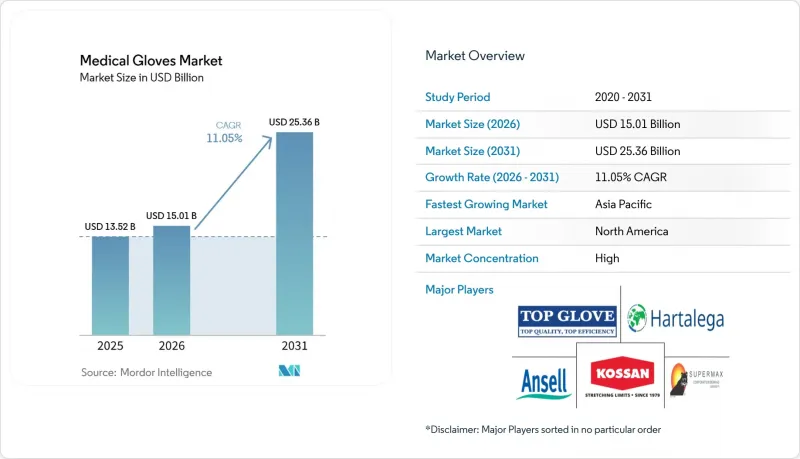
본 보고서에서는 해당 산업을 유형별(파우더 처리, 파우더 미처리), 소재별(천연 고무 장갑, 니트릴 장갑, 비닐 장갑, 기타 소재), 용도별(진찰, 수술, 화학요법, 기타 용도) 및 지역별(북미, 유럽 등)로 분류하고 있습니다. 시장 전망은 금액(달러) 기준으로 제시되어 있습니다.
세계의 의료용 장갑 시장 동향 및 분석
세계의 병원 내 감염 예방에 대한 노력
미국 질병통제예방센터(CDC)가 입원 환자 31명 중 1명이 매일 적어도 한 가지 감염증에 걸리고 있음을 확인함에 따라, 병원에서는 장갑 사용 규정이 더욱 엄격해지고 있습니다. 의료기관에서는 단순히 장갑을 비치하는 데 그치지 않고, 시술별로 적절한 장갑을 선정하는 방향으로 전환되고 있으며, 이에 따라 고위험 수술용 대표 제품이 중요시되고 있습니다. 2024년 체계적 문헌고찰에 따르면, 이중 장갑 사용으로 인해 안쪽 장갑의 천공이 80% 감소한 것으로 나타났으며, 이에 따라 이러한 고급형 제품의 도입이 가속화되고 있습니다. 이러한 새로운 초점을 통해, 감염관리위원회가 현재 손 위생 지표와 함께 전자 대시보드에서 장갑 사용 데이터를 분석하고, 장갑의 적정 사용 현황을 일일 임상 보고서에 반영하고 있다는 인사이트를 얻을 수 있게 되었습니다.
팬데믹 이후 선택적 수술 및 비응급 수술의 회복
병원들이 수술 지연 해소에 힘쓰고 있는 가운데, 탑글로브사는 2025년도 1분기 판매량이 전년 동기 대비 104% 증가했다고 보고했습니다. 정형외과 및 순환기 계통의 사례가 가장 빠르게 증가하고 있으며, 두 분야 모두 섬세한 촉각 반응성과 높은 내천자성을 갖춘 장갑이 요구되고 있습니다. 현재 최소 침습 수술을 시행하는 외과의사들은 정교한 기구의 그립감을 높이기 위해 극히 얇은 니트릴 또는 폴리이소프렌 장갑을 지정하고 있습니다. 실용적인 관점에서 볼 때, 복잡한 증례당 장갑 소비량 증가가 일상적인 진료에서의 성장 둔화를 상쇄하고 있어, 전반적인 수요는 꾸준한 상승 추세를 유지하고 있습니다.
기후 변화에 따른 수확량 변동이 촉매가 되어 천연고무 가격이 급등락
기후 변화로 인해 라텍스 공급량이 감소하고 있어, 예측 불가능한 가격 변동을 초래하고 있습니다. 이로 인해 장갑 제조업체의 비용 예측이 어려워지고 있습니다. 미국은 최근 니트릴-부타디엔 고무 원료의 국내 부족을 지적하는 면제 조치를 발표하며, madeinamerica.gov에서 생산되는 합성 소재조차도 공급의 취약성을 여실히 드러냈습니다. 화학제품 생산까지 수직 통합을 이룬 제조업체는 이러한 충격을 완화하고, 병원 구매처에 대해 보다 안정적인 가격을 유지할 수 있습니다. 이로부터 명확히 도출되는 점은 다양한 원자재에 대한 접근성이 핵심적인 경쟁 우위로 자리 잡고 있으며, 이는 의료용 장갑 업계에서 대출 기관의 신용 위험에 대한 인식에 영향을 미치고 있다는 것입니다.
부문별 분석
진찰용 장갑은 2025년 의료용 장갑 시장의 62.94%를 차지했으며, 비용 대비 효과가 뛰어난 차단 보호 기능을 통해 일상적인 환자 간호를 뒷받침하고 있습니다. 이 부문의 생산량은 공장에서 장시간 연속 생산 라인을 가동할 수 있게 해 주며, 원자재 가격 변동 속에서도 가격을 안정적으로 유지할 수 있는 경제성을 실현하고 있습니다. 새로운 추세로, 원격 진료용 가정 의료 키트에 진료용 장갑 한 쌍이 포함되기 시작하면서, 규모는 작지만 성장세를 보이는 소비자 채널이 새롭게 등장하고 있습니다.
클린룸용 장갑은 의료용 장갑 시장 규모에서 차지하는 비중이 미미하지만, 연평균 성장률(CAGR) 11.92%로 성장하고 있으며, 이는 모든 제품 유형 중 가장 높은 성장률입니다. 이러한 수요는 ISO 클래스 1-3 규격 준수 및 정전기 제어가 필요한 반도체 및 제약 공장에서 발생하고 있습니다. 무균성과 낮은 입자 발생량을 모두 인증받을 수 있는 제조업체가 고부가가치 계약을 수주하고 있습니다. 관찰된 시사점 중 하나로, 산업용 및 의료용 고객을 담당하는 영업팀을 대상으로 교차 교육을 실시함으로써 클린룸용 생산 라인의 가동률이 향상된다는 점을 들 수 있습니다.
수술용 장갑은 무균성과 촉감에 대한 요구 사항이 더 엄격하기 때문에 수량은 적지만, 1,000장당 매출액은 높습니다. 2025년 연구에 따르면, 라텍스가 함유되지 않은 수술용 장갑은 라텍스 장갑에 비해 찢어질 확률이 4.24배 더 높았으며, 이로 인해 복합 필름에 대한 연구 개발이 촉진되고 있습니다(doi.org). 병원에서는 민감도와 백업 기능으로서의 무결성을 겸비한 2층 폴리이소프렌 설계에 대한 시험이 진행되고 있으며, 이는 수술용 장갑 하위 부문 내 시장 점유율의 변동을 시사하고 있습니다.
니트릴 장갑은 2025년 의료용 장갑 시장에서 47.82%라는 압도적인 점유율을 차지했으며, 폭넓은 내약성 및 천연 고무 단백질을 사용하지 않는 점이 높이 평가받고 있습니다. 그러나 해당 공급망은 아크릴로니트릴과 부타디엔의 원자재 가격 변동에 민감하게 반응하며, 이 원자재 가격은 2023년 하반기 이후 높은 수준을 유지하고 있습니다. 이익률을 유지하기 위해 주요 제조업체들은 니트릴 공장을 장갑 공장과 같은 부지 내에 설치하여 운송비와 보관 비용을 절감하고 있습니다. 한편, 네오프렌 장갑 시장은 연평균 성장률(CAGR) 12.22%를 기록하며 성장하고 있으며, 단백질 알레르겐을 포함하지 않으면서도 라텍스와 같은 탄력성을 요구하는 외과 부문 덕분에 그 성장세가 가속화되고 있습니다. 그 부작용으로 폴리클로로프렌 수요가 업스트림 공급량을 초과하고 있어, 화학 제조업체들은 중단했던 생산 능력을 재개할 수밖에 없는 상황입니다.
라텍스는 타의 추종을 불허하는 촉각 재현도가 요구되는 시술, 특히 미세 신경외과 수술 분야에서 여전히 틈새 시장을 차지하고 있습니다. 비닐은 중요도가 낮은 작업에 사용되는 가장 저렴한 대체재로 여전히 자리 잡고 있지만, 차단 성능이 낮기 때문에 단기간 동안 일회용으로 사용할 수 있는 용도로만 제한되고 있습니다. 폴리이소프렌은 가격대가 높은 편이지만, 라텍스의 성능과 니트릴의 안전성을 조화시키는 소재로서 그 입지를 다져가고 있습니다. FDA의 품질 관리 시스템 규정에 따른 동향은 안정적인 공급 체계를 갖춘 소재의 보급을 촉진하고 있으며, 재활용 가능성과 저탄소화를 중시하는 연구 개발 프로그램을 뒷받침하고 있습니다.
지역별 분석
북미는 선진적인 인프라와 엄격한 감염 관리 규정에 힘입어 2025년 의료용 장갑 시장 규모의 34.45%를 차지했습니다. 해당 지역에서는 2025년 2월 중국산 장갑에 대한 10% 관세가 발효됨에 따라 조달처를 재검토하고 있으며, 주문은 말레이시아 생산자(mida.gov.my)로 전환되고 있습니다. 유통업체들이 공급업체에 재활용 소재 사용을 증명할 것을 요구하는 사례가 늘어나고 있으며, 이는 환경 고려가 시장 진입의 조건이 되어가고 있음을 보여줍니다. 이러한 점으로 미루어 볼 때, 북미의 병원들은 수량 할인을 활용하기 위해 장갑 구매를 보다 광범위한 개인보호구(PPE)(PPE) 계약에 포함시키고 있는 것으로 추정됩니다.
아시아태평양은 가장 빠르게 성장하는 지역으로, 2026-2031년 연평균 성장률(CAGR) 13.02%를 나타낼 것으로 전망됩니다. 말레이시아에서만 연간 1,000억 장의 장갑을 생산하고 있으며, 태국과 베트남의 제조업체들도 자동화 생산 라인을 확대되고 있습니다. 또한, 지역 전체적으로 국민건강보험제도로 인해 의료 접근성이 확대됨에 따라 국내 수요도 증가하고 있습니다. 한 가지 추론으로, 아시아 각국 정부가 국가 비축품에 장갑을 추가함으로써, 세계 경기 침체 시 제조업체를 보호하는 ‘수요의 하한선’이 형성되고 있다는 점을 들 수 있습니다.
유럽은 국민 모두를 대상으로 하는 의료보험 제도와 엄격한 화학물질 안전법 덕분에 의료용 장갑 시장에서 큰 점유율을 차지하고 있습니다. EU 의료기기 규정에 따라 공급업체는 유해 물질이 포함되어 있지 않음을 문서화해야 할 의무가 있으며, 이것이 가속제를 사용하지 않은 니트릴 장갑의 보급을 촉진하고 있습니다. 개정된 EU GMP 부록 1은 제약 공장의 무균 제조 규정을 더욱 엄격하게 함에 따라, 검증된 무균 장갑에 대한 수요를 높이고 있습니다. 또한, 유럽의 병원 그룹이 시범적으로 도입하고 있는 장갑 재활용 시스템은 비용 절감 효과가 입증된다면 북미에서도 유사한 움직임이 확산될 가능성이 있다고 볼 수 있습니다.
기타 혜택 :
- 엑셀 형식 시장 예측(ME) 시트
- 3개월간의 애널리스트 지원
자주 묻는 질문
목차
제1장 서론
제2장 조사 방법
제3장 주요 요약
제4장 시장 구도
제5장 시장 규모 및 성장 예측
제6장 경쟁 구도
제7장 시장 기회 및 향후 전망
AJY 26.06.26According to Mordor Intelligence, the medical gloves market size was valued at USD 13.52 billion in 2025 and is estimated to grow from USD 15.01 billion in 2026 to reach USD 25.36 billion by 2031, at a CAGR of 11.05% during the forecast period (2026-2031).
This report Segments the Industry Into by Type (Powdered, Non-Powdered), by Material (Natural Rubber Gloves, Nitrile Gloves, Vinyl Gloves, Other Materials), by Application (Medical Examination, Surgery, Chemotherapy, Other Applications), and by Geography (North America, Europe and More). The Market Forecasts are Provided in Terms of Value (USD).
Global Medical Gloves Market Trends and Insights
Global Emphasis on Preventing Hospital-Acquired Infections
Hospitals are tightening glove protocols after the Centers for Disease Control and Prevention confirmed that one in 31 in-patients acquires at least one infection each day. Facilities are moving from simple availability of gloves to procedure-specific selection, which favors indicator products for high-risk surgeries. A 2024 systematic review showing an 80 % drop in inner-glove perforations with double gloving has accelerated uptake of these premium variants. The new focus creates an insight that infection-control committees now analyse glove-use data in electronic dashboards alongside hand-hygiene metrics, embedding glove adherence into daily clinical reporting.
Rebound in Elective and Non-Urgent Surgical Procedures Post-Pandemic
Top Glove reported a 104 % year-on-year jump in sales volume for Q1 FY2025 as hospitals attack procedure backlogs . Orthopedic and cardiovascular cases are rising fastest, each demanding gloves with fine tactile response and high puncture resistance. Surgeons adopting minimally invasive techniques now specify ultra-thin nitrile or polyisoprene layers to improve grip on delicate instruments. A practical inference is that the higher glove consumption per complex case is offsetting slowing growth in routine examinations, keeping overall unit demand on a strong upward slope.
Volatile Natural Rubber Pricing Driven by Climate-Linked Yield Shifts
Climate variability is shrinking latex supply and driving unpredictable price swings that complicate cost forecasts for glove makers. The United States recently issued a waiver noting domestic shortfalls in nitrile-butadiene rubber feedstock, highlighting supply fragility even for synthetic options madeinamerica.gov. Manufacturers with vertical integration into chemical production can buffer these shocks, maintaining steadier pricing for hospital buyers. A clear inference is that access to diversified raw materials is becoming a core competitive moat, influencing lender perceptions of credit risk in the Medical Gloves industry.
Other drivers and restraints analyzed in the detailed report include:
- Expansion of Cleanroom Manufacturing Across Semiconductor and Pharma Industries
- Broader Adoption of Universal Health Coverage in Emerging Economies
- Rising Allergic/Hypersensitivity Concerns Prompting Powdered Glove Bans
For complete list of drivers and restraints, kindly check the Table Of Contents.
Segment Analysis
Examination gloves hold a 62.94 % Medical Gloves market share in 2025, underpinning daily patient care with cost-effective barrier protection. The segment's volume allows factories to run long continuous lines, achieving economies that keep prices stable even amid feedstock swings. A fresh inference is that home-health kits shipped for telemedicine visits now include single-pair exam gloves, adding a modest but growing consumer channel.
Cleanroom gloves capture a modest slice of Medical Gloves market size yet grow at 11.92 % CAGR, the fastest of all product types. Demand comes from semiconductor and pharma plants that require ISO Class 1-3 compliance and electrostatic control. Manufacturers able to certify both sterility and low particulate generation win premium contracts. An observed implication is that cross-training sales teams for industrial and healthcare accounts boosts utilization of cleanroom lines.
Surgical gloves account for lower volume but higher revenue per thousand pieces because of stricter sterility and tactile demands. A 2025 study found that latex-free surgical gloves are 4.24 times more prone to perforation than latex, driving R&D into composite films doi.org. Hospitals are trialling double-layer polyisoprene designs that combine sensitivity with backup integrity, signaling possible market share shifts within the surgical subset.
Nitrile gloves own a commanding 47.82 % Medical Gloves market share in 2025, prized for broad chemical resistance and the absence of natural-rubber proteins. Their supply chain, however, is sensitive to acrylonitrile and butadiene feedstock prices, which have stayed elevated since late 2023. To insulate margins, top manufacturers are co-locating nitrile plants with glove factories, cutting transit and storage costs. Neoprene gloves, meanwhile, are growing at a 12.22 % CAGR, accelerated by surgical departments seeking latex-like elasticity minus protein allergens. One side effect is that polychloroprene demand is outpacing upstream supply, nudging chemical companies to reopen mothballed capacity.
Latex still holds a niche in procedures that require unmatched tactile fidelity, especially microneurosurgery. Vinyl remains the lowest-cost alternative for non-critical tasks, yet its weak barrier properties confine use to quick-turn applications. Polyisoprene, though premium-priced, is carving out space as a bridge between latex performance and nitrile safety. Regulatory trends under the FDA's Quality Management System Regulation are catalyzing broader adoption of materials with stable supply profiles, encouraging R&D programs that emphasize recyclability and lower carbon intensity.
Geography Analysis
North America contributes 34.45 % of Medical Gloves market size in 2025, supported by advanced infrastructure and stringent infection-control rules. The region is reshaping sourcing after a 10 % tariff on Chinese gloves took effect in February 2025, steering orders toward Malaysian producers mida.gov.my. Distributors increasingly require suppliers to certify recycled content, signaling that green credentials are turning into market-entry tickets. An inference is that North American hospitals are bundling glove purchases within broader personal-protective-equipment contracts to leverage volume discounts.
Asia-Pacific is the fastest-growing geography with a 13.02 % CAGR outlook from 2026-2031. Malaysia alone manufactures 100 billion gloves annually, while Thai and Vietnamese producers expand automated lines. Domestic demand is also climbing as universal health insurance widens access to care across the region. One inference is that Asian governments adding gloves to national stockpiles create a built-in demand floor that cushions producers during global downturns.
Europe commands significant Medical Gloves market share thanks to universal coverage and strict chemical-safety laws. The EU Medical Device Regulation forces suppliers to document the absence of harmful substances, driving uptake of accelerator-free nitrile. Updated EU GMP Annex 1 tightens sterile manufacturing rules for pharma plants, bolstering demand for validated sterile gloves. An inference is that European hospital groups piloting glove-recycling loops could spark similar initiatives in North America once proof of cost savings emerges.
- Top Glove
- Hartalega Holdings
- Ansell
- Kossan Rubber Industries
- Supermax
- Semperit
- Cardinal Health
- Medline Industries
- Molnlycke Health Care
- O&M Halyard (Owens & Minor)
- B. Braun
- 3M
- Mckesson
- Kimberly-Clark Worldwide
- Intco Medical Technology Co. Ltd.
- Shandong Blue Sail Plastic & Rubber Co. Ltd.
- Showa Group
- Rubberex Corp.
- UG Healthcare Corporation
- Renco
- Dynarex
- Kanam Latex Industries Pvt. Ltd.
- Comfort Rubber Gloves Industries Sdn Bhd
- Liberty Glove & Safety
Additional Benefits:
- The market estimate (ME) sheet in Excel format
- 3 months of analyst support
TABLE OF CONTENTS
1 Introduction
- 1.1 Study Assumptions & Market Definition
- 1.2 Scope of the Study
2 Research Methodology
3 Executive Summary
4 Market Landscape
- 4.1 Market Overview
- 4.2 Market Drivers
- 4.2.1 Global Emphasis on Preventing Hospital-Acquired Infections
- 4.2.2 Rebound in Elective & Non-Urgent Surgical Procedures Post-Pandemic
- 4.2.3 Expansion of Cleanroom Manufacturing Across Semiconductor & Pharma Industries
- 4.2.4 Broader Adoption of Universal Health Coverage in Emerging Economies
- 4.2.5 Rapid Growth of Home-Based Point-of-Care Diagnostics
- 4.2.6 Government Incentives Catalyzing New Glove Manufacturing Capacity
- 4.3 Market Restraints
- 4.3.1 Volatile Natural Rubber Pricing Driven by Climate-Linked Yield Shifts
- 4.3.2 Rising Allergic/Hypersensitivity Concerns Prompting Powdered Glove Bans
- 4.3.3 Regulatory Approval Back-Logs Delaying New Product Launches
- 4.3.4 Increasing Carbon-Footprint Compliance Costs for Manufacturers
- 4.4 Value-Chain Analysis
- 4.5 Regulatory Outlook
- 4.6 Technological Outlook
- 4.7 Porter's Five Forces Analysis
- 4.7.1 Bargaining Power of Buyers
- 4.7.2 Bargaining Power of Suppliers
- 4.7.3 Threat of New Entrants
- 4.7.4 Threat of Substitutes
- 4.7.5 Intensity of Competitive Rivalry
5 Market Size & Growth Forecasts (Value - USD)
- 5.1 By Product Type
- 5.1.1 Examination Gloves
- 5.1.2 Surgical Gloves
- 5.1.3 Cleanroom Gloves
- 5.2 By Material Type
- 5.2.1 Nitrile
- 5.2.2 Latex
- 5.2.3 Vinyl
- 5.2.4 Neoprene
- 5.2.5 Polyisoprene
- 5.3 By Sterility
- 5.3.1 Sterile
- 5.3.2 Non-Sterile
- 5.4 By End User
- 5.4.1 Hospitals & Clinics
- 5.4.2 Ambulatory Surgery Centers
- 5.4.3 Diagnostic Laboratories
- 5.4.4 Home Healthcare Settings
- 5.4.5 Dental Practices
- 5.5 By Geography
- 5.5.1 North America
- 5.5.1.1 United States
- 5.5.1.2 Canada
- 5.5.1.3 Mexico
- 5.5.2 Europe
- 5.5.2.1 Germany
- 5.5.2.2 United Kingdom
- 5.5.2.3 France
- 5.5.2.4 Italy
- 5.5.2.5 Spain
- 5.5.2.6 Rest of Europe
- 5.5.3 Asia-Pacific
- 5.5.3.1 China
- 5.5.3.2 Japan
- 5.5.3.3 India
- 5.5.3.4 South Korea
- 5.5.3.5 Australia
- 5.5.3.6 Rest of Asia-Pacific
- 5.5.4 Middle East
- 5.5.4.1 GCC
- 5.5.4.2 South Africa
- 5.5.4.3 Rest of Middle East
- 5.5.5 South America
- 5.5.5.1 Brazil
- 5.5.5.2 Argentina
- 5.5.5.3 Rest of South America
- 5.5.1 North America
6 Competitive Landscape
- 6.1 Market Concentration
- 6.2 Strategic Moves
- 6.3 Market Share Analysis
- 6.4 Company Profiles (includes Global-level Overview, Market-level Overview, Core Segments, Financials as available, Strategic Information, Market Rank/Share, Products & Services, Recent Developments)
- 6.4.1 Top Glove Corporation Bhd
- 6.4.2 Hartalega Holdings Berhad
- 6.4.3 Ansell Limited
- 6.4.4 Kossan Rubber Industries Bhd
- 6.4.5 Supermax Corporation Berhad
- 6.4.6 Semperit AG Holding
- 6.4.7 Cardinal Health Inc.
- 6.4.8 Medline Industries LP
- 6.4.9 Molnlycke Health Care AB
- 6.4.10 O&M Halyard (Owens & Minor)
- 6.4.11 B. Braun Melsungen AG
- 6.4.12 3M Company
- 6.4.13 McKesson Corporation
- 6.4.14 Kimberly-Clark Corporation
- 6.4.15 Intco Medical Technology Co. Ltd.
- 6.4.16 Shandong Blue Sail Plastic & Rubber Co. Ltd.
- 6.4.17 Showa Group
- 6.4.18 Rubberex Corp.
- 6.4.19 UG Healthcare Corporation
- 6.4.20 Renco Corporation
- 6.4.21 Dynarex Corporation
- 6.4.22 Kanam Latex Industries Pvt. Ltd.
- 6.4.23 Comfort Rubber Gloves Industries Sdn Bhd
- 6.4.24 Liberty Glove & Safety
7 Market Opportunities & Future Outlook
- 7.1 White-space & Unmet-Need Assessment


