

|
시장보고서
상품코드
2114696
라텍스 의료용 장갑 : 시장 점유율 분석, 산업 동향 및 통계 데이터, 성장 예측(2026-2031년)Latex Medical Gloves - Market Share Analysis, Industry Trends & Statistics, Growth Forecasts (2026 - 2031) |
||||||
 Mordor Intelligence
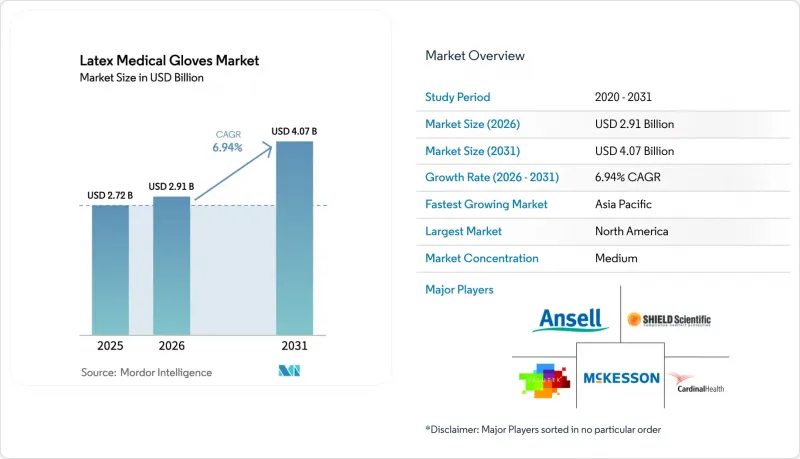
Mordor Intelligence에 의하면, 라텍스 의료용 장갑 시장 규모는 2025년 27억 2,000만 달러로 평가되었습니다. 2026년에는 29억 1,000만 달러로 확대되어 2026년부터 2031년에 걸쳐 CAGR 6.94%로 성장을 지속하여, 2031년에는 40억 7,000만 달러에 이를 것으로 예측됩니다.
본 보고서는 제품 유형(멸균 장갑, 비멸균 장갑), 형태(파우더 프리 장갑, 파우더 장갑), 용도(진찰용 장갑, 수술용 장갑), 최종 사용자(병원, 진료소, 외래수술센터(ASC), 진단실험실, 기타),및 지역(북미, 유럽, 아시아태평양, 기타)별로 분류되어 있습니다. 시장 예측은 금액(달러) 기준으로 제시되어 있습니다.
세계의 라텍스 의료용 장갑 시장 동향 및 인사이트
팬데믹 이후 의료 기관에서의 일회용 개인보호구(PPE)(PPE) 수요 증가
2024년 전 세계 장갑 소비량은 3,570억 장으로 회복되어 2021년 정점 대비 불과 6% 낮은 수준에 그쳤으나, 베트남과 인도네시아에 위치한 중국계 공장의 과잉 생산 능력이 평균 판매 가격을 하락시키는 요인으로 작용하고 있습니다. 병원 그룹은 현재 공급의 회복탄력성을 중시하고 있으며, 그 예로 Medline사가 국내 생산 및 예측형 물류에 투입하기 위해 62억 6,000만 달러의 IPO 조달 자금을 배정한 것을 들 수 있습니다. 미국 법무부의 ‘프로젝트 에어브리지’ 판례는 조달 규정을 계속해서 지침으로 삼는 유통업체 주도의 조정을 지지하는 내용입니다. 카디널 헬스(Cardinal Health)는 2024년에 4억 9,100만 달러 규모의 라텍스 관련 위험을 공시하며, 원자재 가격 변동이 이익률에 대한 위험 요인임을 입증했습니다. 관세 인상에 앞서 미국 구매자들의 선구매가 이루어지면서 하타레가(Hataraga)사의 2024년 하반기 매출은 증가했으나, 2025년 초에는 판매량이 바닥을 치는 결과를 낳았습니다. 이는 정책의 불확실성이 분기별 수요를 어떻게 왜곡하는지를 보여줍니다.
고위험 수술 시 이중 장갑 착용 프로토콜 의무화
단일 장갑을 사용할 경우, 수술 중 천공 발생률은 30%를 초과합니다. WHO 지침에서는 이중 장갑 착용 의무화를 명시하고 있지는 않지만, 주요 교육 병원에서는 이를 철저히 시행하고 있어 1건당 장갑 소비량이 증가하고 있습니다. 천공 감지 시스템이 탑재된 수술용 장갑이 표준 흰색 장갑을 대체하고 있으며, 가격은 10-15% 더 비쌉니다. 스리 트란(Sri Tran)사가 2024년에 취득한 저산화아연 라텍스 관련 특허는 금속 이온 방출량을 5 mg/kg 미만으로 저감하여, 장시간 착용이 필요한 외과 수술을 염두에 두고 있습니다. 미국산 니트릴 장갑 비용은 환급 대상에 포함하고, 라텍스 장갑은 대상에서 제외하는 CMS(미국 의료보험센터)의 제안은 정책상의 역풍이 되고 있지만, 촉각 감도가 높다는 점 때문에 외과의사들 사이에서는 여전히 라텍스 장갑이 선호되고 있습니다. 병원들이 감염 관리 지표를 세분화하는 가운데, 색상으로 구분된 인디케이터 장갑이 정형외과나 외상 수술실에서 사실상 표준으로 자리 잡고 있습니다.
천연 고무의 가격 변동과 소규모 생산자에 의한 공급 충격
Hartalega사의 2024년 상반기 이익률은 매출이 39% 증가했음에도 불구하고 축소되었습니다. 이는 말레이시아 링깃의 급등으로 인해 평균 판매 가격(ASP) 상승이 억제된 데다, 겨울철에 원자재 비용이 급등했기 때문입니다. 전 세계 라텍스의 85%를 공급하는 소규모 생산자들은 노동력 부족에 직면해 있어 수액 채취 빈도가 감소하고 있을 뿐만 아니라, 수령 증가로 인해 구조적인 공급 부족 위험이 높아지고 있습니다. 2024년 5월부터 7월까지의 겨울철에는 현물 가격이 15-20% 급등했으나, 계절적 회복기에 접어들며 드디어 안정세를 보였습니다. 메이뱅크는 비용 부담이 완화될 것으로 전망하고 있지만, 재조림 부족으로 인해 2027년까지 가격 변동이 반복될 것으로 시사되고 있습니다. 하트알레가의 베스타리 자야 철수 등 사업 재편은 가격 충격을 흡수하기 위해 업계 전체가 더 적은 수의 효율적인 생산 거점으로 전환하고 있음을 여실히 보여주고 있습니다.
부문별 분석
멸균 장갑은 2025년 매출의 67.34%를 차지하며, 수술실에서의 고부가가치 계약의 기반이 되었습니다. 라텍스 의료용 장갑 시장의 이러한 우위는 무균 장벽을 의무화하는 규제 요건을 반영하며, 비멸균 제품에 비해 0.02-0.05달러 높은 평균 판매 가격(ASP)을 정당화합니다. 그러나 특히 아시아의 신흥국에서 외래 진료소 및 진단실험실이 확대됨에 따라, 비멸균 장갑은 연평균 성장률(CAGR) 7.87%를 나타낼 것으로 전망됩니다. 4-6주라는 짧은 리드 타임 덕분에 비멸균 장갑 제조업체는 신속하게 대응할 수 있으며, 이는 팬데믹으로 인한 파괴적 혁신 상황에서 매우 중요한 요소임이 입증되었습니다.
멸균 생산에는 감마선 조사 또는 에틸렌옥사이드 처리가 필요하며, 이에 따른 높은 자본 집약성은 대규모 사업자에게 유리하게 작용합니다. Sri Tran사가 2024년에 외과용 제품 라인을 출시하는 것은 연평균 성장률(CAGR) 7.98%를 기록하는 외과용 부문으로의 전략적 전환을 나타냅니다. ISO 10282 및 ISO 11193 규격의 차이로 인해 타 제품으로의 전환이 쉽지 않아, 전문적인 생산 능력을 둘러싼 경쟁 우위가 유지되고 있습니다. 과거 공급 부족 사례를 분석해 보면, 의료 과실로 인한 배상 책임이 건당 100만 달러를 초과하기 때문에 병원들은 타사 브랜드의 멸균 장갑 사용을 주저하고 있으며, 이는 라텍스 의료용 장갑 시장에서 기존 기업들의 지배력을 더욱 강화하고 있습니다.
2025년에는 파우더 프리 제품이 70.12%의 점유율을 차지했으며, 2016년 FDA가 외과용으로 사용을 금지한 옥수수 전분을 입힌 제품이 의료 기관에서 단계적으로 폐지됨에 따라 2031년까지 연평균 성장률(CAGR) 7.91%로 성장할 전망입니다. 제조 과정에서는 염소 처리 및 폴리머 코팅이 사용되어 비용을 8-12% 가중시키고 있지만, 이러한 장갑은 유럽 입찰에서 중요하게 여겨지는 ‘저피부염성’ 기준을 충족하고 있습니다. 파우더 처리 장갑은 수의학 및 외식 산업에서 여전히 사용되고 있지만, 점차 시장 점유율을 내주고 있습니다.
Top Glove사의 ‘ElastiCore’ 가속제 미사용 시리즈와 SHOWA사의 FDA 승인 저피부염 위험 장갑은 제품 혁신이 프리미엄 가격을 어떻게 뒷받침하고 있는지를 보여줍니다. 태국에서 실시된 임상 연구에 따르면, 저단백·파우더 프리 장갑으로 전환한 후 증상이 동반된 반응이 9.8%에서 1.2%로 감소한 것으로 나타나, 병원의 구매 경향이 입증되었습니다. 조달 팀이 SKU를 합리화함에 따라 재고 관리가 간소화되면서, 라텍스 의료용 장갑 시장의 판매량은 파우더 프리 제품 쪽으로 더욱 기울고 있습니다.
지역별 분석
2025년, 북미는 40.01%의 점유율을 유지했습니다. 이는 중국산 장갑에 대한 미국의 관세가 7.5%에서 50%로 인상되었고, 2027년에는 100%에 달할 전망이어서 주문이 말레이시아와 태국의 제조업체로 이동했기 때문입니다. 하타레가(Hatarega)사는 2026 회계연도에 미국 수요의 약 13%를 확보했으며, 이 회사의 매출은 현재 그룹 매출의 53%를 차지하고 있습니다. 미국산 니트릴 장갑에 대한 CMS의 장려 조치로 인해 라텍스 장갑 수입에 불확실성이 발생하고 있지만, 단기적인 공급 부족으로 인해 수입 유입은 계속될 것으로 예측됩니다.
아시아태평양은 아세안(ASEAN)의 6억 8,540만 인구가 있으며, 2029년까지 1,000억 달러를 넘어설 가능성이 있는 의료 관광 수입에 힘입어 연평균 성장률(CAGR) 8.01%로 가장 빠르게 성장하고 있는 지역입니다. 말레이시아는 여전히 세계 생산량의 45%를 공급하고 있지만, 베트남과 인도네시아에 대한 중국의 ‘+1’ 전략은 2025년 4월에 발표된 각각 46% 및 32%의 새로운 미국 관세 대상이 됩니다. 인도의 생산 연계형 인센티브에 따라 2024 회계연도까지 수입 의존도를 60%로 낮출 전망이며, 이는 국내 생산 능력 확대를 시사합니다.
유럽은 수요의 약 5분의 1을 차지하고 있으며, EUDR(유럽 디지털 건강 기록)에 따라 추적성 확보를 위해 장갑 1장당 0.005-0.010달러의 비용 증가가 발생하여, 수직 통합형 공급업체에 유리하게 작용하고 있습니다. 중동 및 아프리카는 GCC(걸프협력회의)의 500억 달러를 넘는 의료 투자를 배경으로 연평균 성장률(CAGR) 7.2-7.5%로 확대될 전망이지만, 물류망의 분산화로 인해 프리미엄 제품의 보급이 저해되고 있습니다. 브라질을 필두로 한 남미는 세계 생산량의 5-6%를 소비하고 있으며, 공공 입찰에서는 저비용이 우선시되고 있습니다.
기타 혜택 :
- 엑셀 형식 시장 예측(ME) 시트
- 3개월간의 애널리스트 지원
자주 묻는 질문
목차
제1장 서론
제2장 분석 방법
제3장 주요 요약
제4장 시장 구도
제5장 시장 규모 및 성장률 예측
제6장 경쟁 구도
제7장 시장 기회 및 향후 전망
KTH 26.08.28According to Mordor Intelligence, the latex medical gloves market size is expected to grow from USD 2.72 billion in 2025 to USD 2.91 billion in 2026 and is forecast to reach USD 4.07 billion by 2031 at 6.94% CAGR over 2026-2031.
This report is Segmented by Product Type (Sterile Gloves, Non-Sterile Gloves), Form (Powder-Free Gloves, Powdered Gloves), Application (Examination Gloves, Surgical Gloves), End User (Hospitals, Clinics, Ambulatory Surgery Centers, Diagnostic Laboratories, Others), and Geography (North America, Europe, Asia-Pacific, and More). The Market Forecasts are Provided in Terms of Value (USD).
Global Latex Medical Gloves Market Trends and Insights
Rising Post-Pandemic Institutional Demand for Single-Use PPE
Global glove consumption normalized to 357 billion pieces in 2024, only 6% below the 2021 peak, yet excess capacity from Chinese plants in Vietnam and Indonesia holds down average selling prices. Hospital groups now emphasize supply resilience, exemplified by Medline's USD 6.26 billion IPO proceeds earmarked for domestic manufacturing and predictive logistics. The U.S. Department of Justice's Project Airbridge precedent supports distributor-led coordination that continues to guide procurement rules. Cardinal Health disclosed USD 491 million latex exposure in 2024, confirming raw-material volatility as a margin risk. Front-loading by U.S. buyers ahead of tariff hikes boosted Hartalega's late-2024 revenue but created a volume trough in early-2025, illustrating how policy uncertainty distorts quarterly demand.
Mandatory Double-Gloving Protocols in High-Risk Surgeries
Surgical puncture incidence exceeds 30% under single-layer use, and although WHO guidelines stop short of mandating double-gloving, leading teaching hospitals enforce it, driving higher per-case glove consumption. Surgical-grade gloves featuring puncture-indicator systems are replacing standard white gloves and carry a 10-15% premium. Sri Trang's 2024 patent for low-zinc-oxide latex reduces metal migration below 5 mg/kg, targeting extended-wear surgical scenarios. CMS proposals that reimburse U.S.-made nitrile but not latex gloves add policy headwinds, yet tactile sensitivity keeps latex favored among surgeons. As hospitals refine infection-control metrics, color-coded indicator gloves are emerging as a de-facto standard in orthopedics and trauma theaters.
Natural-Rubber Price Volatility & Smallholder Supply Shocks
Hartalega's H1 2024 margins shrank even as revenue climbed 39% because a stronger Malaysian ringgit muted ASP gains and raw-material costs spiked during the wintering season. Smallholders supplying 85% of global latex suffer labor shortages, cutting tapping frequency, while aging tree stock heightens structural under-supply risk. Spot prices surged 15-20% during the May-July 2024 wintering phase, only easing after seasonal recovery. Although Maybank forecasts easing costs, replanting deficits signal recurrent volatility through 2027. Plant consolidations such as Hartalega's exit from Bestari Jaya underscore a sector-wide pivot toward fewer, more efficient sites to absorb price shocks.
Other drivers and restraints analyzed in the detailed report include:
- Fast-Growing Ambulatory Surgery Network in Emerging APAC
- Top-5 OEMs Scaling Biodegradable Low-Protein Latex Lines
- OSHA-Driven Switch to Nitrile in U.S. Outpatient Clinics
For complete list of drivers and restraints, kindly check the Table Of Contents.
Segment Analysis
Sterile gloves accounted for 67.34% of 2025 revenue, anchoring high-value contracts across surgical suites. This dominance in the latex medical gloves market reflects regulatory mandates that demand aseptic barriers and justifies ASPs that run USD 0.02-0.05 above non-sterile equivalents. Non-sterile gloves will nonetheless post a 7.87% CAGR as outpatient clinics and diagnostic labs expand, especially in emerging Asia. Shorter 4-6-week lead times give non-sterile producers agility that proved critical during pandemic disruptions.
Sterile production requires gamma irradiation or ethylene oxide cycles, adding capital intensity that favors scale players. Sri Trang's 2024 launch of a surgical line indicates the strategic pivot toward the 7.98% CAGR surgical segment. ISO 10282 and ISO 11193 distinctions prevent easy cross-over, preserving moats around specialist capacity. Examination of past shortages shows hospitals reluctant to trial off-brand sterile gloves because malpractice liabilities exceed USD 1 million per incident, reinforcing incumbents' grip on the latex medical gloves market.
Powder-free variants captured 70.12% share in 2025 and will grow at a 7.91% CAGR through 2031 as institutions phase out cornstarch-dusted alternatives banned by the FDA for surgical use in 2016. Production relies on chlorination or polymer coatings that raise costs 8-12%, yet these gloves meet low-dermatitis criteria prized by European tenders. Powdered gloves linger in veterinary and food service but will gradually cede ground.
Top Glove's ElastiCore accelerator-free line and SHOWA's FDA-cleared low-dermatitis glove demonstrate how product innovation supports premiums. A Thai clinical study showed symptomatic reactions falling from 9.8% to 1.2% after switching to low-protein powder-free gloves, validating hospital purchasing preferences. As procurement teams rationalize SKUs, inventory simplicity further tilts volume toward powder-free in the latex medical gloves market.
Complete Report Scope:
- By Product Type
- Sterile Gloves
- Non-sterile Gloves
- By Form
- Powder-free Gloves
- Powdered Gloves
- By Application
- Examination Gloves
- Surgical Gloves
- By End User
- Hospitals
- Clinics
- Ambulatory Surgery Centers
- Diagnostic Laboratories
- Others
- By Geography
- North America
- United States
- Canada
- Mexico
- Europe
- Germany
- United Kingdom
- France
- Italy
- Spain
- Rest of Europe
- Asia-Pacific
- China
- Japan
- India
- Australia
- South Korea
- Rest of Asia-Pacific
- Middle East and Africa
- GCC
- South Africa
- Rest of Middle East and Africa
- South America
- Brazil
- Argentina
- Rest of South America
- North America
Geography Analysis
North America retained 40.01% share in 2025 as U.S. tariffs on Chinese gloves rose from 7.5% to 50% and will reach 100% in 2027, diverting orders to Malaysian and Thai producers. Hartalega captured roughly 13% of U.S. demand in FY 2026, and its sales now comprise 53% of group revenue. CMS incentives for U.S.-made nitrile cast uncertainty over latex imports, yet near-term supply gaps ensure continued inflows.
Asia-Pacific is the fastest-growing region at 8.01% CAGR, fueled by ASEAN's 685.4 million population and medical tourism revenue that could exceed USD 100 billion by 2029. Malaysia still supplies 45% of global output, but Chinese "+1" strategies in Vietnam and Indonesia face new U.S. tariffs of 46% and 32%, respectively, announced April 2025. India's production-linked incentives, reducing import reliance to 60% by FY 2024, signal growing domestic capacity.
Europe accounts for roughly one-fifth of demand; the EUDR adds USD 0.005-0.010 per glove for traceability, favoring vertically integrated suppliers. Middle East and Africa will expand 7.2-7.5% CAGR on over USD 50 billion GCC healthcare investment, yet fragmented logistics temper premium uptake. South America, led by Brazil, consumes 5-6% of global volume, with public tenders prioritizing low cost.
- Ansell
- Cardinal Health
- Clean Q Grip
- Dynarex
- Hartalega Holdings
- Kanam Latex Industries Pvt Ltd
- Kimberly-Clark Worldwide
- Kossan Rubber Industries
- Mckesson
- Medline Industries
- Molnlycke Health Care
- Riverstone Holdings Ltd
- Rubberex Corporation (M) Bhd
- Semperit
- SHIELD Scientific
- Showa Group
- Solventum
- Sri Trang Gloves (Thailand) PLC
- Sunflower Ave
- Supermax
- Top Glove
- UG Healthcare Corp. Ltd
- Valutek
- YTY Group
Additional Benefits:
- The market estimate (ME) sheet in Excel format
- 3 months of analyst support
TABLE OF CONTENTS
1 Introduction
- 1.1 Study Assumptions & Market Definition
- 1.2 Scope of the Study
2 Research Methodology
3 Executive Summary
4 Market Landscape
- 4.1 Market Overview
- 4.2 Market Drivers
- 4.2.1 Rising post-pandemic institutional demand for single-use PPE
- 4.2.2 Mandatory double-gloving protocols in high-risk surgeries
- 4.2.3 Fast-growing ambulatory surgery network in emerging APAC
- 4.2.4 Top-5 gloves OEMs scaling biodegradable low-protein latex lines
- 4.2.5 Hospital vendor-managed-inventory (VMI) contracts lengthening to 3-5 yrs
- 4.2.6 Carbon-credit incentives for natural-rubber plantations
- 4.3 Market Restraints
- 4.3.1 Natural-rubber price volatility & smallholder supply shocks
- 4.3.2 OSHA-driven switch to nitrile in U.S. outpatient clinics
- 4.3.3 EU traceability rules raising compliance costs for latex importers
- 4.3.4 Surging counterfeit certifications on e-commerce channels
- 4.4 Value / Supply-Chain Analysis
- 4.5 Regulatory Landscape
- 4.6 Technological Outlook
- 4.7 Porter's Five Forces Analysis
- 4.7.1 Bargaining Power of Suppliers
- 4.7.2 Bargaining Power of Buyers
- 4.7.3 Threat of New Entrants
- 4.7.4 Threat of Substitute Products
- 4.7.5 Intensity of Competitive Rivalry
5 Market Size & Growth Forecasts (Value, USD)
- 5.1 By Product Type
- 5.1.1 Sterile Gloves
- 5.1.2 Non-sterile Gloves
- 5.2 By Form
- 5.2.1 Powder-free Gloves
- 5.2.2 Powdered Gloves
- 5.3 By Application
- 5.3.1 Examination Gloves
- 5.3.2 Surgical Gloves
- 5.4 By End User
- 5.4.1 Hospitals
- 5.4.2 Clinics
- 5.4.3 Ambulatory Surgery Centers
- 5.4.4 Diagnostic Laboratories
- 5.4.5 Others
- 5.5 By Geography
- 5.5.1 North America
- 5.5.1.1 United States
- 5.5.1.2 Canada
- 5.5.1.3 Mexico
- 5.5.2 Europe
- 5.5.2.1 Germany
- 5.5.2.2 United Kingdom
- 5.5.2.3 France
- 5.5.2.4 Italy
- 5.5.2.5 Spain
- 5.5.2.6 Rest of Europe
- 5.5.3 Asia-Pacific
- 5.5.3.1 China
- 5.5.3.2 Japan
- 5.5.3.3 India
- 5.5.3.4 Australia
- 5.5.3.5 South Korea
- 5.5.3.6 Rest of Asia-Pacific
- 5.5.4 Middle East and Africa
- 5.5.4.1 GCC
- 5.5.4.2 South Africa
- 5.5.4.3 Rest of Middle East and Africa
- 5.5.5 South America
- 5.5.5.1 Brazil
- 5.5.5.2 Argentina
- 5.5.5.3 Rest of South America
- 5.5.1 North America
6 Competitive Landscape
- 6.1 Market Concentration
- 6.2 Market Share Analysis
- 6.3 Company Profiles (includes Global level Overview, Market level overview, Core Segments, Financials as available, Strategic Information, Market Rank/Share for key companies, Products & Services, and Recent Developments)
- 6.3.1 Ansell Ltd
- 6.3.2 Cardinal Health Inc.
- 6.3.3 Clean Q Grip
- 6.3.4 Dynarex Corporation
- 6.3.5 Hartalega Holdings Berhad
- 6.3.6 Kanam Latex Industries Pvt Ltd
- 6.3.7 Kimberly-Clark Corporation
- 6.3.8 Kossan Rubber Industries Bhd
- 6.3.9 McKesson Medical-Surgical Inc.
- 6.3.10 Medline Industries Inc.
- 6.3.11 Molnlycke Health Care AB
- 6.3.12 Riverstone Holdings Ltd
- 6.3.13 Rubberex Corporation (M) Bhd
- 6.3.14 Semperit AG Holding
- 6.3.15 SHIELD Scientific
- 6.3.16 Showa Group
- 6.3.17 Solventum
- 6.3.18 Sri Trang Gloves (Thailand) PLC
- 6.3.19 Sunflower Ave
- 6.3.20 Supermax Corporation Berhad
- 6.3.21 Top Glove Corporation Bhd
- 6.3.22 UG Healthcare Corp. Ltd
- 6.3.23 Valutek Inc.
- 6.3.24 YTY Group
7 Market Opportunities & Future Outlook
- 7.1 White-space & Unmet-need Assessment


