

|
시장보고서
상품코드
2061753
유럽의 IT 디바이스 시장 : 시장 점유율 분석, 업계 동향 및 통계, 성장 예측(2026-2031년)Europe IT Device - Market Share Analysis, Industry Trends & Statistics, Growth Forecasts (2026 - 2031) |
||||||
 Mordor Intelligence
Mordor Intelligence에 의하면, 유럽의 IT 디바이스 시장 규모는 2025년 2,100억 달러로 평가되었고, 2026년 2,300억 달러로 추정되고, 2031년까지 3조 3,200억 달러로 확대될 전망이며, 2026-2031년 연평균 복합 성장률(CAGR)은 7.58%를 나타낼 것으로 예측됩니다.
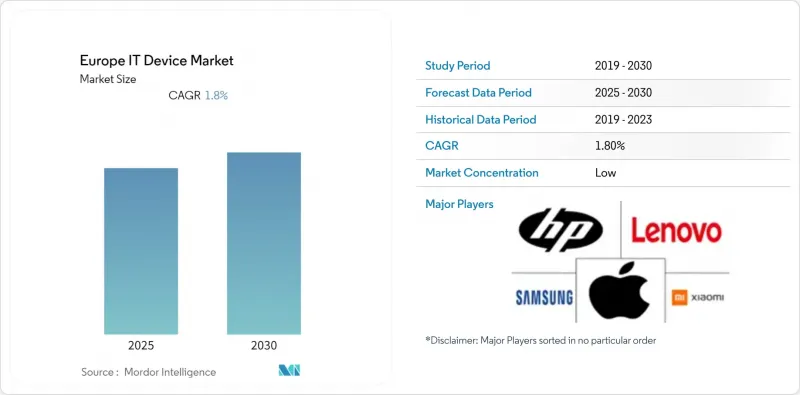
본 보고서는 디바이스 유형별(스마트폰, 노트북, 태블릿, 데스크톱 및 워크스테이션, 주변기기), 최종 사용자 산업별(일반 소비자, 기업, 정부, 교육 기관), 유통 채널별(온라인 소매, 오프라인 소매 등), 운영 체제별(Android, Windows 등) 및 지역별로 분류되어 있습니다. 시장 전망은 금액(달러) 기준으로 제시되어 있습니다.
유럽의 IT 디바이스 시장 동향 및 인사이트
5G 네트워크의 확대가 스마트폰 교체 주기를 앞당기고 있습니다.
유럽에는 79개의 독립형(SA) 상용 5G 네트워크가 구축되어 있으며, 이 인프라를 통해 창고 자동화나 증강현실(AR)을 활용한 현장 서비스와 같이 낮은 지연 시간이 요구되는 이용 사례가 가능해졌습니다. 독일의 통신 사업자들은 2025년까지 전국적인 SA 방식의 커버리지를 구축할 예정이며, 이에 따라 기업들은 네트워크 슬라이싱을 지원하는 견고한 5G 단말기로의 업그레이드를 추진하고 있습니다. 도시 지역의 부유층은 mm파를 지원하는 플래그십 모델을 선택하는 반면, 중산층은 가격 하락을 기다리고 있어 기기 교체 추세가 양극화되고 있습니다. 3GPP 릴리스 18의 RedCap 사양에 따라 5G 기능이 웨어러블 기기 및 IoT 노드로 확장되었습니다(ETSI.ORG). 따라서 주변기기 제조업체들은 이러한 네트워크와 동기화되는 호환 가능한 스마트 워치 및 바코드 스캐너에 대한 수요가 증가할 것으로 전망하고 있습니다.
EU 전역에서 시행되는 정부 주도의 디지털화 프로그램
'디지털·유럽·프로그램'은 2025-2027년 슈퍼컴퓨팅, AI, 사이버 보안 분야에 대한 지원금으로 13억 유로(14억 7,000만 달러)를 배정했습니다. 스페인은 이 자금 중 37억 5,000만 유로(42억 4,000만 달러)를 ‘에스파냐 디지털 2026’ 계획에 따라 지방의 통신 환경 정비 및 중소기업용 단말기 보조금으로 사용하고 있습니다. 폴란드, 이탈리아 및 발트 3국에서는 EU 역내에서 조립된 노트북과 태블릿을 지정하는 유사한 공동 자금 지원 제도를 시행하고 있으며, 이는 레노버의 폴란드 공장과 델의 아일랜드 공장에 대규모 수주 기회를 제공합니다. 이러한 요건들은 수년에 걸친 조달 파이프라인을 공고히 하고, 유럽 IT 디바이스 시장에서 예측 가능한 수요 전망을 만들어내고 있습니다.
성숙 시장에서 스마트폰 교체 주기의 장기화
성능 향상이 정체기에 접어들고, 많은 시장에서 단말기 가격이 1,000유로(1,130달러)를 넘어섬에 따라, 기기 교체 주기는 2019년의 24-30개월에서 2025년에는 33-40개월로 늘어났습니다. iOS 18 및 One UI 7에 대한 7년간의 소프트웨어 지원 덕분에, 보안상의 노후화가 신제품 구매의 계기가 되는 일은 더 이상 없습니다. 휴대폰 단말기와 통신 요금제의 번들 판매에 대한 이자율을 제한하는 EU 규제로 인해 통신사의 보조금이 축소되면서, 구매 결정 기준이 월별 현금 흐름에서 총 소유 비용으로 전환되고 있습니다. 이러한 요인들이 복합적으로 작용하여, 유럽 IT 디바이스 시장의 예상 연평균 성장률(CAGR)에서 약 1퍼센트 포인트가 차감될 것으로 보입니다.
부문별 분석
각 부처가 교실 내 1대 1 태블릿 보급을 추진하고 있는 만큼, 태블릿 시장은 2026-2031년 연평균 성장률(CAGR) 8.58%를 나타낼 것으로 예측되며, 이는 모든 폼 팩터 중 가장 높은 성장률입니다. 스마트폰은 2025년 유럽 IT 디바이스 시장에서 여전히 46.43%의 점유율을 차지하며 지배적인 위치를 유지하고 있지만, 서유럽 시장의 포화로 인해 연간 교체 수요가 억제되면서 판매 대수 증가세가 둔화되고 있습니다. 노트북은 대용량 배터리와 AI 최적화 칩셋의 이점을 바탕으로 하이브리드 업무의 주력 기기로서의 역할을 유지하고 있습니다. 데스크톱 및 워크스테이션은 컴퓨터 지원 설계(CAD)나 퀀트 금융과 같은 전문적인 틈새 시장을 차지하고 있으며, 이러한 분야에서는 휴대성보다 방열 대책이나 멀티 모니터 구성이 더 중요하게 여겨집니다.
교육 분야 입찰에서는 안드로이드 및 iPadOS가 탑재된 태블릿이 모바일 기기 관리 기능의 완성도를 놓고 경쟁하는 반면, ChromeOS 기반의 분리형 단말기는 라이선스 비용이 저렴하다는 점 덕분에 예산을 중시하는 입찰에서 우위를 점하고 있습니다. 프랑스에서는 2025년, ‘Territoires Numeriques Educatifs’ 프로그램의 일환으로 학생용 태블릿 13만 대가 출하되었습니다. 스페인도 같은 해에 50만 대의 기기를 조달했습니다. 그 중 대부분은 오프라인에서도 사용할 수 있는 교육 과정을 탑재한 300유로(339달러) 미만의 크롬북이었습니다. 이러한 도입으로 주변 기기의 보급률이 높아지면서, 모니터 및 스타일러스 제조업체들은 유럽 IT 디바이스 시장을 겨냥해 교실용 번들 제품을 맞춤형으로 제작하고 있습니다.
교육 분야는 2031년까지 연평균 성장률(CAGR) 8.38%를 나타낼 것으로 예측되며, 이는 다른 모든 사용자층을 상회하는 수치입니다. 소비자 부문은 스마트폰 교체 주기와 게이밍 노트북의 호조에 힘입어 2025년 유럽 IT 디바이스 시장에서 54.19%의 점유율을 유지했으나, 북유럽에서는 보유율이 거의 포화 상태에 도달함에 따라 성장세가 주춤해지고 있습니다. 기업용 수요는 Windows 11의 하드웨어 요구 사항, 제로 트러스트 프로젝트, 그리고 더 높은 연산 능력을 필요로 하는 ESG 공시 소프트웨어 덕분에 견조한 추세를 유지하고 있습니다. 정부 기관들은 EU 부흥 기금의 혜택을 받고 있지만, 입찰 절차가 장기화되면서 그 진척 속도는 다소 더딘 임베디드니다.
ESF Plus는 2021-2027년 디지털 역량 강화를 위해 993억 유로(1,120억 달러)를 배정하고, 직업 훈련 기관에서의 디지털 리터러시 향상과 기술 도입 촉진에 중점을 두고 있습니다. 이 자금은 노트북, 태블릿 및 기타 필수 IT 디바이스 구입을 지원하여, 학생과 교육자들이 효과적인 학습을 위한 최신 도구를 활용할 수 있도록 하는 것을 목적으로 합니다. 또한, 이탈리아의 ‘Piano Scuola 4.0’에서는 기존의 교실을 스마트 교실 환경으로 전환하기 위해 21억 유로(23억 8,000만 달러)가 배정되었습니다. 이 이니셔티브에는 교육 분야로의 기술 도입을 촉진하기 위한 대화형 디스플레이, 첨단 교육 보조 기기 및 종합적인 교원 연수 프로그램에 대한 투자가 포함되어 있습니다. 이러한 체계적인 프로그램은 IT 디바이스에 대한 안정적인 수요를 창출하며, 수요가 변동하는 시기에도 유럽 IT 디바이스 시장에서 수요 전망의 가시성과 안정성을 제공합니다.
기타 혜택 :
- 엑셀 형식 시장 예측(ME) 시트
- 3개월간의 애널리스트 지원
자주 묻는 질문
목차
제1장 서론
제2장 조사 방법
제3장 주요 요약
제4장 시장 구도
제5장 시장 규모 및 성장 예측
제6장 경쟁 구도
제7장 시장 기회 및 향후 전망
AJY 26.06.26According to Mordor Intelligence, the europe iT device market size is projected to expand from USD 0.21 trillion in 2025 and USD 0.23 trillion in 2026 to USD 3.32 trillion by 2031, registering a 7.58% CAGR between 2026 and 2031.
This report is Segmented by Device Type (Smartphones, Laptops and Notebooks, Tablets, Desktops and Workstations, and Peripherals), End-User Industry (Consumer, Enterprise, Government, and Education), Distribution Channel (Online Retail, Brick-And-Mortar Retail, and More), Operating System (Android, Windows, and More), and Geography. The Market Forecasts are Provided in Terms of Value (USD).
Europe IT Device Market Trends and Insights
Expansion Of 5G Networks Accelerating Smartphone Refresh Cycles
Europe hosts 79 standalone 5G commercial networks, a footprint that enables low-latency use cases such as warehouse automation and augmented-reality field service. German operators finalized nationwide SA coverage in 2025, triggering enterprise upgrades to ruggedized 5G handsets capable of network slicing. Premium consumers in urban corridors adopt mmWave-ready flagships, while mid-tier users wait for prices to fall, creating a bifurcated refresh curve. The RedCap specifications in 3GPP Release 18 extend 5G capability to wearables and IoT nodes ETSI.ORG. Peripheral makers, therefore, see incremental demand for compatible smartwatches and barcode scanners that sync with those networks.
Government-Led Digitalization Programs Across The EU
The Digital Europe Program earmarked EUR 1.3 billion (USD 1.47 billion) for supercomputing, AI, and cybersecurity grants between 2025-2027. Spain channels EUR 3.75 billion (USD 4.24 billion) of that pool into rural connectivity and SME device subsidies under its Espana Digital 2026 plan. Poland, Italy, and the Baltic states run similar co-funded schemes that specify EU-assembled laptops and tablets, providing volume opportunities for Lenovo's Polish factory and Dell's Irish plant. These mandates anchor multi-year procurement pipelines and create predictable demand visibility for the Europe IT device market.
Lengthening Smartphone Replacement Cycles In A Maturing Market
Upgrade intervals widened to 33-40 months in 2025, up from 24-30 months in 2019, as performance gains flattened and devices crossed the EUR 1,000 (USD 1,130) threshold in many markets. Seven years of software support for iOS 18 and One UI 7 removes security obsolescence as a trigger to buy new models. EU rules that cap interest rates on bundled handset plans have weakened carrier subsidies, shifting decisions from monthly cashflow to lifetime cost. Collectively, these forces subtract nearly 1 percentage point from the projected CAGR of the Europe IT device market.
Other drivers and restraints analyzed in the detailed report include:
- Rising Adoption Of Hybrid Work Models Boosting Mobile Computing Demand
- Growth Of E-Commerce Channels Enhancing Device Accessibility
- Semiconductor Supply Chain Volatility
For complete list of drivers and restraints, kindly check the Table Of Contents.
Segment Analysis
Tablets are expected to post an 8.58% CAGR over 2026-2031, the quickest clip among form factors, as ministries enforce one-to-one ratios in classrooms. Smartphones, though still dominant with a 46.43% share of the Europe IT device market in 2025, are experiencing slower unit growth as saturation in Western Europe tempers annual upgrades. Laptops retain their role as the hybrid-work workhorse, benefiting from larger battery envelopes and AI-optimized chipsets. Desktops and workstations occupy specialized niches such as computer-aided design and quantitative finance, where thermal budgets and multi-monitor arrays matter more than portability.
In education tenders, Android and iPadOS tablets compete on depth of mobile device management, while ChromeOS-based detachables win budget-sensitive bids through lower licensing costs. France shipped 130,000 student tablets under its Territoires Numeriques Educatifs program in 2025. Spain procured 500,000 devices the same year, mostly sub-EUR 300 (USD 339) Chromebooks fitted with offline-capable curricula. These deployments lift peripheral attach rates, prompting monitor and stylus makers to tailor classroom bundles for the Europe IT device market.
The education vertical is forecast to record an 8.38% CAGR through 2031, outstripping all other user groups. The consumer segment retained 54.19% of the Europe IT device market in 2025, buoyed by smartphone cycles and gaming laptops, yet its growth rate is plateauing as ownership nears full penetration in Northern Europe. Enterprise demand remains resilient thanks to Windows 11 hardware prerequisites, zero-trust projects, and ESG disclosure software that requires higher compute headroom. Government agencies, although beneficiaries of EU recovery funds, advance at a steadier clip due to protracted tendering processes.
ESF Plus allocates EUR 99.3 billion (USD 112 billion) for digital skills from 2021-2027, focusing on enhancing digital literacy and fostering technological adoption across vocational schools. This funding supports the procurement of laptops, tablets, and other essential IT devices, ensuring that students and educators have access to modern tools for effective learning. Additionally, Italy's Piano Scuola 4.0 allocates EUR 2.1 billion (USD 2.38 billion) to transforming traditional classrooms into smart classroom environments. This initiative includes investments in interactive displays, advanced teaching aids, and comprehensive teacher training programs to facilitate the integration of technology into education. These structured programs provide a steady demand for IT devices, creating pipeline visibility and offering stability to the Europe IT device market, even during periods of fluctuating consumer demand.
List of Companies Covered in this Report:
- Apple Inc.
- Samsung Electronics Co., Ltd.
- Lenovo Group Limited
- HP Inc.
- Dell Technologies Inc.
- ASUSTeK Computer Inc.
- Acer Inc.
- Xiaomi Corporation
- Huawei Technologies Co., Ltd.
- Microsoft Corporation
- ASUS Cloud Corporation
- Logitech International S.A.
- Koninklijke Philips N.V.
- Fujitsu Limited
- Huawei Device Co., Ltd.
- OPPO Guangdong Mobile Communications Co., Ltd.
- Realme Chongqing Mobile Telecommunications Corp., Ltd.
- Sony Group Corporation
- TCL Technology Group Corporation
Additional Benefits:
- The market estimate (ME) sheet in Excel format
- 3 months of analyst support
TABLE OF CONTENTS
1 INTRODUCTION
- 1.1 Study Assumptions and Market Definition
- 1.2 Scope of the Study
2 RESEARCH METHODOLOGY
3 EXECUTIVE SUMMARY
4 MARKET LANDSCAPE
- 4.1 Market Overview
- 4.2 Market Drivers
- 4.2.1 Rising Adoption of Hybrid Work Models Boosting Mobile Computing Demand
- 4.2.2 Expansion of 5G Networks Accelerating Smartphone Refresh Cycles
- 4.2.3 Government-Led Digitalisation Programmes Across the EU
- 4.2.4 Growth of E-Commerce Channels Enhancing Device Accessibility
- 4.2.5 EU Right-to-Repair Legislation Encouraging Modular Design
- 4.2.6 Emergence of AI-Enabled Edge Devices in Smart Manufacturing
- 4.3 Market Restraints
- 4.3.1 Lengthening Smartphone Replacement Cycles in a Maturing Market
- 4.3.2 Semiconductor Supply Chain Volatility
- 4.3.3 Heightened Compliance Costs Under EU Sustainability Rules
- 4.3.4 Growth of Refurbished Device Sales Cannibalising New Units
- 4.4 Impact of Macroeconomic Factors on the Market
- 4.5 Industry Value Chain Analysis
- 4.6 Regulatory Landscape
- 4.7 Technological Outlook
- 4.8 Porter's Five Forces Analysis
- 4.8.1 Bargaining Power of Suppliers
- 4.8.2 Bargaining Power of Buyers
- 4.8.3 Threat of New Entrants
- 4.8.4 Threat of Substitutes
- 4.8.5 Intensity of Competitive Rivalry
5 MARKET SIZE AND GROWTH FORECASTS (VALUE)
- 5.1 By Device Type
- 5.1.1 Smartphones
- 5.1.2 Laptops and Notebooks
- 5.1.3 Tablets
- 5.1.4 Desktops and Workstations
- 5.1.5 Peripherals (Monitors, Keyboards, Mice, Printers)
- 5.2 By End-user Industry
- 5.2.1 Consumer
- 5.2.2 Enterprise
- 5.2.3 Government
- 5.2.4 Education
- 5.3 By Distribution Channel
- 5.3.1 Online Retail
- 5.3.2 Brick-and-Mortar Retail
- 5.3.3 Value-Added Resellers
- 5.3.4 Direct Sales (OEM Web-stores)
- 5.4 By Operating Systems
- 5.4.1 Android
- 5.4.2 Windows
- 5.4.3 iOS / iPadOS
- 5.4.4 ChromeOS
- 5.4.5 Linux
- 5.5 By Geography
- 5.5.1 Germany
- 5.5.2 United Kingdom
- 5.5.3 France
- 5.5.4 Italy
- 5.5.5 Spain
- 5.5.6 Rest of Europe
6 COMPETITIVE LANDSCAPE
- 6.1 Market Concentration
- 6.2 Strategic Moves
- 6.3 Market Share Analysis
- 6.4 Company Profiles (includes Global Level Overview, Market Level Overview, Core Segments, Financials as available, Strategic Information, Market Rank/Share, Products and Services, Recent Developments)
- 6.4.1 Apple Inc.
- 6.4.2 Samsung Electronics Co., Ltd.
- 6.4.3 Lenovo Group Limited
- 6.4.4 HP Inc.
- 6.4.5 Dell Technologies Inc.
- 6.4.6 ASUSTeK Computer Inc.
- 6.4.7 Acer Inc.
- 6.4.8 Xiaomi Corporation
- 6.4.9 Huawei Technologies Co., Ltd.
- 6.4.10 Microsoft Corporation
- 6.4.11 ASUS Cloud Corporation
- 6.4.12 Logitech International S.A.
- 6.4.13 Koninklijke Philips N.V.
- 6.4.14 Fujitsu Limited
- 6.4.15 Huawei Device Co., Ltd.
- 6.4.16 OPPO Guangdong Mobile Communications Co., Ltd.
- 6.4.17 Realme Chongqing Mobile Telecommunications Corp., Ltd.
- 6.4.18 Sony Group Corporation
- 6.4.19 TCL Technology Group Corporation
7 MARKET OPPORTUNITIES AND FUTURE OUTLOOK
- 7.1 White-Space and Unmet-Need Assessment


