

|
시장보고서
상품코드
2061971
신호화학물질 : 시장 점유율 분석, 업계 동향 및 통계, 성장 예측(2026-2031년)Semiochemicals - Market Share Analysis, Industry Trends & Statistics, Growth Forecasts (2026 - 2031) |
||||||
 Mordor Intelligence
Mordor Intelligence에 의하면, 신호화학물질 시장은 2025년에 64억 달러로 평가되었습니다. 2026년 69억 달러에서 2031년까지 119억 달러로 성장하여 2026년부터 2031년 예측 기간 동안 CAGR은 9.50%를 나타낼 전망입니다.
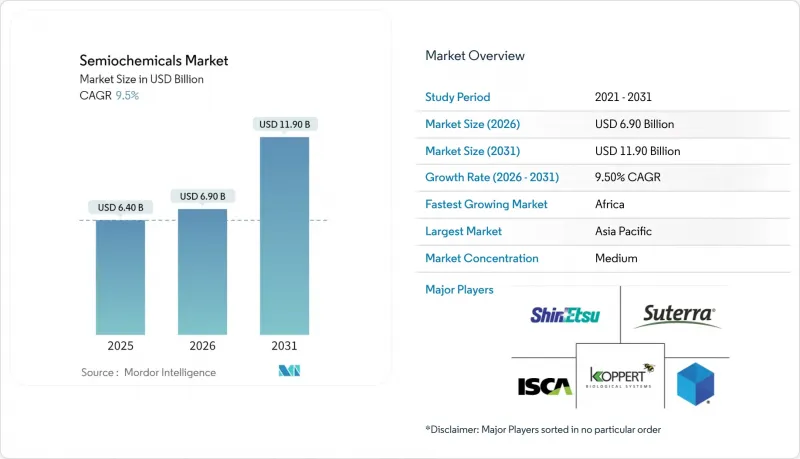
본 보고서는 제품 유형(페로몬, 카이로몬, 알로몬 등), 원료(식물 유래, 합성 등), 용도(해충 모니터링, 교미 억제, 대량 포획 등), 가축 유형(가금류, 돼지, 수산 양식 등), 지역(북미, 남미, 유럽 등)별로 분류되어 있습니다. 시장 전망은 금액(달러) 기준으로 제시되어 있습니다.
세계의 신호화학물질 시장 동향 및 인사이트
고부가가치 과수 작물에 페로몬 기반 교미 억제 기술 도입
교미 저해는 내성을 유발하지 않으면서 대상 해충의 개체 수를 억제하는 효과가 있기 때문에 아몬드, 피스타치오, 호두 과수원에서 널리 채택되고 있는 신호화학물질 전략입니다. Suterra의 에어로졸식 Puffer 장치는 1에이커당 1대 비율로 설치되어 있으며, 현재 캘리포니아주에서 40만 에이커 이상에 도입되어 있습니다. 이 방법은 모니터링 트랩과 병행하여 나벨 오렌지 벌레로 인한 피해를 50% 이상 줄였습니다. 이 기술을 통해 살충제의 반복적인 살포 필요성을 최소화하고, 수출 인증에 차질을 빚을 수 있는 잔류 농약 수준을 낮추며, 종합 해충 관리 프로그램에 필수적인 유익한 절지동물의 보호에도 기여합니다. 또한, 생산자들로부터는 시즌당 1회의 보충 일정과 살포 횟수의 감소로 인해 운영 비용이 절감되었습니다는 보고가 접수되고 있습니다. 일반 살충제의 효과가 떨어지고, 잔류 농약이 없는 농산물에 대한 소비자 수요가 계속 증가함에 따라, 이 기법의 도입은 포도나 감귤류 과수원으로 확대되고 있습니다.
광역 살충제 규제 및 사용 금지와 생물학적 해결책의 중시
2024년 12월까지 클로티아니딘, 이미다클로프리드, 티아메톡삼을 단계적으로 폐지하기로 한 영국의 결정은 농약 규제가 전 세계적으로 강화되고 있는 추세를 여실히 보여주고 있습니다. 유럽연합(EU)에서는 직쇄형 나비목 페로몬이 간소화된 승인 절차의 혜택을 받고 있어, 신청 서류 작성 비용 절감과 제품 포트폴리오 확대가 촉진되고 있습니다. 이러한 규제상의 이점은 기존 데이터 패키지를 보유한 기존 기업의 상품화를 가속화하는 한편, 신규 카이로몬에 대해서는 완전한 독성 평가를 실시해야 할 의무가 부과됩니다. 이러한 격차로 인해, 수확량을 희생하지 않으면서도 규제 요건을 충족하고자 하는 생산자들에게 신호화학물질의 매력이 커지고 있으며, 신호화학물질 시장은 두 자릿수 성장률을 향해 나아가고 있습니다.
높은 제제화 및 마이크로캡슐화 비용
제조업체는 서방형 시스템에 폴리머 코팅이나 메조포러스 실리카를 사용할 경우, 1Kg당 50-150달러의 추가 비용이 발생합니다. 아몬드나 와인용 포도 재배자들은 재살포 횟수 감소로 인한 비용 절감의 혜택을 누리고 있지만, 이익률이 낮은 옥수수나 쌀 재배자들은 보다 신중한 태도를 보이고 있습니다. 산업 규모의 발효에는 전망이 있지만, 에난티오머의 순도와 안정적인 수율을 확보하기 위해서는 막대한 자본이 필요합니다. Unife의 보고에 따르면, 유럽연합(EU)의 민관 공동 이니셔티브는 불과 2시즌 만에 비용을 50% 절감하기 위한 공정 최적화 시험을 지원하고 있습니다. 그러나 이러한 진전이 이루어지기 전까지는 가격 문제가 주식으로 활용되는 광역 작물의 광범위한 도입에 있어 계속해서 걸림돌이 되고 있습니다.
부문별 분석
페로몬은 신호화학물질 시장에서 가장 큰 점유율을 차지했으며, 2025년에는 44%에 달했습니다. 한편, 블렌드는 가장 빠르게 성장할 부문이 될 것으로 예상되며, 2026년부터 2031년까지의 연평균 성장률(CAGR)은 15.8%로 전망됩니다. 이러한 성장은 내성 강화 및 해충 발생 주기의 중복에 대처하기 위해 생산자들 사이에서 다분자 솔루션으로의 전환이 진행되고 있음을 반영합니다. 포장 시험에 따르면, 성 페로몬과 숙주 식물의 카이로몬을 혼합한 제제는 1헥타르당 여러 대상 종에 대해 피해를 최대 70%까지 줄일 수 있는 것으로 나타났습니다. 또한, 기피 작용을 하는 알로몬과 천적 유인 작용을 하는 시노몬을 포함한 60종 이상의 후보 혼합물을 추적하는 조사 파이프라인은 시장 내 지속적인 혁신을 뒷받침하고 있습니다.
이 시장의 성장은 농약 잔류물에 대한 소비자의 용인도가 낮아지고, 농산물 소매업체의 감사 요건이 강화됨에 따라 주도되고 있습니다. 각 제조업체는 인공지능을 활용한 배합 기술을 통해 각 성분의 방출 곡선을 동기화하여, 생육 기간 내내 균형 잡힌 비율을 유지하고 있습니다. 라이선스 계약을 통해 특수 작물 생산자들은 자신의 특정 해충 군에 맞추어 맞춤 제작된 카트리지로 디스펜서를 보충할 수 있게 되어, 지속적인 수익원이 창출되고 있습니다. 또한, 규제 변경에 따라 단계적으로 폐지되고 있는 곤충 성장 조절제를 대체하여 혼합 제품이 보급됨에 따라, 신호화학물질 시장은 회복력을 높이고 있으며, 단일 작용형 내성의 발생 위험이 줄어들고 있습니다.
2025년 시점에서 합성 페로몬은 신호화학물질 시장에서 38%의 최대 점유율을 차지하고 있었으나, 유기 인증에 대한 수요 증가와 소비자의 신뢰를 배경으로, 식물 유래 휘발성 물질은 2026년부터 2031년에 걸쳐 연평균 성장률(CAGR) 14.6%로 가장 빠르게 성장하는 부문이 될 것으로 예측됩니다. 티몰, 오이게놀, 게라니올 등을 수증기 증류법으로 추출한 에센셜 오일은 기피제와 미생물 억제제라는 이중 기능을 갖추고 있어, 행동 조절과 생물학적 활성 조절을 결합한 하이브리드 제제의 개발을 가능하게 합니다.
신선 바이오매스에서 추출되는 정유 수율이 0.3-2.0%로 낮기 때문에 공급망은 어려움에 직면해 있으며, 기업들은 생산 전용 경작지를 확보해야 하는 압박을 받고 있습니다. 로즈마리와 바질의 대사공학 분야에서의 진전은 휘발성 화합물의 생산량을 3배로 늘리는 것을 목표로 하고 있는 반면, 친환경 추출 기술은 용매 폐기물을 최소화하는 것을 목표로 하고 있습니다. 합성생물학 기업들은 계절적인 공급 부족에 대처하기 위해 테르펜 경로의 효모 발효 기술을 활용하고 있습니다. 합성 백본 페로몬과 식물 유래 부스터를 결합한 통합 솔루션은 두 접근 방식의 장점을 활용하여 단일 제제 내에서 규제, 비용, 효능 요건을 모두 충족합니다.
지역별 분석
2025년, 아시아태평양은 신호화학물질 시장에서 33%라는 가장 높은 시장 점유율을 차지했습니다. 이러한 우위는 중국과 인도의 유기농 경작지 면적 합계에 의해 뒷받침되고 있습니다. 페로몬 트랩이나 마이크로 스프링클러를 활용한 교미 억제 시스템을 도입하는 실증 농장에 대한 자금 지원을 포함한 정부의 이니셔티브는 농업 관행 개선에 있어 매우 중요한 역할을 해왔습니다. 이러한 조치들은 해충 관련 문제를 해결함으로써 채소의 불량률을 대폭 낮추고, 이를 통해 생산자들의 신뢰를 높이며, 지역 전체에 걸쳐 신호화학물질의 도입을 촉진하고 있습니다.
아프리카는 2026년부터 2031년까지 연평균 성장률(CAGR) 14.9%를 기록하며, 신호화학물질 시장에서 가장 빠르게 성장하는 지역이 될 것으로 전망됩니다. 이러한 성장은 망고, 아보카도, 절화 등 잔류 농약이 없는 수출 작물에 초점을 맞춘, 기부자 지원에 의한 통합 해충 관리(IPM) 프로그램에 의해 주도되고 있습니다. 동아프리카의 고습도 환경에도 견딜 수 있게 된 기후 변화에 강한 제제의 발전 덕분에, 유인제의 유효 기간이 3개월에서 6개월로 연장되었습니다. 또한, 아프리카 대륙 자유무역지대(AfCFTA) 하에서의 정책 조화를 통해 등록 장벽이 낮아지고, 지역적 승인이 촉진되며, 보다 광범위한 시장 확대가 뒷받침되고 있습니다.
북미에서는 신호화학물질 시장이 견과류 및 핵과류 과수원에서 높은 도입 실적을 보이고 있습니다. 그러나 시장 침투율이 포화 상태에 가까워짐에 따라 성장은 정체 국면에 접어들고 있습니다. 한편, 옥수수 재배 지역에서는 피해가 계속 확대되고 있는 가운데, Provivi, Inc.의 비용 효율이 뛰어난 페로몬 향주머니가 2차 해충의 발생을 유발하지 않으면서 가을 군충의 피해를 효과적으로 줄이고 있습니다. 남미에서는 마토그로소 주의 곡물 수송 회랑 인근에 콜드체인 허브가 설립됨에 따라 시장 침투가 가속화되고 있습니다. 이러한 허브들은 그동안 수요를 저해하던 제품 품질 유지와 관련된 과제를 해결함으로써, 더욱 강력한 시장 성장을 가능하게 하고 있습니다.
기타 혜택 :
- 엑셀 형식 시장 예측(ME) 시트
- 3개월간의 애널리스트 지원
자주 묻는 질문
목차
제1장 서론
제2장 조사 방법
제3장 주요 요약
제4장 시장 구도
제5장 시장 규모 및 성장 예측
제6장 경쟁 구도
제7장 시장 기회 및 향후 전망
KTH 26.06.26According to Mordor Intelligence, the semiochemicals market was valued at USD 6.40 billion in 2025 and is projected to grow from USD 6.90 billion in 2026 to USD 11.90 billion by 2031, registering a CAGR of 9.50% during the forecast period 2026-2031.
This report is Segmented by Product Type (Pheromones, Kairomones, Allomones, and More), by Source (Plant-Derived, Synthetic, and More), by Application (Pest Monitoring, Mating Disruption, Mass Trapping, and More), by Livestock Species (Poultry, Swine, Aquaculture, and More), and by Geography (North America, South America, Europe, and More). The Market Forecasts are Provided in Terms of Value (USD).
Global Semiochemicals Market Trends and Insights
Adoption of Pheromone-Based Mating-Disruption in High-Value Fruit Crops
Mating disruption has become a widely adopted semiochemical strategy in almond, pistachio, and walnut orchards due to its effectiveness in suppressing target pest populations without promoting resistance. Suterra's aerosol Puffer devices, deployed at a rate of one unit per acre, now cover over 400,000 acres in California. This method has reduced navel orangeworm damage by more than 50% when combined with monitoring traps . The technique minimizes the need for repeated insecticide applications, reduces residue levels that could jeopardize export certification, and helps preserve beneficial arthropods essential for integrated pest management programs. Additionally, growers report operational cost savings due to the once-per-season refill schedule and fewer sprayer passes. The adoption of this approach is expanding into grape and citrus orchards as generic insecticides become less effective and consumer demand for residue-free produce continues to grow.
Regulatory Bans on Broad-Spectrum Pesticides Favoring Bio-Rational Solutions
England's decision to phase out clothianidin, imidacloprid, and thiamethoxam by December 2024 highlights a global trend toward stricter pesticide regulations . In the European Union, straight-chain lepidopteran pheromones benefit from a streamlined approval process, reducing dossier costs and fostering portfolio expansion. This regulatory advantage accelerates commercialization for established players with existing data packages, while new kairomones are required to undergo full toxicology assessments. This disparity increases the attractiveness of semiochemicals for growers aiming to meet regulatory requirements without compromising yields, driving the semiochemicals market toward double-digit growth rates.
High Formulation and Micro-Encapsulation Costs
Manufacturers incur an added cost of USD 50-150 per kilogram when using polymer coatings or mesoporous silica in controlled-release systems. While almond and wine grape growers benefit from savings due to reduced re-sprays, those cultivating maize or rice, operating on tighter margins, are more cautious. There's promise in industrial-scale fermentation, yet the pursuit of enantiomeric purity and stable yields demands significant capital. As reported by Unife, public-private initiatives in the European Union are backing process-optimization trials to cut costs by 50% in just two seasons. However, until such advancements materialize, the pricing remains a barrier for widespread adoption in staple broadacre crops.
Other drivers and restraints analyzed in the detailed report include:
- Rapid Expansion of Organic Acreage in Asia-Pacific
- Feed Conversion-Efficiency Gains in Poultry Through Kairomone Blends
- Limited Field-Efficacy Data Under Tropical Humidity
For complete list of drivers and restraints, kindly check the Table Of Contents.
Segment Analysis
Pheromones accounted for the largest share of the semiochemicals market, representing 44% in 2025. Meanwhile, blends are anticipated to be the fastest-growing segment, with a projected CAGR of 15.8% from 2026 to 2031. This growth reflects a shift among growers toward multi-molecule solutions to address rising resistance and overlapping pest cycles. Field studies suggest that blends combining sex pheromones with host-plant kairomones can reduce infestation by up to 70% across multiple target species per hectare. Furthermore, research pipelines tracking over 60 candidate blends, including allomones for repellency and synomones for natural enemy attraction, underscore ongoing innovation in the market.
The market's growth is driven by increasing consumer intolerance for pesticide residues and heightened audit requirements from produce retailers. Manufacturers are utilizing artificial intelligence-guided formulation techniques to synchronize the release curves of each component, ensuring balanced ratios throughout the growing season. Licensing agreements enable specialty-crop growers to refill dispensers with custom canisters tailored to their specific pest complexes, fostering recurring revenue streams. Additionally, the semiochemicals market is gaining resilience as blends replace insect growth regulators that are being phased out due to regulatory changes, reducing the likelihood of single-mode resistance outbreaks.
Synthetic pheromones held the largest market share in the semiochemicals market at 38% in 2025, while plant-derived volatiles are projected to be the fastest-growing segment at a CAGR of 14.6% from 2026 to 2031, driven by increasing demand for organic certification and consumer trust. Steam-distilled essential oils such as thymol, eugenol, and geraniol offer dual functionality as repellents and microbial inhibitors, enabling hybrid formulations that combine behavioral and bioactive control.
Supply chains face challenges due to the low essential oil yields of 0.3-2.0% from fresh biomass, prompting companies to secure dedicated acreage for production. Advances in metabolic engineering of rosemary and basil are targeting a three-fold increase in volatile compound output, while green extraction technologies aim to minimize solvent waste. Synthetic biology companies are utilizing yeast fermentation of terpene pathways to address seasonal supply gaps. Integrated solutions combining synthetic backbone pheromones with plant-derived boosters leverage the advantages of both approaches, addressing regulatory, cost, and efficacy requirements within a single formulation.
Geography Analysis
Asia-Pacific held the largest market share of the semiochemicals market at 33% in 2025. This dominance is supported by the combined organic acreage of China and India. Government initiatives, including funding for demonstration farms that utilize pheromone traps and micro-sprinkler mating-disruption systems, have played a crucial role in improving agricultural practices. These measures have significantly reduced vegetable rejection rates by addressing pest-related challenges, thereby enhancing grower confidence and encouraging the adoption of semiochemicals across the region.
Africa is projected to be the fastest-growing region in the semiochemicals market, with a CAGR of 14.9% from 2026 to 2031. Growth is fueled by donor-supported integrated pest management programs that focus on residue-free export crops such as mangoes, avocados, and cut flowers. Advances in climate-resilient formulations, which now endure high humidity in East Africa, have extended lure life from three to six months. Additionally, policy harmonization under the African Continental Free Trade Area is reducing registration barriers, facilitating regional approvals, and supporting broader market expansion.
In North America, the semiochemicals market shows a high installed base in tree nuts and pome fruit orchards. However, growth is plateauing as market penetration nears saturation. Expansion persists in maize-growing regions, where Provivi, Inc.'s cost-effective pheromone sachets effectively reduce fall armyworm pressure without triggering secondary pest outbreaks. In South America, market uptake is accelerating with the establishment of cold-chain hubs near Mato Grosso grain corridors. These hubs address product-integrity challenges that previously hindered demand, enabling stronger market growth.
- Suterra LLC
- Shin-Etsu Chemical Co., Ltd.
- Koppert Biological Systems B.V.
- ISCA Technologies, Inc.
- Russell IPM Ltd
- Provivi, Inc.
- Bedoukian Research, Inc.
- Trece, Inc.
- Biobest Group NV
- BASF SE
- Mitsui Chemicals Agro, Inc.
- Sumitomo Chemical Co., Ltd.
- FMC Corporation
- SemiosBio Technologies Inc.
- Exosect Ltd.
Additional Benefits:
- The market estimate (ME) sheet in Excel format
- 3 months of analyst support
TABLE OF CONTENTS
1 Introduction
- 1.1 Study Assumptions and Market Definition
- 1.2 Scope of the Study
2 Research Methodology
3 Executive Summary
4 Market Landscape
- 4.1 Market Overview
- 4.2 Market Drivers
- 4.2.1 Adoption of pheromone-based mating-disruption in high-value fruit crops
- 4.2.2 Regulatory bans on broad-spectrum pesticides favoring bio-rational solutions
- 4.2.3 Rapid expansion of organic acreage in Asia-Pacific
- 4.2.4 Feed conversion-efficiency gains in poultry through kairomone blends
- 4.2.5 Precision-ag platforms integrating semiochemical dispensers
- 4.2.6 Emergence of climate-resilient semiochemical formulations
- 4.3 Market Restraints
- 4.3.1 High formulation and micro-encapsulation costs
- 4.3.2 Limited field-efficacy data under tropical humidity
- 4.3.3 Fragmented distribution in South America smallholder channels
- 4.3.4 Regulatory uncertainty over synthetic-analog approvals in Europe
- 4.4 Regulatory Landscape
- 4.5 Technological Outlook
- 4.6 Porter's Five Forces Analysis
- 4.6.1 Threat of New Entrants
- 4.6.2 Bargaining Power of Suppliers
- 4.6.3 Bargaining Power of Buyers
- 4.6.4 Threat of Substitutes
- 4.6.5 Intensity of Competitive Rivalry
5 Market Size and Growth Forecasts (Value)
- 5.1 By Product Type
- 5.1.1 Pheromones
- 5.1.2 Kairomones
- 5.1.3 Allomones
- 5.1.4 Synomones
- 5.1.5 Semiochemical Blends
- 5.2 By Source
- 5.2.1 Plant-derived
- 5.2.2 Insect-derived
- 5.2.3 Synthetic
- 5.3 By Application
- 5.3.1 Pest Monitoring
- 5.3.2 Mating Disruption
- 5.3.3 Mass Trapping
- 5.3.4 Livestock Feed-Intake Modulation
- 5.3.5 Stress Reduction and Welfare
- 5.4 By Livestock Species
- 5.4.1 Poultry
- 5.4.2 Swine
- 5.4.3 Ruminants (Cattle, Sheep, Goat)
- 5.4.4 Aquaculture
- 5.4.5 Other Livestock Species
- 5.5 By Geography
- 5.5.1 North America
- 5.5.1.1 United States
- 5.5.1.2 Canada
- 5.5.1.3 Mexico
- 5.5.1.4 Rest of North America
- 5.5.2 South America
- 5.5.2.1 Brazil
- 5.5.2.2 Argentina
- 5.5.2.3 Rest of South America
- 5.5.3 Europe
- 5.5.3.1 Germany
- 5.5.3.2 France
- 5.5.3.3 United Kingdom
- 5.5.3.4 Italy
- 5.5.3.5 Spain
- 5.5.3.6 Russia
- 5.5.3.7 Rest of Europe
- 5.5.4 Asia-Pacific
- 5.5.4.1 China
- 5.5.4.2 India
- 5.5.4.3 Japan
- 5.5.4.4 Australia
- 5.5.4.5 South Korea
- 5.5.4.6 Rest of Asia-Pacific
- 5.5.5 Middle East
- 5.5.5.1 Saudi Arabia
- 5.5.5.2 Turkey
- 5.5.5.3 United Arab Emirates
- 5.5.5.4 Rest of Middle East
- 5.5.6 Africa
- 5.5.6.1 South Africa
- 5.5.6.2 Nigeria
- 5.5.6.3 Egypt
- 5.5.6.4 Rest of Africa
- 5.5.1 North America
6 Competitive Landscape
- 6.1 Market Concentration
- 6.2 Strategic Moves
- 6.3 Market Share Analysis
- 6.4 Company Profiles (Includes Global level Overview, Market level overview, Core Segments, Financials as available, Strategic Information, Market Rank/Share for key companies, Products and Services, and Recent Developments)
- 6.4.1 Suterra LLC
- 6.4.2 Shin-Etsu Chemical Co., Ltd.
- 6.4.3 Koppert Biological Systems B.V.
- 6.4.4 ISCA Technologies, Inc.
- 6.4.5 Russell IPM Ltd
- 6.4.6 Provivi, Inc.
- 6.4.7 Bedoukian Research, Inc.
- 6.4.8 Trece, Inc.
- 6.4.9 Biobest Group NV
- 6.4.10 BASF SE
- 6.4.11 Mitsui Chemicals Agro, Inc.
- 6.4.12 Sumitomo Chemical Co., Ltd.
- 6.4.13 FMC Corporation
- 6.4.14 SemiosBio Technologies Inc.
- 6.4.15 Exosect Ltd.


