

|
시장보고서
상품코드
2061986
카이로몬 시장 : 점유율 분석, 업계 동향과 통계, 성장 예측(2026-2031년)Kairomones - Market Share Analysis, Industry Trends & Statistics, Growth Forecasts (2026 - 2031) |
||||||
 Mordor Intelligence
Mordor Intelligence에 의하면, 카이로몬 시장 규모는 2025년 8억 달러에서 2026년에는 9억 달러로 확대되어 2031년까지 16억 3,000만 달러에 이를 것으로 예측되며, 2026년부터 2031년까지 기간 CAGR은 12.6%를 나타낼 전망입니다.
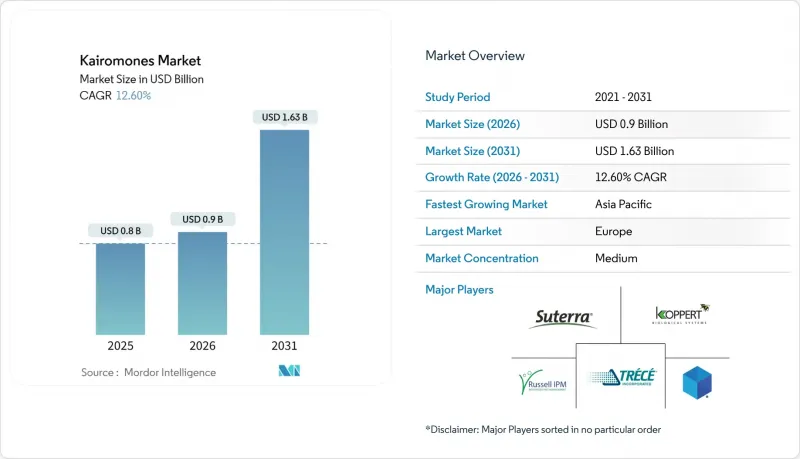
본 보고서는 기능별(대량 포획, 감지 및 감시, 교미 억제, 기타 기능), 작물 유형별(밭작물, 원예작물, 플랜테이션 작물, 화훼 재배, 기타 작물 유형), 지역별(북미, 남미, 유럽, 아시아태평양, 중동 및 아프리카)로 분류되어 있습니다. 시장 전망은 금액(달러) 기준으로 제시되어 있습니다.
세계 카이로몬 시장 동향 및 분석
광역 살충제 대체를 위한 규제 움직임
각국 정부는 잔류 기준 강화에 나서고 있으며, 이에 따라 생산자들은 위험이 적은 대체 수단을 도입해야 하는 상황에 처해 있습니다. 이러한 변화로 인해, 통합 해충 관리(IPM) 체계 내에서 카이로몬 유인제의 사용이 확대되고 있습니다. 2022년 유럽연합(EU)이 제안한 ‘지속 가능한 사용 규정(SUR)’은 비화학적 대체 수단의 사용을 장려하고, 2030년까지 위험을 50% 감축함으로써 통합 해충 관리(IPM)의 도입을 촉진하는 것을 목표로 하고 있습니다. 캐나다에서는 캐나다 보건부의 농약 재평가 프로그램이 세미케미컬 물질에 대한 심사를 지속적으로 진행하고 있으며, 지속적인 규제 감독이 이루어지고 있습니다. 이러한 규제 동향은 살충제 사용 감소를 촉진하고, 생산자들이 GlobalG.A.P.나 레인포레스트 얼라이언스 등의 인증 기준을 충족할 수 있도록 지원하고 있습니다.
바이오 발효 반합성 원료의 단가 하락
바이오 발효 세미케미컬의 단가 하락으로 인해, 작물 보호 분야에서 카이로몬 기반 솔루션의 도입이 확대되고 있습니다. 대사 공학 및 발효 공정의 개선을 통해 생산 효율이 향상되었으며, 복잡한 휘발성 화합물을 확장 가능하고 비용 효율적인 방식으로 제조할 수 있게 되었습니다. 예를 들어, 2021년 『Bioengineering and Biotechnology』지에 게재된 연구에 따르면, 유전자 변형 Yarrowia lipolytica는 곤충 페로몬 및 관련 세미오케미컬을 생산하기 위한 효과적인 미생물 플랫폼으로 기능하는 것으로 나타났습니다. 대사공학의 발전으로 인해, 기존의 미생물 시스템에 비해 생산 효율이 현저히 향상되었습니다.
다자간 등록 비용의 고가
유럽연합(EU)에서는 유효 성분별로 동일성, 순도, 효능 및 환경 동태에 관한 자료를 작성하는 데 막대한 비용이 소요되며, 승인 절차에는 수년이 걸립니다. 일본이나 호주에서도 유사한 규제상의 과제가 존재하기 때문에 Suterra LLC와 같은 자금력이 풍부한 기업은 경쟁 우위를 점하고 있지만, 소규모 혁신 기업들은 독자적으로 등록 절차를 진행하기보다는 제제 라이선싱을 선택하는 경우가 많습니다. 경제협력개발기구(OECD)의 바이오 농약 운영 그룹에 따르면, 상호 승인 체제를 확립하기 위한 노력이 진행되고 있으나, 그 진전은 여전히 더딘 상태입니다.
부문별 분석
감지 및 모니터링 부문은 카이로몬 시장에서 여전히 가장 큰 점유율을 차지하고 있으며, 2025년에는 시장 점유율의 41%를 차지할 것으로 전망됩니다. 그러나 이 부문은 유인제를 활용한 조사 기법이 이미 널리 채택되고 있는 유럽이나 북미 등의 지역에서는 점차 성숙 단계에 접어들고 있습니다. 교미 억제제 시장 규모는 가장 높은 성장률을 보일 것으로 예상되며, 2026년부터 2031년까지 연평균 성장률(CAGR) 18%로 확대되어 전체 시장의 성장률인 12.6%를 상회할 것으로 전망됩니다. 이러한 성장은 생산 비용의 감소와 대규모 작물 보호 전략의 도입 확대에 힘입어 이루어지고 있습니다. 한편, 케냐나 브라질 등의 지역에서는 가혹한 환경 조건에서도 현장에서의 성능을 향상시키는 제제 기술의 발전에 힘입어, 대량 포획법이 꾸준히 보급되고 있습니다.
2022년, 지속 가능한 페로몬 해충 방제 솔루션의 세계 공급업체인 Suterra LLC는 자사의 4가지 기존 제품이 유기농 농업 생산에 사용하기 위해 유기농 재료 심사 기관(OMRI)에 등록되었다고 발표했습니다. 또한, 케냐의 원예 분야에서 러셀 IPM(Russell IPM Ltd)이 제공하는 인공지능(AI) 탑재 트랩 시스템은 교미 억제 프로그램과 연동된 데이터 기반의 해충 방제 판단을 가능하게 하고 있습니다. 이러한 동향은 최근 업계 전반에서 관찰되는 즉 ‘감지 중심 솔루션’에서 ‘차단 전략’으로의 전환을 반영하고 있습니다. 이러한 변화는 디지털 농업 도구의 통합에 의해 영향을 받고 있습니다.
지역별 분석
카이로몬 시장에서 유럽은 2025년 기준 29%의 시장 점유율을 차지하며, 여전히 가장 규모가 큰 지역 시장으로 자리 잡고 있습니다. 이러한 우위는 프랑스, 독일, 네덜란드 등의 국가에서 확립된 견고한 규제 체계와 통합 해충 관리(IPM) 기법의 광범위한 도입에 기인합니다. 이 지역은 지속 가능한 농업을 위한 정책 주도적 전환, 바이오 반화학 물질의 현지 생산 증가, 그리고 지역 혁신 프로그램에 대한 적극적인 참여의 혜택을 누리고 있습니다. 또한, 동유럽 시장에서는 지속가능성에 중점을 둔 농업 이니셔티브에 힘입어 카이로몬 기반 솔루션이 점차 도입되고 있습니다.
아시아태평양 시장 규모는 가장 높은 성장률을 보일 것으로 예상되며, 2026년부터 2031년까지 연평균 성장률(CAGR) 15.8%를 나타낼 것으로 전망됩니다. 이 지역의 성장은 중국과 인도 등 국가들의 바이오 농약 도입 확대, 우호적인 정부 정책, 그리고 국내 생산 능력 향상 등에 힘입어 이루어지고 있습니다. 특히 고부가가치 작물 재배 시스템 분야에서 디지털 농업 도구와 반화학 물질의 활용을 통합하려는 움직임도 확산되고 있습니다. 그러나 농촌 지역의 인프라 및 도입과 관련된 과제로 인해, 지역 전체 시장 확대 속도에 차이가 나타나고 있습니다.
북미는 카이로몬 시장의 규제 및 혁신 거점으로서 계속해서 매우 중요한 역할을 수행하고 있습니다. 정책의 변화에 따라 생산자들 사이에서 세미오케미컬(반화학물질) 기반 솔루션의 도입이 확산되고 있습니다. 남미에서는 협동조합 주도의 유통 모델과 상업 농업 분야의 지속 가능한 해충 관리 기법의 보급 확대를 통해 시장 내 입지를 강화하고 있습니다. 아프리카와 중동에서는 특히 농장 및 수출용 작물 분야에서 카이몬 기반 솔루션이 점차 보급되고 있습니다. 이러한 성장은 모니터링 기술의 발전과 잔류물이 없는 농업 관행에 대한 인식 제고에 힘입은 것입니다.
기타 혜택:
- 엑셀 형식 시장 예측(ME) 시트
- 3개월간의 애널리스트 지원
자주 묻는 질문
목차
제1장 서론
제2장 조사 방법
제3장 주요 요약
제4장 시장 구도
제5장 시장 규모와 성장 예측
제6장 경쟁 구도
제7장 시장 기회와 향후 전망
JHS 26.06.19According to Mordor Intelligence, the kairomones market size is projected to grow from USD 0.80 billion in 2025 to USD 0.90 billion in 2026, reaching USD 1.63 billion by 2031, with a CAGR of 12.6% during the 2026-2031 period.
This report is Segmented by Function (Mass Trapping, Detection and Monitoring, Mating Disruption, and Other Functions), by Crop Type (Field Crops, Horticulture Crops, Plantation Crops, Floriculture, and Other Crop Types), and by Geography (North America, South America, Europe, Asia-Pacific, Middle East, and Africa). The Market Forecasts are Provided in Terms of Value (USD).
Global Kairomones Market Trends and Insights
Regulatory Push to Replace Broad-Spectrum Insecticides
Governments are increasingly implementing stricter residue limits, prompting growers to adopt low-risk alternatives. This shift is encouraging the use of kairomone lures within integrated pest management (IPM) frameworks. The Sustainable Use Regulation (SUR), proposed by the European Union in 2022, seeks to enhance the adoption of integrated pest management (IPM) by encouraging the use of non-chemical alternatives and reducing the risk by 50% by 2030. In Canada, Health Canada's pesticide re-evaluation programs continue to review semiochemical substances, demonstrating ongoing regulatory oversight. These regulatory developments promote reduced insecticide usage and assist growers in meeting certification standards such as GlobalG.A.P. and Rainforest Alliance.
Falling Unit-Cost of Bio-Fermented Semiochemicals
Declining unit costs of bio-fermented semiochemicals are driving increased adoption of kairomone-based solutions in crop protection. Improvements in metabolic engineering and fermentation processes have enhanced production efficiency, enabling scalable and cost-effective manufacturing of complex volatile compounds. For instance, a study published in Bioengineering and Biotechnology in 2021 indicates that engineered Yarrowia lipolytica serves as an effective microbial platform for producing insect pheromones and related semiochemicals. Advances in metabolic engineering have notably enhanced production efficiency compared to previous microbial systems.
High Multi-Jurisdictional Registration Fees
The preparation of identity, purity, efficacy, and environmental fate dossiers incurs high costs per active substance in the European Union, with approval processes taking several years. Comparable regulatory challenges in Japan and Australia provide a competitive edge to well-funded companies like Suterra LLC, while smaller innovators often opt to license formulations instead of pursuing independent registrations. According to the Organisation for Economic Co-operation and Development Biopesticide Steering Group, efforts are being made to establish mutual recognition frameworks, though progress remains slow.
Other drivers and restraints analyzed in the detailed report include:
- Precision-Ag Adoption of Smart Kairomone Lures
- Climate-Smart Repellent Portfolios for Heat-Stressed Regions
- Field Instability in Hot and Humid Climates
For complete list of drivers and restraints, kindly check the Table Of Contents.
Segment Analysis
The detection and monitoring segment remains the largest in the kairomones market, accounting for 41% of the market share in 2025. However, this segment is maturing in regions such as Europe and North America, where lure-based scouting methods are already widely adopted. The mating disruption market size is projected to grow at the fastest rate, with a CAGR of 18% from 2026 to 2031, surpassing the overall market growth rate of 12.6%. This growth is driven by declining production costs and increasing adoption in large-scale crop protection strategies. Meanwhile, mass trapping continues to gain steady traction in regions like Kenya and Brazil, supported by advancements in formulation technologies that improve field performance under challenging environmental conditions.
In 2022, Suterra LLC, a global provider of sustainable pheromone pest control solutions, announced that four of its established products are now listed with the Organic Materials Review Institute (OMRI) for use in organic agricultural production. Further, Russell IPM Ltd's artificial intelligence (AI)-enabled trapping systems in Kenya's floriculture sector, facilitating data-driven pest control decisions in alignment with mating disruption programs. These developments reflect a broader industry trend observed in recent years, transitioning from detection-focused solutions to disruption strategies. This shift is influenced by the integration of digital agriculture tools.
Geography Analysis
Europe remained the largest regional segment in the kairomones market, holding a 29% market share in 2025. This dominance is attributed to robust regulatory frameworks and the widespread adoption of integrated pest management practices in countries such as France, Germany, and the Netherlands. The region benefits from policy-driven transitions toward sustainable agriculture, increased local production of bio-based semiochemicals, and active participation in regional innovation programs. Additionally, Eastern European markets are gradually adopting kairomone-based solutions, supported by sustainability-focused agricultural initiatives.
The Asia-Pacific market size is projected to grow at the fastest rate, with a projected CAGR of 15.8% from 2026 to 2031. Growth in this region is driven by increasing biopesticide adoption, favorable government policies, and rising domestic production capabilities in countries like China and India. The integration of digital agriculture tools with semiochemical applications, particularly in high-value crop systems, is also gaining traction. However, infrastructure and adoption challenges in rural areas create a varied pace of market expansion across the region.
North America continues to play a pivotal role as a regulatory and innovation hub for the kairomones market. Evolving policies are encouraging broader adoption of semiochemical-based solutions among growers. South America is enhancing its market presence through cooperative-led distribution models and the increasing use of sustainable pest management practices in commercial agriculture. The Middle East and Africa are witnessing a gradual uptake of kairomone-based solutions, particularly in plantation and export-oriented crops. This growth is supported by advancements in monitoring technologies and a growing awareness of residue-free agricultural practices.
- Suterra LLC
- Russell IPM Ltd
- Synergy Semiochemicals Corp.
- Koppert Biological Systems B.V.
- Trece, Inc.
- Bioglobal Holdings Limited
- Chemtica Internacional, S.A.
- Rincon-Vitova Insectaries, Inc.
- Harmony Ecotech Private Limited
- SANIDAD AGRICOLA ECONEX, S.L.
- SOSPALM
- Colkim S.r.l.
- Novagrica Hellas S.A.
- Provivi, Inc.
- ISCA Technologies, Inc.
Additional Benefits:
- The market estimate (ME) sheet in Excel format
- 3 months of analyst support
TABLE OF CONTENTS
1 Introduction
- 1.1 Study Assumptions and Market Definition
- 1.2 Scope of the Study
2 Research Methodology
3 Executive Summary
4 Market Landscape
- 4.1 Market Overview
- 4.2 Market Drivers
- 4.2.1 Regulatory push to replace broad-spectrum insecticides
- 4.2.2 Falling unit-cost of bio-fermented semiochemicals
- 4.2.3 Precision-ag adoption of smart kairomone lures
- 4.2.4 Climate-smart repellent portfolios for heat-stressed regions
- 4.2.5 Clustered Regularly Interspaced Short Palindromic (CRISPR)-engineered microbial chassis for volatile synthesis
- 4.2.6 Digital-twin modeling that optimizes kairomone release
- 4.3 Market Restraints
- 4.3.1 High multi-jurisdictional registration fees
- 4.3.2 Field instability in hot and humid climates
- 4.3.3 Patchy last-mile distribution in developing agri-economies
- 4.3.4 Brand cannibalization from low-priced synthetic pheromones
- 4.4 Regulatory Landscape
- 4.5 Technological Outlook
- 4.6 Porter's Five Forces Analysis
- 4.6.1 Threat of New Entrants
- 4.6.2 Bargaining Power of Suppliers
- 4.6.3 Bargaining Power of Buyers
- 4.6.4 Threat of Substitutes
- 4.6.5 Intensity of Competitive Rivalry
5 Market Size and Growth Forecasts (Value)
- 5.1 By Function
- 5.1.1 Mass Trapping
- 5.1.2 Detection and Monitoring
- 5.1.3 Mating Disruption
- 5.1.4 Other Functions
- 5.2 By Crop Type
- 5.2.1 Field Crops
- 5.2.2 Horticulture Crops
- 5.2.3 Plantation Crops
- 5.2.4 Floriculture
- 5.2.5 Other Crop Types
- 5.3 By Geography
- 5.3.1 North America
- 5.3.1.1 United States
- 5.3.1.2 Canada
- 5.3.1.3 Mexico
- 5.3.1.4 Rest of North America
- 5.3.2 South America
- 5.3.2.1 Brazil
- 5.3.2.2 Argentina
- 5.3.2.3 Rest of South America
- 5.3.3 Europe
- 5.3.3.1 Germany
- 5.3.3.2 France
- 5.3.3.3 Russia
- 5.3.3.4 United Kingdom
- 5.3.3.5 Rest of Europe
- 5.3.4 Asia-Pacific
- 5.3.4.1 China
- 5.3.4.2 India
- 5.3.4.3 Japan
- 5.3.4.4 Australia
- 5.3.4.5 Rest of Asia-Pacific
- 5.3.5 Middle East
- 5.3.5.1 Saudi Arabia
- 5.3.5.2 United Arab Emirates
- 5.3.5.3 Rest of Middle East
- 5.3.6 Africa
- 5.3.6.1 South Africa
- 5.3.6.2 Kenya
- 5.3.6.3 Rest of Africa
- 5.3.1 North America
6 Competitive Landscape
- 6.1 Market Concentration
- 6.2 Strategic Moves
- 6.3 Market Share Analysis
- 6.4 Company Profiles (includes Global level Overview, Market level overview, Core Segments, Financials as available, Strategic Information, Market Rank/Share for key companies, Products and Services, and Recent Developments)
- 6.4.1 Suterra LLC
- 6.4.2 Russell IPM Ltd
- 6.4.3 Synergy Semiochemicals Corp.
- 6.4.4 Koppert Biological Systems B.V.
- 6.4.5 Trece, Inc.
- 6.4.6 Bioglobal Holdings Limited
- 6.4.7 Chemtica Internacional, S.A.
- 6.4.8 Rincon-Vitova Insectaries, Inc.
- 6.4.9 Harmony Ecotech Private Limited
- 6.4.10 SANIDAD AGRICOLA ECONEX, S.L.
- 6.4.11 SOSPALM
- 6.4.12 Colkim S.r.l.
- 6.4.13 Novagrica Hellas S.A.
- 6.4.14 Provivi, Inc.
- 6.4.15 ISCA Technologies, Inc.


