

|
시장보고서
상품코드
2114515
IPM 페로몬 시장 : 점유율 분석, 업계 동향과 통계, 성장 예측(2026-2031년)IPM Pheromone - Market Share Analysis, Industry Trends & Statistics, Growth Forecasts (2026 - 2031) |
||||||
 Mordor Intelligence
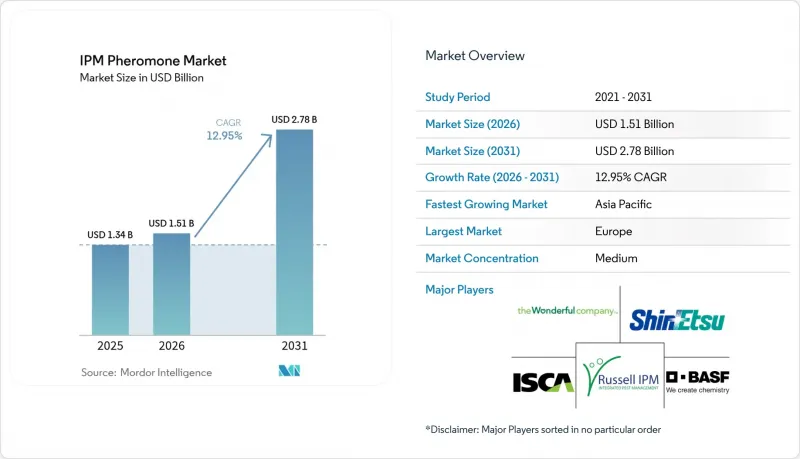
Mordor Intelligence에 의하면, IPM 페로몬 시장 규모는 2025년 13억 4,000만 달러에서 2026년에는 15억 1,000만 달러로 확대되어 2026년부터 2031년까지 CAGR 12.95%로 성장을 지속하여, 2031년까지 27억 8,000만 달러에 이를 것으로 예측됩니다.
본 보고서는 유형(페로몬 등), 기능(교미 억제 등), 적용 방법(트랩, 분무기, 디스펜서), 작물(밭작물, 채소 작물, 기타 작물), 지역(북미, 유럽 등)별로 분류되어 있습니다. 시장 예측은 금액(달러) 기준으로 제시되어 있습니다.
세계 IPM 페로몬 시장 동향 및 인사이트
농지 감소
2000년부터 2020년까지 전 세계 1인당 경작 가능 면적은 20% 감소했습니다. 이에 따라 생산자들은 해충 피해를 억제하면서 제한된 경작 면적에서 더 높은 수확량을 이끌어내야 할 필요가 있습니다. 페로몬을 활용한 통합 해충 관리(IPM)는 자연 방제 작용의 30%에서 40%를 담당하는 유익한 곤충에 악영향을 미치지 않으면서 해충을 정확하게 표적으로 삼을 수 있습니다. 유럽연합(EU)의 ‘농장에서 식탁까지’ 전략에서는 2030년까지 화학 농약 사용량을 50% 감축할 것을 의무화하고 있으며, 이에 따라 고부가가치 작물에서의 페로몬 도입이 가속화되고 있습니다. 아시아태평양의 소규모 농가(경작 면적 2헥타르 미만)는 현재 인도의 ‘지속 가능한 농업에 관한 국가 미션’에서 제공하는 보조금을 활용하여 1헥타르당 20-30개의 트랩을 설치하고 있어 비용 대비 효과가 향상되고 있습니다. 마이크로캡슐화 기술 덕분에 밭에서의 유효 기간이 90일로 연장되어, 노동력 부족 지역에서의 시즌 중 재살포가 최소화되고 있습니다.
지속 가능한 해충 관리에 대한 인식 제고
기업의 지속가능성 목표는 공급망 전체로 파급되고 있으며, 계약 농가들은 IPM(통합 해충 관리)을 채택하지 않으면 공급업체 목록에서 제외될 위험에 직면해 있습니다. 월마트의 ‘프로젝트 기가톤(Project Gigaton)’은 공급업체들에게 농약 사용량 감축 실적을 문서화할 것을 장려하고 있으며, 이로 인해 우선 공급업체들 사이에서 페로몬에 대한 수요가 발생하고 있습니다. 미국 농무부(USDA)의 ‘전국 유기농 프로그램’은 페로몬 사용을 명시적으로 허용하고 있으며, 생산자들에게 630억 달러 규모의 유기농 식품 시장에 대응할 수 있는 적합한 도구를 제공합니다. 잔류물이 없는 농산물에 대해 소비자가 지불할 의사가 있는 금액은 2020년 이후 18% 상승했으며, 이에 따라 인증된 유기농 과일 및 채소의 농가 출하 가격은 1kg당 0.30-0.50달러 상승했습니다. 아시아태평양의 보급 프로그램은 2024년에 230만 명의 소규모 농가에 도달했으며, 도입을 방해하는 요인은 기술 부족이 아니라 대부분의 경우 정보 격차라는 사실이 부각되고 있습니다.
기존 농약에 비해 높은 비용
교미 방해법의 비용은 1에이커당 50-300달러인 반면, 피레스로이드계 농약은 20-80달러로 2.5배에서 3.8배 정도 비싸게 느껴집니다. 이로 인해 1헥타르당 이익이 500달러 미만인 생산자들은 경영에 어려움을 겪고 있습니다. 대량 트랩 방식의 경우, 20-50개의 트랩이 필요하기 때문에 1에이커당 100-400달러의 추가 비용이 발생합니다. 캘리포니아주의 비용 대비 효과 분석에 따르면, 3년 동안 3대 1에서 5대 1의 수익률이 나타났지만, 회수 기간이 18개월을 초과하기 때문에 유동성을 중시하는 1년생 작물 생산자에게는 장벽이 되고 있습니다. 브랜드 제품보다 30%에서 40% 저렴한 제네릭 제품은 종종 효과가 불안정하여 신뢰를 떨어뜨리고 있습니다. 실적 연동형 자금 조달 모델은 여전히 드물며, 도입은 자본력이 있는 농장에 한정되어 있습니다.
부문 분석
2025년, 페로몬은 IPM 페로몬 시장 점유율의 45.40%를 차지하며, 사과바구미, 동양과실나방, 핑크 볼웜에 대한 교미 억제에서 그 우위를 반영하고 있습니다. 여전히 시장 점유율은 작지만, 집결 페로몬은 저장 해충 및 도시 임업 분야의 딱정벌레류에 대한 사용이 증가함에 따라 2031년까지 연평균 성장률(CAGR) 14.85%를 기록할 전망입니다. 집결 페로몬의 IPM 시장 규모는 다른 어떤 유형보다 빠르게 확대될 것으로 예측되지만, 절대적인 매출액은 성 페로몬에 비해 여전히 낮은 수준을 유지하고 있습니다. 신에츠 화학공업은 생산 효율을 높여 단위당 비용을 발효법을 이용한 대체품보다 18%-22% 낮게 유지하고 있습니다. PHERA 프로젝트에 의한 발효 기반 합성은 수명 주기 배출량을 40%-50% 감축하지만, 여전히 비용이 높기 때문에 그 채택은 고급 유기농 제품 시장에 국한되어 있습니다.
집단 페로몬은 경계 행동을 유발하지 않도록 정확한 혼합 비율이 필요하며, 이러한 장벽으로 인해 전 세계에서 시판되는 제품은 10종 미만에 그치고 있습니다. ISCA사의 ‘ACTTRA Percevejo’ 블렌드는 대두 매미충을 방제하는 제품으로, 브라질과 아르헨티나에서 발생하는 20억 달러에 달하는 해충 피해를 해결하고 있습니다. 카이로몬 및 알로몬은 ‘기타’ 범주에 속하며 아직 개발 단계에 있지만, 기피 신호와 유인 신호를 결합한 푸시-풀 방식은 아프리카의 옥수수 재배에서 유망한 것으로 평가받고 있습니다. 2024년 1월 유럽연합(EU) 지침에서 발효 페로몬의 ‘천연 유래’가 인정됨에 따라 규제 당국의 승인 상황은 개선되었으나, 미국에서는 디스펜서에 포함된 미세 플라스틱을 둘러싼 논란이 계속되고 있습니다.
교미 억제법은 과수 작물에서 한 시즌 내내 보호 효과가 지속되기 때문에 2025년에는 IPM 페로몬 시장 점유율의 51.60%를 차지했습니다. 박과나 십자화과 작물에서 이미 중요한 역할을 하고 있는 대량 트랩은 원격 감지를 통해 해충 발생 집중 지역을 특정함으로써,선택적 설치가 가능해짐에 따라 1에이커당 비용을 25%-35% 절감할 수 있어, 2031년까지 연평균 성장률(CAGR) 14.10%를 나타낼 것으로 예측됩니다. 감지 및 모니터링은 여전히 필수적이지만, 최소한의 이익 마진으로 구성되는 경향이 강해지고 있습니다. Suterra사의 ‘CheckMate’ 에어로졸 퍼퍼는 수작업으로 끈을 묶는 과정을 생략함으로써 인건비가 높은 시장에서 노동력을 60% 절감하는 반면, Trece사의 ‘Cidetrak’ 멤브레인은 사막의 혹서 속에서도 안정적인 방출을 보장합니다.
투자 수익률(ROI) 모델 분석에 따르면, 유기농 과수원에서 흔히 발생하는 ‘트랩 1개당 주당 5마리 이상의 나방’이라는 해충 압력이 발생할 경우, 대량 트랩 방식은 교미 억제 방식과 동등한 비용 효율성을 달성하는 것으로 나타났습니다. 프로비비(Provivi)와 신젠타(Syngenta)의 ‘YSB 에코 디스펜서’는 페로몬과 생분해성 캐리어를 일체화하여 유기 인증 과정에서 발생하는 플라스틱 폐기물을 방지하고 있습니다. 구독 모델이 모니터링과 농업적 조언을 세트로 제공함에 따라, 트랩 단독 매출은 서비스 기반 수익으로 전환되고 있으며, 이는 IPM 페로몬 시장의 확대로 이어지고 있습니다.
지역별 분석
유럽은 2025년 IPM 페로몬 시장 점유율 31.80%를 유지했습니다. 이는 모든 전문 사용자에게 IPM을 의무화하는 ‘농약의 지속 가능한 사용에 관한 지침’에 힘입은 결과입니다. 2024년 1월에 발간된 반곤충화학물질에 관한 지침에 따르면, 페로몬은 저위험 물질로 간주되어 승인까지 걸리는 기간이 12개월 미만으로 단축되었습니다. 독일, 프랑스, 스페인은 포도원 및 핵과류 재배 분야에서 도입을 주도하고 있으며, Kg당 0.40-0.60유로(Kg당 0.43-0.65달러)의 유기농 프리미엄이 비용을 상쇄하고 있습니다. 영국의 ‘컨트리사이드 스튜어드십(Countryside Stewardship)’ 제도에 따른 헥타르당 45파운드(헥타르당 57달러)의 보조금으로 인해 투자 회수 기간은 18개월로 단축됩니다. 동유럽에서는 보조금이 제한적이고, 운송 중 효능을 저하시키는 콜드체인의 미비로 인해 도입이 지연되고 있습니다.
아시아태평양은 연평균 성장률(CAGR) 12.20%를 기록하며 세계에서 가장 빠른 성장이 예상됩니다. 중국의 ‘녹색 개발 계획’에서는 2025년까지 화학 농약을 50% 감축할 것을 의무화하고 있으며, 각 성의 보조금을 통해 페로몬 구입비의 40%가 환급됩니다. 인도의 ‘지속 가능한 농업에 관한 국가 미션’에서는 평균 면적 2헥타르 미만의 농장을 대상으로 트랩에 대한 보조금이 지급되고 있으며, 한편,‘파란파라가트 크리시 비카스 요자나’에서는 유기 농업 전환을 지원하기 위해 3년까지 1헥타르당 50,000루피(1헥타르당 600달러)가 지급됩니다. 일본에서는 벼의 벼좀벌레용 페로몬을 위성 유도형 플랫폼에 탑재하고 있습니다. 높은 습도가 여전히 성능상의 제약 요인으로 작용하고 있지만, 부하량이 높은 생분해성 캐리어를 사용함으로써 효능 저하를 완화하고 있습니다.
기타 혜택:
- 엑셀 형식 시장 예측(ME) 시트
- 3개월간의 애널리스트 지원
자주 묻는 질문
목차
제1장 서론
제2장 조사 방법
제3장 주요 요약
제4장 시장 구도
제5장 시장 규모와 성장 예측
제6장 경쟁 구도
제7장 시장 기회와 향후 전망
JHS 26.09.03According to Mordor Intelligence, the IPM pheromone market size is expected to grow from USD 1.34 billion in 2025 to USD 1.51 billion in 2026 and is forecast to reach USD 2.78 billion by 2031 at 12.95% CAGR over 2026-2031.
This report is Segmented by Type (Pheromones, and More), Function (Mating Disruption, and More), Mode of Application (Traps, Sprayers, and Dispensers), Crop (Field Crops, Vegetable Crops, and Other Crops), and Geography (North America, Europe, and More). Market Forecasts are Provided in Terms of Value (USD).
Global IPM Pheromone Market Trends and Insights
Shrinking Agricultural Land
Global arable land per capita contracted 20% between 2000 and 2020, prompting growers to extract higher yields from fixed acreage while keeping pest pressure in check . Pheromone-based integrated pest management (IPM) offers precision targeting of pests without disrupting beneficial insects that provide 30% to 40% of natural suppression. The European Union's Farm to Fork Strategy mandates a 50% cut in chemical pesticide use by 2030, accelerating pheromone uptake in high-value crops. Asia-Pacific smallholders, operating on under 2 hectares, now deploy 20 to 30 traps per hectare using subsidies from India's National Mission on Sustainable Agriculture, improving affordability. Microencapsulation stretches field life to 90 days, minimizing mid-season reapplication in labor-scarce locales.
Growing Awareness of Sustainable Pest Management
Corporate sustainability targets flow through supply chains, compelling contract growers to adopt IPM or risk delisting. Walmart's Project Gigaton incentivises suppliers to document pesticide reductions, creating demand for pheromones among preferred vendors. The United States Department of Agriculture (USDA) National Organic Program explicitly allows pheromones, giving growers a compliant tool for the USD 63 billion organic food market . Consumer willingness to pay for residue-free produce has climbed 18% since 2020, raising farm-gate prices by USD 0.30 to USD 0.50 per kilogram for certified organic fruits and vegetables. Asia-Pacific outreach programs reached 2.3 million smallholders in 2024, underscoring that information gaps, not technology scarcity, often stall adoption.
Higher Cost Versus Conventional Pesticides
Mating disruption costs USD 50 to USD 300 per acre versus USD 20 to USD 80 for pyrethroids, a 2.5-fold to 3.8-fold premium that squeezes growers with margins under USD 500 per hectare. Mass trapping adds USD 100 to USD 400 per acre when 20 to 50 traps are needed. Although California benefit-cost analyses show 3:1 to 5:1 returns over three-year horizons, payback periods longer than 18 months deter annual-crop growers prioritizing liquidity. Generic blends priced 30% to 40% below branded products often deliver inconsistent potency, diminishing trust. Performance-based financing models remain scarce, limiting adoption to capital-rich farms.
Other drivers and restraints analyzed in the detailed report include:
- Increasing Demand for Crop-protection Solutions
- Government Incentive Programs for Pheromone-based IPM
- Lack of Global Standardization and Fragmented Regulation
For complete list of drivers and restraints, kindly check the Table Of Contents.
Segment Analysis
Pheromones captured 45.40% of the IPM pheromone market share in 2025, reflecting their dominance in mating disruption for codling moth, oriental fruit moth, and pink bollworm. Aggregation pheromones, still a smaller slice, will post a 14.85% CAGR through 2031, propelled by use against stored-product pests and urban forestry beetles. The IPM pheromone market size for aggregation variants is forecast to rise faster than any other type, although absolute revenue remains lower relative to sex pheromones. Shin-Etsu Chemical scales production efficiently, cutting per-unit costs 18%-22% below fermentation alternatives. Fermentation-based synthesis from the PHERA project trims lifecycle emissions 40%-50% yet remains costlier, confining uptake to premium organic channels.
Aggregation pheromones require precise blend ratios to avoid triggering alarm behaviors, a hurdle that restricts commercial launches to fewer than 10 products worldwide. ISCA's ACTTRA Percevejo blend combats soybean stink bugs, addressing pest losses of USD 2 billion across Brazil and Argentina. Kairomones and allomones reside in the "others" category and remain nascent, yet push-pull systems combining repellent and attractant signals demonstrate promise in African maize. Regulatory acceptance for fermented pheromones improved after the European Union's January 2024 guidance recognized their "natural exposure," though U.S. debates over microplastics in dispensers continue.
Mating disruption held 51.60% of the IPM pheromone market share in 2025, owing to its season-long protection in tree crops. Mass trapping, already important in cucurbits and brassicas, is projected to grow at a 14.10% CAGR by 2031 as remote sensing pinpoints pest hotspots, allowing selective deployment that lowers per-acre cost 25%-35%. Detection and monitoring remain essential but increasingly bundled at a minimal margin. Suterra's CheckMate aerosol puffers cut labor 60% in high-wage markets by eliminating hand ties, while Trece's Cidetrak membranes assure consistent release under desert heat.
Return-on-investment modeling shows mass trapping achieves cost parity with mating disruption when pest pressure exceeds five moths per trap per week, typical in organic orchards. Provivi and Syngenta's YSB Eco-Dispenser integrates pheromone with degradable carriers, sidestepping plastic waste in organic certification. As subscription models bundle monitoring with agronomic advice, standalone trap revenue gives way to service-based income, broadening the IPM pheromone market.
Complete Report Scope:
- Type
- Pheromones
- Aggregation pheromones
- Others
- Function
- Mating disruption
- Detection and monitoring
- Mass trapping
- Mode of Application
- Traps
- Sprayers
- Dispensers
- Crop
- Field crops
- Vegetable crops
- Other crops
- Geography
- North America
- United States
- Canada
- Mexico
- Rest of North America
- Europe
- Germany
- United Kingdom
- France
- Russia
- Spain
- Rest of Europe
- Asia-Pacific
- India
- China
- Japan
- Rest of the Asia-Pacific
- South America
- Brazil
- Argentina
- Rest of South America
- Middle East
- United Arab Emirates
- Saudi Arabia
- Rest of Middle East
- Africa
- South Africa
- Egypt
- Rest of Africa
- North America
Geography Analysis
Europe retained 31.80% of the IPM pheromone market share in 2025, underpinned by the Sustainable Use of Pesticides Directive that mandates IPM for all professional users. Semiochemical guidance issued in January 2024 treats pheromones as low-risk, cutting approval timelines to under 12 months. Germany, France, and Spain spearhead adoption in vineyards and stone fruits, where organic premiums of EUR 0.40 to EUR 0.60 per kilogram (USD 0.43 to USD 0.65 per kilogram) offset costs. The United Kingdom's Countryside Stewardship payment of GBP 45 per hectare (USD 57 per hectare) shortens payback to 18 months. Eastern Europe trails due to limited subsidies and cold-chain gaps that degrade potency during transit.
Asia-Pacific will record a 12.20% CAGR, the fastest worldwide. China's Green Development Plan enforces a 50% chemical pesticide cut by 2025, and provincial subsidies refund 40% of pheromone purchases. India's National Mission on Sustainable Agriculture subsidizes traps for farms averaging under 2 hectares, while Paramparagat Krishi Vikas Yojana supplies INR 50,000 per hectare (USD 600 per hectare) over three years for organic transition. Japan integrates rice stem-borer pheromones into satellite-guided platforms. High humidity remains a performance constraint, yet biodegradable carriers with higher loadings mitigate potency loss.
- Suterra (The Wonderful Company)
- Russell IPM
- Shin-Etsu Chemical Co.
- BASF SE
- ISCA
- Koppert Biological Systems
- Provivi
- Trece
- Pherobank
- Bedoukian Research
- Novagrica
- Hercon Environmental
- Blue Magpie India
- Certis Biologicals (Mitsui & Co.)
- Alpha Scents
Additional Benefits:
- The market estimate (ME) sheet in Excel format
- 3 months of analyst support
TABLE OF CONTENTS
1 Introduction
- 1.1 Study Assumptions and Market Definition
- 1.2 Scope of the Study
2 Research Methodology
3 Executive Summary
4 Market Landscape
- 4.1 Market Overview
- 4.2 Market Drivers
- 4.2.1 Shrinking agricultural land
- 4.2.2 Growing awareness of sustainable pest management
- 4.2.3 Increasing demand for crop-protection solutions
- 4.2.4 Government incentive programs for pheromone-based IPM
- 4.2.5 Advances in micro-encapsulation for controlled release
- 4.2.6 Carbon-credit-linked adoption of low-emission pest control
- 4.3 Market Restraints
- 4.3.1 Higher cost versus conventional pesticides
- 4.3.2 Lack of global standardization and fragmented regulation
- 4.3.3 Limited shelf-life and humidity sensitivity
- 4.3.4 Intellectual-property concentration hindering generics
- 4.4 Regulatory Landscape
- 4.5 Technological Outlook
- 4.6 Porter's Five Forces
- 4.6.1 Threat of new entrants
- 4.6.2 Bargaining power of buyers
- 4.6.3 Bargaining power of suppliers
- 4.6.4 Threat of substitute products
- 4.6.5 Intensity of competitive rivalry
5 Market Size and Growth Forecasts (Value)
- 5.1 Type
- 5.1.1 Pheromones
- 5.1.2 Aggregation pheromones
- 5.1.3 Others
- 5.2 Function
- 5.2.1 Mating disruption
- 5.2.2 Detection and monitoring
- 5.2.3 Mass trapping
- 5.3 Mode of Application
- 5.3.1 Traps
- 5.3.2 Sprayers
- 5.3.3 Dispensers
- 5.4 Crop
- 5.4.1 Field crops
- 5.4.2 Vegetable crops
- 5.4.3 Other crops
- 5.5 Geography
- 5.5.1 North America
- 5.5.1.1 United States
- 5.5.1.2 Canada
- 5.5.1.3 Mexico
- 5.5.1.4 Rest of North America
- 5.5.2 Europe
- 5.5.2.1 Germany
- 5.5.2.2 United Kingdom
- 5.5.2.3 France
- 5.5.2.4 Russia
- 5.5.2.5 Spain
- 5.5.2.6 Rest of Europe
- 5.5.3 Asia-Pacific
- 5.5.3.1 India
- 5.5.3.2 China
- 5.5.3.3 Japan
- 5.5.3.4 Rest of the Asia-Pacific
- 5.5.4 South America
- 5.5.4.1 Brazil
- 5.5.4.2 Argentina
- 5.5.4.3 Rest of South America
- 5.5.5 Middle East
- 5.5.5.1 United Arab Emirates
- 5.5.5.2 Saudi Arabia
- 5.5.5.3 Rest of Middle East
- 5.5.6 Africa
- 5.5.6.1 South Africa
- 5.5.6.2 Egypt
- 5.5.6.3 Rest of Africa
- 5.5.1 North America
6 Competitive Landscape
- 6.1 Market Concentration
- 6.2 Strategic Moves
- 6.3 Market Share Analysis
- 6.4 Company Profiles (Includes Global level Overview, Market Level Overview, Core Segments, Financials as Available, Strategic Information, Market Rank/Share for Key Companies, Products and Services, and Recent Developments)
- 6.4.1 Suterra (The Wonderful Company)
- 6.4.2 Russell IPM
- 6.4.3 Shin-Etsu Chemical Co.
- 6.4.4 BASF SE
- 6.4.5 ISCA
- 6.4.6 Koppert Biological Systems
- 6.4.7 Provivi
- 6.4.8 Trece
- 6.4.9 Pherobank
- 6.4.10 Bedoukian Research
- 6.4.11 Novagrica
- 6.4.12 Hercon Environmental
- 6.4.13 Blue Magpie India
- 6.4.14 Certis Biologicals (Mitsui & Co.)
- 6.4.15 Alpha Scents


