|
시장보고서
상품코드
2062104
사염화규소 : 시장 점유율 분석, 업계 동향 및 통계, 성장 예측(2026-2031년)Silicon Tetrachloride - Market Share Analysis, Industry Trends & Statistics, Growth Forecasts (2026 - 2031) |
||||||
 Mordor Intelligence
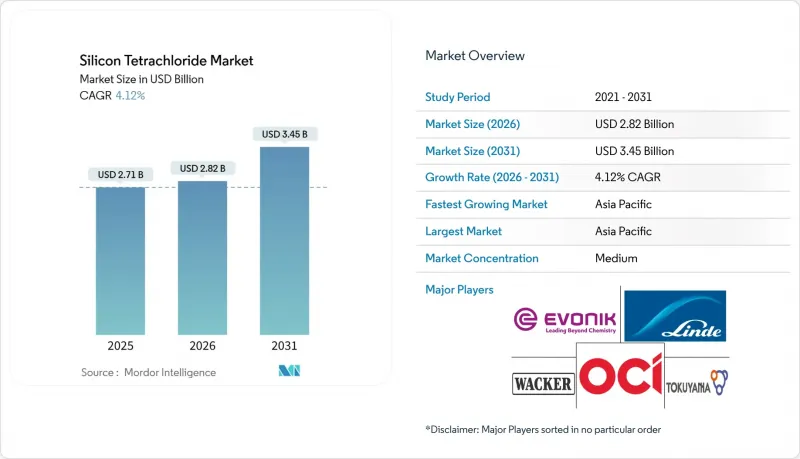
Mordor Intelligence에 의하면, 사염화규소 시장 규모는 2025년에 27억 1,000만 달러로 평가되었습니다. 2026년에 28억 2,000만 달러에 달하고, 2031년까지 34억 5,000만 달러에 이를 것으로 예측되며, 2026-2031년에 걸쳐 CAGR은 4.12%를 나타낼 전망입니다.
본 보고서는 등급(전자 등급, 기술 등급, 시약 등급), 용도(일렉트로믹스 및 반도체, 광섬유 프리폼, 기타), 최종 이용 산업(전자, 통신, 에너지(태양광), 기타), 지역(아시아태평양, 북미, 유럽, 남미, 중동 및 아프리카)별로 분류되어 있습니다. 시장 전망은 금액(달러) 기준으로 제시되어 있습니다.
세계의 사염화규소 시장 동향 및 분석
통신 부문에서의 광섬유 수요 증가
세계 통신망의 확충에 따라 고순도 사염화규소(SiCl4)에 대한 수요가 증가하고 있습니다. 이는 MCVD(개량형 화학 기상 증착법), PCVD(플라즈마 화학기상증착법), OVD(외부 기상증착법), VAD(축방향 기상증착법)과 같은 프리폼 제조 공정이 모두 SiCl₄와 산소의 반응을 통해 실리카 수스를 형성하고, 이를 나중에 유리로 고화시키는 방식에 의존하기 때문입니다. VAD와 OVD는 가장 높은 처리량을 실현하며, 개당 최대 250km의 광섬유를 생산할 수 있는 프리폼을 제조합니다. 한편, PCVD는 전구체의 100% 전환율을 제공하지만, 순도 사양은 6N-7N까지 높아집니다. 중국에서 5G 매크로셀과 스몰셀의 활발한 고밀도화, 그리고 인도에서의 FTTH(Fiber to the Home) 구축 가속화가 아시아태평양의 사염화규소 시장 수요를 뒷받침하고 있습니다. 북미와 유럽의 데이터센터 사업자들이 400G/800G 코히런트 광통신으로 전환하고 있는 점도, 특히 7N 이상의 원료가 필요한 초저손실 광섬유 분야에서 수요 증가에 기여하고 있습니다. 중공 코어 광섬유 및 메타물질 광섬유에 대한 전문적인 조사는 순도 요건을 더욱 강화하여, 전자 등급 제품의 높은 가격을 유지하고 있습니다.
태양광 발전용 폴리실리콘으로의 용도 확대
폴리실리콘은 여전히 SiCl4의 최대 단일 소비 부문이지만, 공급 과잉과 가격 압박으로 인해 중국 내에서는 광범위한 산업 재편이 불가피한 상황입니다. 상위 6개 생산 기업은 2025년에 총 500억 위안(69억 6,000만 달러) 이상을 조달하여 약 100만 톤 규모의 노후화된 생산 능력을 인수하거나 가동을 중단했습니다. 이러한 움직임으로 인해 기술 등급 제품공급이 부족해지면서 가격 안정화에 기여했습니다. 동시에, 유동층 반응로 기술 시장 점유율이 확대되고 있습니다. 이는 에너지 소비를 약 25% 절감하고, 폴리실리콘 1kg당 SiCl4 생성량을 줄이기 위한 조치이지만, 절대적인 생산량 증가를 소폭 억제하는 요인이 되기도 합니다. N형 태양전지는 2023년에 세계 시장 점유율의 절반을 차지할 것으로 예상되며, 9N-11N 순도의 폴리실리콘을 필요로 하고 있어, 간접적으로 SiCl4 정제 기술을 새로운 차원으로 끌어올리고 있습니다. 오만의 연간 10만 톤 규모 소하르 공장 등 중동의 신흥 생산 거점은 장기적인 수요의 성장세를 유지하면서, 사염화규소 시장의 지리적 다각화를 가져올 것으로 보입니다.
점점 더 엄격해지는 염소 배출 규제
중국의 T/CCSAS 052-2025 규격에서는 클로로실란의 회수율이 98.5% 이상이어야 한다고 규정하고 있어, 구형 폴리실리콘 생산 라인은 증류 및 스크러빙 설비 업그레이드에 수천만 달러를 투자하거나 시장에서 철수할 수밖에 없는 상황에 처해 있습니다. 인도 및 유럽연합(EU)에서 동시에 마련되고 있는 ESG(환경·사회·지배구조) 체계는 배출 상한선과 탄소 회계를 더욱 엄격하게 함으로써, 소규모 생산자나 기술적으로 구식인 생산자의 비용 하한선을 사실상 끌어올리고 있습니다. 이미 99% 이상의 재활용률을 달성한 수직 통합형 대기업들은 규정 준수 비용 측면에서 우위를 점하고 있으며, 사염화규소 시장에서의 통합 추세를 더욱 강화하고 있습니다.
부문별 분석
2025년 기준으로 전자용 등급은 사염화규소 시장 점유율의 47.13%를 차지했으며, 2031년까지 연평균 성장률(CAGR) 4.61%를 나타낼 것으로 전망됩니다. 3nm 로직 반도체, 3D DRAM, 99.999999999%의 초고순도 폴리실리콘에 대한 수요가 증가함에 따라, 다단 증류 설비, 미량 붕소 제거 공정 및 폐쇄형 회수 시스템에 대한 투자가 가속화되고 있습니다. 그 결과, 특히 중국의 재활용 의무화 조치로 인해 태양광 등급 생산자조차 고순도 공정을 도입해야 하는 상황에 놓이면서, 전자 등급과 기술 등급 간의 기존 가격 차이는 점차 줄어들고 있습니다. 도쿠야마 화학, 와커, 헴록 세미컨덕터는 현재 SiCl4, 실란, 초고순도 폴리실리콘을 통합 패키지로 공급하고 있어, 하류 팹에서의 전환 비용을 높이고 있습니다.
기술 등급은 태양광 발전(PV)에 있어 여전히 필수적이지만, 공급 과잉으로 인한 이익률 압박에 직면해 있습니다. 2025년 초에는 가동률이 33-40%까지 떨어졌고, 폴리실리콘 현물 가격은 전년 대비 50% 이상 급락하여 산업 전반의 현금 원가를 압박하고 있습니다. 시약 등급은 실험실 및 특수 합성용 틈새 시장으로, 그 생산량과 가격은 태양광 발전 시장의 변동으로부터 거의 영향을 받지 않습니다. 모든 등급을 통틀어, 전자 등급 실리콘 테트라클로라이드 소재 시장 규모는 전체 성장률을 상회할 것으로 예상되며, 순도에 따른 차별화가 지속적 이점을 가져다줄 것으로 보입니다.
지역별 분석
아시아태평양은 2025년에 세계 시장 점유율 57.45%를 유지했으며, 예측 기간(2026-2031년) 동안 연평균 성장률(CAGR) 4.66%를 나타낼 것으로 전망됩니다. 이는 폴리실리콘, 광섬유 프리폼, 특수 실리카 분야에서 중국의 우위가 주도한 결과입니다. 중국 내 생산 능력의 합리화로 인해 공급 곡선이 상향 이동하면서, 자금력이 풍부한 대기업들이 스프레드를 확보하는 한편, 구식 설비는 폐쇄되었습니다. 일본과 한국은 초고순도 제품의 생산을 강화하고 있으며, 말레이시아의 수력발전을 기반으로 한 반도체 등급 사업은 아세안(ASEAN)을 사염화규소 시장의 중요한 예비 거점으로 자리매김하고 있습니다.
북미는 전략적 생산 거점으로 다시 부상하고 있습니다. 헴록 세미컨덕터와 REC 실리콘의 모세스 레이크 공장 재가동에 활용된 ‘CHIPS법’에 따른 자금 지원은 정책 주도의 초고순도 소재 국내 복귀를 뒷받침하고 있습니다. 특수 가스 업계의 주요 기업들은 ISO 탱크에 따른 물류 비용을 절감하기 위해 지역별로 현장 생산 공장을 순차적으로 증설하고 있습니다. 유럽에서는 높은 전기 요금이 폴리실리콘의 수익성을 압박하고 있지만, 부가가치가 높은 전자용 SiCl4의 경우 이러한 영향을 받지 않아 독일과 아일랜드의 팹 클러스터 주변에 투자가 집중되고 있습니다.
중동에서는 오만에 저비용 태양광·풍력 발전을 활용한 10만 톤 규모의 폴리실리콘 생산 시설이 가동을 시작했으며, 안정적으로 가동되면 연간 30만-40만 톤 규모의 SiCl4에 대한 핵심 수요가 창출될 것입니다. 아프리카와 남미는 여전히 수입에 의존하고 있으며, 시장 점유율은 극히 미미하지만, 사염화규소 시장에서 지리적 분산을 도모하려는 공급업체들에게는 수요 증가가 예상됩니다.
기타 혜택
- 엑셀 형식 시장 예측(ME) 시트
- 3개월간의 애널리스트 지원
자주 묻는 질문
목차
제1장 서론
제2장 조사 방법
제3장 주요 요약
제4장 시장 구도
제5장 시장 규모 및 성장 예측
제6장 경쟁 구도
제7장 시장 기회 및 향후 전망
KTH 26.06.22According to Mordor Intelligence, the silicon tetrachloride market size is projected to be USD 2.71 billion in 2025, USD 2.82 billion in 2026, and reach USD 3.45 billion by 2031, growing at a CAGR of 4.12% from 2026 to 2031.
This report is Segmented by Grade (Electronic Grade, Technical Grade, and Reagent Grade), Application (Electronics and Semiconductors, Optical Fibre Preforms, and More), End-Use Industry (Electronics, Telecommunications, Energy (Solar), and More), and Geography (Asia-Pacific, North America, Europe, South America, and Middle East and Africa). The Market Forecasts are Provided in Terms of Value (USD).
Global Silicon Tetrachloride Market Trends and Insights
Growing Demand for Optical Fibres in Telecommunications
Global telecom build-outs are tightening demand for high-purity SiCl4 because MCVD (Modified Chemical Vapor Deposition), PCVD (Plasma Chemical Vapor Deposition), OVD (Outside Vapor Deposition), and VAD (Vapor Axial Deposition) preform routes all rely on the reaction of SiCl4 and oxygen to form silica soot that is later consolidated into glass. VAD and OVD deliver the highest throughput, producing preforms that yield up to 250 km of fiber each, while PCVD offers 100% precursor conversion but drives purity specifications to 6N-7N. Active 5G macro- and small-cell densification in China and accelerating FTTH (Fiber to the Home) roll-outs in India underpin the Asia-Pacific pull on the silicon tetrachloride market. North American and European data-center operators moving to 400G/800G coherent optics are also contributing, especially for ultra-low-loss fibers that require 7N-plus feedstock. Specialized research into hollow-core and metamaterial fibers further elevates purity requirements and sustains premium pricing on electronic-grade supplies.
Expanding Use in Polysilicon for Solar Photovoltaics
Polysilicon remains the largest single consumer of SiCl4, yet oversupply and price pressure have forced widespread consolidation inside China. The top six producers collectively raised more than CNY 50 billion (USD 6.96 billion) in 2025 to acquire and idle roughly 1 million tons of obsolete capacity, a move that tightened technical-grade availability and helped stabilize prices. At the same time, fluidized bed reactor technology is gaining share because it cuts energy consumption by about 25% and generates less SiCl4 per kilogram of polysilicon, slightly tempering absolute volume growth. N-type solar cells captured half of the global market share in 2023 and demand polysilicon purity of 9N-11N, indirectly pushing SiCl4 purification technology to new limits. Emerging Middle-Eastern production, such as the 100 kilotons-per-year Sohar plant in Oman, will diversify the silicon tetrachloride market geographically while preserving long-term demand momentum.
Increasingly Stringent Chlorine-Emission Regulations
China's T/CCSAS 052-2025 standard requires more than or equal to 98.5% chlorosilane recycling, forcing legacy polysilicon lines to invest tens of millions of dollars in distillation and scrubbing upgrades or exit the market. Parallel ESG (Environmental, Social, and Governance) frameworks emerging in India and the European Union further tighten emission ceilings and carbon accounting, effectively raising the cost floor for small or technologically outdated producers. Vertically integrated majors already operating more than 99% recycling enjoy a compliance cost advantage, reinforcing consolidation trends in the silicon tetrachloride market.
Other drivers and restraints analyzed in the detailed report include:
- Rising Investments in Semiconductor Manufacturing
- Expanding Adoption in Fumed Silica and Silane Chains
- High Logistics Costs for ISO-Tank Transport of 6N-9N Grades
For complete list of drivers and restraints, kindly check the Table Of Contents.
Segment Analysis
Electronic Grade held a commanding 47.13% of the silicon tetrachloride market share in 2025 and is projected to grow at a 4.61% CAGR through 2031. The quest for 3 nm logic, 3D DRAM, and 11-nines polysilicon is propelling investment in multi-stage distillation columns, trace-boron removal, and closed-loop recovery systems. Consequently, the historical price gap between electronic and technical grades is narrowing, especially as China's recycle mandates press even solar-grade producers to adopt higher-purity processes. Tokuyama, Wacker, and Hemlock Semiconductor now bundle SiCl4, silane, and hyper-pure polysilicon in integrated offerings, reinforcing switching costs for downstream fabs.
Technical Grade, while still indispensable to solar PV, faces margin pressure from overcapacity; utilization rates dipped to 33-40% in early 2025, and spot polysilicon prices crashed more than 50% year-over-year, squeezing cash costs industry-wide. Reagent Grade remains a niche for laboratories and specialty synthesis, with volumes and pricing largely insulated from solar market swings. Across all grades, the silicon tetrachloride market size for electronic-grade material is expected to outpace aggregate growth, illustrating the enduring benefit of purity-driven differentiation.
Geography Analysis
Asia-Pacific retained 57.45% of global share in 2025 and is forecast to expand at a 4.66% CAGR during the forecast period (2026-2031), driven by China's dominance in polysilicon, optical-fiber preforms, and specialty silica. Capacity rationalization in China shifted the supply curve upward, allowing well-capitalized leaders to capture spread while older assets shuttered. Japan and South Korea are bolstering extreme-purity output, and Malaysia's hydropower-backed semiconductor-grade venture positions ASEAN as an important redundancy node for the silicon tetrachloride market.
North America is re-emerging as a strategic production base. The CHIPS Act funding for Hemlock Semiconductor and REC Silicon's Moses Lake restart underscores policy-driven reshoring of hyper-pure materials. Specialty-gas majors are layering on regional on-site generation plants to slash ISO-tank logistics costs. Europe's high electricity tariffs curb the economics of polysilicon but not of value-added electronic-grade SiCl4, prompting investments concentrated around fab clusters in Germany and Ireland.
The Middle East debuts with Oman's 100 kiloton polysilicon facility using low-cost solar and wind power, creating anchor demand for 300-400 kilotons of SiCl4 annually once steady-state operations begin. Africa and South America remain import-dependent, accounting for a minimal share but offering incremental volume for suppliers seeking geographic diversification in the silicon tetrachloride market.
- Air Liquide
- American Elements
- Evonik Industries AG
- GCL TECH
- Hemlock Semiconductor Operations LLC
- Linde plc
- Merck KGaA
- OCI Company Ltd.
- ProChem, Inc.
- REC Silicon ASA
- Thermo Fisher Scientific Inc.
- Tokuyama Corporation
- Valmet
- Wacker Chemie AG
Additional Benefits:
- The market estimate (ME) sheet in Excel format
- 3 months of analyst support
TABLE OF CONTENTS
1 Introduction
- 1.1 Study Assumptions and Market Definition
- 1.2 Scope of the Study
2 Research Methodology
3 Executive Summary
4 Market Landscape
- 4.1 Market Overview
- 4.2 Market Drivers
- 4.2.1 Growing Demand for Optical Fibres in Telecommunications
- 4.2.2 Expanding Use in Polysilicon for Solar Photovoltaics
- 4.2.3 Rising Investments in Semiconductor Manufacturing
- 4.2.4 Expanding Adoption in Fumed Silica and Silane Chains
- 4.2.5 Ultra-low-loss hollow-core fibre and metamaterial RandD needing 7N-plus SiCl4
- 4.3 Market Restraints
- 4.3.1 Increasingly stringent chlorine-emission regulations (e.g., PRC greater than or equal to 98.5 % recycle rule)
- 4.3.2 High logistics costs for ISO-tank transport of 6N-9N grades
- 4.3.3 Supply-chain exposure to silicon-metal price volatility
- 4.4 Value Chain Analysis
- 4.5 Porter's Five Forces
- 4.5.1 Threat of New Entrants
- 4.5.2 Bargaining Power of Buyers
- 4.5.3 Bargaining Power of Suppliers
- 4.5.4 Threat of Substitutes
- 4.5.5 Competitive Rivalry
5 Market Size and Growth Forecasts (Value)
- 5.1 By Grade
- 5.1.1 Electronic Grade
- 5.1.2 Technical Grade
- 5.1.3 Reagent Grade
- 5.2 By Application
- 5.2.1 Electronics and Semiconductors
- 5.2.2 Optical Fibre Preforms
- 5.2.3 Chemical Intermediates
- 5.2.4 Other Applications (Silicon Rubber, etc.)
- 5.3 By End-Use Industry
- 5.3.1 Electronics
- 5.3.2 Telecommunications
- 5.3.3 Energy (Solar)
- 5.3.4 Other End-user Industries (Aerospace, Pharmaceuticals, etc.)
- 5.4 By Geography
- 5.4.1 Asia-Pacific
- 5.4.1.1 China
- 5.4.1.2 Japan
- 5.4.1.3 India
- 5.4.1.4 South Korea
- 5.4.1.5 ASEAN Countries
- 5.4.1.6 Rest of Asia-Pacific
- 5.4.2 North America
- 5.4.2.1 United States
- 5.4.2.2 Canada
- 5.4.2.3 Mexico
- 5.4.3 Europe
- 5.4.3.1 Germany
- 5.4.3.2 United Kingdom
- 5.4.3.3 France
- 5.4.3.4 Italy
- 5.4.3.5 Spain
- 5.4.3.6 Russia
- 5.4.3.7 NORDIC Countries
- 5.4.3.8 Rest of Europe
- 5.4.4 South America
- 5.4.4.1 Brazil
- 5.4.4.2 Argentina
- 5.4.4.3 Rest of South America
- 5.4.5 Middle-East and Africa
- 5.4.5.1 Saudi Arabia
- 5.4.5.2 South Africa
- 5.4.5.3 Rest of Middle-East and Africa
- 5.4.1 Asia-Pacific
6 Competitive Landscape
- 6.1 Market Concentration
- 6.2 Strategic Moves
- 6.3 Market Share(%)/Ranking Analysis
- 6.4 Company Profiles (includes Global Overview, Market Overview, Core Segments, Financials, Strategic Information, Products and Services, Recent Developments)
- 6.4.1 Air Liquide
- 6.4.2 American Elements
- 6.4.3 Evonik Industries AG
- 6.4.4 GCL TECH
- 6.4.5 Hemlock Semiconductor Operations LLC
- 6.4.6 Linde plc
- 6.4.7 Merck KGaA
- 6.4.8 OCI Company Ltd.
- 6.4.9 ProChem, Inc.
- 6.4.10 REC Silicon ASA
- 6.4.11 Thermo Fisher Scientific Inc.
- 6.4.12 Tokuyama Corporation
- 6.4.13 Valmet
- 6.4.14 Wacker Chemie AG
7 Market Opportunities and Future Outlook
- 7.1 White-space and Unmet Needs